
Judges 20:34

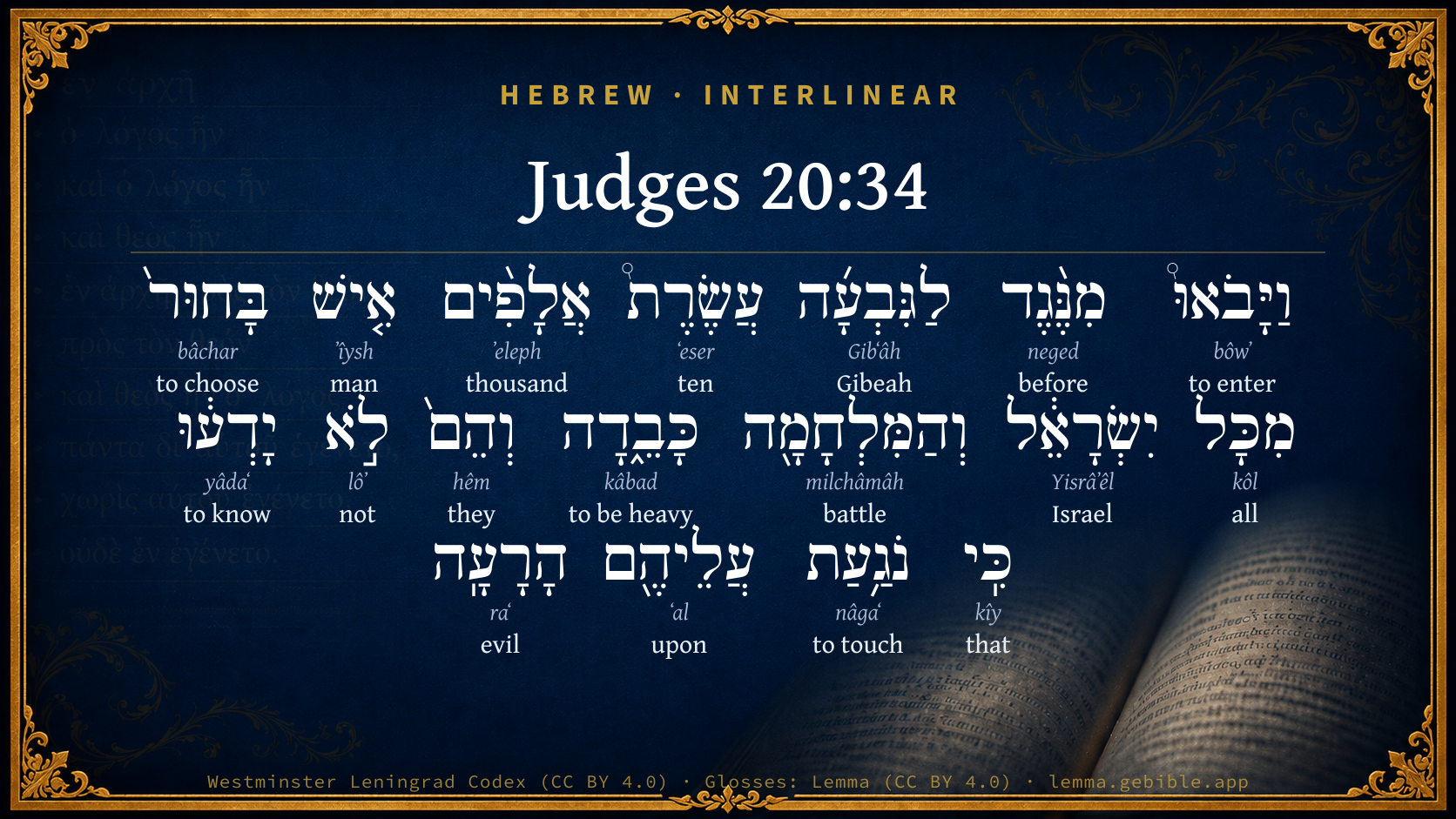
Hebrew (Westminster Leningrad Codex) Judges 20:34 appears in the Hebrew Old Testament. The text above is from the Westminster Leningrad Codex. Each word links to its Strong’s number, a concise gloss, and parsing drawn from the Open Scriptures Hebrew Bible morphology. Click any word for its full Brown-Driver-Briggs (BDB) entry.
Download image
Cite this verse

Judges 20:34 (World English Bible). Public Domain. Lemma interlinear Bible study tool, https://lemma.gebible.app/v/judges/20/34.

Show BibTeX & RIS
BibTeX
RIS
English Translation
There came over against Gibeah ten thousand chosen men out of all Israel, and the battle was sore; but they didn't know that evil was close on them.
World English Bible · Public Domain
Download a study sheet

One document with this verse’s original text, its word-by-word gloss line, the meaning frame, cross-references with their text, attributed commentary, and full source and license credits — printable, and it pastes into notes with its structure intact.

This verse Autodidact and up

Study sheet (.html) Plain text (.txt)

A passage Seminary Student

Up to 50 verses in one chapter. A passage sheet keeps up to 6 commentary sources and 12 cross-references per verse, in the order this page ranks them, and says so on the sheet whenever that leaves anything out. Ask for a single verse and you get the Autodidact verse sheet above.

Everything on this page stays free to read, with no account — the sheet is a download of what is already on screen, not access to it.

Want to remove ads? Support Godless Engineer
Compare translations 3

The same verse in 3 English versions, stacked beneath the original-language interlinear above. Click any original word for its lexicon entry.

Each is an independent rendering of the whole verse — the interlinear is not word-aligned to these translations.

Highlighted words mark where these versions differ — a whole-verse word diff, not a word-by-word alignment.

  • World English Bible Public Domain
    There came over against Gibeah ten thousand chosen men out of all Israel, and the battle was sore; but they didn't know that evil was close on them.
  • King James Version Public Domain
    And there came against Gibeah ten thousand chosen men out of all Israel, and the battle was sore: but they knew not that evil was near them.
  • unfoldingWord Literal Text CC BY-SA 4.0
    And 10,000 men, chosen from all of Israel, came from opposite Gibeah, and the battle heavy. But they did not know that harm touching upon them.

unfoldingWord Literal Text — © unfoldingWord, licensed CC BY-SA 4.0. Word-aligned USFM3 via Door43 (git.door43.org/unfoldingWord/en_ult).

Versions to compare (up to 4)

3 of 4 selected

Show all 18 translations

Every available English version of this verse, each an independent rendering of the whole verse.

  • World English Bible Public Domain
    There came over against Gibeah ten thousand chosen men out of all Israel, and the battle was sore; but they didn't know that evil was close on them.
  • Berean Standard Bible Public Domain
    Then 10,000 select men from all Israel made a frontal assault against Gibeah, and the battle was fierce. But the Benjamites did not realize that disaster was upon them.
  • Majority Standard Bible Public Domain
    Then 10,000 select men from all Israel made a frontal assault against Gibeah, and the battle was fierce. But the Benjamites did not realize that disaster was upon them.
  • King James Version Public Domain
    And there came against Gibeah ten thousand chosen men out of all Israel, and the battle was sore: but they knew not that evil was near them.
  • American Standard Version (1901) Public Domain
    And there came over against Gibeah ten thousand chosen men out of all Israel, and the battle was sore; but they knew not that evil was close upon them.
  • Revised Version (1885) Public Domain
    And there came over against Gibeah ten thousand chosen men out of all Israel, and the battle was sore: but they knew not that evil was close upon them.
  • Geneva Bible (1599) Public Domain
    And they came ouer against Gibeah, ten thousande chosen men of all Israel, and the battell was sore: for they knewe not that the euill was neere them.
  • Douay-Rheims (1899) Public Domain
    And to march from the west side of the city. And other ten thousand men chosen out of all Israel attacked the inhabitants of the city. And the battle grew hot against the children of Benjamin: and they understood not that present death threatened them on every side.
  • Young's Literal Translation Public Domain
    And they come in over against Gibeah -- ten thousand chosen men out of all Israel -- and the battle `is' grievous, and they have not known that the evil is striking against them.
  • Literal Standard Version CC BY-SA 4.0
    And they come in from the front against Gibeah—ten thousand chosen men out of all Israel—and the battle [is] grievous, and they have not known that the calamity is reaching toward them.
  • Unlocked Literal Bible CC BY-SA 4.0
    There came out against Gibeah ten thousand chosen men out of all Israel, and the fighting was fierce, but the Benjamites did not know that disaster was close to them.
  • unfoldingWord Literal Text CC BY-SA 4.0
    And 10,000 men, chosen from all of Israel, came from opposite Gibeah, and the battle heavy. But they did not know that harm touching upon them.
  • Darby Bible Public Domain
    And there came against Gib'e-ah ten thousand picked men out of all Israel, and the battle was hard; but the Benjaminites did not know that disaster was close upon them.
  • World Messianic Bible Public Domain
    Ten thousand chosen men out of all Israel came over against Gibeah, and the battle was severe; but they didn’t know that disaster was close to them.
  • Webster's Bible Public Domain
    And there came against Gibeah ten thousand chosen men out of all Israel, and the battle was severe: but they knew not that evil was near them.
  • Free Bible Version CC BY-SA 4.0
    Ten thousand seasoned Israelite warriors attacked Gibeah, and the fighting was so intense the Benjamites didn't realize they were on the brink of disaster.
  • Bible in Basic English Public Domain
    And they came in front of Gibeah, ten thousand of the best men in all Israel, and the fighting became more violent; but the children of Benjamin were not conscious that evil was coming on them.
  • JPS Tanakh (1917) Public Domain
    And there came over against Gibeah ten thousand chosen men out of all Israel, and the battle was sore; but they knew not that evil was close upon them.

Literal Standard Version (2020), Covenant Press — licensed CC BY-SA 4.0. Text via the HelloAO Bible API (eBible.org). Unlocked Literal Bible (unfoldingWord) — licensed CC BY-SA 4.0. Text via the HelloAO Bible API (eBible.org). unfoldingWord Literal Text — © unfoldingWord, licensed CC BY-SA 4.0. Word-aligned USFM3 via Door43 (git.door43.org/unfoldingWord/en_ult). Free Bible Version, Dr. Jonathan Gallagher — licensed CC BY-SA 4.0. Text via the HelloAO Bible API (eBible.org).

Word by word

More ways to search: Search by grammar → Find every occurrence → Compare this word →

Practice this passage: Drill this verse → Learn its vocabulary →

לַגִּבְעָ֜ה
Gibʻâh
H1390
“to/for the · Gibeah”
Preposition, Determined + Noun, Proper
Part of Speech
Preposition + Noun
Type
Proper
Full BDB Definition

Origin: the same as H1389

TWOT: None

Gibeah = "hill" - a city in the mountain district of Judah - a city of Benjamin, birthplace of king Saul - a city in Kirjath-jearim of Ephraim
  1. וַיָּבֹאוּ֩ bôwʼ H935 “and · to enter” Conjunction + Verb, Qal, Sequential Imperfect, 3rd Person, Masculine, Plural
  2. מִנֶּ֨גֶד neged H5048 “from · before” Preposition + Preposition
  3. עֲשֶׂרֶת֩ ʻeser H6235 “ten” Adjective, Cardinal number, Masculine, Singular, Construct
  4. אֲלָפִ֨ים ʼeleph H505 “thousand” Adjective, Cardinal number, Both, Plural, Absolute
  5. אִ֤ישׁ ʼîysh H376 “man” Noun, Common, Masculine, Singular, Absolute
  6. בָּחוּר֙ bâchar H977 “chosen” Verb, Qal, Participle Passive, Masculine, Singular, Absolute
  7. מִכָּל kôl H3605 “from · all of” Preposition + Noun, Common, Masculine, Singular, Construct
  8. יִשְׂרָאֵ֔ל Yisrâʼêl H3478 “Israel” Noun, Proper
  9. וְהַמִּלְחָמָ֖ה milchâmâh H4421 “and · the · battle” Conjunction + Particle, Definite Article + Noun, Common, Feminine, Singular, Absolute
  10. כָּבֵ֑דָה kâbad H3513 “to be heavy” Verb, Qal, Perfect, 3rd Person, Feminine, Singular
  11. וְהֵם֙ hêm H1992 “and · they” Conjunction + Pronoun, Personal, 3rd Person, Masculine, Plural
  12. לֹ֣א lôʼ H3808 “not” Particle, Negative
  13. יָדְע֔וּ yâdaʻ H3045 “to know” Verb, Qal, Perfect, 3rd Person, Common, Plural
  14. כִּֽי kîy H3588 “that” Conjunction
  15. נֹגַ֥עַת nâgaʻ H5060 “touching” Verb, Qal, Participle Active, Feminine, Singular, Absolute
  16. עֲלֵיהֶ֖ם ʻal H5921 “upon · them” Preposition + Suffix, Personal, 3rd Person, Masculine, Plural
  17. הָרָעָֽה raʻ H7451 “the · evil” Particle, Definite Article + Noun, Common, Feminine, Singular, Absolute

About this verse

These counts appear in no published source. They are computed here, from the morphology-tagged text and Lemma’s own curated glosses. What Lemma adds →

18
words
18
distinct lemmas
Historical
section

Shared distinctive vocabulary

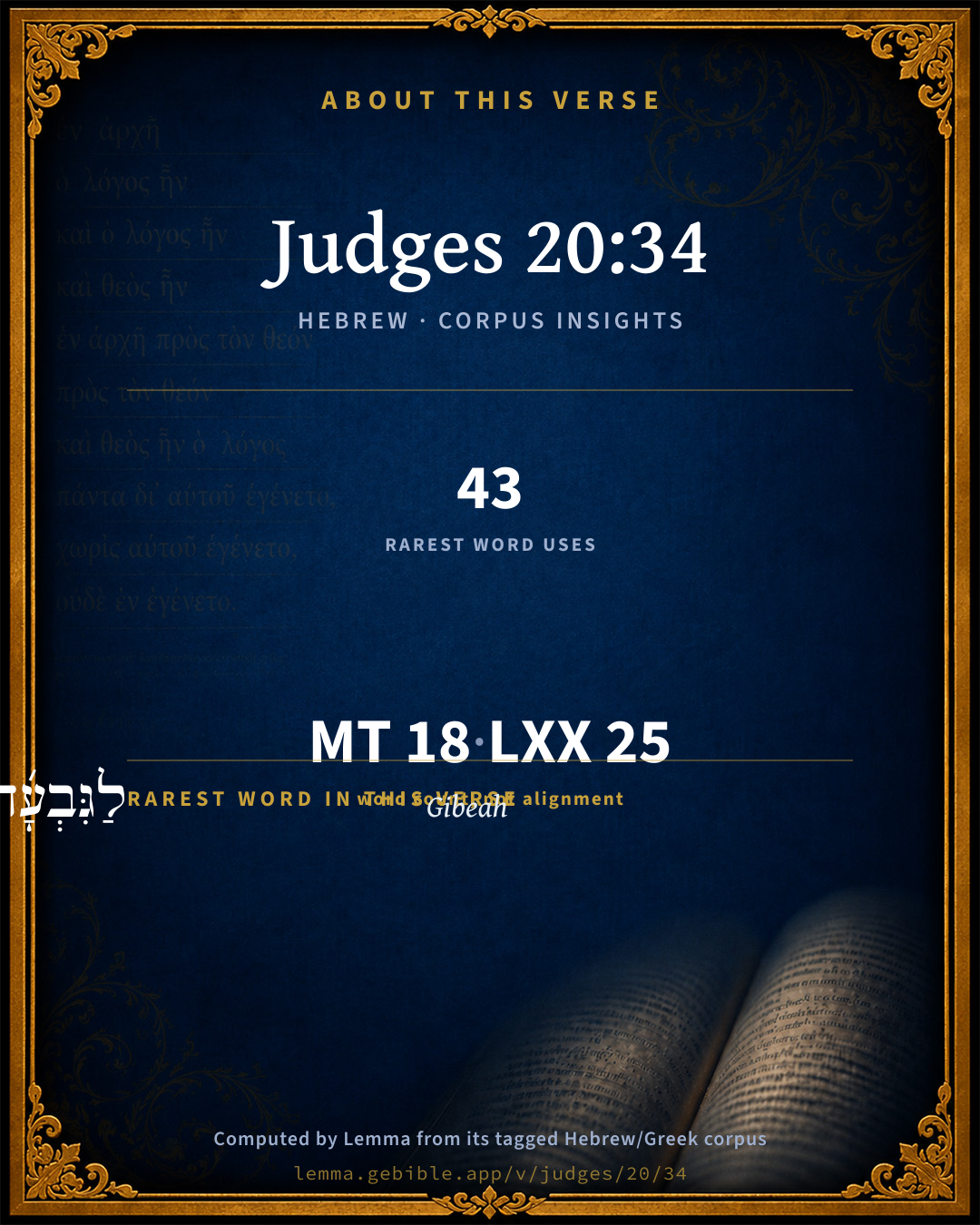
לַגִּבְעָ֜ה Gibeah H1390 occurs in 42 verses of the Hebrew Bible. Also found in:

Grammatical profile

  • 5 verbs
  • 6 nouns
  • 2 adjectives
  • 1 pronoun
  • 2 prepositions
  • 1 conjunction
  • 1 particle

Verb forms

  • וַיָּבֹאוּ֩ Qal · Sequential Imperfect
  • בָּחוּר֙ Qal · Participle Passive
  • כָּבֵ֑דָה Qal · Perfect
  • יָדְע֔וּ Qal · Perfect
  • נֹגַ֥עַת Qal · Participle Active

Hebrew & Septuagint length

In English translation the verse runs 28 words from the Hebrew and 29 from the Septuagint (LXX English) — closely comparable.

A rough comparison of the two English renderings, which tokenize alike — not a word-level alignment.

Word counts can differ between the Hebrew and the Greek without any difference in meaning — e.g. the Hebrew direct-object marker אֵת has no separate Greek word, and Greek often adds the article ὁ.

In the original languages it is 18 Hebrew tokens and 25 Greek tokens — but the two are counted differently (Hebrew bundles its prefixes and suffixes into one token; the Greek is in lemma form), so that isn’t a like-for-like length.

Cross-references

11

Topical passages linked to Judges 20:34 in the Treasury of Scripture Knowledge — connected by theme and wording, ordered by reader-vote popularity; previews shown in the World English Bible.

  • Joshua 8:14 It happened, when the king of Ai saw it, that they hurried and rose up early, and the men of the city went out against Israel to battle, he and all his people, at the time appointed, before the Arabah; but he didn't know that there was an ambush against him behind the city.
  • Isaiah 47:11 Therefore shall evil come on you; you shall not know the dawning of it: and mischief shall fall on you; you shall not be able to put it away: and desolation shall come on you suddenly, which you don't know.
  • Job 21:13 They spend their days in prosperity. In an instant they go down to Sheol.
  • Proverbs 4:19 The way of the wicked is like darkness. They don't know what they stumble over.
  • Proverbs 29:6 An evil man is snared by his sin, But the righteous can sing and be glad.
  • Ecclesiastes 8:11–12 Because sentence against an evil work is not executed speedily, therefore the heart of the sons of men is fully set in them to do evil.
  • Ecclesiastes 9:12 For man also doesn't know his time. As the fish that are taken in an evil net, and as the birds that are caught in the snare, even so are the sons of men snared in an evil time, when it falls suddenly on them.
  • Isaiah 3:10–11 Tell the righteous "Good!" For they shall eat the fruit of their deeds.
  • Matthew 24:44 Therefore also be ready, for in an hour that you don't expect, the Son of Man will come.
  • Luke 21:34 "So be careful, or your hearts will be loaded down with carousing, drunkenness, and cares of this life, and that day will come on you suddenly.
  • 1 Thessalonians 5:3 For when they are saying, "Peace and safety," then sudden destruction will come on them, like birth pains on a pregnant woman; and they will in no way escape.

Cross-references courtesy of OpenBible.info (CC BY 4.0).

Hebrew and Greek witnesses Masoretic Hebrew ↔ Greek Septuagint

The same verse in the two great witnesses to the Old Testament, shown verse-for-verse.

These are two independent witnesses, not word-aligned to each other, and the Septuagint is shown in lemma (dictionary) form.

Hebrew Judges 20:34 Masoretic · Westminster Leningrad Codex

וַיָּבֹאוּ֩ מִנֶּ֨גֶד לַגִּבְעָ֜ה עֲשֶׂרֶת֩ אֲלָפִ֨ים אִ֤ישׁ בָּחוּר֙ מִכָּל יִשְׂרָאֵ֔ל וְהַמִּלְחָמָ֖ה כָּבֵ֑דָה וְהֵם֙ לֹ֣א יָדְע֔וּ כִּֽי נֹגַ֥עַת עֲלֵיהֶ֖ם הָרָעָֽה

There came over against Gibeah ten thousand chosen men out of all Israel, and the battle was sore; but they didn't know that evil was close on them.

World English Bible · Public Domain

Greek LXX Judges 20:34 Septuagint · lemma form

καί ἔρχομαι ἐκ ἐναντίος γαβαα δέκα χιλιάς ἀνήρ ἐκλεκτός ἐκ πᾶς ἰσραήλ καί παράταξις βαρύς καί αὐτός οὐ γιγνώσκω ὅτι φθάνω ἐπί αὐτός ὁ κακία

And there came over against Gabaa ten thousand chosen men out of all Israel; and the fight was severe; and they knew not that evil was coming upon them.

LXX2012 (modern English Septuagint) · Public Domain

On this verse, Haydock's Catholic Bible Commentary discusses the Septuagint’s reading. Read the note in Commentary ↓

Hebrew: Westminster Leningrad Codex (CC BY 4.0). Greek: Septuagint (public domain); English from LXX2012 (modern English Septuagint) (Public Domain). How the Septuagint differs from the Hebrew →

Targum (Aramaic paraphrase)

1

The Targum is the ancient Jewish Aramaic paraphrase of the Hebrew Scriptures — an interpretive translation, not the Hebrew text itself. Onkelos (literal) and Pseudo-Jonathan (expansive) render the Torah, and Jonathan the Prophets. Coverage is partial: where no permissively-licensed English translation exists for a verse, only the Aramaic is shown. This is verse-level text, not a word-by-word alignment to the Hebrew.

  1. Targum Jonathan Prophets (Joshua–Malachi)
    וַאֲתוֹ מִדָרוֹם לְגִבְעָתָא עַסְרָא אַלְפִין גְבַר עוּלֵים מִכָּל יִשְׂרָאֵל וְעָבְדֵי קְרָבָא תַקִיפוּ וְאִנוּן לָא יָדְעִין אֲרֵי קְרִיבַת דְתֵיתֵי לְהוֹן בִּישְׁתָּא:

    (no public-domain English translation for this verse)

    Targum Jonathan — Aramaic: “Mikraot Gedolot” (public domain). English: “Sefaria Community Translation” (CC0 1.0 (public-domain dedication)); “London "Chaldee Paraphrase," 1871” (public domain). Text via Sefaria.

Commentary

Notes on Judges 20:34 from classic Christian and Jewish commentators (each source and its license shown beneath its notes). The classic Christian expositions comment on the surrounding passage and are grouped to its opening verse, so a note may address several verses; the Jewish commentaries on the Tanakh (Rashi and others) are per-verse, so they appear only where the commentator wrote on this verse.

Lemma curates 59 commentaries, every one of them public domain or Creative Commons licensed, each selected and text-cleaned for this edition rather than reprinted as found. About our sources →

The Cambridge Bible for Schools and Colleges

gen. ed. J. J. S. Perowne

34. ten thousand chosen men] Apparently the men who had formed the ambush: they now moved from their place of concealment, and posted themselves between the city and the Benjamites, who were chasing the men of Israel, so as to cut off the possibility of retreat.

evil was close upon them] lit. was about to touch them; cf. Jdg_20:41 evil had touched them. Cf. Jos_8:14. The recurrence of the words in Jdg_20:41 has led to the suggestion (made by Torrey) that Jdg_20:35-36 a once stood after Jdg_20:41, and that a scribe, glancing from the similar endings of Jdg_20:41; Jdg_20:34, accidentally transposed Jdg_20:35-36 a to their present position, where they destroy the natural order of events. The composition of this chapter is so entangled that we may readily assume a disturbance of the text here as in other places (e.g. Jdg_20:22 f.).

An alternative reconstruction is proposed by Budde, who assigns the passage to A: ‘And Israel set liers in wait against Gibeah round about (Jdg_20:29), while all the men of Israel rose up out of their place, and set themselves in array at Baal-tamar (Jdg_20:33 a). And there came over against Gibeah 10,000 chosen men out of all Israel, and the battle was sore (Jdg_20:34 a). Thereupon the liers in wait of Israel brake forth out of their place west of Geba (Jdg_20:33 b); but they knew not that evil was close upon them’ (Jdg_20:34 b); then follow Jdg_20:36 b–38. This gives a fairly lucid order; but it is based upon a rather different treatment of the chapter from that which is being followed.

The Cambridge Bible for Schools and Colleges (gen. ed. J. J. S. Perowne; Cambridge University Press, 1878–1918) — public domain. Text from a community e-Sword module.

Trapp's Complete Commentary

John Trapp

Jdg 20:34 And there came against Gibeah ten thousand chosen men out of all Israel, and the battle was sore: but they knew not that evil [was] near them.

Ver. 34. They knew not that evil, &c.] See Jdg 20:31. As they say of the metal they make glass of, it is nearest melting when it shineth brightest, so are the wicked nearest destruction when at their greatest lustre.

John Trapp, A Commentary or Exposition upon All the Books of the Old and New Testament (1647–1656) — public domain. Text from a community e-Sword module.

Joseph Benson's Commentary

Jdg 20:34. Ten thousand chosen men — These seem to have been a detachment from the main body, which was at Baal-tamar, and marched to attack Gibeah on one side, while the liers in wait assaulted it on the other, and while the great body of the army laboured to intercept the Benjamites, who, having pursued the Israelites that pretended to flee, now endeavoured to retreat to Gibeah. The battle was sore; but they knew not, &c. — The Benjamites fought stoutly; but were not sensible of the danger they were in to be destroyed.

Joseph Benson's Commentary on the Old and New Testaments (1811–1818) — public domain. Text from a community e-Sword module.

Geneva Bible (1599)

Geneva Bible translators

They knew not that God’s judgment was at hand to destroy them.

Geneva Bible (1599) marginal notes — public domain. Text via Bolls.life.

Jamieson, Fausset & Brown

Robert Jamieson, A. R. Fausset & David Brown

there came against Gibeah ten thousand chosen men--This was a third division, different both from the ambuscade and the army, who were fighting at Baal-tamar. The general account stated in Jdg 20:35 is followed by a detailed narrative of the battle, which is continued to the end of the chapter.

Jamieson, Fausset & Brown — Commentary Critical and Explanatory on the Whole Bible (1871) — public domain (CC PDM 1.0). Text via the HelloAO Bible API.

Ellicott's Commentary for English Readers

(34) Ten thousand chosen men.—Though the verse is obscurely expressed, the meaning probably is that this was the number of the ambuscade of picked warriors. If it means that this was the Israelite force left after the slaughter of 40,000, we are not told the number of the ambush.

The battle was sore.—It would be a battle in which the Benjamites were now attacked both in front and rear.

But.—Rather, and.

They knew not that evil was near them—i.e., as we should say, “that the hour of their ruin had come,” or, as the Vulg. has it, quod ex omni parte illis instaret interitus, “that destruction was threatening them on every side.” (Comp. Isa_47:10.)

A Bible Commentary for English Readers, edited by Charles John Ellicott (1878–1897) — public domain. Text from a community e-Sword module.

John Gill's Exposition

And the Lord smote Benjamin before Israel,.... Gave Israel the victory over them at Baaltamar; for notwithstanding all the art and stratagem they used, their numbers and their valour, victory was of the Lord, and to him it is ascribed; for until now Benjamin, though fewer in number, had been always victorious; and the children of Israel destroyed of the Benjaminites that day 25,100; which is the total sum of all that were slain of them that day, the particulars of which are afterwards given:

all these drew the sword; were armed men.

John Gill's Exposition of the Whole Bible (1746–1763) — public domain (CC PDM 1.0). Text via the HelloAO Bible API.

Haydock's Catholic Bible Commentary

West side. Hebrew mare, "a cavern," (Calmet) "a plain," (Chaldean) "the thickets." (Vat.[Vatable?] &c.) But the Septuagint have read marbe, "the west," with the Vulgate. (Calmet) --- The Vatican copy leave Maraagabe. (Menochius) --- Gabaa was situated on a hill, and the ambuscade might be concealed in a cavern, some of which in Palestine are very spacious. (Calmet)

George Leo Haydock (1774–1849), Haydock's Catholic Family Bible and Commentary, 1859 edition — public domain. Excludes Psalms (Douay-Rheims chapter numbering differs from Protestant) and Deuterocanonical books (Catholic canon only).

Matthew Poole's English Annotations

Chosen men out of all Israel; selected out of the main body, which was at Baal-tamar; and these were to march directly to Gibeah on the one side, whilst the liers in wait stormed it on the other side, and whilst the great body of the army laboured to intercept these Benjamites, who, having pursued the Israelites that pretended to flee, now endeavoured to retreat to Gibeah.

They knew not that evil was near them; they were so puffed up with their former successes, that they were insensible of their danger.

Matthew Poole's English Annotations on the Holy Bible (1683–1685) — public domain. Text from a community e-Sword/MySword module.

Whedon's Commentary on the Bible

Daniel D. Whedon

34. Ten thousand chosen men out of all Israel — These may have been identical with the “liers in wait,” (Jdg_20:29; Jdg_20:33,) but were more probably a detachment from the main army that marched from Baal-tamar, sent to assist the men of the ambush in capturing and smiting Gibeah, while the rest marched on to smite the Benjamite forces outside of the city.

They knew not — That is, the Benjamites knew not the evil that was about to befall them.

Daniel D. Whedon (gen. ed.), Commentary on the Old and New Testaments (1874–1909) — public domain. Text from a community e-Sword module.

The Pulpit Commentary

Against Gibeah, i.e. against the army of Gibeah. The sense seems to be that the 10, 000 Israelites who had been fleeing before Benjamin, and drawing them away from the city, now faced them, and commenced a resolute attack upon them, which at first the Benjamites, not knowing of the ambushment in their rear met with equal resolution, so that "the battle was sore." But the result, the details of which are given at length in vers. 36-46, was that 25, 100 Benjamites fell that day (see ver. 46).

"They knew not that evil was near them.

How descriptive this of all men I Our misfortunes often overtake us unawares. There is no earthly security. The sinner especially should not encourage himself in fancied immunity. The Son of man cometh as a thief in the night, for judgment and for reward.

I THE UNCERTAIN NATURE OF THE FUTURE.

II THE IGNORANCE AND HEEDLESSNESS OF SINNERS RESPECTING GOD"S JUDGMENTS.

III How TO BE DELIVERED FROM FEAR AND THE REAL EVILS OF THIS IGNORANCE. A righteous life the great safeguard. But how attained? Christ"s the only authoritative "Fear not." External evils will through him minister to our eternal welfare and well-being. This trust in him should he implicit, and an active force in every life. M.

The Pulpit Commentary (1880–1919), ed. H.D.M. Spence-Jones & Joseph S. Exell — public domain. Text from a community e-Sword module.

John Wesley's Explanatory Notes

Chosen men - Selected out of the main body, which was at Baal-tamar; and these were to march directly to Gibeah on the one side, whilst the liers in wait stormed it on the other side, and whilst the great body of the army laboured to intercept the Benjamites, who having pursued the Israelites that pretended to flee, now endeavoured to retreat to Gibeah.

John Wesley, Explanatory Notes Upon the Whole Bible (1754–1765) — public domain. Text via the GEBible commentary corpus.

unfoldingWord translationNotes

Door43 World Missions Community

ten thousand

"10,000" (See: Numbers)

chosen men

This is an idiom that means these were particularly good soldiers. AT: "well-trained soldier" (See: Idiom)

disaster was close to them

Here immanent disaster is spoken of as if it was standing very close by them. AT: "they would soon be completely defeated" (See: Metaphor)

25,100 men

"twenty-five thousand one hundred men" (See: Numbers)

translationWords

Gibeah

Israel

Benjamin

Yahweh

sword

unfoldingWord translationNotes — © Distant Shores Media and the Door43 World Missions Community, licensed CC BY-SA 4.0. Source: git.door43.org/Door43/en_tn.

Lesson kit

Teaching starters — assembled from the data on this page, not authored interpretation. Every prompt links to the verse data it draws on. Edit before teaching.

Judges, in the Historical, opens this verse with 18 words (18 distinct Hebrew lemmas). Its most distinctive word is Gibʻâh (“Gibeah”). A historical commentator’s framing appears above. Read the whole chapter for the surrounding context.

Discussion questions

  1. How does “Gibeah” (Gibʻâh) shape what this verse is saying?
  2. How does Joshua 15:57, which shares the word «Gibeah», read alongside this verse?
  3. These translations render this verse differently; the difference is in the English rendering, not the original. What questions does that raise?
  4. «וַיָּבֹאוּ֩» is a Qal Sequential Imperfect verb. How does that grammatical form shape the action described?
  5. Compare how The Cambridge Bible for Schools and Colleges and Trapp's Complete Commentary read this verse. Where do they agree or differ?

Things to notice

Reading settings

Reading text

Shown beneath each verse's original-language words.

Old Testament
Old Testament edition

Read the OT as the Masoretic Hebrew (MT) or the Greek Septuagint (LXX).

English shown for the Greek Septuagint (in the Hebrew ↔ Greek comparison).

Comparing translations? Open the Compare panel on any verse page to stack up to four side by side.