
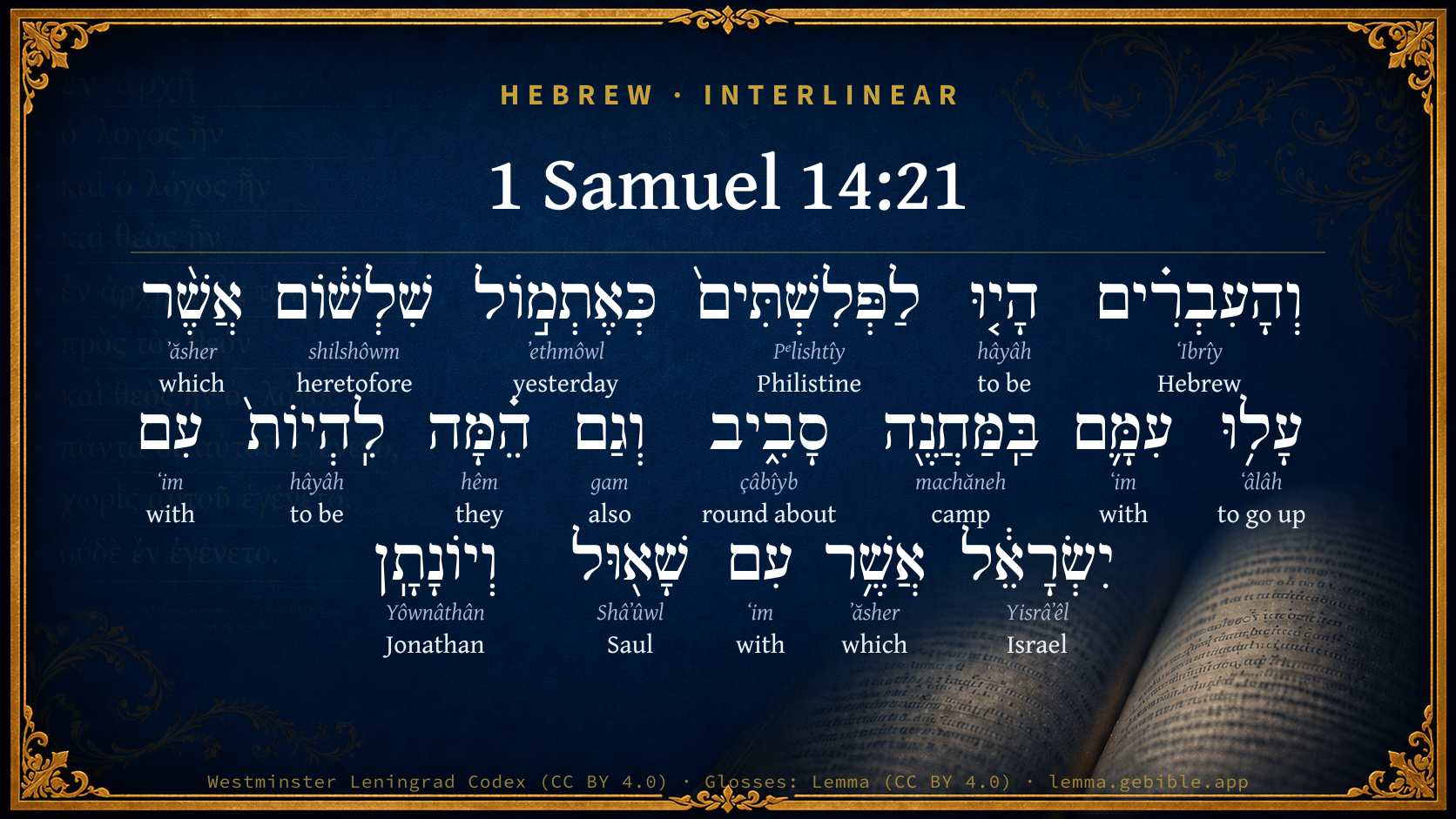
1 Samuel 14:21

Hebrew (Westminster Leningrad Codex) 1 Samuel 14:21 appears in the Hebrew Old Testament. The text above is from the Westminster Leningrad Codex. Each word links to its Strong’s number, a concise gloss, and parsing drawn from the Open Scriptures Hebrew Bible morphology. Click any word for its full Brown-Driver-Briggs (BDB) entry.
Download image
Cite this verse

1 Samuel 14:21 (World English Bible). Public Domain. Lemma interlinear Bible study tool, https://lemma.gebible.app/v/1-samuel/14/21.

Show BibTeX & RIS
BibTeX
RIS
English Translation
Now the Hebrews who were with the Philistines as before, and who went up with them into the camp, [from the country] round about, even they also [turned] to be with the Israelites who were with Saul and Jonathan.
World English Bible · Public Domain
Download a study sheet

One document with this verse’s original text, its word-by-word gloss line, the meaning frame, cross-references with their text, attributed commentary, and full source and license credits — printable, and it pastes into notes with its structure intact.

This verse Autodidact and up

Study sheet (.html) Plain text (.txt)

A passage Seminary Student

Up to 50 verses in one chapter. A passage sheet keeps up to 6 commentary sources and 12 cross-references per verse, in the order this page ranks them, and says so on the sheet whenever that leaves anything out. Ask for a single verse and you get the Autodidact verse sheet above.

Everything on this page stays free to read, with no account — the sheet is a download of what is already on screen, not access to it.

Want to remove ads? Support Godless Engineer
Compare translations 3

The same verse in 3 English versions, stacked beneath the original-language interlinear above. Click any original word for its lexicon entry.

Each is an independent rendering of the whole verse — the interlinear is not word-aligned to these translations.

Highlighted words mark where these versions differ — a whole-verse word diff, not a word-by-word alignment.

  • World English Bible Public Domain
    Now the Hebrews who were with the Philistines as before, and who went up with them into the camp, [from the country] round about, even they also [turned] to be with the Israelites who were with Saul and Jonathan.
  • King James Version Public Domain
    Moreover the Hebrews that were with the Philistines before that time, which went up with them into the camp from the country round about, even they also turned to be with the Israelites that were with Saul and Jonathan.
  • unfoldingWord Literal Text CC BY-SA 4.0
    Now some Hebrews were to the Philistines according to yesterday and the third day who had gone up with them into the camp all around. But even they to be with Israel who with Saul and Jonathan.

unfoldingWord Literal Text — © unfoldingWord, licensed CC BY-SA 4.0. Word-aligned USFM3 via Door43 (git.door43.org/unfoldingWord/en_ult).

Versions to compare (up to 4)

3 of 4 selected

Show all 18 translations

Every available English version of this verse, each an independent rendering of the whole verse.

  • World English Bible Public Domain
    Now the Hebrews who were with the Philistines as before, and who went up with them into the camp, [from the country] round about, even they also [turned] to be with the Israelites who were with Saul and Jonathan.
  • Berean Standard Bible Public Domain
    And the Hebrews who had previously gone up into the surrounding camps of the Philistines now went over to the Israelites who were with Saul and Jonathan.
  • Majority Standard Bible Public Domain
    And the Hebrews who had previously gone up into the surrounding camps to join the Philistines now went over to the Israelites who were with Saul and Jonathan.
  • King James Version Public Domain
    Moreover the Hebrews that were with the Philistines before that time, which went up with them into the camp from the country round about, even they also turned to be with the Israelites that were with Saul and Jonathan.
  • American Standard Version (1901) Public Domain
    Now the Hebrews that were with the Philistines as beforetime, and that went up with them into the camp, `from the country' round about, even they also `turned' to be with the Israelites that were with Saul and Jonathan.
  • Revised Version (1885) Public Domain
    Now the Hebrews that were with the Philistines as beforetime, which went up with them into the camp from the country round about; even they also turned to be with the Israelites that were with Saul and Jonathan.
  • Geneva Bible (1599) Public Domain
    Moreouer, the Ebrewes that were with the Philistims beforetime, and were come with them into all partes of the hoste, euen they also turned to be with the Israelites that were with Saul and Ionathan.
  • Douay-Rheims (1899) Public Domain
    Moreover the Hebrews that had been with the Philistines yesterday and the day before, and went up with them into the camp, returned to be with the Israelites, who were with Saul and Jonathan.
  • Young's Literal Translation Public Domain
    And the Hebrews `who' have been for the Philistines as heretofore, who had gone up with them into the camp, have turned round, even they, to be with Israel who `are' with Saul and Jonathan,
  • Literal Standard Version CC BY-SA 4.0
    And the Hebrews [who] have been with the Philistines before the day prior, who had gone up with them into the camp, have turned around, even they, to be with Israel who [are] with Saul and Jonathan,
  • Unlocked Literal Bible CC BY-SA 4.0
    Now those Hebrews who previously had been with the Philistines, and who had gone with them into the camp, even they joined with the Israelites that were with Saul and Jonathan.
  • unfoldingWord Literal Text CC BY-SA 4.0
    Now some Hebrews were to the Philistines according to yesterday and the third day who had gone up with them into the camp all around. But even they to be with Israel who with Saul and Jonathan.
  • Darby Bible Public Domain
    And there were Hebrews with the Philistines before that time, who had gone up with them into the camp round about; and they also [turned] to be with the Israelites who were with Saul and Jonathan.
  • World Messianic Bible Public Domain
    Now the Hebrews who were with the Philistines before and who went up with them into the camp from all around, even they also turned to be with the Israelites who were with Saul and Jonathan.
  • Webster's Bible Public Domain
    Moreover the Hebrews that were with the Philistines before that time, who went up with them into the camp from the country around, even they also turned to be with the Israelites that were with Saul and Jonathan.
  • Free Bible Version CC BY-SA 4.0
    The Hebrews who had previously sided with the Philistines, and who were with them in their camp, switched sides and joined the Israelites who were with Saul and Jonathan.
  • Bible in Basic English Public Domain
    Then the Hebrews who had been with the Philistines for some time, and had gone up with them to their tents, turning round were joined to those who were with Saul and Jonathan.
  • JPS Tanakh (1917) Public Domain
    Now the Hebrews that were with the Philistines as beforetime, and that went up with them into the camp round about; even they also turned to be with the Israelites that were with Saul and Jonathan.

Literal Standard Version (2020), Covenant Press — licensed CC BY-SA 4.0. Text via the HelloAO Bible API (eBible.org). Unlocked Literal Bible (unfoldingWord) — licensed CC BY-SA 4.0. Text via the HelloAO Bible API (eBible.org). unfoldingWord Literal Text — © unfoldingWord, licensed CC BY-SA 4.0. Word-aligned USFM3 via Door43 (git.door43.org/unfoldingWord/en_ult). Free Bible Version, Dr. Jonathan Gallagher — licensed CC BY-SA 4.0. Text via the HelloAO Bible API (eBible.org).

Word by word

More ways to search: Search by grammar → Find every occurrence → Compare this word →

Practice this passage: Drill this verse → Learn its vocabulary →

כְּאֶתְמ֣וֹל
ʼethmôwl
H865
“like/as · yesterday”
Preposition + Noun, Common, Masculine, Singular, Absolute
Part of Speech
Preposition + Noun
Type
Common
Gender
Masculine
Number
Singular
State
Absolute
Full BDB Definition

Origin: probably from H853 or H854 and H4136

TWOT: 2521

yesterday, recently, formerly - yesterday - formerly (figuratively) - from yesterday, already (in phrase) - (TWOT +) before, before that time, before the time, heretofore, of late, of old, these days, time(s) past
  1. וְהָעִבְרִ֗ים ʻIbrîy H5680 “and · the · Hebrews” Conjunction + Particle, Definite Article + Noun, Gentilic, Masculine, Plural, Absolute
  2. הָי֤וּ hâyâh H1961 “to be” Verb, Qal, Perfect, 3rd Person, Common, Plural
  3. לַפְּלִשְׁתִּים֙ Pᵉlishtîy H6430 “to/for the · Philistines” Preposition, Determined + Noun, Gentilic, Masculine, Plural, Absolute
  4. שִׁלְשׁ֔וֹם shilshôwm H8032 “heretofore” Noun, Common, Masculine, Singular, Absolute
  5. אֲשֶׁ֨ר ʼăsher H834 “which” Particle, Relative
  6. עָל֥וּ ʻâlâh H5927 “to go up” Verb, Qal, Perfect, 3rd Person, Common, Plural
  7. עִמָּ֛ם ʻim H5973 “with · them” Preposition + Suffix, Personal, 3rd Person, Masculine, Plural
  8. בַּֽמַּחֲנֶ֖ה machăneh H4264 “in/at the · camp” Preposition, Determined + Noun, Common, Both, Singular, Absolute
  9. סָבִ֑יב çâbîyb H5439 “round about” Noun, Common, Both, Singular, Absolute
  10. וְגַם gam H1571 “and · also” Conjunction + Particle, Accusative
  11. הֵ֗מָּה hêm H1992 “they” Pronoun, Personal, 3rd Person, Masculine, Plural
  12. לִֽהְיוֹת֙ hâyâh H1961 “to be” Preposition + Verb, Qal, Infinitive Construct
  13. עִם ʻim H5973 “with” Preposition
  14. יִשְׂרָאֵ֔ל Yisrâʼêl H3478 “Israel” Noun, Proper
  15. אֲשֶׁ֥ר ʼăsher H834 “which” Particle, Relative
  16. עִם ʻim H5973 “with” Preposition
  17. שָׁא֖וּל Shâʼûwl H7586 “Saul” Noun, Proper
  18. וְיוֹנָתָֽן Yôwnâthân H3129 “and · Jonathan” Conjunction + Noun, Proper

About this verse

These counts appear in no published source. They are computed here, from the morphology-tagged text and Lemma’s own curated glosses. What Lemma adds →

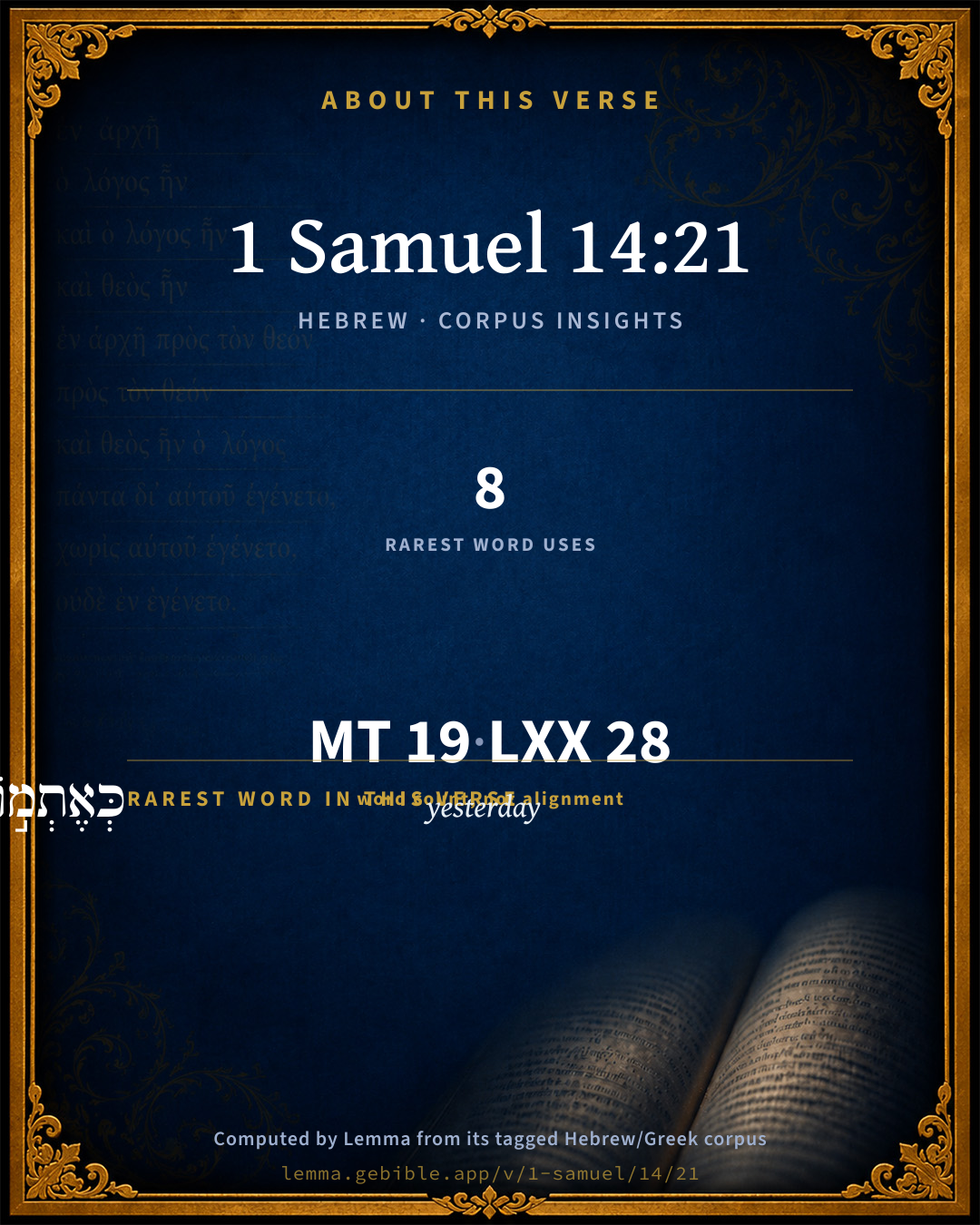
19
words
15
distinct lemmas
Historical
section

Notable vocabulary

The rarest word here is כְּאֶתְמ֣וֹל yesterday H865 — appearing just 8 times in the whole Hebrew Bible.

Shared distinctive vocabulary

כְּאֶתְמ֣וֹל yesterday H865 occurs in 8 verses of the Hebrew Bible. Also found in:

Grammatical profile

  • 3 verbs
  • 9 nouns
  • 1 pronoun
  • 3 prepositions
  • 3 particles

Verb forms

  • הָי֤וּ Qal · Perfect
  • עָל֥וּ Qal · Perfect
  • לִֽהְיוֹת֙ Qal · Infinitive Construct

Repetition

Words recur within this verse — often emphatic in Hebrew:

  • הָי֤וּ to be H1961 ×2
  • עִמָּ֛ם with H5973 ×3
  • אֲשֶׁ֨ר which H834 ×2

Hebrew & Septuagint length

In English translation the verse runs 39 words from the Hebrew and 31 from the Septuagint (LXX English) — closely comparable.

A rough comparison of the two English renderings, which tokenize alike — not a word-level alignment.

Word counts can differ between the Hebrew and the Greek without any difference in meaning — e.g. the Hebrew direct-object marker אֵת has no separate Greek word, and Greek often adds the article ὁ.

In the original languages it is 19 Hebrew tokens and 28 Greek tokens — but the two are counted differently (Hebrew bundles its prefixes and suffixes into one token; the Greek is in lemma form), so that isn’t a like-for-like length.

Cross-references

2

Topical passages linked to 1 Samuel 14:21 in the Treasury of Scripture Knowledge — connected by theme and wording, ordered by reader-vote popularity; previews shown in the World English Bible.

  • 1 Samuel 29:4 But the princes of the Philistines were angry with him; and the princes of the Philistines said to him, Make the man return, that he may go back to his place where you have appointed him, and let him not go down with us to battle, lest in the battle he become an adversary to us: for with what should this [fellow] reconcile himself to his lord? should it not be with the heads of these men?
  • Judges 7:23 The men of Israel were gathered together out of Naphtali, and out of Asher, and out of all Manasseh, and pursued after Midian.

Cross-references courtesy of OpenBible.info (CC BY 4.0).

Hebrew and Greek witnesses Masoretic Hebrew ↔ Greek Septuagint

The same verse in the two great witnesses to the Old Testament, shown verse-for-verse.

These are two independent witnesses, not word-aligned to each other, and the Septuagint is shown in lemma (dictionary) form.

Hebrew 1 Samuel 14:21 Masoretic · Westminster Leningrad Codex

וְהָעִבְרִ֗ים הָי֤וּ לַפְּלִשְׁתִּים֙ כְּאֶתְמ֣וֹל שִׁלְשׁ֔וֹם אֲשֶׁ֨ר עָל֥וּ עִמָּ֛ם בַּֽמַּחֲנֶ֖ה סָבִ֑יב וְגַם הֵ֗מָּה לִֽהְיוֹת֙ עִם יִשְׂרָאֵ֔ל אֲשֶׁ֥ר עִם שָׁא֖וּל וְיוֹנָתָֽן

Now the Hebrews who were with the Philistines as before, and who went up with them into the camp, [from the country] round about, even they also [turned] to be with the Israelites who were with Saul and Jonathan.

World English Bible · Public Domain

Greek LXX 1 Samuel 14:21 Septuagint · lemma form

καί ὁ δοῦλος ὁ εἰμί χθές καί τρίτος ἡμέρα μετά ὁ ἀλλόφυλος ὁ ἀναβαίνω εἰς ὁ παρεμβολή ἐπιστρέφω καί αὐτός εἰμί μετά ἰσραήλ ὁ μετά σαούλ καί ιωναθαν

And the servants who had been before with the Philistines, who had gone up to the army, turned themselves also to be with the Israelites who were with Saul and Jonathan.

LXX2012 (modern English Septuagint) · Public Domain

On this verse, Adam Clarke's Commentary discusses the Septuagint’s reading. Read the note in Commentary ↓

Hebrew: Westminster Leningrad Codex (CC BY 4.0). Greek: Septuagint (public domain); English from LXX2012 (modern English Septuagint) (Public Domain). How the Septuagint differs from the Hebrew →

Targum (Aramaic paraphrase)

1

The Targum is the ancient Jewish Aramaic paraphrase of the Hebrew Scriptures — an interpretive translation, not the Hebrew text itself. Onkelos (literal) and Pseudo-Jonathan (expansive) render the Torah, and Jonathan the Prophets. Coverage is partial: where no permissively-licensed English translation exists for a verse, only the Aramaic is shown. This is verse-level text, not a word-by-word alignment to the Hebrew.

  1. Targum Jonathan Prophets (Joshua–Malachi)
    וִיהוּדָאֵי הֲווֹ לִפְלִשְׁתָּאֵי כְּמֵאִתְמָלֵי וּמִדְקָדָמוֹהִי דִסְלִיקוּ עִמְהוֹן בְּמַשְׁרִיתָא סְחוֹר סְחוֹר וְאַף אִינוּן תָּבוּ לְמֶהֱוֵי עִם יִשְׂרָאֵל דְעִם שָׁאוּל וְיוֹנָתָן:

    (no public-domain English translation for this verse)

    Targum Jonathan — Aramaic: “Mikraot Gedolot” (public domain). English: “Sefaria Community Translation” (CC0 1.0 (public-domain dedication)); “London "Chaldee Paraphrase," 1871” (public domain). Text via Sefaria.

Commentary

Notes on 1 Samuel 14:21 from classic Christian and Jewish commentators (each source and its license shown beneath its notes). The classic Christian expositions comment on the surrounding passage and are grouped to its opening verse, so a note may address several verses; the Jewish commentaries on the Tanakh (Rashi and others) are per-verse, so they appear only where the commentator wrote on this verse.

Lemma curates 59 commentaries, every one of them public domain or Creative Commons licensed, each selected and text-cleaned for this edition rather than reprinted as found. About our sources →

Trapp's Complete Commentary

John Trapp

1Sa 14:21 Moreover the Hebrews [that] were with the Philistines before that time, which went up with them into the camp [from the country] round about, even they also [turned] to be with the Israelites that [were] with Saul and Jonathan.

Ver. 21. Moreover the Hebrews that were with the Philistines.] Either as their slaves or fugitives; these now took part with their countrymen. It is bard trusting of such in battle whose hearts are with the enemy.

John Trapp, A Commentary or Exposition upon All the Books of the Old and New Testament (1647–1656) — public domain. Text from a community e-Sword module.

Tyndale Open Study Notes

Tyndale Open Resources

14:21-22 Previously, a large group of Israelites had gone into hiding out of fear (13:6-7). Others might have joined the Philistine army. However, the statement that they revolted when the opportunity arose suggests they might have been taken as prisoners of war and forced into the Philistines’ service.

Tyndale Open Study Notes — © Tyndale Open Resources, licensed CC BY-SA 4.0. Text via the HelloAO Bible API.

Geneva Bible (1599)

Geneva Bible translators

Though before for fear of the Philistines they declared themselves as enemies to their brethren.

Geneva Bible (1599) marginal notes — public domain. Text via Bolls.life.

Adam Clarke's Commentary

Verse 21. The Hebrews that were with the Philistines] We may understand such as they held in bondage, or who were their servants. Instead of Hebrews the Septuagint read, οι δουλοι, the slaves; from which it is evident that, instead of עברים Ibrim, Hebrews, they found in their text עבדים abadim, servants. But this reading is not countenanced by any other version, nor by any MS. yet discovered.

Adam Clarke's Commentary on the Bible (1810–1826) — public domain. Text from a community e-Sword/MySword module.

Ellicott's Commentary for English Readers

(21) Moreover the Hebrews that were with the Philistines.—These Israelites were, most likely, prisoners who had been compelled to fight against their countrymen, or were levies raised in those parts of the land more immediately under Philistine influence. These, we read, took the first opportunity to go over to Saul. Other Israelites—probably the men of whole villages, who had been compelled, as the result of the late Philistine successes, to desert their homesteads, and seek a precarious living in the hills—joined in the pursuit of the now flying Philistine armies. This is the meaning of the words of the 22nd verse, which speaks of “the men of Israel which had hid themselves in Mount Ephraim.”

A Bible Commentary for English Readers, edited by Charles John Ellicott (1878–1897) — public domain. Text from a community e-Sword module.

The Cambridge Bible for Schools and Colleges

gen. ed. J. J. S. Perowne

21. the Hebrews that were with the Philistines] Either renegade Israelites who had taken service in the Philistine army, or forced levies from the districts occupied by the Philistines. The name “Hebrews” by which they were known to the Philistines is used to distinguish them from the “Israelites” who had not submitted to their oppressors. The Sept. reads “slaves.” See notes on 1Sa_4:6 and 1Sa_13:3.

The Cambridge Bible for Schools and Colleges (gen. ed. J. J. S. Perowne; Cambridge University Press, 1878–1918) — public domain. Text from a community e-Sword module.

John Gill's Exposition

Moreover, the Hebrews that were with the Philistines before that time,.... Who either were their servants and bondsmen they brought along with them, or such in whose cities they dwelt, or had taken as they came along, and forced into their army; or it may be some of them were renegades from the Israelites, deserters, who for safety and subsistence betook themselves to them as the stronger party. The Greek version reads,"the servants that were with the Philistines:"

which went up with them into the camp from the country round about; either willingly or by force; the words, "from the country", are not in the text, wherefore some observe, as Kimchi and Abarbinel, that this respects their being round about the camp, and that they were not within it, but without it, that if possible they might escape fighting against the Israelites:

even they also turned to be with the Israelites that were with Saul and Jonathan; who were now joined; when they saw the dread and confusion in the camp of the Philistines, and them destroying one another, and the Israelites prevailing over them, victorious and pursuing, they took part with them, and assisted them in completing the victory.

John Gill's Exposition of the Whole Bible (1746–1763) — public domain (CC PDM 1.0). Text via the HelloAO Bible API.

Haydock's Catholic Bible Commentary

Before; that is, for some time, as slaves. (Menochius) --- Having retired to their camp, to avoid the plunderers, (Calmet) they rose upon their oppressors, as Christian slaves have often done upon the Turks, when a galley has been engaged, and fallen into the hands of their friends. (Menochius) --- Camp. Hebrew adds, "round about," as if they guarded the baggage, (Piscator) or had retreated thither form the environs. (Calmet)

George Leo Haydock (1774–1849), Haydock's Catholic Family Bible and Commentary, 1859 edition — public domain. Excludes Psalms (Douay-Rheims chapter numbering differs from Protestant) and Deuterocanonical books (Catholic canon only).

Matthew Poole's English Annotations

Which went up with them into the camp; either by constraint, as servants; or in policy, to gain their favour and protection.

Matthew Poole's English Annotations on the Holy Bible (1683–1685) — public domain. Text from a community e-Sword/MySword module.

Whedon's Commentary on the Bible

Daniel D. Whedon

21. The Hebrews that were with the Philistines — Those who had deserted Saul’s army and gone over to them, and those whom they had taken captive during this last invasion. Instead of Hebrews, the Septuagint reads slaves; and it is altogether probable that in their wars and conquests the Philistines had captured and made slaves of many of the Hebrews. These, seeing the confusion of the Philistines, turned against them and made the confusion worse confounded.

Before that time — Before the time of this assault of Jonathan. Literally the Hebrew is, yesterday and the third day. Compare Jos_3:4, note.

Daniel D. Whedon (gen. ed.), Commentary on the Old and New Testaments (1874–1909) — public domain. Text from a community e-Sword module.

The Pulpit Commentary

Vers. 21, 22. Round about, even. All the versions by a very slight alteration change this into turned, which the A.V is forced to supply. With this necessary correction the translation is easy: "And the Hebrews who were previously with the Philistines, and had gone up with them into the camp, turned to be with the Israelites who were with Saul and Jonathan." It appears, therefore, that certain districts of the Israelite territory were so completely in the power of the Philistines that they could compel the men to go with them, not perhaps as soldiers, as is our custom in India, but as drivers and servants. These now turned upon their masters, and were reinforced by the Israelites who had taken refuge in Mount Ephraim. It is noteworthy that these subject "Hebrews" retain the name of contempt given them by their masters.

The Pulpit Commentary (1880–1919), ed. H.D.M. Spence-Jones & Joseph S. Exell — public domain. Text from a community e-Sword module.

John Wesley's Explanatory Notes

Which went - Either by constraint, as servants; or in policy, to gain their favour and protection.

John Wesley, Explanatory Notes Upon the Whole Bible (1754–1765) — public domain. Text via the GEBible commentary corpus.

Rashi

Rabbi Shlomo Yitzchaki (Rashi)

And the Hebrews who were with the Philistines. To help them, out of fear, in earlier times; but today they too turned [against the Philistines and joined] their fellows to be at their brethren's assistance.

Rashi on the Tanakh — English translations: “The Judaica Press complete Tanach with Rashi, translated by A. J. Rosenberg” (CC BY 4.0); “Pentateuch with Rashi's commentary by M. Rosenbaum and A.M. Silbermann, 1929-1934” (public domain); “The Metsudah Tanach series, Lakewood, N.J” (CC BY 4.0); and “The Book of Joshua, Metsudah Publications, 1997” (CC BY 4.0). Text via Sefaria.

Lesson kit

Teaching starters — assembled from the data on this page, not authored interpretation. Every prompt links to the verse data it draws on. Edit before teaching.

1 Samuel, in the Historical, opens this verse with 19 words (15 distinct Hebrew lemmas). Its most distinctive word is ʼethmôwl (“yesterday”). A historical commentator’s framing appears above. Read the whole chapter for the surrounding context.

Discussion questions

  1. How does “yesterday” (ʼethmôwl) shape what this verse is saying?
  2. 1 Samuel 4:7 shares the word «yesterday» with this verse. How do the two illuminate each other?
  3. “to be” occurs 2× in this one verse. What is the effect of the repetition?
  4. The translations on this page render this verse differently — a whole-verse word diff, not a word-by-word alignment. What might account for the different wordings?
  5. The verb «הָי֤וּ» is Qal Perfect. How does its form color the action?
  6. Reading how Trapp's Complete Commentary and Tyndale Open Study Notes read this verse, where do the two commentators agree and where do they part?

Things to notice

Reading settings

Reading text

Shown beneath each verse's original-language words.

Old Testament
Old Testament edition

Read the OT as the Masoretic Hebrew (MT) or the Greek Septuagint (LXX).

English shown for the Greek Septuagint (in the Hebrew ↔ Greek comparison).

Comparing translations? Open the Compare panel on any verse page to stack up to four side by side.