
1 Samuel 19:21

Hebrew (Westminster Leningrad Codex) 1 Samuel 19:21 appears in the Hebrew Old Testament. The text above is from the Westminster Leningrad Codex. Each word links to its Strong’s number, a concise gloss, and parsing drawn from the Open Scriptures Hebrew Bible morphology. Click any word for its full Brown-Driver-Briggs (BDB) entry.
Download image
Cite this verse

1 Samuel 19:21 (World English Bible). Public Domain. Lemma interlinear Bible study tool, https://lemma.gebible.app/v/1-samuel/19/21.

Show BibTeX & RIS
BibTeX
RIS
English Translation
When it was told Saul, he sent other messengers, and they also prophesied. Saul sent messengers again the third time, and they also prophesied.
World English Bible · Public Domain
Download a study sheet

One document with this verse’s original text, its word-by-word gloss line, the meaning frame, cross-references with their text, attributed commentary, and full source and license credits — printable, and it pastes into notes with its structure intact.

This verse Autodidact and up

Study sheet (.html) Plain text (.txt)

A passage Seminary Student

Up to 50 verses in one chapter. A passage sheet keeps up to 6 commentary sources and 12 cross-references per verse, in the order this page ranks them, and says so on the sheet whenever that leaves anything out. Ask for a single verse and you get the Autodidact verse sheet above.

Everything on this page stays free to read, with no account — the sheet is a download of what is already on screen, not access to it.

Want to remove ads? Support Godless Engineer
Compare translations 3

The same verse in 3 English versions, stacked beneath the original-language interlinear above. Click any original word for its lexicon entry.

Each is an independent rendering of the whole verse — the interlinear is not word-aligned to these translations.

Highlighted words mark where these versions differ — a whole-verse word diff, not a word-by-word alignment.

  • World English Bible Public Domain
    When it was told Saul, he sent other messengers, and they also prophesied. Saul sent messengers again the third time, and they also prophesied.
  • King James Version Public Domain
    And when it was told Saul, he sent other messengers, and they prophesied likewise. And Saul sent messengers again the third time, and they prophesied also.
  • unfoldingWord Literal Text CC BY-SA 4.0
    And they declared to Saul, and he sent other messengers, and they also prophesied. And Saul added and sent messengers a third, and they also prophesied.

unfoldingWord Literal Text — © unfoldingWord, licensed CC BY-SA 4.0. Word-aligned USFM3 via Door43 (git.door43.org/unfoldingWord/en_ult).

Versions to compare (up to 4)

3 of 4 selected

Show all 18 translations

Every available English version of this verse, each an independent rendering of the whole verse.

  • World English Bible Public Domain
    When it was told Saul, he sent other messengers, and they also prophesied. Saul sent messengers again the third time, and they also prophesied.
  • Berean Standard Bible Public Domain
    When this was reported to Saul, he sent more messengers, but they began to prophesy as well. So Saul tried again and sent messengers a third time, and even they began to prophesy.
  • Majority Standard Bible Public Domain
    When this was reported to Saul, he sent more messengers, but they began to prophesy as well. So Saul tried again and sent messengers a third time, and even they began to prophesy.
  • King James Version Public Domain
    And when it was told Saul, he sent other messengers, and they prophesied likewise. And Saul sent messengers again the third time, and they prophesied also.
  • American Standard Version (1901) Public Domain
    And when it was told Saul, he sent other messengers, and they also prophesied. And Saul sent messengers again the third time, and they also prophesied.
  • Revised Version (1885) Public Domain
    And when it was told Saul, he sent other messengers, and they also prophesied. And Saul sent messengers again the third time, and they also prophesied.
  • Geneva Bible (1599) Public Domain
    And when it was tolde Saul, he sent other messengers, and they prophecied likewise: againe Saul sent the third messengers, and they prophecied also.
  • Douay-Rheims (1899) Public Domain
    And when this was told Saul, he sent other messengers: but they also prophesied. And again Saul sent messengers the third time: and they prophesied also. And Saul being exceedingly angry,
  • Young's Literal Translation Public Domain
    And they declare `it' to Saul, and he sendeth other messengers, and they prophesy -- they also; and Saul addeth and sendeth messengers a third time, and they prophesy -- they also.
  • Literal Standard Version CC BY-SA 4.0
    And they declare [it] to Saul, and he sends other messengers, and they prophesy—they also; and Saul adds and sends messengers a third time, and they prophesy—they also.
  • Unlocked Literal Bible CC BY-SA 4.0
    When Saul was told this, he sent other messengers, and they also prophesied. So Saul sent messengers again the third time, and they also prophesied.
  • unfoldingWord Literal Text CC BY-SA 4.0
    And they declared to Saul, and he sent other messengers, and they also prophesied. And Saul added and sent messengers a third, and they also prophesied.
  • Darby Bible Public Domain
    And it was told Saul, and he sent other messengers, and they also prophesied. And Saul sent messengers again the third time, and they also prophesied.
  • World Messianic Bible Public Domain
    When Saul was told, he sent other messengers, and they also prophesied. Saul sent messengers again the third time, and they also prophesied.
  • Webster's Bible Public Domain
    And when it was told Saul, he sent other messengers, and they prophesied likewise. And Saul sent messengers again the third time, and they prophesied also.
  • Free Bible Version CC BY-SA 4.0
    Saul was told what had happened, so he sent more messengers, and they started prophesying as well.
  • Bible in Basic English Public Domain
    And Saul, having news of this, sent other men, who in the same way became like prophets. And a third time Saul sent men, and they like the others became like prophets.
  • JPS Tanakh (1917) Public Domain
    And when it was told Saul, he sent other messengers, and they also prophesied. And Saul sent messengers again the third time, and they also prophesied.

Literal Standard Version (2020), Covenant Press — licensed CC BY-SA 4.0. Text via the HelloAO Bible API (eBible.org). Unlocked Literal Bible (unfoldingWord) — licensed CC BY-SA 4.0. Text via the HelloAO Bible API (eBible.org). unfoldingWord Literal Text — © unfoldingWord, licensed CC BY-SA 4.0. Word-aligned USFM3 via Door43 (git.door43.org/unfoldingWord/en_ult). Free Bible Version, Dr. Jonathan Gallagher — licensed CC BY-SA 4.0. Text via the HelloAO Bible API (eBible.org).

Word by word

More ways to search: Search by grammar → Find every occurrence → Compare this word →

Practice this passage: Drill this verse → Learn its vocabulary →

שְׁלִשִׁ֔ים
shᵉlîyshîy
H7992
“third”
Adjective, Ordinal number, Masculine, Plural, Absolute
Part of Speech
Adjective
Type
Ordinal number
Gender
Masculine
Number
Plural
State
Absolute
Full BDB Definition

Origin: ordinal from H7969

TWOT: 2403b

third, one third, third part, third time - ordinal number
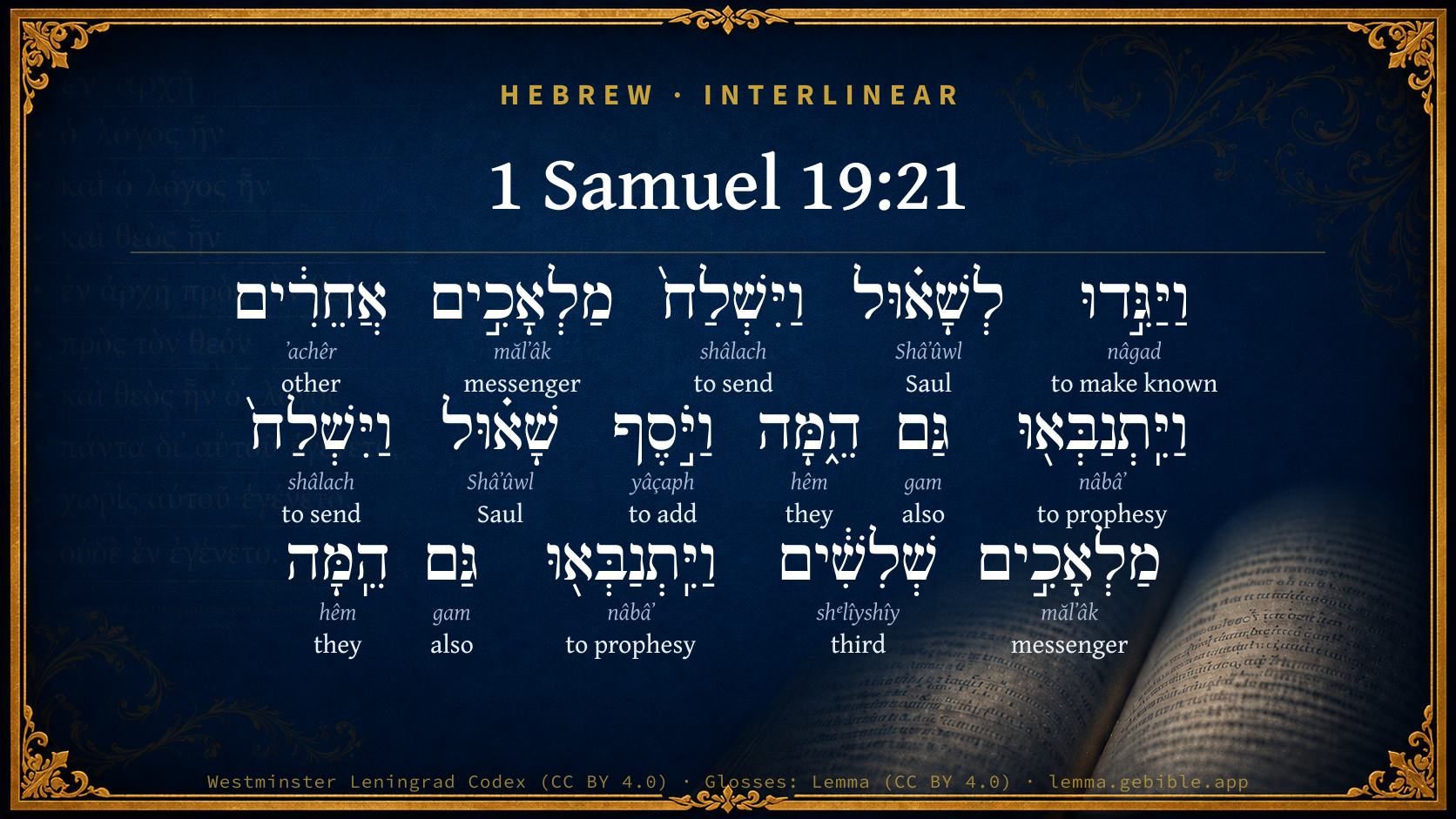
  1. וַיַּגִּ֣דוּ nâgad H5046 “and · to make known” Conjunction + Verb, Hiphil, Sequential Imperfect, 3rd Person, Masculine, Plural
  2. לְשָׁא֗וּל Shâʼûwl H7586 “to/for · Saul” Preposition + Noun, Proper
  3. וַיִּשְׁלַח֙ shâlach H7971 “and · to send” Conjunction + Verb, Qal, Sequential Imperfect, 3rd Person, Masculine, Singular
  4. מַלְאָכִ֣ים mălʼâk H4397 “messengers” Noun, Common, Masculine, Plural, Absolute
  5. אֲחֵרִ֔ים ʼachêr H312 “other” Adjective, Adjective, Masculine, Plural, Absolute
  6. וַיִּֽתְנַבְּא֖וּ nâbâʼ H5012 “and · to prophesy” Conjunction + Verb, Hithpael, Sequential Imperfect, 3rd Person, Masculine, Plural
  7. גַּם gam H1571 “also” Particle, Accusative
  8. הֵ֑מָּה hêm H1992 “they” Pronoun, Personal, 3rd Person, Masculine, Plural
  9. וַיֹּ֣סֶף yâçaph H3254 “and · to add” Conjunction + Verb, Hiphil, Sequential Imperfect, 3rd Person, Masculine, Singular
  10. שָׁא֗וּל Shâʼûwl H7586 “Saul” Noun, Proper
  11. וַיִּשְׁלַח֙ shâlach H7971 “and · to send” Conjunction + Verb, Qal, Sequential Imperfect, 3rd Person, Masculine, Singular
  12. מַלְאָכִ֣ים mălʼâk H4397 “messengers” Noun, Common, Masculine, Plural, Absolute
  13. וַיִּֽתְנַבְּא֖וּ nâbâʼ H5012 “and · to prophesy” Conjunction + Verb, Hithpael, Sequential Imperfect, 3rd Person, Masculine, Plural
  14. גַּם gam H1571 “also” Particle, Accusative
  15. הֵֽמָּה hêm H1992 “they” Pronoun, Personal, 3rd Person, Masculine, Plural

About this verse

These counts appear in no published source. They are computed here, from the morphology-tagged text and Lemma’s own curated glosses. What Lemma adds →

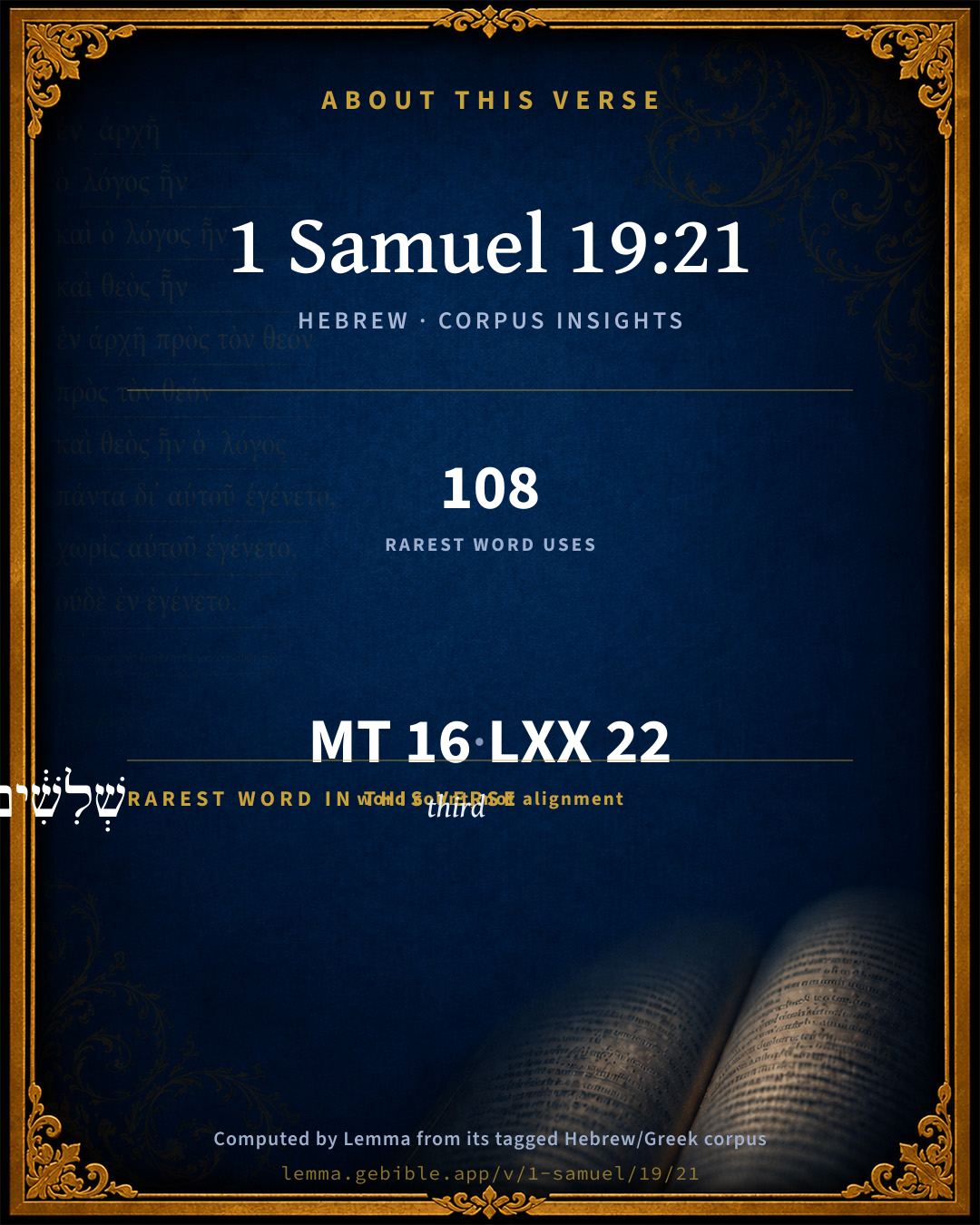
16
words
10
distinct lemmas
Historical
section

Grammatical profile

  • 6 verbs
  • 4 nouns
  • 2 adjectives
  • 2 pronouns
  • 2 particles

Verb forms

  • וַיַּגִּ֣דוּ Hiphil · Sequential Imperfect
  • וַיִּשְׁלַח֙ Qal · Sequential Imperfect
  • וַיִּֽתְנַבְּא֖וּ Hithpael · Sequential Imperfect
  • וַיֹּ֣סֶף Hiphil · Sequential Imperfect
  • וַיִּשְׁלַח֙ Qal · Sequential Imperfect
  • וַיִּֽתְנַבְּא֖וּ Hithpael · Sequential Imperfect

Repetition

Words recur within this verse — often emphatic in Hebrew:

  • לְשָׁא֗וּל Saul H7586 ×2
  • וַיִּשְׁלַח֙ to send H7971 ×2
  • מַלְאָכִ֣ים messenger H4397 ×2
  • וַיִּֽתְנַבְּא֖וּ to prophesy H5012 ×2
  • גַּם also H1571 ×2
  • הֵ֑מָּה they H1992 ×2

Hebrew & Septuagint length

In English translation the verse runs 24 words from the Hebrew and 27 from the Septuagint (LXX English) — closely comparable.

A rough comparison of the two English renderings, which tokenize alike — not a word-level alignment.

Word counts can differ between the Hebrew and the Greek without any difference in meaning — e.g. the Hebrew direct-object marker אֵת has no separate Greek word, and Greek often adds the article ὁ.

In the original languages it is 16 Hebrew tokens and 22 Greek tokens — but the two are counted differently (Hebrew bundles its prefixes and suffixes into one token; the Greek is in lemma form), so that isn’t a like-for-like length.

Cross-references

4

Topical passages linked to 1 Samuel 19:21 in the Treasury of Scripture Knowledge — connected by theme and wording, ordered by reader-vote popularity; previews shown in the World English Bible.

  • 2 Kings 1:9–13 Then [the king] sent to him a captain of fifty with his fifty. He went up to him: and, behold, he was sitting on the top of the hill. He spoke to him, man of God, the king has said, Come down.
  • Proverbs 27:22 Though you grind a fool in a mortar with a pestle along with grain, Yet his foolishness will not be removed from him.
  • Jeremiah 13:23 Can the Ethiopian change his skin, or the leopard his spots? then may you also do good, who are accustomed to do evil.
  • Joel 2:28 "It will happen afterward, that I will pour out my Spirit on all flesh; And your sons and your daughters will prophesy. Your old men will dream dreams. Your young men will see visions.

Cross-references courtesy of OpenBible.info (CC BY 4.0).

Hebrew and Greek witnesses Masoretic Hebrew ↔ Greek Septuagint

The same verse in the two great witnesses to the Old Testament, shown verse-for-verse.

These are two independent witnesses, not word-aligned to each other, and the Septuagint is shown in lemma (dictionary) form.

Hebrew 1 Samuel 19:21 Masoretic · Westminster Leningrad Codex

וַיַּגִּ֣דוּ לְשָׁא֗וּל וַיִּשְׁלַח֙ מַלְאָכִ֣ים אֲחֵרִ֔ים וַיִּֽתְנַבְּא֖וּ גַּם הֵ֑מָּה וַיֹּ֣סֶף שָׁא֗וּל וַיִּשְׁלַח֙ מַלְאָכִ֣ים שְׁלִשִׁ֔ים וַיִּֽתְנַבְּא֖וּ גַּם הֵֽמָּה

When it was told Saul, he sent other messengers, and they also prophesied. Saul sent messengers again the third time, and they also prophesied.

World English Bible · Public Domain

Greek LXX 1 Samuel 19:21 Septuagint · lemma form

καί ἀποἀγγέλλω ὁ σαούλ καί ἀποστέλλω ἄγγελος ἕτερος καί προφητεύω καί αὐτός καί προςτίθημι σαούλ ἀποστέλλω ἄγγελος τρίτος καί προφητεύω καί αὐτός

And it was told Saul, and he sent other messengers, and they also prophesied: and Saul sent again a third set of messengers, and they also prophesied.

LXX2012 (modern English Septuagint) · Public Domain

Hebrew: Westminster Leningrad Codex (CC BY 4.0). Greek: Septuagint (public domain); English from LXX2012 (modern English Septuagint) (Public Domain). How the Septuagint differs from the Hebrew →

Targum (Aramaic paraphrase)

1

The Targum is the ancient Jewish Aramaic paraphrase of the Hebrew Scriptures — an interpretive translation, not the Hebrew text itself. Onkelos (literal) and Pseudo-Jonathan (expansive) render the Torah, and Jonathan the Prophets. Coverage is partial: where no permissively-licensed English translation exists for a verse, only the Aramaic is shown. This is verse-level text, not a word-by-word alignment to the Hebrew.

  1. Targum Jonathan Prophets (Joshua–Malachi)
    וְחַוִיאוּ לְשָׁאוּל וּשְׁלַח אִזְגַדִין אוֹחֲרָנִין וְשַׁבָּחוּ אַף אִנוּן וְאוֹסִיף שָׁאוּל וּשְׁלַח אִזְגַדִין תְּלִיתָאִין וְשַׁבָּחוּ אַף אִנוּן:

    (no public-domain English translation for this verse)

    Targum Jonathan — Aramaic: “Mikraot Gedolot” (public domain). English: “Sefaria Community Translation” (CC0 1.0 (public-domain dedication)); “London "Chaldee Paraphrase," 1871” (public domain). Text via Sefaria.

Commentary

Notes on 1 Samuel 19:21 from classic Christian and Jewish commentators (each source and its license shown beneath its notes). The classic Christian expositions comment on the surrounding passage and are grouped to its opening verse, so a note may address several verses; the Jewish commentaries on the Tanakh (Rashi and others) are per-verse, so they appear only where the commentator wrote on this verse.

Lemma curates 59 commentaries, every one of them public domain or Creative Commons licensed, each selected and text-cleaned for this edition rather than reprinted as found. About our sources →

Trapp's Complete Commentary

John Trapp

1Sa 19:21 And when it was told Saul, he sent other messengers, and they prophesied likewise. And Saul sent messengers again the third time, and they prophesied also.

Ver. 21. And they prophesied also.] Such sudden changes we read of also in 2Ki 1:13 Joh 7:46. So Augustine was suddenly converted by Ambrose; Latimer by hearing Mr Stafford’s lectures, which he came to scoff at, and Mr Bilney’s confession. {a} Concerning the Christian congregation in Queen Mary’s time, I have heard of one, saith Mr Fox, who being sent to them to take their names and to espy their doings, yet, in being amongst them, was converted, and cried them all mercy. At Miltenberg, a town in the territory of Mentz, an officer was sent to take a certain godly deacon sojourning in a widow’s house. The deacon meeting and embracing him said, Salve mi frater, frater enimvero meus es, Et adsum, transfode me, vel suffoca me: Hail, brother; here I am, stab me, hang me, do as thou pleasest to me. The officer, by a sudden innovation of his heart from heaven, said, Sir, I will do you no harm, nor shall any man else, if I can hinder it. And when the rustics came in to help to kill the deacon, the officer kept them off, and would not let them harm him. {b}

{a} Act. and Mon., fol. 188l.

{b} Scultet., Annal., p. 174.

John Trapp, A Commentary or Exposition upon All the Books of the Old and New Testament (1647–1656) — public domain. Text from a community e-Sword module.

Joseph Benson's Commentary

1Sa 19:21-23. He sent other messengers — Strange obstinacy, to contend so long with the Spirit of God. And they prophesied likewise — That is, they joined with the rest in praising God. “Instead,” says Henry, “of seizing David, they were themselves seized.” Thus God again secured David, put an honour on the sons and school of the prophets, and manifested his power over the spirits of men. The Spirit of God was upon him also — It came upon him in the way; whereas it came not upon his messengers till they came to the place. Hereby God would convince Saul of the vanity of his designs against David, and that in them he fought against God himself.

Joseph Benson's Commentary on the Old and New Testaments (1811–1818) — public domain. Text from a community e-Sword module.

Tyndale Open Study Notes

Tyndale Open Resources

19:21 other troops . . . a third time: Each time Saul sent troops, David’s would-be captors were captured by the Spirit. Prophesying diverted them from pursuing David.

Tyndale Open Study Notes — © Tyndale Open Resources, licensed CC BY-SA 4.0. Text via the HelloAO Bible API.

Ellicott's Commentary for English Readers

(21) And they prophesied likewise.—Bishop Wordsworth calls attention here to the fact of “this portion of Scripture, from 1Sa_19:18 to end of the chapter, which relates the illapse of the Spirit on Saul’s messengers, and even on Saul himself, the persecutor of David, being appointed by the Church to be read on Whitsun Tuesday (Old Lect.), in order to show the existence and working of the Holy Spirit before the times of the Gospel, and the freedom and power of His Divine agency.” (Comp. here Num_11:26-31 : the history of Eldad and Medad, which we read on Whitsun Monday, New Lect.)

A Bible Commentary for English Readers, edited by Charles John Ellicott (1878–1897) — public domain. Text from a community e-Sword module.

The Cambridge Bible for Schools and Colleges

gen. ed. J. J. S. Perowne

21. they prophesied also] Carried away by the religious excitement they forgot their errand, and joined the chant of the prophets.

The Cambridge Bible for Schools and Colleges (gen. ed. J. J. S. Perowne; Cambridge University Press, 1878–1918) — public domain. Text from a community e-Sword module.

John Gill's Exposition

And when it was told Saul,.... That the messengers he had sent, instead of seizing on David, were prophesying of him, or however were attending to services of a different nature than what they were sent upon:

he sent other messengers, and they prophesied likewise; when they came to the same place:

and Saul sent messengers again a third time, and they prophesied also; joined the rest in singing praises, or foretelling future events.

John Gill's Exposition of the Whole Bible (1746–1763) — public domain (CC PDM 1.0). Text via the HelloAO Bible API.

Whedon's Commentary on the Bible

Daniel D. Whedon

21. Sent… the third time — Here we have a striking exhibition of Saul’s blind infatuation. In the face of signal displays of Divine power frustrating the mission of his messengers, he seems to take no warning, but still insists on invading the sanctity of the prophetic schools to capture David. His action reminds one of Ahaziah, who dispatched successive bands of men to take Elijah, and took no warning, though fire from heaven twice consumed his messengers. 2Ki_1:1-12.

Daniel D. Whedon (gen. ed.), Commentary on the Old and New Testaments (1874–1909) — public domain. Text from a community e-Sword module.

The Pulpit Commentary

Vers. 21-24. Saul sends messengers a second and even a third time with the same result, and finally determines to go in person. Having set out, he came to a more correctly thegreat well that is in Sechu more probably the cistern or tank there. From the value of water it was no doubt a well known spot at the time, but in the present ruined state of the country all such works have perished. Sechu, according to Conder ("Handbook"), was probably on the site of the present ruin of Suweikeh, immediately south of Beeroth. Having there made inquiries whether Samuel and David were still at Ramah, courageously awaiting his craning, he proceeds on his way. But even before arriving in Samuel"s presence, with that extraordinary susceptibility to external impressions which is so marked a feature in his character, he begins singing psalms, and no sooner had he entered the Nevavoth than he stripped off his clothes his beged and meiland lay down nakedi.e. with only his tunic upon himall that day and all that night. His excitement had evidently been intense, and probably to the chanting he had added violent gesticulation. But it was not this so much as the tempest of his emotions which had exhausted him, and made him thus throw himself down as one dead. And once again the people wondered at so strange an occurrence, and called back to mind the proverb, Is Saul also among the prophets? When first used (1Sa_10:11) Saul"s enthusiasm was an outburst of piety, genuine but evanescent, and which had long since passed away. What was it now? The Chaldee, as explained by Rashi, says he was mad. More probably, in the violent state of excitement under which Saul had for some time been labouring, the thought of seeing Samuel, from whom he had been so long separated, brought back to his mind the old days when the prophet had loved and counselled him, and made him king, and been his true and faithful friend. And the remembrance overpowered him. What would he not have given to have continued such as he then was! And for a time he became once again the old Saul of Ramah; but the change was transient and fitful; and after these twenty-four hours of agony Saul rose up, full perhaps of good intentions, but with a heart unchanged, and certain, therefore, very quickly to disappoint all hopes of real amendment, and to become a still more moody and relentless tyrant.

The Pulpit Commentary (1880–1919), ed. H.D.M. Spence-Jones & Joseph S. Exell — public domain. Text from a community e-Sword module.

unfoldingWord translationNotes

Door43 World Missions Community

When Saul was told this

This can be stated in active form. AT: "When someone told Saul this" (See: Active or Passive)

Ramah ... Seku ... Naioth

These are place names. (See: How to Translate Names)

translationWords

Saul (OT)

messenger

prophet

cistern

David

unfoldingWord translationNotes — © Distant Shores Media and the Door43 World Missions Community, licensed CC BY-SA 4.0. Source: git.door43.org/Door43/en_tn.

Lesson kit

Teaching starters — assembled from the data on this page, not authored interpretation. Every prompt links to the verse data it draws on. Edit before teaching.

1 Samuel, in the Historical, opens this verse with 16 words (10 distinct Hebrew lemmas). Its most distinctive word is shᵉlîyshîy (“third”). A historical commentator’s framing appears above. Read the whole chapter for the surrounding context.

Discussion questions

  1. How does “third” (shᵉlîyshîy) shape what this verse is saying?
  2. How does 2 Kings 1:9–13, which shares this passage’s theme, read alongside this verse?
  3. What does the repetition of “Saul” (2× in this one verse) do in this verse?
  4. These translations render this verse differently; the difference is in the English rendering, not the original. What questions does that raise?
  5. «וַיַּגִּ֣דוּ» is a Hiphil Sequential Imperfect verb. How does that grammatical form shape the action described?
  6. Compare how Trapp's Complete Commentary and Joseph Benson's Commentary read this verse. Where do they agree or differ?

Things to notice

Reading settings

Reading text

Shown beneath each verse's original-language words.

Old Testament
Old Testament edition

Read the OT as the Masoretic Hebrew (MT) or the Greek Septuagint (LXX).

English shown for the Greek Septuagint (in the Hebrew ↔ Greek comparison).

Comparing translations? Open the Compare panel on any verse page to stack up to four side by side.