Exodus 6:27

Hebrew (Westminster Leningrad Codex) Exodus 6:27 appears in the Hebrew Old Testament. The text above is from the Westminster Leningrad Codex. Each word links to its Strong’s number, a concise gloss, and parsing drawn from the Open Scriptures Hebrew Bible morphology. Click any word for its full Brown-Driver-Briggs (BDB) entry.
Download image
Cite this verse

Exodus 6:27 (World English Bible). Public Domain. Lemma interlinear Bible study tool, https://lemma.gebible.app/v/exodus/6/27.

Show BibTeX & RIS
BibTeX
RIS
English Translation
These are those who spoke to Pharaoh king of Egypt, to bring out the children of Israel from Egypt. These are that Moses and Aaron.
World English Bible · Public Domain
Download a study sheet

One document with this verse’s original text, its word-by-word gloss line, the meaning frame, cross-references with their text, attributed commentary, and full source and license credits — printable, and it pastes into notes with its structure intact.

This verse Autodidact and up

Study sheet (.html) Plain text (.txt)

A passage Seminary Student

Up to 50 verses in one chapter. A passage sheet keeps up to 6 commentary sources and 12 cross-references per verse, in the order this page ranks them, and says so on the sheet whenever that leaves anything out. Ask for a single verse and you get the Autodidact verse sheet above.

Everything on this page stays free to read, with no account — the sheet is a download of what is already on screen, not access to it.

Want to remove ads? Support Godless Engineer
Compare translations 3

The same verse in 3 English versions, stacked beneath the original-language interlinear above. Click any original word for its lexicon entry.

Each is an independent rendering of the whole verse — the interlinear is not word-aligned to these translations.

Highlighted words mark where these versions differ — a whole-verse word diff, not a word-by-word alignment.

  • World English Bible Public Domain
    These are those who spoke to Pharaoh king of Egypt, to bring out the children of Israel from Egypt. These are that Moses and Aaron.
  • King James Version Public Domain
    These are they which spake to Pharaoh king of Egypt, to bring out the children of Israel from Egypt: these are that Moses and Aaron.
  • unfoldingWord Literal Text CC BY-SA 4.0
    They were the ones who spoke to Pharaoh, king of Egypt, to bring out the sons of Israel from Egypt. It was Moses and Aaron.

unfoldingWord Literal Text — © unfoldingWord, licensed CC BY-SA 4.0. Word-aligned USFM3 via Door43 (git.door43.org/unfoldingWord/en_ult).

Versions to compare (up to 4)

3 of 4 selected

Show all 18 translations

Every available English version of this verse, each an independent rendering of the whole verse.

  • World English Bible Public Domain
    These are those who spoke to Pharaoh king of Egypt, to bring out the children of Israel from Egypt. These are that Moses and Aaron.
  • Berean Standard Bible Public Domain
    Moses and Aaron were the ones who spoke to Pharaoh king of Egypt in order to bring the Israelites out of Egypt.
  • Majority Standard Bible Public Domain
    Moses and Aaron were the ones who spoke to Pharaoh king of Egypt in order to bring the Israelites out of Egypt.
  • King James Version Public Domain
    These are they which spake to Pharaoh king of Egypt, to bring out the children of Israel from Egypt: these are that Moses and Aaron.
  • American Standard Version (1901) Public Domain
    These are they that spake to Pharaoh king of Egypt, to bring out the children of Israel from Egypt: these are that Moses and Aaron.
  • Revised Version (1885) Public Domain
    These are they which spake to Pharaoh king of Egypt, to bring out the children of Israel from Egypt: these are that Moses and Aaron.
  • Geneva Bible (1599) Public Domain
    These are that Moses and Aaron, which spake to Pharaoh King of Egypt, that they might bring the children of Israel out of Egypt.
  • Douay-Rheims (1899) Public Domain
    These are they that speak to Pharao king of Egypt, in order to bring out the children of Israel from Egypt: these are that Moses and Aaron
  • Young's Literal Translation Public Domain
    these are they who are speaking unto Pharaoh king of Egypt, to bring out the sons of Israel from Egypt, this `is' Moses -- and Aaron.
  • Literal Standard Version CC BY-SA 4.0
    these are they who are speaking to Pharaoh king of Egypt, to bring out the sons of Israel from Egypt, this [is] Moses—and Aaron.
  • Unlocked Literal Bible CC BY-SA 4.0
    Aaron and Moses spoke to Pharaoh, king of Egypt, to allow them bring out the Israelites from Egypt. These were the same Moses and Aaron.
  • unfoldingWord Literal Text CC BY-SA 4.0
    They were the ones who spoke to Pharaoh, king of Egypt, to bring out the sons of Israel from Egypt. It was Moses and Aaron.
  • Darby Bible Public Domain
    These are they who spoke to Pharaoh king of Egypt, to bring out the children of Israel from Egypt: this is that Moses and Aaron.
  • World Messianic Bible Public Domain
    These are those who spoke to Pharaoh king of Egypt, to bring out the children of Israel from Egypt. These are that Moses and Aaron.
  • Webster's Bible Public Domain
    These are they who spoke to Pharaoh, king of Egypt, to bring out the children of Israel from Egypt: these are that Moses and Aaron.
  • Free Bible Version CC BY-SA 4.0
    Moses and Aaron were also the ones who went to speak with Pharaoh, king of Egypt, about the Israelites leaving Egypt.
  • Bible in Basic English Public Domain
    These are the men who gave orders to Pharaoh to let the children of Israel go out of Egypt: these are the same Moses and Aaron.
  • JPS Tanakh (1917) Public Domain
    These are they that spoke to Pharaoh king of Egypt, to bring out the children of Israel from Egypt. These are that Moses and Aaron.

Literal Standard Version (2020), Covenant Press — licensed CC BY-SA 4.0. Text via the HelloAO Bible API (eBible.org). Unlocked Literal Bible (unfoldingWord) — licensed CC BY-SA 4.0. Text via the HelloAO Bible API (eBible.org). unfoldingWord Literal Text — © unfoldingWord, licensed CC BY-SA 4.0. Word-aligned USFM3 via Door43 (git.door43.org/unfoldingWord/en_ult). Free Bible Version, Dr. Jonathan Gallagher — licensed CC BY-SA 4.0. Text via the HelloAO Bible API (eBible.org).

Word by word

More ways to search: Search by grammar → Find every occurrence → Compare this word →

Practice this passage: Drill this verse → Learn its vocabulary →

פַּרְעֹ֣ה
Parʻôh
H6547
“Pharaoh”
Noun, Proper
Part of Speech
Noun
Type
Proper
Full BDB Definition

Origin: of Egyptian derivation

TWOT: 1825

Pharaoh = "great house" - the common title of the king of Egypt
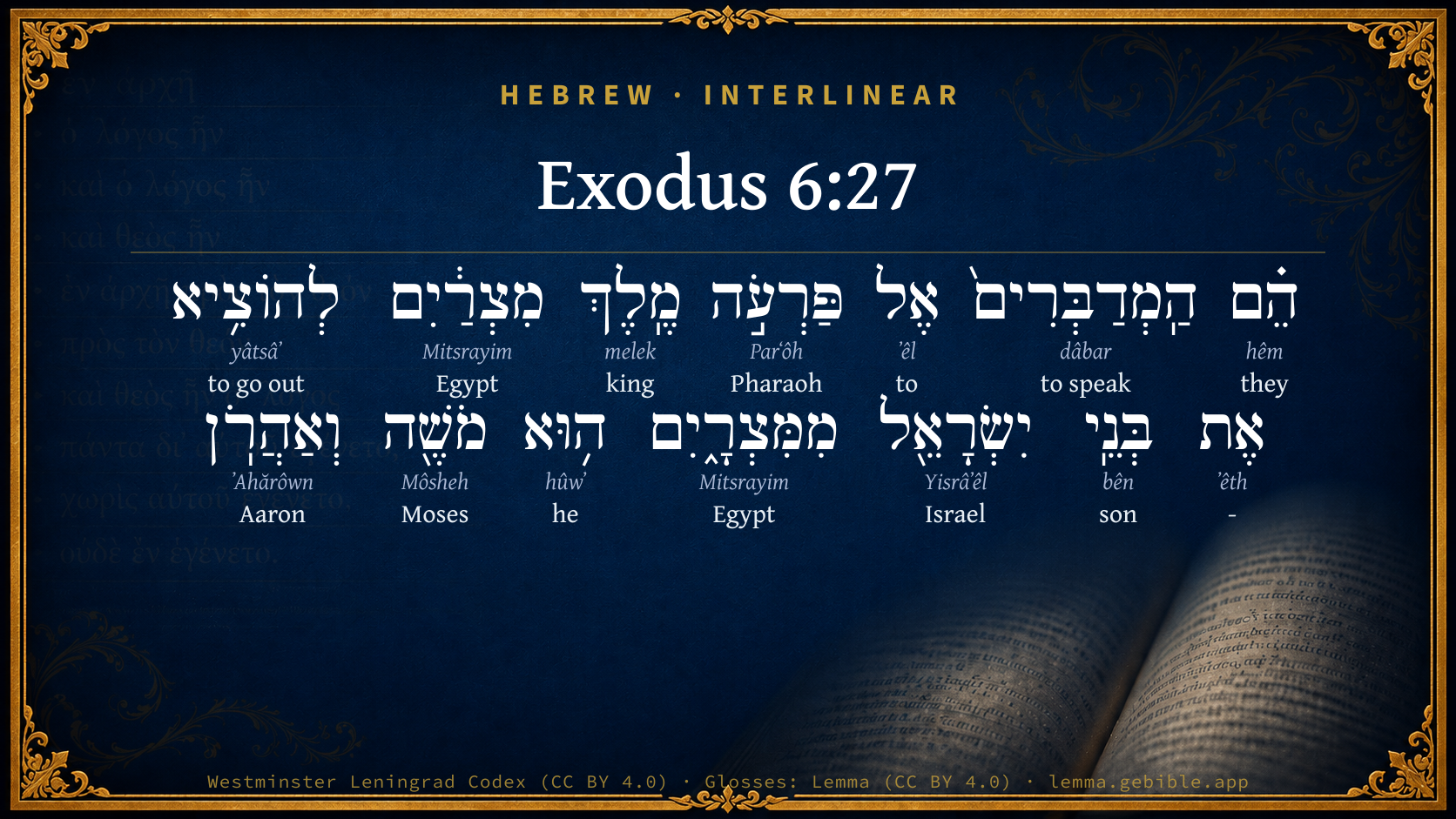
  1. הֵ֗ם hêm H1992 “they” Pronoun, Personal, 3rd Person, Masculine, Plural
  2. הַֽמְדַבְּרִים֙ dâbar H1696 “the · speaking” Particle, Definite Article + Verb, Piel, Participle Active, Masculine, Plural, Absolute
  3. אֶל ʼêl H413 “to” Preposition
  4. מֶֽלֶךְ melek H4428 “king of” Noun, Common, Masculine, Singular, Construct
  5. מִצְרַ֔יִם Mitsrayim H4714 “Egypt” Noun, Proper
  6. לְהוֹצִ֥יא yâtsâʼ H3318 “to go out” Preposition + Verb, Hiphil, Infinitive Construct
  7. אֶת ʼêth H853 “-” Particle, Direct Object
  8. בְּנֵֽי bên H1121 “sons of” Noun, Common, Masculine, Plural, Construct
  9. יִשְׂרָאֵ֖ל Yisrâʼêl H3478 “Israel” Noun, Proper
  10. מִמִּצְרָ֑יִם Mitsrayim H4714 “from · Egypt” Preposition + Noun, Proper
  11. ה֥וּא hûwʼ H1931 “he” Pronoun, Personal, 3rd Person, Masculine, Singular
  12. מֹשֶׁ֖ה Môsheh H4872 “Moses” Noun, Proper
  13. וְאַהֲרֹֽן ʼAhărôwn H175 “and · Aaron” Conjunction + Noun, Proper

About this verse

These counts appear in no published source. They are computed here, from the morphology-tagged text and Lemma’s own curated glosses. What Lemma adds →

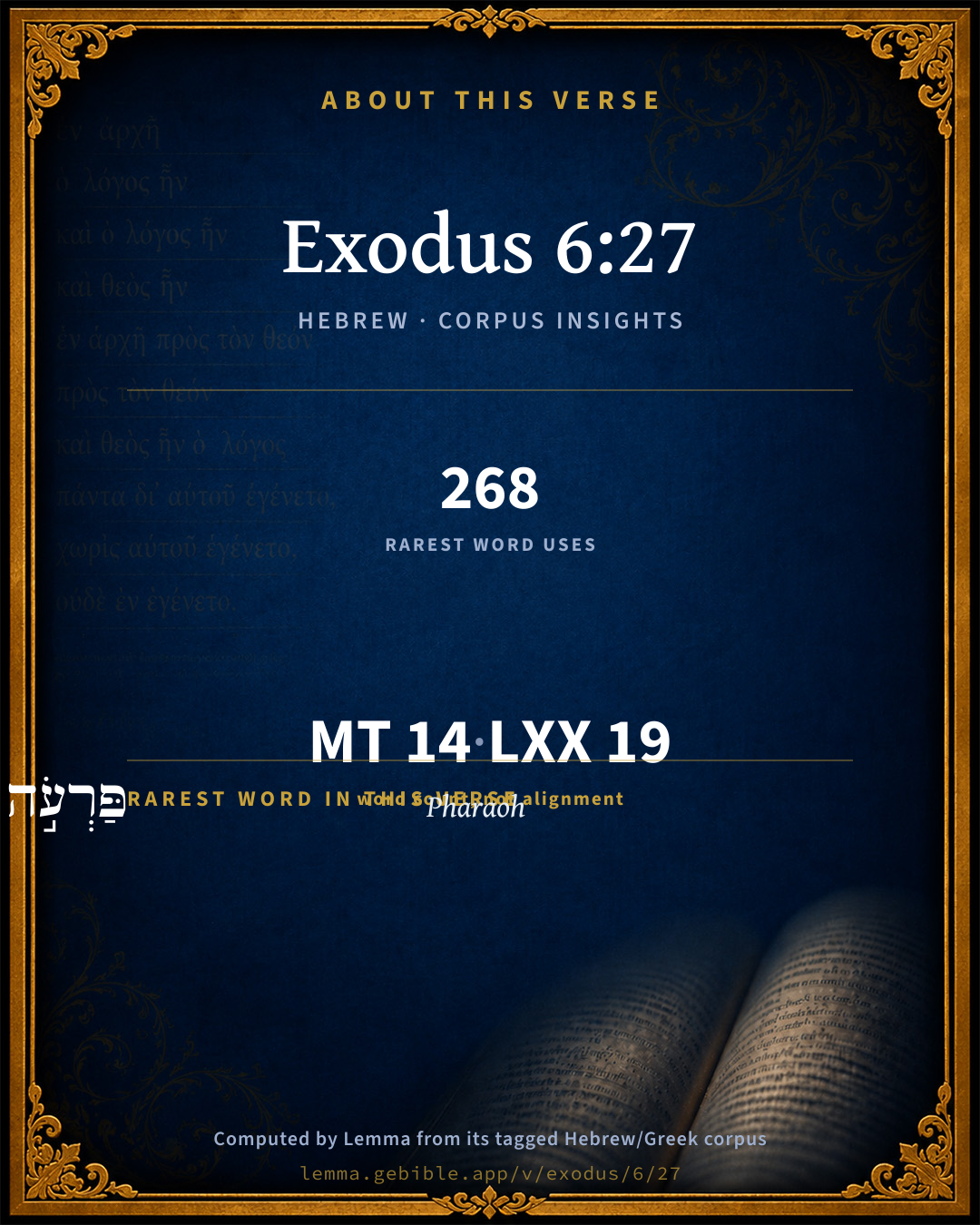
14
words
13
distinct lemmas
Pentateuch
section

Grammatical profile

  • 2 verbs
  • 8 nouns
  • 2 pronouns
  • 1 preposition
  • 1 particle

Verb forms

  • הַֽמְדַבְּרִים֙ Piel · Participle Active
  • לְהוֹצִ֥יא Hiphil · Infinitive Construct

Repetition

A word recurs within this verse — often emphatic in Hebrew:

  • מִצְרַ֔יִם Egypt H4714 ×2

Hebrew & Septuagint length

In English translation the verse runs 25 words from the Hebrew and 26 from the Septuagint (LXX English) — closely comparable.

A rough comparison of the two English renderings, which tokenize alike — not a word-level alignment.

Word counts can differ between the Hebrew and the Greek without any difference in meaning — e.g. the Hebrew direct-object marker אֵת has no separate Greek word, and Greek often adds the article ὁ.

In the original languages it is 14 Hebrew tokens and 19 Greek tokens — but the two are counted differently (Hebrew bundles its prefixes and suffixes into one token; the Greek is in lemma form), so that isn’t a like-for-like length.

Cross-references

8

Topical passages linked to Exodus 6:27 in the Treasury of Scripture Knowledge — connected by theme and wording, ordered by reader-vote popularity; previews shown in the World English Bible.

  • Exodus 5:1–3 Afterward Moses and Aaron came, and said to Pharaoh, "This is what Yahweh, the God of Israel, says, 'Let my people go, that they may hold a feast to me in the wilderness.'"
  • Exodus 6:13 Yahweh spoke to Moses and to Aaron, and gave them a charge to the children of Israel, and to Pharaoh king of Egypt, to bring the children of Israel out of the land of Egypt.
  • Exodus 6:26 These are that Aaron and Moses, to whom Yahweh said, "Bring out the children of Israel from the land of Egypt according to their hosts."
  • Exodus 7:10 Moses and Aaron went in to Pharaoh, and they did so, as Yahweh had commanded: and Aaron cast down his rod before Pharaoh and before his servants, and it became a serpent.
  • Exodus 32:7 Yahweh spoke to Moses, "Go, get down; for your people, who you brought up out of the land of Egypt, have corrupted themselves!
  • Exodus 33:1 Yahweh spoke to Moses, "Depart, go up from here, you and the people that you have brought up out of the land of Egypt, to the land of which I swore to Abraham, to Isaac, and to Jacob, saying, 'I will give it to your seed.'
  • Psalms 77:20 You led your people like a flock, By the hand of Moses and Aaron.
  • Micah 6:4 For I brought you up out of the land of Egypt, And redeemed you out of the house of bondage. I sent before you Moses, Aaron, and Miriam.

Cross-references courtesy of OpenBible.info (CC BY 4.0).

Hebrew and Greek witnesses Masoretic Hebrew ↔ Greek Septuagint

The same verse in the two great witnesses to the Old Testament, shown verse-for-verse.

These are two independent witnesses, not word-aligned to each other, and the Septuagint is shown in lemma (dictionary) form.

Hebrew Exodus 6:27 Masoretic · Westminster Leningrad Codex

הֵ֗ם הַֽמְדַבְּרִים֙ אֶל פַּרְעֹ֣ה מֶֽלֶךְ מִצְרַ֔יִם לְהוֹצִ֥יא אֶת בְּנֵֽי יִשְׂרָאֵ֖ל מִמִּצְרָ֑יִם ה֥וּא מֹשֶׁ֖ה וְאַהֲרֹֽן

These are those who spoke to Pharaoh king of Egypt, to bring out the children of Israel from Egypt. These are that Moses and Aaron.

World English Bible · Public Domain

Greek LXX Exodus 6:27 Septuagint · lemma form

οὗτος εἰμί ὁ διαλέγομαι πρός φαραώ βασιλεύς αἴγυπτος καί ἐκἄγω ὁ υἱός ἰσραήλ ἐκ αἴγυπτος αὐτός ααρων καί μωυσῆς

These are they that spoke with Pharao king of Egypt, and Aaron himself and Moses brought out the children of Israel from the land of Egypt,

LXX2012 (modern English Septuagint) · Public Domain

Hebrew: Westminster Leningrad Codex (CC BY 4.0). Greek: Septuagint (public domain); English from LXX2012 (modern English Septuagint) (Public Domain). How the Septuagint differs from the Hebrew →

Targum (Aramaic paraphrase)

2

The Targum is the ancient Jewish Aramaic paraphrase of the Hebrew Scriptures — an interpretive translation, not the Hebrew text itself. Onkelos (literal) and Pseudo-Jonathan (expansive) render the Torah, and Jonathan the Prophets. Coverage is partial: where no permissively-licensed English translation exists for a verse, only the Aramaic is shown. This is verse-level text, not a word-by-word alignment to the Hebrew.

  1. Targum Onkelos Torah (Genesis–Deuteronomy)
    אִנוּן דְמַלְלִין עִם פַּרְעֹה מַלְכָּא דְמִצְרַיִם לְאַפָּקָא יָת בְּנֵי יִשְׂרָאֵל מִמִצְרָיִם הוּא משֶׁה וְאַהֲרֹן:

    (no public-domain English translation for this verse)

    Targum Onkelos — Aramaic: “Onkelos Genesis” (public domain); “Onkelos Exodus” (public domain); “Onkelos Leviticus” (public domain); “Onkelos Numbers” (public domain); “Onkelos Deuteronomy” (public domain). English: “Sefaria Community Translation” (CC0 1.0 (public-domain dedication)); “J.W. Etheridge. The Targums of Onkelos and Jonathan Ben Uzziel on the Pentateuch. London: Longmans, Green, 1862” (public domain). Text via Sefaria.

  2. Targum Pseudo-Jonathan Torah (Genesis–Deuteronomy)
    הִינוּן דְמַלְלִין עִם פַּרְעה מַלְכָּא דְמִצְרַיִם לְהַנְפָּקָא יַת בְּנֵי יִשְרָאֵל מִמְצְרַיִם הוּא משֶׁה נְבִיָא וְאַהֲרן כַּהֲנָא

    -these are they who spake with Pharoh, king of Mizraim, that he should send out the sons of Israel from Mizraim; it is Mosheh the prophet, and Aharon the priest.

    Targum Pseudo-Jonathan — Aramaic: “Targum Jonathan on Genesis” (public domain); “Targum Jonathan on Exodus” (public domain); “Targum Jonathan on Leviticus” (public domain); “Targum Jonathan on Numbers” (public domain); “Targum Jonathan on Deuteronomy” (public domain). English: “The Targum of Jonathan ben Uzziel, trans. J. W. Etheridge, London, 1862” (public domain). Text via Sefaria.

Commentary

Notes on Exodus 6:27 from classic Christian and Jewish commentators (each source and its license shown beneath its notes). The classic Christian expositions comment on the surrounding passage and are grouped to its opening verse, so a note may address several verses; the Jewish commentaries on the Tanakh (Rashi and others) are per-verse, so they appear only where the commentator wrote on this verse.

Lemma curates 59 commentaries, every one of them public domain or Creative Commons licensed, each selected and text-cleaned for this edition rather than reprinted as found. About our sources →

Trapp's Complete Commentary

John Trapp

Exo 6:27 These [are] they which spake to Pharaoh king of Egypt, to bring out the children of Israel from Egypt: these [are] that Moses and Aaron.

Ver. 27. These are that Moses and Aaron.] Before it was Aaron and Moses. It made no matter which was first set: they had their several precellencies; but were so well agreed, that there was no striving for the pre-eminence. {See Trapp on "Exo 6:26"}

John Trapp, A Commentary or Exposition upon All the Books of the Old and New Testament (1647–1656) — public domain. Text from a community e-Sword module.

The Cambridge Bible for Schools and Colleges

gen. ed. J. J. S. Perowne

27. These were the men commissioned also to speak to the Pharaoh on behalf of Israel: cf. vv. 11, 13. The diffuseness, and repetitions (vv. 26, 27), are in P’s style: cf Gen_9:16-17 (repetition of vv. 13–15), Gen_17:26-27 (repetition of v. 23), Gen_23:20 (see vv. 17, 18).

It is to be observed that P consistently represents Moses, or his contemporaries, as being in the fourth generation (cf. Gen_15:16) from on or other of Jacob’s sons: thus Levi, Kohath, Amram, Moses (here, vv. 16, 18, 20); Levi, Kohath, Iẓhar, Koraḥ, (vv. 16, 18, 21, Num_14:1); Levi, Kohath, Uzziel, Mishael (Lev_10:4); Reuben, Pallu, Eliab, Dathan (Num_26:7-9). On the chronological question involved, see the Introd. p. xlv, and on Exo_12:40.

The Cambridge Bible for Schools and Colleges (gen. ed. J. J. S. Perowne; Cambridge University Press, 1878–1918) — public domain. Text from a community e-Sword module.

Rashi

Rabbi Shlomo Yitzchaki (Rashi)

הם המדברים וגו׳ THESE ARE THEY WHO SPAKE TO PHARAOH — It was they who received the command to speak to Pharaoh (cf. v. 26), and it was they who carried it out by actually speaking to him (cf. e.g. Exodus 7:7).

הוא משה ואהרן THESE ARE MOSES AND AARON — they remained always the same in carrying out their mission and in their integrity from beginning to end (cf. Megillah 11a).

Rashi on the Tanakh — English translations: “The Judaica Press complete Tanach with Rashi, translated by A. J. Rosenberg” (CC BY 4.0); “Pentateuch with Rashi's commentary by M. Rosenbaum and A.M. Silbermann, 1929-1934” (public domain); “The Metsudah Tanach series, Lakewood, N.J” (CC BY 4.0); and “The Book of Joshua, Metsudah Publications, 1997” (CC BY 4.0). Text via Sefaria.

Lesson kit

Teaching starters — assembled from the data on this page, not authored interpretation. Every prompt links to the verse data it draws on. Edit before teaching.

Exodus, in the Pentateuch, opens this verse with 14 words (13 distinct Hebrew lemmas). Its most distinctive word is Parʻôh (“Pharaoh”). A historical commentator’s framing appears above. Read the whole chapter for the surrounding context.

Discussion questions

  1. How does “Pharaoh” (Parʻôh) shape what this verse is saying?
  2. How does Exodus 5:1–3, which shares this passage’s theme, read alongside this verse?
  3. What does the repetition of “Egypt” (2× in this one verse) do in this verse?
  4. These translations render this verse differently. What is at stake in choosing one wording over another?
  5. «הַֽמְדַבְּרִים֙» is a Piel Participle Active verb. How does that grammatical form shape the action described?
  6. Compare how Trapp's Complete Commentary and The Cambridge Bible for Schools and Colleges read this verse. Where do they agree or differ?

Things to notice

Reading settings

Reading text

Shown beneath each verse's original-language words.

Old Testament
Old Testament edition

Read the OT as the Masoretic Hebrew (MT) or the Greek Septuagint (LXX).

English shown for the Greek Septuagint (in the Hebrew ↔ Greek comparison).

Comparing translations? Open the Compare panel on any verse page to stack up to four side by side.