
Joshua 23:12

Hebrew (Westminster Leningrad Codex) Joshua 23:12 appears in the Hebrew Old Testament. The text above is from the Westminster Leningrad Codex. Each word links to its Strong’s number, a concise gloss, and parsing drawn from the Open Scriptures Hebrew Bible morphology. Click any word for its full Brown-Driver-Briggs (BDB) entry.
Download image
Cite this verse

Joshua 23:12 (World English Bible). Public Domain. Lemma interlinear Bible study tool, https://lemma.gebible.app/v/joshua/23/12.

Show BibTeX & RIS
BibTeX
RIS
English Translation
Else if you do at all go back, and cleave to the remnant of these nations, even these who remain among you, and make marriages with them, and go in to them, and they to you;
World English Bible · Public Domain
Download a study sheet

One document with this verse’s original text, its word-by-word gloss line, the meaning frame, cross-references with their text, attributed commentary, and full source and license credits — printable, and it pastes into notes with its structure intact.

This verse Autodidact and up

Study sheet (.html) Plain text (.txt)

A passage Seminary Student

Up to 50 verses in one chapter. A passage sheet keeps up to 6 commentary sources and 12 cross-references per verse, in the order this page ranks them, and says so on the sheet whenever that leaves anything out. Ask for a single verse and you get the Autodidact verse sheet above.

Everything on this page stays free to read, with no account — the sheet is a download of what is already on screen, not access to it.

Want to remove ads? Support Godless Engineer
Compare translations 3

The same verse in 3 English versions, stacked beneath the original-language interlinear above. Click any original word for its lexicon entry.

Each is an independent rendering of the whole verse — the interlinear is not word-aligned to these translations.

Highlighted words mark where these versions differ — a whole-verse word diff, not a word-by-word alignment.

  • World English Bible Public Domain
    Else if you do at all go back, and cleave to the remnant of these nations, even these who remain among you, and make marriages with them, and go in to them, and they to you;
  • King James Version Public Domain
    Else if ye do in any wise go back, and cleave unto the remnant of these nations, even these that remain among you, and shall make marriages with them, and go in unto them, and they to you:
  • unfoldingWord Literal Text CC BY-SA 4.0
    For if turning, you turn and cling to the remnant of these nations, these ones remaining with you, and you intermarry with them and you go among them and they among you,

unfoldingWord Literal Text — © unfoldingWord, licensed CC BY-SA 4.0. Word-aligned USFM3 via Door43 (git.door43.org/unfoldingWord/en_ult).

Versions to compare (up to 4)

3 of 4 selected

Show all 18 translations

Every available English version of this verse, each an independent rendering of the whole verse.

  • World English Bible Public Domain
    Else if you do at all go back, and cleave to the remnant of these nations, even these who remain among you, and make marriages with them, and go in to them, and they to you;
  • Berean Standard Bible Public Domain
    For if you turn away and cling to the rest of these nations that remain among you, and if you intermarry and associate with them,
  • Majority Standard Bible Public Domain
    For if you turn away and cling to the rest of these nations that remain among you, and if you intermarry and associate with them,
  • King James Version Public Domain
    Else if ye do in any wise go back, and cleave unto the remnant of these nations, even these that remain among you, and shall make marriages with them, and go in unto them, and they to you:
  • American Standard Version (1901) Public Domain
    Else if ye do at all go back, and cleave unto the remnant of these nations, even these that remain among you, and make marriages with them, and go in unto them, and they to you;
  • Revised Version (1885) Public Domain
    Else if ye do in any wise go back, and cleave unto the remnant of these nations, even these that remain among you, and make marriages with them, and go in unto them, and they to you:
  • Geneva Bible (1599) Public Domain
    Els, if ye goe backe, and cleaue vnto the rest of these nations: that is, of them that remaine with you, and shall make marriages with them, and goe vnto them, and they to you,
  • Douay-Rheims (1899) Public Domain
    But if you will embrace the errors of these nations that dwell among you, and make marriages with them, and join friendships:
  • Young's Literal Translation Public Domain
    `But -- if ye at all turn back and have cleaved to the remnant of these nations, these who are left with you, and intermarried with them, and gone in to them, and they to you,
  • Literal Standard Version CC BY-SA 4.0
    But—if you turn back at all and have cleaved to the remnant of these nations, these who are left with you, and intermarried with them, and gone in to them, and they to you,
  • Unlocked Literal Bible CC BY-SA 4.0
    But if you turn back and cling to the survivors of these nations who remain among you, or if you intermarry with them, or if you come together with them and they with you,
  • unfoldingWord Literal Text CC BY-SA 4.0
    For if turning, you turn and cling to the remnant of these nations, these ones remaining with you, and you intermarry with them and you go among them and they among you,
  • Darby Bible Public Domain
    For if ye in any wise go back, and cleave unto the residue of these nations, these that remain among you, and make marriages with them, and come in unto them and they unto you:
  • World Messianic Bible Public Domain
    “But if you do at all go back, and hold fast to the remnant of these nations, even these who remain among you, and make marriages with them, and go in to them, and they to you;
  • Webster's Bible Public Domain
    Else if ye do in any wise go back, and cleave to the remnant of these nations, even these that remain among you, and shall make marriages with them, and associate with them, and they with you:
  • Free Bible Version CC BY-SA 4.0
    For if you do turn from him, and adopt the ways of the nations that are left, if you intermarry with them, associating with one another,
  • Bible in Basic English Public Domain
    For if you go back, joining yourselves to the rest of these nations who are still among you, getting married to them and living with them and they with you:
  • JPS Tanakh (1917) Public Domain
    Else if ye do in any wise go back, and cleave unto the remnant of these nations, even these that remain among you, and make marriages with them, and go in unto them, and they to you;

Literal Standard Version (2020), Covenant Press — licensed CC BY-SA 4.0. Text via the HelloAO Bible API (eBible.org). Unlocked Literal Bible (unfoldingWord) — licensed CC BY-SA 4.0. Text via the HelloAO Bible API (eBible.org). unfoldingWord Literal Text — © unfoldingWord, licensed CC BY-SA 4.0. Word-aligned USFM3 via Door43 (git.door43.org/unfoldingWord/en_ult). Free Bible Version, Dr. Jonathan Gallagher — licensed CC BY-SA 4.0. Text via the HelloAO Bible API (eBible.org).

Word by word

More ways to search: Search by grammar → Find every occurrence → Compare this word →

Practice this passage: Drill this verse → Learn its vocabulary →

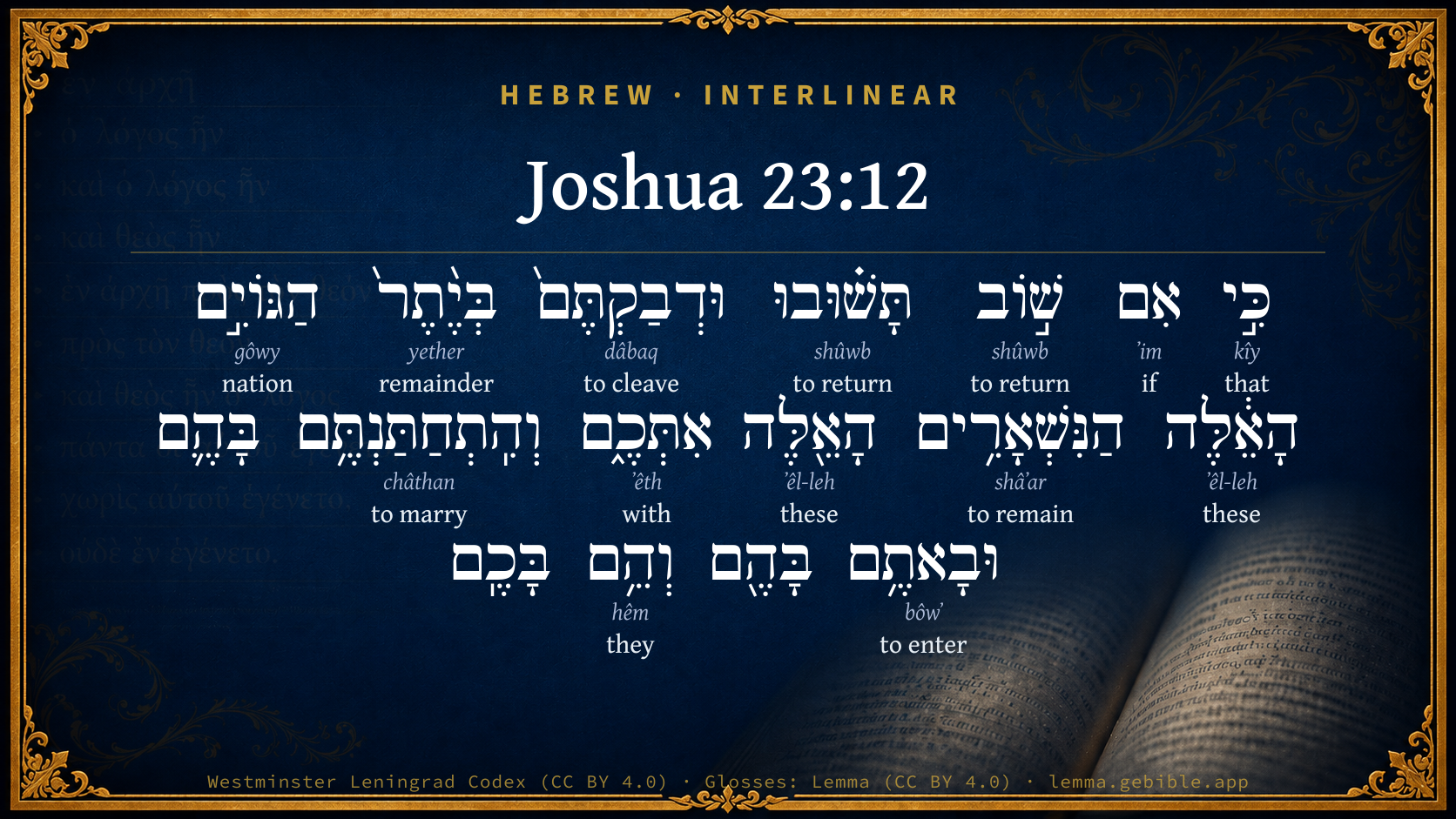
וְהִֽתְחַתַּנְתֶּ֥ם
châthan
H2859
“and · to marry”
Conjunction + Verb, Hithpael, Sequential Perfect, 2nd Person, Masculine, Plural
Part of Speech
Conjunction + Verb
Stem
Hithpael
Form
Sequential Perfect
Person
2nd Person
Gender
Masculine
Number
Plural
Full BDB Definition

Origin: a primitive root

TWOT: 781b

to become a son-in-law, make oneself a daughter's husband - (Qal) wife's father, wife's mother, father-in-law, mother-in-law (participle) - (Hithpael) to make oneself a daughter's husband
  1. כִּ֣י kîy H3588 “that” Conjunction
  2. אִם ʼim H518 “if” Conjunction
  3. שׁ֣וֹב shûwb H7725 “to return” Verb, Qal, Infinitive Absolute
  4. תָּשׁ֗וּבוּ shûwb H7725 “to return” Verb, Qal, Imperfect, 2nd Person, Masculine, Plural
  5. וּדְבַקְתֶּם֙ dâbaq H1692 “and · to cleave” Conjunction + Verb, Qal, Sequential Perfect, 2nd Person, Masculine, Plural
  6. בְּיֶ֨תֶר֙ yether H3499 “in/at · remainder of” Preposition + Noun, Common, Masculine, Singular, Construct
  7. הַגּוֹיִ֣ם gôwy H1471 “the · nations” Particle, Definite Article + Noun, Common, Masculine, Plural, Absolute
  8. הָאֵ֔לֶּה ʼêl-leh H428 “the · these” Particle, Definite Article + Pronoun, Demonstrative, Common, Plural
  9. הַנִּשְׁאָרִ֥ים shâʼar H7604 “the · remaining” Particle, Definite Article + Verb, Niphal, Participle Active, Masculine, Plural, Absolute
  10. הָאֵ֖לֶּה ʼêl-leh H428 “the · these” Particle, Definite Article + Pronoun, Demonstrative, Common, Plural
  11. אִתְּכֶ֑ם ʼêth H854 “with · you” Preposition + Suffix, Personal, 2nd Person, Masculine, Plural
  12. וּבָאתֶ֥ם bôwʼ H935 “and · to enter” Conjunction + Verb, Qal, Sequential Perfect, 2nd Person, Masculine, Plural
  13. וְהֵ֥ם hêm H1992 “and · they” Conjunction + Pronoun, Personal, 3rd Person, Masculine, Plural

About this verse

These counts appear in no published source. They are computed here, from the morphology-tagged text and Lemma’s own curated glosses. What Lemma adds →

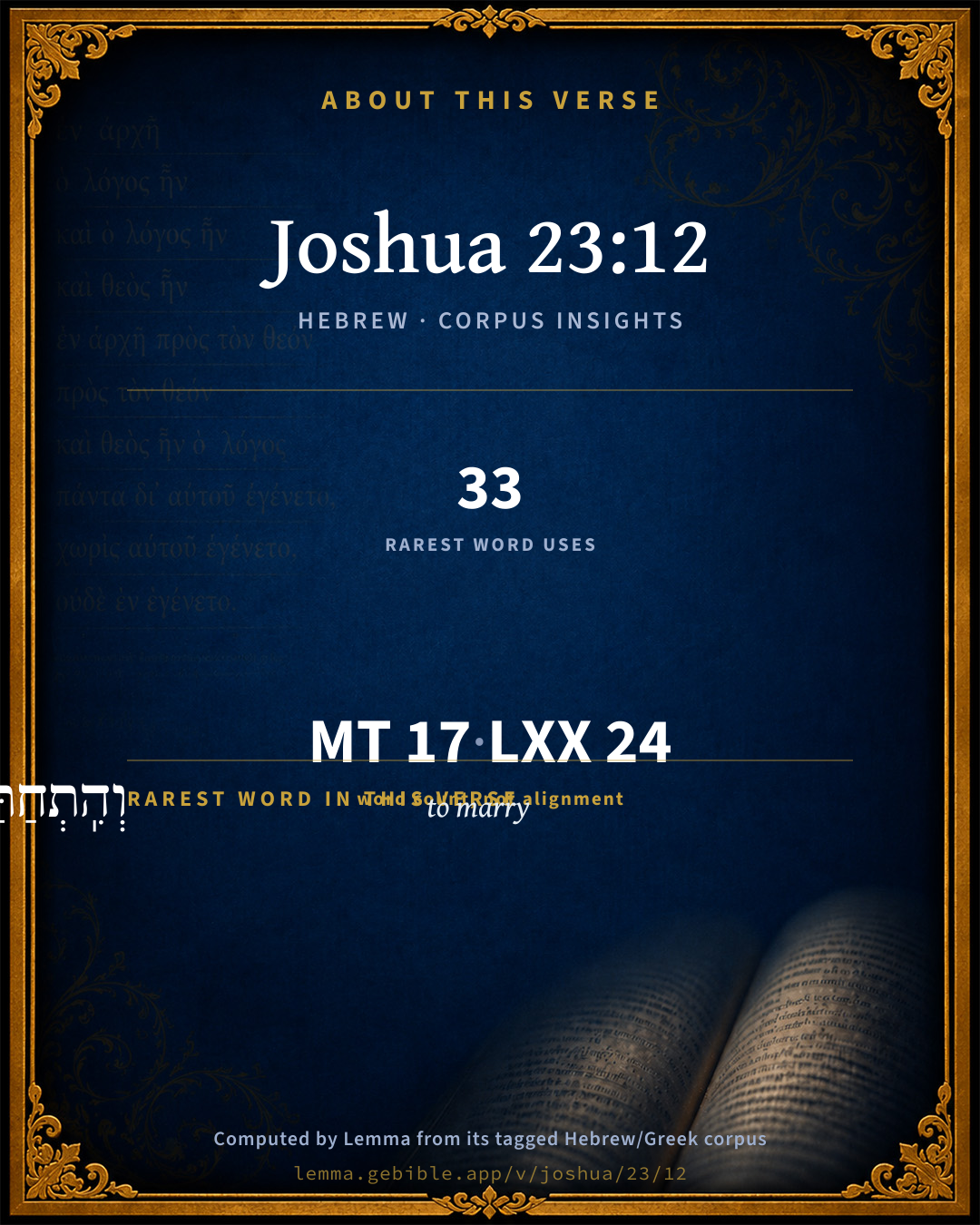
17
words
12
distinct lemmas
Historical
section

Shared distinctive vocabulary

וְהִֽתְחַתַּנְתֶּ֥ם to marry H2859 occurs in 32 verses of the Hebrew Bible. Also found in:

Grammatical profile

  • 6 verbs
  • 2 nouns
  • 3 pronouns
  • 4 prepositions
  • 2 conjunctions

Verb forms

  • שׁ֣וֹב Qal · Infinitive Absolute
  • תָּשׁ֗וּבוּ Qal · Imperfect
  • וּדְבַקְתֶּם֙ Qal · Sequential Perfect
  • הַנִּשְׁאָרִ֥ים Niphal · Participle Active
  • וְהִֽתְחַתַּנְתֶּ֥ם Hithpael · Sequential Perfect
  • וּבָאתֶ֥ם Qal · Sequential Perfect

Repetition

Words recur within this verse — often emphatic in Hebrew:

  • שׁ֣וֹב to return H7725 ×2
  • הָאֵ֔לֶּה these H428 ×2

Hebrew & Septuagint length

In English translation the verse runs 36 words from the Hebrew and 31 from the Septuagint (LXX English) — closely comparable.

A rough comparison of the two English renderings, which tokenize alike — not a word-level alignment.

Word counts can differ between the Hebrew and the Greek without any difference in meaning — e.g. the Hebrew direct-object marker אֵת has no separate Greek word, and Greek often adds the article ὁ.

In the original languages it is 17 Hebrew tokens and 24 Greek tokens — but the two are counted differently (Hebrew bundles its prefixes and suffixes into one token; the Greek is in lemma form), so that isn’t a like-for-like length.

Cross-references

23

Topical passages linked to Joshua 23:12 in the Treasury of Scripture Knowledge — connected by theme and wording, ordered by reader-vote popularity; previews shown in the World English Bible.

  • Deuteronomy 7:3 neither shall you make marriages with them; your daughter you shall not give to his son, nor his daughter shall you take to your son.
  • Ezekiel 18:24 But when the righteous turns away from his righteousness, and commits iniquity, and does according to all the abominations that the wicked man does, shall he live? None of his righteous deeds that he has done shall be remembered: in his trespass that he has trespassed, and in his sin that he has sinned, in them shall he die.
  • Zephaniah 1:6 those who have turned back from following Yahweh, and those who haven't sought Yahweh nor inquired after him.
  • Genesis 2:24 Therefore a man will leave his father and his mother, and will join with his wife, and they will be one flesh.
  • Genesis 34:3 His soul joined to Dinah, the daughter of Jacob, and he loved the young lady, and spoke kindly to the young lady.
  • Exodus 34:12–16 Be careful, lest you make a covenant with the inhabitants of the land where you are going, lest it be for a snare in the midst of you:
  • 1 Samuel 18:1–3 It happened, when he had made an end of speaking to Saul, that the soul of Jonathan was knit with the soul of David, and Jonathan loved him as his own soul.
  • 1 Kings 11:2 of the nations concerning which Yahweh said to the children of Israel, You shall not go among them, neither shall they come among you; for surely they will turn away your heart after their gods: Solomon joined to these in love.
  • 1 Kings 11:4 For it happened, when Solomon was old, that his wives turned away his heart after other gods; and his heart was not perfect with Yahweh his God, as was the heart of David his father.
  • Ezra 9:1–2 Now when these things were done, the princes drew near to me, saying, The people of Israel, and the priests and the Levites, have not separated themselves from the peoples of the lands, [doing] according to their abominations, even of the Canaanites, the Hittites, the Perizzites, the Jebusites, the Ammonites, the Moabites, the Egyptians, and the Amorites.
  • Ezra 9:11–12 which you have commanded by your servants the prophets, saying, The land, to which you go to possess it, is an unclean land through the uncleanness of the peoples of the lands, through their abominations, which have filled it from one end to another with their filthiness:
  • Nehemiah 13:23–26 In those days also saw I the Jews who had married women of Ashdod, of Ammon, [and] of Moab:
  • Psalms 36:3 The words of his mouth are iniquity and deceit. He has ceased to be wise and to do good.
  • Psalms 106:34–35 They didn't destroy the peoples, As Yahweh commanded them,
  • Psalms 125:5 But as for those who turn aside to their crooked ways, Yahweh will lead them away with the workers of iniquity. Peace be on Israel.
  • Isaiah 1:4 Ah sinful nation, A people loaded with iniquity, A seed of evil-doers, Children who deal corruptly! They have forsaken Yahweh. They have despised the Holy One of Israel. They are estranged and backward.
  • Matthew 12:45 Then he goes, and takes with himself seven other spirits more evil than he is, and they enter in and dwell there. The last state of that man becomes worse than the first. Even so will it be also to this evil generation."
  • John 6:66 At this, many of his disciples went back, and walked no more with him.
  • Romans 12:9 Let love be without hypocrisy. Abhor that which is evil. Cling to that which is good.
  • 2 Corinthians 6:14–17 Don't be unequally yoked with unbelievers, for what fellowship have righteousness and iniquity? Or what communion has light with darkness?
  • Hebrews 10:38–39 But the righteous will live by faith. If he shrinks back, my soul has no pleasure in him."
  • 2 Peter 2:18–22 For, uttering great swelling words of emptiness, they entice in the lusts of the flesh, by licentiousness, those who are indeed escaping from those who live in error;
  • 1 John 2:9 He who says he is in the light and hates his brother, is in the darkness even until now.

Cross-references courtesy of OpenBible.info (CC BY 4.0).

Hebrew and Greek witnesses Masoretic Hebrew ↔ Greek Septuagint

The same verse in the two great witnesses to the Old Testament, shown verse-for-verse.

These are two independent witnesses, not word-aligned to each other, and the Septuagint is shown in lemma (dictionary) form.

Hebrew Joshua 23:12 Masoretic · Westminster Leningrad Codex

כִּ֣י אִם שׁ֣וֹב תָּשׁ֗וּבוּ וּדְבַקְתֶּם֙ בְּיֶ֨תֶר֙ הַגּוֹיִ֣ם הָאֵ֔לֶּה הַנִּשְׁאָרִ֥ים הָאֵ֖לֶּה אִתְּכֶ֑ם וְהִֽתְחַתַּנְתֶּ֥ם בָּהֶ֛ם וּבָאתֶ֥ם בָּהֶ֖ם וְהֵ֥ם בָּכֶֽם

Else if you do at all go back, and cleave to the remnant of these nations, even these who remain among you, and make marriages with them, and go in to them, and they to you;

World English Bible · Public Domain

Greek LXX Joshua 23:12 Septuagint · lemma form

ἐάν γάρ ἀποστρέφω καί προςτίθημι ὁ ὑπολείπω ἔθνος οὗτος ὁ μετά σύ καί ἐπιγαμία ποιέω πρός αὐτός καί συν καταμίγνυμι αὐτός καί αὐτός σύ

For if you⌃ shall turn aside and attach yourselves to these nations that are left with you, and make marriages with them, and become mingled with them and they with you,

LXX2012 (modern English Septuagint) · Public Domain

Hebrew: Westminster Leningrad Codex (CC BY 4.0). Greek: Septuagint (public domain); English from LXX2012 (modern English Septuagint) (Public Domain). How the Septuagint differs from the Hebrew →

Targum (Aramaic paraphrase)

1

The Targum is the ancient Jewish Aramaic paraphrase of the Hebrew Scriptures — an interpretive translation, not the Hebrew text itself. Onkelos (literal) and Pseudo-Jonathan (expansive) render the Torah, and Jonathan the Prophets. Coverage is partial: where no permissively-licensed English translation exists for a verse, only the Aramaic is shown. This is verse-level text, not a word-by-word alignment to the Hebrew.

  1. Targum Jonathan Prophets (Joshua–Malachi)
    אֲרֵי אִם מֵיתַב תְּתוּבוּן וְתִדְבְּקוּן בִּשְׁאָר עַמְמַיָא הָאִלֵין דִי אִשְׁתָּאֲרוּ הָאִלֵין עִמְכוֹן וְתִתְחַתְּנוּן בְּהוֹן וְתִתְעַרְבוּן בְּהוֹן וְאִינוּן יִתְעַרְבוּן בְּכוֹן:

    (no public-domain English translation for this verse)

    Targum Jonathan — Aramaic: “Mikraot Gedolot” (public domain). English: “Sefaria Community Translation” (CC0 1.0 (public-domain dedication)); “London "Chaldee Paraphrase," 1871” (public domain). Text via Sefaria.

Commentary

Notes on Joshua 23:12 from classic Christian and Jewish commentators (each source and its license shown beneath its notes). The classic Christian expositions comment on the surrounding passage and are grouped to its opening verse, so a note may address several verses; the Jewish commentaries on the Tanakh (Rashi and others) are per-verse, so they appear only where the commentator wrote on this verse.

Lemma curates 59 commentaries, every one of them public domain or Creative Commons licensed, each selected and text-cleaned for this edition rather than reprinted as found. About our sources →

Jamieson, Fausset & Brown

Robert Jamieson, A. R. Fausset & David Brown

BY THREATENINGS IN CASE OF DISOBEDIENCE. (Jos 23:12)

Else if ye do in any wise go back, and cleave unto the remnant of these nations--As marriage connections with the idolatrous Canaanites would present many and strong temptations to transgress it, these were strictly prohibited (Exo 34:12-16; Deu 7:3). With his eye, as it were, upon those prohibitions, Joshua threatens them with the certain withdrawal of the divine aid in the further expulsion of the Canaanites (a threat founded Exo 23:33; Num 33:55; Deu 7:16).

Next: Joshua Chapter 24

Jamieson, Fausset & Brown — Commentary Critical and Explanatory on the Whole Bible (1871) — public domain (CC PDM 1.0). Text via the HelloAO Bible API.

Trapp's Complete Commentary

John Trapp

Jos 23:12 Else if ye do in any wise go back, and cleave unto the remnant of these nations, [even] these that remain among you, and shall make marriages with them, and go in unto them, and they to you:

Ver. 12. Else, if ye do in any wise go back.] Apostates cannot choose to themselves a worse condition; there is martial law for such: they "draw back to perdition." {Heb 10:39}

And cleave unto the remnant.] It is not safe to seek the association of others in a sinful way. Jehoshaphat smarted for joining with Ahab: Hunniades, for cleaving to that perjured Popish king at the battle of Varna: the Greek Church, for calling in the help of the Latin Church against the Turk; subjecting themselves to the Bishop of Rome.

John Trapp, A Commentary or Exposition upon All the Books of the Old and New Testament (1647–1656) — public domain. Text from a community e-Sword module.

Joseph Benson's Commentary

Jos 23:12-13. If ye in any wise go back — From God, and from his worship and service. They shall be snares and traps to you — By your converse with them, you will be drawn by degrees into their errors, and impieties, and brutish lusts. Thorns in your eyes — When they have seduced, and thereby weakened you, then they will molest and vex you, no less than a severe scourge doth a man’s sides which are lashed by it, or than a small thorn doth the eye when it is got within it. Till ye perish — They shall so persecute you, and fight against you with such success, that you shall be forced to quit your own land, and wander, you know not whither. Which must needs have been very terrible to them to think of, when they compared their present ease, and plenty, and safety, with the pains, and weariness, and hazards, and wants of their former wanderings.

Joseph Benson's Commentary on the Old and New Testaments (1811–1818) — public domain. Text from a community e-Sword module.

Tyndale Open Study Notes

Tyndale Open Resources

23:12-16 Apostasy—turning away from the true God—is fatal. • Because God is holy, Joshua could speak with optimism regarding God’s promises and the good land into which God had brought them. God will not change his holy character even if his people change. The rebellion of God’s people cannot damage his holiness, but rebellion will destroy those who rebel.

23:12 Joshua warned God’s people not to intermarry with their polytheistic neighbors because such an intimate relationship would lead the Israelites astray (Deut 7:3-4). However, Canaanites who desired to worship the Lord and join God’s people were welcomed (Josh 6:25; Ruth 4:10). Race, language, and ethnicity had no bearing on God’s prohibition of intermarriage; it was a matter of faithfulness to the Lord (cp. 2 Cor 6:14-15).

Tyndale Open Study Notes — © Tyndale Open Resources, licensed CC BY-SA 4.0. Text via the HelloAO Bible API.

Geneva Bible (1599)

Geneva Bible translators

Or, be of their affinity.

Or, have conversation with them.

Geneva Bible (1599) marginal notes — public domain. Text via Bolls.life.

Adam Clarke's Commentary

Verse 12. Else if ye do - go back] The soldier who draws back when going to meet the enemy, forfeits his life. These were the Lord's soldiers, and if they drew back they drew back unto perdition, their lives being forfeited by their infidelity.

Adam Clarke's Commentary on the Bible (1810–1826) — public domain. Text from a community e-Sword/MySword module.

John Calvin's Commentaries

12. Else if you do in any wise go back, etc According to the usual method observed in the Law, he adds threatening, in order that if they are not sufficiently allured by the divine goodness, they may be aroused by fear to the performance of their duty. It is, indeed, disgraceful for men, when God graciously condescends to invite them, not at once to run forward and meet the invitation by prompt and alert obedience; but such is the lethargy of the flesh, that it always requires to be stimulated by threats. Joshua, therefore, adopts the usual method of the Law, while he reminds the Israelites of the terrors of the Lord, provided they do not of their own accord embrace his offered favor. Moreover, it is not once only that, he sets before them the denunciation that the nations of Canaan will be scourges to their sides and thorns in their eyes if they become familiar with them. First, inasmuch as God had consecrated the land to himself, he wished it to be purged of all impurities; and secondly, inasmuch as he saw how prone the people were to be corrupted by bad example, he wished also to provide a remedy for this evil. Then, while on the one hand the people counted it as nothing that the land should be contaminated by impious superstitions, and that idols should be worshipped in it instead of the true God, and on the other hand, eagerly contracted contagion from their vices, it was only a just punishment of this gross contempt that they should experience molestation and hostility from those whom they had improperly spared.

That the threatening which both Moses and Joshua thus denounced were openly accomplished, is but too plain from the Book of Judges. And yet this promulgation of the divine vengeance was not altogether useless; for after Joshua was dead, they became courageous enough to engage in war. Their ardor, however, proved evanescent, and they shortly after were initiated in nefarious Gentile rites. Hence, we perceive in the human mind an intemperate longing for perverse worship, a longing which no curbs are able to restrain.

It is now proper to consider how far this doctrine is applicable to us. It is true a special command was given to the ancient people to destroy the nations of Canaan, and keep aloof from all profane defilement’s. To us, in the present day, no certain region marks out our precise boundaries; nor are we armed with the sword to slay all the ungodly; we have only to beware of allowing ourselves to become involved in fellowship with wickedness, by not keeping at a sufficient distance from it. For it is almost impossible, if we mingle with it, spontaneously to avoid receiving some spot or blemish. But this point having been elsewhere expounded, I now merely advert to it in passing.

John Calvin's Commentaries (1540-1563) — public domain. Text from the Calvin Translation Society English edition (1840s-50s) via the Christian Classics Ethereal Library (ccel.org). Calvin's coverage is partial (roughly two-thirds of the Bible); uncommented books and verses are honest gaps, never fabricated. The 19th-century editor's footnotes and remarks are omitted so the notes are faithfully Calvin's own voice.

Ellicott's Commentary for English Readers

(12,13) if ye . . . make marriages with them . . . the Lord your God will no more drive out.—The common-sense of this warning is manifest. The God of Israel cannot treat as His enemies those whom Israel has united with itself, unless He also makes war on Israel. It was a long time before Israel learned the lesson how to live in the world without being of the world. It was not learnt until after the Babylonish captivity, and when learnt, it soon developed into a Pharisaical exclusiveness, which produced the very opposite effect to that which the law was intended to have.

A Bible Commentary for English Readers, edited by Charles John Ellicott (1878–1897) — public domain. Text from a community e-Sword module.

The Cambridge Bible for Schools and Colleges

gen. ed. J. J. S. Perowne

12. if ye do] “If ye do in any wise turn back, and cleave to the remnant of these nations, these that remain with you, and make marriages with them, and ye come among them, and they among you, know for a certainty that the protection of the Almighty will fail you, and His arm will no more give you success against them.”

The Cambridge Bible for Schools and Colleges (gen. ed. J. J. S. Perowne; Cambridge University Press, 1878–1918) — public domain. Text from a community e-Sword module.

John Gill's Exposition

Else if ye do in any wise go back,.... From the Lord and his worship, from his word and ordinances:

and cleave unto the remnant of these nations, even those that remain among you; in cities not taken, or in several which the Philistines were in possession of, or lived among them as tributaries to them, if they should take to them, and be free and familiar with them, which may lead on to nearer connections in civil and religious matters:

and shall make marriages with them; marry their daughters to the sons of Canaanites, or admit the daughters of Canaanites to be married to their sons:

and go in unto them, and they to you; which is expressive of the consummation of marriage, and of the performance of the conjugal duty,

John Gill's Exposition of the Whole Bible (1746–1763) — public domain (CC PDM 1.0). Text via the HelloAO Bible API.

Matthew Poole's English Annotations

If ye go back, from God, and from his worship and service.

Go in unto them; the phrase notes the matrimonial act.

Matthew Poole's English Annotations on the Holy Bible (1683–1685) — public domain. Text from a community e-Sword/MySword module.

Whedon's Commentary on the Bible

Daniel D. Whedon

12. Make marriages — This most intimate form of alliance was forbidden in Exo_34:12-16, as a precaution against temptation. Thus Christians are forbidden to wed infidels or pagans. 2Co_6:14. The affections largely determine religious opinions and practice. The heart makes theology.

Daniel D. Whedon (gen. ed.), Commentary on the Old and New Testaments (1874–1909) — public domain. Text from a community e-Sword module.

The Pulpit Commentary

Go back. Literally, return. Cleave. A word (see ver. 8) signifying close and intimate relationship. And the intimacy of the relationship is indicated, as in ver. 8, by the use of the preposition B. Make marriages with them. No closer or more intimate relationship is possible than this. Nothing, therefore, would be more certain to draw the Israelites away from their allegiance to God, and to seduce them and their children into the false and corrupt worship of the nations around them. "Unde deprecor vos qui fidelis estis, ut ita vitam vestram et conversationem servetis, ne in aliquo vel ipsi scandalum patiamini vel aliis scandalum faciatis; sit in vobis summi studii, summaeque cautelae, ne quis in hanc sanctam congregationem vestram pollutus introeat" (Orig., Hom. 21 on Joshua). Go in unto them. Rather, go among them. Spoken of the familiar intercourse of friendship. It is equivalent to our words "associate with them."

The Pulpit Commentary (1880–1919), ed. H.D.M. Spence-Jones & Joseph S. Exell — public domain. Text from a community e-Sword module.

John Wesley's Explanatory Notes

Go back - From God, and from his worship and service.

John Wesley, Explanatory Notes Upon the Whole Bible (1754–1765) — public domain. Text via the GEBible commentary corpus.

unfoldingWord translationNotes

Door43 World Missions Community

cling to the survivors of these nations

Accepting the beliefs of these nations is spoken of as holding tightly to them. AT: "accept the beliefs of the survivors of these nations" (See: Metaphor)

a snare and a trap

The words "snare" and "trap" mean basically the same thing. Together they speak of the other nations as if they were a deadly trap that will cause trouble for Israel. (See: Doublet and Metaphor)

whips on your backs and thorns in your eyes

These phrases speak of the troubles these nations will cause Israel as if they were as painful as whips and thorns. (See: Metaphor)

translationWords

perish

good

unfoldingWord translationNotes — © Distant Shores Media and the Door43 World Missions Community, licensed CC BY-SA 4.0. Source: git.door43.org/Door43/en_tn.

Lesson kit

Teaching starters — assembled from the data on this page, not authored interpretation. Every prompt links to the verse data it draws on. Edit before teaching.

Joshua, in the Historical, opens this verse with 17 words (12 distinct Hebrew lemmas). Its most distinctive word is châthan (“to marry”). A historical commentator’s framing appears above. Read the whole chapter for the surrounding context.

Discussion questions

  1. What does “to marry” (châthan) contribute to the verse as a whole?
  2. Genesis 34:9 shares the word «to marry» with this verse. How do the two illuminate each other?
  3. “to return” occurs 2× in this one verse. What is the effect of the repetition?
  4. The translations on this page render this verse differently — a whole-verse word diff, not a word-by-word alignment. What might account for the different wordings?
  5. The verb «שׁ֣וֹב» is Qal Infinitive Absolute. How does its form color the action?
  6. Reading how Jamieson, Fausset & Brown and Trapp's Complete Commentary read this verse, where do the two commentators agree and where do they part?

Things to notice

Reading settings

Reading text

Shown beneath each verse's original-language words.

Old Testament
Old Testament edition

Read the OT as the Masoretic Hebrew (MT) or the Greek Septuagint (LXX).

English shown for the Greek Septuagint (in the Hebrew ↔ Greek comparison).

Comparing translations? Open the Compare panel on any verse page to stack up to four side by side.