
1 Samuel 9:27

Hebrew (Westminster Leningrad Codex) 1 Samuel 9:27 appears in the Hebrew Old Testament. The text above is from the Westminster Leningrad Codex. Each word links to its Strong’s number, a concise gloss, and parsing drawn from the Open Scriptures Hebrew Bible morphology. Click any word for its full Brown-Driver-Briggs (BDB) entry.
Download image
Cite this verse

1 Samuel 9:27 (World English Bible). Public Domain. Lemma interlinear Bible study tool, https://lemma.gebible.app/v/1-samuel/9/27.

Show BibTeX & RIS
BibTeX
RIS
English Translation
As they were going down at the end of the city, Samuel said to Saul, Bid the servant pass on before us (and he passed on), but stand you still first, that I may cause you to hear the word of God.
World English Bible · Public Domain
Download a study sheet

One document with this verse’s original text, its word-by-word gloss line, the meaning frame, cross-references with their text, attributed commentary, and full source and license credits — printable, and it pastes into notes with its structure intact.

This verse Autodidact and up

Study sheet (.html) Plain text (.txt)

A passage Seminary Student

Up to 50 verses in one chapter. A passage sheet keeps up to 6 commentary sources and 12 cross-references per verse, in the order this page ranks them, and says so on the sheet whenever that leaves anything out. Ask for a single verse and you get the Autodidact verse sheet above.

Everything on this page stays free to read, with no account — the sheet is a download of what is already on screen, not access to it.

Want to remove ads? Support Godless Engineer
Compare translations 3

The same verse in 3 English versions, stacked beneath the original-language interlinear above. Click any original word for its lexicon entry.

Each is an independent rendering of the whole verse — the interlinear is not word-aligned to these translations.

Highlighted words mark where these versions differ — a whole-verse word diff, not a word-by-word alignment.

  • World English Bible Public Domain
    As they were going down at the end of the city, Samuel said to Saul, Bid the servant pass on before us (and he passed on), but stand you still first, that I may cause you to hear the word of God.
  • King James Version Public Domain
    And as they were going down to the end of the city, Samuel said to Saul, Bid the servant pass on before us, (and he passed on), but stand thou still a while, that I may show thee the word of God.
  • unfoldingWord Literal Text CC BY-SA 4.0
    They were going down to the end of the city, and Samuel said to Saul, “Speak to the servant, that he may pass on to our face” (and he passed on), “but you, stand according to today, and I will make you hear the word of God.”

unfoldingWord Literal Text — © unfoldingWord, licensed CC BY-SA 4.0. Word-aligned USFM3 via Door43 (git.door43.org/unfoldingWord/en_ult).

Versions to compare (up to 4)

3 of 4 selected

Show all 18 translations

Every available English version of this verse, each an independent rendering of the whole verse.

  • World English Bible Public Domain
    As they were going down at the end of the city, Samuel said to Saul, Bid the servant pass on before us (and he passed on), but stand you still first, that I may cause you to hear the word of God.
  • Berean Standard Bible Public Domain
    As they were going down to the edge of the city, Samuel said to Saul, “Tell the servant to go on ahead of us, but you stay for a while, and I will reveal to you the word of God.” So the servant went on.
  • Majority Standard Bible Public Domain
    As they were going down to the edge of the city, Samuel said to Saul, “Tell the servant to go on ahead of us, but you stay for a while, and I will reveal to you the word of God.” So the servant went on.
  • King James Version Public Domain
    And as they were going down to the end of the city, Samuel said to Saul, Bid the servant pass on before us, (and he passed on), but stand thou still a while, that I may show thee the word of God.
  • American Standard Version (1901) Public Domain
    As they were going down at the end of the city, Samuel said to Saul, Bid the servant pass on before us (and he passed on), but stand thou still first, that I may cause thee to hear the word of God.
  • Revised Version (1885) Public Domain
    As they were going down at the end of the city, Samuel said to Saul, Bid the servant pass on before us, (and he passed on,) but stand thou still at this time, that I may cause thee to hear the word of God.
  • Geneva Bible (1599) Public Domain
    And when they were come downe to the ende of the citie, Samuel said to Saul, Bid the seruant goe before vs, (and he went) but stand thou still nowe, that I may shewe thee the worde of God.
  • Douay-Rheims (1899) Public Domain
    And as they were going down in the end of the city, Samuel said to Saul: Speak to the servant to go before us, and pass on: but stand thou still a while, that I may tell thee the word of the Lord.
  • Young's Literal Translation Public Domain
    They are going down in the extremity of the city, and Samuel hath said unto Saul, `Say to the young man that he pass on before us (and he passeth on), and thou, stand at this time, and I cause thee to hear the word of God.'
  • Literal Standard Version CC BY-SA 4.0
    They are going down in the extremity of the city, and Samuel has said to Saul, “Say to the young man that he should pass on before us (and he passes on), and you, stand at this time, and I cause you to hear the word of God.”
  • Unlocked Literal Bible CC BY-SA 4.0
    As they were going to the outskirts of the city, Samuel said to Saul, “Tell the servant to go ahead of us”—and he went ahead—”but you must stay here awhile, that I may announce the message of God to you.”
  • unfoldingWord Literal Text CC BY-SA 4.0
    They were going down to the end of the city, and Samuel said to Saul, “Speak to the servant, that he may pass on to our face” (and he passed on), “but you, stand according to today, and I will make you hear the word of God.”
  • Darby Bible Public Domain
    As they were going down to the end of the city, Samuel said to Saul, Tell the servant to pass on before us (and he passed on), but stand thou still now, that I may cause thee to hear the word of God.
  • World Messianic Bible Public Domain
    As they were going down at the end of the city, Samuel said to Saul, “Tell the servant to go on ahead of us.” He went ahead, then Samuel said, “But stand still first, that I may cause you to hear God’s message.”
  • Webster's Bible Public Domain
    And as they were going down to the end of the city, Samuel said to Saul, Bid the servant pass on before us, (and he passed on,) but stand thou still a while, that I may show thee the word of God.
  • Free Bible Version CC BY-SA 4.0
    As they approached the edge of town, Samuel said to Saul, “Tell your servant to go on ahead of us. Once he's gone stay here for a while, because I have a message from God to give you.” So the servant went on ahead.
  • Bible in Basic English Public Domain
    And on their way down to the end of the town, Samuel said to Saul, Give your servant orders to go on in front of us, (so he went on,) but you keep here, so that I may give you the word of God.
  • JPS Tanakh (1917) Public Domain
    As they were going down at the end of the city, Samuel said to Saul: 'Bid the servant pass on before us — and he passed on — but stand thou still at this time, that I may cause thee to hear the word of God.'

Literal Standard Version (2020), Covenant Press — licensed CC BY-SA 4.0. Text via the HelloAO Bible API (eBible.org). Unlocked Literal Bible (unfoldingWord) — licensed CC BY-SA 4.0. Text via the HelloAO Bible API (eBible.org). unfoldingWord Literal Text — © unfoldingWord, licensed CC BY-SA 4.0. Word-aligned USFM3 via Door43 (git.door43.org/unfoldingWord/en_ult). Free Bible Version, Dr. Jonathan Gallagher — licensed CC BY-SA 4.0. Text via the HelloAO Bible API (eBible.org).

Word by word

More ways to search: Search by grammar → Find every occurrence → Compare this word →

Practice this passage: Drill this verse → Learn its vocabulary →

בִּקְצֵ֣ה
qâtseh
H7097
“in/at · end of”
Preposition + Noun, Common, Both, Singular, Construct
Part of Speech
Preposition + Noun
Type
Common
Gender
Both
Number
Singular
State
Construct
Full BDB Definition

Origin: from H7096

TWOT: 2053a , 2053c

end, extremity - end, mouth, extremity - border, outskirts - the whole (condensed term for what is included within extremities) - at the end of (a certain time)
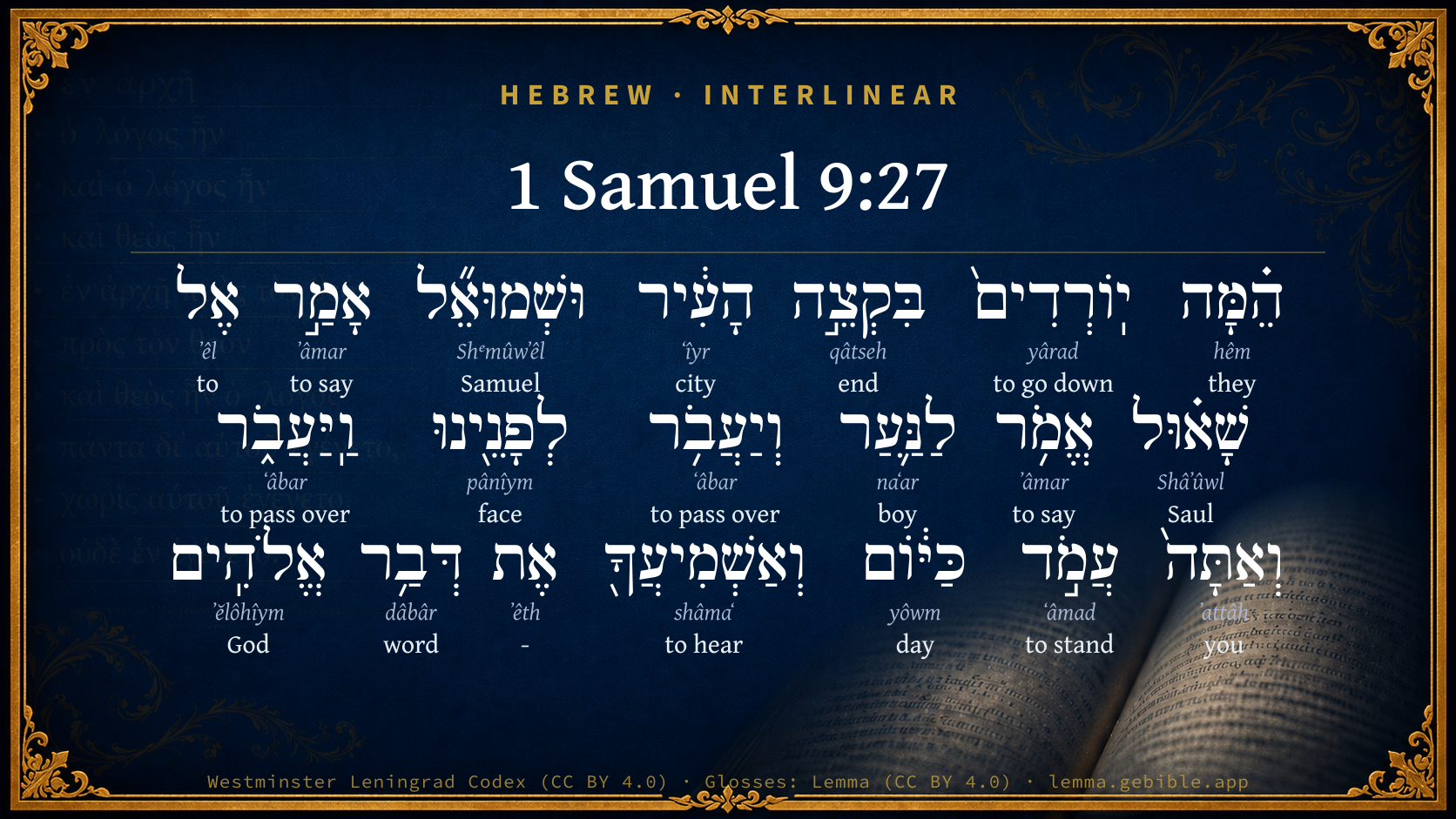
  1. הֵ֗מָּה hêm H1992 “they” Pronoun, Personal, 3rd Person, Masculine, Plural
  2. יֽוֹרְדִים֙ yârad H3381 “going down” Verb, Qal, Participle Active, Masculine, Plural, Absolute
  3. הָעִ֔יר ʻîyr H5892 “the · city” Particle, Definite Article + Noun, Common, Feminine, Singular, Absolute
  4. וּשְׁמוּאֵ֞ל Shᵉmûwʼêl H8050 “and · Samuel” Conjunction + Noun, Proper
  5. אָמַ֣ר ʼâmar H559 “to say” Verb, Qal, Perfect, 3rd Person, Masculine, Singular
  6. אֶל ʼêl H413 “to” Preposition
  7. שָׁא֗וּל Shâʼûwl H7586 “Saul” Noun, Proper
  8. אֱמֹ֥ר ʼâmar H559 “say” Verb, Qal, Imperative, 2nd Person, Masculine, Singular
  9. לַנַּ֛עַר naʻar H5288 “to/for the · boy” Preposition, Determined + Noun, Common, Masculine, Singular, Absolute
  10. וְיַעֲבֹ֥ר ʻâbar H5674 “and · to pass over” Conjunction + Verb, Qal, Imperfect, 3rd Person, Masculine, Singular
  11. לְפָנֵ֖ינוּ pânîym H6440 “to/for · face(s) · our” Preposition + Noun, Common, Both, Plural, Construct + Suffix, Personal, 1st Person, Common, Plural
  12. וַֽיַּעֲבֹ֑ר ʻâbar H5674 “and · to pass over” Conjunction + Verb, Qal, Sequential Imperfect, 3rd Person, Masculine, Singular
  13. וְאַתָּה֙ ʼattâh H859 “and · you” Conjunction + Pronoun, Personal, 2nd Person, Masculine, Singular
  14. עֲמֹ֣ד ʻâmad H5975 “stand” Verb, Qal, Imperative, 2nd Person, Masculine, Singular
  15. כַּיּ֔וֹם yôwm H3117 “like/as the · day” Preposition, Determined + Noun, Common, Masculine, Singular, Absolute
  16. וְאַשְׁמִיעֲךָ֖ shâmaʻ H8085 “and · to hear · you” Conjunction + Verb, Hiphil, Imperfect, 1st Person, Common, Singular + Suffix, Personal, 2nd Person, Masculine, Singular
  17. אֶת ʼêth H853 “-” Particle, Direct Object
  18. דְּבַ֥ר dâbâr H1697 “word of” Noun, Common, Masculine, Singular, Construct
  19. אֱלֹהִֽים ʼĕlôhîym H430 “God(s)” Noun, Common, Masculine, Plural, Absolute

About this verse

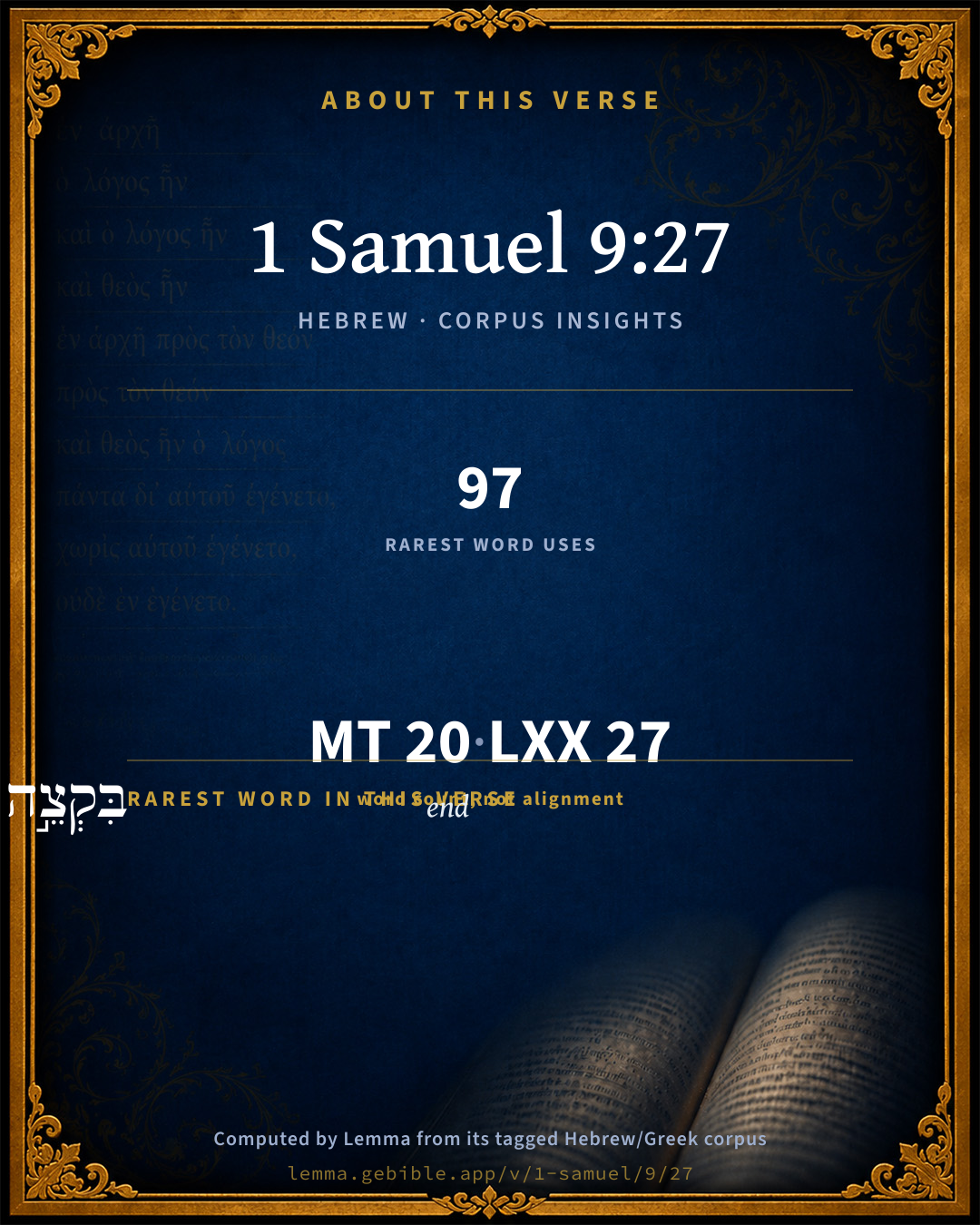
These counts appear in no published source. They are computed here, from the morphology-tagged text and Lemma’s own curated glosses. What Lemma adds →

20
words
18
distinct lemmas
Historical
section

Grammatical profile

  • 7 verbs
  • 9 nouns
  • 2 pronouns
  • 1 preposition
  • 1 particle

Verb forms

  • יֽוֹרְדִים֙ Qal · Participle Active
  • אָמַ֣ר Qal · Perfect
  • אֱמֹ֥ר Qal · Imperative
  • וְיַעֲבֹ֥ר Qal · Imperfect
  • וַֽיַּעֲבֹ֑ר Qal · Sequential Imperfect
  • עֲמֹ֣ד Qal · Imperative
  • וְאַשְׁמִיעֲךָ֖ Hiphil · Imperfect

Repetition

Words recur within this verse — often emphatic in Hebrew:

  • אָמַ֣ר to say H559 ×2
  • וְיַעֲבֹ֥ר to pass over H5674 ×2

Hebrew & Septuagint length

In English translation the verse runs 42 words from the Hebrew and 39 from the Septuagint (LXX English) — closely comparable.

A rough comparison of the two English renderings, which tokenize alike — not a word-level alignment.

Word counts can differ between the Hebrew and the Greek without any difference in meaning — e.g. the Hebrew direct-object marker אֵת has no separate Greek word, and Greek often adds the article ὁ.

In the original languages it is 20 Hebrew tokens and 27 Greek tokens — but the two are counted differently (Hebrew bundles its prefixes and suffixes into one token; the Greek is in lemma form), so that isn’t a like-for-like length.

Cross-references

4

Topical passages linked to 1 Samuel 9:27 in the Treasury of Scripture Knowledge — connected by theme and wording, ordered by reader-vote popularity; previews shown in the World English Bible.

  • John 15:14–15 You are my friends, if you do whatever I command you.
  • 1 Samuel 20:38–39 Jonathan cried after the boy, Go fast! Hurry! Don't delay! Jonathan's boy gathered up the arrows, and came to his master.
  • 2 Kings 9:5–6 When he came, behold, the captains of the host were sitting; and he said, I have an errand to you, captain. Jehu said, To which of us all? He said, To you, O captain.
  • 1 Samuel 15:16 Then Samuel said to Saul, Stay, and I will tell you what Yahweh has said to me this night. He said to him, Say on.

Cross-references courtesy of OpenBible.info (CC BY 4.0).

Hebrew and Greek witnesses Masoretic Hebrew ↔ Greek Septuagint

The same verse in the two great witnesses to the Old Testament, shown verse-for-verse.

These are two independent witnesses, not word-aligned to each other, and the Septuagint is shown in lemma (dictionary) form.

Hebrew 1 Samuel 9:27 Masoretic · Westminster Leningrad Codex

הֵ֗מָּה יֽוֹרְדִים֙ בִּקְצֵ֣ה הָעִ֔יר וּשְׁמוּאֵ֞ל אָמַ֣ר אֶל שָׁא֗וּל אֱמֹ֥ר לַנַּ֛עַר וְיַעֲבֹ֥ר לְפָנֵ֖ינוּ וַֽיַּעֲבֹ֑ר וְאַתָּה֙ עֲמֹ֣ד כַּיּ֔וֹם וְאַשְׁמִיעֲךָ֖ אֶת דְּבַ֥ר אֱלֹהִֽים

As they were going down at the end of the city, Samuel said to Saul, Bid the servant pass on before us (and he passed on), but stand you still first, that I may cause you to hear the word of God.

World English Bible · Public Domain

Greek LXX 1 Samuel 9:27 Septuagint · lemma form

αὐτός καταβαίνω εἰς μέρος ὁ πόλις καί σαμουηλ εἶπον ὁ σαούλ εἰπόν ὁ νεανίσκος καί διαἔρχομαι ἔμπροσθεν ἐγώ καί σύ ἵστημι ὡς σήμερον καί ἀκούω ῥῆμα θεός

As they went down to a part of the city, Samuel said to Saul, Speak to the young man, and let him pass on before us; and do you stand as today, and listen to the word of God.

LXX2012 (modern English Septuagint) · Public Domain

Hebrew: Westminster Leningrad Codex (CC BY 4.0). Greek: Septuagint (public domain); English from LXX2012 (modern English Septuagint) (Public Domain). How the Septuagint differs from the Hebrew →

Targum (Aramaic paraphrase)

1

The Targum is the ancient Jewish Aramaic paraphrase of the Hebrew Scriptures — an interpretive translation, not the Hebrew text itself. Onkelos (literal) and Pseudo-Jonathan (expansive) render the Torah, and Jonathan the Prophets. Coverage is partial: where no permissively-licensed English translation exists for a verse, only the Aramaic is shown. This is verse-level text, not a word-by-word alignment to the Hebrew.

  1. Targum Jonathan Prophets (Joshua–Malachi)
    אִינוּן נַחֲתִין בִּסְיָפֵי קַרְתָּא וּשְׁמוּאֵל אֲמַר לְשָׁאוּל אֲמַר לְעוּלֵימָא וְיְעִבַּר קֳדָמָנָא וַעֲבַר וְאַתְּ קוּם הָכָא כְּיוֹמָא דֵין וְאַשְׁמְעִינָךְ יַת פִתְגָמָא דַיָי:

    (no public-domain English translation for this verse)

    Targum Jonathan — Aramaic: “Mikraot Gedolot” (public domain). English: “Sefaria Community Translation” (CC0 1.0 (public-domain dedication)); “London "Chaldee Paraphrase," 1871” (public domain). Text via Sefaria.

Commentary

Notes on 1 Samuel 9:27 from classic Christian and Jewish commentators (each source and its license shown beneath its notes). The classic Christian expositions comment on the surrounding passage and are grouped to its opening verse, so a note may address several verses; the Jewish commentaries on the Tanakh (Rashi and others) are per-verse, so they appear only where the commentator wrote on this verse.

Lemma curates 59 commentaries, every one of them public domain or Creative Commons licensed, each selected and text-cleaned for this edition rather than reprinted as found. About our sources →

Trapp's Complete Commentary

John Trapp

1Sa 9:27 [And] as they were going down to the end of the city, Samuel said to Saul, Bid the servant pass on before us, (and he passed on,) but stand thou still a while, that I may shew thee the word of God.

Ver. 27. Stand thou still a while.] And so show thy reverence to the divine oracle that I shall deliver. {See Trapp on "Jdg 3:20"}

John Trapp, A Commentary or Exposition upon All the Books of the Old and New Testament (1647–1656) — public domain. Text from a community e-Sword module.

The Biblical Illustrator

Joseph S. Exell

1Sa_9:27

Bid the servant pass on before us.

Samuel and the young man Saul

This was Samuels third interview with this goodly young man. This time he spoke to him with great closeness of personal application, sending the servant out of the way that he might say things to him which nobody else might hear. He tried to speak to the young mans inmost soul. The prophet felt a deep solemnity, his whole heart saying every word that fell from his lip. I think I hear his earnest tones, and accents sweetened by a great love, for Samuel loved Saul, and it was his affection which made him speak so earnestly and pointedly. This time the preacher would hold you fast, as if he said to each one, I will not let thee go unless thou givest thy heart to Christ, and become His servant from this very hour.

I. First, let us think upon the attention which he requested. He said to the servant, Pass on before us, and he passed on. Bid the servant pass on; forget for a while your business, forget your family, forget your joys, forget your sorrows. I wish I could so speak that men would say of my preaching what they said of Whitefields. One man said, Whenever I went to church before, I calculated how many looms the church would hold--for he was a weaver--but when I heard Whitefield I never thought of a loom. Another said, While I have been in church I have often built a ship from stem to stern; but when I heard Mr. Whitefield I could not lay a plank; he took my mind right away from such things, and occupied me with higher thoughts. The next point in the attention requested was the desire that he would stand still a while. I pray you bask in the gospel as men do in the sunlight when they would be warm. Let the gospel have its own legitimate effect upon you. Lay bare your bosom to it. Ask that your soul may have no stone of carelessness laid upon it, as though it were a dead thing in a sepulchre, but that it may come forth in resurrection life through the quickening word of the Divine Spirit. Is not this what the word of God deserves? Should it not have our living, loving attention? When God speaks let all be silent. I have heard that the great clock at St. Pauls can scarcely be heard in Cheapside, by reason of the traffic that is going on; and so the most solemn voices are drowned amidst the din and uproar of our business, and we do not often hear Gods voice, unless we are accustomed to give ourselves a little quiet and holy stillness, and sit in our chamber alone, and say, Now, Lord, commune with me. As the Word of God deserves such quiet attention, it certainly is only by such attention that it is likely to bless us. I remember a child who used to be noted for great attention during sermon, and his mother, noticing his deep earnestness, asked him why He said, Because, mother, I heard the preacher once say that if there was a piece of the discourse that was likely to be of good to our souls, Satan would try to make us lose it; and as I do not know which part God will bless me by, I try to hear it all, and to remember it all. Oh, when people come to listen to the preacher with such a spirit as that, it is sweet work to preach. But many things arise to prevent this attrition. You cannot get some folks to be still, they are so frivolous; you cannot make them think. Some men dread the process of thinking, almost as much as they would a touch of the cat on their backs. They cannot bear to consider and meditate. God has distinguished them above brutes by giving them the faculty of thought, but this high privilege they try to ignore. Do stand still a while, and let nothing come in to break the silence of your spirit, while you listen to the voice of God. I would earnestly persuade every one here who is not saved to get an hour alone somehow.

II. The subject upon which Samuel discoursed with Saul, or rather the subject about which I would discourse at this time, if I am so happy as to have secured your ear. The subject is the Word of God. That God should give us a Word at all is very gracious. It is wonderful that he should condescend to speak to us, because we cannot understand much: we are like little children at the very best. In the particular word of God which Samuel spoke to Saul there was some likeness to the message which I am bound to deliver to you! Samuel spoke to Saul about a kingdom, of which this young man should be the king. Little did Saul dream that on this day the kingdom should be given him, and little dost thou dream of it perhaps as yet; but I pray thee let me show thee the word of God, for thou mayest yet find a kingdom there, a kingdom for thee, a crown of life for thee which fadeth not away, and a seat at the right hand of God with Christ in the day of His appearing.

2. Samuel not only spoke about the kingdom, but he showed him the word of God by an anointing Thou sayest, I am not capable of high and noble things. Thou shalt be made capable, for in the day when God anoints thee thou shalt receive strength,--To as many as received Him, to them gave He power to become the sons of God. Thou shalt receive enlightenment and illumination by the Divine unction of the Holy Ghost.

3. Samuel spake to Saul about another matter, namely, about a change that he should undergo. Hast thou never heard that God can create thee for the second time? can destroy in thee the power for sin, and bring thee under another dominion, and make thee an eager after right as thou hast been after wrong, and make thee as happy in the service of Christ as ever thou wast in the service of the devil, ay, and ten thousand times more so? (C. H. Spurgeon.)

Stand thou still a while that I may shew thee the Word of God.

Communications from God to Man

The text suggests two remarks concerning Divine communication to man.

I. They are necessary to qualify him for the discharge of his obligations. Saul was about assuming an office of enormous responsibility, and Samuel felt that a knowledge of the Word of God was of primary importance to him. I may shew thee the word of God.

1. The word of God is essential to enlighten us as to our duty. On no subject has man made greater mistakes than on that of duty. The greatest sages of the old world blundered terribly on this point. But how clearly it is unfolded in the Divine Word! Thou shalt love the Lord thy God. Do justly, love mercy, walk humbly with thy God, Whatsoever ye would that men would do unto you do ye even so to them.

2. The word of God is necessary to stimulate us in the discharge of our duty. Where else can we find motives strong enough for this purpose.

II. That patient waiting is necessary for the reception of these communications. But stand thou still a while that I may shew thee the word of God. Gods voice cannot be heard in the hurry and bustle of life. There must be the halt and the hush, the pause and the quiet.

1. Stand thou still a while to listen. The ear must be opened. Incline thine ear, etc.

2. Stand thou still a while, to interpret. Ponder the meaning, pass from the sound to the sense, from the symbol to the substance.

3. Stand thou still a while, to apply. Apply the meaning to your own condition, experience, circumstances. Conclusion:--The words may be legitimately applied to all the good who are pressed down with the trials of life. To every tried saint I might say, Stand thou still a while, and

(1) Thou shalt have a solution of those intellectual difficulties that embarrass thee.

(2) Thou shalt be delivered from all the moral infections that grieve thee.

(3) Thou shalt be freed from all afflictions that oppress thee. (Homilist.)

Samuel and Saul

I. Samuel found much that was good in Saul. A cluster of excellencies incidentally present themselves in this chapter.

1. Saul had reverence for his father. He promptly obeyed his father; yet he was from his shoulders and upwards taller, etc.

2. Saul was no idler. He was no stranger to work; yet his father was a mighty man of power.

3. Saul was not particular as to the kind of work he did. We have his photograph in verse

2. Yet this splendid young man went in search of the lost asses: no person who is usefully employed is ignobly employed.

4. Saul found teachers everywhere. He listened to and was advised by his servant: he was guided by young maidens.

5. Saul was very modest and humble (1Sa_9:21).

II. Samuel touches the one guiding principle of a true life, Stand thou still a while . . . This is the worlds only safe guiding star. Whoever would live a true life must often say with the child Samuel: Speak Lord for . . .

1. Sometimes we are tossed by restlessness. Soul satisfaction, heart rest, are far from us. These are eagerly but vainly sought in company, pleasure, business, intellectual pursuits; what is wanted? A teacher to say in tones that will compel attention. Stand thou . . .

2. Sometimes we are moved by covetousness. Men get the hunger of gold, and houses, and lands upon them. O, that some prophet of God would stand across their path, and in ringing tones that would make them pause, tremble, and repent, say: Stand . . .

3. Sometimes we are pressed by difficulties. We must take care how we get free; Satan will be quite ready to help us; but he will not do it for nothing; he is a lawyer who never goes without his fee. Find one who with eyes bent upon this book will say: Stand . . .

III. Sauls great disasters and his final overthrow were the results of his neglect of the Word of God. Saul made a good beginning, but a terribly sad ending. Alas! what numbers do the same. (R. Berry.)

It is not easy to stand still

Now, there is Saul, a great, big, six-and-a-half-foot man, and broad in proportion. Head and shoulders above his fellows, full of health and strength and flesh and blood, full of his own plans and his own purposes; and Samuel virtually says, Saul, halt! I can do nothing until I arrest you and get you to stand still, body and soul, to listen to the word of God. Now, there, Sauls, I speak as a Samuel. I have all the same--ay, and more--reason, if I am Gods messenger at all, and if you believe in God and that there is anything in the preachers gift, the offered Lord Jesus Christ, then give me your full attention. Stand still, and it is not easy. Did you ever, when you were young, take your fathers spirit level out of the long pocket, as I used to take my fathers out of the moleskins, and try to hold it straight and steady, There you were, watching the little bead in the glass, and you think you have it dead level in the middle, when, without any motion you are aware of, it bangs away to the far end, then back again to the other. Why? There is a movement--the very coursing of your blood through your veins disturbs the balance. My friend, the devil counts on that trouble to spoil the Gospel. He knows that we are just set on wires--that he can fool or annoy with this, that, or the other thing. He knows how easily the balance is upset, and he is forever upsetting it. I sympathise with Samuel, coming to that big, healthy young giant, and saying, Saul, stand still a bit, that I may show you the word of God. Oh, I know you are still as regards your body, but I will do no good till I get your mind, which is as sensitive as the quicksilver, arrested: and with Gods help I will. (John McNeil.)

.

The Biblical Illustrator, edited by Joseph S. Exell (c. 1880s–1900s) — public domain. Text from a community e-Sword module.

Joseph Benson's Commentary

1Sa 9:27. Samuel said, Bid the servant pass on before us — That thou and I may speak privately of the matter of the kingdom. Which Samuel hitherto endeavoured to conceal, lest he should be thought now to impose a king upon them, as before he denied one to them: and that it might appear by the lot mentioned in the next chapter, that the kingdom was given to Saul by God’s destination, and not by Samuel’s contrivance. That I may show thee the word of God — That is, a message delivered to me from God, which now I shall impart to thee.

Joseph Benson's Commentary on the Old and New Testaments (1811–1818) — public domain. Text from a community e-Sword module.

Geneva Bible (1599)

Geneva Bible translators

God’s commandment as concerning thee.

Geneva Bible (1599) marginal notes — public domain. Text via Bolls.life.

Adam Clarke's Commentary

Verse 27. As they were going down] So it appears that Saul arose immediately, and Samuel accompanied him out of the town, and sent the servant on that he might show Saul the word - the counsel or design, of the Lord. What this was we shall see in the following chapter.

Adam Clarke's Commentary on the Bible (1810–1826) — public domain. Text from a community e-Sword/MySword module.

Ellicott's Commentary for English Readers

(27) That I may shew thee the word of God.—The wonderment of Saul at the strange honour and distinction shown to him, a comparatively unknown Benjamite, by the famous prophet-judge, was, no doubt, increased by this proposal of Samuel to accompany him a little way on his journey homeward. The meaning of all that had happened to him on the day before was, however, now to be revealed: the gracious welcome as a distinguished guest evidently looked for, the courteous hospitality in the judge’s house; and, more than all, the long private instructions Samuel had given him in the evening on the state of Israel. The prophet now directs that the servant should be sent on alone, that he might in all solemn confidence impart to Saul “the word of God,” that is, all that the God of Israel had revealed to him, the seer, concerning Saul’s appointment.

It would have been interesting to have learned something of Saul’s state of mind when this startling revelation of the choice of God was first made to him.

The writer here is silent, but in the next chapter (1Sa_9:6) we read that the Spirit of the Lord was specially promised to this chosen one. When new duties are imposed by God, He never forgets to bestow the gift of new powers.

A Bible Commentary for English Readers, edited by Charles John Ellicott (1878–1897) — public domain. Text from a community e-Sword module.

John Gill's Exposition

And as they were going down to the end of the city,.... That end of it that led the way to the place where Saul was going. As this city was built on an hill, going to the end of it was a declivity, a descent:

Samuel said to Saul, bid the servant pass on before us; being another man's servant, he did not choose of himself to bid him go on, but desired his master to order him to go before them, that he might not hear what Samuel had to say to Saul, or see what he did unto him; for as the choice of Saul to be king was to be declared by lot, as coming from the Lord, all those precautions were taken of rising early, and going abroad, and sending the servant before them, that it might not be thought that Samuel did this of himself:

and he passed on; his master bidding him:

but stand thou still a while; that he might hear the better, and more attentively than in walking; such a posture was most fitting also for what was to be done, anointing him with oil:

that I may show thee the word of God: tell him more of the mind of God concerning his being king, and declare more fully the word, will, and decree of God about that matter, by an action which would put it out of all doubt that he was the man God designed to be king, as in the following chapter.

Next: 1 Samuel Chapter 10

John Gill's Exposition of the Whole Bible (1746–1763) — public domain (CC PDM 1.0). Text via the HelloAO Bible API.

Haydock's Catholic Bible Commentary

Before us, and. Hebrew, ("and he passed on,") agreeably to his master’s order. (Haydock)

George Leo Haydock (1774–1849), Haydock's Catholic Family Bible and Commentary, 1859 edition — public domain. Excludes Psalms (Douay-Rheims chapter numbering differs from Protestant) and Deuterocanonical books (Catholic canon only).

Matthew Poole's English Annotations

Bid the servant pass on before us, that thou and I may speak privately of the matter of the kingdom; which Samuel hitherto endeavoured to conceal, lest he should be thought now to impose a king upon them as before he denied one to them; and that it might appear by the lot mentioned in the next chapter, that the kingdom was given to Saul by God’s destination, and not by Samuel’s contrivance.

The word of God, i.e. a message delivered to me from God, which now I shall impart to thee.

Matthew Poole's English Annotations on the Holy Bible (1683–1685) — public domain. Text from a community e-Sword/MySword module.

Whedon's Commentary on the Bible

Daniel D. Whedon

27. Bid the servant pass on before us — For he did not wish Saul’s anointing to be yet made public.

Daniel D. Whedon (gen. ed.), Commentary on the Old and New Testaments (1874–1909) — public domain. Text from a community e-Sword module.

John Wesley's Explanatory Notes

Pass on - That thou and I may speak privately of the matter or the kingdom. Which Samuel hitherto endeavoured to conceal, lest he should be thought now to impose a king upon them, as before he denied one to them; and that it might appear by the lot mentioned in the next chapter, that the kingdom was given to Saul by God's destination, and not by Samuel's contrivance. Word of God - That is, a message delivered to me from God, which now I shall impart to thee.

John Wesley, Explanatory Notes Upon the Whole Bible (1754–1765) — public domain. Text via the GEBible commentary corpus.

unfoldingWord translationNotes

Door43 World Missions Community

ahead of us"—and he went ahead—"but you must stay

It is possible that Samuel speaks all of these words. AT: "ahead of us, and when he has gone ahead, you must stay"

that I may announce the message of God to you

"so that I can tell you God's message for you"

translationWords

Samuel

Saul (OT)

servant

God

unfoldingWord translationNotes — © Distant Shores Media and the Door43 World Missions Community, licensed CC BY-SA 4.0. Source: git.door43.org/Door43/en_tn.

Rashi

Rabbi Shlomo Yitzchaki (Rashi)

To pass ahead of us. To go at a distance from us so that he will not hear our conversation.

And he went ahead. The youth went ahead of them, but to Shaul he said, 'And you stand with me.'

Rashi on the Tanakh — English translations: “The Judaica Press complete Tanach with Rashi, translated by A. J. Rosenberg” (CC BY 4.0); “Pentateuch with Rashi's commentary by M. Rosenbaum and A.M. Silbermann, 1929-1934” (public domain); “The Metsudah Tanach series, Lakewood, N.J” (CC BY 4.0); and “The Book of Joshua, Metsudah Publications, 1997” (CC BY 4.0). Text via Sefaria.

Lesson kit

Teaching starters — assembled from the data on this page, not authored interpretation. Every prompt links to the verse data it draws on. Edit before teaching.

1 Samuel, in the Historical, opens this verse with 20 words (18 distinct Hebrew lemmas). Its most distinctive word is qâtseh (“end”). A historical commentator’s framing appears above. Read the whole chapter for the surrounding context.

Discussion questions

  1. How does “end” (qâtseh) shape what this verse is saying?
  2. John 15:14–15 shares this passage’s theme. How do the two illuminate each other?
  3. “to say” occurs 2× in this one verse. What is the effect of the repetition?
  4. These translations render this verse differently; the difference is in the English rendering, not the original. What questions does that raise?
  5. The verb «יֽוֹרְדִים֙» is Qal Participle Active. How does its form color the action?
  6. Reading how Trapp's Complete Commentary and The Biblical Illustrator read this verse, where do the two commentators agree and where do they part?

Things to notice

Reading settings

Reading text

Shown beneath each verse's original-language words.

Old Testament
Old Testament edition

Read the OT as the Masoretic Hebrew (MT) or the Greek Septuagint (LXX).

English shown for the Greek Septuagint (in the Hebrew ↔ Greek comparison).

Comparing translations? Open the Compare panel on any verse page to stack up to four side by side.