
Exodus 8:21

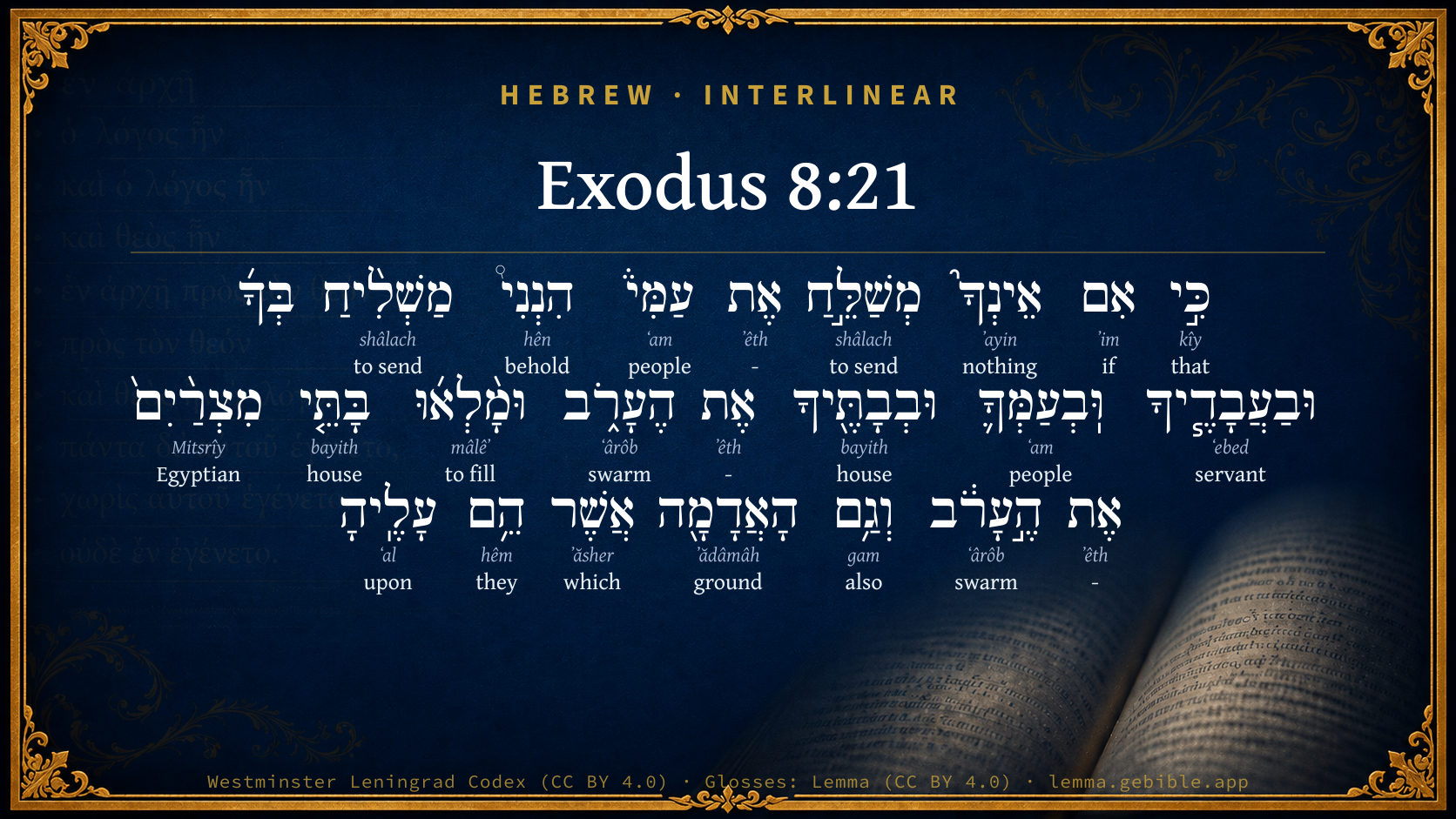
Hebrew (Westminster Leningrad Codex) Exodus 8:21 appears in the Hebrew Old Testament. The text above is from the Westminster Leningrad Codex. Each word links to its Strong’s number, a concise gloss, and parsing drawn from the Open Scriptures Hebrew Bible morphology. Click any word for its full Brown-Driver-Briggs (BDB) entry.
Download image
Cite this verse

Exodus 8:21 (World English Bible). Public Domain. Lemma interlinear Bible study tool, https://lemma.gebible.app/v/exodus/8/21.

Show BibTeX & RIS
BibTeX
RIS
English Translation
Else, if you will not let my people go, behold, I will send swarms of flies on you, and on your servants, and on your people, and into your houses: and the houses of the Egyptians shall be full of swarms of flies, and also the ground whereon they are.
World English Bible · Public Domain
Highlights
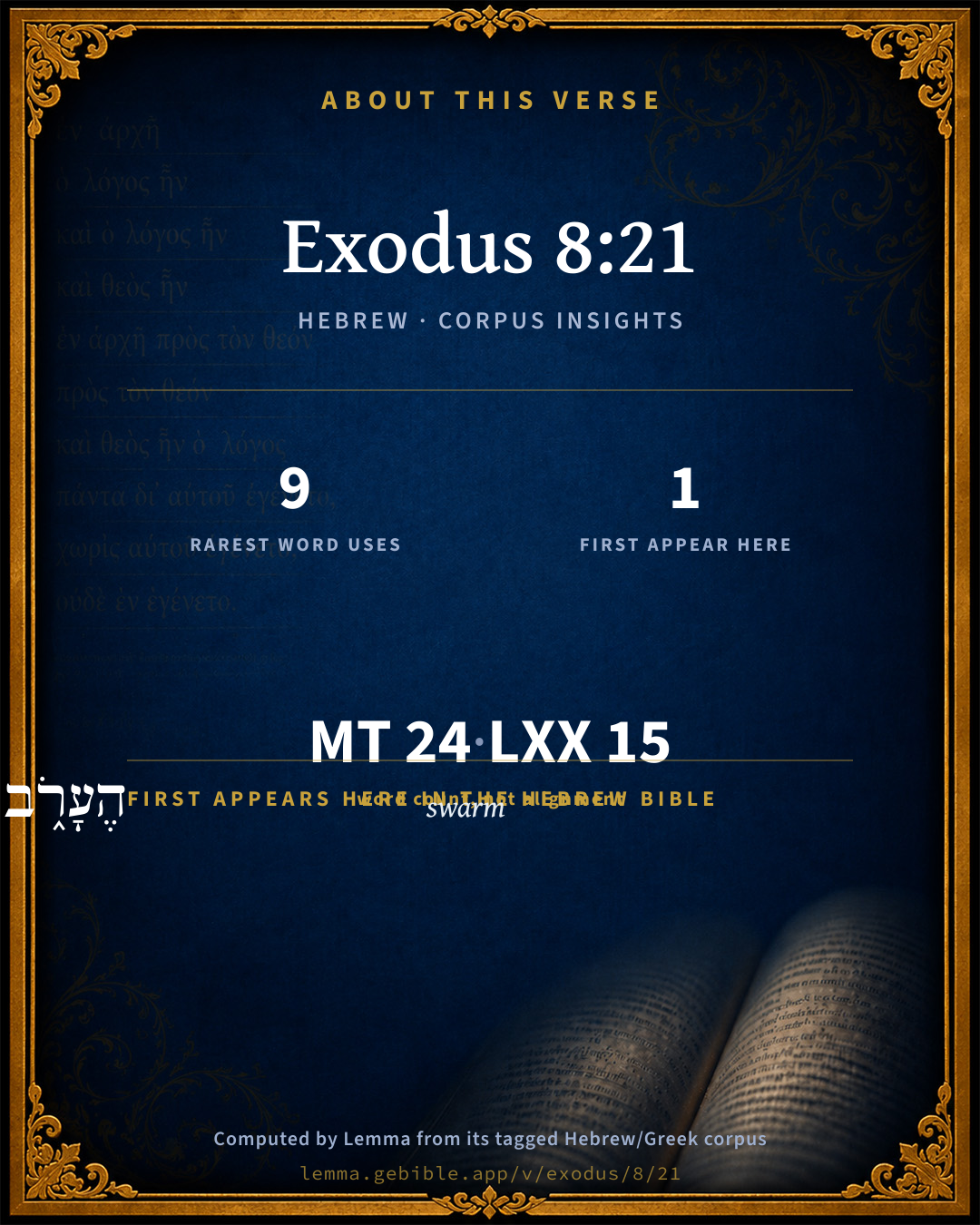
  • 1 first appearance in the Hebrew Bible
Full analysis ↓
Download a study sheet

One document with this verse’s original text, its word-by-word gloss line, the meaning frame, cross-references with their text, attributed commentary, and full source and license credits — printable, and it pastes into notes with its structure intact.

This verse Autodidact and up

Study sheet (.html) Plain text (.txt)

A passage Seminary Student

Up to 50 verses in one chapter. A passage sheet keeps up to 6 commentary sources and 12 cross-references per verse, in the order this page ranks them, and says so on the sheet whenever that leaves anything out. Ask for a single verse and you get the Autodidact verse sheet above.

Everything on this page stays free to read, with no account — the sheet is a download of what is already on screen, not access to it.

Want to remove ads? Support Godless Engineer
Compare translations 3

The same verse in 3 English versions, stacked beneath the original-language interlinear above. Click any original word for its lexicon entry.

Each is an independent rendering of the whole verse — the interlinear is not word-aligned to these translations.

Highlighted words mark where these versions differ — a whole-verse word diff, not a word-by-word alignment.

  • World English Bible Public Domain
    Else, if you will not let my people go, behold, I will send swarms of flies on you, and on your servants, and on your people, and into your houses: and the houses of the Egyptians shall be full of swarms of flies, and also the ground whereon they are.
  • King James Version Public Domain
    Else, if thou wilt not let my people go, behold, I will send swarms of flies upon thee, and upon thy servants, and upon thy people, and into thy houses: and the houses of the Egyptians shall be full of swarms of flies, and also the ground whereon they are.
  • unfoldingWord Literal Text CC BY-SA 4.0
    Surely if you do not immediately send my people out, behold me! I am about to send the swarm at you and at your servants and at your people and into your houses. And the houses of Egypt will be full of the swarm, and even the ground which they are on.

unfoldingWord Literal Text — © unfoldingWord, licensed CC BY-SA 4.0. Word-aligned USFM3 via Door43 (git.door43.org/unfoldingWord/en_ult).

Versions to compare (up to 4)

3 of 4 selected

Show all 18 translations

Every available English version of this verse, each an independent rendering of the whole verse.

  • World English Bible Public Domain
    Else, if you will not let my people go, behold, I will send swarms of flies on you, and on your servants, and on your people, and into your houses: and the houses of the Egyptians shall be full of swarms of flies, and also the ground whereon they are.
  • Berean Standard Bible Public Domain
    But if you will not let My people go, I will send swarms of flies upon you and your officials and your people and your houses. The houses of the Egyptians and even the ground where they stand will be full of flies.
  • Majority Standard Bible Public Domain
    But if you will not let My people go, I will send swarms of flies upon you and your officials and your people and your houses. The houses of the Egyptians and even the ground where they stand will be full of flies.
  • King James Version Public Domain
    Else, if thou wilt not let my people go, behold, I will send swarms of flies upon thee, and upon thy servants, and upon thy people, and into thy houses: and the houses of the Egyptians shall be full of swarms of flies, and also the ground whereon they are.
  • American Standard Version (1901) Public Domain
    Else, if thou wilt not let my people go, behold, I will send swarms of flies upon thee, and upon they servants, and upon thy people, and into thy houses: and the houses of the Egyptians shall be full of swarms of flies, and also the ground whereon they are.
  • Revised Version (1885) Public Domain
    Else, if thou wilt not let my people go, behold, I will send swarms of flies upon thee, and upon thy servants, and upon thy people, and into thy houses: and the houses of the Egyptians shall be full of swarms of flies, and also the ground whereon they are.
  • Geneva Bible (1599) Public Domain
    Els, if thou wilt not let my people goe, behold, I will send swarmes of flies both vpon thee, and vpon thy seruants, and vpon thy people, and into thine houses: and the houses of the Egyptians shalbe full of swarmes of flies, and the ground also whereon they are.
  • Douay-Rheims (1899) Public Domain
    But if thou wilt not let them go, behold I will send in upon thee, and upon thy servants, and upon thy houses all kind of flies: and the houses of the Egyptians shall be filled with flies of divers kinds, and the whole land wherein they shall be.
  • Young's Literal Translation Public Domain
    for, if thou art not sending My people away, lo, I am sending against thee, and against thy servants, and against thy people, and against thy houses, the beetle, and the houses of the Egyptians have been full of the beetle, and also the ground on which they are.
  • Literal Standard Version CC BY-SA 4.0
    for if you are not sending My people away, behold, I am sending against you, and against your servants, and against your people, and against your houses, the beetle, and the houses of the Egyptians have been full of the beetle, and also the ground on which they are.
  • Unlocked Literal Bible CC BY-SA 4.0
    But if you do not let my people go, I will send swarms of flies on you, your servants, and your people, and into your houses. The Egyptians' houses will be full of swarms of flies, and even the ground on which they stand will be full of flies.
  • unfoldingWord Literal Text CC BY-SA 4.0
    Surely if you do not immediately send my people out, behold me! I am about to send the swarm at you and at your servants and at your people and into your houses. And the houses of Egypt will be full of the swarm, and even the ground which they are on.
  • Darby Bible Public Domain
    For, if thou do not let my people go, behold, I will send dog-flies upon thee, and upon thy bondmen, and upon thy people, and into thy houses; and the houses of the Egyptians shall be full of dog-flies, and also the ground on which they are.
  • World Messianic Bible Public Domain
    Else, if you will not let my people go, behold, I will send swarms of flies on you, and on your servants, and on your people, and into your houses. The houses of the Egyptians shall be full of swarms of flies, and also the ground they are on.
  • Webster's Bible Public Domain
    Else, if thou wilt not let my people go, behold, I will send swarms of flies upon thee, and upon thy servants, and upon thy people, and into thy houses: and the houses of the Egyptians shall be full of swarms of flies, and also the ground on which they are.
  • Free Bible Version CC BY-SA 4.0
    If you don't let my people leave, I will send swarms of flies on you and your officials, and on your people and your houses. Every Egyptian house and even the ground on which they stand will be filled with swarms of flies.
  • Bible in Basic English Public Domain
    For if you do not let my people go, see, I will send clouds of flies on you and on your servants and on your people and into their houses; and the houses of the Egyptians and the land where they are will be full of flies.
  • JPS Tanakh (1917) Public Domain
    (8-17) Else, if thou wilt not let My people go, behold, I will send swarms of flies upon thee, and upon thy servants, and upon thy people, and into thy houses; and the houses of the Egyptians shall be full of swarms of flies, and also the ground whereon they are.

Literal Standard Version (2020), Covenant Press — licensed CC BY-SA 4.0. Text via the HelloAO Bible API (eBible.org). Unlocked Literal Bible (unfoldingWord) — licensed CC BY-SA 4.0. Text via the HelloAO Bible API (eBible.org). unfoldingWord Literal Text — © unfoldingWord, licensed CC BY-SA 4.0. Word-aligned USFM3 via Door43 (git.door43.org/unfoldingWord/en_ult). Free Bible Version, Dr. Jonathan Gallagher — licensed CC BY-SA 4.0. Text via the HelloAO Bible API (eBible.org).

Word by word

More ways to search: Search by grammar → Find every occurrence → Compare this word →

Practice this passage: Drill this verse → Learn its vocabulary →

הֶעָרֹ֑ב
ʻârôb
H6157
“the · swarm”
Particle, Definite Article + Noun, Common, Masculine, Singular, Absolute
Part of Speech
Particle + Noun
Type
Common
Gender
Masculine
Number
Singular
State
Absolute
Full BDB Definition

Origin: from H6148

TWOT: 1685c

swarm - probable meaning from 'mixture' and 'incessant or involved motion'
  1. כִּ֣י kîy H3588 “that” Conjunction
  2. אִם ʼim H518 “if” Conjunction
  3. אֵינְךָ֮ ʼayin H369 “nothing · you” Particle, Negative + Suffix, Personal, 2nd Person, Masculine, Singular
  4. מְשַׁלֵּ֣חַ shâlach H7971 “sending” Verb, Piel, Participle Active, Masculine, Singular, Absolute
  5. אֶת ʼêth H853 “-” Particle, Direct Object
  6. עַמִּי֒ ʻam H5971 “people · my” Noun, Common, Masculine, Singular, Construct + Suffix, Personal, 1st Person, Common, Singular
  7. הִנְנִי֩ hên H2005 “behold · me” Particle, Demonstrative + Suffix, Personal, 1st Person, Common, Singular
  8. מַשְׁלִ֨יחַ shâlach H7971 “sending” Verb, Hiphil, Participle Active, Masculine, Singular, Absolute
  9. וּבַעֲבָדֶ֧יךָ ʻebed H5650 “and · in/at · servants · your” Conjunction + Preposition + Noun, Common, Masculine, Plural, Construct + Suffix, Personal, 2nd Person, Masculine, Singular
  10. וּֽבְעַמְּךָ֛ ʻam H5971 “and · in/at · people · your” Conjunction + Preposition + Noun, Common, Masculine, Singular, Construct + Suffix, Personal, 2nd Person, Masculine, Singular
  11. וּבְבָתֶּ֖יךָ bayith H1004 “and · in/at · houses · your” Conjunction + Preposition + Noun, Common, Masculine, Plural, Construct + Suffix, Personal, 2nd Person, Masculine, Singular
  12. אֶת ʼêth H853 “-” Particle, Direct Object
  13. וּמָ֨לְא֜וּ mâlêʼ H4390 “and · to fill” Conjunction + Verb, Qal, Sequential Perfect, 3rd Person, Common, Plural
  14. בָּתֵּ֤י bayith H1004 “houses of” Noun, Common, Masculine, Plural, Construct
  15. מִצְרַ֨יִם֙ Mitsrîy H4713 “Egyptian” Noun, Proper
  16. אֶת ʼêth H853 “-” Particle, Direct Object
  17. הֶ֣עָרֹ֔ב ʻârôb H6157 “the · swarm” Particle, Definite Article + Noun, Common, Masculine, Singular, Absolute
  18. וְגַ֥ם gam H1571 “and · also” Conjunction + Particle, Accusative
  19. הָאֲדָמָ֖ה ʼădâmâh H127 “the · ground” Particle, Definite Article + Noun, Common, Feminine, Singular, Absolute
  20. אֲשֶׁר ʼăsher H834 “which” Particle, Relative
  21. הֵ֥ם hêm H1992 “they” Pronoun, Personal, 3rd Person, Masculine, Plural
  22. עָלֶֽיהָ ʻal H5921 “upon · her” Preposition + Suffix, Personal, 3rd Person, Feminine, Singular

About this verse

These counts appear in no published source. They are computed here, from the morphology-tagged text and Lemma’s own curated glosses. What Lemma adds →

24
words
17
distinct lemmas
Pentateuch
section

Notable vocabulary

The rarest word here is הֶעָרֹ֑ב swarm H6157 — appearing just 9 times in the whole Hebrew Bible.

First appearance in Scripture

This word makes its first canonical appearance in the Hebrew Bible here:

  • הֶעָרֹ֑ב swarm H6157

Shared distinctive vocabulary

הֶעָרֹ֑ב swarm H6157 occurs in 7 verses of the Hebrew Bible. Also found in:

Grammatical profile

  • 3 verbs
  • 9 nouns
  • 1 pronoun
  • 2 prepositions
  • 2 conjunctions
  • 7 particles

Verb forms

  • מְשַׁלֵּ֣חַ Piel · Participle Active
  • מַשְׁלִ֨יחַ Hiphil · Participle Active
  • וּמָ֨לְא֜וּ Qal · Sequential Perfect

Repetition

Words recur within this verse — often emphatic in Hebrew:

  • מְשַׁלֵּ֣חַ to send H7971 ×2
  • עַמִּי֒ people H5971 ×2
  • וּבְבָתֶּ֖יךָ house H1004 ×2
  • הֶעָרֹ֑ב swarm H6157 ×2

Hebrew & Septuagint length

In English translation the verse runs 50 words from the Hebrew and 48 from the Septuagint (LXX English) — closely comparable.

A rough comparison of the two English renderings, which tokenize alike — not a word-level alignment.

Word counts can differ between the Hebrew and the Greek without any difference in meaning — e.g. the Hebrew direct-object marker אֵת has no separate Greek word, and Greek often adds the article ὁ.

In the original languages it is 24 Hebrew tokens and 15 Greek tokens — but the two are counted differently (Hebrew bundles its prefixes and suffixes into one token; the Greek is in lemma form), so that isn’t a like-for-like length.

Cross-references

3

Topical passages linked to Exodus 8:21 in the Treasury of Scripture Knowledge — connected by theme and wording, ordered by reader-vote popularity; previews shown in the World English Bible.

  • Psalms 78:45 He sent among them swarms of flies, which devoured them; And frogs, which destroyed them.
  • Psalms 105:31 He spoke, and swarms of flies came, And lice in all their borders.
  • Isaiah 7:18 It will happen in that day that Yahweh will whistle for the fly that is in the uttermost part of the rivers of Egypt, and for the bee that is in the land of Assyria.

Cross-references courtesy of OpenBible.info (CC BY 4.0).

Hebrew and Greek witnesses Masoretic Hebrew ↔ Greek Septuagint

The same verse in the two great witnesses to the Old Testament, shown verse-for-verse.

These are two independent witnesses, not word-aligned to each other, and the Septuagint is shown in lemma (dictionary) form.

Hebrew Exodus 8:21 Masoretic · Westminster Leningrad Codex

כִּ֣י אִם אֵינְךָ֮ מְשַׁלֵּ֣חַ אֶת עַמִּי֒ הִנְנִי֩ מַשְׁלִ֨יחַ בְּךָ֜ וּבַעֲבָדֶ֧יךָ וּֽבְעַמְּךָ֛ וּבְבָתֶּ֖יךָ אֶת הֶעָרֹ֑ב וּמָ֨לְא֜וּ בָּתֵּ֤י מִצְרַ֨יִם֙ אֶת הֶ֣עָרֹ֔ב וְגַ֥ם הָאֲדָמָ֖ה אֲשֶׁר הֵ֥ם עָלֶֽיהָ

Else, if you will not let my people go, behold, I will send swarms of flies on you, and on your servants, and on your people, and into your houses: and the houses of the Egyptians shall be full of swarms of flies, and also the ground whereon they are.

World English Bible · Public Domain

Greek LXX Exodus 8:21 Septuagint · lemma form

καλέω δέ φαραώ μωυσῆς καί ααρων λέγω ἔρχομαι θύω ὁ θεός σύ ἐν ὁ γῆ

And if you will not let my people go, behold, I send upon you, and upon your servants, and upon your people, and upon your houses, the dog-fly; and the houses of the Egyptians shall be filled with the dog-fly, even throughout the land upon which they are.

LXX2012 (modern English Septuagint) · Public Domain

On this verse, Joseph Benson's Commentary discusses the Septuagint’s reading. Read the note in Commentary ↓

Hebrew: Westminster Leningrad Codex (CC BY 4.0). Greek: Septuagint (public domain); English from LXX2012 (modern English Septuagint) (Public Domain). How the Septuagint differs from the Hebrew →

Targum (Aramaic paraphrase)

2

The Targum is the ancient Jewish Aramaic paraphrase of the Hebrew Scriptures — an interpretive translation, not the Hebrew text itself. Onkelos (literal) and Pseudo-Jonathan (expansive) render the Torah, and Jonathan the Prophets. Coverage is partial: where no permissively-licensed English translation exists for a verse, only the Aramaic is shown. This is verse-level text, not a word-by-word alignment to the Hebrew.

  1. Targum Onkelos Torah (Genesis–Deuteronomy)
    וּקְרָא פַרְעֹה לְמשֶׁה וּלְאַהֲרֹן וַאֲמַר אֱזִילוּ דַבָּחוּ קֳדָם אֱלָהָכוֹן בְּאַרְעָא:

    (no public-domain English translation for this verse)

    Targum Onkelos — Aramaic: “Onkelos Genesis” (public domain); “Onkelos Exodus” (public domain); “Onkelos Leviticus” (public domain); “Onkelos Numbers” (public domain); “Onkelos Deuteronomy” (public domain). English: “Sefaria Community Translation” (CC0 1.0 (public-domain dedication)); “J.W. Etheridge. The Targums of Onkelos and Jonathan Ben Uzziel on the Pentateuch. London: Longmans, Green, 1862” (public domain). Text via Sefaria.

  2. Targum Pseudo-Jonathan Torah (Genesis–Deuteronomy)
    וּקְרָא פַרְעה לְמשֶׁה וּלְאַהֲרן וַאֲמַר אִיזִילוּ פְּלָחוּ נִכְסַת חַגָא קֳדָם יְיָ אֱלָהָכוֹן בְּאַרְעָא הָדָא

    And Pharoh called to Mosheh and to Aharon., saying, Go, worship with festival sacrifices before the Lord your God in this land.

    Targum Pseudo-Jonathan — Aramaic: “Targum Jonathan on Genesis” (public domain); “Targum Jonathan on Exodus” (public domain); “Targum Jonathan on Leviticus” (public domain); “Targum Jonathan on Numbers” (public domain); “Targum Jonathan on Deuteronomy” (public domain). English: “The Targum of Jonathan ben Uzziel, trans. J. W. Etheridge, London, 1862” (public domain). Text via Sefaria.

Commentary

Notes on Exodus 8:21 from classic Christian and Jewish commentators (each source and its license shown beneath its notes). The classic Christian expositions comment on the surrounding passage and are grouped to its opening verse, so a note may address several verses; the Jewish commentaries on the Tanakh (Rashi and others) are per-verse, so they appear only where the commentator wrote on this verse.

Lemma curates 59 commentaries, every one of them public domain or Creative Commons licensed, each selected and text-cleaned for this edition rather than reprinted as found. About our sources →

Trapp's Complete Commentary

John Trapp

Exo 8:21 Else, if thou wilt not let my people go, behold, I will send swarms [of flies] upon thee, and upon thy servants, and upon thy people, and into thy houses: and the houses of the Egyptians shall be full of swarms [of flies], and also the ground whereon they [are].

Ver. 21. Shall be full of swarms of flies.] Of all the ten plagues this was the most troublesome; for that they never suffered men to rest: so worldly cares; nocte ac die non dabunt requiem, as those tyrants in Jer 16:1-21.

John Trapp, A Commentary or Exposition upon All the Books of the Old and New Testament (1647–1656) — public domain. Text from a community e-Sword module.

Joseph Benson's Commentary

Exo 8:21. Swarms of flies — The original word, ערב, means properly a mixture, or multitude of noisome creatures. And some understand by it, swarms of venomous insects and noxious animals, as serpents, scorpions, &c. See the margin. The Septuagint renders it κυνομυια, the dog-fly, flies these which stick fast in the skin, lance it with a sharp proboscis, and suck the blood. Bochart and several others approve of this translation, the rather because this insect was peculiarly offensive to dogs, animals held in religious veneration by the Egyptians. But no doubt, insects of various kinds are included, not only flies, but gnats, wasps, hornets, and those probably more pernicious than the common ones were.

Joseph Benson's Commentary on the Old and New Testaments (1811–1818) — public domain. Text from a community e-Sword module.

Geneva Bible (1599)

Geneva Bible translators

Or, a multitude of venomous beasts as serpents, etc.

Geneva Bible (1599) marginal notes — public domain. Text via Bolls.life.

Adam Clarke's Commentary

The FOURTH plague - FLIES

Verse 21. Swarms of flies upon thee] It is not easy to ascertain the precise meaning of the original word הערב hearob; as the word comes from ערב arab, he mingled, it may be supposed to express a multitude of various sorts of insects. And if the conjecture be admitted that the putrid frogs became the occasion of this plague, (different insects laying their eggs in the bodies of those dead animals, which would soon be hatched, see on Ex 8:14), then the supposition that a multitude of different hinds of insects is meant, will seem the more probable. Though the plague of the locusts was miraculous, yet God both brought it and removed it by natural means; see Ex 10:13-19.

Bochart, who has treated this subject with his usual learning and ability, follows the Septuagint, explaining the original by κυνομυια, the dog-fly; which must be particularly hateful to the Egyptians, because they held dogs in the highest veneration, and worshipped Anubis under the form of a dog. In a case of this kind the authority of the Septuagint is very high, as they translated the Pentateuch in the very place where these plagues happened. But as the Egyptians are well known to have paid religious veneration to all kinds of animals and monsters, whence the poet: -

Omnigenumque deum monstra, et latrator Anubis,

I am inclined to favour the literal construction of the word: for as ערב ereb, Ex 12:38, expresses that mixed multitude of different kinds of people who accompanied the Israelites in their departure from Egypt; so here the same term being used, it may have been designed to express a multitude of different kinds of insects, such as flies, wasps, hornets, c., &c. The ancient Jewish interpreters suppose that all kinds of beasts and reptiles are intended, such as wolves, lions, bears, serpents, &c. Mr. Bate thinks the raven is meant, because the original is so understood in other places and thus he translates it in his literal version of the Pentateuch: but the meaning already given is the most likely. As to the objection against this opinion drawn from Ex 8:31, there remained not one, it can have very little weight, when it is considered that this may as well be spoken of one of any of the different kinds, as of an individual of one species.

Adam Clarke's Commentary on the Bible (1810–1826) — public domain. Text from a community e-Sword/MySword module.

The Cambridge Bible for Schools and Colleges

gen. ed. J. J. S. Perowne

21. swarms of flies] Heb. ‘ârôb,—except here and in the sequel, only Psa_78:45; Psa_105:31 (in allusions to this plague). ‘Arôb might mean a mixture (cf. ‘çreb, Exo Exo_12:38, a ‘mixed multitude’), and so possibly a swarm (AV. rightly kept ‘of flies’ in italics); but some definite insect is evidently meant; and it is best to suppose that the word, whatever its etymology may be1[122], denotes some particularly irritating kind of fly, LXX. κυνόμυια, or dog-fly: in Psa_78:45 the ‘ârôb is said to have ‘eaten,’ or devoured, the Egyptians. Flies are a common pest in Egypt; swarms are often brought up by the S. wind, settling everywhere, filling the houses, irritating men and animals alike, and often carrying with them the germs of contagious diseases, especially ophthalmia, diphtheria, and (one kind) malignant pustules (Post in DB. ii. 25). In Isa_7:18 the ‘fly’ (the ordinary word) is a symbol for the Egyptian armies. The ‘dog-fly’ is described by Philo (Vit M. p. 101), who lived in Egypt, as a biting insect, attacking its victim with the force of a dart, and not desisting till it had had its fill of blood and flesh.

[122] The meaning ‘the sucker’ (Ges.), from an isolated sense, to ‘eat,’ of the Arab. ‘araba (which generally has very different meanings: Lane, Arab. Lex. p. 1991). is very uncertain.

The Cambridge Bible for Schools and Colleges (gen. ed. J. J. S. Perowne; Cambridge University Press, 1878–1918) — public domain. Text from a community e-Sword module.

John Gill's Exposition

And I will sever in that day the land of Goshen, in which my people dwell,.... Distinguish it from other parts of the land of Egypt:

that no swarms of flies shall be there; which was a very wonderful thing, and so the word may be rendered. "I will marvellously sever or separate" (o), and so the Targum of Jonathan, "I will do wonders or miracles in that day": as they were to make such a difference in one part of the country from another, and so near as Goshen was to the place where Pharaoh lived, and to bound and limit such sort of creatures as flies, which move swiftly from place to place, and particularly to keep the land of Goshen clear of them; when, as Bishop Patrick observes, it was a country that abounded with cattle, whose dung is apt to breed flies:

to the end thou mayest know that I am the Lord in the midst of the earth; he is God over all the earth, and rules as a King in the midst of it, and does whatsoever he pleases in it; see Psa 74:12 and in the midst of the land of Goshen where his people dwelt, and over whom he was King in a peculiar manner, and took a peculiar care of them, to protect and defend them; and which must the more vex and distress the Egyptians, when they saw the Israelites clear of those plagues they were afflicted with.

(o) "faciamque mirabilem", V. L. "miraculose agam", Fagius; "marvellously sever", Ainsworth.

John Gill's Exposition of the Whole Bible (1746–1763) — public domain (CC PDM 1.0). Text via the HelloAO Bible API.

Albert Barnes' Notes on the Bible

Swarms of flies - Generally, supposed to be the dog-fly, which at certain seasons is described as a plague far worse than mosquitos. Others, however, adopt the opinion that the insects were a species of beetle, which was reverenced by the Egyptians as a symbol of life, of reproductive or creative power. The sun-god, as creator, bore the name Chepera, and is represented in the form, or with the head, of a beetle.

Albert Barnes' Notes on the Bible (1834–1885) — public domain. Text from a community e-Sword/MySword module.

Haydock's Catholic Bible Commentary

Flies. Hebrew earob. Septuagint, "dog-flies." Some include under this plague all sorts of wild beasts. (Josephus, [Antiquities?] ii. 13; Wisdom xi. 9, 16, 18.) Insects are very troublesome, and the pagans honoured Jupiter with the title of Apomuios, because he delivered them from flies. Beelzebub, "the god-fly," got his name for the same reason, 4 Kings i. 1. (Calmet)

George Leo Haydock (1774–1849), Haydock's Catholic Family Bible and Commentary, 1859 edition — public domain. Excludes Psalms (Douay-Rheims chapter numbering differs from Protestant) and Deuterocanonical books (Catholic canon only).

Matthew Poole's English Annotations

Swarms of flies; Heb. a mixture of insects or flies, as appears from Psa 78:45, which were of various kinds, as bees, wasps, gnats, hornets, &c, infinite in their numbers, and doubtless larger and more venomous and pernicious than the common ones were.

Matthew Poole's English Annotations on the Holy Bible (1683–1685) — public domain. Text from a community e-Sword/MySword module.

Whedon's Commentary on the Bible

Daniel D. Whedon

21. Swarms of flies — The precise nature of this plague is doubtful. The word used, ערב, occurs only in this place and in the two psalms where this judgment is described, so that we get no aid in interpretation from parallel passages. The rendering of the Septuagint is dog-fly, an insect which in Egypt gives great annoyance to man and beast; and as the authority of that version is very high on Egyptian subjects, this is the most usual interpretation. These insects are described as coming in immense swarms, and settling in black masses on whatever part of the person of the traveller is exposed. Stuart Poole considers it to have been the domestic fly, which is now the most troublesome insect in Egypt. Hengstenberg quotes a traveller as saying: “Men and beasts are cruelly tormented by them. You can form no conception of their fury when they want to settle on any part of your body. You may drive them away, but they settle again immediately, and their obstinacy wearies out the most patient man.” The distress arising from ophthalmia, now so common in Egypt, is much aggravated by the swarms of flies. Others, as Adam Clarke, Wordsworth, Kurtz, following a Jewish tradition, consider this plague to have been swarms of all kinds of noxious insects, and the author of the Book of Wisdom seems to have supposed that there were beasts also. (Wis_11:15-16, etc.) Swarming creatures of some kind, probably of various species of insects, so afflicted Pharaoh that he yielded more than ever before, and consented to allow the Israelites to go into the wilderness and sacrifice. Further than this we cannot yet affirm.

Daniel D. Whedon (gen. ed.), Commentary on the Old and New Testaments (1874–1909) — public domain. Text from a community e-Sword module.

The Pulpit Commentary

Swarms of flies is an unfortunate translation of a single substantive in the singular number, accompanied by the article. A mixture, etc., is nearly as bad. The writer must mean some one definite species of animal, which he called "the "arob. " On the probable identification of the animal, see the Introductory paragraph to this Chapter. And also the ground. The "arob, like the frogs, was to plague them both inside their houses and outside, but especially inside.

The Pulpit Commentary (1880–1919), ed. H.D.M. Spence-Jones & Joseph S. Exell — public domain. Text from a community e-Sword module.

John Wesley's Explanatory Notes

Flies - Or insects of various kinds; not only flies, but gnats, wasps, hornets; and those probably more pernicious than the common ones were.

John Wesley, Explanatory Notes Upon the Whole Bible (1754–1765) — public domain. Text via the GEBible commentary corpus.

Rashi

Rabbi Shlomo Yitzchaki (Rashi)

זבחו לאלהיכם בארץ SACRIFICE TO YOUR GOD IN THE LAND, in the place where you are, and do not go into the wilderness.

Rashi on the Tanakh — English translations: “The Judaica Press complete Tanach with Rashi, translated by A. J. Rosenberg” (CC BY 4.0); “Pentateuch with Rashi's commentary by M. Rosenbaum and A.M. Silbermann, 1929-1934” (public domain); “The Metsudah Tanach series, Lakewood, N.J” (CC BY 4.0); and “The Book of Joshua, Metsudah Publications, 1997” (CC BY 4.0). Text via Sefaria.

Lesson kit

Teaching starters — assembled from the data on this page, not authored interpretation. Every prompt links to the verse data it draws on. Edit before teaching.

Exodus, in the Pentateuch, opens this verse with 24 words (17 distinct Hebrew lemmas). Its most distinctive word is ʻârôb (“swarm”). A historical commentator’s framing appears above. Read the whole chapter for the surrounding context.

Discussion questions

  1. What does “swarm” (ʻârôb) contribute to the verse as a whole?
  2. This is the first place “swarm” appears in Scripture (first appears here). What does its debut here establish?
  3. How does Exodus 8:22, which shares the word «swarm», read alongside this verse?
  4. What does the repetition of “to send” (2× in this one verse) do in this verse?
  5. These translations render this verse differently. What is at stake in choosing one wording over another?
  6. «מְשַׁלֵּ֣חַ» is a Piel Participle Active verb. How does that grammatical form shape the action described?
  7. Compare how Trapp's Complete Commentary and Joseph Benson's Commentary read this verse. Where do they agree or differ?

Things to notice

Reading settings

Reading text

Shown beneath each verse's original-language words.

Old Testament
Old Testament edition

Read the OT as the Masoretic Hebrew (MT) or the Greek Septuagint (LXX).

English shown for the Greek Septuagint (in the Hebrew ↔ Greek comparison).

Comparing translations? Open the Compare panel on any verse page to stack up to four side by side.