
Leviticus 26:43

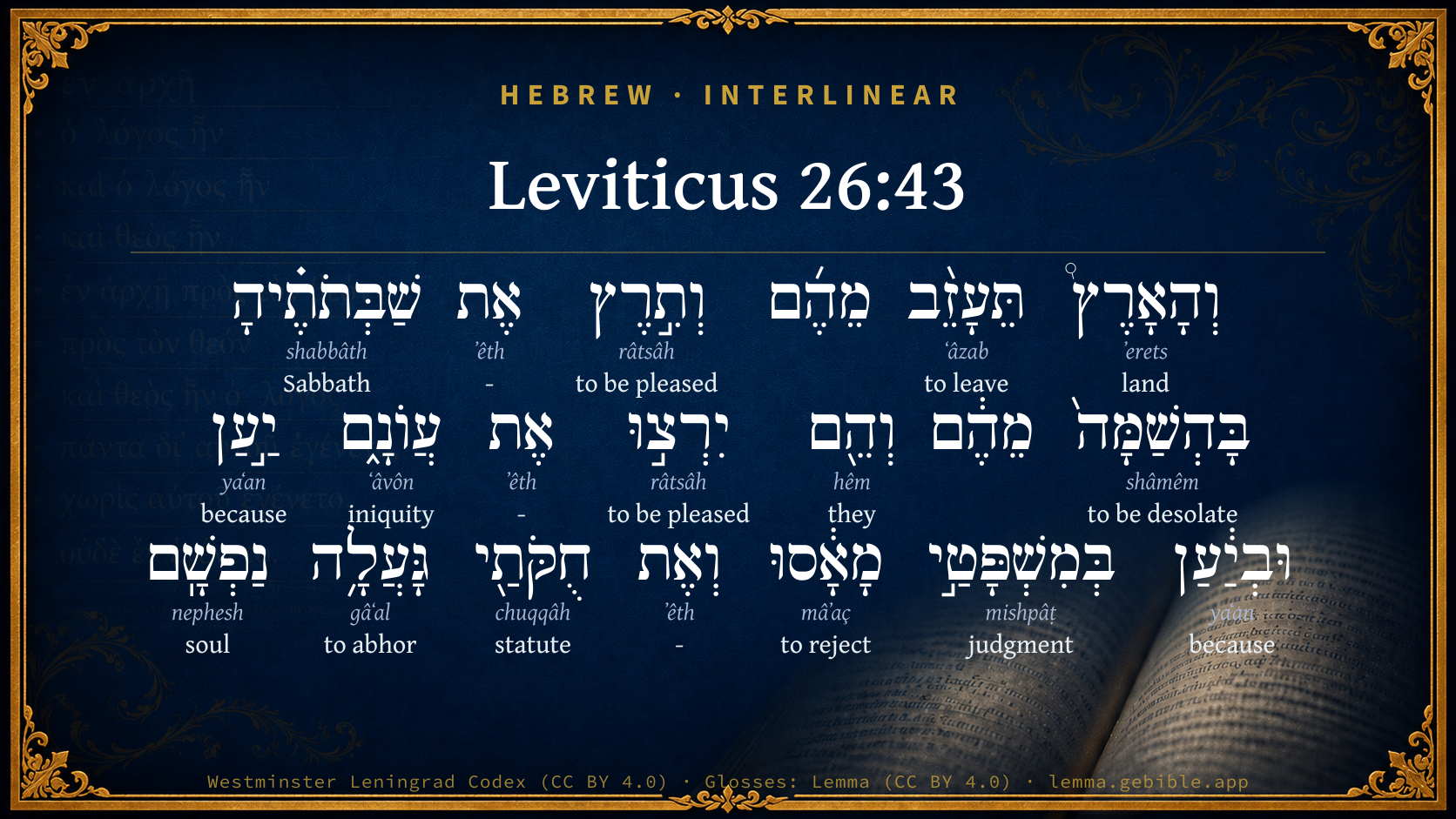
Hebrew (Westminster Leningrad Codex) Leviticus 26:43 appears in the Hebrew Old Testament. The text above is from the Westminster Leningrad Codex. Each word links to its Strong’s number, a concise gloss, and parsing drawn from the Open Scriptures Hebrew Bible morphology. Click any word for its full Brown-Driver-Briggs (BDB) entry.
Download image
Cite this verse

Leviticus 26:43 (World English Bible). Public Domain. Lemma interlinear Bible study tool, https://lemma.gebible.app/v/leviticus/26/43.

Show BibTeX & RIS
BibTeX
RIS
English Translation
The land also will be left by them, and will enjoy its sabbaths while it lies desolate without them: and they will accept the punishment of their iniquity; because, even because they rejected my ordinances, and their soul abhorred my statutes.
World English Bible · Public Domain
Download a study sheet

One document with this verse’s original text, its word-by-word gloss line, the meaning frame, cross-references with their text, attributed commentary, and full source and license credits — printable, and it pastes into notes with its structure intact.

This verse Autodidact and up

Study sheet (.html) Plain text (.txt)

A passage Seminary Student

Up to 50 verses in one chapter. A passage sheet keeps up to 6 commentary sources and 12 cross-references per verse, in the order this page ranks them, and says so on the sheet whenever that leaves anything out. Ask for a single verse and you get the Autodidact verse sheet above.

Everything on this page stays free to read, with no account — the sheet is a download of what is already on screen, not access to it.

Want to remove ads? Support Godless Engineer
Compare translations 3

The same verse in 3 English versions, stacked beneath the original-language interlinear above. Click any original word for its lexicon entry.

Each is an independent rendering of the whole verse — the interlinear is not word-aligned to these translations.

Highlighted words mark where these versions differ — a whole-verse word diff, not a word-by-word alignment.

  • World English Bible Public Domain
    The land also will be left by them, and will enjoy its sabbaths while it lies desolate without them: and they will accept the punishment of their iniquity; because, even because they rejected my ordinances, and their soul abhorred my statutes.
  • King James Version Public Domain
    The land also shall be left of them, and shall enjoy her sabbaths, while she lieth desolate without them: and they shall accept of the punishment of their iniquity: because, even because they despised my judgments, and because their soul abhorred my statutes.
  • unfoldingWord Literal Text CC BY-SA 4.0
    And the land will be deserted by them and will enjoy its sabbaths in its desolation from them. And they, they will accept their iniquity because, even because they rejected my judgments and their soul detested my statutes.

unfoldingWord Literal Text — © unfoldingWord, licensed CC BY-SA 4.0. Word-aligned USFM3 via Door43 (git.door43.org/unfoldingWord/en_ult).

Versions to compare (up to 4)

3 of 4 selected

Show all 18 translations

Every available English version of this verse, each an independent rendering of the whole verse.

  • World English Bible Public Domain
    The land also will be left by them, and will enjoy its sabbaths while it lies desolate without them: and they will accept the punishment of their iniquity; because, even because they rejected my ordinances, and their soul abhorred my statutes.
  • Berean Standard Bible Public Domain
    For the land will be abandoned by them, and it will enjoy its Sabbaths by lying desolate without them. And they will pay the penalty for their iniquity, because they rejected My ordinances and abhorred My statutes.
  • Majority Standard Bible Public Domain
    For the land will be abandoned by them, and it will enjoy its Sabbaths by lying desolate without them. And they will pay the penalty for their iniquity, because they rejected My ordinances and abhorred My statutes.
  • King James Version Public Domain
    The land also shall be left of them, and shall enjoy her sabbaths, while she lieth desolate without them: and they shall accept of the punishment of their iniquity: because, even because they despised my judgments, and because their soul abhorred my statutes.
  • American Standard Version (1901) Public Domain
    The land also shall be left by them, and shall enjoy its sabbaths, while it lieth desolate without them: and they shall accept of the punishment of their iniquity; because, even because they rejected mine ordinances, and their soul abhorred my statutes.
  • Revised Version (1885) Public Domain
    The land also shall be left of them, and shall enjoy her sabbaths, while she lieth desolate without them; and they shall accept of the punishment of their iniquity: because, even because they rejected my judgments, and their soul abhorred my statutes.
  • Geneva Bible (1599) Public Domain
    The land also in the meane season shalbe left of them, and shall enioye her Sabbaths while she lieth waste without them, but they shall willingly suffer the punishment of their iniquitie, because they despised my lawes, and because their soule abhorred mine ordinances.
  • Douay-Rheims (1899) Public Domain
    Which when she shall be left by them, shall enjoy her sabbaths, being desolate for them. But they shall pray for their sins, because they rejected my judgments, and despised my laws.
  • Young's Literal Translation Public Domain
    `And -- the land is left of them, and doth enjoy its sabbaths, in the desolation without them, and they accept the punishment of their iniquity, because, even because, against My judgments they have kicked, and My statutes hath their soul loathed,
  • Literal Standard Version CC BY-SA 4.0
    And the land is left by them, and enjoys its Sabbaths, in the desolation without them, and they accept the punishment of their iniquity, because, even because, they have kicked against My judgments, and their soul has loathed My statutes,
  • Unlocked Literal Bible CC BY-SA 4.0
    The land will be abandoned by them, so it will be pleased with its Sabbaths while it lies abandoned without them. They will have to pay the penalty for their sins because they themselves rejected my decrees and detested my laws.
  • unfoldingWord Literal Text CC BY-SA 4.0
    And the land will be deserted by them and will enjoy its sabbaths in its desolation from them. And they, they will accept their iniquity because, even because they rejected my judgments and their soul detested my statutes.
  • Darby Bible Public Domain
    For the land shall be left by them, and shall enjoy its sabbaths, when it is in desolation without them; and they shall accept the punishment of their iniquity; because, even because they despised my judgments, and their soul abhorred my statutes.
  • World Messianic Bible Public Domain
    The land also will be left by them, and will enjoy its Sabbaths while it lies desolate without them; and they will accept the punishment of their iniquity because they rejected my ordinances, and their soul abhorred my statutes.
  • Webster's Bible Public Domain
    The land also shall be left by them, and shall enjoy her sabbaths, while she lieth desolate without them: and they shall accept of the punishment of their iniquity; because, even because they despised my judgments, and because their soul abhorred my statutes.
  • Free Bible Version CC BY-SA 4.0
    For the land will be left empty by them, and it will enjoy its Sabbaths being abandoned. They will pay for their sins, because they rejected my rules and regulations.
  • Bible in Basic English Public Domain
    And the land, while she is without them, will keep her Sabbaths; and they will undergo the punishment of their sins, because they were turned away from my decisions and in their souls was hate for my laws.
  • JPS Tanakh (1917) Public Domain
    For the land shall lie forsaken without them, and shall be paid her sabbaths, while she lieth desolate without them; and they shall be paid the punishment of their iniquity; because, even because they rejected Mine ordinances, and their soul abhorred My statutes.

Literal Standard Version (2020), Covenant Press — licensed CC BY-SA 4.0. Text via the HelloAO Bible API (eBible.org). Unlocked Literal Bible (unfoldingWord) — licensed CC BY-SA 4.0. Text via the HelloAO Bible API (eBible.org). unfoldingWord Literal Text — © unfoldingWord, licensed CC BY-SA 4.0. Word-aligned USFM3 via Door43 (git.door43.org/unfoldingWord/en_ult). Free Bible Version, Dr. Jonathan Gallagher — licensed CC BY-SA 4.0. Text via the HelloAO Bible API (eBible.org).

Word by word

More ways to search: Search by grammar → Find every occurrence → Compare this word →

Practice this passage: Drill this verse → Learn its vocabulary →

גָּעֲלָ֥ה
gâʻal
H1602
“to abhor”
Verb, Qal, Perfect, 3rd Person, Feminine, Singular
Part of Speech
Verb
Stem
Qal
Form
Perfect
Person
3rd Person
Gender
Feminine
Number
Singular
Full BDB Definition

Origin: a primitive root

TWOT: 369

to abhor, loathe, be vilely cast away, fall - (Qal) to abhor, loathe - (Niphal) to be defiled - (Hiphil) to reject as loathsome, show aversion
  1. וְהָאָרֶץ֩ ʼerets H776 “and · the · land” Conjunction + Particle, Definite Article + Noun, Common, Both, Singular, Absolute
  2. תֵּעָזֵ֨ב ʻâzab H5800 “to leave” Verb, Niphal, Imperfect, 3rd Person, Feminine, Singular
  3. וְתִ֣רֶץ râtsâh H7521 “and · to be pleased” Conjunction + Verb, Qal, Imperfect, 3rd Person, Feminine, Singular
  4. אֶת ʼêth H853 “-” Particle, Direct Object
  5. שַׁבְּתֹתֶ֗יהָ shabbâth H7676 “Sabbaths · her” Noun, Common, Both, Plural, Construct + Suffix, Personal, 3rd Person, Feminine, Singular
  6. בָּהְשַׁמָּה֙ shâmêm H8074 “in/at the · to be desolate · her” Preposition, Determined + Verb, Hophal, Infinitive Construct + Suffix, Personal, 3rd Person, Feminine, Singular
  7. וְהֵ֖ם hêm H1992 “and · they” Conjunction + Pronoun, Personal, 3rd Person, Masculine, Plural
  8. יִרְצ֣וּ râtsâh H7521 “to be pleased” Verb, Qal, Imperfect, 3rd Person, Masculine, Plural
  9. אֶת ʼêth H853 “-” Particle, Direct Object
  10. עֲוֺנָ֑ם ʻâvôn H5771 “iniquity · their” Noun, Common, Both, Singular, Construct + Suffix, Personal, 3rd Person, Masculine, Plural
  11. יַ֣עַן yaʻan H3282 “because” Conjunction
  12. וּבְיַ֔עַן yaʻan H3282 “and · in/at · because” Conjunction + Preposition + Conjunction
  13. בְּמִשְׁפָּטַ֣י mishpâṭ H4941 “in/at · judgments · my” Preposition + Noun, Common, Masculine, Plural, Construct + Suffix, Personal, 1st Person, Common, Singular
  14. מָאָ֔סוּ mâʼaç H3988 “to reject” Verb, Qal, Perfect, 3rd Person, Common, Plural
  15. וְאֶת ʼêth H853 “and · -” Conjunction + Particle, Direct Object
  16. חֻקֹּתַ֖י chuqqâh H2708 “statutes · my” Noun, Common, Both, Plural, Construct + Suffix, Personal, 1st Person, Common, Singular
  17. נַפְשָֽׁם nephesh H5315 “soul · their” Noun, Common, Both, Singular, Construct + Suffix, Personal, 3rd Person, Masculine, Plural

About this verse

These counts appear in no published source. They are computed here, from the morphology-tagged text and Lemma’s own curated glosses. What Lemma adds →

20
words
14
distinct lemmas
Pentateuch
section

Notable vocabulary

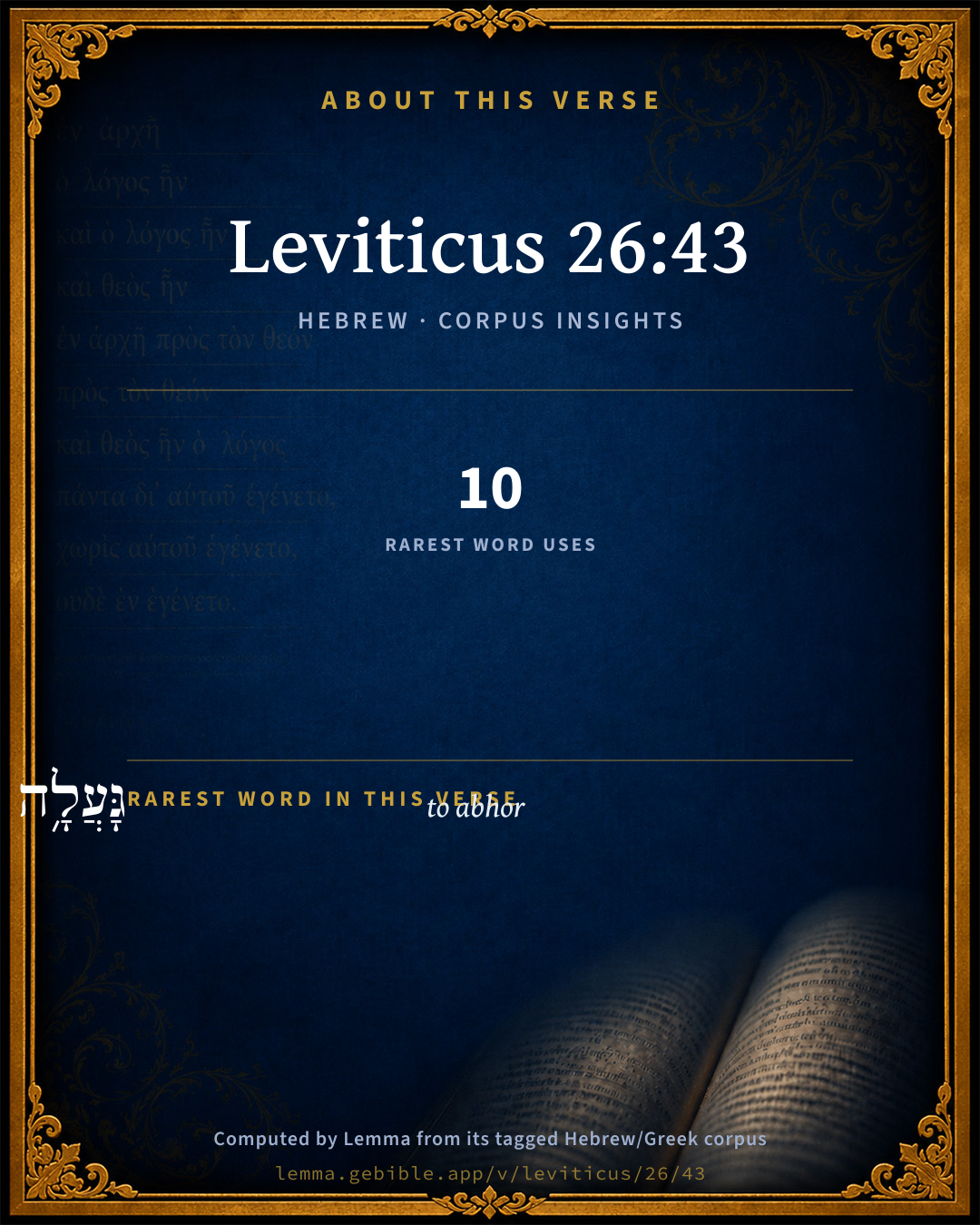
The rarest word here is גָּעֲלָ֥ה to abhor H1602 — appearing just 10 times in the whole Hebrew Bible.

Shared distinctive vocabulary

גָּעֲלָ֥ה to abhor H1602 occurs in 9 verses of the Hebrew Bible. Also found in:

Grammatical profile

  • 6 verbs
  • 6 nouns
  • 1 pronoun
  • 2 prepositions
  • 2 conjunctions
  • 3 particles

Verb forms

  • תֵּעָזֵ֨ב Niphal · Imperfect
  • וְתִ֣רֶץ Qal · Imperfect
  • בָּהְשַׁמָּה֙ Hophal · Infinitive Construct
  • יִרְצ֣וּ Qal · Imperfect
  • מָאָ֔סוּ Qal · Perfect
  • גָּעֲלָ֥ה Qal · Perfect

Repetition

Words recur within this verse — often emphatic in Hebrew:

  • וְתִ֣רֶץ to be pleased H7521 ×2
  • יַ֣עַן because H3282 ×2

Hebrew & Septuagint length

In English translation the verse runs 41 words from the Hebrew and 48 from the Septuagint (LXX English) — closely comparable.

A rough comparison of the two English renderings, which tokenize alike — not a word-level alignment.

Word counts can differ between the Hebrew and the Greek without any difference in meaning — e.g. the Hebrew direct-object marker אֵת has no separate Greek word, and Greek often adds the article ὁ.

Cross-references

25

Topical passages linked to Leviticus 26:43 in the Treasury of Scripture Knowledge — connected by theme and wording, ordered by reader-vote popularity; previews shown in the World English Bible.

  • Leviticus 26:15 and if you shall reject my statutes, and if your soul abhors my ordinances, so that you will not do all my commandments, but break my covenant;
  • Romans 8:7 because the mind of the flesh is hostile towards God; for it is not subject to God's law, neither indeed can it be.
  • Leviticus 26:30 I will destroy your high places, and cut down your incense altars, and cast your dead bodies upon the bodies of your idols; and my soul will abhor you.
  • Leviticus 26:34–35 Then the land will enjoy its sabbaths as long as it lies desolate and you are in your enemies' land. Even then the land will rest and enjoy its sabbaths.
  • Leviticus 26:41 I also walked contrary to them, and brought them into the land of their enemies: if then their uncircumcised heart is humbled, and they then accept the punishment of their iniquity;
  • 1 Kings 8:46–48 If they sin against you (for there is no man who doesn't sin), and you are angry with them, and deliver them to the enemy, so that they carry them away captive to the land of the enemy, far off or near;
  • 2 Kings 17:7–17 It was so, because the children of Israel had sinned against Yahweh their God, who brought them up out of the land of Egypt from under the hand of Pharaoh king of Egypt, and had feared other gods,
  • 2 Chronicles 33:12 When he was in distress, he begged Yahweh his God, and humbled himself greatly before the God of his fathers.
  • 2 Chronicles 36:14–16 Moreover all the chiefs of the priests, and the people, trespassed very greatly after all the abominations of the nations; and they polluted the house of Yahweh which he had made holy in Jerusalem.
  • Job 5:17 "Behold, happy is the man whom God corrects: Therefore do not despise the chastening of the Almighty.
  • Job 34:31–32 "For has any said to God, 'I am guilty, but I will not offend any more.
  • Psalms 50:15 Call on me in the day of trouble. I will deliver you, and you will honor me."
  • Psalms 50:17 Seeing you hate instruction, And throw my words behind you?
  • Psalms 119:67 Before I was afflicted, I went astray; But now I observe your word.
  • Psalms 119:71 It is good for me that I have been afflicted, That I may learn your statutes.
  • Psalms 119:75 Yahweh, I know that your judgments are righteous, That in faithfulness you have afflicted me.
  • Isaiah 26:16 Yahweh, in trouble have they visited you; they poured out a prayer [when] your chastening was on them.
  • Jeremiah 31:19 Surely after that I was turned, I repented; and after that I was instructed, I struck on my thigh: I was ashamed, yes, even confounded, because I did bear the reproach of my youth.
  • Daniel 9:7–9 Lord, righteousness belongs to you, but to us confusion of face, as at this day; to the men of Judah, and to the inhabitants of Jerusalem, and to all Israel, who are near, and who are far off, through all the countries where you have driven them, because of their trespass that they have trespassed against you.
  • Daniel 9:14 Therefore has Yahweh watched over the evil, and brought it on us; for Yahweh our God is righteous in all his works which he does, and we have not obeyed his voice.
  • Amos 5:10 They hate him who reproves in the gate, And they abhor him who speaks blamelessly.
  • Zechariah 11:8 I cut off the three shepherds in one month; for my soul was weary of them, and their soul also loathed me.
  • John 7:7 The world can't hate you, but it hates me, because I testify about it, that its works are evil.
  • John 15:23–24 He who hates me, hates my Father also.
  • Hebrews 12:5–11 and you have forgotten the exhortation which reasons with you as with children, "My son, don't take lightly the chastening of the Lord, Nor faint when you are reproved by him;

Cross-references courtesy of OpenBible.info (CC BY 4.0).

Hebrew and Greek witnesses Masoretic Hebrew ↔ Greek Septuagint

The same verse in the two great witnesses to the Old Testament, shown verse-for-verse.

These are two independent witnesses, not word-aligned to each other, and the Septuagint is shown in lemma (dictionary) form.

Hebrew Leviticus 26:43 Masoretic · Westminster Leningrad Codex

וְהָאָרֶץ֩ תֵּעָזֵ֨ב מֵהֶ֜ם וְתִ֣רֶץ אֶת שַׁבְּתֹתֶ֗יהָ בָּהְשַׁמָּה֙ מֵהֶ֔ם וְהֵ֖ם יִרְצ֣וּ אֶת עֲוֺנָ֑ם יַ֣עַן וּבְיַ֔עַן בְּמִשְׁפָּטַ֣י מָאָ֔סוּ וְאֶת חֻקֹּתַ֖י גָּעֲלָ֥ה נַפְשָֽׁם

The land also will be left by them, and will enjoy its sabbaths while it lies desolate without them: and they will accept the punishment of their iniquity; because, even because they rejected my ordinances, and their soul abhorred my statutes.

World English Bible · Public Domain

Greek LXX Leviticus 26:43 Septuagint · lemma form

καί ὁ γῆ ἐν καταλείπω ὑπό αὐτός τότε προςδέχομαι ὁ γῆ ὁ σάββατον αὐτός ἐν ὁ ἐρημόω αὐτός διά αὐτός καί αὐτός προςδέχομαι ὁ αὐτός ἀνομία ἀντί ὅς ὁ κρίμα ἐγώ ὑπερὁράω καί ὁ πρόσταγμα ἐγώ προςὀχθίζω ὁ ψυχή αὐτός

And I will remember the land, and the land shall be left of them; then the land shall enjoy her sabbaths, when it is deserted through them: and they shall accept the punishment of their iniquities, because they neglected my judgments, and in their soul loathed my ordinances.

LXX2012 (modern English Septuagint) · Public Domain

Hebrew: Westminster Leningrad Codex (CC BY 4.0). Greek: Septuagint (public domain); English from LXX2012 (modern English Septuagint) (Public Domain). How the Septuagint differs from the Hebrew →

Targum (Aramaic paraphrase)

2

The Targum is the ancient Jewish Aramaic paraphrase of the Hebrew Scriptures — an interpretive translation, not the Hebrew text itself. Onkelos (literal) and Pseudo-Jonathan (expansive) render the Torah, and Jonathan the Prophets. Coverage is partial: where no permissively-licensed English translation exists for a verse, only the Aramaic is shown. This is verse-level text, not a word-by-word alignment to the Hebrew.

  1. Targum Onkelos Torah (Genesis–Deuteronomy)
    וְאַרְעָא תִתְרְטֵשׁ מִנְהוֹן וְתַרְעֵי יָת שְׁמִיטָהָא בְּדִצְדִיאַת מִנְהוֹן וְאִנוּן יִרְעוּן יָת חוֹבֵיהוֹן לְוָטִין חֳלַף בִּרְכָן אַיְתִי עֲלֵיהוֹן בְּדִיל דִבְדִינַי קָצוּ וְיָת קְיָמַי רְחֵקַת נַפְשְׁהוֹן

    (no public-domain English translation for this verse)

    Targum Onkelos — Aramaic: “Onkelos Genesis” (public domain); “Onkelos Exodus” (public domain); “Onkelos Leviticus” (public domain); “Onkelos Numbers” (public domain); “Onkelos Deuteronomy” (public domain). English: “Sefaria Community Translation” (CC0 1.0 (public-domain dedication)); “J.W. Etheridge. The Targums of Onkelos and Jonathan Ben Uzziel on the Pentateuch. London: Longmans, Green, 1862” (public domain). Text via Sefaria.

  2. Targum Pseudo-Jonathan Torah (Genesis–Deuteronomy)
    וְאַרְעָא תִּתְרְטֵישׁ וְתִשְׁתְּבֵיק מִנְהוֹן וְתַרְעֵי יַת שׁוֹבֵי שְׁמִיטָהָא כָּל יוֹמִין דְהִיא צַדְיָא מִנְכוֹן וְהִינוּן יַרְעוּן יַת חוֹבֵיהוֹן לְוָוטִין חֲלַף בִּירְכָן יִמְטוּן עֲלֵיהוֹן מֵיכְלָא כָּל קֳבֵיל מֵיכְלָא הוּא מְטוּל דְהִינוּן בְּסִידְרֵי דִינַי קָצוּ וְיַת קְיָימֵי אוֹרַיְיתִי רְחִיקַת נַפְשֵׁיהוֹן

    But the land shall (first) be relinquished and forsaken you; and enjoy the repose of her remissions all the days that it shall be deserted by you. And they will receive retribution for their sins: curses instead of blessings will come upon them, measure for measure: because they shunned the orders of judgments, and their souls revolted from the covenant of My law.

    Targum Pseudo-Jonathan — Aramaic: “Targum Jonathan on Genesis” (public domain); “Targum Jonathan on Exodus” (public domain); “Targum Jonathan on Leviticus” (public domain); “Targum Jonathan on Numbers” (public domain); “Targum Jonathan on Deuteronomy” (public domain). English: “The Targum of Jonathan ben Uzziel, trans. J. W. Etheridge, London, 1862” (public domain). Text via Sefaria.

Commentary

Notes on Leviticus 26:43 from classic Christian and Jewish commentators (each source and its license shown beneath its notes). The classic Christian expositions comment on the surrounding passage and are grouped to its opening verse, so a note may address several verses; the Jewish commentaries on the Tanakh (Rashi and others) are per-verse, so they appear only where the commentator wrote on this verse.

Lemma curates 59 commentaries, every one of them public domain or Creative Commons licensed, each selected and text-cleaned for this edition rather than reprinted as found. About our sources →

Trapp's Complete Commentary

John Trapp

Lev 26:43 The land also shall be left of them, and shall enjoy her sabbaths, while she lieth desolate without them: and they shall accept of the punishment of their iniquity: because, even because they despised my judgments, and because their soul abhorred my statutes.

Ver. 43. They shall accept,] q.d., I will give them to do what I require of them. See Lev 26:41.

John Trapp, A Commentary or Exposition upon All the Books of the Old and New Testament (1647–1656) — public domain. Text from a community e-Sword module.

Geneva Bible (1599)

Geneva Bible translators

While they are captives, and without repentance.

Geneva Bible (1599) marginal notes — public domain. Text via Bolls.life.

Ellicott's Commentary for English Readers

(43) The land also shall be left of them.—Better, but the land shall be deserted by them. The solemn warning is here reiterated, that before God will remember His covenant with the patriarchs, and also be mindful of the land, the land must be depopulated of its rebellious inhabitants, and enjoy the Sabbaths which have been denied to it. This verse, therefore which is substantially a repetition of Lev_26:33-34, seems to have been inserted here to deprecate more solemnly the heinousness of their sins.

A Bible Commentary for English Readers, edited by Charles John Ellicott (1878–1897) — public domain. Text from a community e-Sword module.

The Cambridge Bible for Schools and Colleges

gen. ed. J. J. S. Perowne

43, 44. These vv. have rather the air of a later insertion.

The Cambridge Bible for Schools and Colleges (gen. ed. J. J. S. Perowne; Cambridge University Press, 1878–1918) — public domain. Text from a community e-Sword module.

John Gill's Exposition

And yet for all that,.... I will have on them, in or through my Word, as the Targum of Jonathan; notwithstanding their many and great sins and transgressions, and the sad and miserable condition they were brought into by them, the Lord would have mercy on them and be gracious to them, through Christ and for his sake, and convert and save them, see Rom 11:26; the Jews, as Fagius tells us, wonderfully delight themselves with this passage, and read it with the greatest joy and pleasure, and with an elevated voice; concluding from hence that they shall certainly return to their own land; and because the first word in this verse is in sound the same as the Germans use for an "ape", they call this paragraph "the golden ape", and say, when this shall be fulfilled the golden age will take place with them: a very learned man (f) has wrote a dissertation upon it: when

they shall be in the land of their enemies; of the Romans and other nations, among whom they have been disposed ever since the destruction of Jerusalem by Titus:

I will not cast them away, neither will I abhor them, to destroy them utterly; for though they have been cast away by the Lord out of their land, and from being his people, and enjoying either the civil or religious privileges they formerly did; and though they have been cast off with abhorrence, and had in great detestation by him, for their sin of rejecting the Messiah, as appears by the punishment inflicted on them; yet not so as to make an utter end of them as a body of people, for, notwithstanding their dispersion everywhere, and their long captivity, they remain a distinct people from all others, which seems to forebode something favourable to them:

and to break my covenant with them; which he will not do, even his promise of the future call and conversion of them, and of their return to their own land:

for I am the Lord their God; their covenant God, and a covenant keeping God, Rom 11:27.

(f) Carpzovius de aurea Judaeorum Simia, in Thesaur. Theolog. Philolog. vol. 1. p. 344. vid. Pfeiffer. dubia vexata cent. 2. loc. 17. p. 145.

John Gill's Exposition of the Whole Bible (1746–1763) — public domain (CC PDM 1.0). Text via the HelloAO Bible API.

unfoldingWord translationNotes

Door43 World Missions Community

The land will be abandoned by them

This can be stated in active form. AT: "The people of Israel will abandon their land" (See: Active or Passive)

so it will be pleased with its Sabbaths

Yahweh speaks about the land as if it were a person who is happy about resting, because no one will be planting seed or growing crops on it. This will allow the land to become more fertile. AT: "so it will benefit from the Sabbaths" (See: Personification)

translationWords

reject

decree

law

unfoldingWord translationNotes — © Distant Shores Media and the Door43 World Missions Community, licensed CC BY-SA 4.0. Source: git.door43.org/Door43/en_tn.

Rashi

Rabbi Shlomo Yitzchaki (Rashi)

יען וביען BECAUSE AND BECAUSE [THEY REJECTED MY ORDINANCES] — i. e. it is a retribution — and a retribution, too, that they have rejected My ordinances.

Rashi on the Tanakh — English translations: “The Judaica Press complete Tanach with Rashi, translated by A. J. Rosenberg” (CC BY 4.0); “Pentateuch with Rashi's commentary by M. Rosenbaum and A.M. Silbermann, 1929-1934” (public domain); “The Metsudah Tanach series, Lakewood, N.J” (CC BY 4.0); and “The Book of Joshua, Metsudah Publications, 1997” (CC BY 4.0). Text via Sefaria.

Ramban (Nachmanides)

Rabbi Moshe ben Nachman (Ramban / Nachmanides)

And the Land shall lie forsaken without them. This means that even after the remembring [of the covenant and the Land] it shall lie forsaken without them, hinting that even after the decree of Cyrus [granting the Jews in Babylon permission to return and rebuild the Temple], the Land will still lie forsaken without them and her Sabbatical years, until nineteen years after the Temple was rebuilt; and then they sanctified the city [of Jerusalem] with two thanks-offerings, and the sanctity of the Land was restored,. and they made the covenant, and declared [among other conditions] and that we would forego the Seventh year and the exaction of every debt., Verse 32. I.e., they undertook to keep the Sabbatical laws with respect to cessation of agricultural work and cancellation of debts. All events that happened to them [at the beginning of their return to the Land after the Babylonian exile] are alluded to in this section.

Ramban (Nachmanides) on the Tanakh — English translation: “Commentary on the Torah by Ramban (Nachmanides). Translated and annotated by Charles B. Chavel. New York, Shilo Pub. House, 1971-1976” (CC BY 4.0). Text via Sefaria.

Lesson kit

Teaching starters — assembled from the data on this page, not authored interpretation. Every prompt links to the verse data it draws on. Edit before teaching.

Leviticus, in the Pentateuch, opens this verse with 20 words (14 distinct Hebrew lemmas). Its most distinctive word is gâʻal (“to abhor”). A historical commentator’s framing appears above. Read the whole chapter for the surrounding context.

Discussion questions

  1. How does “to abhor” (gâʻal) shape what this verse is saying?
  2. How does Leviticus 26:11, which shares the word «to abhor», read alongside this verse?
  3. What does the repetition of “to be pleased” (2× in this one verse) do in this verse?
  4. These translations render this verse differently; the difference is in the English rendering, not the original. What questions does that raise?
  5. «תֵּעָזֵ֨ב» is a Niphal Imperfect verb. How does that grammatical form shape the action described?
  6. Compare how Trapp's Complete Commentary and Geneva Bible (1599) read this verse. Where do they agree or differ?

Things to notice

  • These translations choose different wording for 18 words in this verse.
  • “to be pleased” occurs 2× in this single verse.
  • 14 distinct Hebrew lemmas span 20 words in this verse.

Reading settings

Reading text

Shown beneath each verse's original-language words.

Old Testament
Old Testament edition

Read the OT as the Masoretic Hebrew (MT) or the Greek Septuagint (LXX).

English shown for the Greek Septuagint (in the Hebrew ↔ Greek comparison).

Comparing translations? Open the Compare panel on any verse page to stack up to four side by side.