
Numbers 11:26

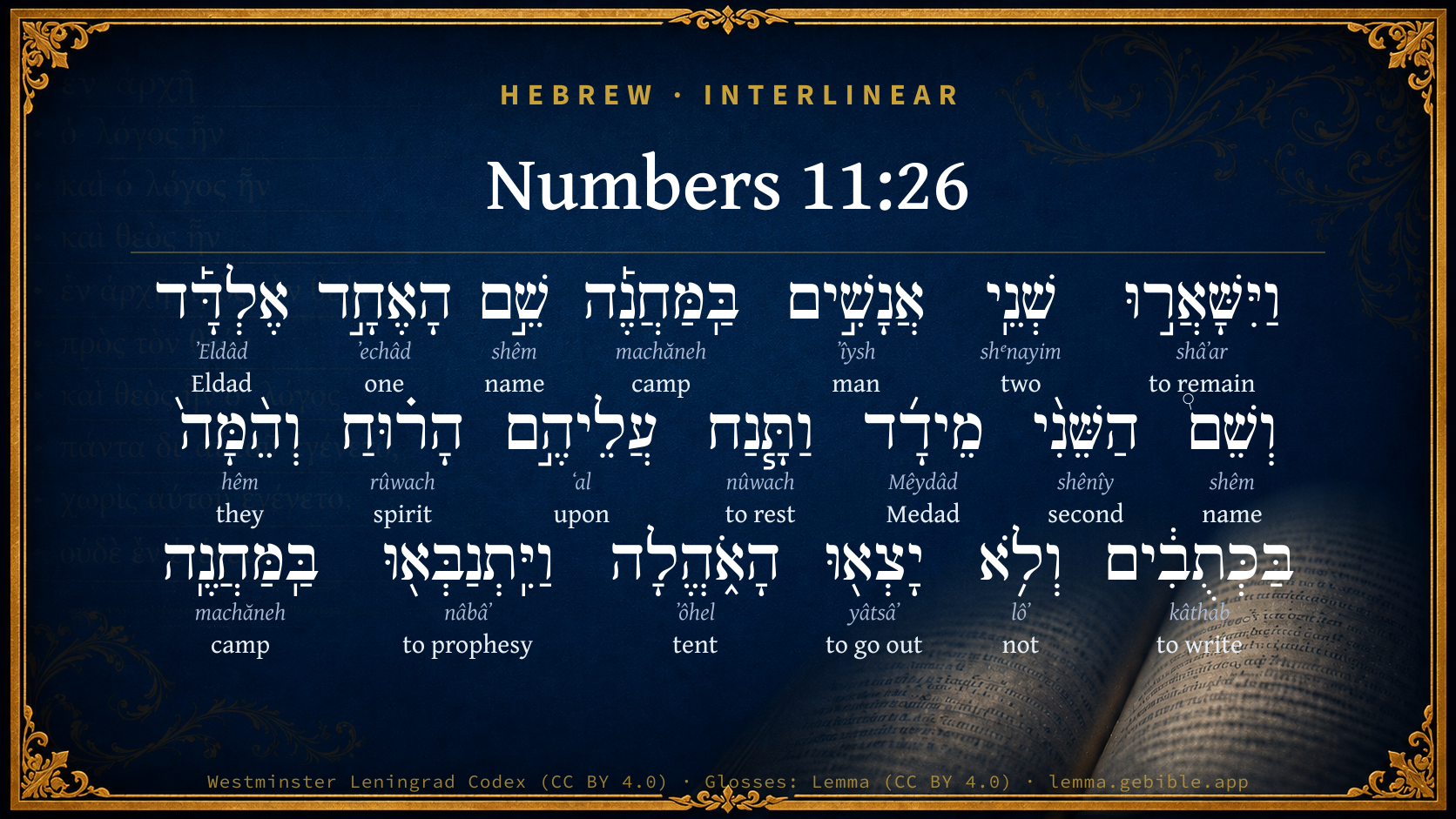
Hebrew (Westminster Leningrad Codex) Numbers 11:26 appears in the Hebrew Old Testament. The text above is from the Westminster Leningrad Codex. Each word links to its Strong’s number, a concise gloss, and parsing drawn from the Open Scriptures Hebrew Bible morphology. Click any word for its full Brown-Driver-Briggs (BDB) entry.
Download image
Cite this verse

Numbers 11:26 (World English Bible). Public Domain. Lemma interlinear Bible study tool, https://lemma.gebible.app/v/numbers/11/26.

Show BibTeX & RIS
BibTeX
RIS
English Translation
But there remained two men in the camp, the name of the one was Eldad, and the name of the other Medad: and the Spirit rested on them; and they were of those who were written, but had not gone out to the Tent; and they prophesied in the camp.
World English Bible · Public Domain
Highlights
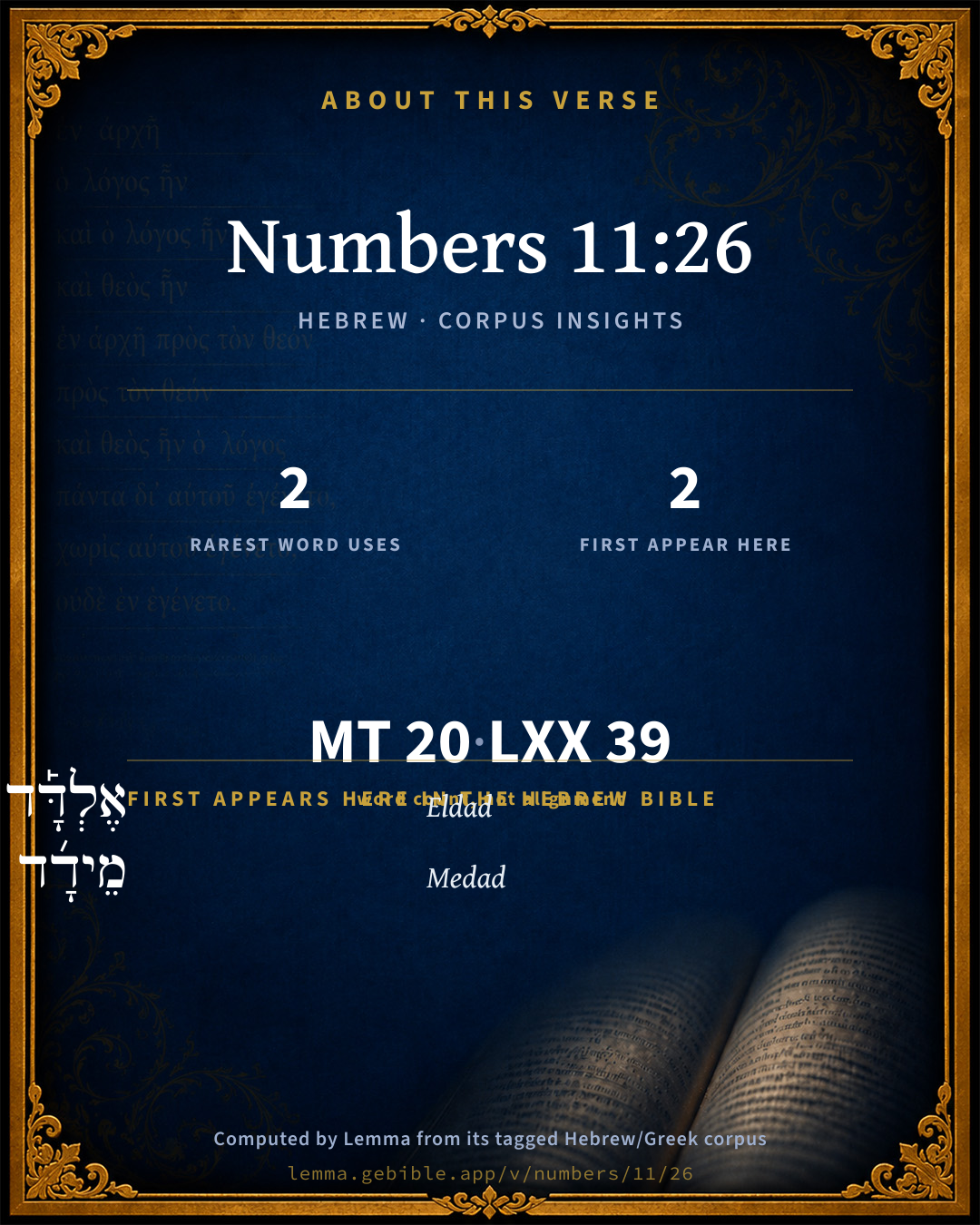
  • 2 first appearances in the Hebrew Bible
Full analysis ↓
Download a study sheet

One document with this verse’s original text, its word-by-word gloss line, the meaning frame, cross-references with their text, attributed commentary, and full source and license credits — printable, and it pastes into notes with its structure intact.

This verse Autodidact and up

Study sheet (.html) Plain text (.txt)

A passage Seminary Student

Up to 50 verses in one chapter. A passage sheet keeps up to 6 commentary sources and 12 cross-references per verse, in the order this page ranks them, and says so on the sheet whenever that leaves anything out. Ask for a single verse and you get the Autodidact verse sheet above.

Everything on this page stays free to read, with no account — the sheet is a download of what is already on screen, not access to it.

Want to remove ads? Support Godless Engineer
Compare translations 3

The same verse in 3 English versions, stacked beneath the original-language interlinear above. Click any original word for its lexicon entry.

Each is an independent rendering of the whole verse — the interlinear is not word-aligned to these translations.

Highlighted words mark where these versions differ — a whole-verse word diff, not a word-by-word alignment.

  • World English Bible Public Domain
    But there remained two men in the camp, the name of the one was Eldad, and the name of the other Medad: and the Spirit rested on them; and they were of those who were written, but had not gone out to the Tent; and they prophesied in the camp.
  • King James Version Public Domain
    But there remained two of the men in the camp, the name of the one was Eldad, and the name of the other Medad: and the spirit rested upon them; and they were of them that were written, but went not out unto the tabernacle: and they prophesied in the camp.
  • unfoldingWord Literal Text CC BY-SA 4.0
    And two of the men were left in the camp: The name of the one Eldad, and the name of the second Medad. And the Spirit rested on them, and they among the written ones, but they did not go out to the tent; and they prophesied in the camp.

unfoldingWord Literal Text — © unfoldingWord, licensed CC BY-SA 4.0. Word-aligned USFM3 via Door43 (git.door43.org/unfoldingWord/en_ult).

Versions to compare (up to 4)

3 of 4 selected

Show all 18 translations

Every available English version of this verse, each an independent rendering of the whole verse.

  • World English Bible Public Domain
    But there remained two men in the camp, the name of the one was Eldad, and the name of the other Medad: and the Spirit rested on them; and they were of those who were written, but had not gone out to the Tent; and they prophesied in the camp.
  • Berean Standard Bible Public Domain
    Two men, however, had remained in the camp—one named Eldad and the other Medad—and the Spirit rested on them. They were among those listed, but they had not gone out to the tent, and they prophesied in the camp.
  • Majority Standard Bible Public Domain
    Two men, however, had remained in the camp—one named Eldad and the other Medad—and the Spirit rested on them. They were among those listed, but they had not gone out to the tent, and they prophesied in the camp.
  • King James Version Public Domain
    But there remained two of the men in the camp, the name of the one was Eldad, and the name of the other Medad: and the spirit rested upon them; and they were of them that were written, but went not out unto the tabernacle: and they prophesied in the camp.
  • American Standard Version (1901) Public Domain
    But there remained two men in the camp, the name of the one was Eldad, and the name of the other Medad: and the Spirit rested upon them; and they were of them that were written, but had not gone out unto the Tent; and they prophesied in the camp.
  • Revised Version (1885) Public Domain
    But there remained two men in the camp, the name of the one was Eldad, and the name of the other Medad: and the spirit rested upon them; and they were of them that were written, but had not gone out unto the Tent: and they prophesied in the camp.
  • Geneva Bible (1599) Public Domain
    But there remained two of the men in the hoste: the name of the one was Eldad, and the name of the other Medad, and the Spirit rested vpon them, (for they were of them that were written, and went not out vnto the Tabernacle) and they prophecied in the hoste.
  • Douay-Rheims (1899) Public Domain
    Now there remained in the camp two of the men, of whom one was called Eldad, and the other Medad, upon whom the spirit rested; for they also had been enrolled, but were not gone forth to the tabernacle.
  • Young's Literal Translation Public Domain
    And two of the men are left in the camp, the name of the one `is' Eldad, and the name of the second Medad, and the spirit resteth upon them, (and they are among those written, and have not gone out to the tent), and they prophesy in the camp;
  • Literal Standard Version CC BY-SA 4.0
    And two of the men are left in the camp, the name of the first [is] Eldad and the name of the second Medad, and the spirit rests on them (and they are among those written, but they have not gone out to the tent), and they prophesy in the camp;
  • Unlocked Literal Bible CC BY-SA 4.0
    Two men remained in the camp, named Eldad and Medad. The Spirit also rested on them. Their names were written on the list, but they had not gone out to the tent. Nevertheless, they prophesied in the camp.
  • unfoldingWord Literal Text CC BY-SA 4.0
    And two of the men were left in the camp: The name of the one Eldad, and the name of the second Medad. And the Spirit rested on them, and they among the written ones, but they did not go out to the tent; and they prophesied in the camp.
  • Darby Bible Public Domain
    And two men remained in the camp, the name of the one, Eldad, and the name of the other, Medad; and the Spirit rested upon them (and they were among them that were written, but they had not gone out to the tent); and they prophesied in the camp.
  • World Messianic Bible Public Domain
    But two men remained in the camp. The name of one was Eldad, and the name of the other Medad; and the Spirit rested on them. They were of those who were written, but had not gone out to the Tent; and they prophesied in the camp.
  • Webster's Bible Public Domain
    But there remained two of the men in the camp, the name of the one was Eldad, and the name of the other Medad: and the spirit rested upon them, and they were of them that were described, but went not out to the tabernacle: and they prophesied in the camp.
  • Free Bible Version CC BY-SA 4.0
    However, two men named Eldad and Medad had stayed behind in the camp. The Spirit came on them too. (They had been put on the list of the seventy elders, but they hadn't gone to the tent. But they prophesied where they were in the camp anyway.)
  • Bible in Basic English Public Domain
    But two men were still in the tent-circle one of them named Eldad and the other Medad: and the spirit came to rest on them; they were among those who had been sent for, but they had not gone out to the Tent: and the prophet's power came on them in the tent-circle.
  • JPS Tanakh (1917) Public Domain
    But there remained two men in the camp, the name of the one was Eldad, and the name of the other Medad; and the spirit rested upon them; and they were of them that were recorded, but had not gone out unto the Tent; and they prophesied in the camp.

Literal Standard Version (2020), Covenant Press — licensed CC BY-SA 4.0. Text via the HelloAO Bible API (eBible.org). Unlocked Literal Bible (unfoldingWord) — licensed CC BY-SA 4.0. Text via the HelloAO Bible API (eBible.org). unfoldingWord Literal Text — © unfoldingWord, licensed CC BY-SA 4.0. Word-aligned USFM3 via Door43 (git.door43.org/unfoldingWord/en_ult). Free Bible Version, Dr. Jonathan Gallagher — licensed CC BY-SA 4.0. Text via the HelloAO Bible API (eBible.org).

Word by word

More ways to search: Search by grammar → Find every occurrence → Compare this word →

Practice this passage: Drill this verse → Learn its vocabulary →

אֶלְדָּ֡ד
ʼEldâd
H419
“Eldad”
Noun, Proper
Part of Speech
Noun
Type
Proper
Full BDB Definition

Origin: from H410 and H1730

TWOT: None

Eldad = "God has loved" - one of the two elders who prophesied in the Israelite camp
  1. וַיִּשָּׁאֲר֣וּ shâʼar H7604 “and · to remain” Conjunction + Verb, Niphal, Sequential Imperfect, 3rd Person, Masculine, Plural
  2. שְׁנֵֽי shᵉnayim H8147 “two” Adjective, Cardinal number, Masculine, Dual, Construct
  3. אֲנָשִׁ֣ים ʼîysh H376 “men” Noun, Common, Masculine, Plural, Absolute
  4. בַּֽמַּחֲנֶ֡ה machăneh H4264 “in/at the · camp” Preposition, Determined + Noun, Common, Both, Singular, Absolute
  5. שֵׁ֣ם shêm H8034 “name of” Noun, Common, Masculine, Singular, Construct
  6. הָאֶחָ֣ד ʼechâd H259 “the · one” Particle, Definite Article + Adjective, Cardinal number, Masculine, Singular, Absolute
  7. וְשֵׁם֩ shêm H8034 “and · name of” Conjunction + Noun, Common, Masculine, Singular, Construct
  8. הַשֵּׁנִ֨י shênîy H8145 “the · second” Particle, Definite Article + Adjective, Ordinal number, Masculine, Singular, Absolute
  9. מֵידָ֜ד Mêydâd H4312 “Medad” Noun, Proper
  10. וַתָּ֧נַח nûwach H5117 “and · to rest” Conjunction + Verb, Qal, Sequential Imperfect, 3rd Person, Feminine, Singular
  11. עֲלֵיהֶ֣ם ʻal H5921 “upon · them” Preposition + Suffix, Personal, 3rd Person, Masculine, Plural
  12. הָר֗וּחַ rûwach H7307 “the · spirit” Particle, Definite Article + Noun, Common, Both, Singular, Absolute
  13. וְהֵ֨מָּה֙ hêm H1992 “and · they” Conjunction + Pronoun, Personal, 3rd Person, Masculine, Plural
  14. בַּכְּתֻבִ֔ים kâthab H3789 “in/at the · written” Preposition, Determined + Verb, Qal, Participle Passive, Masculine, Plural, Absolute
  15. וְלֹ֥א lôʼ H3808 “and · not” Conjunction + Particle, Negative
  16. יָצְא֖וּ yâtsâʼ H3318 “to go out” Verb, Qal, Perfect, 3rd Person, Common, Plural
  17. הָאֹ֑הֱלָה ʼôhel H168 “the · tent · toward” Particle, Definite Article + Noun, Common, Masculine, Singular, Absolute + Suffix, Demonstrative
  18. וַיִּֽתְנַבְּא֖וּ nâbâʼ H5012 “and · to prophesy” Conjunction + Verb, Hithpael, Sequential Imperfect, 3rd Person, Masculine, Plural
  19. בַּֽמַּחֲנֶֽה machăneh H4264 “in/at the · camp” Preposition, Determined + Noun, Common, Both, Singular, Absolute

About this verse

These counts appear in no published source. They are computed here, from the morphology-tagged text and Lemma’s own curated glosses. What Lemma adds →

20
words
18
distinct lemmas
Pentateuch
section

Notable vocabulary

The rarest word here is אֶלְדָּ֡ד Eldad H419 — appearing just 2 times in the whole Hebrew Bible.

First appearance in Scripture

These words make their first canonical appearance in the Hebrew Bible here:

  • אֶלְדָּ֡ד Eldad H419
  • מֵידָ֜ד Medad H4312

Shared distinctive vocabulary

אֶלְדָּ֡ד Eldad H419 occurs in 2 verses of the Hebrew Bible. Also found in:

Grammatical profile

  • 5 verbs
  • 9 nouns
  • 3 adjectives
  • 1 pronoun
  • 1 preposition
  • 1 particle

Verb forms

  • וַיִּשָּׁאֲר֣וּ Niphal · Sequential Imperfect
  • וַתָּ֧נַח Qal · Sequential Imperfect
  • בַּכְּתֻבִ֔ים Qal · Participle Passive
  • יָצְא֖וּ Qal · Perfect
  • וַיִּֽתְנַבְּא֖וּ Hithpael · Sequential Imperfect

Repetition

Words recur within this verse — often emphatic in Hebrew:

  • בַּֽמַּחֲנֶ֡ה camp H4264 ×2
  • שֵׁ֣ם name H8034 ×2

Hebrew & Septuagint length

In English translation the verse runs 50 words from the Hebrew and 54 from the Septuagint (LXX English) — closely comparable.

A rough comparison of the two English renderings, which tokenize alike — not a word-level alignment.

Word counts can differ between the Hebrew and the Greek without any difference in meaning — e.g. the Hebrew direct-object marker אֵת has no separate Greek word, and Greek often adds the article ὁ.

In the original languages it is 20 Hebrew tokens and 39 Greek tokens — but the two are counted differently (Hebrew bundles its prefixes and suffixes into one token; the Greek is in lemma form), so that isn’t a like-for-like length.

Cross-references

6

Topical passages linked to Numbers 11:26 in the Treasury of Scripture Knowledge — connected by theme and wording, ordered by reader-vote popularity; previews shown in the World English Bible.

  • Jeremiah 36:5 Jeremiah commanded Baruch, saying, I am shut up; I can't go into the house of Yahweh:
  • Exodus 3:11 Moses said to God, "Who am I, that I should go to Pharaoh, and that I should bring forth the children of Israel out of Egypt?"
  • Exodus 4:13–14 He said, "Oh, Lord, please send someone else."
  • 1 Samuel 10:22 Therefore they asked of Yahweh further, Is there yet a man to come here? Yahweh answered, Behold, he has hid himself among the baggage.
  • 1 Samuel 20:26 Nevertheless Saul didn't say anything that day: for he thought, Something has happened to him. He is not clean. Surely he is not clean.
  • Jeremiah 1:6 Then said I, Ah, Lord Yahweh! behold, I don't know how to speak; for I am a child.

Cross-references courtesy of OpenBible.info (CC BY 4.0).

Hebrew and Greek witnesses Masoretic Hebrew ↔ Greek Septuagint

The same verse in the two great witnesses to the Old Testament, shown verse-for-verse.

These are two independent witnesses, not word-aligned to each other, and the Septuagint is shown in lemma (dictionary) form.

Hebrew Numbers 11:26 Masoretic · Westminster Leningrad Codex

וַיִּשָּׁאֲר֣וּ שְׁנֵֽי אֲנָשִׁ֣ים בַּֽמַּחֲנֶ֡ה שֵׁ֣ם הָאֶחָ֣ד אֶלְדָּ֡ד וְשֵׁם֩ הַשֵּׁנִ֨י מֵידָ֜ד וַתָּ֧נַח עֲלֵיהֶ֣ם הָר֗וּחַ וְהֵ֨מָּה֙ בַּכְּתֻבִ֔ים וְלֹ֥א יָצְא֖וּ הָאֹ֑הֱלָה וַיִּֽתְנַבְּא֖וּ בַּֽמַּחֲנֶֽה

But there remained two men in the camp, the name of the one was Eldad, and the name of the other Medad: and the Spirit rested on them; and they were of those who were written, but had not gone out to the Tent; and they prophesied in the camp.

World English Bible · Public Domain

Greek LXX Numbers 11:26 Septuagint · lemma form

καί καταλείπω δύο ἀνήρ ἐν ὁ παρεμβολή ὄνομα ὁ εἷς ελδαδ καί ὄνομα ὁ δεύτερος μωδαδ καί ἐπι ἀναπαύω ἐπί αὐτός ὁ πνεῦμα καί οὗτος εἰμί ὁ καταγράφω καί οὐ ἔρχομαι πρός ὁ σκηνή καί προφητεύω ἐν ὁ παρεμβολή

And there were two men left in the camp, the name of the one was Eldad, and the name of the other Modad; and the spirit rested upon them, and these were of the number of them that were enrolled, but they did not come to the tabernacle; and they prophesied in the camp.

LXX2012 (modern English Septuagint) · Public Domain

Hebrew: Westminster Leningrad Codex (CC BY 4.0). Greek: Septuagint (public domain); English from LXX2012 (modern English Septuagint) (Public Domain). How the Septuagint differs from the Hebrew →

Targum (Aramaic paraphrase)

2

The Targum is the ancient Jewish Aramaic paraphrase of the Hebrew Scriptures — an interpretive translation, not the Hebrew text itself. Onkelos (literal) and Pseudo-Jonathan (expansive) render the Torah, and Jonathan the Prophets. Coverage is partial: where no permissively-licensed English translation exists for a verse, only the Aramaic is shown. This is verse-level text, not a word-by-word alignment to the Hebrew.

  1. Targum Onkelos Torah (Genesis–Deuteronomy)
    וְאִשְׁתַּאֲרוּ תְּרֵין גַבְרִין בְּמַשְׁרִיתָא שׁוּם חָד אֶלְדָד וְשׁוּם תִּנְיָנָא מֵידָד וּשְׁרַת עֲלֵיהוֹן רוּחַ נְבוּאָה וְאִנוּן בַּכְּתִיבַיָא וְלָא נְפָקוּ לְמַשְׁכְּנָא וְאִתְנַבִּיאוּ בְּמַשְׁרִיתָא

    (no public-domain English translation for this verse)

    Targum Onkelos — Aramaic: “Onkelos Genesis” (public domain); “Onkelos Exodus” (public domain); “Onkelos Leviticus” (public domain); “Onkelos Numbers” (public domain); “Onkelos Deuteronomy” (public domain). English: “Sefaria Community Translation” (CC0 1.0 (public-domain dedication)); “J.W. Etheridge. The Targums of Onkelos and Jonathan Ben Uzziel on the Pentateuch. London: Longmans, Green, 1862” (public domain). Text via Sefaria.

  2. Targum Pseudo-Jonathan Torah (Genesis–Deuteronomy)
    וְאִשְׁתְּיָירוּ תְּרֵין גוּבְרִין בְּמַשְׁרִיתָא שְׁמֵיהּ דְחָד אֶלְדָד וּשְׁמֵיהּ דְתִנְיַין מֵידָד בְּנוֹי דְאֶלְצָפָן בַּר פַּרְנָךְ דִילֵידַת לֵיהּ יוֹכֶבֶד בְּרַת לֵוִי בִּזְמַן דְפַּטְרָהּ עַמְרָם גַבְרָהּ וְאִתְנְסִיבַת לֵיהּ עַד דְלָא יְלֵידַת יַת משֶׁה וּשְׁרַת עֲלֵיהוֹן רוּחַ נְבוּאָה אֶלְדָד הֲוָה מִתְנַבֵּי וַאֲמַר הָא משֶׁה מִתְכְּנִישׁ מִן עַלְמָא וִיהוֹשֻׁע בַּר נוּן מְשַׁמֵשׁ מַשְׁרִיתָא קָאִי מִן בַּתְרֵיהּ וּמְדַבֵּר עַמָא בֵּית יִשְרָאֵל וּמֵיעַל יַתְהוֹן לְאַרַע כְּנַעֲנָאֵי וּמַחֲסִין יָתָהּ לְהוֹן מֵידָד הֲוָה מִתְנַבֵּי וַאֲמַר הָא סִלְוֵי סַלְקִין מִן יַמָא וְחַפְיָין כָּל מַשְׁרִיתָא דְיִשְרָאֵל וְיֶהֱוֵי לְעַמָא לְתוּקְלָא בְּרַם תְּרֵיהוֹן כַּחֲדָא מִתְנַבִּין וְאָמְרִין הָא מַלְכָּא סְלִיק מִן אַרְעָא דְמָגוֹג בְּסוֹף יוֹמַיָא וּמַכְנַשׁ מַלְכִין קִטְרֵי תַגִין וְאַפַרְכִין לוֹבְשֵׁי שִרְיוֹנִין וְכָל עַמְמַיָא יִשְׁתַּמְעוּן לֵיהּ וּמְסַדְרִין קְרָבָא בְּאַרְעָא דְיִשְרָאֵל עַל בְּנֵי גַלְוָתָא בְּרַם קִירִיס אִיטִימוֹס לְהוֹן בְּשַׁעַת אֲנִיקִין וּמִקְטַל כֻּלְהוֹן בִּיקִידַת נִשְׁמָתָא בְּשַׁלְהוֹבִית אֵשָׁתָא דְנַפְקָא מִתְּחוֹת כּוּרְסֵי יְקָרָא וְנָפְלִין פִּגְרֵיהוֹן עַל טַוְורַיָא דְאַרְעָא דְיִשְרָאֵל וְיֵיתוּן כָּל חֵיוַת בָּרָא וְצִיפְרֵי שְׁמַיָא וְיֵיכְלוּן גוּשְׁמֵיהוֹן וּמִבָּתַר כְּדֵין יֵיחוֹן כָּל מֵתַיָא דְיִשְרָאֵל וְיִתְפַּנְקוּן מִן טַוְורָא דְאִצְטְנַע לְהוֹן מִן שֵׁירוּיָא וִיקַבְּלוּן אֲגַר עוֹבָדֵיהוֹן וְהִינוּן הֲווֹן מִן סָבַיָא דִסְלִיקוּ בִּפְטִיקַיָא כְּתוֹבַיָא וְלָא נַפְקָן לְמַשְׁכְּנָא דְאִיטַמָרוּ לְמֵעֲרוֹק מִן רַבָּנוּתָא וְאִתְנַבִּיאוּ בְּמַשְׁרִיתָא

    But two men had remained in the camp; the name of the one Eldad, and the name of the second Medad, the sons of Elizaphan bar Parnak, whom Jokebed the daughter of Levi bare to him when Amram her husband had put her away; and to whom she had been espoused before she gave birth to Mosheh. And the Spirit of prophecy resting upon them, Eldad prophe­sied, and said: Behold, Mosheh shall be gathered from the world; and Jehoshua bar Nun, the minister of the camps, will be established after him, and will lead the people of the house of Israel into the land of Kenaan, and make it their inheritance. Medad prophesied, and said: Behold, quails come up from the sea, and cover all the camp of Israel; but they will be to the people (a cause of) an offence. And both of them prophesied together, and said: Behold, a king will arise from the land of Magog, at the end of the days, and will assemble kings crowned with crowns, and captains wearing armour, and him will all nations obey. And they will set battle in array in the land of Israel against the children of the captivity; but already is it provided that in the hour of distresses all of them shall perish by the burning blast of the flame that cometh forth from beneath the Throne of Glory; and their carcases shall fall upon the mountains of the land of Israel, and the wild beasts of the field and the fowls of the sky shall come and consume their dead bodies. And afterward will all the dead of Israel live (again), and be feasted from the ox which hath been set apart for them from the beginning, and they shall receive the reward of their works. And they were of the elders who stood in the registers among them; but they had not gone forth to the tabernacle, but had hidden to escape from the dignity; yet they prophesied in the camp.

    Targum Pseudo-Jonathan — Aramaic: “Targum Jonathan on Genesis” (public domain); “Targum Jonathan on Exodus” (public domain); “Targum Jonathan on Leviticus” (public domain); “Targum Jonathan on Numbers” (public domain); “Targum Jonathan on Deuteronomy” (public domain). English: “The Targum of Jonathan ben Uzziel, trans. J. W. Etheridge, London, 1862” (public domain). Text via Sefaria.

Commentary

Notes on Numbers 11:26 from classic Christian and Jewish commentators (each source and its license shown beneath its notes). The classic Christian expositions comment on the surrounding passage and are grouped to its opening verse, so a note may address several verses; the Jewish commentaries on the Tanakh (Rashi and others) are per-verse, so they appear only where the commentator wrote on this verse.

Lemma curates 59 commentaries, every one of them public domain or Creative Commons licensed, each selected and text-cleaned for this edition rather than reprinted as found. About our sources →

Trapp's Complete Commentary

John Trapp

Num 11:26 But there remained two [of the] men in the camp, the name of the one [was] Eldad, and the name of the other Medad: and the spirit rested upon them; and they [were] of them that were written, but went not out unto the tabernacle: and they prophesied in the camp.

Ver. 26. But there remained two of the men.] Being stayed by some lawful occasion, as in 1Sa 20:26 Jer 36:5, or haply out of sense of their own insufficiency, as in 1Sa 10:22. Howsoever, hereby it appeared to all the people that these seventy seniors were set apart by God for the service.

And they prophesied in the camp.] Hermas, in his book called "Pastor" (chap. ii.), mentioneth a book of their prophesy, and citeth these words, "The Lord is near to all those that turn unto him, as it is written in Eldad and Medad, who prophesied in the wilderness to the people." But this book of Hermas is of small credit.

John Trapp, A Commentary or Exposition upon All the Books of the Old and New Testament (1647–1656) — public domain. Text from a community e-Sword module.

Joseph Benson's Commentary

Num 11:26. In the camp — Not going to the tabernacle, as the rest did, either not having seasonable notice to repair thither, or, being detained in the camp by sickness, or some urgent occasion, not without God’s special providence, that so the miracle might be more evident. They were of them that were written — In a book or paper by Moses, who, by God’s direction, nominated the fittest persons.

Joseph Benson's Commentary on the Old and New Testaments (1811–1818) — public domain. Text from a community e-Sword module.

Jamieson, Fausset & Brown

Robert Jamieson, A. R. Fausset & David Brown

But there remained two of the men in the camp--They did not repair with the rest to the tabernacle, either from modesty in shrinking from the assumption of a public office, or being prevented by some ceremonial defilement. They, however, received the gifts of the Spirit as well as their brethren. And when Moses was urged to forbid their prophesying, his answer displayed a noble disinterestedness as well as zeal for the glory of God akin to that of our Lord (Mar 9:39).

Jamieson, Fausset & Brown — Commentary Critical and Explanatory on the Whole Bible (1871) — public domain (CC PDM 1.0). Text via the HelloAO Bible API.

The Cambridge Bible for Schools and Colleges

gen. ed. J. J. S. Perowne

26. them that were written] i.e. registered as being of the number of the elders and officers. They were not of the number of the seventy, for Num_11:24 says that seventy were present at the Tent.

The Cambridge Bible for Schools and Colleges (gen. ed. J. J. S. Perowne; Cambridge University Press, 1878–1918) — public domain. Text from a community e-Sword module.

John Gill's Exposition

But there remained two of the men in the camp,.... Of the seventy who were summoned, that came not out of the camp of Israel to the tabernacle when the rest did:

the name of the one was Eldad, and the name of the other Medad: who, according to the Targum of Jonathan, were brethren of Moses by his mother's side; for it says, they were the sons of Elizaphan the son of Parnac, whom Jochebed the daughter of Levi brought forth at the time that Amram her husband dismissed her, and she was married to him before she brought forth Moses; but it is elsewhere said (r), that Elizaphan married her after the death of Amram; and Eldad and Medad were born unto them:

and the Spirit rested upon them; as it did upon the rest of the seventy that came to the tabernacle; these two had the same gifts of the Spirit bestowed upon them as they had:

and they were of them that were written; among the seventy whose names were put down in the summons Moses gave them to attend the tabernacle; for as for the notion of the Jews about schedules and pieces of paper put into an urn to draw lots with, there is no foundation in the text:

but went not out unto the tabernacle; out of the camp to it, when they were summoned to come together; which they declined, as is commonly said, out of modesty, thinking themselves unfit for such an high office; and therefore, as Saul hid himself among the stuff when he was about to be chosen king, so did they, or something like it: the Targum of Jonathan is express for it, which adds, because they hid themselves to flee from government; but the Spirit of God found them out, and filled them with his gifts, and constrained them to prophesy, whereby they were discovered:

and they prophesied in the camp; perhaps in a private manner, it may be in their own houses; which, how it came to be known is after related: what they prophesied of cannot be said; according to the Targums of Jonathan and Jerusalem, and other Jewish writers (s), they prophesied of the quails, and of the death of Moses, and the succession of Joshua, of Gog and Magog, and their armies, and of their destruction by the Messiah, and of the resurrection of the dead; but these are things not to be depended on.

(r) Shalshalet Hakabala, fol. 7. 1. (s) Vid. T. Bab. Sanhedrin, fol. 17. 1. Abendana in Miclol Yophi in loc.

John Gill's Exposition of the Whole Bible (1746–1763) — public domain (CC PDM 1.0). Text via the HelloAO Bible API.

Haydock's Catholic Bible Commentary

Forth, being lawfully hindered, (Calmet) or out of humility. (St. Jerome, ep. 127.)

George Leo Haydock (1774–1849), Haydock's Catholic Family Bible and Commentary, 1859 edition — public domain. Excludes Psalms (Douay-Rheims chapter numbering differs from Protestant) and Deuterocanonical books (Catholic canon only).

Matthew Poole's English Annotations

In the camp; not going to the tabernacle, as the rest did; either modestly declining that high employment from a tremble sense of their own insufficiency, as Saul did, 1Sa 10:22; or not having sufficient or seasonable notice to repair thither; or, being detained in the camp and in their dwellings, whether by uncleanness, or sickness, or some urgent occasion, not without God’s special providence, that so the miracle might be more evident, and their call and authority more unquestionable, to all the people.

Were written, to wit, in a book or paper, by Moses, who by God’s direction nominated the fittest and worthiest persons.

Matthew Poole's English Annotations on the Holy Bible (1683–1685) — public domain. Text from a community e-Sword/MySword module.

Whedon's Commentary on the Bible

Daniel D. Whedon

26. But there remained two — For reasons satisfactory to the Lord, perhaps from excessive reserve and self-distrust, certainly not from obstinacy, Eldad and Medad did not go to the tabernacle, though they were of them that were written in the roll of the elect seventy. But the Spirit found them out and endowed them. The fire shut up in their bones finds a vent through their lips.

Went not out unto the tabernacle — This is by no means a proof that the tabernacle was at this time outside of the camp. “If a gentleman goes out of his yard into his house, it does not follow that his house is not in the yard. The camp, considered as the abode of the people, had its limits within as well as without. An open space, such as reverence required, separated the tents of the people from the tent of God; and this must be traversed in passing from one to the other. It was just as natural to distinguish the camp from the sacred enclosure of the tabernacle as it is for a person in New York city to speak of driving out to Central Park, which is nevertheless within the city limits.” — Dr. W.H. Green. There was, for a short time, at the foot of Mount Sinai, a tabernacle without the camp. See Exo_33:7-11. This was because the sin of the golden calf ruptured the covenant and put an end to all proceedings under it. Without going on to construct the tabernacle according to the specifications given him, Moses sets before the eyes of the people a visible sign of their altered relation to Jehovah by pitching a provisional tabernacle some distance outside the camp, signifying that he would not dwell in the midst of them. But when THE TABERNACLE was built out of the gifts of Israel it was located in the midst of the camp. How wide of the truth is the assertion of Professor W.R. Smith, that Ezekiel paved the way for the sanctuary being located in the midst of the people!

They prophesied in the camp — This was deemed an irregularity and an infraction of good order. The unity of the Church in the wilderness was in danger of destruction by this independent centre of prophetic inspiration and authority separate from Moses and the tabernacle.

Daniel D. Whedon (gen. ed.), Commentary on the Old and New Testaments (1874–1909) — public domain. Text from a community e-Sword module.

The Pulpit Commentary

There remained two of the men in the comp. No reason is here given why they did not accompany the rest to the tabernacle; but as they did not thereby forfeit the gift designed for them, it is certain that some necessity or duty detained them. They were of them that were written. This incidental notice shows how usual the practice of writing was, at any rate with Moses, who was "learned in all the wisdom of the Egyptians". (Act_7:22) And they prophesied in the comp. As a sign that they too had received the charisma from the Lord. Seeing that it was the work of the Holy Spirit, there was of course nothing really more wonderful in their case than in the ease of the others, but no doubt it seemed so. That men in the camp, and away from the visible center and scene of Divine manifestations, should be accessible to the heavenly afflatus was a vast astonishment to an ignorant people. We may compare the surprise felt by the Jewish Christians when the sign of tongues was shown among the Gentiles. (Act_10:45, Act_10:46)

Vers. 26-30. Eldad and Medad; or, irregular prophesying.

This narrative brings up a subject which is at once of great practical importance and of great delicacy, on which men have been apt to run to extremes on the one side or the other. It will be our wisdom, therefore, to begin by weighing carefully the facts as they are set forth in the sacred narrative.

I THE FACTS are, shortly, these: Moses having complained that the leadership of the nation was a burden greater than he could bear, the Lord gave direction that a Council of Seventy should be associated with him in it. This was done. From among the acting elders and officers of the congregation Moses called out seventy and they were solemnly set apart to the new office, before the Lord and the congregation. This consecration-service (as it may be called) did not pass without a palpable token of the Divine approval, a palpable token that appropriate gifts would be forthcoming to the new rulers as they had been to Moses. When the Seventy were being set apart, the Spirit fell upon them, and they prophesied. While this was going on at the tent of meeting, a young man came running with the tidings that two men were prophesying in the comp. On inquiry it turned out that these were two of the seventy whom Moses had nominated for the council. For some reason or other they had not come forward with the rest to the tent of meeting. Notwithstanding of this, the Spirit had come on them in the camp exactly as he had come on their brethren, and they were prophesying. Clearly there was in this a breach of due order. Eldad and Medad ought to have presented themselves along with the rest. They were chargeable with an irregularity. Accordingly, Joshua, who is already the trusted "minister of Moses," suggests that they should be silenced. "My lord Moses, forbid them." But Moses is of another mind. Is it certain that Eldad and Medad are prophesying? If so, the hand of the Lord, we may presume, is in the matter. Spiritual gifts are not such cheap and common things that we can afford to throw them away. Possibly enough these prophets in the camp have failed to make due acknowledgment of me as the Divinely-appointed leader of the congregation. But let no man look with an evil eye on them for my sake. Would that the Spirit were put on all the people! I should rejoice to see my light outshone in such a general brightness!

II WHAT HAVE THESE FACTS TO SAY TO US? What lesson do they teach?

1. At first sight it might seem as if they taught us to make light of office, solemn ordination to office, official service, and to attach importance only to the possession and exercise of gifts. But that certainly is not intended. The new council was not to consist of men simply obeying an internal call. No one was admissible without prior experience in office, and without election by Moses. And it was by Divine command that the sixty-eight were solemnly set apart before the Lord and the congregation. I need not prove that in the State it is the will of God that there should be magistrates, laws, and strict enforcement of the laws. In the Church there is: no doubt, a difference; for the Church has no coercive power. Its weapons are the truth and the tongue of fire, not the sword. Nevertheless, order is quite as necessary in the Church as in the State. "In all churches of the saints God is the author of peace, not of confusion," and all things are to be "done decently and in order". (1Co_14:33-40)

2. The narrative admonishes us that office and order and official service, necessary as they may be, are not everything. They are not everything, even in the State, much less are they everything in the Church. The salvation and edification of souls will not go forward unless there is a continual ministration of the Spirit in gifts and in grace. That is a general lesson the facts teach. More particularly they admonish us that we need not be surprised if it should occasionally happen that men who are walking irregularly give evidence of having been richly endowed with spiritual gifts. I will not discuss the question, How such a thing can be; how the God of order can, without contradicting himself, bestow his valuable gifts on men who do not quite conform to the good order of his house. For the fact is plain. Whether we can account for it or no, the fact is indubitable. Has not Christ raised up men like Pascal within the Romish communion? Yet every Protestant believes that the Church of Rome has grievously erred both in respect to Church order, and in the weightiest points of faith and holiness. Do not suppose that these and similar facts are to be accounted for by alleging that Christendom has for a long while fallen away into anarchy. For facts of the same kind found place in connection with the personal ministry of Christ himself. The Twelve were Christ"s apostles, and it was the duty of all disciples to follow with them. Did, therefore, Christ withhold his gifts from all save those in the apostles" company? On the contrary, there was found an individual now and then who, though he followed not with the apostles, nevertheless both spoke in Christ"s name, and spoke to such good purpose that devils were cast forth. (cf. Mar_9:38-40)

3. What, then, is the conclusion to which we are led? "Quench not the Spirit: despise not prophesying." I do not say that it was the duty of Moses, or is our duty in similar circumstances, to go forth to Eldad and Medad, and identify ourselves with them in their work. That will depend on circumstances. Sometimes one cannot take part with the irregular prophets without concurring in what would for us be sin. Christ"s command was not, Go and join yourselves to the man who is casting out devils in my name, irregularly. But it was, Forbid him not. Is a man really prophesying? Is he casting out devils? Is he setting forth the truth and doing-good? Then do not forbid him. Bring him, if you can, to a fuller knowledge of the truth, and to more regular courses, but do not look on him with jealous eyes, or try to put him down. If Christ is preached, whether it be in pretence or in truth, I therein do rejoice, yea, and will rejoice. B. (Php_1:14-28)

Vers. 26-29. Largeness of heart.

The brevity of the narrative prevents us forming an adverse judgment of the conduct of Eldad and Medad, for we do net know their motive for remaining in the comp. It may have been ignorance of the call, or shrinking through timidity from a duty which, nevertheless, God would not allow them to escape. But the narrative is not too brief to enable us to see in Moses" words a fine illustration of largeness of heart. Note

I JOSHUA"S APPEAL. His love of order may have been offended. He feared lest the unity of the camp under the leadership of Moses should be disturbed. He was anxious for the honour of his master, and desired that political and ecclesiastical discipline should be not only really, but ostensibly, in his hands. The call of the seventy elders with prophetic powers was a new departure in the history of the theocracy, and now the prophesying of Eldad and Medad, apart, threatened still further apparently to derogate from the honours of Moses. Thus now narrow minds or small hearts may be fearful of that which is novel, and envious of those who take a course independent of established authorities and Church traditions, even though they "seem to have the Spirit of God." They may forbid, or at least "despise, prophesyings" which are not according to rule.

II MOSES" REPLY. The only question with Moses is one not of place or method, but of reality. Are the prophesyings and the spirit "of God"? Largeness of heart cannot exempt us from this duty. (1Th_5:21 1Jn_4:1-3) Moses could not recognize the falsehoods uttered in the tabernacle of Korah, though he rejoiced in the prophesyings of Eldad. Spurious charity is traitorous to truth; true charity can only rejoice "in the truth". (1Co_13:6) The lesson taught us is illustrated by various incidents in the New Testament. A large-hearted Christian will not be offended

1. If those who are clearly working in the name of Christ, and with the seal of his approval, do not follow with him. (Mar_9:38-40)

2. If their success seems to imperil the prosperity of his party or denomination. (Joh_3:26, &c.);

3. He will rejoice in the work, though unofficial and obscure men have originated it. (Act_11:19-24)

4. He will not "envy," but delight, in the proclamation of the gospel, even if the motives of the preachers are marred by "envy and strife". (Php_1:15-18) Large-heartedness will "covet earnestly the best gifts" for others, whatever the consequences may be to ourselves. P.

Vers. 26-29. Foolish advice wisely rejected.

God fulfils his promise, and gives to these seventy men a spirit which doubtless brings them into more active sympathy with Moses, and takes away the carnal and selfish views which had prevailed in their minds. The difference between their present and former state was probably much like that between the state of the apostles after and before the day of Pentecost. They had a perspicacity, a power, a courage, a zeal, which did not belong to them before. As they prophesied, may we not suppose that Moses beard from them expressions quite new to his ears as coming from Israelite lips? And to make the occasion more memorable and significant, two of the seventy, who for some unexplained reason remained in the camp, nevertheless prophesied, as did those in the tabernacle. The intelligence was very quickly brought to Moses. Some of the Israelites would be greatly shocked by such an irregular proceeding, though perhaps they had seen nothing very censurable in the general cry of the people for flesh. Punctiliousness in ceremony and etiquette is often joined with laxity in things of moment. (Mat_23:23) The reception of the news is followed by

I THE FOOLISH ADVICE Or JOSHUA. Foolish, although given by a devoted friend. Joshua would probably have died for Moses, but he could not, therefore, give him good counsel. Attachment itself has not unfrequently a blinding effect on the judgment. A stranger might advise more wisely. It is the right of friendship to offer advice, but it is often the height of friendship, the very bloom and delicacy of it, to refrain. We find similar instances. (Mat_16:21-23 Act_21:12, Act_21:13) Foolish, because evidently given without consideration. The circumstances were quite novel to Joshua. The grounds on which he dashed out his advice were mere matters of hearsay. There was enough to have made him cautious. Eldad and Medad were among the chosen ones; those present had been gifted with the spirit; what more likely then upon consideration, what more worthy of reverent acceptance, than that the absentees should have been similarly visited? Advice, when it is given with full knowledge of circumstances and full consideration of thefts, may be indeed precious, the very salvation and security of a perplexed mind. Otherwise, the greater the ignorance the greater the mischief. Advice should mostly come in response to a request for it. Foolish, because it concerned the status of Moses rather than the glory of God. Much of the advice of friendship is vitiated, through shutting out all save personal considerations. One friend advises another as a counsel does his client, not that justice may be done, but that his client may gain his end. Joshua was considering how the reputation and influence of "his lord Moses" would be affected. Foolish because it was given to a man who was in no doubt. Moses was rejoicing in escape from a heavy burden, and the visitation upon Eldad and Medad was the very thing still further to comfort him. The folly of the advice is crowned, as we observe that it recommended an impossibility. "Forbid them." Forbid what? That they should prophesy! As well forbid the branches not to sway with a strong wind as forbid men to prophesy when the Spirit comes upon them. Even Balaam could not help uttering the Lord"s prophecies and blessing Israel from the very mouth that would fain, in its greed of filthy lucre, have uttered a curse.

II THIS FOOLISH ADVICE WISELY REJECTED.

1. As to the substance of the rejection. Possibly if Moses had been a different kind of man, he might have said to himself, "There is something in what Joshua says." But he was not one of the aut Caesar ant nullus order. Joshua, in his impetuous word, was concerned for his master"s honour; the master himself was concerned about his grievous burden. Not even Joshua understood the bitter experiences through which Moses had lately passed. "Would that all the Lord"s people were prophets!" Our measure before God does not depend on our standing among men. Moses would not have been one whit less esteemed in heaven if every other Israelite had been as spiritually-minded as himself. Joshua had been speaking to a man who, like Christian, had been toiling on with a weary weight on his back. He has just got rid of it, and "Forbid them" really meant, "Take the burden up again.

2. As to the spirit of the rejection. Moses shows here the meekness and gentleness with which he is so emphatically credited in the next chapter. Advice, when it cannot be taken, even when it is most foolish and meddlesome, should be pushed gently away; and if the spirit in which it has been given is evidently kind and generous, let the refusal be mingled with gratefulness. Joshua loved Moses, and Moses loved Joshua. "Enviest thou for my sake?" Thus Moses recognizes the devotion and bona fides of his friend. Y.

The Pulpit Commentary (1880–1919), ed. H.D.M. Spence-Jones & Joseph S. Exell — public domain. Text from a community e-Sword module.

John Wesley's Explanatory Notes

In the camp - Not going to the tabernacle, as the rest did, either not having seasonable notice to repair thither: or, being detained in the camp by sickness, or some urgent occasion, not without God's special providence, that so the miracle might be more evident. Were written - In a book or paper by Moses, who by God's direction nominated the fittest persons.

John Wesley, Explanatory Notes Upon the Whole Bible (1754–1765) — public domain. Text via the GEBible commentary corpus.

unfoldingWord translationNotes

Door43 World Missions Community

The Spirit also rested on them

The Spirit giving them power is spoken of as if the Spirit rested on them. AT: "The Spirit also gave them power" (See: Metaphor)

Their names were written on the list

This can be written in active form. AT: "Moses had written their names on the list" (See: Active or Passive)

unfoldingWord translationNotes — © Distant Shores Media and the Door43 World Missions Community, licensed CC BY-SA 4.0. Source: git.door43.org/Door43/en_tn.

Rashi

Rabbi Shlomo Yitzchaki (Rashi)

וישארו שני אנשים BUT THERE REMAINED TWO MEN [IN THE CAMP] — i. e. two of them that had been selected. They remained, in the camp because they said, “We are not worthy of this distinction” (Sifrei Bamidbar 95:2).

והמה בכתובים [BUT THERE REMAINED TWO MEN IN THE CAMP] … AND THEY WERE AMONGST THEM THAT WERE WRITTEN — i.e. they were amongst those of them (of the people) who had been selected to constitute the Sanhedrion. For all these were written down, mentioned expressly by their names, but the requisite number was chosen by lot, because the calculation gives for twelve tribes, six elders for each tribe, with the exception of two tribes to each of which there would belong only five elders. Moses said, “No tribe will listen to me to have one elder less for his tribe!” What did he do? He took seventy-two tablets and wrote on seventy of them the word “Elder” and on two he left the surface blank. He then selected six men of each tribe so that there were altogether 72. He said to them, “Draw your tablets from the urn”. He in whose hand there came up a tablet bearing the inscription “Elder” was set apart as a member of the Sanhedrion, whilst to him in whose hand there came up a blank tablet, he said, “The Omnipresent does not require you” (Sifrei Bamidbar 95:2; Sanhedrin 17a).

Rashi on the Tanakh — English translations: “The Judaica Press complete Tanach with Rashi, translated by A. J. Rosenberg” (CC BY 4.0); “Pentateuch with Rashi's commentary by M. Rosenbaum and A.M. Silbermann, 1929-1934” (public domain); “The Metsudah Tanach series, Lakewood, N.J” (CC BY 4.0); and “The Book of Joshua, Metsudah Publications, 1997” (CC BY 4.0). Text via Sefaria.

Lesson kit

Teaching starters — assembled from the data on this page, not authored interpretation. Every prompt links to the verse data it draws on. Edit before teaching.

Numbers, in the Pentateuch, opens this verse with 20 words (18 distinct Hebrew lemmas). Its most distinctive word is ʼEldâd (“Eldad”). A historical commentator’s framing appears above. Read the whole chapter for the surrounding context.

Discussion questions

  1. The word ʼEldâd carries the sense “Eldad.” How does it shape the verse?
  2. 2 words here appear for the first time in Scripture. What is being introduced at this debut?
  3. Numbers 11:27 shares the word «Eldad» with this verse. How do the two illuminate each other?
  4. “camp” occurs 2× in this one verse. What is the effect of the repetition?
  5. The translations on this page render this verse differently — a whole-verse word diff, not a word-by-word alignment. What might account for the different wordings?
  6. The verb «וַיִּשָּׁאֲר֣וּ» is Niphal Sequential Imperfect. How does its form color the action?
  7. Reading how Trapp's Complete Commentary and Joseph Benson's Commentary read this verse, where do the two commentators agree and where do they part?

Things to notice

Reading settings

Reading text

Shown beneath each verse's original-language words.

Old Testament
Old Testament edition

Read the OT as the Masoretic Hebrew (MT) or the Greek Septuagint (LXX).

English shown for the Greek Septuagint (in the Hebrew ↔ Greek comparison).

Comparing translations? Open the Compare panel on any verse page to stack up to four side by side.