
Ezekiel 10:22

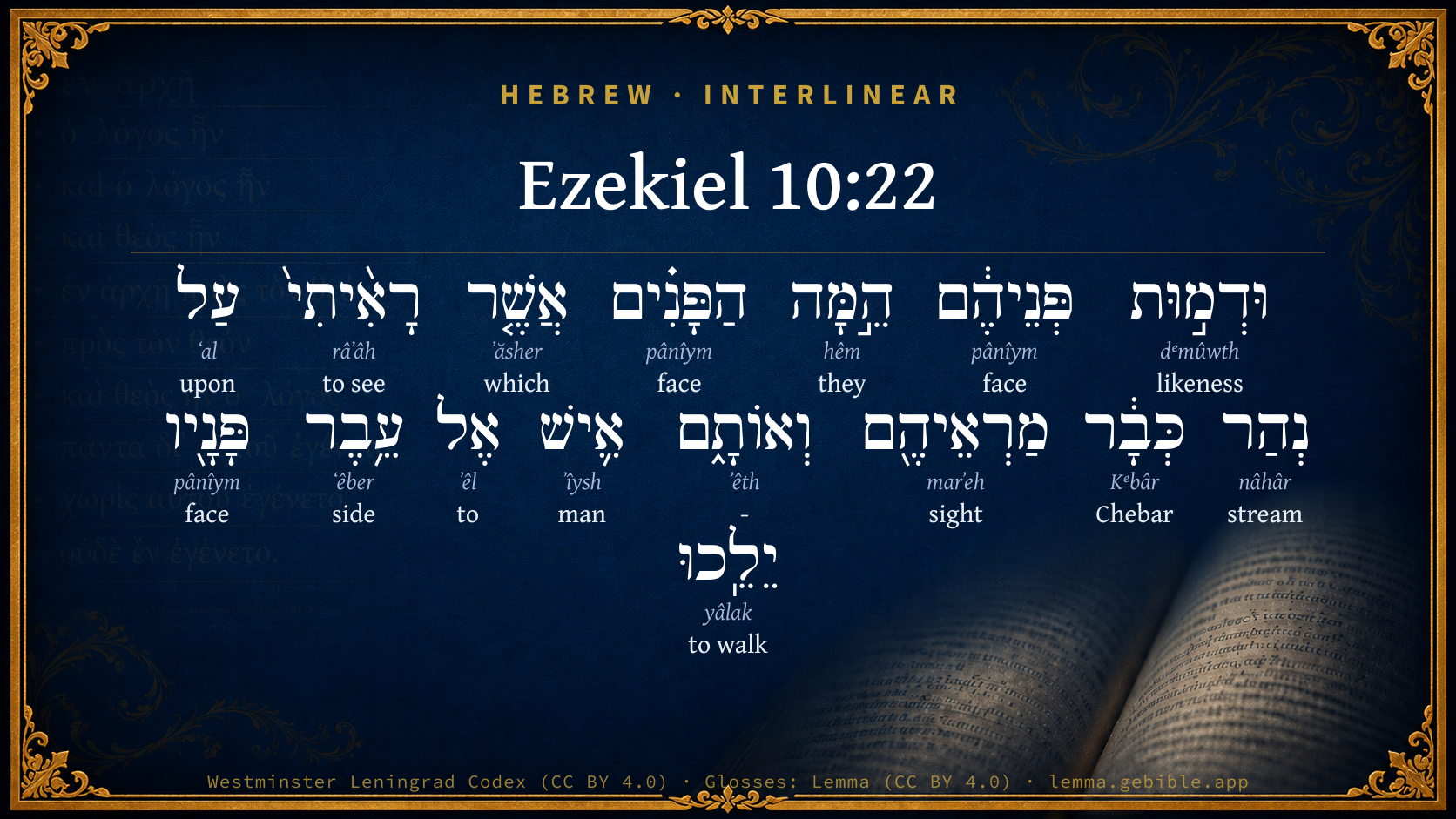
Hebrew (Westminster Leningrad Codex) Ezekiel 10:22 appears in the Hebrew Old Testament. The text above is from the Westminster Leningrad Codex. Each word links to its Strong’s number, a concise gloss, and parsing drawn from the Open Scriptures Hebrew Bible morphology. Click any word for its full Brown-Driver-Briggs (BDB) entry.
Download image
Cite this verse

Ezekiel 10:22 (World English Bible). Public Domain. Lemma interlinear Bible study tool, https://lemma.gebible.app/v/ezekiel/10/22.

Show BibTeX & RIS
BibTeX
RIS
English Translation
As for the likeness of their faces, they were the faces which I saw by the river Chebar, their appearances and themselves; they went every one straight forward.
World English Bible · Public Domain
Download a study sheet

One document with this verse’s original text, its word-by-word gloss line, the meaning frame, cross-references with their text, attributed commentary, and full source and license credits — printable, and it pastes into notes with its structure intact.

This verse Autodidact and up

Study sheet (.html) Plain text (.txt)

A passage Seminary Student

Up to 50 verses in one chapter. A passage sheet keeps up to 6 commentary sources and 12 cross-references per verse, in the order this page ranks them, and says so on the sheet whenever that leaves anything out. Ask for a single verse and you get the Autodidact verse sheet above.

Everything on this page stays free to read, with no account — the sheet is a download of what is already on screen, not access to it.

Want to remove ads? Support Godless Engineer
Compare translations 3

The same verse in 3 English versions, stacked beneath the original-language interlinear above. Click any original word for its lexicon entry.

Each is an independent rendering of the whole verse — the interlinear is not word-aligned to these translations.

Highlighted words mark where these versions differ — a whole-verse word diff, not a word-by-word alignment.

  • World English Bible Public Domain
    As for the likeness of their faces, they were the faces which I saw by the river Chebar, their appearances and themselves; they went every one straight forward.
  • King James Version Public Domain
    And the likeness of their faces was the same faces which I saw by the river of Chebar, their appearances and themselves: they went every one straight forward.
  • unfoldingWord Literal Text CC BY-SA 4.0
    and the likeness of their faces was like the faces that I had seen in the vision at the Kebar Canal, and each of them went straight ahead.

unfoldingWord Literal Text — © unfoldingWord, licensed CC BY-SA 4.0. Word-aligned USFM3 via Door43 (git.door43.org/unfoldingWord/en_ult).

Versions to compare (up to 4)

3 of 4 selected

Show all 18 translations

Every available English version of this verse, each an independent rendering of the whole verse.

  • World English Bible Public Domain
    As for the likeness of their faces, they were the faces which I saw by the river Chebar, their appearances and themselves; they went every one straight forward.
  • Berean Standard Bible Public Domain
    Their faces looked like the faces I had seen by the River Kebar. Each creature went straight ahead.
  • Majority Standard Bible Public Domain
    Their faces looked like the faces I had seen by the River Kebar. Each creature went straight ahead.
  • King James Version Public Domain
    And the likeness of their faces was the same faces which I saw by the river of Chebar, their appearances and themselves: they went every one straight forward.
  • American Standard Version (1901) Public Domain
    And as for the likeness of their faces, they were the faces which I saw by the river Chebar, their appearances and themselves; they went every one straight forward.
  • Revised Version (1885) Public Domain
    And as for the likeness of their faces, they were the faces which I saw by the river Chebar, their appearances and themselves; they went every one straight forward.
  • Geneva Bible (1599) Public Domain
    And the likenesse of their faces was the selfe same faces, which I sawe by the riuer Chebar, and the appearance of the Cherubims was ye selfe same, and they went euery one straight forwarde.
  • Douay-Rheims (1899) Public Domain
    And as to the likeness of their faces, they were the same faces which I had seen by the river Chobar, and their looks, and the impulse of every one to go straight forward.
  • Young's Literal Translation Public Domain
    As to the likeness of their faces, they `are' the faces that I saw by the river Chebar, their appearances and themselves; each straight forward they go.
  • Literal Standard Version CC BY-SA 4.0
    And the likeness of their faces, they [are] the faces that I saw by the river Chebar, their appearances and themselves; they each go straight forward.
  • Unlocked Literal Bible CC BY-SA 4.0
    and the likeness of their faces was like the faces that I had seen in the vision at the Kebar Canal, and each of them went straight ahead.
  • unfoldingWord Literal Text CC BY-SA 4.0
    and the likeness of their faces was like the faces that I had seen in the vision at the Kebar Canal, and each of them went straight ahead.
  • Darby Bible Public Domain
    And as for the likeness of their faces, they were the faces which I had seen by the river Chebar -- their appearance and themselves: they went every one straight before them.
  • World Messianic Bible Public Domain
    As for the likeness of their faces, they were the faces which I saw by the river Chebar, their appearances and themselves. They each went straight forward.
  • Webster's Bible Public Domain
    And the likeness of their faces was the same faces which I saw by the river of Kebar, their appearances and themselves: they went every one straight forward.
  • Free Bible Version CC BY-SA 4.0
    Their faces looked like the faces I had seen by the River Kebar. Each of them moved directly ahead.
  • Bible in Basic English Public Domain
    As for the form of their faces, they were the faces whose form I saw by the river Chebar; when they went, every one of them went straight forward.
  • JPS Tanakh (1917) Public Domain
    And as for the likeness of their faces, they were the faces which I saw by the river Chebar, their appearances and themselves; they went every one straight forward.

Literal Standard Version (2020), Covenant Press — licensed CC BY-SA 4.0. Text via the HelloAO Bible API (eBible.org). Unlocked Literal Bible (unfoldingWord) — licensed CC BY-SA 4.0. Text via the HelloAO Bible API (eBible.org). unfoldingWord Literal Text — © unfoldingWord, licensed CC BY-SA 4.0. Word-aligned USFM3 via Door43 (git.door43.org/unfoldingWord/en_ult). Free Bible Version, Dr. Jonathan Gallagher — licensed CC BY-SA 4.0. Text via the HelloAO Bible API (eBible.org).

Word by word

More ways to search: Search by grammar → Find every occurrence → Compare this word →

Practice this passage: Drill this verse → Learn its vocabulary →

כְּבָ֔ר
Kᵉbâr
H3529
“Chebar”
Noun, Proper
Part of Speech
Noun
Type
Proper
Full BDB Definition

Origin: the same as H3528

TWOT: 947d

Chebar = "far-off" - a Babylonian river near which many Israelite exiles settled; maybe the 'Habor' or the 'Royal Canal' of Nebuchadnezzar
  1. וּדְמ֣וּת dᵉmûwth H1823 “and · likeness of” Conjunction + Noun, Common, Feminine, Singular, Construct
  2. פְּנֵיהֶ֔ם pânîym H6440 “face(s) · their” Noun, Common, Both, Plural, Construct + Suffix, Personal, 3rd Person, Masculine, Plural
  3. הֵ֣מָּה hêm H1992 “they” Pronoun, Personal, 3rd Person, Masculine, Plural
  4. הַפָּנִ֗ים pânîym H6440 “the · face(s)” Particle, Definite Article + Noun, Common, Both, Plural, Absolute
  5. אֲשֶׁ֤ר ʼăsher H834 “which” Particle, Relative
  6. רָאִ֨יתִי֙ râʼâh H7200 “to see” Verb, Qal, Perfect, 1st Person, Common, Singular
  7. עַל ʻal H5921 “upon” Preposition
  8. נְהַר nâhâr H5104 “stream of” Noun, Common, Masculine, Singular, Construct
  9. מַרְאֵיהֶ֖ם marʼeh H4758 “sight · their” Noun, Common, Masculine, Singular, Construct + Suffix, Personal, 3rd Person, Masculine, Plural
  10. וְאוֹתָ֑ם ʼêth H853 “and · - · them” Conjunction + Particle, Direct Object + Suffix, Personal, 3rd Person, Masculine, Plural
  11. אִ֛ישׁ ʼîysh H376 “man” Noun, Common, Masculine, Singular, Absolute
  12. אֶל ʼêl H413 “to” Preposition
  13. עֵ֥בֶר ʻêber H5676 “side of” Noun, Common, Masculine, Singular, Construct
  14. פָּנָ֖יו pânîym H6440 “face(s) · his” Noun, Common, Both, Plural, Construct + Suffix, Personal, 3rd Person, Masculine, Singular
  15. יֵלֵֽכוּ yâlak H3212 “to walk” Verb, Qal, Imperfect, 3rd Person, Masculine, Plural

About this verse

These counts appear in no published source. They are computed here, from the morphology-tagged text and Lemma’s own curated glosses. What Lemma adds →

16
words
14
distinct lemmas
Prophets
section

Notable vocabulary

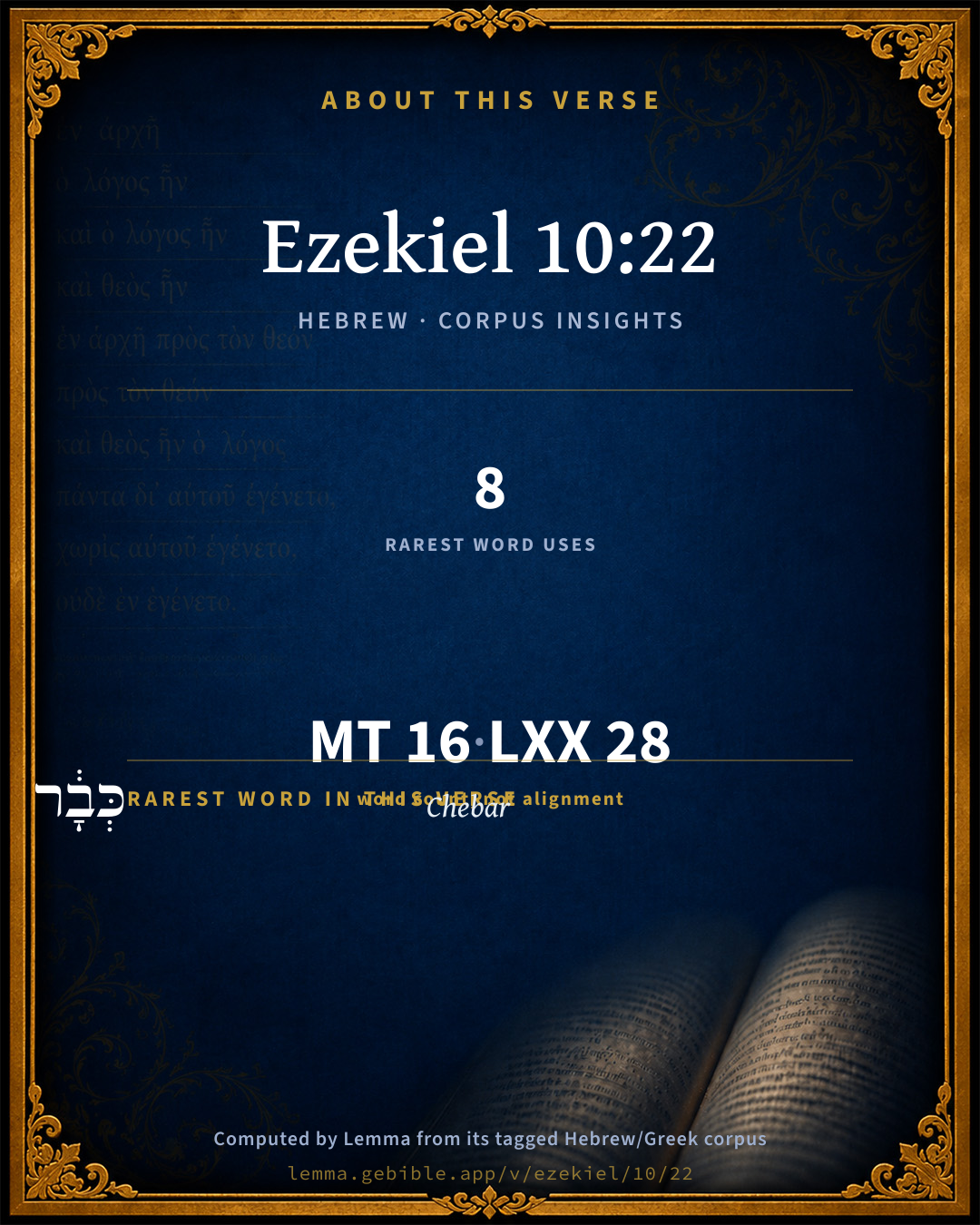
The rarest word here is כְּבָ֔ר Chebar H3529 — appearing just 8 times in the whole Hebrew Bible.

Shared distinctive vocabulary

כְּבָ֔ר Chebar H3529 occurs in 8 verses of the Hebrew Bible. Also found in:

Grammatical profile

  • 2 verbs
  • 9 nouns
  • 1 pronoun
  • 2 prepositions
  • 2 particles

Verb forms

  • רָאִ֨יתִי֙ Qal · Perfect
  • יֵלֵֽכוּ Qal · Imperfect

Repetition

A word recurs within this verse — often emphatic in Hebrew:

  • פְּנֵיהֶ֔ם face H6440 ×3

Hebrew & Septuagint length

In English translation the verse runs 28 words from the Hebrew and 35 from the Septuagint (LXX English) — closely comparable.

A rough comparison of the two English renderings, which tokenize alike — not a word-level alignment.

Word counts can differ between the Hebrew and the Greek without any difference in meaning — e.g. the Hebrew direct-object marker אֵת has no separate Greek word, and Greek often adds the article ὁ.

In the original languages it is 16 Hebrew tokens and 28 Greek tokens — but the two are counted differently (Hebrew bundles its prefixes and suffixes into one token; the Greek is in lemma form), so that isn’t a like-for-like length.

Cross-references

4

Topical passages linked to Ezekiel 10:22 in the Treasury of Scripture Knowledge — connected by theme and wording, ordered by reader-vote popularity; previews shown in the World English Bible.

  • Ezekiel 1:10 As for the likeness of their faces, they had the face of a man; and they four had the face of a lion on the right side; and they four had the face of an ox on the left side; they four had also the face of an eagle.
  • Ezekiel 10:11 When they went, they went in their four directions: they didn't turn as they went, but to the place where the head looked they followed it; they didn't turn as they went.
  • Ezekiel 1:12 They went everyone straight forward: where the spirit was to go, they went; they didn't turn when they went.
  • Hosea 14:9 Who is wise, that he may understand these things? Who is prudent, that he may know them? For the ways of Yahweh are right, And the righteous walk in them; But the rebellious stumble in them.

Cross-references courtesy of OpenBible.info (CC BY 4.0).

Hebrew and Greek witnesses Masoretic Hebrew ↔ Greek Septuagint

The same verse in the two great witnesses to the Old Testament, shown verse-for-verse.

These are two independent witnesses, not word-aligned to each other, and the Septuagint is shown in lemma (dictionary) form.

Hebrew Ezekiel 10:22 Masoretic · Westminster Leningrad Codex

וּדְמ֣וּת פְּנֵיהֶ֔ם הֵ֣מָּה הַפָּנִ֗ים אֲשֶׁ֤ר רָאִ֨יתִי֙ עַל נְהַר כְּבָ֔ר מַרְאֵיהֶ֖ם וְאוֹתָ֑ם אִ֛ישׁ אֶל עֵ֥בֶר פָּנָ֖יו יֵלֵֽכוּ

As for the likeness of their faces, they were the faces which I saw by the river Chebar, their appearances and themselves; they went every one straight forward.

World English Bible · Public Domain

Greek LXX Ezekiel 10:22 Septuagint · lemma form

καί ὁμοίωσις ὁ πρόσωπον αὐτός οὗτος ὁ πρόσωπον εἰμί ὅς ὁράω ὑποκάτω ὁ δόξα θεός ἰσραήλ ἐπί ὁ ποταμός ὁ χοβαρ καί αὐτός ἕκαστος κατά πρόσωπον αὐτός πορεύομαι

And as for the likeness of their faces, these are the same faces which I saw under the glory of the God of Israel by the river of Chobar: and they went each straight forward.

LXX2012 (modern English Septuagint) · Public Domain

Hebrew: Westminster Leningrad Codex (CC BY 4.0). Greek: Septuagint (public domain); English from LXX2012 (modern English Septuagint) (Public Domain). How the Septuagint differs from the Hebrew →

Targum (Aramaic paraphrase)

1

The Targum is the ancient Jewish Aramaic paraphrase of the Hebrew Scriptures — an interpretive translation, not the Hebrew text itself. Onkelos (literal) and Pseudo-Jonathan (expansive) render the Torah, and Jonathan the Prophets. Coverage is partial: where no permissively-licensed English translation exists for a verse, only the Aramaic is shown. This is verse-level text, not a word-by-word alignment to the Hebrew.

  1. Targum Jonathan Prophets (Joshua–Malachi)
    וּדְמוּת אַפֵּיהוֹן אִינוּן אַפַּיָא דִי חֲזֵיתִי עַל נְהַר כְּבָר חֶזְוֵיהוֹן וְאִינוּן בִּרְיָא לָקֳבֵיל אַפָּהָא אָזְלָא:

    (no public-domain English translation for this verse)

    Targum Jonathan — Aramaic: “Mikraot Gedolot” (public domain). English: “Sefaria Community Translation” (CC0 1.0 (public-domain dedication)); “London "Chaldee Paraphrase," 1871” (public domain). Text via Sefaria.

Commentary

Notes on Ezekiel 10:22 from classic Christian and Jewish commentators (each source and its license shown beneath its notes). The classic Christian expositions comment on the surrounding passage and are grouped to its opening verse, so a note may address several verses; the Jewish commentaries on the Tanakh (Rashi and others) are per-verse, so they appear only where the commentator wrote on this verse.

Lemma curates 59 commentaries, every one of them public domain or Creative Commons licensed, each selected and text-cleaned for this edition rather than reprinted as found. About our sources →

Trapp's Complete Commentary

John Trapp

Eze 10:22 And the likeness of their faces [was] the same faces which I saw by the river of Chebar, their appearances and themselves: they went every one straight forward.

Ver. 22. They went every one straightforward.] Let us, by their example, learn to advance forward to the high prize of the heavenly calling in Christ Jesus.

John Trapp, A Commentary or Exposition upon All the Books of the Old and New Testament (1647–1656) — public domain. Text from a community e-Sword module.

Jamieson, Fausset & Brown

Robert Jamieson, A. R. Fausset & David Brown

straight forward--intent upon the object they aimed at, not deviating from the way nor losing sight of the end (Luk 9:52).

Next: Ezekiel Chapter 11

Jamieson, Fausset & Brown — Commentary Critical and Explanatory on the Whole Bible (1871) — public domain (CC PDM 1.0). Text via the HelloAO Bible API.

John Calvin's Commentaries

He pursues the same sentiment, that nothing was obscure or perplexed in this vision, since all things were mutually suitable. For the remembrance of the vision which he had received remained in the Prophet’s mind: but now when he is hurried into the temple, he recognizes the same God and the same forms as those to which he had been accustomed. We see then how he meets their perverseness, who had otherwise boasted that he had offered them only his own fictions without any truth in them. Hence he restrains this petulance, and shows that God had certainly appeared to him, and that too a second time. Since he now says that each living creature went, forward in the direction of its face, it is not doubtful that this refers to their actions. Hence he points out that angels did not wander in their course as a person usually does who looks this way and that, or deserts the path, or turns to the right hand or the left. The Prophet therefore says, that the living creatures proceeded so that each was intent on its own end or scope: because if the motion of the angels had been turbulent, they had not been the servants of God. Finally, the Prophet signifies that the angels were not only alert and prepared for obedience, but were at the same time arranged and formed after a fixed rule, so that they did not in the slightest degree turn aside from. the command and direction of God It now follows —

John Calvin's Commentaries (1540-1563) — public domain. Text from the Calvin Translation Society English edition (1840s-50s) via the Christian Classics Ethereal Library (ccel.org). Calvin's coverage is partial (roughly two-thirds of the Bible); uncommented books and verses are honest gaps, never fabricated. The 19th-century editor's footnotes and remarks are omitted so the notes are faithfully Calvin's own voice.

John Gill's Exposition

And the likeness of their faces was the same faces,.... Or their faces were like the same,

which I saw by the river of Chebar; which prove that the living creatures and the cherubim must be the same:

their appearance and themselves; were exactly the same there was no difference in their faces or in their bodies:

they went everyone straight forward; their motion as well as their form were alike; they kept one even course, looking right on, and their eyes right before them.

Next: Ezekiel Chapter 11

John Gill's Exposition of the Whole Bible (1746–1763) — public domain (CC PDM 1.0). Text via the HelloAO Bible API.

Haydock's Catholic Bible Commentary

Forward, thus shewing God’s decree to abandon the synagogue. (Tirinus)

George Leo Haydock (1774–1849), Haydock's Catholic Family Bible and Commentary, 1859 edition — public domain. Excludes Psalms (Douay-Rheims chapter numbering differs from Protestant) and Deuterocanonical books (Catholic canon only).

Matthew Poole's English Annotations

See Eze 10:14, and Eze 1:10. These two verses are a full repeated attestation of the prophet’s that God had appeared to him, foreshowed fiery judgments coming and it is so repeated to awaken a stupid and senseless people. They have been already explained.

Matthew Poole's English Annotations on the Holy Bible (1683–1685) — public domain. Text from a community e-Sword/MySword module.

The Pulpit Commentary

Heavenly changelessness.

There is great resemblance between ch. 1. and ch. 10. Ezekiel is transported in spirit from the banks of the Babylonian river Chebar to the temple at Jerusalem. Yet the cherubim which he sees in the one place are exactly the same as those he has seen in the other. This fact of identity in great diversity of circumstances strikes the prophet as remarkable, and he chronicles it with emphasis. Earthly scenes change; heavenly facts remain.

I THE RANGE OF HEAVENLY CHANGELESSNESS.

1. In various times. Divine grace is always essentially the same. On the very threshold of history Abraham is justified by faith; today faith is the one ground of the soul"s becoming right with God. The Psalms of David express the inmost essence of religion for modern Christians. The gospel of the first century is the gospel for the nineteenth century. The Christ of history is the Christ of the future. If we can see the old familiar countenances of the essential Divine facts that cheered and warned and guided our fathers, we have just the vision that we need today though, indeed, the old truths are to have fresh applications, and though, perhaps, we may have to remove the veils with which the errors of the past have sometimes obscured them.

2. In various places. The cherubim of Chebar were the cherubim of Jerusalem. The Christ of Nazareth is the Christ for London. The religion that dawned among the hills of Galilee spreads like a day over the whole earth, and shows itself as suitable for England as for the East, and as suitable for China and Africa and New Guinea as for Europe and America.

3. Under various circumstances. The quiet river bank was very different from noisy Jerusalem. Yet the same wondrous cherubim looked down upon both scenes, as the same stars of heaven gaze upon the city slums and the country villages, on the blood stained battlefield and the peaceful meadow. The same God is over all. The gospel of Christ is the same for all rich and poor, learned and ignorant, young and old.

II THE CAUSES OF HEAVENLY CHANGELESSNESS.

1. Inherent truth. Our better changes come largely from the correction of mistakes. We are always having to unlearn our errors, to slough the old skin. But truth abides. In heaven all is true. God"s Word is true. Therefore while "all flesh is grass and the grass withers the Word of the Lord abideth forever". (1Pe_1:24, 1Pe_1:25)

2. Absolute perfection. Revelation came by stages of growth and development and through human channels. Hence its changes and the putting away of the old form of it in the Law for the new form of it in the gospel. But when we see through these earthly manifestations the really Divine behind them, we come upon absolute perfection, which is changeless.

3. Stable constancy. God is not fickle. His representative agents, symbolized by the cherubim, must be constant too. God will keep to his word. Therefore we may build upon his promise as on a granite rock. We change; he abideth faithful.

The Pulpit Commentary (1880–1919), ed. H.D.M. Spence-Jones & Joseph S. Exell — public domain. Text from a community e-Sword module.

Lesson kit

Teaching starters — assembled from the data on this page, not authored interpretation. Every prompt links to the verse data it draws on. Edit before teaching.

Ezekiel, in the Prophets, opens this verse with 16 words (14 distinct Hebrew lemmas). Its most distinctive word is Kᵉbâr (“Chebar”). A historical commentator’s framing appears above. Read the whole chapter for the surrounding context.

Discussion questions

  1. The word Kᵉbâr carries the sense “Chebar.” How does it shape the verse?
  2. Ezekiel 1:1 shares the word «Chebar» with this verse. How do the two illuminate each other?
  3. “face” occurs 3× in this one verse. What is the effect of the repetition?
  4. These translations render this verse differently; the difference is in the English rendering, not the original. What questions does that raise?
  5. The verb «רָאִ֨יתִי֙» is Qal Perfect. How does its form color the action?
  6. Reading how Trapp's Complete Commentary and Jamieson, Fausset & Brown read this verse, where do the two commentators agree and where do they part?

Things to notice

Reading settings

Reading text

Shown beneath each verse's original-language words.

Old Testament
Old Testament edition

Read the OT as the Masoretic Hebrew (MT) or the Greek Septuagint (LXX).

English shown for the Greek Septuagint (in the Hebrew ↔ Greek comparison).

Comparing translations? Open the Compare panel on any verse page to stack up to four side by side.