Ezekiel 2:5

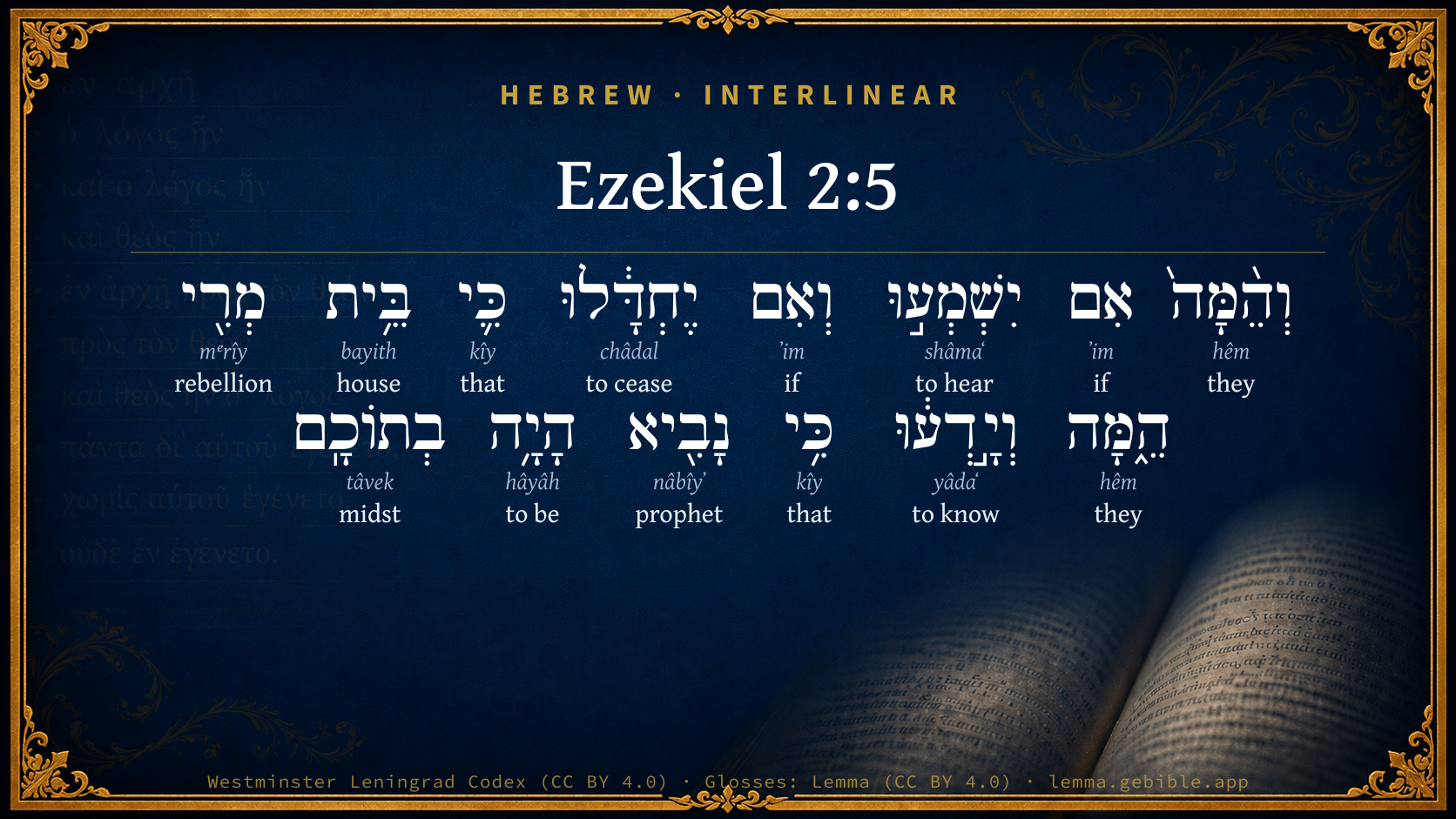
Hebrew (Westminster Leningrad Codex) Ezekiel 2:5 appears in the Hebrew Old Testament. The text above is from the Westminster Leningrad Codex. Each word links to its Strong’s number, a concise gloss, and parsing drawn from the Open Scriptures Hebrew Bible morphology. Click any word for its full Brown-Driver-Briggs (BDB) entry.
Download image
Cite this verse

Ezekiel 2:5 (World English Bible). Public Domain. Lemma interlinear Bible study tool, https://lemma.gebible.app/v/ezekiel/2/5.

Show BibTeX & RIS
BibTeX
RIS
English Translation
They, whether they will hear, or whether they will forbear, (for they are a rebellious house), yet shall know that there has been a prophet among them.
World English Bible · Public Domain
Download a study sheet

One document with this verse’s original text, its word-by-word gloss line, the meaning frame, cross-references with their text, attributed commentary, and full source and license credits — printable, and it pastes into notes with its structure intact.

This verse Autodidact and up

Study sheet (.html) Plain text (.txt)

A passage Seminary Student

Up to 50 verses in one chapter. A passage sheet keeps up to 6 commentary sources and 12 cross-references per verse, in the order this page ranks them, and says so on the sheet whenever that leaves anything out. Ask for a single verse and you get the Autodidact verse sheet above.

Everything on this page stays free to read, with no account — the sheet is a download of what is already on screen, not access to it.

Want to remove ads? Support Godless Engineer
Compare translations 3

The same verse in 3 English versions, stacked beneath the original-language interlinear above. Click any original word for its lexicon entry.

Each is an independent rendering of the whole verse — the interlinear is not word-aligned to these translations.

Highlighted words mark where these versions differ — a whole-verse word diff, not a word-by-word alignment.

  • World English Bible Public Domain
    They, whether they will hear, or whether they will forbear, (for they are a rebellious house), yet shall know that there has been a prophet among them.
  • King James Version Public Domain
    And they, whether they will hear, or whether they will forbear, (for they are a rebellious house,) yet shall know that there hath been a prophet among them.
  • unfoldingWord Literal Text CC BY-SA 4.0
    Either they will listen or they will not listen. They are a rebellious house, but they will at least know that a prophet has been among them.

unfoldingWord Literal Text — © unfoldingWord, licensed CC BY-SA 4.0. Word-aligned USFM3 via Door43 (git.door43.org/unfoldingWord/en_ult).

Versions to compare (up to 4)

3 of 4 selected

Show all 18 translations

Every available English version of this verse, each an independent rendering of the whole verse.

  • World English Bible Public Domain
    They, whether they will hear, or whether they will forbear, (for they are a rebellious house), yet shall know that there has been a prophet among them.
  • Berean Standard Bible Public Domain
    And whether they listen or refuse to listen—for they are a rebellious house—they will know that a prophet has been among them.
  • Majority Standard Bible Public Domain
    And whether they listen or refuse to listen—for they are a rebellious house—they will know that a prophet has been among them.
  • King James Version Public Domain
    And they, whether they will hear, or whether they will forbear, (for they are a rebellious house,) yet shall know that there hath been a prophet among them.
  • American Standard Version (1901) Public Domain
    And they, whether they will hear, or whether they will forbear, (for they are a rebellious house,) yet shall know that there hath been a prophet among them.
  • Revised Version (1885) Public Domain
    And they, whether they will hear, or whether they will forbear, (for they are a rebellious house,) yet shall know that there hath been a prophet among them.
  • Geneva Bible (1599) Public Domain
    But surely they will not heare, neither in deede will they cease: for they are a rebellious house: yet shall they knowe that there hath bene a Prophet among them.
  • Douay-Rheims (1899) Public Domain
    If so be they at least will hear, and if so be they will forbear, for they are a provoking house: and they shall know that there hath been a prophet in the midst of them.
  • Young's Literal Translation Public Domain
    and they -- whether they hear, or whether they forbear, for a rebellious house they `are' -- have known that a prophet hath been in their midst.
  • Literal Standard Version CC BY-SA 4.0
    And they—whether they hear, or whether they refrain, for they [are] a house of rebellion—have known that a prophet has been in their midst.
  • Unlocked Literal Bible CC BY-SA 4.0
    Either they will listen or they will not listen. They are a rebellious house, but they will at least know that a prophet has been among them.
  • unfoldingWord Literal Text CC BY-SA 4.0
    Either they will listen or they will not listen. They are a rebellious house, but they will at least know that a prophet has been among them.
  • Darby Bible Public Domain
    And they, whether they will hear or whether they will forbear -- for they are a rebellious house -- yet shall they know that there hath been a prophet among them.
  • World Messianic Bible Public Domain
    They, whether they will hear, or whether they will refuse—for they are a rebellious house—yet they will know that there has been a prophet among them.
  • Webster's Bible Public Domain
    And they, whether they will hear, or whether they will forbear, (for they are a rebellious house,) yet shall know that there hath been a prophet among them.
  • Free Bible Version CC BY-SA 4.0
    Whether they listen or not—for they are a rebellious people—they will realize that a prophet has come to them.
  • Bible in Basic English Public Domain
    And they, if they give ear to you or if they do not give ear (for they are an uncontrolled people), will see that there has been a prophet among them.
  • JPS Tanakh (1917) Public Domain
    And they, whether they will hear, or whether they will forbear — for they are a rebellious house — yet shall know that there hath been a prophet among them.

Literal Standard Version (2020), Covenant Press — licensed CC BY-SA 4.0. Text via the HelloAO Bible API (eBible.org). Unlocked Literal Bible (unfoldingWord) — licensed CC BY-SA 4.0. Text via the HelloAO Bible API (eBible.org). unfoldingWord Literal Text — © unfoldingWord, licensed CC BY-SA 4.0. Word-aligned USFM3 via Door43 (git.door43.org/unfoldingWord/en_ult). Free Bible Version, Dr. Jonathan Gallagher — licensed CC BY-SA 4.0. Text via the HelloAO Bible API (eBible.org).

Word by word

More ways to search: Search by grammar → Find every occurrence → Compare this word →

Practice this passage: Drill this verse → Learn its vocabulary →

מְרִ֖י
mᵉrîy
H4805
“rebellion”
Noun, Common, Masculine, Singular, Absolute
Part of Speech
Noun
Type
Common
Gender
Masculine
Number
Singular
State
Absolute
Full BDB Definition

Origin: from H4784

TWOT: 1242a

rebellion - rebellion - rebellious (in construct)
  1. וְהֵ֨מָּה֙ hêm H1992 “and · they” Conjunction + Pronoun, Personal, 3rd Person, Masculine, Plural
  2. אִם ʼim H518 “if” Conjunction
  3. יִשְׁמְע֣וּ shâmaʻ H8085 “to hear” Verb, Qal, Imperfect, 3rd Person, Masculine, Plural
  4. וְאִם ʼim H518 “and · if” Conjunction + Conjunction
  5. יֶחְדָּ֔לוּ châdal H2308 “to cease” Verb, Qal, Imperfect, 3rd Person, Masculine, Plural
  6. כִּ֛י kîy H3588 “that” Conjunction
  7. בֵּ֥ית bayith H1004 “house of” Noun, Common, Masculine, Singular, Construct
  8. הֵ֑מָּה hêm H1992 “they” Pronoun, Personal, 3rd Person, Masculine, Plural
  9. וְיָ֣דְע֔וּ yâdaʻ H3045 “and · to know” Conjunction + Verb, Qal, Sequential Perfect, 3rd Person, Common, Plural
  10. כִּ֥י kîy H3588 “that” Conjunction
  11. נָבִ֖יא nâbîyʼ H5030 “prophet” Noun, Common, Masculine, Singular, Absolute
  12. הָיָ֥ה hâyâh H1961 “to be” Verb, Qal, Perfect, 3rd Person, Masculine, Singular
  13. בְתוֹכָֽם tâvek H8432 “in/at · midst · their” Preposition + Noun, Common, Masculine, Singular, Construct + Suffix, Personal, 3rd Person, Masculine, Plural

About this verse

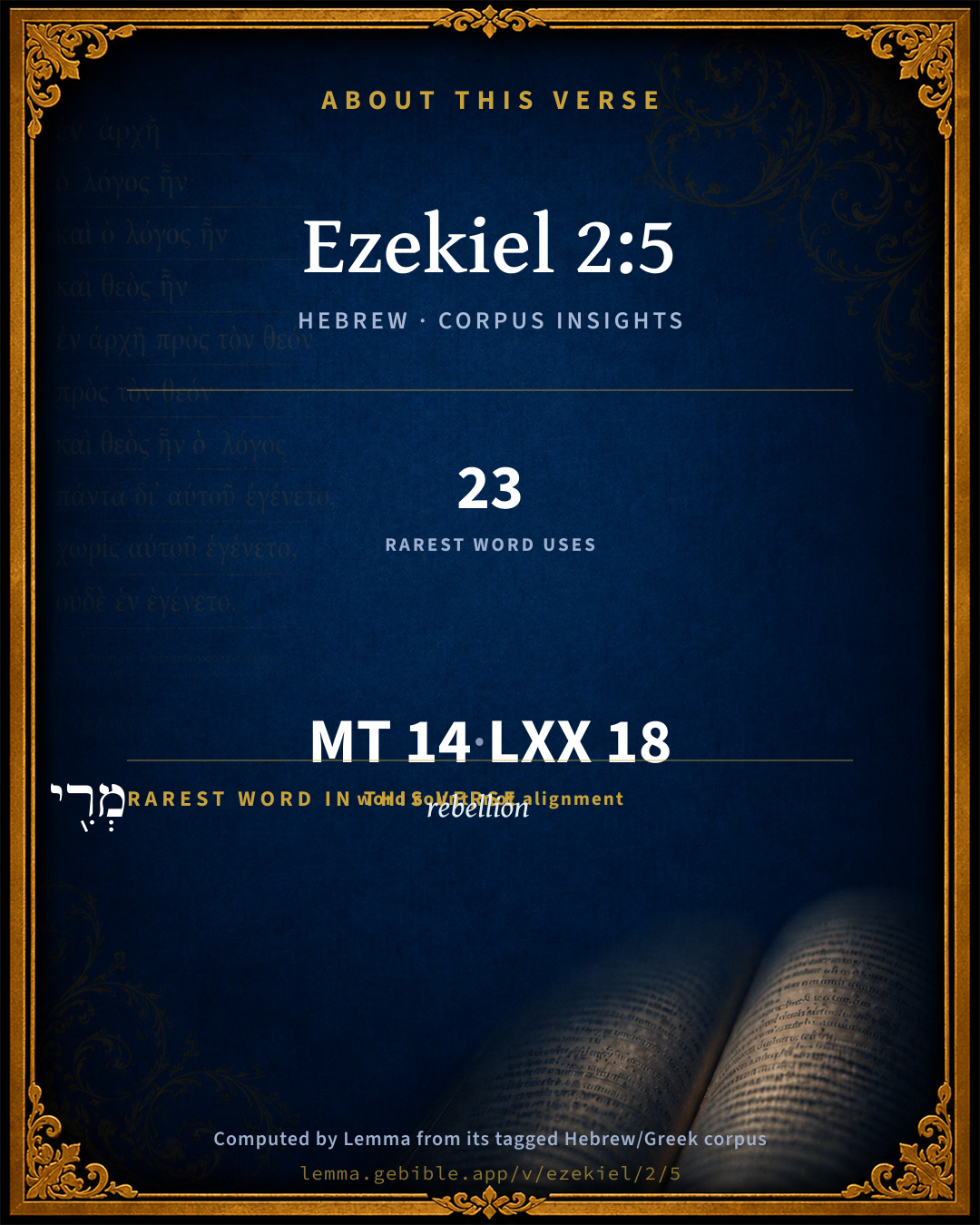
These counts appear in no published source. They are computed here, from the morphology-tagged text and Lemma’s own curated glosses. What Lemma adds →

14
words
11
distinct lemmas
Prophets
section

Notable vocabulary

The rarest word here is מְרִ֖י rebellion H4805 — appearing just 23 times in the whole Hebrew Bible.

Shared distinctive vocabulary

מְרִ֖י rebellion H4805 occurs in 21 verses of the Hebrew Bible. Also found in:

Grammatical profile

  • 4 verbs
  • 4 nouns
  • 2 pronouns
  • 4 conjunctions

Verb forms

  • יִשְׁמְע֣וּ Qal · Imperfect
  • יֶחְדָּ֔לוּ Qal · Imperfect
  • וְיָ֣דְע֔וּ Qal · Sequential Perfect
  • הָיָ֥ה Qal · Perfect

Repetition

Words recur within this verse — often emphatic in Hebrew:

  • וְהֵ֨מָּה֙ they H1992 ×2
  • אִם if H518 ×2
  • כִּ֛י that H3588 ×2

Hebrew & Septuagint length

In English translation the verse runs 27 words from the Hebrew and 28 from the Septuagint (LXX English) — closely comparable.

A rough comparison of the two English renderings, which tokenize alike — not a word-level alignment.

Word counts can differ between the Hebrew and the Greek without any difference in meaning — e.g. the Hebrew direct-object marker אֵת has no separate Greek word, and Greek often adds the article ὁ.

In the original languages it is 14 Hebrew tokens and 18 Greek tokens — but the two are counted differently (Hebrew bundles its prefixes and suffixes into one token; the Greek is in lemma form), so that isn’t a like-for-like length.

Cross-references

12

Topical passages linked to Ezekiel 2:5 in the Treasury of Scripture Knowledge — connected by theme and wording, ordered by reader-vote popularity; previews shown in the World English Bible.

  • Ezekiel 33:33 When this comes to pass, (behold, it comes), then shall they know that a prophet has been among them.
  • Ezekiel 3:27 But when I speak with you, I will open your mouth, and you shall tell them, Thus says the Lord Yahweh: He who hears, let him hear; and he who forbears, let him forbear: for they are a rebellious house.
  • Matthew 10:12–15 As you enter into the household, greet it.
  • John 15:22 If I had not come and spoken to them, they would not have had sin; but now they have no excuse for their sin.
  • Ezekiel 2:7 You shall speak my words to them, whether they will hear, or whether they will forbear; for they are most rebellious.
  • Luke 10:10–12 But into whatever city you enter, and they don't receive you, go out into the streets of it and say,
  • Acts 13:46 Paul and Barnabas spoke out boldly, and said, "It was necessary that God's word should be spoken to you first. Since indeed you thrust it from you, and judge yourselves unworthy of eternal life, behold, we turn to the Gentiles.
  • Romans 3:3 For what if some were without faith? Will their lack of faith nullify the faithfulness of God?
  • 2 Corinthians 2:15–17 For we are a sweet aroma of Christ to God, in those who are saved, and in those who perish;
  • Ezekiel 3:10–11 Moreover he said to me, Son of man, all my words that I shall speak to you receive in your heart, and hear with your ears.
  • Ezekiel 3:19 Yet if you warn the wicked, and he doesn't turn from his wickedness, nor from his wicked way, he shall die in his iniquity; but you have delivered your soul.
  • Ezekiel 33:9 Nevertheless, if you warn the wicked of his way to turn from it, and he doesn't turn from his way; he shall die in his iniquity, but you have delivered your soul.

Cross-references courtesy of OpenBible.info (CC BY 4.0).

Hebrew and Greek witnesses Masoretic Hebrew ↔ Greek Septuagint

The same verse in the two great witnesses to the Old Testament, shown verse-for-verse.

These are two independent witnesses, not word-aligned to each other, and the Septuagint is shown in lemma (dictionary) form.

Hebrew Ezekiel 2:5 Masoretic · Westminster Leningrad Codex

וְהֵ֨מָּה֙ אִם יִשְׁמְע֣וּ וְאִם יֶחְדָּ֔לוּ כִּ֛י בֵּ֥ית מְרִ֖י הֵ֑מָּה וְיָ֣דְע֔וּ כִּ֥י נָבִ֖יא הָיָ֥ה בְתוֹכָֽם

They, whether they will hear, or whether they will forbear, (for they are a rebellious house), yet shall know that there has been a prophet among them.

World English Bible · Public Domain

Greek LXX Ezekiel 2:5 Septuagint · lemma form

ἐάν ἄρα ἀκούω ἤ πτοέω διότι οἶκος παραπικραίνω εἰμί καί γιγνώσκω ὅτι προφήτης εἰμί σύ ἐν μέσος αὐτός

Whether then indeed they shall hear or fear, (for it is a provoking house,) yet they shall know that you are a prophet in the midst of them.

LXX2012 (modern English Septuagint) · Public Domain

Hebrew: Westminster Leningrad Codex (CC BY 4.0). Greek: Septuagint (public domain); English from LXX2012 (modern English Septuagint) (Public Domain). How the Septuagint differs from the Hebrew →

Targum (Aramaic paraphrase)

1

The Targum is the ancient Jewish Aramaic paraphrase of the Hebrew Scriptures — an interpretive translation, not the Hebrew text itself. Onkelos (literal) and Pseudo-Jonathan (expansive) render the Torah, and Jonathan the Prophets. Coverage is partial: where no permissively-licensed English translation exists for a verse, only the Aramaic is shown. This is verse-level text, not a word-by-word alignment to the Hebrew.

  1. Targum Jonathan Prophets (Joshua–Malachi)
    וְאִינוּן אִם יְקַבְּלוּן אוּלְפַן וְאִם יִתְמַנְעוּן מִלְמֶחְטֵי אֲרֵי עַם סַרְבָן אִינוּן וְיֵדְעוּן דִי נְבִיָא הֲוָה בֵינֵיהוֹן:

    (no public-domain English translation for this verse)

    Targum Jonathan — Aramaic: “Mikraot Gedolot” (public domain). English: “Sefaria Community Translation” (CC0 1.0 (public-domain dedication)); “London "Chaldee Paraphrase," 1871” (public domain). Text via Sefaria.

Commentary

Notes on Ezekiel 2:5 from classic Christian and Jewish commentators (each source and its license shown beneath its notes). The classic Christian expositions comment on the surrounding passage and are grouped to its opening verse, so a note may address several verses; the Jewish commentaries on the Tanakh (Rashi and others) are per-verse, so they appear only where the commentator wrote on this verse.

Lemma curates 59 commentaries, every one of them public domain or Creative Commons licensed, each selected and text-cleaned for this edition rather than reprinted as found. About our sources →

Trapp's Complete Commentary

John Trapp

Eze 2:5 And they, whether they will hear, or whether they will forbear, (for they [are] a rebellious house,) yet shall know that there hath been a prophet among them.

Ver. 5. And they, whether they will hear, or whether they will forbear.] Some refractories will not so much as hear a minister of God; but bid him, as those old Italians once did the Roman ambassador, Ad quercus dicere, se interim alia acturos, speak to the posts; they had somewhat else to do than to give ear to them. See 1Co 1:22. Of those also that do hear, scarce the hundredth man believeth our report, saith Calvin; Nay, scarce the thousandth man, saith Chrysostom.

For they are a rebellious house.] This was small encouragement. Hence prophets have so hung off, as Moses, Isaiah, Jonah, Jeremiah, &c. Knox, when called first to preach, burst forth into abundance of tears. Bradford was hardly persuaded by Bucer to enter into the ministry, &c. {a}

Yet shall know that there hath been a prophet among them.] Let them prove incorrigible, they shall also prove inexcusable, and self-condemned. See 2Co 2:16. {See Trapp on "2Co 2:16"} Convinced they shall be, if not converted; and who knows how the word, now slighted, may hereafter work upon them? Saepe fit ut audientes verbum moleste, suscipiant fructuose, {b} They may better bethink themselves.

{a} Acts and Mon.

{b} Jerome.

John Trapp, A Commentary or Exposition upon All the Books of the Old and New Testament (1647–1656) — public domain. Text from a community e-Sword module.

Geneva Bible (1599)

Geneva Bible translators

This declareth on the one part God’s great affection toward his people, that notwithstanding their rebellion, yet he will send his Prophets among them, and admonisheth his ministers on the other part that they cease not to do their duty, though the people be never so obstinate: for the word of God shall be either to their salvation or greater condemnation.

Geneva Bible (1599) marginal notes — public domain. Text via Bolls.life.

Jamieson, Fausset & Brown

Robert Jamieson, A. R. Fausset & David Brown

forbear--namely, to hear.

yet shall know--Even if they will not hear, at least they will not have ignorance to plead as the cause of their perversity (Eze 33:33).

Jamieson, Fausset & Brown — Commentary Critical and Explanatory on the Whole Bible (1871) — public domain (CC PDM 1.0). Text via the HelloAO Bible API.

Adam Clarke's Commentary

Verse 5. Yet shall know that there hath been a prophet among them.] By this they shall be assured of two things:

1. That God in his mercy had given them due warning.

2. That themselves were inexcusable, for not taking it.

Adam Clarke's Commentary on the Bible (1810–1826) — public domain. Text from a community e-Sword/MySword module.

John Calvin's Commentaries

Here, again, God exhorts his servant to persevere whatever be the event of his labor, for if we do not succeed according to the desire of our minds, we are inclined to despair: but God wishes us to proceed in the course of our duty, though all things should turn out contrary to our wishes. But he shows that there shall be some fruit of our labor, although the people, through their own depravity, reject what has been said to them: for this thought breaks the spirits of God’s servants, when they do not perceive the usefulness of their labor: for we always desire to accomplish something worth the trouble which we give to it. God therefore here signifies that he has some other object in view than the salvation of men; namely, the removal of all pretext for error, and the stripping off of every disguise of impiety in which men willingly clothe themselves. For even hypocrites, though they perish knowingly and willfully, yet think themselves excusable, unless God afford them the light of his doctrine. The meaning therefore is, although the Prophet’s teaching would not profit the Israelites, yet it would be useful in another way, namely, that they may perceive that there has been a prophet among them In this way there is no defect, although some think the words of the Prophet abrupt: for an important word seems to be wanting when he says, whether they will hear, or whether they will forbear, because they are a rebellious house, and they shall know, etc. For we have said that the copula ought to be resolved into the adversative particle, because even then they shall know: for their perverseness shall not prevent their being convinced by God. We may learn then from this place, that although the impious furiously endeavor to reject the doctrine of God, yet they obtain no other end than the more complete manifestation of their own wickedness. Hence, also, we may learn that God’s doctrine is precious to himself, and that he cannot bear us to despise it. The wicked then never can escape punishment when they treat with contempt the divine teaching, for it is as if they trampled upon inestimable treasure, Those who are left without the law and the prophets shall not escape God’s hand, because their conscience is sufficient to take away all excuse. (Romans 2:12.) But when God invites men to himself, and approaches near them, and offers himself to them in a peculiar manner as their Father and Teacher, if they reject so remarkable a benefit, truly their ingratitude is worthy of the utmost severity. For as often as God raises up prophets for us and faithful ministers of his doctrine, let this which has just been said come into our minds: unless we embrace such a benefit, we at length shall know that a prophet has been among us, because God will exact fearful vengeance for the contempt of his great loving-kindness. Now it follows —

John Calvin's Commentaries (1540-1563) — public domain. Text from the Calvin Translation Society English edition (1840s-50s) via the Christian Classics Ethereal Library (ccel.org). Calvin's coverage is partial (roughly two-thirds of the Bible); uncommented books and verses are honest gaps, never fabricated. The 19th-century editor's footnotes and remarks are omitted so the notes are faithfully Calvin's own voice.

Ellicott's Commentary for English Readers

(5) Whether they will hear, or whether they will forbear.—Comp. Eze_3:11. God’s word remains the same whatever reception man may accord to it; it cannot return unto Him void, but must accomplish that which He pleases (Isa_55:11); just as the Apostles remained “unto God a sweet savour of Christ” alike “in them that are saved and in them that perish” (2Co_2:15-16). But while the mighty power of the Divine word must thus produce its effect, the character of the effect depends upon those to whom it comes; “to the one we are a savour of death unto death, and to the other the savour of life unto life.” So it would be among the captives by the Chebar: some would be brought back to their allegiance to their God, and would constitute the remnant through whom He would bless His people and the world; and some, resisting the offered grace, would be thus made more obdurate than ever. In either case, they could not remain as before. Whether for gain or for loss, they should “know that there hath been a prophet among them,” by the change his ministrations should produce among them. The offer of grace, imposing the responsibility of accepting or rejecting it, ever becomes thus “a great and terrible day of the Lord.” (See Joe_2:31; Mal_4:5, compared with Mat_17:12; Act_2:16-22.)

A rebellious house.—Literally, a house of rebellion. This phrase, used in Ezekiel about eleven times, seems to be more than a simple epithet; it is a significant substitute for the name in which they gloried. Instead of “house of Israel, the prince of God,” they had come to be the “house of rebellion.”

A Bible Commentary for English Readers, edited by Charles John Ellicott (1878–1897) — public domain. Text from a community e-Sword module.

The Cambridge Bible for Schools and Colleges

gen. ed. J. J. S. Perowne

5. for they are a rebellious house] Whether they hear or whether they forbear—and they will forbear, for they are a rebellious house—yet shall they know that a prophet has been among them. The future shall bring this home to them. They shall see the prophet’s words come to pass, and shall know that a true messenger from the Lord spoke to them. The true prophet, the man who has anything to announce from God, may assure himself that, however he be received when he speaks, in the long run he shall receive his due and be recognized for what he was.

The Cambridge Bible for Schools and Colleges (gen. ed. J. J. S. Perowne; Cambridge University Press, 1878–1918) — public domain. Text from a community e-Sword module.

John Gill's Exposition

And they, whether they will hear, or whether they will forbear,.... Or "cease" (y); that is, from hearing, as Jarchi and Kimchi interpret it; or from sinning, as the Targum. The sense is, whether they would hear the word of the Lord, as spoken by the prophet, attend unto it, receive it, and obey it; or whether they would reject it, turn their backs on it, and discontinue hearing it; or whether they would so hear as to leave their sinful course of life, or not: this the prophet could not know beforehand, nor should he be concerned about it, or be discouraged if his ministry should be fruitless; since he could not expect much from them:

(for they are a rebellious house); or, "a house of rebellion" (z); a most rebellious one; hard of heart, face, and neck:

yet shall know that there hath been a prophet among them; so that they were left without excuse, which was the end of the prophet's being sent unto them; there was little or no hope of reclaiming them; but, however, by such a step taken, they could not say that they had no prophet sent to reprove them for their sins, and warn them of their danger; had they, they would have listened to him, and so have escaped the evils that came upon them,

(y) "cessaverint", Pagninas, Montanus, Starckius; "desistent", Calvin, Junius & Tremellius, Piscator. (z) "domus rebellionis", Montanus, Calvin, Piscator, Junius & Tremellius, Starckius.

John Gill's Exposition of the Whole Bible (1746–1763) — public domain (CC PDM 1.0). Text via the HelloAO Bible API.

Albert Barnes' Notes on the Bible

A rebellious house - A phrase employed continually by Ezekiel in bitter irony, in the place of house of Israel, as much as to say, “House no longer of Israel, but of rebellion.” Compare Isa 30:9.

Albert Barnes' Notes on the Bible (1834–1885) — public domain. Text from a community e-Sword/MySword module.

Haydock's Catholic Bible Commentary

Forbear to sin. (Haydock) --- He thus insinuates free-will. (St. Jerome) --- If they refuse to hear my prophet, they will at least perceive that hey are inexcusable. (Calmet)

George Leo Haydock (1774–1849), Haydock's Catholic Family Bible and Commentary, 1859 edition — public domain. Excludes Psalms (Douay-Rheims chapter numbering differs from Protestant) and Deuterocanonical books (Catholic canon only).

Matthew Poole's English Annotations

Though the omniscient God knows which they will do, yet he lets not the prophet know, but enjoins him his duty, affords these sinners the mercy of warnings and calls, and expects that they act like men, hear and obey.

Hear; they only hear that comply with God’s counsel, and as for others, they hearing hear not.

Forbear; either forbear their ways of sinning, and cease to do evil, or forbear to hear thee: be not too much dejected about it: some perhaps may hear and forbear to sin, others will forbear to hear thee but not forbear to sin, the greatest part will show themselves a rebellious house.

For they are a rebellious house; family, house put for the whole nation; yet wait the event, do thy duty.

Shall know that there hath been a prophet among them; all of them shall know; they that hear and obey shall know by the good that I will do to them, I will bless them and bring them back; those that will neither hear what they should do, nor forbear doing what they should not do, shall know by the evil which I will bring upon them. Thy truth and name will I vindicate, and prove thee a prophet, to the comfort of thyself and others who are obedient, but to the shame and confusion of the evil and wicked.

Matthew Poole's English Annotations on the Holy Bible (1683–1685) — public domain. Text from a community e-Sword/MySword module.

Whedon's Commentary on the Bible

Daniel D. Whedon

5. Whether they will hear — Heredity may have determined the form of their guilt, but it does not relieve them from responsibility. They are still able to hear and obey — yet these words breathe a sad suspicion that they will still remain persistently impenitent. Yet shall know, etc. — To speak as a herald, not originating the message or arguing about it, or tampering with it, but simply crying, “Thus saith the Lord,” is the best way to convince a sharp-tongued and impudent people that there is a prophet in their midst. Even such hearers will soon begin to acknowledge that there is something in religion, and “if there is a prophet on earth, Ezekiel is one.”

Daniel D. Whedon (gen. ed.), Commentary on the Old and New Testaments (1874–1909) — public domain. Text from a community e-Sword module.

The Pulpit Commentary

Whether they will hear, or whether they will forbear, etc. The latter word is used in the sense of "cease" or "desist," as in 1Co_9:6 and Eph_6:9. The same formula meets us in ver. Eze_3:11, Eze_3:27. The prophet is warned beforehand of the (at least) probable failure of his mission, wholly or in part. We note the parallelism of thought, though not language, in 2Co_2:15, 2Co_2:16. Such, at all times, has been the condition of the prophet"s work. The expectation is grounded upon the antecedent fact of their being a "rebellious people." There is the consolation that in the end, partly through the fulfilment of his words, partly, it may be, through the witness of their own conscience, they shall know that there has been a prophet among them. (comp. Jer_28:9) We note that it is the first time that Ezekiel claims that name for himself.

The Pulpit Commentary (1880–1919), ed. H.D.M. Spence-Jones & Joseph S. Exell — public domain. Text from a community e-Sword module.

John Wesley's Explanatory Notes

Shall know - They that obey shall know by the good I will do them, those that will not, by the evil which I will bring upon them.

John Wesley, Explanatory Notes Upon the Whole Bible (1754–1765) — public domain. Text via the GEBible commentary corpus.

Rashi

Rabbi Shlomo Yitzchaki (Rashi)

And they whether they listen or whether they forbear from listening.

for they are a rebellious house They are remonstrative people, but I want them to know at the time of their retribution that a prophet had been in their midst who reproved them, and they did not heed.

Rashi on the Tanakh — English translations: “The Judaica Press complete Tanach with Rashi, translated by A. J. Rosenberg” (CC BY 4.0); “Pentateuch with Rashi's commentary by M. Rosenbaum and A.M. Silbermann, 1929-1934” (public domain); “The Metsudah Tanach series, Lakewood, N.J” (CC BY 4.0); and “The Book of Joshua, Metsudah Publications, 1997” (CC BY 4.0). Text via Sefaria.

Lesson kit

Teaching starters — assembled from the data on this page, not authored interpretation. Every prompt links to the verse data it draws on. Edit before teaching.

Ezekiel, in the Prophets, opens this verse with 14 words (11 distinct Hebrew lemmas). Its most distinctive word is mᵉrîy (“rebellion”). A historical commentator’s framing appears above. Read the whole chapter for the surrounding context.

Discussion questions

  1. The word mᵉrîy carries the sense “rebellion.” How does it shape the verse?
  2. Numbers 17:10 shares the word «rebellion» with this verse. How do the two illuminate each other?
  3. “they” occurs 2× in this one verse. What is the effect of the repetition?
  4. The translations on this page render this verse differently — a whole-verse word diff, not a word-by-word alignment. What might account for the different wordings?
  5. The verb «יִשְׁמְע֣וּ» is Qal Imperfect. How does its form color the action?
  6. Reading how Trapp's Complete Commentary and Geneva Bible (1599) read this verse, where do the two commentators agree and where do they part?

Things to notice

Reading settings

Reading text

Shown beneath each verse's original-language words.

Old Testament
Old Testament edition

Read the OT as the Masoretic Hebrew (MT) or the Greek Septuagint (LXX).

English shown for the Greek Septuagint (in the Hebrew ↔ Greek comparison).

Comparing translations? Open the Compare panel on any verse page to stack up to four side by side.