
Leviticus 21:6

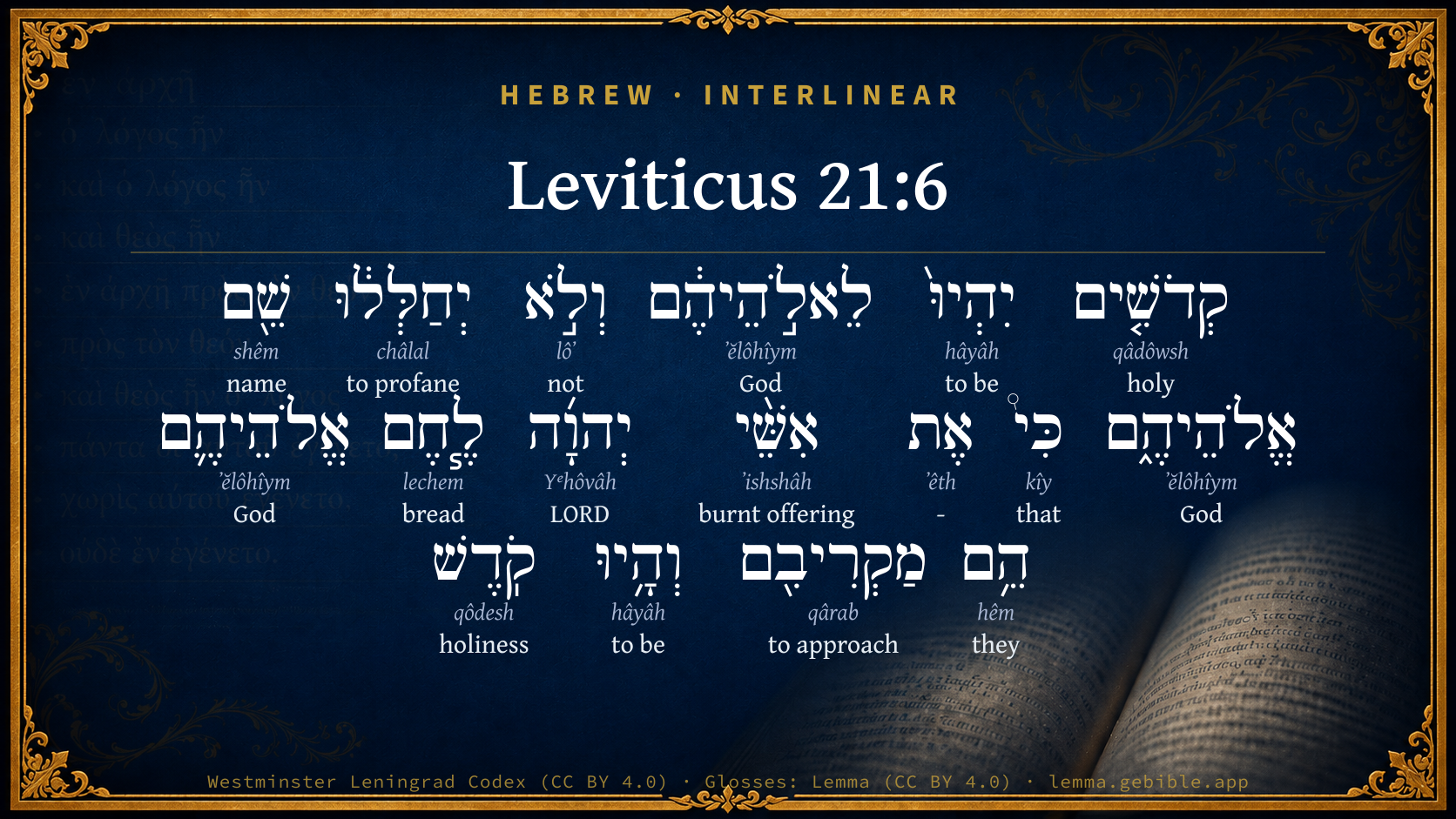
Hebrew (Westminster Leningrad Codex) Leviticus 21:6 appears in the Hebrew Old Testament. The text above is from the Westminster Leningrad Codex. Each word links to its Strong’s number, a concise gloss, and parsing drawn from the Open Scriptures Hebrew Bible morphology. Click any word for its full Brown-Driver-Briggs (BDB) entry.
Download image
Cite this verse

Leviticus 21:6 (World English Bible). Public Domain. Lemma interlinear Bible study tool, https://lemma.gebible.app/v/leviticus/21/6.

Show BibTeX & RIS
BibTeX
RIS
English Translation
They shall be holy to their God, and not profane the name of their God; for they offer the offerings of Yahweh made by fire, the bread of their God; therefore they shall be holy.
World English Bible · Public Domain
Download a study sheet

One document with this verse’s original text, its word-by-word gloss line, the meaning frame, cross-references with their text, attributed commentary, and full source and license credits — printable, and it pastes into notes with its structure intact.

This verse Autodidact and up

Study sheet (.html) Plain text (.txt)

A passage Seminary Student

Up to 50 verses in one chapter. A passage sheet keeps up to 6 commentary sources and 12 cross-references per verse, in the order this page ranks them, and says so on the sheet whenever that leaves anything out. Ask for a single verse and you get the Autodidact verse sheet above.

Everything on this page stays free to read, with no account — the sheet is a download of what is already on screen, not access to it.

Want to remove ads? Support Godless Engineer
Compare translations 3

The same verse in 3 English versions, stacked beneath the original-language interlinear above. Click any original word for its lexicon entry.

Each is an independent rendering of the whole verse — the interlinear is not word-aligned to these translations.

Highlighted words mark where these versions differ — a whole-verse word diff, not a word-by-word alignment.

  • World English Bible Public Domain
    They shall be holy to their God, and not profane the name of their God; for they offer the offerings of Yahweh made by fire, the bread of their God; therefore they shall be holy.
  • King James Version Public Domain
    They shall be holy unto their God, and not profane the name of their God: for the offerings of the LORD made by fire, and the bread of their God, they do offer: therefore they shall be holy.
  • unfoldingWord Literal Text CC BY-SA 4.0
    They shall be holy to their God, and they shall not profane the name of their God, for they are presenting gifts of Yahweh, the bread of their God, and they shall be holy.

unfoldingWord Literal Text — © unfoldingWord, licensed CC BY-SA 4.0. Word-aligned USFM3 via Door43 (git.door43.org/unfoldingWord/en_ult).

Versions to compare (up to 4)

3 of 4 selected

Show all 18 translations

Every available English version of this verse, each an independent rendering of the whole verse.

  • World English Bible Public Domain
    They shall be holy to their God, and not profane the name of their God; for they offer the offerings of Yahweh made by fire, the bread of their God; therefore they shall be holy.
  • Berean Standard Bible Public Domain
    They must be holy to their God and not profane the name of their God. Because they present to the LORD the offerings made by fire, the food of their God, they must be holy.
  • Majority Standard Bible Public Domain
    They must be holy to their God and not profane the name of their God. Because they present to the LORD the food offerings, the food of their God, they must be holy.
  • King James Version Public Domain
    They shall be holy unto their God, and not profane the name of their God: for the offerings of the LORD made by fire, and the bread of their God, they do offer: therefore they shall be holy.
  • American Standard Version (1901) Public Domain
    They shall be holy unto their God, and not profane the name of their God; for the offerings of Jehovah made by fire, the bread of their God, they do offer: therefore they shall be holy.
  • Revised Version (1885) Public Domain
    They shall be holy unto their God, and not profane the name of their God: for the offerings of the LORD made by fire, the bread of their God, they do offer: therefore they shall be holy.
  • Geneva Bible (1599) Public Domain
    They shalbe holy vnto their God, and not pollute the name of their God: for the sacrifices of the Lord made by fire, and the bread of their God they doe offer: therefore they shalbe holie.
  • Douay-Rheims (1899) Public Domain
    They shall be holy to their God, and shall not profane his name: for they offer the burnt offering of the Lord, and the bread of their God, and therefore they shall be holy.
  • Young's Literal Translation Public Domain
    they are holy to their God, and they pollute not the name of their God, for the fire-offerings of Jehovah, bread of their God, they are bringing near, and have been holy.
  • Literal Standard Version CC BY-SA 4.0
    they are holy to their God, and they do not defile the Name of their God, for the fire-offerings of YHWH, bread of their God, they are bringing near, and have been holy.
  • Unlocked Literal Bible CC BY-SA 4.0
    They must be holy to their God and not disgrace the name of their God, because the priests offer Yahweh's food offerings, the bread of their God. Therefore the priests must be holy.
  • unfoldingWord Literal Text CC BY-SA 4.0
    They shall be holy to their God, and they shall not profane the name of their God, for they are presenting gifts of Yahweh, the bread of their God, and they shall be holy.
  • Darby Bible Public Domain
    They shall be holy unto their God, and not profane the name of their God; for they present Jehovah's offerings by fire, the bread of their God; therefore shall they be holy.
  • World Messianic Bible Public Domain
    They shall be holy to their God, and not profane the name of their God, for they offer the offerings of the LORD made by fire, the bread of their God. Therefore they shall be holy.
  • Webster's Bible Public Domain
    They shall be holy to their God, and not profane the name of their God: for the offerings of the LORD made by fire, and the bread of their God they do offer: therefore they shall be holy.
  • Free Bible Version CC BY-SA 4.0
    They must be holy to their God and not disgrace their God's reputation. They are the ones who present the food offerings to the Lord, the food of their God. Consequently they must be holy.
  • Bible in Basic English Public Domain
    Let them be holy to their God and not make the name of their God common; for the fire offerings of the Lord and the bread of their God are offered by them, and they are to be holy.
  • JPS Tanakh (1917) Public Domain
    They shall be holy unto their God, and not profane the name of their God; for the offerings of the LORD made by fire, the bread of their God, they do offer; therefore they shall be holy.

Literal Standard Version (2020), Covenant Press — licensed CC BY-SA 4.0. Text via the HelloAO Bible API (eBible.org). Unlocked Literal Bible (unfoldingWord) — licensed CC BY-SA 4.0. Text via the HelloAO Bible API (eBible.org). unfoldingWord Literal Text — © unfoldingWord, licensed CC BY-SA 4.0. Word-aligned USFM3 via Door43 (git.door43.org/unfoldingWord/en_ult). Free Bible Version, Dr. Jonathan Gallagher — licensed CC BY-SA 4.0. Text via the HelloAO Bible API (eBible.org).

Word by word

More ways to search: Search by grammar → Find every occurrence → Compare this word →

Practice this passage: Drill this verse → Learn its vocabulary →

אִשֵּׁ֨י
ʼishshâh
H801
“burnt offerings of”
Noun, Common, Masculine, Plural, Construct
Part of Speech
Noun
Type
Common
Gender
Masculine
Number
Plural
State
Construct
Full BDB Definition

Origin: the same as H800 , but used in a liturgical sense

TWOT: 172a

burnt-offering, offering made by fire, fire offering
  1. קְדֹשִׁ֤ים qâdôwsh H6918 “holy” Adjective, Adjective, Masculine, Plural, Absolute
  2. יִהְיוּ֙ hâyâh H1961 “to be” Verb, Qal, Imperfect, 3rd Person, Masculine, Plural
  3. לֵאלֹ֣הֵיהֶ֔ם ʼĕlôhîym H430 “to/for · God(s) · their” Preposition + Noun, Common, Masculine, Plural, Construct + Suffix, Personal, 3rd Person, Masculine, Plural
  4. וְלֹ֣א lôʼ H3808 “and · not” Conjunction + Particle, Negative
  5. יְחַלְּל֔וּ châlal H2490 “to profane” Verb, Piel, Imperfect, 3rd Person, Masculine, Plural
  6. שֵׁ֖ם shêm H8034 “name of” Noun, Common, Masculine, Singular, Construct
  7. אֱלֹהֵיהֶ֑ם ʼĕlôhîym H430 “God(s) · their” Noun, Common, Masculine, Plural, Construct + Suffix, Personal, 3rd Person, Masculine, Plural
  8. כִּי֩ kîy H3588 “that” Conjunction
  9. אֶת ʼêth H853 “-” Particle, Direct Object
  10. יְהוָ֜ה Yᵉhôvâh H3068 “LORD” Noun, Proper
  11. לֶ֧חֶם lechem H3899 “bread of” Noun, Common, Both, Singular, Construct
  12. אֱלֹהֵיהֶ֛ם ʼĕlôhîym H430 “God(s) · their” Noun, Common, Masculine, Plural, Construct + Suffix, Personal, 3rd Person, Masculine, Plural
  13. הֵ֥ם hêm H1992 “they” Pronoun, Personal, 3rd Person, Masculine, Plural
  14. מַקְרִיבִ֖ם qârab H7126 “approaching” Verb, Hiphil, Participle Active, Masculine, Plural, Absolute
  15. וְהָ֥יוּ hâyâh H1961 “and · to be” Conjunction + Verb, Qal, Sequential Perfect, 3rd Person, Common, Plural
  16. קֹֽדֶשׁ qôdesh H6944 “holiness” Noun, Common, Masculine, Singular, Absolute

About this verse

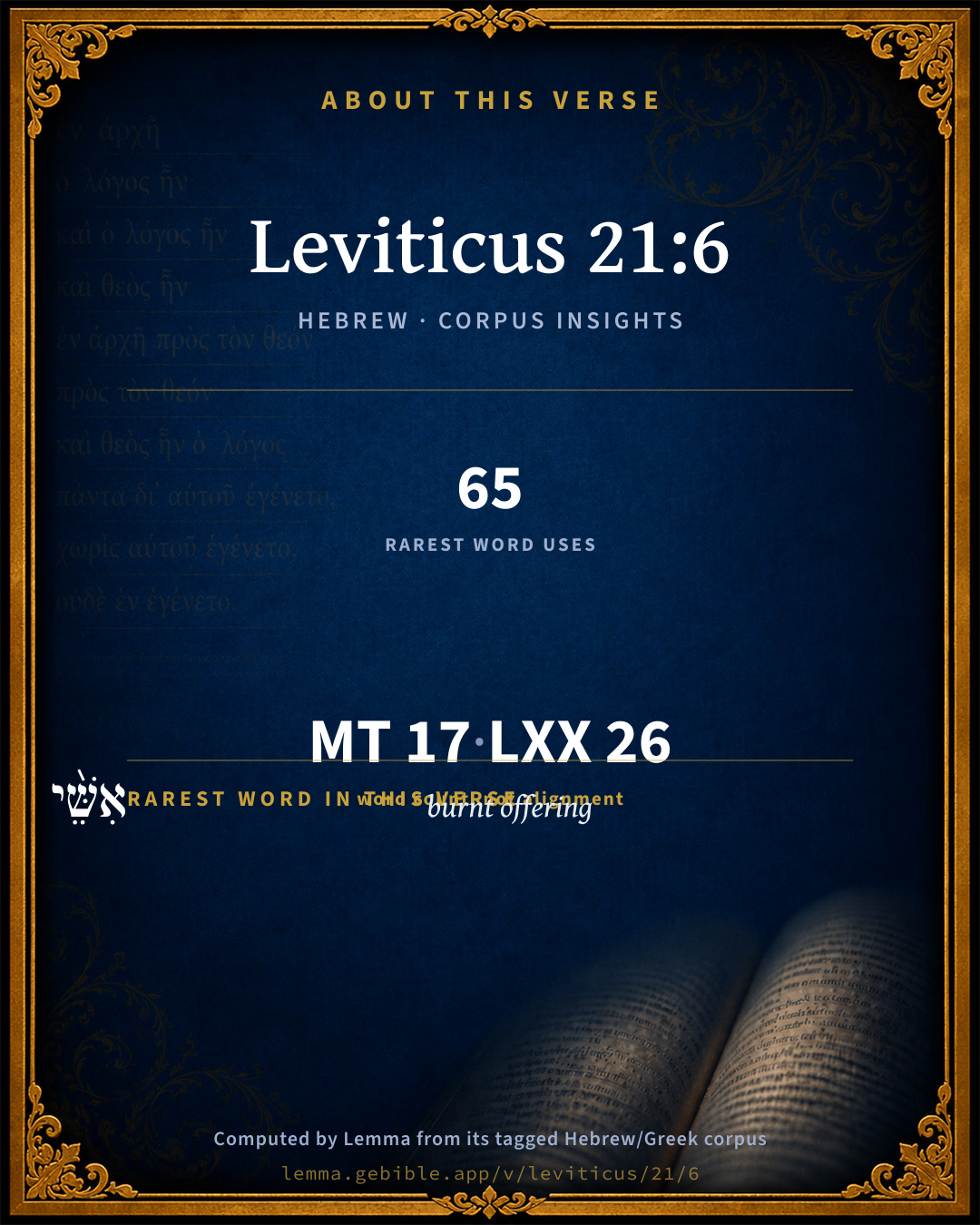
These counts appear in no published source. They are computed here, from the morphology-tagged text and Lemma’s own curated glosses. What Lemma adds →

17
words
14
distinct lemmas
Pentateuch
section

Grammatical profile

  • 4 verbs
  • 8 nouns
  • 1 adjective
  • 1 pronoun
  • 1 conjunction
  • 2 particles

Verb forms

  • יִהְיוּ֙ Qal · Imperfect
  • יְחַלְּל֔וּ Piel · Imperfect
  • מַקְרִיבִ֖ם Hiphil · Participle Active
  • וְהָ֥יוּ Qal · Sequential Perfect

Repetition

Words recur within this verse — often emphatic in Hebrew:

  • לֵאלֹ֣הֵיהֶ֔ם God H430 ×3
  • יִהְיוּ֙ to be H1961 ×2

Hebrew & Septuagint length

In English translation the verse runs 35 words from the Hebrew and 36 from the Septuagint (LXX English) — closely comparable.

A rough comparison of the two English renderings, which tokenize alike — not a word-level alignment.

Word counts can differ between the Hebrew and the Greek without any difference in meaning — e.g. the Hebrew direct-object marker אֵת has no separate Greek word, and Greek often adds the article ὁ.

In the original languages it is 17 Hebrew tokens and 26 Greek tokens — but the two are counted differently (Hebrew bundles its prefixes and suffixes into one token; the Greek is in lemma form), so that isn’t a like-for-like length.

Cross-references

13

Topical passages linked to Leviticus 21:6 in the Treasury of Scripture Knowledge — connected by theme and wording, ordered by reader-vote popularity; previews shown in the World English Bible.

  • Leviticus 3:11 The priest shall burn it on the altar: it is the food of the offering made by fire to Yahweh.
  • Leviticus 18:21 "'You shall not give any of your children to sacrifice to Molech; neither shall you profane the name of your God: I am Yahweh.
  • 1 Peter 2:9 But you are a chosen race, a royal priesthood, a holy nation, a people for God's own possession, that you may show forth the excellencies of him who called you out of darkness into his marvelous light:
  • Exodus 28:36 "You shall make a plate of pure gold, and engrave on it, like the engravings of a signet, 'HOLY TO YAHWEH.'
  • Exodus 29:44 I will sanctify the tent of meeting and the altar: Aaron also and his sons I will sanctify, to minister to me in the priest's office.
  • Leviticus 10:3 Then Moses said to Aaron, "This is what Yahweh spoke of, saying, "'I will show myself holy to those who come near me, And before all the people I will be glorified.'" Aaron held his peace.
  • Leviticus 19:12 "'You shall not swear by my name falsely, and profane the name of your God. I am Yahweh.
  • Leviticus 21:8 You shall sanctify him therefore; for he offers the bread of your God: he shall be holy to you: for I Yahweh, who sanctify you, am holy.
  • Ezra 8:28 I said to them, You are holy to Yahweh, and the vessels are holy; and the silver and the gold are a freewill-offering to Yahweh, the God of your fathers.
  • Isaiah 52:11 Depart you, depart you, go you out from there, touch no unclean thing; go you out of the midst of her; cleanse yourselves, you who bear the vessels of Yahweh.
  • Ezekiel 44:7 in that you have brought in foreigners, uncircumcised in heart and uncircumcised in flesh, to be in my sanctuary, to profane it, even my house, when you offer my bread, the fat and the blood, and they have broken my covenant, [to add] to all your abominations.
  • Malachi 1:6–7 "A son honors his father, and a servant his master. If I am a father, then where is my honor? And if I am a master, where is the respect due me? Says Yahweh of Hosts to you, priests, who despise my name. You say, 'How have we despised your name?'
  • Malachi 1:11–12 For from the rising of the sun even to the going down of the same, my name is great among the nations, and in every place incense will be offered to my name, and a pure offering: for my name is great among the nations," says Yahweh of Hosts.

Cross-references courtesy of OpenBible.info (CC BY 4.0).

Hebrew and Greek witnesses Masoretic Hebrew ↔ Greek Septuagint

The same verse in the two great witnesses to the Old Testament, shown verse-for-verse.

These are two independent witnesses, not word-aligned to each other, and the Septuagint is shown in lemma (dictionary) form.

Hebrew Leviticus 21:6 Masoretic · Westminster Leningrad Codex

קְדֹשִׁ֤ים יִהְיוּ֙ לֵאלֹ֣הֵיהֶ֔ם וְלֹ֣א יְחַלְּל֔וּ שֵׁ֖ם אֱלֹהֵיהֶ֑ם כִּי֩ אֶת אִשֵּׁ֨י יְהוָ֜ה לֶ֧חֶם אֱלֹהֵיהֶ֛ם הֵ֥ם מַקְרִיבִ֖ם וְהָ֥יוּ קֹֽדֶשׁ

They shall be holy to their God, and not profane the name of their God; for they offer the offerings of Yahweh made by fire, the bread of their God; therefore they shall be holy.

World English Bible · Public Domain

Greek LXX Leviticus 21:6 Septuagint · lemma form

ἅγιος εἰμί ὁ θεός αὐτός καί οὐ βεβηλόω ὁ ὄνομα ὁ θεός αὐτός ὁ γάρ θυσία κύριος δῶρον ὁ θεός αὐτός αὐτός προςφέρω καί εἰμί ἅγιος

They shall be holy to their God, and they shall not profane the name of their God; for they offer the sacrifices of the Lord as the gifts of their God, and they shall be holy.

LXX2012 (modern English Septuagint) · Public Domain

Hebrew: Westminster Leningrad Codex (CC BY 4.0). Greek: Septuagint (public domain); English from LXX2012 (modern English Septuagint) (Public Domain). How the Septuagint differs from the Hebrew →

Targum (Aramaic paraphrase)

2

The Targum is the ancient Jewish Aramaic paraphrase of the Hebrew Scriptures — an interpretive translation, not the Hebrew text itself. Onkelos (literal) and Pseudo-Jonathan (expansive) render the Torah, and Jonathan the Prophets. Coverage is partial: where no permissively-licensed English translation exists for a verse, only the Aramaic is shown. This is verse-level text, not a word-by-word alignment to the Hebrew.

  1. Targum Onkelos Torah (Genesis–Deuteronomy)
    קַדִישִׁין יְהוֹן קֳדָם אֱלָהֲהוֹן וְלָא יְחַלוּן שְׁמָא דֶאֱלָהֲהוֹן אֲרֵי יָת קֻרְבָּנַיָא דַיְיָ קֻרְבַּן אֱלָהֲהוֹן אִנוּן מַקְרִיבִין וִיהוֹן קַדִישִׁין

    (no public-domain English translation for this verse)

    Targum Onkelos — Aramaic: “Onkelos Genesis” (public domain); “Onkelos Exodus” (public domain); “Onkelos Leviticus” (public domain); “Onkelos Numbers” (public domain); “Onkelos Deuteronomy” (public domain). English: “Sefaria Community Translation” (CC0 1.0 (public-domain dedication)); “J.W. Etheridge. The Targums of Onkelos and Jonathan Ben Uzziel on the Pentateuch. London: Longmans, Green, 1862” (public domain). Text via Sefaria.

  2. Targum Pseudo-Jonathan Torah (Genesis–Deuteronomy)
    קַדִישִׁין יְהוֹן קֳדָם אֱלָהָהוֹן וְלָא יִפְסוּן יַת שְׁמָא דֶאֱלָהָהוֹן אֲרוּם יַת קוּרְבָּנַיָא דַיְיָ תִּקְרוּבְתָּא דֶאֱלָהָהוֹן הִינוּן מַקְרִיבִין וִיהוֹן קַדִישִׁין בְּגוּפֵיהוֹן

    but they shall be holy before their God, and shall not profane the name of their God;

    Targum Pseudo-Jonathan — Aramaic: “Targum Jonathan on Genesis” (public domain); “Targum Jonathan on Exodus” (public domain); “Targum Jonathan on Leviticus” (public domain); “Targum Jonathan on Numbers” (public domain); “Targum Jonathan on Deuteronomy” (public domain). English: “The Targum of Jonathan ben Uzziel, trans. J. W. Etheridge, London, 1862” (public domain). Text via Sefaria.

Commentary

Notes on Leviticus 21:6 from classic Christian and Jewish commentators (each source and its license shown beneath its notes). The classic Christian expositions comment on the surrounding passage and are grouped to its opening verse, so a note may address several verses; the Jewish commentaries on the Tanakh (Rashi and others) are per-verse, so they appear only where the commentator wrote on this verse.

Lemma curates 59 commentaries, every one of them public domain or Creative Commons licensed, each selected and text-cleaned for this edition rather than reprinted as found. About our sources →

Trapp's Complete Commentary

John Trapp

Lev 21:6 They shall be holy unto their God, and not profane the name of their God: for the offerings of the LORD made by fire, [and] the bread of their God, they do offer: therefore they shall be holy.

Ver. 6. They shall be holy.] Heb., Holiness, i.e. all holy, even as holiness itself, merely spiritual.

Not profane the name of their God.] Not do anything unworthy the majesty of the ministry: but suffer the dead to bury their dead. {Mat 8:22}

John Trapp, A Commentary or Exposition upon All the Books of the Old and New Testament (1647–1656) — public domain. Text from a community e-Sword module.

Joseph Benson's Commentary

Lev 21:6. Holy unto their God — Devoted to God’s service, and always prepared for it, and therefore shall keep themselves from all defilements. The name of their God — Which they especially bear. The bread of their God — That is, the show-bread; or rather, all the other offerings besides burnt-offerings; which are called bread, because bread is commonly put for all food.

Joseph Benson's Commentary on the Old and New Testaments (1811–1818) — public domain. Text from a community e-Sword module.

Tyndale Open Study Notes

Tyndale Open Resources

21:6 A priest should never bring shame by profaning God’s name.

Tyndale Open Study Notes — © Tyndale Open Resources, licensed CC BY-SA 4.0. Text via the HelloAO Bible API.

Ellicott's Commentary for English Readers

(6) They shall be holy unto their God.—This is the reason why the priests are not to disfigure themselves by maiming their outward appearance. Being sacred to the Lord, they are not to indulge in those outward manifestations of grief which would interfere with the discharge of their sacred duties, and thus cause the name of God to be profaned.

The offerings of the Lord made by fire, and the bread of their God.—Better, the offerings of the Lord made by fire, being the food of God. As the altar was the table, the sacrifice burnt on it was called His food. (See Lev_3:11.)

A Bible Commentary for English Readers, edited by Charles John Ellicott (1878–1897) — public domain. Text from a community e-Sword module.

The Cambridge Bible for Schools and Colleges

gen. ed. J. J. S. Perowne

6. The reason is given for the restriction in Lev_21:1, viz. that the name of God, whose ministers they are, may not be polluted by ceremonial uncleanness.

the offerings of the Lord made by fire] This expression, or its equivalent, is very frequent in P.The words are probably an insertion from that source here, and so in Lev_21:21, Lev_22:22; Lev_22:27, Lev_23:13; Lev_23:18.

the bread of their God] See Lev_3:11; Lev_3:16.

The Cambridge Bible for Schools and Colleges (gen. ed. J. J. S. Perowne; Cambridge University Press, 1878–1918) — public domain. Text from a community e-Sword module.

John Gill's Exposition

They shall be holy unto their God,.... Sacred to his service, and wholly given up to it, and not interest themselves in things which hindered from it, or made them unfit for it; and such care becomes the ministers of the word, who should give up themselves to it, and not entangle themselves with other affairs; they should be clean, pure, and holy, that bear the vessels of the Lord, and minister in holy things, and should set an example of purity and holiness to others:

and not profane the name of their God; or cause it to be profaned and evil spoken of on their account, or his service to be interrupted, and they who bore his name put upon a level with common persons through their pollutions:

for the offerings of the Lord made by fire; the burnt offerings, which were offered up to the Lord on the altar of burnt offering every day, besides others on divers occasions:

and the bread of their God do they offer; the shewbread, which they set every week before the Lord on the shewbread table, and the meat or bread offering, the "minchah", which they continually offered along with the sacrifices: or the word "and", being a supplement, may be left out; and so this clause is put by way of apposition, and as interpreting the fire offering to be the bread of their God, which being wholly burnt on the altar, and devoted to God, was his meat and food, and accepted by him, see Lev 3:11,

therefore they shall be holy; separate from all others, and abstain from all impurity both of flesh and spirit, from all uncleanness, moral and ceremonial; it being highly fit and proper that the bread of God should be offered by holy persons.

John Gill's Exposition of the Whole Bible (1746–1763) — public domain (CC PDM 1.0). Text via the HelloAO Bible API.

Albert Barnes' Notes on the Bible

The word here and in Lev 21:8 rendered “bread”, is the same as is rendered food in Lev 3:11, Lev 3:16, etc., and meat in Lev 22:11. The reader of the English Bible should keep in view that bread, meat, and food, were nearly equivalent terms when our translation was made, and represent no distinctions that exist in the Hebrew.

Albert Barnes' Notes on the Bible (1834–1885) — public domain. Text from a community e-Sword/MySword module.

Matthew Poole's English Annotations

Holy unto their God; devoted to God’s service, and always prepared and fit for it; and therefore shall keep themselves as far as they can from all defilement, which makes them unmeet for their Master’s use.

Not profane the name of their God, which they especially bear; they shall not disparage the service of God by making it give place to such slight occasions.

The bread of their God, i.e. the shew-bread; or rather, all the other offerings besides burntofferings; which are called bread, either because bread is commonly put for all food, as below, Lev 21:17,21; or because God is satisfied and refreshed with these offerings, as a man is with his bread; or rather, because they, or part of them, are the bread or food of the priests, and are here called the bread of their God, either objectively, because they were offered to God, or efficiently, because they were given by God to the priests. And these are called bread in opposition to the burnt-offerings, which being wholly consumed gave no food to the priests. Or, the offerings made by fire are here put synecdochically for all the rest, the most eminent kind for all, which are here called bread, because devoured by fire to the honour of God; for the particle and is not in the Hebrew, and may be omitted.

Matthew Poole's English Annotations on the Holy Bible (1683–1685) — public domain. Text from a community e-Sword/MySword module.

Whedon's Commentary on the Bible

Daniel D. Whedon

6. Holy unto their God — See Lev_10:3; Lev_11:44; Lev_19:2, notes. This denotes entire consecration to God and perfect assimilation to his moral character.

Not profane — See Lev_18:21, note.

The bread of their God — See Lev_3:11, note.

Therefore they shall be holy — Holiness of service demands holiness of character. It is astonishing how much is said about holiness in this book. See Introduction, (8.)

Daniel D. Whedon (gen. ed.), Commentary on the Old and New Testaments (1874–1909) — public domain. Text from a community e-Sword module.

John Wesley's Explanatory Notes

Holy unto their God - Devoted to God's service, and always prepared for it, and therefore shall keep themselves from all defilements. The name of their God - Which they especially bear. The bread of their God - That is, the shew-bread: or rather, all the other offerings, besides burnt-offerings: which are called bread, because bread is commonly put for all food.

John Wesley, Explanatory Notes Upon the Whole Bible (1754–1765) — public domain. Text via the GEBible commentary corpus.

Rashi

Rabbi Shlomo Yitzchaki (Rashi)

קדשים יהיו THEY SHALL BE HOLY — even against their will — the court shall force them to remain holy in respect to this (Sifra, Emor, Chapter 1 6).

Rashi on the Tanakh — English translations: “The Judaica Press complete Tanach with Rashi, translated by A. J. Rosenberg” (CC BY 4.0); “Pentateuch with Rashi's commentary by M. Rosenbaum and A.M. Silbermann, 1929-1934” (public domain); “The Metsudah Tanach series, Lakewood, N.J” (CC BY 4.0); and “The Book of Joshua, Metsudah Publications, 1997” (CC BY 4.0). Text via Sefaria.

Ramban (Nachmanides)

Rabbi Moshe ben Nachman (Ramban / Nachmanides)

THEY SHALL BE HOLY UNTO THEIR G-D. Holiness signifies separateness, as I have explained in the section above.. Scripture is thus stating that even in those things which are permissible to Israelites, the priests should exercise self-control, avoiding the impurity of the dead, and marrying of women who are unfit for them in purity and cleanliness.

Ramban (Nachmanides) on the Tanakh — English translation: “Commentary on the Torah by Ramban (Nachmanides). Translated and annotated by Charles B. Chavel. New York, Shilo Pub. House, 1971-1976” (CC BY 4.0). Text via Sefaria.

Lesson kit

Teaching starters — assembled from the data on this page, not authored interpretation. Every prompt links to the verse data it draws on. Edit before teaching.

Leviticus, in the Pentateuch, opens this verse with 17 words (14 distinct Hebrew lemmas). Its most distinctive word is ʼishshâh (“burnt offering”). A historical commentator’s framing appears above. Read the whole chapter for the surrounding context.

Discussion questions

  1. How does “burnt offering” (ʼishshâh) shape what this verse is saying?
  2. How does Leviticus 3:11, which shares this passage’s theme, read alongside this verse?
  3. What does the repetition of “God” (3× in this one verse) do in this verse?
  4. The translations on this page render this verse differently — a whole-verse word diff, not a word-by-word alignment. What might account for the different wordings?
  5. «יִהְיוּ֙» is a Qal Imperfect verb. How does that grammatical form shape the action described?
  6. Compare how Trapp's Complete Commentary and Joseph Benson's Commentary read this verse. Where do they agree or differ?

Things to notice

Reading settings

Reading text

Shown beneath each verse's original-language words.

Old Testament
Old Testament edition

Read the OT as the Masoretic Hebrew (MT) or the Greek Septuagint (LXX).

English shown for the Greek Septuagint (in the Hebrew ↔ Greek comparison).

Comparing translations? Open the Compare panel on any verse page to stack up to four side by side.