
Deuteronomy 26:3

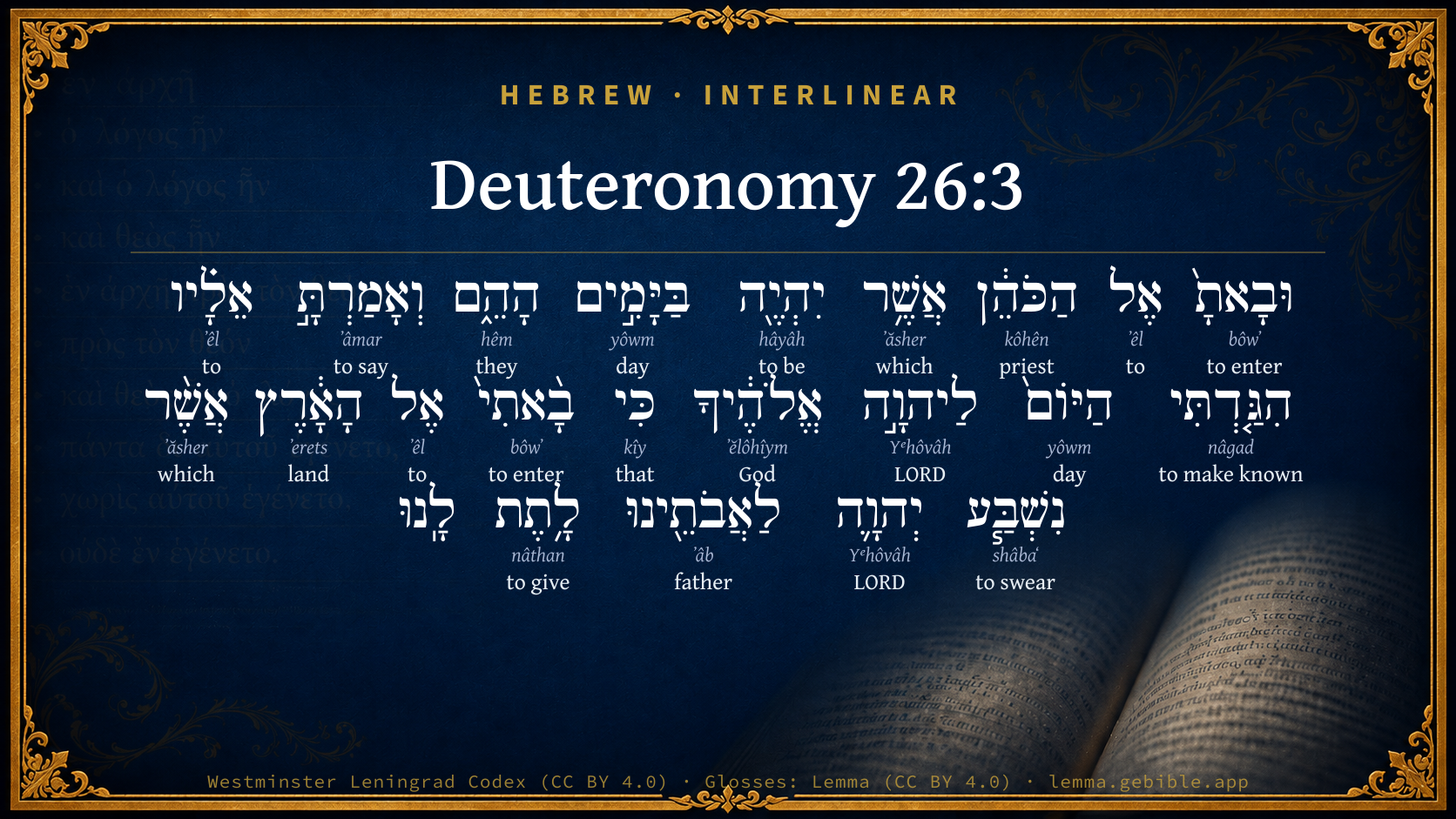
Hebrew (Westminster Leningrad Codex) Deuteronomy 26:3 appears in the Hebrew Old Testament. The text above is from the Westminster Leningrad Codex. Each word links to its Strong’s number, a concise gloss, and parsing drawn from the Open Scriptures Hebrew Bible morphology. Click any word for its full Brown-Driver-Briggs (BDB) entry.
Download image
Cite this verse

Deuteronomy 26:3 (World English Bible). Public Domain. Lemma interlinear Bible study tool, https://lemma.gebible.app/v/deuteronomy/26/3.

Show BibTeX & RIS
BibTeX
RIS
English Translation
You shall come to the priest who shall be in those days, and tell him, I profess this day to Yahweh your God, that I am come to the land which Yahweh swore to our fathers to give us.
World English Bible · Public Domain
Download a study sheet

One document with this verse’s original text, its word-by-word gloss line, the meaning frame, cross-references with their text, attributed commentary, and full source and license credits — printable, and it pastes into notes with its structure intact.

This verse Autodidact and up

Study sheet (.html) Plain text (.txt)

A passage Seminary Student

Up to 50 verses in one chapter. A passage sheet keeps up to 6 commentary sources and 12 cross-references per verse, in the order this page ranks them, and says so on the sheet whenever that leaves anything out. Ask for a single verse and you get the Autodidact verse sheet above.

Everything on this page stays free to read, with no account — the sheet is a download of what is already on screen, not access to it.

Want to remove ads? Support Godless Engineer
Compare translations 3

The same verse in 3 English versions, stacked beneath the original-language interlinear above. Click any original word for its lexicon entry.

Each is an independent rendering of the whole verse — the interlinear is not word-aligned to these translations.

Highlighted words mark where these versions differ — a whole-verse word diff, not a word-by-word alignment.

  • World English Bible Public Domain
    You shall come to the priest who shall be in those days, and tell him, I profess this day to Yahweh your God, that I am come to the land which Yahweh swore to our fathers to give us.
  • King James Version Public Domain
    And thou shalt go unto the priest that shall be in those days, and say unto him, I profess this day unto the LORD thy God, that I am come unto the country which the LORD sware unto our fathers for to give us.
  • unfoldingWord Literal Text CC BY-SA 4.0
    And you shall go to the priest who will be in those days and say to him, ‘I declare today to Yahweh your God that I have come to the land that Yahweh swore to our fathers to give to us.’

unfoldingWord Literal Text — © unfoldingWord, licensed CC BY-SA 4.0. Word-aligned USFM3 via Door43 (git.door43.org/unfoldingWord/en_ult).

Versions to compare (up to 4)

3 of 4 selected

Show all 18 translations

Every available English version of this verse, each an independent rendering of the whole verse.

  • World English Bible Public Domain
    You shall come to the priest who shall be in those days, and tell him, I profess this day to Yahweh your God, that I am come to the land which Yahweh swore to our fathers to give us.
  • Berean Standard Bible Public Domain
    to the priest who is serving at that time, and say to him, “I declare today to the LORD your God that I have entered the land that the LORD swore to our fathers to give us.”
  • Majority Standard Bible Public Domain
    to the priest who is serving at that time, and say to him, “I declare today to the LORD your God that I have entered the land that the LORD swore to our fathers to give us.”
  • King James Version Public Domain
    And thou shalt go unto the priest that shall be in those days, and say unto him, I profess this day unto the LORD thy God, that I am come unto the country which the LORD sware unto our fathers for to give us.
  • American Standard Version (1901) Public Domain
    And thou shalt come unto the priest that shall be in those days, and say unto him, I profess this day unto Jehovah thy God, that I am come unto the land which Jehovah sware unto our fathers to give us.
  • Revised Version (1885) Public Domain
    And thou shalt come unto the priest that shall be in those days, and say unto him, I profess this day unto the LORD thy God, that I am come unto the land which the LORD sware unto our fathers for to give us.
  • Geneva Bible (1599) Public Domain
    And thou shalt come vnto the Priest, that shall be in those dayes, and say vnto him, I acknowledge this day vnto the Lord thy God, that I am come vnto the countrey which the Lord sware vnto our fathers for to giue vs.
  • Douay-Rheims (1899) Public Domain
    And thou shalt go to the priest that shall be in those days, and say to him: I profess this day before the Lord thy God, that I am come into the land, for which he swore to our fathers, that he would give it us.
  • Young's Literal Translation Public Domain
    `And thou hast come in unto the priest who is in those days, and hast said unto him, I have declared to-day to Jehovah thy God, that I have come in unto the land which Jehovah hath sworn to our fathers to give to us;
  • Literal Standard Version CC BY-SA 4.0
    And you have come to the priest who is in those days, and have said to him, I have declared to your God YHWH today that I have come into the land which YHWH has sworn to our fathers to give to us;
  • Unlocked Literal Bible CC BY-SA 4.0
    You must go to the priest who will be serving in those days and say to him, 'I acknowledge today to Yahweh your God that I have come to the land that Yahweh swore to our ancestors to give us.'
  • unfoldingWord Literal Text CC BY-SA 4.0
    And you shall go to the priest who will be in those days and say to him, ‘I declare today to Yahweh your God that I have come to the land that Yahweh swore to our fathers to give to us.’
  • Darby Bible Public Domain
    and thou shalt come unto the priest that shall be in those days, and say unto him, I profess this day unto Jehovah thy God, that I am come unto the land that Jehovah swore unto our fathers to give us.
  • World Messianic Bible Public Domain
    You shall come to the priest who shall be in those days, and tell him, “I profess today to the LORD your God, that I have come to the land which the LORD swore to our fathers to give us.”
  • Webster's Bible Public Domain
    And thou shalt go to the priest that shall be in those days, and say to him, I profess this day to the LORD thy God, that I have come to the country which the LORD swore to our fathers to give us.
  • Free Bible Version CC BY-SA 4.0
    and tell the priest in charge at the time, “Today I declare to the Lord your God that I now live in the country that the Lord promised our forefathers to give us.”
  • Bible in Basic English Public Domain
    And you are to come to him who is priest at that time, and say to him, I give witness today before the Lord your God, that I have come into the land which the Lord made an oath to our fathers to give us.
  • JPS Tanakh (1917) Public Domain
    And thou shalt come unto the priest that shall be in those days, and say unto him: 'I profess this day unto the LORD thy God, that I am come unto the land which the LORD swore unto our fathers to give us.'

Literal Standard Version (2020), Covenant Press — licensed CC BY-SA 4.0. Text via the HelloAO Bible API (eBible.org). Unlocked Literal Bible (unfoldingWord) — licensed CC BY-SA 4.0. Text via the HelloAO Bible API (eBible.org). unfoldingWord Literal Text — © unfoldingWord, licensed CC BY-SA 4.0. Word-aligned USFM3 via Door43 (git.door43.org/unfoldingWord/en_ult). Free Bible Version, Dr. Jonathan Gallagher — licensed CC BY-SA 4.0. Text via the HelloAO Bible API (eBible.org).

Word by word

More ways to search: Search by grammar → Find every occurrence → Compare this word →

Practice this passage: Drill this verse → Learn its vocabulary →

נִשְׁבַּ֧ע
shâbaʻ
H7650
“to swear”
Verb, Niphal, Perfect, 3rd Person, Masculine, Singular
Part of Speech
Verb
Stem
Niphal
Form
Perfect
Person
3rd Person
Gender
Masculine
Number
Singular
Full BDB Definition

Origin: a primitive root

TWOT: 2318

to swear, adjure - (Qal) sworn (participle) - (Niphal) - to swear, take an oath - to swear (of Jehovah by Himself) - to curse - (Hiphil) - to cause to take an oath - to adjure
  1. וּבָאתָ֙ bôwʼ H935 “and · to enter” Conjunction + Verb, Qal, Sequential Perfect, 2nd Person, Masculine, Singular
  2. אֶל ʼêl H413 “to” Preposition
  3. הַכֹּהֵ֔ן kôhên H3548 “the · priest” Particle, Definite Article + Noun, Common, Masculine, Singular, Absolute
  4. אֲשֶׁ֥ר ʼăsher H834 “which” Particle, Relative
  5. יִהְיֶ֖ה hâyâh H1961 “to be” Verb, Qal, Imperfect, 3rd Person, Masculine, Singular
  6. בַּיָּמִ֣ים yôwm H3117 “in/at the · days” Preposition, Determined + Noun, Common, Masculine, Plural, Absolute
  7. הָהֵ֑ם hêm H1992 “the · they” Particle, Definite Article + Pronoun, Personal, 3rd Person, Masculine, Plural
  8. וְאָמַרְתָּ֣ ʼâmar H559 “and · to say” Conjunction + Verb, Qal, Sequential Perfect, 2nd Person, Masculine, Singular
  9. אֵלָ֗יו ʼêl H413 “to · him” Preposition + Suffix, Personal, 3rd Person, Masculine, Singular
  10. הִגַּ֤דְתִּי nâgad H5046 “to make known” Verb, Hiphil, Perfect, 1st Person, Common, Singular
  11. הַיּוֹם֙ yôwm H3117 “the · day” Particle, Definite Article + Noun, Common, Masculine, Singular, Absolute
  12. לַיהוָ֣ה Yᵉhôvâh H3068 “to/for · LORD” Preposition + Noun, Proper
  13. אֱלֹהֶ֔יךָ ʼĕlôhîym H430 “God(s) · your” Noun, Common, Masculine, Plural, Construct + Suffix, Personal, 2nd Person, Masculine, Singular
  14. כִּי kîy H3588 “that” Conjunction
  15. בָ֨אתִי֙ bôwʼ H935 “to enter” Verb, Qal, Perfect, 1st Person, Common, Singular
  16. אֶל ʼêl H413 “to” Preposition
  17. הָאָ֔רֶץ ʼerets H776 “the · land” Particle, Definite Article + Noun, Common, Both, Singular, Absolute
  18. אֲשֶׁ֨ר ʼăsher H834 “which” Particle, Relative
  19. יְהוָ֛ה Yᵉhôvâh H3068 “LORD” Noun, Proper
  20. לַאֲבֹתֵ֖ינוּ ʼâb H1 “to/for · fathers · our” Preposition + Noun, Common, Masculine, Plural, Construct + Suffix, Personal, 1st Person, Common, Plural
  21. לָ֥תֶת nâthan H5414 “to give” Preposition + Verb, Qal, Infinitive Construct

About this verse

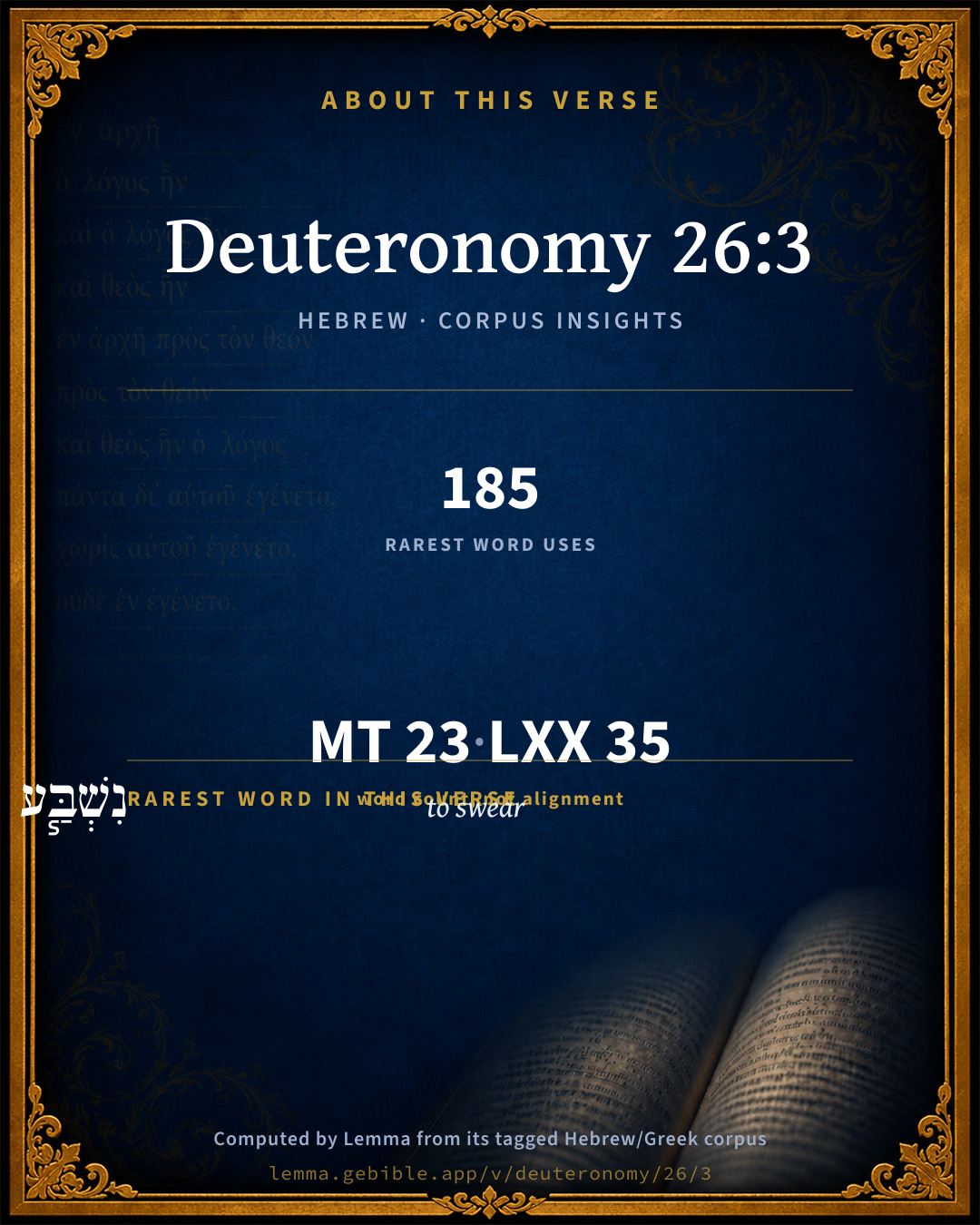
These counts appear in no published source. They are computed here, from the morphology-tagged text and Lemma’s own curated glosses. What Lemma adds →

23
words
16
distinct lemmas
Pentateuch
section

Grammatical profile

  • 7 verbs
  • 8 nouns
  • 1 pronoun
  • 4 prepositions
  • 1 conjunction
  • 2 particles

Verb forms

  • וּבָאתָ֙ Qal · Sequential Perfect
  • יִהְיֶ֖ה Qal · Imperfect
  • וְאָמַרְתָּ֣ Qal · Sequential Perfect
  • הִגַּ֤דְתִּי Hiphil · Perfect
  • בָ֨אתִי֙ Qal · Perfect
  • נִשְׁבַּ֧ע Niphal · Perfect
  • לָ֥תֶת Qal · Infinitive Construct

Repetition

Words recur within this verse — often emphatic in Hebrew:

  • וּבָאתָ֙ to enter H935 ×2
  • בַּיָּמִ֣ים day H3117 ×2
  • לַיהוָ֣ה LORD H3068 ×2
  • אֶל to H413 ×3
  • אֲשֶׁ֥ר which H834 ×2

Hebrew & Septuagint length

In English translation the verse runs 39 words from the Hebrew and 46 from the Septuagint (LXX English) — closely comparable.

A rough comparison of the two English renderings, which tokenize alike — not a word-level alignment.

Word counts can differ between the Hebrew and the Greek without any difference in meaning — e.g. the Hebrew direct-object marker אֵת has no separate Greek word, and Greek often adds the article ὁ.

In the original languages it is 23 Hebrew tokens and 35 Greek tokens — but the two are counted differently (Hebrew bundles its prefixes and suffixes into one token; the Greek is in lemma form), so that isn’t a like-for-like length.

Cross-references

10

Topical passages linked to Deuteronomy 26:3 in the Treasury of Scripture Knowledge — connected by theme and wording, ordered by reader-vote popularity; previews shown in the World English Bible.

  • Genesis 17:8 I will give to you, and to your seed after you, the land where you are traveling, all the land of Canaan, for an everlasting possession. I will be their God."
  • Genesis 26:3 Sojourn in this land, and I will be with you, and will bless you. For to you, and to your seed, I will give all these lands, and I will establish the oath which I swore to Abraham your father.
  • Deuteronomy 19:17 then both the men, between whom the controversy is, shall stand before Yahweh, before the priests and the judges who shall be in those days;
  • Psalms 105:9–10 The covenant which he made with Abraham, His oath to Isaac,
  • Luke 1:72–73 To show mercy towards our fathers, To remember his holy covenant,
  • Hebrews 6:16–18 For men indeed swear by a greater one, and in every dispute of theirs the oath is final for confirmation.
  • Hebrews 7:26 For such a high priest was fitting for us: holy, guiltless, undefiled, separated from sinners, and made higher than the heavens;
  • Hebrews 10:21 and having a great priest over the house of God,
  • Hebrews 13:15 Through him, then, let us offer up a sacrifice of praise to God continually, that is, the fruit of lips which make confession to his name.
  • 1 Peter 2:5 You also, as living stones, are built up as a spiritual house, to be a holy priesthood, to offer up spiritual sacrifices, acceptable to God through Jesus Christ.

Cross-references courtesy of OpenBible.info (CC BY 4.0).

Hebrew and Greek witnesses Masoretic Hebrew ↔ Greek Septuagint

The same verse in the two great witnesses to the Old Testament, shown verse-for-verse.

These are two independent witnesses, not word-aligned to each other, and the Septuagint is shown in lemma (dictionary) form.

Hebrew Deuteronomy 26:3 Masoretic · Westminster Leningrad Codex

וּבָאתָ֙ אֶל הַכֹּהֵ֔ן אֲשֶׁ֥ר יִהְיֶ֖ה בַּיָּמִ֣ים הָהֵ֑ם וְאָמַרְתָּ֣ אֵלָ֗יו הִגַּ֤דְתִּי הַיּוֹם֙ לַיהוָ֣ה אֱלֹהֶ֔יךָ כִּי בָ֨אתִי֙ אֶל הָאָ֔רֶץ אֲשֶׁ֨ר נִשְׁבַּ֧ע יְהוָ֛ה לַאֲבֹתֵ֖ינוּ לָ֥תֶת לָֽנוּ

You shall come to the priest who shall be in those days, and tell him, I profess this day to Yahweh your God, that I am come to the land which Yahweh swore to our fathers to give us.

World English Bible · Public Domain

Greek LXX Deuteronomy 26:3 Septuagint · lemma form

καί ἔρχομαι πρός ὁ ἱερεύς ὅς ἐάν εἰμί ἐν ὁ ἡμέρα ἐκεῖνος καί εἶπον πρός αὐτός ἀναἀγγέλλω σήμερον κύριος ὁ θεός ἐγώ ὅτι εἰςἔρχομαι εἰς ὁ γῆ ὅς ὄμνυμι κύριος ὁ πατήρ ἐγώ δίδωμι ἐγώ

And you shall come to the priest who shall be in those days, and you shall say to him, I testify this day to the Lord my God, that I am come into the land which the Lord swore to our fathers to give to us.

LXX2012 (modern English Septuagint) · Public Domain

On this verse, The Cambridge Bible for Schools and Colleges discusses the Septuagint’s reading. Read the note in Commentary ↓

Hebrew: Westminster Leningrad Codex (CC BY 4.0). Greek: Septuagint (public domain); English from LXX2012 (modern English Septuagint) (Public Domain). How the Septuagint differs from the Hebrew →

Targum (Aramaic paraphrase)

2

The Targum is the ancient Jewish Aramaic paraphrase of the Hebrew Scriptures — an interpretive translation, not the Hebrew text itself. Onkelos (literal) and Pseudo-Jonathan (expansive) render the Torah, and Jonathan the Prophets. Coverage is partial: where no permissively-licensed English translation exists for a verse, only the Aramaic is shown. This is verse-level text, not a word-by-word alignment to the Hebrew.

  1. Targum Onkelos Torah (Genesis–Deuteronomy)
    וְתֵיתֵי לְוָת כַּהֲנָא דִי יְהֵי בְּיוֹמַיָא הָאִנוּן וְתֵימַר לֵהּ חַוֵיתִי יוֹמָא דֵין קֳדָם יְיָ אֱלָהָךְ אֲרֵי עַלִית לְאַרְעָא דִי קַיִים יְיָ לַאֲבָהָתָנָא לְמִתַּן לָנָא

    (no public-domain English translation for this verse)

    Targum Onkelos — Aramaic: “Onkelos Genesis” (public domain); “Onkelos Exodus” (public domain); “Onkelos Leviticus” (public domain); “Onkelos Numbers” (public domain); “Onkelos Deuteronomy” (public domain). English: “Sefaria Community Translation” (CC0 1.0 (public-domain dedication)); “J.W. Etheridge. The Targums of Onkelos and Jonathan Ben Uzziel on the Pentateuch. London: Longmans, Green, 1862” (public domain). Text via Sefaria.

  2. Targum Pseudo-Jonathan Torah (Genesis–Deuteronomy)
    וּתְעַטְרוּן בְּסַלַיָא וְצִינַיָא וּפֵיפוּרַיָא וְתֵיעֲלוּן לְוַת כַּהֲנָא דִי יֶהֱוֵי מְמַנֵי לְכַהֵן רַב בְּיוֹמַיָא הָאִינוּן וְתֵימְרוּן לֵיהּ אוֹדִינָן יוֹמָא דֵין קֳדָם יְיָ אֱלָהָךְ אֲרוּם עָלֵינָן לְאַרְעָא דְקַיֵים יְיָ לְאַבְהָתָן לְמִתַּן לָנָא

    And you shall put crowns upon the baskets, hampers, and paper cases, and bring them to the priest appointed to be the chief priest in those days, and shall say to him: We acknowledge this day before the Lord thy God that we have come into the land which the Lord sware unto our fathers to give us.

    Targum Pseudo-Jonathan — Aramaic: “Targum Jonathan on Genesis” (public domain); “Targum Jonathan on Exodus” (public domain); “Targum Jonathan on Leviticus” (public domain); “Targum Jonathan on Numbers” (public domain); “Targum Jonathan on Deuteronomy” (public domain). English: “The Targum of Jonathan ben Uzziel, trans. J. W. Etheridge, London, 1862” (public domain). Text via Sefaria.

Commentary

Notes on Deuteronomy 26:3 from classic Christian and Jewish commentators (each source and its license shown beneath its notes). The classic Christian expositions comment on the surrounding passage and are grouped to its opening verse, so a note may address several verses; the Jewish commentaries on the Tanakh (Rashi and others) are per-verse, so they appear only where the commentator wrote on this verse.

Lemma curates 59 commentaries, every one of them public domain or Creative Commons licensed, each selected and text-cleaned for this edition rather than reprinted as found. About our sources →

Joseph Benson's Commentary

Deu 26:3. I profess this day unto the Lord — Thus, at his presenting them to the priest in waiting, the offerer was to declare he brought them in humble and grateful acknowledgment of the divine providence and goodness, that had settled him and his family in this fruitful country, pursuant to the gracious promises made to his forefathers. And the following confession appointed to be made on the occasion was well fitted to excite in his mind humility, gratitude, and trust in God; it being an important part of the worship of God, as Maimonides observes, for a man to be mindful of his afflictions, when God has given him rest from them.

Joseph Benson's Commentary on the Old and New Testaments (1811–1818) — public domain. Text from a community e-Sword module.

The Cambridge Bible for Schools and Colleges

gen. ed. J. J. S. Perowne

3. the priest … in those days] Deu_17:9, Deu_19:17. Priest probably collective (cp. prophet, Deu_18:15), not necessarily high-priest.

profess] or declare, solemnly, publicly proclaim.

my God] So LXX; Heb. thy is due to dittography.

that I am come] D gives to this as to other rites a historical meaning.

sware, etc.] See on Deu_1:8.

3, 4. Possibly a later interpolation, see introd. note.

The Cambridge Bible for Schools and Colleges (gen. ed. J. J. S. Perowne; Cambridge University Press, 1878–1918) — public domain. Text from a community e-Sword module.

John Gill's Exposition

And thou shalt go unto the priest that shall be in those days,.... Whose course and turn it would be to minister before the Lord; though, according to the Targum of Jonathan, it was the high priest they were to apply to on this occasion; and so Aben Ezra observes, that this law is obligatory all the time there is an high priest, as if it was not binding when there was none, and all depended on him; who in this case was typical of Christ our high priest, to whom we must bring, and by him offer up, the sacrifice of praise, even the fruit of our lips, giving thanks to God for all his mercies:

and say unto him; what follows, and the basket of firstfruits all the while on his shoulder (d), even if a king:

I profess this day; it being done once in a year, and not twice, as Jarchi notes:

unto the Lord thy God; directing his speech to the priest:

that I am come into the country which the Lord sware unto our fathers for to give us; and not only come into it, but was in the possession of it, and in the enjoyment of the fruits of it; of which the basket of firstfruits he had brought on his shoulder was a token. The natural and moral use of these firstfruits to the Israelites, and the bringing of them, was hereby to own and acknowledge that God was the proprietor of the land of Canaan; that they had it by gift from him, and that they held it of him, the firstfruits being a sort of a small rent they brought him; and that he was faithful to his oath and promise he had made to their fathers, and which they professed with great humility and thankfulness. The typical use of them was to direct to Christ himself, the firstfruits of them that sleep in him, the first begotten from the dead, the pledge and earnest of the resurrection of his people; to the Spirit of God and his grace, which are the earnest of glory; and to the first converts among Jews and Gentiles, in the first times of the Gospel; to Christians in general, who are the firstfruits of God and of the Lamb, and to their sacrifices of praise and thankfulness they are to offer up to God through Christ, which are acceptable to him through him; and whereby they glorify him as the author of all their mercies, to whom they are to bring their best, and in the first place; see Co1 15:20.

(d) Misn. Biccurim, c. 3. sect. 4, 6. Maimon. Biccurim, c. 3. sect. 12.

John Gill's Exposition of the Whole Bible (1746–1763) — public domain (CC PDM 1.0). Text via the HelloAO Bible API.

Matthew Poole's English Annotations

Unto the priest, i.e. to any of the priests, who shall be appointed in God’s stead to receive these oblations and acknowledgements.

Matthew Poole's English Annotations on the Holy Bible (1683–1685) — public domain. Text from a community e-Sword/MySword module.

The Pulpit Commentary

The priest that shall be in those clays; not the high priest, but the priests collectively, or the individual priest whose function it was to officiate on the occasion. The fruit presented was the sensible proof that the land was now in their possession, and the confession made along with the presentation was an acknowledgment of their unworthiness, and of the Divine favor as that to which alone they were indebted for the privileged position in which they were placed.

The Pulpit Commentary (1880–1919), ed. H.D.M. Spence-Jones & Joseph S. Exell — public domain. Text from a community e-Sword module.

unfoldingWord translationNotes

Door43 World Missions Community

General Information:

Moses speaks to the Israelites as if they were one man, so the words "you" and "your" here are singular. (See: Forms of You)

translationWords

priest

servant

acknowledge

oath

basket

altar

unfoldingWord translationNotes — © Distant Shores Media and the Door43 World Missions Community, licensed CC BY-SA 4.0. Source: git.door43.org/Door43/en_tn.

Rashi

Rabbi Shlomo Yitzchaki (Rashi)

אשר יהיה בימים ההם [AND THOU SHALT GO UNTO THE PRIEST] THAT SHALL BE IN THOSE DAYS — These apparently redundant words suggest: you have none else than the priest who lives in your days (you are only concerned with him) (cf. Sifrei Devarim 298:3; Rosh Hashanah 25b; see also Rashi on Deuteronomy 17:9).

ואמרת אליו AND SAY UNTO HIM that you are not ungrateful (Sifrei Devarim 299:1).

הגדתי היום I PROFESS THIS DAY — [the expression "this day" implies that the declaration is made] one once a year, but not twice a year [even when bringing from a different fruit or crop] (Sifrei Devarim 299:2).

Rashi on the Tanakh — English translations: “The Judaica Press complete Tanach with Rashi, translated by A. J. Rosenberg” (CC BY 4.0); “Pentateuch with Rashi's commentary by M. Rosenbaum and A.M. Silbermann, 1929-1934” (public domain); “The Metsudah Tanach series, Lakewood, N.J” (CC BY 4.0); and “The Book of Joshua, Metsudah Publications, 1997” (CC BY 4.0). Text via Sefaria.

Ramban (Nachmanides)

Rabbi Moshe ben Nachman (Ramban / Nachmanides)

AND THOU SHALT COME UNTO THE PRIEST THAT SHALL BE IN THOSE DAYS — to the priest that shall be there in those days, for first-fruits, like all offerings, are given to the men of the [priestly] Division [who are assigned to the Sanctuary for a week at a time], but he may not bring along a priest from his city in order to offer him his first-fruits.Now, Rashi wrote: “You have none else than the priest who lives in your days as he is.” But I have not understood this, for in the case of an elder [of the Sanhedrin] it is proper to say [and thou shalt come …] unto the judge that shall be in those days, meaning that even though he is not as great and wise as the early judges in the ages which were before us, still he [the elder] is obligated to hearken to him [the judge], for “Jephtah in his generation is as Samuel in his generation.” But when bringing first-fruits, to whom shall he bring them if not to the priest that shall be in his days? Now, I have also seen the following text in the Sifre: 298. “And thou shalt come unto the priest that shall be in those days. This is what Rabbi Yosei the Galilean says, And would it occur to you to come to the priest that is not in your days? Rather, [I must say that the verse requires one to come to] the priest who is considered by you to be established and fit in those days. Kinsmen who have ceased to be kinsmen are qualified. And so it is also said, Say not thou: ‘How was it that the former days were better than these?’ ” thus refers to “the judges of the former days.” Do not say that the judges of the former generations were better than those of the present, and therefore I would not listen to them. Instead you are to listen to them, for you are only concerned with them (Maharsha, Rosh Hashanah 25b). It appears that the Sages interpreted in this connection that if one brought first-fruits or a burnt-offering to a priest who was presumed to be qualified and afterwards it was discovered that he was the son of a divorced woman, [a defiled priest not entitled to perform the Divine Service, nor to receive the priestly gifts] the offerings are nevertheless valid, as is mentioned in the last chapter of Tractate Kiddushin. Also included in this principle is [the rule] that a kinsman who has ceased to be a kinsman is qualified, this applying to an elder who may not be judged by a relative, but it is not relevant to first-fruits.

HIGAD’TI’ (I PROFESS) THIS DAY. “Through this fruit which I have brought I profess and give thanks to the Eternal your G-d Who brought me into the Land which He swore unto our fathers to give us. Thus G-d fulfilled His words, and I give thanks and praise to His Name.” The meaning of the word higad’ti is like “I have told.” So also ‘vayageid Mosheh’ (and Moses told) the words of the people unto the Eternal, which is in the past, when he has not made yet his declaration. Therefore Ramban writes that the very act of bringing the first-fruits into the Sanctuary Court constitutes a form of professing the omnipotence of G-d and an expression of thanksgiving to Him. In this sense the form of the word higad’ti is properly in the past, since the act of bringing the first-fruits has formed the way of communicating these thoughts. Such a usage is seen in the verse vayegeid Mosheh, which means that Moses “communicated” the words of the people to the Eternal. which means communicating. Or the interpretation thereof may be as follows: “I declare to you, O priest, and to all who stand by, and this declaration is unto the Eternal thy G-d, that is to say, to His Name, that I am come into the Land which He swore unto our fathers, for it is He Who brought me [near] to Him to serve Him in the Land.”

Ramban (Nachmanides) on the Tanakh — English translation: “Commentary on the Torah by Ramban (Nachmanides). Translated and annotated by Charles B. Chavel. New York, Shilo Pub. House, 1971-1976” (CC BY 4.0). Text via Sefaria.

Sforno

Rabbi Ovadia Sforno

To the kohein: Even though he is not great in wisdom, you must still speak to him respectfully. You must say, “Hashem, your God” even though this phrase is only spoken to people of stature, such as kings or prophets. Nevertheless, since you are bringing your first fruits to him, like bringing a gift to Hashem, Master of the Heavens, it is appropriate to speak respectfully also to the kohein.

Sforno on the Tanakh — English translation: “Yalkut, Sifsei Chachomim Chumash, Metsudah Publications, 2009” (CC BY 4.0). Text via Sefaria.

Lesson kit

Teaching starters — assembled from the data on this page, not authored interpretation. Every prompt links to the verse data it draws on. Edit before teaching.

Deuteronomy, in the Pentateuch, opens this verse with 23 words (16 distinct Hebrew lemmas). Its most distinctive word is shâbaʻ (“to swear”). A historical commentator’s framing appears above. Read the whole chapter for the surrounding context.

Discussion questions

  1. What does “to swear” (shâbaʻ) contribute to the verse as a whole?
  2. Genesis 17:8 shares this passage’s theme. How do the two illuminate each other?
  3. “to enter” occurs 2× in this one verse. What is the effect of the repetition?
  4. These translations render this verse differently; the difference is in the English rendering, not the original. What questions does that raise?
  5. The verb «וּבָאתָ֙» is Qal Sequential Perfect. How does its form color the action?
  6. Reading how Joseph Benson's Commentary and The Cambridge Bible for Schools and Colleges read this verse, where do the two commentators agree and where do they part?

Things to notice

Reading settings

Reading text

Shown beneath each verse's original-language words.

Old Testament
Old Testament edition

Read the OT as the Masoretic Hebrew (MT) or the Greek Septuagint (LXX).

English shown for the Greek Septuagint (in the Hebrew ↔ Greek comparison).

Comparing translations? Open the Compare panel on any verse page to stack up to four side by side.