Judges 10:14

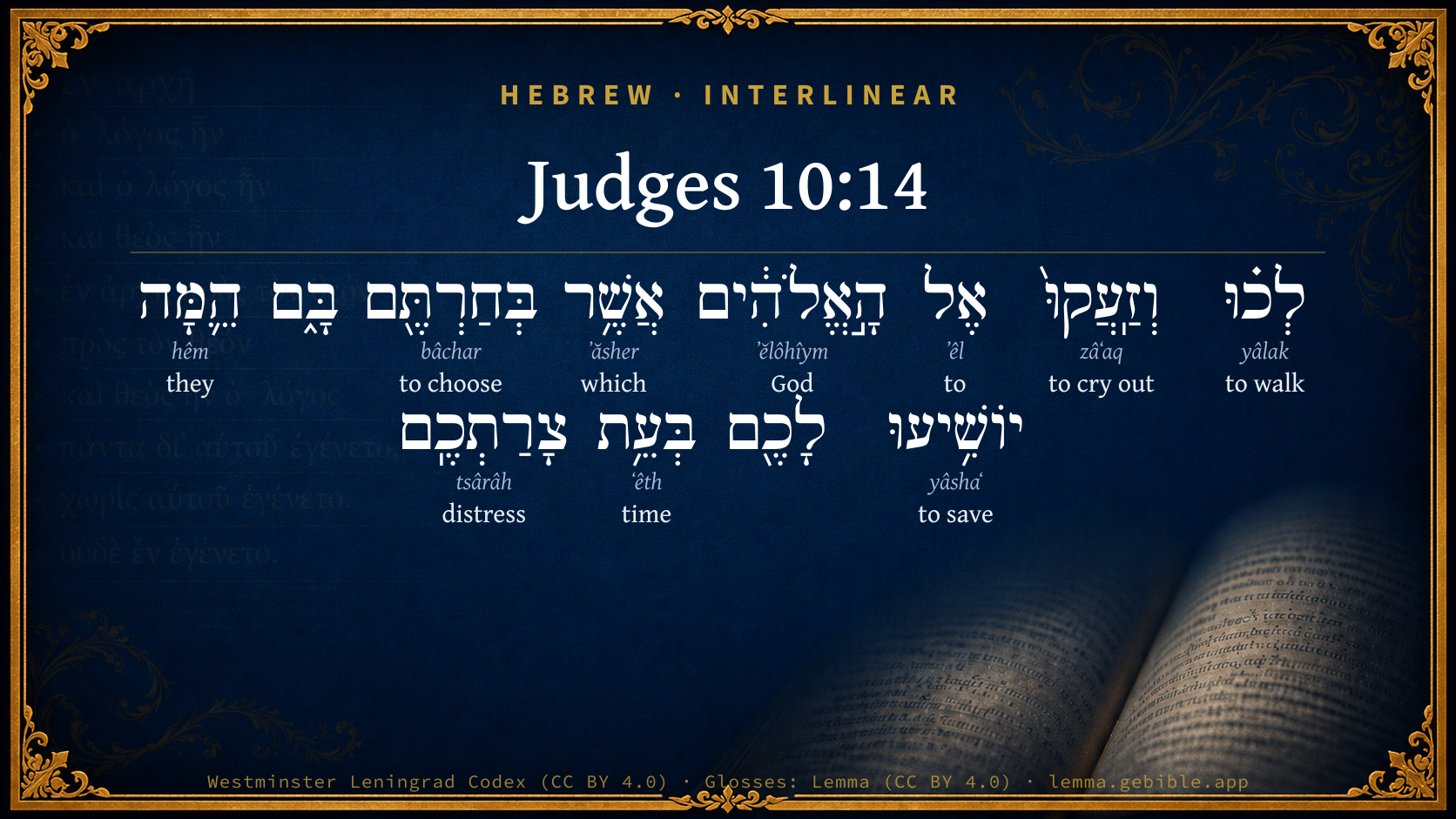
Hebrew (Westminster Leningrad Codex) Judges 10:14 appears in the Hebrew Old Testament. The text above is from the Westminster Leningrad Codex. Each word links to its Strong’s number, a concise gloss, and parsing drawn from the Open Scriptures Hebrew Bible morphology. Click any word for its full Brown-Driver-Briggs (BDB) entry.
Download image
Cite this verse

Judges 10:14 (World English Bible). Public Domain. Lemma interlinear Bible study tool, https://lemma.gebible.app/v/judges/10/14.

Show BibTeX & RIS
BibTeX
RIS
English Translation
Go and cry to the gods which you have chosen; let them save you in the time of your distress.
World English Bible · Public Domain
Download a study sheet

One document with this verse’s original text, its word-by-word gloss line, the meaning frame, cross-references with their text, attributed commentary, and full source and license credits — printable, and it pastes into notes with its structure intact.

This verse Autodidact and up

Study sheet (.html) Plain text (.txt)

A passage Seminary Student

Up to 50 verses in one chapter. A passage sheet keeps up to 6 commentary sources and 12 cross-references per verse, in the order this page ranks them, and says so on the sheet whenever that leaves anything out. Ask for a single verse and you get the Autodidact verse sheet above.

Everything on this page stays free to read, with no account — the sheet is a download of what is already on screen, not access to it.

Want to remove ads? Support Godless Engineer
Compare translations 3

The same verse in 3 English versions, stacked beneath the original-language interlinear above. Click any original word for its lexicon entry.

Each is an independent rendering of the whole verse — the interlinear is not word-aligned to these translations.

Highlighted words mark where these versions differ — a whole-verse word diff, not a word-by-word alignment.

  • World English Bible Public Domain
    Go and cry to the gods which you have chosen; let them save you in the time of your distress.
  • King James Version Public Domain
    Go and cry unto the gods which ye have chosen; let them deliver you in the time of your tribulation.
  • unfoldingWord Literal Text CC BY-SA 4.0
    Go and cry out to the gods upon whom you have chosen. Let them save you in the time of your distress.”

unfoldingWord Literal Text — © unfoldingWord, licensed CC BY-SA 4.0. Word-aligned USFM3 via Door43 (git.door43.org/unfoldingWord/en_ult).

Versions to compare (up to 4)

3 of 4 selected

Show all 18 translations

Every available English version of this verse, each an independent rendering of the whole verse.

  • World English Bible Public Domain
    Go and cry to the gods which you have chosen; let them save you in the time of your distress.
  • Berean Standard Bible Public Domain
    Go and cry out to the gods you have chosen. Let them save you in your time of trouble.”
  • Majority Standard Bible Public Domain
    Go and cry out to the gods you have chosen. Let them save you in your time of trouble.”
  • King James Version Public Domain
    Go and cry unto the gods which ye have chosen; let them deliver you in the time of your tribulation.
  • American Standard Version (1901) Public Domain
    Go and cry unto the gods which ye have chosen; let them save you in the time of your distress.
  • Revised Version (1885) Public Domain
    Go and cry unto the gods which ye have chosen; let them save you in the time of your distress.
  • Geneva Bible (1599) Public Domain
    Goe, and cry vnto the gods which ye haue chosen: let them saue you in the time of your tribulation.
  • Douay-Rheims (1899) Public Domain
    Go and call upon the gods which you have chosen: let them deliver you in the time of distress.
  • Young's Literal Translation Public Domain
    Go and cry unto the gods on which ye have fixed; they -- they save you in the time of your adversity.'
  • Literal Standard Version CC BY-SA 4.0
    Go and cry to the gods on which you have fixed; they save you in the time of your tribulation.”
  • Unlocked Literal Bible CC BY-SA 4.0
    Go and call out to the gods that you have worshiped. Let them rescue you when you have trouble.”
  • unfoldingWord Literal Text CC BY-SA 4.0
    Go and cry out to the gods upon whom you have chosen. Let them save you in the time of your distress.”
  • Darby Bible Public Domain
    Go and cry to the gods whom you have chosen; let them deliver you in the time of your distress."
  • World Messianic Bible Public Domain
    Go and cry to the gods which you have chosen. Let them save you in the time of your distress!”
  • Webster's Bible Public Domain
    Go and cry to the gods which ye have chosen; let them deliver you in the time of your tribulation.
  • Free Bible Version CC BY-SA 4.0
    Go and cry out for help to the gods you have chosen. Let them save you in your time of trouble.”
  • Bible in Basic English Public Domain
    Go, send up your cry for help to the gods of your selection; let them be your saviours in the time of your trouble.
  • JPS Tanakh (1917) Public Domain
    Go and cry unto the gods which ye have chosen; let them save you in the time of your distress.'

Literal Standard Version (2020), Covenant Press — licensed CC BY-SA 4.0. Text via the HelloAO Bible API (eBible.org). Unlocked Literal Bible (unfoldingWord) — licensed CC BY-SA 4.0. Text via the HelloAO Bible API (eBible.org). unfoldingWord Literal Text — © unfoldingWord, licensed CC BY-SA 4.0. Word-aligned USFM3 via Door43 (git.door43.org/unfoldingWord/en_ult). Free Bible Version, Dr. Jonathan Gallagher — licensed CC BY-SA 4.0. Text via the HelloAO Bible API (eBible.org).

Word by word

More ways to search: Search by grammar → Find every occurrence → Compare this word →

Practice this passage: Drill this verse → Learn its vocabulary →

וְזַֽעֲקוּ֙
zâʻaq
H2199
“and · cry out”
Conjunction + Verb, Qal, Imperative, 2nd Person, Masculine, Plural
Part of Speech
Conjunction + Verb
Stem
Qal
Form
Imperative
Person
2nd Person
Gender
Masculine
Number
Plural
Full BDB Definition

Origin: a primitive root

TWOT: 570

to cry, cry out, call, call for help - (Qal) - to call (to one's aid) - to cry, cry out (in need) - (Niphal) to be assembled, be called together, be joined together - (Hiphil) - to call, call out, call together, summon - to make a crying, proclaim - to have a proclamation made - to call out to, call out at
  1. לְכ֗וּ yâlak H3212 “walk” Verb, Qal, Imperative, 2nd Person, Masculine, Plural
  2. אֶל ʼêl H413 “to” Preposition
  3. הָ֣אֱלֹהִ֔ים ʼĕlôhîym H430 “the · God(s)” Particle, Definite Article + Noun, Common, Masculine, Plural, Absolute
  4. אֲשֶׁ֥ר ʼăsher H834 “which” Particle, Relative
  5. בְּחַרְתֶּ֖ם bâchar H977 “to choose” Verb, Qal, Perfect, 2nd Person, Masculine, Plural
  6. הֵ֛מָּה hêm H1992 “they” Pronoun, Personal, 3rd Person, Masculine, Plural
  7. יוֹשִׁ֥יעוּ yâshaʻ H3467 “to save” Verb, Hiphil, Imperfect, 3rd Person, Masculine, Plural
  8. בְּעֵ֥ת ʻêth H6256 “in/at · time of” Preposition + Noun, Common, Both, Singular, Construct
  9. צָרַתְכֶֽם tsârâh H6869 “distress · your” Noun, Common, Feminine, Singular, Construct + Suffix, Personal, 2nd Person, Masculine, Plural

About this verse

These counts appear in no published source. They are computed here, from the morphology-tagged text and Lemma’s own curated glosses. What Lemma adds →

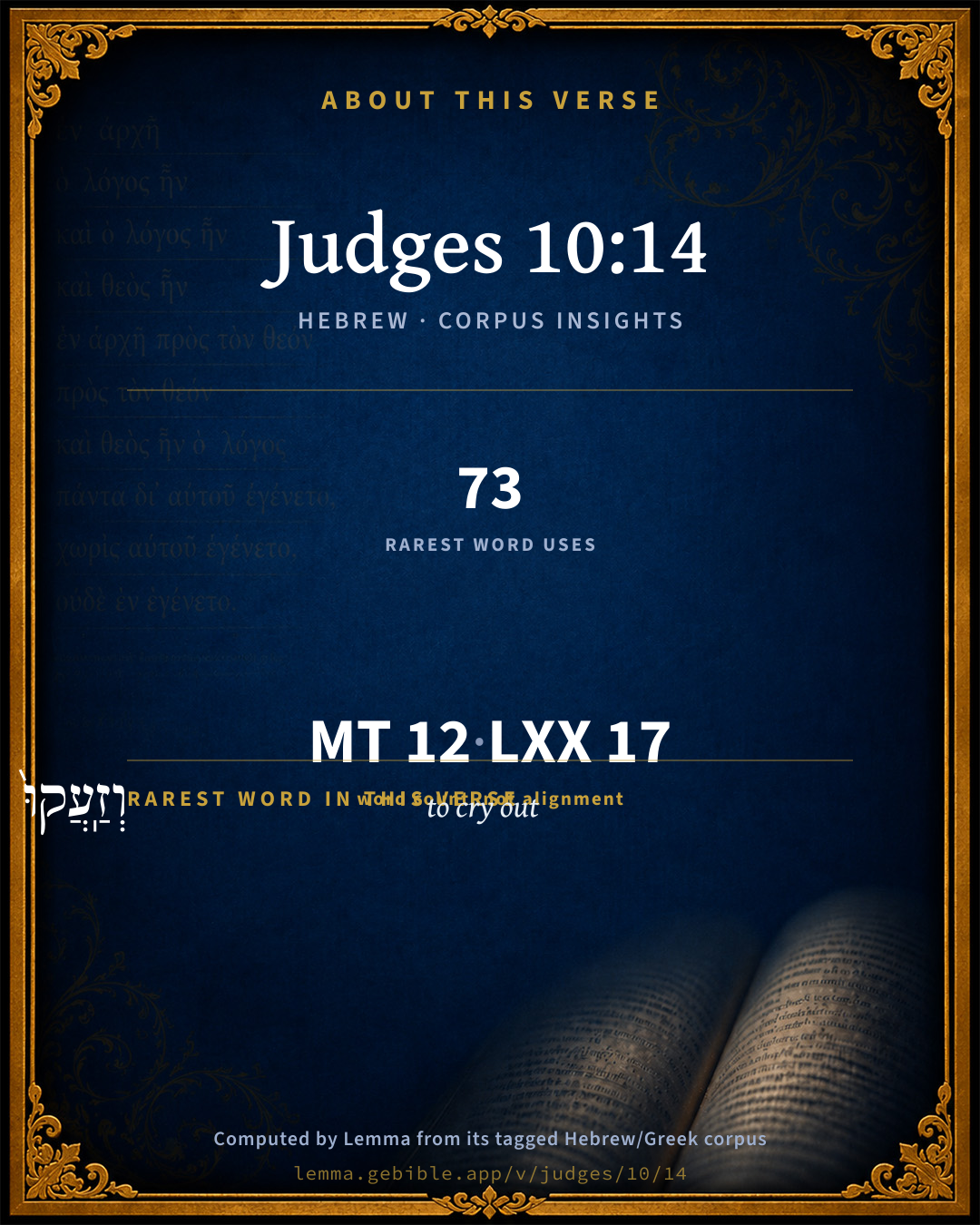
12
words
10
distinct lemmas
Historical
section

Grammatical profile

  • 4 verbs
  • 3 nouns
  • 1 pronoun
  • 3 prepositions
  • 1 particle

Verb forms

  • לְכ֗וּ Qal · Imperative
  • וְזַֽעֲקוּ֙ Qal · Imperative
  • בְּחַרְתֶּ֖ם Qal · Perfect
  • יוֹשִׁ֥יעוּ Hiphil · Imperfect

Hebrew & Septuagint length

In English translation the verse runs 20 words from the Hebrew and 23 from the Septuagint (LXX English) — closely comparable.

A rough comparison of the two English renderings, which tokenize alike — not a word-level alignment.

Word counts can differ between the Hebrew and the Greek without any difference in meaning — e.g. the Hebrew direct-object marker אֵת has no separate Greek word, and Greek often adds the article ὁ.

In the original languages it is 12 Hebrew tokens and 17 Greek tokens — but the two are counted differently (Hebrew bundles its prefixes and suffixes into one token; the Greek is in lemma form), so that isn’t a like-for-like length.

Cross-references

7

Topical passages linked to Judges 10:14 in the Treasury of Scripture Knowledge — connected by theme and wording, ordered by reader-vote popularity; previews shown in the World English Bible.

  • Deuteronomy 32:37–38 He will say, Where are their gods, The rock in which they took refuge;
  • Jeremiah 2:28 But where are your gods that you have made you? let them arise, if they can save you in the time of your trouble: for according to the number of your cities are your gods, Judah.
  • Proverbs 1:25–27 But you have ignored all my counsel, And wanted none of my reproof;
  • Deuteronomy 32:26–28 I said, I would scatter them afar, I would make the memory of them to cease from among men;
  • Isaiah 10:3 What will you do in the day of visitation, and in the desolation which shall come from far? to whom will you flee for help? and where will you leave your glory?
  • 1 Kings 18:27–28 It happened at noon, that Elijah mocked them, and said, Cry aloud; for he is a god: either he is musing, or he is gone aside, or he is on a journey, or peradventure he sleeps and must be awakened.
  • 2 Kings 3:13 Elisha said to the king of Israel, What have I to do with you? get you to the prophets of your father, and to the prophets of your mother. The king of Israel said to him, No; for Yahweh has called these three kings together to deliver them into the hand of Moab.

Cross-references courtesy of OpenBible.info (CC BY 4.0).

Hebrew and Greek witnesses Masoretic Hebrew ↔ Greek Septuagint

The same verse in the two great witnesses to the Old Testament, shown verse-for-verse.

These are two independent witnesses, not word-aligned to each other, and the Septuagint is shown in lemma (dictionary) form.

Hebrew Judges 10:14 Masoretic · Westminster Leningrad Codex

לְכ֗וּ וְזַֽעֲקוּ֙ אֶל הָ֣אֱלֹהִ֔ים אֲשֶׁ֥ר בְּחַרְתֶּ֖ם בָּ֑ם הֵ֛מָּה יוֹשִׁ֥יעוּ לָכֶ֖ם בְּעֵ֥ת צָרַתְכֶֽם

Go and cry to the gods which you have chosen; let them save you in the time of your distress.

World English Bible · Public Domain

Greek LXX Judges 10:14 Septuagint · lemma form

πορεύομαι καί βοάω πρός ὁ θεός ὅς ἐκλέγω ἑαυτοῦ καί αὐτός σώζω σύ ἐν καιρός θλῖψις σύ

Go, and cry to the gods whom you⌃ have chosen to yourselves, and let them save you in the time of your affliction.

LXX2012 (modern English Septuagint) · Public Domain

Hebrew: Westminster Leningrad Codex (CC BY 4.0). Greek: Septuagint (public domain); English from LXX2012 (modern English Septuagint) (Public Domain). How the Septuagint differs from the Hebrew →

Targum (Aramaic paraphrase)

1

The Targum is the ancient Jewish Aramaic paraphrase of the Hebrew Scriptures — an interpretive translation, not the Hebrew text itself. Onkelos (literal) and Pseudo-Jonathan (expansive) render the Torah, and Jonathan the Prophets. Coverage is partial: where no permissively-licensed English translation exists for a verse, only the Aramaic is shown. This is verse-level text, not a word-by-word alignment to the Hebrew.

  1. Targum Jonathan Prophets (Joshua–Malachi)
    אֱזִילוּ וּבְעוֹ מִן טַעֲוָתָא דְאִיתְרְעִיתוּן בְּהוֹן הַאִם יָכְלִין לְמִפְרַקְכוֹן בְּעִידָן עֲקַתְכוֹן:

    (no public-domain English translation for this verse)

    Targum Jonathan — Aramaic: “Mikraot Gedolot” (public domain). English: “Sefaria Community Translation” (CC0 1.0 (public-domain dedication)); “London "Chaldee Paraphrase," 1871” (public domain). Text via Sefaria.

Commentary

Notes on Judges 10:14 from classic Christian and Jewish commentators (each source and its license shown beneath its notes). The classic Christian expositions comment on the surrounding passage and are grouped to its opening verse, so a note may address several verses; the Jewish commentaries on the Tanakh (Rashi and others) are per-verse, so they appear only where the commentator wrote on this verse.

Lemma curates 59 commentaries, every one of them public domain or Creative Commons licensed, each selected and text-cleaned for this edition rather than reprinted as found. About our sources →

Trapp's Complete Commentary

John Trapp

Jdg 10:14 Go and cry unto the gods which ye have chosen; let them deliver you in the time of your tribulation.

Ver. 14. Go and cry unto the gods, &c.] He commandeth them not idolatry, but upbraideth them with it; layeth it in their dish, and showeth them how little they have profited by it. See the like in Deu 32:37-38 1Ki 18:27. And were we not ready to think in our late unnatural troubles, that God had even abandoned us, whatever he may do yet, and to say of England, as he once did of Rome, Nunquam magis, iustis iudiciis, approbatum est non esse curae Deo securitatem nostrum, esse vindictam? {a} That God had cast away the care of our safety, but not of our utter destruction?

{a} Tac., Hist., lib. i. cap. 11.

John Trapp, A Commentary or Exposition upon All the Books of the Old and New Testament (1647–1656) — public domain. Text from a community e-Sword module.

The Biblical Illustrator

Joseph S. Exell

Jdg_10:14

Cry unto the gods which ye have chosen.

Man in trouble crying to his god

I. Every sinner is destined to meet with trouble. Personal afflictions; social bereavements; death.

II. in great trouble he instinctively cries to his god.

1. Every man has a god.

2. Every mans god ought to be able to help him when help is needed.

III. No god can help him in trouble but the true one. (Homilist.)

No help in trouble save from God

Travellers tell us that they who are at the top of the Alps can see great showers of rain fall under them, but not a drop of it falls on them. They who have God for their portion are in a high tower, and thereby safe from all troubles and showers. A drift rain of evil will beat in at the creatures windows, be they never so well pointed: all the garments this world can make up cannot keep them that travel in such weather from being wet to the skin. No creature is able to bear the weight of its fellow-creature, but as reeds break under, and as thorns run into the sides that lean on them. The bow drawn beyond its compass breaks in sunder, and the string wound above its strength snaps in pieces. Such are outward helps to all that trust to them in hardships. (G. Swinnock.)

Helpless gods

It is a most grievous casting them in the teeth, by an ironical mocking of them with their idolatry, as if he should say, Now ye prove and see what your gods can do. As Elias did the like to the prophets of Baal. Therefore by thus speaking, and bidding them go seek help at their idols hands, they having shaken off the Lord, he teacheth us that they whom we have served, and committed ourselves to, must pay us our wages, and to them the Lord justly doth and will send us to their patronage in our greatest need, even to our horror, yea, destruction, if He take us not, as He did these here, to His mercy. They therefore that have trusted, and still do in man, and have made flesh their arm, shall know by experience one day that they have trusted to a bruised reed. Briefly to conclude this doctrine with some other uses thereof, we see secondly by this that God doth import no less than that (by the law of like equity, and by virtue of a far stronger covenant) if this people had persisted faithful in His service He could not have denied their suit for help and defence against their enemies. Thirdly, these words note out this, that it is wisdom for a man to bestow his chief cost there whence he looks for best recompense and acknowledgment in the time of most need. A man is not ashamed of that labour which hath brought him in plentiful gain, but of that which answers not his cost and hope. Men that have run themselves out of breath all their life, groping after a blind happiness, in their unprofitable, superstitious, profane course, at length, seeing themselves deceived, wish they had served a Master who might have saved them and received them into everlasting habitations. Thus the Lord is fain to upbraid men (though not by word, saying, Go to your idols, yet in effect, in that He leaveth them shiftless), or else who should persuade one of a hundred that he soweth among thorns, or loseth his labour and cost, when he casteth it and himself away upon idols? (R. Rogers.)

The misery of forsaking God

I know not how anything can be imagined more sublime, more edifying, or more truly affecting than the delineations of the moral character of the Almighty Governor of the universe, afforded us by Scripture. Immensity of power, combined with the most unrestricted condescension to the wants of the meanest of His creatures; and purity, which charges the very heavens with comparative uncleanness, united with plenitude of compassion. Perhaps, however, there is no passage in the book of the Old Testament more completely to this purpose than the text. Now, be it remembered, that a correct theory of the Divine Being, and sound views of practical morality, are as closely connected with each other as cause and effect. All real morality being the adaptation of our actions to some authentic first rule, and that rule being the presumed will of the great Being who has an undisputed claim to our obedience, it follows as a matter of course that, in order that our standard of morals should be high, our notions of Him to whose approbation that standard is referable should be high in a like proportion. We might as well expect the subsequent course of a stream to be more elevated than its fountain as imagine holy and perfect actions to proceed from belief in an imperfect or impure deity. This con- sideration will at once show us that spiritual debasement is a necessary result of false worship; and will point out the fallaciousness of that favourite assertion of the unbeliever, that accuracy of our abstract notions respecting the Deity is of no consequence provided our practical theory of morality be correct, And now, then, by this infallible test let us try the Christian revelation, comparing it with all that the most plausible surmises of pagan philosophy, or of modern infidelity, have at any time suggested in opposition or rivalry to it. The more substantial theories of paganism on this subject lie in very small compass. It is true that the better disposed heathens in all ages have, from an instinctive feeling of religion, been ready to admit the occasional intervention of Providence with the affairs of mankind, and something like a general system of rewards and punishments, having reference to the morality of human actions. These opinions, however, so far as they went, were, I believe, on all such occasions, rather the spontaneous suggestion of the moral feeling within them, acting against theory, than the result of any deliberate assent of the understanding, founded upon rational inquiry. In fact, I know only of two views of the great question, What is God? or, What is the great moral sanction for the guidance of mans actions? as taken up after mature deliberation by the philosophers of antiquity, which can lay claim to the character of a regular system; the one is that adopted by the Stoics, which pronounces virtue to be so intrinsically lovely in itself as, under all external circumstances, to prove its own reward; the other, that which, though not formally avowed, would, if strictly reasoned out, necessarily result from the principles of the Peripatetics, which, considering the Creator of the universe as the summit of all possible perfection, would represent Him as eternally wrapt up in the contemplation of His own transcendental nature, and consequently indifferent to the vicissitudes which may befall inferior beings. Now it is obvious that both these views, either if entertained as physically true, as affording a substantial first principle of religious morality, are quite unsatisfactory and inoperative. Strange, then, as the proposition may sound in the ears of those who have not been accustomed to consider the doctrines of paganism in all their strictness and in all their consequences, it is undoubtedly true that the belief in a Being at once all perfect in His own nature, and yet at the same time watchfully attentive to all that passes in the creation beneath Him, is the result of revelation only. Our natural reason not only never could have arrived at such a conclusion, but in fact, at the first blush of the question, it absolutely recoils from it. Can God really regard, not merely perishable man, but even the very worms that creep at our feet? Our first impulse, when we consider the presumed impassiveness of its nature, is to say, Certainly not. How can He be at once complete in His own perfection and happiness and accessible to prayer; or, in other words, liable to be influenced by causes external to Himself? Our natural reason is quite unequal to the solution of this difficulty. It is only, I repeat, when we reflect how entirely the whole sum and substance of religion, the elevation of our souls, the establishment of all morality, and the consequent entire welfare of society turn upon this very doctrine, that we learn how much more complete is the revealed wisdom which is from heaven than that which it is given to unassisted man to find out. The question is, not what God might have done, but what He actually has done. The infidel may try to get rid of the difficulty by turning the whole discussion into ridicule, and attempting to show that human life, and all connected with it, is merely like a feverish dream or an ill-told tale without object or connection. The worldly man may assert that, after all that may be said against it, life is still a state of tolerable ease and comfort, and contented with living like the brutes, may think it unnecessary to inquire further; or the more stern philosopher, arguing upon the principles of the ancient Stoics, may assert, contrary to self-evident fact, that life in reality possesses no evil for the truly wise, and that the theory of a future state is not necessary for the vindication of the ways of Providence. But meanwhile the really painful circumstances of our existence will make themselves felt, whether we will or not; and, if we would explain them in a manner satisfactory to our highest notions of Gods goodness, we must have recourse to our Bible. I do not, indeed, say that even in our Bibles we shall find all our difficulties removed. Very far from it; but I do say, that the Bible presupposes the existence of all these very difficulties; that the theory of the Bible would be false did we not find the world precisely what we do find it; and that the great object of the Bible is to show how this very state of things (the great stumbling-block of every other form of religious belief) is part and parcel of the Divine arrangements for the accomplishment of Gods wise and beneficent purposes. Let us pass on to the inferences resulting from these momentous facts. Consider, then, in what a new position, with respect to everything around us, we are all of us placed by this circumstance of the intimate, and almost social, connection which revelation thus declares to exist between ourselves arid our Maker. What a vast interest is communicated to the whole tenor of our existence when we recollect that we are not, as heathen speculation would teach us, placed as in a dreary moral solitude, withdrawn from the superintendence of the Divine mind, who has other and better occupations than to trouble Himself with the details of our sorrows or of our pleasures, of our good or of our bad actions; but that we subsist day and night under His all-searching eye; that not a thought passes through our breasts, not a word escapes our lips, but is pregnant with the consequences of our future weal or woe; that every apparent blessing, every seeming evil with which we are visited, has its peculiar errand and object, viz., the disciplining of our hearts, and the preparing us for immortality! (Bp. Shuttleworth.)

.

The Biblical Illustrator, edited by Joseph S. Exell (c. 1880s–1900s) — public domain. Text from a community e-Sword module.

Ellicott's Commentary for English Readers

(14) Go and cry unto the gods.—With this bitter reproach comp. Deu_32:37-38; 2Ki_3:13; Jer_2:28.

In the time of your tribulation.—Comp. 1Ki_18:27; Pro_1:26.

A Bible Commentary for English Readers, edited by Charles John Ellicott (1878–1897) — public domain. Text from a community e-Sword module.

The Cambridge Bible for Schools and Colleges

gen. ed. J. J. S. Perowne

14. For the thought cf. Deu_32:37-38, Jer_2:28.

The Cambridge Bible for Schools and Colleges (gen. ed. J. J. S. Perowne; Cambridge University Press, 1878–1918) — public domain. Text from a community e-Sword module.

John Gill's Exposition

Go and cry unto the gods which ye have chosen,.... For they were their choice, and not what they were obliged to serve through persecution, and by compulsion of others, and whom they needed not, having the Lord Jehovah to be their God; and they are bid not seriously, but in an ironical or sarcastic way, to call upon them for help in this their time of distress, in whose power it was not to relieve them:

let them deliver you in the time of your tribulation; if they can, whom you have served in your prosperity.

John Gill's Exposition of the Whole Bible (1746–1763) — public domain (CC PDM 1.0). Text via the HelloAO Bible API.

Haydock's Catholic Bible Commentary

Go. This is not a command, but an ironical expression, as Deuteronomy xxxii. 38.

George Leo Haydock (1774–1849), Haydock's Catholic Family Bible and Commentary, 1859 edition — public domain. Excludes Psalms (Douay-Rheims chapter numbering differs from Protestant) and Deuterocanonical books (Catholic canon only).

Matthew Poole's English Annotations

You have not been forced to worship those gods by your oppressors and tyrants; but you have freely chosen these gods before me.

Matthew Poole's English Annotations on the Holy Bible (1683–1685) — public domain. Text from a community e-Sword/MySword module.

Whedon's Commentary on the Bible

Daniel D. Whedon

14. Cry unto the gods — A bitter and taunting irony. Thus Divine Wisdom deals with the rebellious and profane. It laughs at their calamity and mocks when their fear cometh. Pro_1:26.

Daniel D. Whedon (gen. ed.), Commentary on the Old and New Testaments (1874–1909) — public domain. Text from a community e-Sword module.

John Wesley's Explanatory Notes

Chosen - You have not been forced to worship those gods by your oppressors; but you have freely chosen them before me.

John Wesley, Explanatory Notes Upon the Whole Bible (1754–1765) — public domain. Text via the GEBible commentary corpus.

Lesson kit

Teaching starters — assembled from the data on this page, not authored interpretation. Every prompt links to the verse data it draws on. Edit before teaching.

Judges, in the Historical, opens this verse with 12 words (10 distinct Hebrew lemmas). Its most distinctive word is zâʻaq (“to cry out”). A historical commentator’s framing appears above. Read the whole chapter for the surrounding context.

Discussion questions

  1. How does “to cry out” (zâʻaq) shape what this verse is saying?
  2. Deuteronomy 32:37–38 shares this passage’s theme. How do the two illuminate each other?
  3. These translations render this verse differently. What is at stake in choosing one wording over another?
  4. The verb «לְכ֗וּ» is Qal Imperative. How does its form color the action?
  5. Reading how Trapp's Complete Commentary and The Biblical Illustrator read this verse, where do the two commentators agree and where do they part?

Things to notice

Reading settings

Reading text

Shown beneath each verse's original-language words.

Old Testament
Old Testament edition

Read the OT as the Masoretic Hebrew (MT) or the Greek Septuagint (LXX).

English shown for the Greek Septuagint (in the Hebrew ↔ Greek comparison).

Comparing translations? Open the Compare panel on any verse page to stack up to four side by side.