
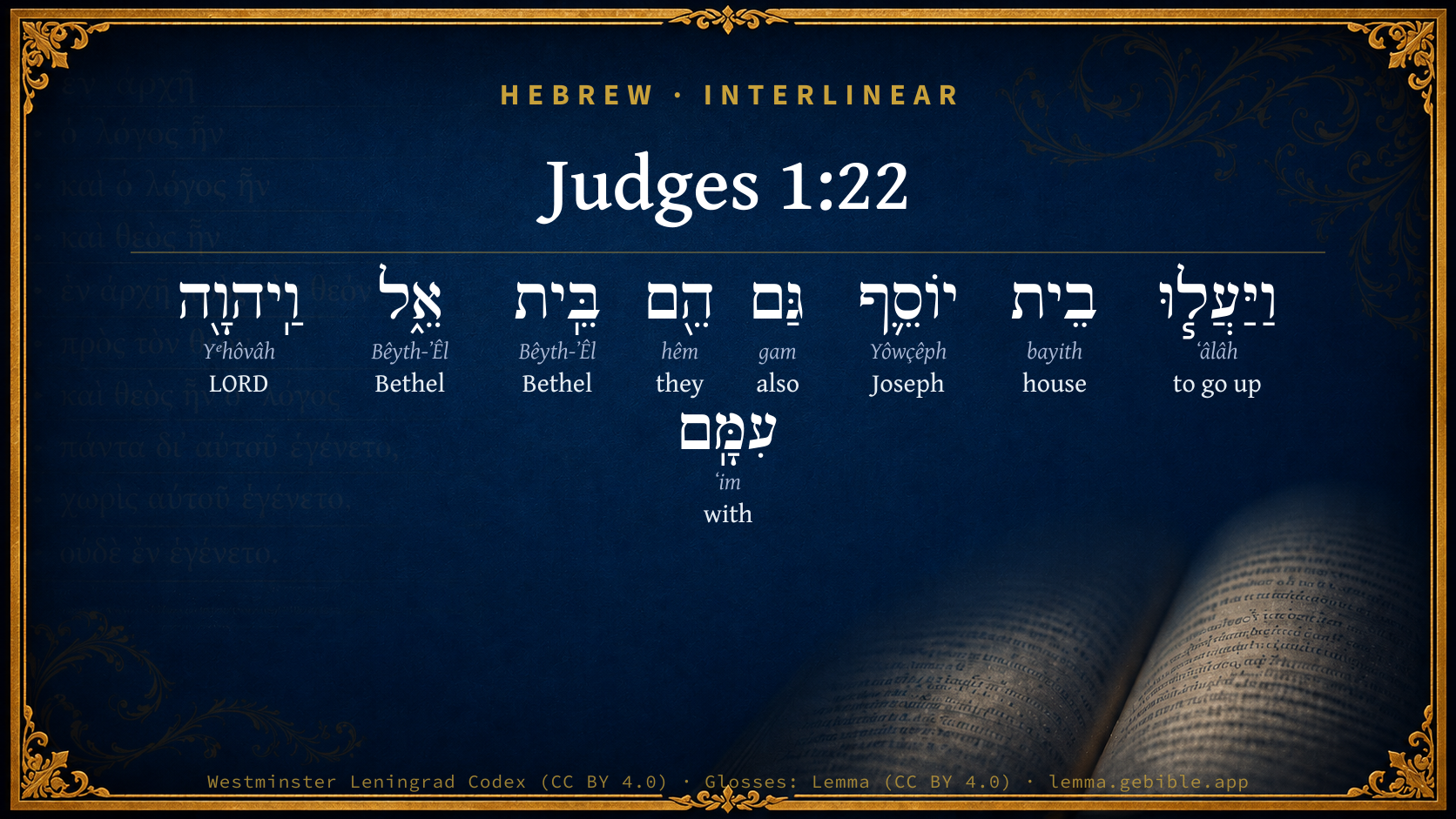
Judges 1:22

Hebrew (Westminster Leningrad Codex) Judges 1:22 appears in the Hebrew Old Testament. The text above is from the Westminster Leningrad Codex. Each word links to its Strong’s number, a concise gloss, and parsing drawn from the Open Scriptures Hebrew Bible morphology. Click any word for its full Brown-Driver-Briggs (BDB) entry.
Download image
Cite this verse

Judges 1:22 (World English Bible). Public Domain. Lemma interlinear Bible study tool, https://lemma.gebible.app/v/judges/1/22.

Show BibTeX & RIS
BibTeX
RIS
English Translation
The house of Joseph, they also went up against Bethel; and Yahweh was with them.
World English Bible · Public Domain
Download a study sheet

One document with this verse’s original text, its word-by-word gloss line, the meaning frame, cross-references with their text, attributed commentary, and full source and license credits — printable, and it pastes into notes with its structure intact.

This verse Autodidact and up

Study sheet (.html) Plain text (.txt)

A passage Seminary Student

Up to 50 verses in one chapter. A passage sheet keeps up to 6 commentary sources and 12 cross-references per verse, in the order this page ranks them, and says so on the sheet whenever that leaves anything out. Ask for a single verse and you get the Autodidact verse sheet above.

Everything on this page stays free to read, with no account — the sheet is a download of what is already on screen, not access to it.

Want to remove ads? Support Godless Engineer
Compare translations 3

The same verse in 3 English versions, stacked beneath the original-language interlinear above. Click any original word for its lexicon entry.

Each is an independent rendering of the whole verse — the interlinear is not word-aligned to these translations.

Highlighted words mark where these versions differ — a whole-verse word diff, not a word-by-word alignment.

  • World English Bible Public Domain
    The house of Joseph, they also went up against Bethel; and Yahweh was with them.
  • King James Version Public Domain
    And the house of Joseph, they also went up against Bethel: and the LORD was with them.
  • unfoldingWord Literal Text CC BY-SA 4.0
    And the house of Joseph, they too went up Bethel, and Yahweh with them.

unfoldingWord Literal Text — © unfoldingWord, licensed CC BY-SA 4.0. Word-aligned USFM3 via Door43 (git.door43.org/unfoldingWord/en_ult).

Versions to compare (up to 4)

3 of 4 selected

Show all 18 translations

Every available English version of this verse, each an independent rendering of the whole verse.

  • World English Bible Public Domain
    The house of Joseph, they also went up against Bethel; and Yahweh was with them.
  • Berean Standard Bible Public Domain
    The house of Joseph also attacked Bethel, and the LORD was with them.
  • Majority Standard Bible Public Domain
    The house of Joseph also attacked Bethel, and the LORD was with them.
  • King James Version Public Domain
    And the house of Joseph, they also went up against Bethel: and the LORD was with them.
  • American Standard Version (1901) Public Domain
    And the house of Joseph, they also went up against Beth-el; and Jehovah was with them.
  • Revised Version (1885) Public Domain
    And the house of Joseph, they also went up against Beth-el: and the LORD was with them.
  • Geneva Bible (1599) Public Domain
    They also that were of the house of Ioseph, went vp to Beth-el, and the Lord was with them,
  • Douay-Rheims (1899) Public Domain
    The house of Joseph also went up against Bethel, and the Lord was with them.
  • Young's Literal Translation Public Domain
    And the house of Joseph go up -- even they -- to Beth-El, and Jehovah `is' with them;
  • Literal Standard Version CC BY-SA 4.0
    And the house of Joseph goes up—even they—to Beth-El, and YHWH [is] with them;
  • Unlocked Literal Bible CC BY-SA 4.0
    The house of Joseph prepared to attack Bethel, and Yahweh was with them.
  • unfoldingWord Literal Text CC BY-SA 4.0
    And the house of Joseph, they too went up Bethel, and Yahweh with them.
  • Darby Bible Public Domain
    The house of Joseph also went up against Bethel; and the LORD was with them.
  • World Messianic Bible Public Domain
    The house of Joseph also went up against Bethel, and the LORD was with them.
  • Webster's Bible Public Domain
    And the house of Joseph, they also went up against Beth-el: and the LORD was with them.
  • Free Bible Version CC BY-SA 4.0
    The descendants of Joseph went and attacked the town of Bethel, and the Lord was with them.
  • Bible in Basic English Public Domain
    And the family of Joseph went up against Beth-el, and the Lord was with them.
  • JPS Tanakh (1917) Public Domain
    And the house of Joseph, they also went up against Beth-el; and the LORD was with them.

Literal Standard Version (2020), Covenant Press — licensed CC BY-SA 4.0. Text via the HelloAO Bible API (eBible.org). Unlocked Literal Bible (unfoldingWord) — licensed CC BY-SA 4.0. Text via the HelloAO Bible API (eBible.org). unfoldingWord Literal Text — © unfoldingWord, licensed CC BY-SA 4.0. Word-aligned USFM3 via Door43 (git.door43.org/unfoldingWord/en_ult). Free Bible Version, Dr. Jonathan Gallagher — licensed CC BY-SA 4.0. Text via the HelloAO Bible API (eBible.org).

Word by word

More ways to search: Search by grammar → Find every occurrence → Compare this word →

Practice this passage: Drill this verse → Learn its vocabulary →

About this verse

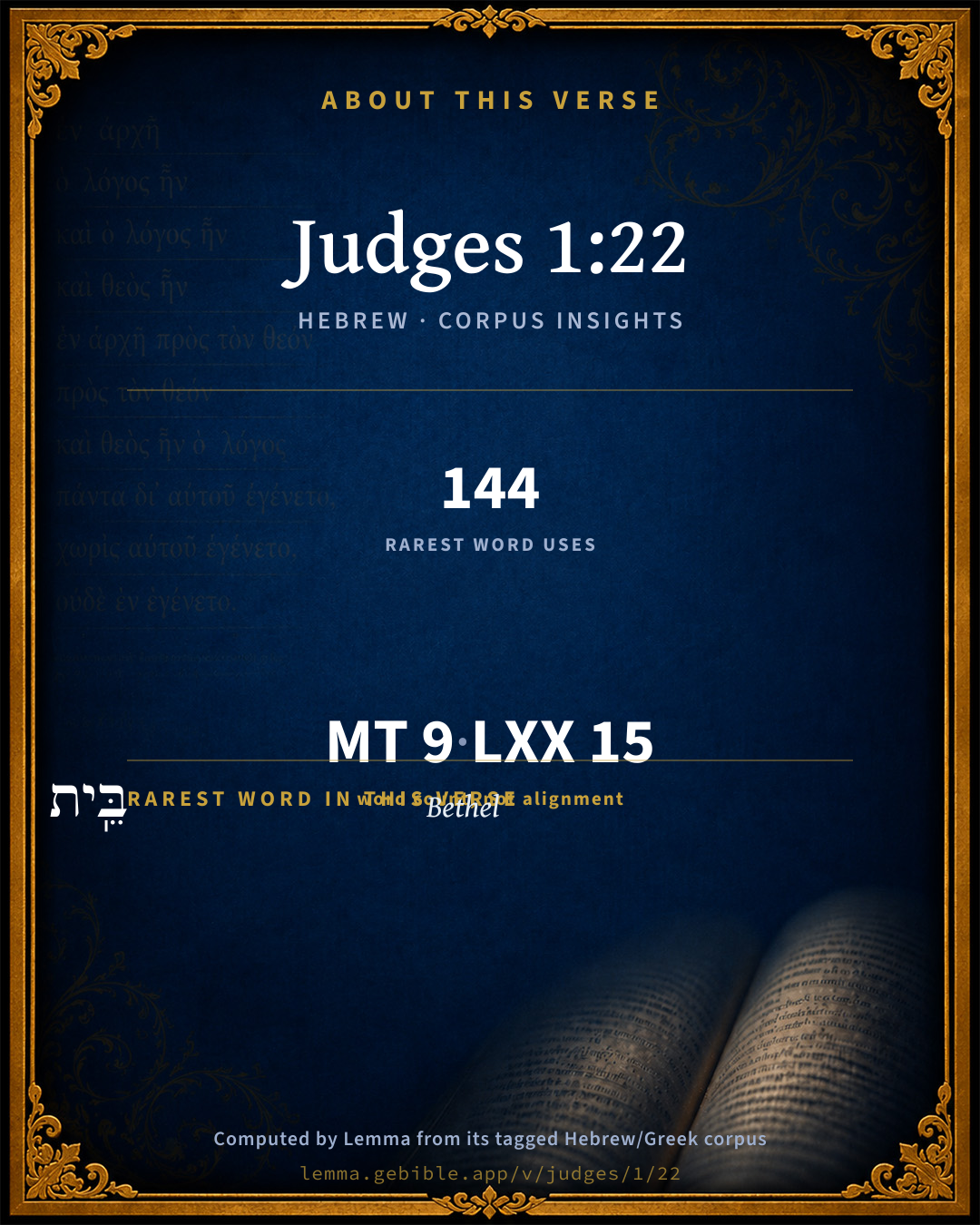
These counts appear in no published source. They are computed here, from the morphology-tagged text and Lemma’s own curated glosses. What Lemma adds →

9
words
8
distinct lemmas
Historical
section

Grammatical profile

  • 1 verb
  • 5 nouns
  • 1 pronoun
  • 1 preposition
  • 1 particle

Verb forms

  • וַיַּעֲל֧וּ Qal · Sequential Imperfect

Repetition

A word recurs within this verse — often emphatic in Hebrew:

  • בֵּֽית Bethel H1008 ×2

Hebrew & Septuagint length

In English translation the verse runs 15 words from the Hebrew and 17 from the Septuagint (LXX English) — closely comparable.

A rough comparison of the two English renderings, which tokenize alike — not a word-level alignment.

Word counts can differ between the Hebrew and the Greek without any difference in meaning — e.g. the Hebrew direct-object marker אֵת has no separate Greek word, and Greek often adds the article ὁ.

In the original languages it is 9 Hebrew tokens and 15 Greek tokens — but the two are counted differently (Hebrew bundles its prefixes and suffixes into one token; the Greek is in lemma form), so that isn’t a like-for-like length.

Cross-references

9

Topical passages linked to Judges 1:22 in the Treasury of Scripture Knowledge — connected by theme and wording, ordered by reader-vote popularity; previews shown in the World English Bible.

  • Judges 1:19 Yahweh was with Judah; and drove out [the inhabitants of] the hill-country; for he could not drive out the inhabitants of the valley, because they had chariots of iron.
  • Genesis 49:24 But his bow abode in strength, The arms of his hands were made strong, By the hands of the Mighty One of Jacob, (From there is the shepherd, the stone of Israel),
  • Numbers 1:10 Of the children of Joseph: Of Ephraim: Elishama the son of Ammihud. Of Manasseh: Gamaliel the son of Pedahzur.
  • Numbers 1:32 Of the children of Joseph, of the children of Ephraim, their generations, by thir families, by their fathers' houses, according to the number of the names, from twenty years old and upward, all who were able to go out to war;
  • Joshua 14:4 For the children of Joseph were two tribes, Manasseh and Ephraim: and they gave no portion to the Levites in the land, save cities to dwell in, with the suburbs of it for their cattle and for their substance.
  • Joshua 16:1–4 The lot came out for the children of Joseph from the Jordan at Jericho, at the waters of Jericho on the east, even the wilderness, going up from Jericho through the hill-country to Bethel;
  • 2 Kings 18:7 Yahweh was with him; wherever he went forth he prospered: and he rebelled against the king of Assyria, and didn't serve him.
  • 1 Chronicles 7:29 and by the borders of the children of Manasseh, Beth-shean and its towns, Taanach and its towns, Megiddo and its towns, Dor and its towns. In these lived the children of Joseph the son of Israel.
  • Revelation 7:8 Of the tribe of Zebulun twelve thousand, Of the tribe of Joseph twelve thousand, Of the tribe of Benjamin were sealed twelve thousand.

Cross-references courtesy of OpenBible.info (CC BY 4.0).

Hebrew and Greek witnesses Masoretic Hebrew ↔ Greek Septuagint

The same verse in the two great witnesses to the Old Testament, shown verse-for-verse.

These are two independent witnesses, not word-aligned to each other, and the Septuagint is shown in lemma (dictionary) form.

Hebrew Judges 1:22 Masoretic · Westminster Leningrad Codex

וַיַּעֲל֧וּ בֵית יוֹסֵ֛ף גַּם הֵ֖ם בֵּֽית אֵ֑ל וַֽיהוָ֖ה עִמָּֽם

The house of Joseph, they also went up against Bethel; and Yahweh was with them.

World English Bible · Public Domain

Greek LXX Judges 1:22 Septuagint · lemma form

καί ἀναβαίνω ὁ υἱός ιωσηφ καί γέ αὐτός εἰς βαιθηλ καί κύριος εἰμί μετά αὐτός

And the sons of Joseph, they also went up to Baethel; and the Lord was with them.

LXX2012 (modern English Septuagint) · Public Domain

On this verse, The Cambridge Bible for Schools and Colleges discusses the Septuagint’s reading. Read the note in Commentary ↓

Hebrew: Westminster Leningrad Codex (CC BY 4.0). Greek: Septuagint (public domain); English from LXX2012 (modern English Septuagint) (Public Domain). How the Septuagint differs from the Hebrew →

Targum (Aramaic paraphrase)

1

The Targum is the ancient Jewish Aramaic paraphrase of the Hebrew Scriptures — an interpretive translation, not the Hebrew text itself. Onkelos (literal) and Pseudo-Jonathan (expansive) render the Torah, and Jonathan the Prophets. Coverage is partial: where no permissively-licensed English translation exists for a verse, only the Aramaic is shown. This is verse-level text, not a word-by-word alignment to the Hebrew.

  1. Targum Jonathan Prophets (Joshua–Malachi)
    וּסְלִיקוּ דְבֵית יוֹסֵף אַף אִנוּן לְבֵית אֵל וּמֵימְרָא דַייָ בְּסַעְדְהוֹן:

    (no public-domain English translation for this verse)

    Targum Jonathan — Aramaic: “Mikraot Gedolot” (public domain). English: “Sefaria Community Translation” (CC0 1.0 (public-domain dedication)); “London "Chaldee Paraphrase," 1871” (public domain). Text via Sefaria.

Commentary

Notes on Judges 1:22 from classic Christian and Jewish commentators (each source and its license shown beneath its notes). The classic Christian expositions comment on the surrounding passage and are grouped to its opening verse, so a note may address several verses; the Jewish commentaries on the Tanakh (Rashi and others) are per-verse, so they appear only where the commentator wrote on this verse.

Lemma curates 59 commentaries, every one of them public domain or Creative Commons licensed, each selected and text-cleaned for this edition rather than reprinted as found. About our sources →

Jamieson, Fausset & Brown

Robert Jamieson, A. R. Fausset & David Brown

SOME CANAANITES LEFT. (Jdg 1:22-26)

the house of Joseph--the tribe of Ephraim, as distinguished from Manasseh (Jdg 1:27).

Jamieson, Fausset & Brown — Commentary Critical and Explanatory on the Whole Bible (1871) — public domain (CC PDM 1.0). Text via the HelloAO Bible API.

The Cambridge Bible for Schools and Colleges

gen. ed. J. J. S. Perowne

22. the house of Joseph] i.e. the tribes of Ephraim and Manasseh (Jos_17:17); from 2Sa_19:16; 2Sa_19:20 it appears that the tribe of Benjamin was included.

they also] Just as Judah went up, Jdg_1:4.

Beth-el] The modern Bçtîn, about four hours N. of Jerusalem, 2880 ft. above the sea, and high up in the Central Range (cf. Jdg_4:5, Jdg_20:18; Jdg_20:31 etc.). From Jericho the direct ascent to Beth-el must have passed Ai, the capture of which is recorded in Joshua 8; but we are to think of a gradual process of occupation rather than of a campaign in regular stages.

and the Lord was with them] as He was with Judah, Jdg_1:19. The LXX. cod. A reads ‘and Judah was with them,’ most likely due to a copyist’s slip; in Hebrew Jehovah and Judah differ in only one letter.

22–26. The fortunes of the house of Joseph

The account of the capture of Beth-el (Jdg_1:22-26) has all the marks of antiquity, like the early fragments preserved in Jdg_1:1-21. After the invasion of the South comes the invasion of Central Palestine, and, as this ancient version of the history shews, the two were independent of one another. The narrative knows nothing of such a leader as Joshua, though tradition connected him with the house of Joseph (Jos_19:50 JE, Jos_24:1 [Shechem], Jos_24:30 E; Jdg_2:9), and with the taking of Ai near Beth-el (Joshua 8).

The Cambridge Bible for Schools and Colleges (gen. ed. J. J. S. Perowne; Cambridge University Press, 1878–1918) — public domain. Text from a community e-Sword module.

Trapp's Complete Commentary

John Trapp

Jdg 1:22 And the house of Joseph, they also went up against Bethel: and the LORD [was] with them.

Ver. 22. And the Lord was with them.] "The Lord, mighty in battle."

22 And of some have compassion, making a difference:

Ver. 22. And of some] Or (according to other copies), "Retell their false reasonings," and dispute them out of their errors, ελεειτε, alias ελεγχετε.

John Trapp, A Commentary or Exposition upon All the Books of the Old and New Testament (1647–1656) — public domain. Text from a community e-Sword module.

The Biblical Illustrator

Joseph S. Exell

Jdg_1:22-26

The house of Joseph . . . went up against Bethel; and the Lord was with them.

Success in carrying out Gods commands

This work of the house of Joseph which they went about, namely, to take this city Bethel, as God had injoined them, doth lively set before our eyes the duty of all Gods people, that is to say, readily to go about and set upon the work that God hath appointed them, yea, and this is to be done, whatsoever discouragements may stand up in the way to hinder them. For hath not He commanded them? And is not He able to remove those impediments, rather than they shall hinder His work in the hands of His servants? For otherwise, if we look not to God by faith, but what let is in the way, and be hindered thereby, we shall cast the commandment of God behind our back, and do as they who observe the wind, and therefore sow not; and look too much to the clouds, and therefore reap not; and so for fear of inconveniences we shall let pass necessary duties. Again, when we thrive and have good success, we bless God, and are merry; but if we be crossed, we curse ourselves with impatience. Whereas it ought to be enough to us, that God hath brought it to pass either thus, or otherwise. And beside the authority He hath over us, His bountiful rewarding of us in His service, ought to encourage us to address ourselves to all such work; and not only so, but further, seeing He commandeth and would have us do it, as it may be most for our own ease, that is, willingly, readily, cheerfully; for the Lord loveth that, in all His service, as He loveth a cheerful giver. And we know (for our own parts) that men go untowardly about that work which they take in hand unwillingly. But I would that even they who are so, did go about that which they do by Gods commandment cheerfully, and with delight for the Lords sake; then should there many excrements be cut off from the infinite actions which are done in our lives, and with so much sin removed; many plagues and annoyances should be avoided from mens lives also. (R. Rogers.)

The spies saw a man come forth.

The spies and the man of Bethel

In this verse, where it is said that the spies met this man coming out of the city, somewhat is to be noted by occasion of the man and somewhat from the spies. By the man first, going in his simplicity out of the city (whether to save his life or upon some other necessary occasion), meeting with these spies, and falling into such a fright thereby, that either he must lose his life or betray the city (for the spies said to him, Show us the way into the city and we will show thee mercy). We may see what straits and difficulties we meet with in this life; for that peril which we neither fear nor once think of, may befall us, even to the hazarding of our lives, much more of our undoing, or the loss of the best of Gods blessings that we enjoy, as wife, children, goods, dec. The Shunammites child went into the field in the morning well, but died at noon. This we have to learn by occasion of the man. Now of the spies. The spies offered him kindness, if he would show them the way into the city; in that they dealt kindly with him, rather than roughly and cruelly, seeking such a matter at his hands, they did as became them. But he being one of the cursed nations, how could they promise him mercy? For though they did so to Rahab before, yet she turned to their religion; and so did the Gibeonites serve them as bondmen, and embraced their religion also. But no such thing can be said of this man, for he went unto the Hittites, out of the seven cursed nations, and dwelt there. I answer, we must interpret the laws of God against the Canaanites, and concerning the rooting them out, by mitigating them with this equity, that if they made peace with Israel, they should not root them out. And this appears by that which is written in Joshua, that these nations were rooted out, seeing none of them save the Gibeonites, made peace with the Hebrews. And this being so, teacheth all men to deal even with the bad kindly, and to be harmless toward them. And again, oh that we could deal pitifully, kindly, and lovingly with the miserable and the afflicted; and that all the gentlest means were used to reclaim offenders, of whom there is hope, such as are as this man of Bethel was, in great distress, which is not done but very rarely, and therefore is there much hardness of heart in those to whom it is neglected, and wilfulness, that carrieth them to all profaneness and impenitency. (R. Rogers.)

The Biblical Illustrator, edited by Joseph S. Exell (c. 1880s–1900s) — public domain. Text from a community e-Sword module.

Joseph Benson's Commentary

Jdg 1:22-25. The house of Joseph — That is, the tribe of Ephraim. Show us the entrance into the city — That is, where it may be most easily entered. For they did not inquire the way to the gate, which, no doubt, was common and plain enough; but for the weakest part, where the walls were lowest, or most out of repair, or had the least guard. Or they desired him, perhaps, to show them some private way to get into it, which none knew but the inhabitants. He showed them the entrance — Upon which, we may suppose, notice was immediately sent to the army, which lay near. They smote the city — Came upon them suddenly, and attacked them where they least expected it; so that the assailants met with little resistance.

Joseph Benson's Commentary on the Old and New Testaments (1811–1818) — public domain. Text from a community e-Sword module.

Whedon's Commentary on the Bible

Daniel D. Whedon

CONQUEST OF BETH-EL, Jdg_1:22-26.

22. House of Joseph — The combined forces of Ephraim and western Manasseh. This seems evident, not only from the words, but also from the fact that Manasseh and Ephraim are mentioned separately, in Jdg_1:27; Jdg_1:29, in reference to other matters. Beth-el belonged to the tribe of Benjamin, (Jos_18:22,) but was so near the border of Ephraim that the security and peace of all the neighbouring tribes required the expulsion of the Canaanites from it. So important was it to accomplish this conquest that the whole house of Joseph unite in the war.

Daniel D. Whedon (gen. ed.), Commentary on the Old and New Testaments (1874–1909) — public domain. Text from a community e-Sword module.

Adam Clarke's Commentary

Verse 22. The house of Joseph, they also went up against Bethel] That is, the tribe of Ephraim and the half tribe of Manasseh, who dwelt beyond Jordan. Beth-el was not taken by Joshua, though he took Ai, which was nigh to it.

Instead of בית יוסף beith Yoseph, "the house of Joseph," ten of Dr. Kennicott's MSS. and six of De Rossi's have בני יוסף beney Yoseph, "the children of Joseph;" and this is the reading of both the Septuagint and Arabic, as well as of two copies in the Hexapla of Origen.

Adam Clarke's Commentary on the Bible (1810–1826) — public domain. Text from a community e-Sword/MySword module.

Ellicott's Commentary for English Readers

(22) The house of Joseph.—Ephraim and Manasseh. The narrative now leaves the conquest of southern for that of central Palestine (Joshua 16, 17).

Beth-el.—The position of this town on the “highway” between Hebron and Shechem—the main thoroughfare of Palestine (Jdg_20:31; Jdg_21:19)—gave it great importance, as did also its sacred connection with events in the life of Abraham (Gen_12:8-9; Gen_13:3-4; Gen_12:8) and Jacob (Gen_28:10-17). For its subsequent history, see Jdg_20:18-26, and the history of the northern kingdom, Hos_10:8; Amo_5:21-23; Amo_7:10; 1 Kings 12, 13; 2Ki_2:3, &c. It is now the wretched village of Beitin. Bethel belonged properly to Benjamin (Jos_18:22), but possibly, as in the case of Jerusalem, the border of Ephraim and Benjamin separated the upper from the lower town.

A Bible Commentary for English Readers, edited by Charles John Ellicott (1878–1897) — public domain. Text from a community e-Sword module.

John Gill's Exposition

And the house of Joseph, they also went up against Bethel,.... Which lay upon the borders of the sons of Joseph, Ephraim and Manasseh, Jos 16:1; and though it seems to have been taken when Ai was, Jos 8:17; yet it appears that it was now in the possession of the Canaanites; wherefore the tribes of Ephraim and Manasseh being desirous of enlarging their borders after the example of Judah, went against this place in order to take it:

and the Lord was with them; the Word of the Lord, as the Targum, directing, assisting, and succeeding them in their attempt.

John Gill's Exposition of the Whole Bible (1746–1763) — public domain (CC PDM 1.0). Text via the HelloAO Bible API.

Albert Barnes' Notes on the Bible

Bethel was within the borders of Benjamin, but was captured, as we here learn, by the house of Joseph, who probably retained it.

Albert Barnes' Notes on the Bible (1834–1885) — public domain. Text from a community e-Sword/MySword module.

Haydock's Catholic Bible Commentary

Of Joseph, on the west side of the Jordan, attacked Bethel, which it does not appear that Josue molested. (Haydock) --- Instead of house, some Hebrew manuscripts and the Arabic and Septuagint read, "the sons," which seems to be the better reading. (Kennicott)

George Leo Haydock (1774–1849), Haydock's Catholic Family Bible and Commentary, 1859 edition — public domain. Excludes Psalms (Douay-Rheims chapter numbering differs from Protestant) and Deuterocanonical books (Catholic canon only).

Matthew Poole's English Annotations

The house of Joseph, i.e. the tribe of Ephraim, as appears from their opposition to the tribe of Manasseh, Jdg 1:27.

Matthew Poole's English Annotations on the Holy Bible (1683–1685) — public domain. Text from a community e-Sword/MySword module.

The Pulpit Commentary

The house of Joseph, i.e. Ephraim, but probably, here spoken of as "the house of Joseph because in the original document, from which both this chapter and Jos_15:63, and Jos 16 Jos 17 are taken, the mention of "the lot of the children of Joseph" occurs, embracing both Ephraim and Manasseh. See Jos_16:1 and Jos_15:23, with which the twenty-first and twenty-second verses of this chapter are manifestly identical.

HOMILIES BY A.F. MUIR. Vers. 22-26. An unwilling helper of the cause of God.

Into the motives that actuated him we need not pry. Chief of all was the great one of self-preservation. Was it honourable? Was it right for the soldiers of God to make use of such an instrument? There may have been other considerations that had weight with him. It might have been virtuous to resist the offer: was it necessarily vicious to yield to it?

I THERE ARE MANY WHO HELP THE TRUTH FROM LOWER MOTIVES WHO MIGHT DO SO FROM HIGHER. Expediency; public benefits of religion; ties of relationship; reputation. How great the blessing to Christ"s cause if the same things were done from higher motives!

II THEY ARE BLESSED, BUT NOT AS THEY MIGHT OTHERWISE HAVE BEEN. A better service would have secured a higher reward.

III THEY CANNOT BE RELIED UPON, AND THEREFORE MAY NOT BECOME PART OF GOD"S PEOPLE. The conquering host could not trust the traitor whose help had won them the city. He must go forth with his reproach. Many churches contain the elements of weakness and ruin because they have failed to exercise a wise censorship over those admitted to their communion. The true Church is composed of those who serve God from the purest motives. M.

The Pulpit Commentary (1880–1919), ed. H.D.M. Spence-Jones & Joseph S. Exell — public domain. Text from a community e-Sword module.

John Wesley's Explanatory Notes

House of Joseph - That is, the tribe of Ephraim.

John Wesley, Explanatory Notes Upon the Whole Bible (1754–1765) — public domain. Text via the GEBible commentary corpus.

Keil & Delitzsch

C. F. Keil & F. Delitzsch

Like Judah, so also ("they also," referring back to Jdg 1:2, Jdg 1:3) did the house of Joseph (Ephraim and western Manasseh) renew the hostilities with the Canaanites who were left in their territory after the death of Joshua. The children of Joseph went up against Bethel, and Jehovah was with them, so that they were able to conquer the city. Bethel had indeed been assigned to the tribe of Benjamin (Jos 18:22), but it was situated on the southern boundary of the tribe-land of Ephraim (Jos 16:2; Jos 18:13); so that the tribe of Joseph could not tolerate the Canaanites in this border town, if it would defend its own territory against them, and purge it entirely of them. This is a sufficient explanation of the fact that this one conquest is mentioned, and this only, without there being any necessity to seek for the reason, as Bertheau does, in the circumstance that the town of Bethel came into such significant prominence in the later history of Israel, and attained the same importance in many respects in relation to the northern tribes, as that which Jerusalem attained in relation to the southern. For the fact that nothing more is said about the other conquests of the children of Joseph, may be explained simply enough on the supposition that they did not succeed in rooting out the Canaanites from the other fortified towns in their possessions; and therefore there was nothing to record about any further conquests, as the result of their hostilities was merely this, that they did not drive the Canaanites out of the towns named in Jdg 1:27, Jdg 1:29, but simply made them tributary. יתירוּ, they had it explored, or spied out. תּוּר is construed with בּ here, because the spying laid hold, as it were, of its object. Bethel, formerly Luz, now Beitin: see at Gen 28:19 and Jos 7:2.

Keil & Delitzsch — Biblical Commentary on the Old Testament (1861–1891) — public domain (CC PDM 1.0). Text via the HelloAO Bible API. (Old Testament only.)

unfoldingWord translationNotes

Door43 World Missions Community

The house of Joseph

Here "house" represents descendants. Manasseh and Ephraim were sons of Joseph, and the "house of Joseph" can refer to the descendants of Manasseh and Ephraim. AT: "The descendants of Manasseh and Ephraim" or "The men of the tribes of Manasseh and Ephraim" (See: Metonymy)

to attack Bethel

Here "Bethel" represents the people who live in Bethel. (See: Metonymy)

spy

to get information secretly

the city that was formerly called Luz

This is background information. Some people who first read this book had probably heard of Luz but did not know that it was the same as the city that they called Bethel. (See: Background Information and How to Translate Names)

spies

people who get information secretly

translationWords

house

Joseph (OT)

Bethel

Yahweh

send

unfoldingWord translationNotes — © Distant Shores Media and the Door43 World Missions Community, licensed CC BY-SA 4.0. Source: git.door43.org/Door43/en_tn.

Rashi

Rabbi Shlomo Yitzchaki (Rashi)

Beis El which was part of their ancestral allotment. Although Michah's idol was in their possession—for Michah was from the tribe of Ephraim—it is said here, "and Adonoy was with them." Concerning this, Daniel said, "Yours, O Adonoy, is benevolence—ours is the face of humiliation."

Rashi on the Tanakh — English translations: “The Judaica Press complete Tanach with Rashi, translated by A. J. Rosenberg” (CC BY 4.0); “Pentateuch with Rashi's commentary by M. Rosenbaum and A.M. Silbermann, 1929-1934” (public domain); “The Metsudah Tanach series, Lakewood, N.J” (CC BY 4.0); and “The Book of Joshua, Metsudah Publications, 1997” (CC BY 4.0). Text via Sefaria.

Lesson kit

Teaching starters — assembled from the data on this page, not authored interpretation. Every prompt links to the verse data it draws on. Edit before teaching.

Judges, in the Historical, opens this verse with 9 words (8 distinct Hebrew lemmas). Its most distinctive word is Bêyth-ʼÊl (“Bethel”). A historical commentator’s framing appears above. Read the whole chapter for the surrounding context.

Discussion questions

  1. How does “Bethel” (Bêyth-ʼÊl) shape what this verse is saying?
  2. How does Judges 1:19, which shares this passage’s theme, read alongside this verse?
  3. What does the repetition of “Bethel” (2× in this one verse) do in this verse?
  4. The translations on this page render this verse differently — a whole-verse word diff, not a word-by-word alignment. What might account for the different wordings?
  5. «וַיַּעֲל֧וּ» is a Qal Sequential Imperfect verb. How does that grammatical form shape the action described?
  6. Compare how Jamieson, Fausset & Brown and The Cambridge Bible for Schools and Colleges read this verse. Where do they agree or differ?

Things to notice

Reading settings

Reading text

Shown beneath each verse's original-language words.

Old Testament
Old Testament edition

Read the OT as the Masoretic Hebrew (MT) or the Greek Septuagint (LXX).

English shown for the Greek Septuagint (in the Hebrew ↔ Greek comparison).

Comparing translations? Open the Compare panel on any verse page to stack up to four side by side.