
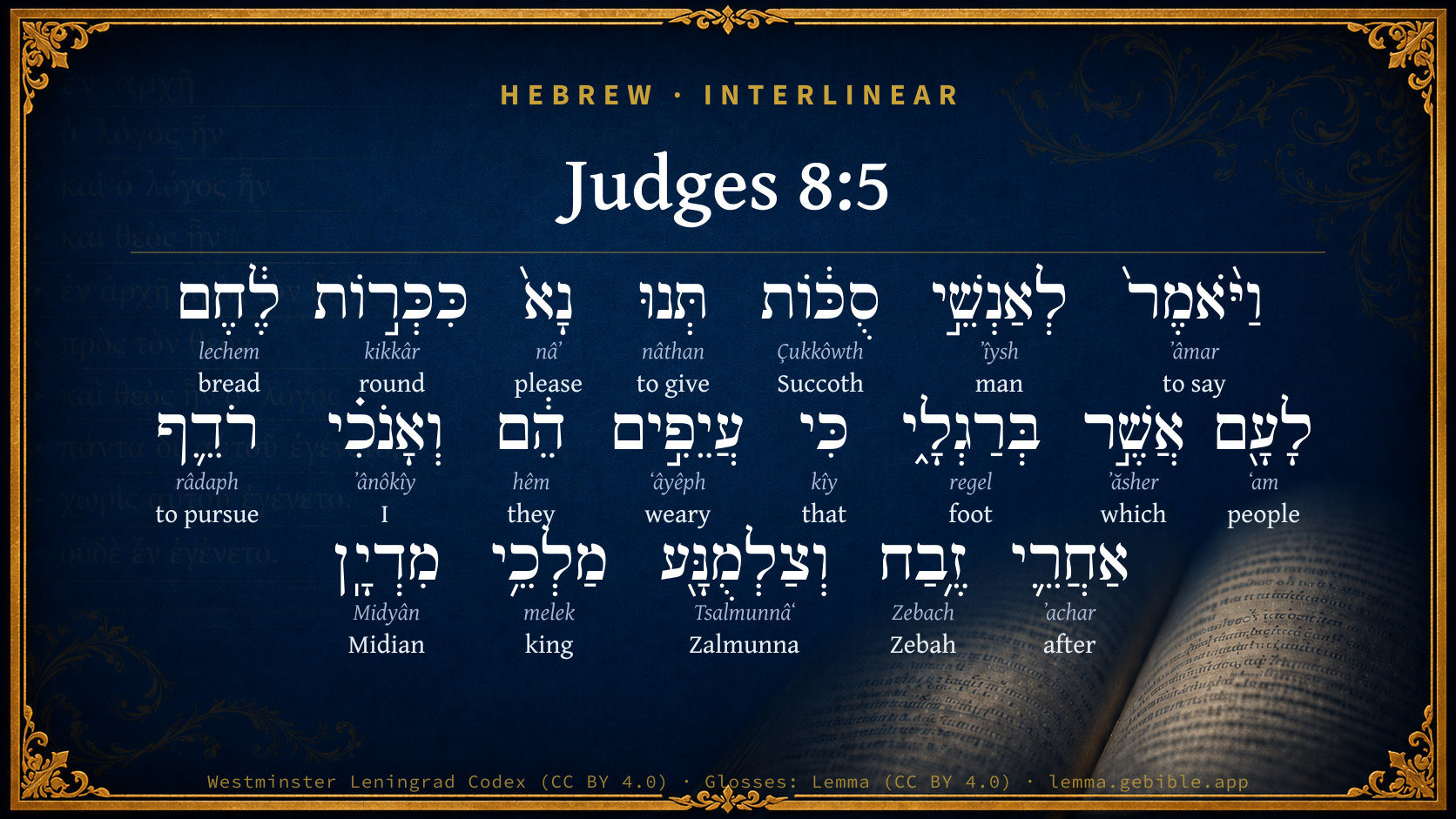
Judges 8:5

Hebrew (Westminster Leningrad Codex) Judges 8:5 appears in the Hebrew Old Testament. The text above is from the Westminster Leningrad Codex. Each word links to its Strong’s number, a concise gloss, and parsing drawn from the Open Scriptures Hebrew Bible morphology. Click any word for its full Brown-Driver-Briggs (BDB) entry.
Download image
Cite this verse

Judges 8:5 (World English Bible). Public Domain. Lemma interlinear Bible study tool, https://lemma.gebible.app/v/judges/8/5.

Show BibTeX & RIS
BibTeX
RIS
English Translation
He said to the men of Succoth, Please give loaves of bread to the people who follow me; for they are faint, and I am pursuing after Zebah and Zalmunna, the kings of Midian.
World English Bible · Public Domain
Highlights
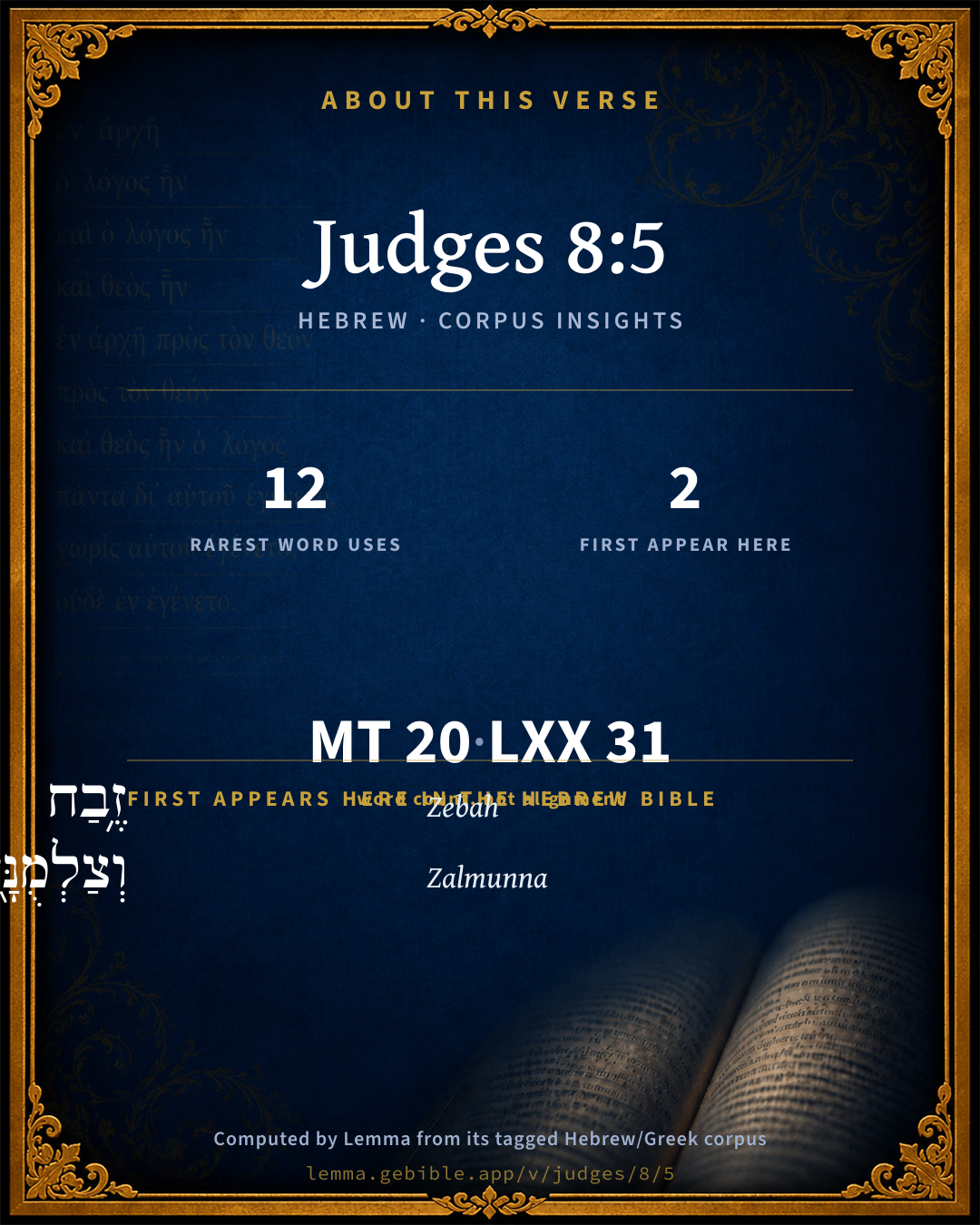
  • 2 first appearances in the Hebrew Bible
Full analysis ↓
Download a study sheet

One document with this verse’s original text, its word-by-word gloss line, the meaning frame, cross-references with their text, attributed commentary, and full source and license credits — printable, and it pastes into notes with its structure intact.

This verse Autodidact and up

Study sheet (.html) Plain text (.txt)

A passage Seminary Student

Up to 50 verses in one chapter. A passage sheet keeps up to 6 commentary sources and 12 cross-references per verse, in the order this page ranks them, and says so on the sheet whenever that leaves anything out. Ask for a single verse and you get the Autodidact verse sheet above.

Everything on this page stays free to read, with no account — the sheet is a download of what is already on screen, not access to it.

Want to remove ads? Support Godless Engineer
Compare translations 3

The same verse in 3 English versions, stacked beneath the original-language interlinear above. Click any original word for its lexicon entry.

Each is an independent rendering of the whole verse — the interlinear is not word-aligned to these translations.

Highlighted words mark where these versions differ — a whole-verse word diff, not a word-by-word alignment.

  • World English Bible Public Domain
    He said to the men of Succoth, Please give loaves of bread to the people who follow me; for they are faint, and I am pursuing after Zebah and Zalmunna, the kings of Midian.
  • King James Version Public Domain
    And he said unto the men of Succoth, Give, I pray you, loaves of bread unto the people that follow me; for they be faint, and I am pursuing after Zebah and Zalmunna, kings of Midian.
  • unfoldingWord Literal Text CC BY-SA 4.0
    And he said to the men of Succoth, “Please give loaves of bread to the people who at my feet, for they weary, and I pursuing after Zebah and Zalmunna, the kings of Midian.”

unfoldingWord Literal Text — © unfoldingWord, licensed CC BY-SA 4.0. Word-aligned USFM3 via Door43 (git.door43.org/unfoldingWord/en_ult).

Versions to compare (up to 4)

3 of 4 selected

Show all 18 translations

Every available English version of this verse, each an independent rendering of the whole verse.

  • World English Bible Public Domain
    He said to the men of Succoth, Please give loaves of bread to the people who follow me; for they are faint, and I am pursuing after Zebah and Zalmunna, the kings of Midian.
  • Berean Standard Bible Public Domain
    So Gideon said to the men of Succoth, “Please give my troops some bread, for they are exhausted, and I am still pursuing Zebah and Zalmunna, the kings of Midian.”
  • Majority Standard Bible Public Domain
    So Gideon said to the men of Succoth, “Please give my troops some bread, for they are exhausted, and I am still pursuing Zebah and Zalmunna, the kings of Midian.”
  • King James Version Public Domain
    And he said unto the men of Succoth, Give, I pray you, loaves of bread unto the people that follow me; for they be faint, and I am pursuing after Zebah and Zalmunna, kings of Midian.
  • American Standard Version (1901) Public Domain
    And he said unto the men of Succoth, Give, I pray you, loaves of bread unto the people that follow me; for they are faint, and I am pursuing after Zebah and Zalmunna, the kings of Midian.
  • Revised Version (1885) Public Domain
    And he said unto the men of Succoth, Give, I pray you, loaves of bread unto the people that follow me; for they be faint, and I am pursuing after Zebah and Zalmunna, the kings of Midian.
  • Geneva Bible (1599) Public Domain
    And he said vnto the men of Succoth, Giue, I pray you, morsels of bread vnto the people that follow me (for they be wearie) that I may follow after Zebah, and Zalmunna Kings of Midian.
  • Douay-Rheims (1899) Public Domain
    And he said to the men of Soccoth: Give, I beseech you, bread to the people that is with me, for they are faint: that we may pursue Zebee, and Salmana the kings of Madian.
  • Young's Literal Translation Public Domain
    and he saith to the men of Succoth, `Give, I pray you, cakes of bread to the people who `are' at my feet, for they `are' wearied, and I am pursuing after Zebah and Zalmunna kings of Midian.'
  • Literal Standard Version CC BY-SA 4.0
    and he says to the men of Succoth, “Please give cakes of bread to the people who [are] at my feet, for they [are] wearied, and I am pursuing after Zebah and Zalmunna, kings of Midian.”
  • Unlocked Literal Bible CC BY-SA 4.0
    He said to the men of Succoth, “Please give loaves of bread to the people who follow me, for they are exhausted, and I am pursuing Zebah and Zalmunna, the kings of Midian.”
  • unfoldingWord Literal Text CC BY-SA 4.0
    And he said to the men of Succoth, “Please give loaves of bread to the people who at my feet, for they weary, and I pursuing after Zebah and Zalmunna, the kings of Midian.”
  • Darby Bible Public Domain
    So he said to the men of Succoth, "Pray, give loaves of bread to the people who follow me; for they are faint, and I am pursuing after Zebah and Zalmun'na, the kings of Mid'ian."
  • World Messianic Bible Public Domain
    He said to the men of Succoth, “Please give loaves of bread to the people who follow me; for they are faint, and I am pursuing after Zebah and Zalmunna, the kings of Midian.”
  • Webster's Bible Public Domain
    And he said to the men of Succoth, Give, I pray you, loaves of bread to the people that follow me: for they are faint, and I am pursuing Zebah and Zalmunna, kings of Midian.
  • Free Bible Version CC BY-SA 4.0
    When they got to Succoth, Gideon asked the people there, “Please provide some bread to the men with me because they're worn out—I'm pursuing Zebah and Zalmunna, the Midianite kings.”
  • Bible in Basic English Public Domain
    And he said to the men of Succoth, Give bread cakes to my people, for they are overcome with weariness, and I am going on after Zebah and Zalmunna, the kings of Midian.
  • JPS Tanakh (1917) Public Domain
    And he said unto the men of Succoth: 'Give, I pray you, loaves of bread unto the people that follow me; for they are faint, and I am pursuing after Zebah and Zalmunna, the kings of Midian.'

Literal Standard Version (2020), Covenant Press — licensed CC BY-SA 4.0. Text via the HelloAO Bible API (eBible.org). Unlocked Literal Bible (unfoldingWord) — licensed CC BY-SA 4.0. Text via the HelloAO Bible API (eBible.org). unfoldingWord Literal Text — © unfoldingWord, licensed CC BY-SA 4.0. Word-aligned USFM3 via Door43 (git.door43.org/unfoldingWord/en_ult). Free Bible Version, Dr. Jonathan Gallagher — licensed CC BY-SA 4.0. Text via the HelloAO Bible API (eBible.org).

Word by word

More ways to search: Search by grammar → Find every occurrence → Compare this word →

Practice this passage: Drill this verse → Learn its vocabulary →

זֶ֥בַח
Zebach
H2078
“Zebah”
Noun, Proper
Part of Speech
Noun
Type
Proper
Full BDB Definition

Origin: the same as H2077

TWOT: None

Zebah = "deprived of protection" - one of the two kings of Midian who commanded the great invasion of Palestine and finally were defeated by Gideon
  1. וַיֹּ֨אמֶר֙ ʼâmar H559 “and · to say” Conjunction + Verb, Qal, Sequential Imperfect, 3rd Person, Masculine, Singular
  2. לְאַנְשֵׁ֣י ʼîysh H376 “to/for · men of” Preposition + Noun, Common, Masculine, Plural, Construct
  3. סֻכּ֔וֹת Çukkôwth H5523 “Succoth” Noun, Proper
  4. תְּנוּ nâthan H5414 “give” Verb, Qal, Imperative, 2nd Person, Masculine, Plural
  5. נָא֙ nâʼ H4994 “please” Particle, Exhortation
  6. כִּכְּר֣וֹת kikkâr H3603 “talents of” Noun, Common, Both, Plural, Construct
  7. לֶ֔חֶם lechem H3899 “bread” Noun, Common, Both, Singular, Absolute
  8. לָעָ֖ם ʻam H5971 “to/for the · people” Preposition, Determined + Noun, Common, Masculine, Singular, Absolute
  9. אֲשֶׁ֣ר ʼăsher H834 “which” Particle, Relative
  10. בְּרַגְלָ֑י regel H7272 “in/at · feet · my” Preposition + Noun, Common, Feminine, Dual, Construct + Suffix, Personal, 1st Person, Common, Singular
  11. כִּי kîy H3588 “that” Conjunction
  12. עֲיֵפִ֣ים ʻâyêph H5889 “weary” Adjective, Adjective, Masculine, Plural, Absolute
  13. הֵ֔ם hêm H1992 “they” Pronoun, Personal, 3rd Person, Masculine, Plural
  14. וְאָנֹכִ֗י ʼânôkîy H595 “and · I” Conjunction + Pronoun, Personal, 1st Person, Common, Singular
  15. רֹדֵ֛ף râdaph H7291 “pursuing” Verb, Qal, Participle Active, Masculine, Singular, Absolute
  16. אַחֲרֵ֛י ʼachar H310 “after” Preposition
  17. וְצַלְמֻנָּ֖ע Tsalmunnâʻ H6759 “and · Zalmunna” Conjunction + Noun, Proper
  18. מַלְכֵ֥י melek H4428 “kings of” Noun, Common, Masculine, Plural, Construct
  19. מִדְיָֽן Midyân H4080 “Midian” Noun, Proper

About this verse

These counts appear in no published source. They are computed here, from the morphology-tagged text and Lemma’s own curated glosses. What Lemma adds →

20
words
20
distinct lemmas
Historical
section

Notable vocabulary

The rarest word here is זֶ֥בַח Zebah H2078 — appearing just 12 times in the whole Hebrew Bible.

First appearance in Scripture

These words make their first canonical appearance in the Hebrew Bible here:

  • זֶ֥בַח Zebah H2078
  • וְצַלְמֻנָּ֖ע Zalmunna H6759

Shared distinctive vocabulary

זֶ֥בַח Zebah H2078 occurs in 9 verses of the Hebrew Bible. Also found in:

Grammatical profile

  • 3 verbs
  • 10 nouns
  • 1 adjective
  • 2 pronouns
  • 1 preposition
  • 1 conjunction
  • 2 particles

Verb forms

  • וַיֹּ֨אמֶר֙ Qal · Sequential Imperfect
  • תְּנוּ Qal · Imperative
  • רֹדֵ֛ף Qal · Participle Active

Hebrew & Septuagint length

In English translation the verse runs 34 words from the Hebrew and 36 from the Septuagint (LXX English) — closely comparable.

A rough comparison of the two English renderings, which tokenize alike — not a word-level alignment.

Word counts can differ between the Hebrew and the Greek without any difference in meaning — e.g. the Hebrew direct-object marker אֵת has no separate Greek word, and Greek often adds the article ὁ.

In the original languages it is 20 Hebrew tokens and 31 Greek tokens — but the two are counted differently (Hebrew bundles its prefixes and suffixes into one token; the Greek is in lemma form), so that isn’t a like-for-like length.

Cross-references

7

Topical passages linked to Judges 8:5 in the Treasury of Scripture Knowledge — connected by theme and wording, ordered by reader-vote popularity; previews shown in the World English Bible.

  • Genesis 33:17 Jacob traveled to Succoth, built himself a house, and made shelters for his cattle. Therefore the name of the place is called Succoth.
  • Psalms 60:6 God has spoken from his sanctuary: "I will triumph. I will divide Shechem, And measure out the valley of Succoth.
  • Genesis 14:18 Melchizedek king of Salem brought forth bread and wine: and he was priest of God Most High.
  • Deuteronomy 23:4 because they didn't meet you with bread and with water in the way, when you came forth out of Egypt, and because they hired against you Balaam the son of Beor from Pethor of Mesopotamia, to curse you.
  • 1 Samuel 25:18 Then Abigail made haste, and took two hundred loaves, and two bottles of wine, and five sheep ready dressed, and five measures of parched grain, and one hundred clusters of raisins, and two hundred cakes of figs, and laid them on donkeys.
  • 2 Samuel 17:28–29 brought beds, and basins, and earthen vessels, and wheat, and barley, and meal, and parched [grain], and beans, and lentils, and parched [pulse],
  • 3 John 1:6–8 They have testified about your love before the assembly. You will do well to send them forward on their journey in a manner worthy of God,

Cross-references courtesy of OpenBible.info (CC BY 4.0).

Hebrew and Greek witnesses Masoretic Hebrew ↔ Greek Septuagint

The same verse in the two great witnesses to the Old Testament, shown verse-for-verse.

These are two independent witnesses, not word-aligned to each other, and the Septuagint is shown in lemma (dictionary) form.

Hebrew Judges 8:5 Masoretic · Westminster Leningrad Codex

וַיֹּ֨אמֶר֙ לְאַנְשֵׁ֣י סֻכּ֔וֹת תְּנוּ נָא֙ כִּכְּר֣וֹת לֶ֔חֶם לָעָ֖ם אֲשֶׁ֣ר בְּרַגְלָ֑י כִּי עֲיֵפִ֣ים הֵ֔ם וְאָנֹכִ֗י רֹדֵ֛ף אַחֲרֵ֛י זֶ֥בַח וְצַלְמֻנָּ֖ע מַלְכֵ֥י מִדְיָֽן

He said to the men of Succoth, Please give loaves of bread to the people who follow me; for they are faint, and I am pursuing after Zebah and Zalmunna, the kings of Midian.

World English Bible · Public Domain

Greek LXX Judges 8:5 Septuagint · lemma form

καί εἶπον ὁ ἀνήρ σοκχωθ δίδωμι δή ἄρτος εἰς τροφή ὁ λαός οὗτος ὁ ἐν πούς ἐγώ ὅτι ἐκλείπω καί ἰδού ἐγώ εἰμί διώκω ὀπίσω ὁ ζεβεε καί σελμανα βασιλεύς μαδιαμ

And he said to the men of Socchoth, Give, I pray you, bread to feed this people that follow me; because they are faint, and behold, I am following after Zebee and Salmana, kings of Madiam.

LXX2012 (modern English Septuagint) · Public Domain

Hebrew: Westminster Leningrad Codex (CC BY 4.0). Greek: Septuagint (public domain); English from LXX2012 (modern English Septuagint) (Public Domain). How the Septuagint differs from the Hebrew →

Targum (Aramaic paraphrase)

1

The Targum is the ancient Jewish Aramaic paraphrase of the Hebrew Scriptures — an interpretive translation, not the Hebrew text itself. Onkelos (literal) and Pseudo-Jonathan (expansive) render the Torah, and Jonathan the Prophets. Coverage is partial: where no permissively-licensed English translation exists for a verse, only the Aramaic is shown. This is verse-level text, not a word-by-word alignment to the Hebrew.

  1. Targum Jonathan Prophets (Joshua–Malachi)
    וַאֲמַר לֶאֱנָשֵׁי סֻכּוֹת הָבוּ כְעַן פִּתָּא דְלַחְמָא לְעַמָא דִי עִמִי אֲרֵי מְשַׁלְהָן אִנוּן וַאֲנָא רָדִיף בָּתַר זֶבַח וְצַלְמֻנָע מַלְכֵי מִדְיָן:

    (no public-domain English translation for this verse)

    Targum Jonathan — Aramaic: “Mikraot Gedolot” (public domain). English: “Sefaria Community Translation” (CC0 1.0 (public-domain dedication)); “London "Chaldee Paraphrase," 1871” (public domain). Text via Sefaria.

Commentary

Notes on Judges 8:5 from classic Christian and Jewish commentators (each source and its license shown beneath its notes). The classic Christian expositions comment on the surrounding passage and are grouped to its opening verse, so a note may address several verses; the Jewish commentaries on the Tanakh (Rashi and others) are per-verse, so they appear only where the commentator wrote on this verse.

Lemma curates 59 commentaries, every one of them public domain or Creative Commons licensed, each selected and text-cleaned for this edition rather than reprinted as found. About our sources →

Trapp's Complete Commentary

John Trapp

Jdg 8:5 And he said unto the men of Succoth, Give, I pray you, loaves of bread unto the people that follow me; for they [be] faint, and I am pursuing after Zebah and Zalmunna, kings of Midian.

Ver. 5. Loaves of bread.] Or, Morsels, or cakes that may be soon baked, and we not hindered in our pursuit. Thus Gideon performed all the parts of a good general: he not only knew how to overcome an enemy, but also how to use the victory.

John Trapp, A Commentary or Exposition upon All the Books of the Old and New Testament (1647–1656) — public domain. Text from a community e-Sword module.

Geneva Bible (1599)

Geneva Bible translators

Hebrew, that are at my feet.

Or, some small portion.

Geneva Bible (1599) marginal notes — public domain. Text via Bolls.life.

Jamieson, Fausset & Brown

Robert Jamieson, A. R. Fausset & David Brown

he said unto the men of Succoth--that is, a place of tents or booths. The name seems to have been applied to the whole part of the Jordan valley on the west, as well as on the east side of the river, all belonging to the tribe of Gad (compare Gen 33:17; Kg1 7:46; with Jos 13:27). Being engaged in the common cause of all Israel, he had a right to expect support and encouragement from his countrymen everywhere.

Jamieson, Fausset & Brown — Commentary Critical and Explanatory on the Whole Bible (1871) — public domain (CC PDM 1.0). Text via the HelloAO Bible API.

Adam Clarke's Commentary

Verse 5. Give, I pray you, loaves of bread] As Gideon was engaged in the common cause of Israel, he had a right to expect succour from the people at large. His request to the men of Succoth and Penuel was both just and reasonable.

Adam Clarke's Commentary on the Bible (1810–1826) — public domain. Text from a community e-Sword/MySword module.

Ellicott's Commentary for English Readers

(5) Unto the men of Succoth.—The name Succoth means “booths,” and the place was so named, or re-named, because of the “booths” which had been erected there by Jacob on his return from Padanaram (Gen_33:17; Jos_13:27). It was situated in the tribe of Gad, and is probably the Sukkot mentioned by Burckhardt as on the east of Jordan, south wards from Bethshean. The “valley of Succoth” is mentioned in Psa_60:6; Psa_108:7.

Loaves of bread.—The loaves are round cakes (ciccar). His request was a very modest and considerate one. He did not “requisition” them for forces, or for intelligence, or for any active assistance, because he might bear in mind that they on the east of Jordan would, in case of any reverse or incomplete victory, be the first to feel the vengeance of the neighbouring-Midianites. But to supply bread to their own hungry countrymen, who were fighting their battles, was an act of common humanity which even the Midianites could not greatly resent.

Unto the people that follow me.—Literally, which is at my feet, as in Jdg_4:10.

Zebah and Zalmunna.—These were Emîrs of higher rank than the Sheykhs Oreb and Zeeb, though Josephus calls them only “leaders,” while he calls Oreb and Zeeb “kings.” Zebah means “a sacrifice,” perhaps one who had been consecrated by his parents to the gods of Midian. Zalmunna seems to mean “shadow of an exile,” or, according to Gesenius, “shelter is denied him”—an unintelligible name, but perhaps due to some unknown incident. They are called “kings of Midian” (malkai Midian), as in Num_31:8. Oreb and Zeeb are only called Sarim, the same title as that given to Sisera (Jdg_4:2), and in the next verse to the elders of Succoth.

A Bible Commentary for English Readers, edited by Charles John Ellicott (1878–1897) — public domain. Text from a community e-Sword module.

The Cambridge Bible for Schools and Colleges

gen. ed. J. J. S. Perowne

5. Succoth] On the E. of Jordan, in the territory of Gad (Jos_13:27), near Penuel (cf. Gen_33:17), and below it (went up Jdg_8:8); and Penuel, as we learn from Gen_32:22; Gen_32:30 f., lay not far from the ford of Jabbok (Nahr ez-Zerḳâ). The question is, were Succoth and Penuel north or south of the Jabbok? On the whole, a position S. of the river satisfies the conditions of the narratives: Penuel near the point where the road coming E. from es-Salṭ crosses the road which comes down the Jordan valley from the north (the Ghôr route), i.e. 3 miles due E. of the ford ed-Dâmiyeh; and Succoth to the W. of Penuel, and lower down in the Jordan valley, cf. Psa_60:6. See Driver, Expos. Times xiii. 457 ff., Genesis, 300 ff. In the Jerus. Talmud Succoth is identified with Tar‘çla (now Deir ‘Allâ), N. of the Jabbok (Shebi‘ith ix. 38 d); the identification probably rests only on a guess.

Zebah and Zalmunna, the kings of Midian] Contrast Jdg_7:25, and cf. Psa_83:11. The Hebr. pronunciation of these Midianite names is intended to convey a contemptuous meaning, ‘Sacrifice,’ ‘Shadow (i.e. protection, Num_14:9) withheld,’ which of course was not the real one. Zalmunna, strictly perhaps Ṣalm-na‘, appears to contain the name of the god Ṣalm, who is mentioned in the Aramaic inscriptions (fifth century b.c.) from Tçma in N. Arabia; in Assyrian also Ṣalmu, i.e. ‘the dark’ (a name of the planet Saturn) or ‘the image,’ seems to be used of a divinity1[39].

[39] See NSI., p. 196 f.; KAT.3, p. 475 f.

The Cambridge Bible for Schools and Colleges (gen. ed. J. J. S. Perowne; Cambridge University Press, 1878–1918) — public domain. Text from a community e-Sword module.

John Gill's Exposition

And he said to the men of Succoth,.... The inhabitants of that place, the principal men of it, which lay in his way as he was pursuing the Midianites in their flight to their own country; for this was a city on the other side Jordan, and in the tribe of Gad and was inhabited by Israelites, Jos 13:27 it had its name from the booths or tents which Jacob erected here, Gen 33:17.

give, I pray you, loaves of bread unto the people that follow me; he did not desire them to leave their habitations and families, and join him in pursuing his and their enemies, or to furnish him and his men with arms; only to give them some provisions and that not dainties, but loaves of bread; or "morsels of bread" (t), and broken pieces; and these he did not demand in an authoritative manner, as he might have done as a general, but in a way of entreaty; and the arguments he uses are:

for they be faint; for want of food, through the long fatigue from midnight hitherto, in the pursuit of the enemy, and which was not over:

and I am pursuing after Zebah and Zalmunna, kings of Midian; who had fled with 15,000 men, and were now, as Jarchi conjectures, destroying the countries of Reuben and Gad, and the half tribe of Manasseh; and now Gideon and his men were closely pursuing them, in hopes of taking them, and so complete the conquest, and thoroughly deliver Israel from their bondage on both sides Jordan, the benefits of which these men of Succoth would share with others; these were the arguments, and cogent ones they were, to persuade them to give his weary troops some refreshment.

(t) "buccellas panis", Vatablus; "tractas panis", Junius & Tremellius, Piscator; so the Targum.

John Gill's Exposition of the Whole Bible (1746–1763) — public domain (CC PDM 1.0). Text via the HelloAO Bible API.

Albert Barnes' Notes on the Bible

Succoth was in the tribe of Gad which was entirely trans-Jordanic Jos 13:27; and the ruins are at Sukkot, on the east of Jordan, a little south of Bethshan.

Give, I pray you etc. - Gideon might fairly expect so much aid from the trans-Jordanic tribes, and from so considerable a town as Succoth Jdg 8:14.

Albert Barnes' Notes on the Bible (1834–1885) — public domain. Text from a community e-Sword/MySword module.

Haydock's Catholic Bible Commentary

Soccoth. "The tents," where Jacob had encamped, Genesis xxxiii. It belonged to the tribe of Dan. (Menochius) --- The people of this town, as well as the ancients of Phanuel, returned an insolent reply to the just request of Gedeon. In cases of such extremity, all are bound to assist the defenders of their country; and the refusal is punished as a sort of rebellion, 2 Kings xxv. 10. (Calmet)

George Leo Haydock (1774–1849), Haydock's Catholic Family Bible and Commentary, 1859 edition — public domain. Excludes Psalms (Douay-Rheims chapter numbering differs from Protestant) and Deuterocanonical books (Catholic canon only).

Matthew Poole's English Annotations

Succoth; a place beyond Jordan, Gen 33:17; Jos 13:27; Psa 60:6.

Kings of Midian; where before this time were five kings at once, Num 31:8, who either reigned separately in divers parts of the land, or governed by common counsel and consent, as sometimes there were two or three Roman emperors together.

Matthew Poole's English Annotations on the Holy Bible (1683–1685) — public domain. Text from a community e-Sword/MySword module.

Whedon's Commentary on the Bible

Daniel D. Whedon

5. Succoth — A town of considerable size, as appears from its having seventy-seven princes and elders. Jdg_8:14. It took its name from Jacob’s having there put up booths (Hebrews, succoth) for himself and his cattle.

Gen_33:17. It was on the east of the Jordan, but its site has not been certainly identified with any modern town.

I am pursuing — He was engaged in the Lord’s work, and had reason to expect assistance from the towns through which he passed.

Daniel D. Whedon (gen. ed.), Commentary on the Old and New Testaments (1874–1909) — public domain. Text from a community e-Sword module.

The Pulpit Commentary

Succoth. On the east side of Jordan, as appears plainly from the narrative in Gen_33:17, Gen_33:18; for we read there that Jacob journeyed from Mount Gilead to Mahanaim, thence to Penuel, and from Pe-nuel to Succoth, so called from the booths or tabernacles which he made for his cattle; and that after leaving Succoth he came to the city of Shechem (called Shalem)," in the land of Canaan," showing that Succoth was not in the land of Canaan. In Jos_13:27 we are also distinctly told that Succoth was in the trans-Jordanic tribe of Gad (which lay south of the Jabbok), in the valley of the Jordan, where its proximity to Mahanaim (vers. 26, 30) shows it to be the same place as Jacob"s Succoth, which was also near the Jabbok. (Gen_32:22) The identification of Succoth with any modern representative is very uncertain. Jerome mentions a trans-Jordanic place named Soc-hoth, in the region of Beth-shan, or Scythe-polls; and Burkhardt also mentions a place described by him as "the ruins of Sukkot," two hours from Bysan (Beth-shan), and on the cast of Jordan. But this, as well as the Sakut of Robinson and Van de Velde, on the west of Jordan, about ten miles south of Beth-shan, is too far north for the Suceoth of Jacob, which is shown to be the same as the Succoth of Gideon by the connection of the latter with Penuel (ver. 8), and which, as above noticed, is shown to be the same as the Succoth of Joshua 13 by its proximity to Mahanaim. We must await some further light before we can decide the exact position of Succoth.

The Pulpit Commentary (1880–1919), ed. H.D.M. Spence-Jones & Joseph S. Exell — public domain. Text from a community e-Sword module.

Rashi

Rabbi Shlomo Yitzchaki (Rashi)

To the people of Succos. They were Yisroelites.

Rashi on the Tanakh — English translations: “The Judaica Press complete Tanach with Rashi, translated by A. J. Rosenberg” (CC BY 4.0); “Pentateuch with Rashi's commentary by M. Rosenbaum and A.M. Silbermann, 1929-1934” (public domain); “The Metsudah Tanach series, Lakewood, N.J” (CC BY 4.0); and “The Book of Joshua, Metsudah Publications, 1997” (CC BY 4.0). Text via Sefaria.

Lesson kit

Teaching starters — assembled from the data on this page, not authored interpretation. Every prompt links to the verse data it draws on. Edit before teaching.

Judges, in the Historical, opens this verse with 20 words (20 distinct Hebrew lemmas). Its most distinctive word is Zebach (“Zebah”). A historical commentator’s framing appears above. Read the whole chapter for the surrounding context.

Discussion questions

  1. How does “Zebah” (Zebach) shape what this verse is saying?
  2. 2 words make their first appearance in Scripture here. What does this debut establish?
  3. How does Judges 8:6, which shares the word «Zebah», read alongside this verse?
  4. The translations on this page render this verse differently — a whole-verse word diff, not a word-by-word alignment. What might account for the different wordings?
  5. «וַיֹּ֨אמֶר֙» is a Qal Sequential Imperfect verb. How does that grammatical form shape the action described?
  6. Compare how Trapp's Complete Commentary and Geneva Bible (1599) read this verse. Where do they agree or differ?

Things to notice

Reading settings

Reading text

Shown beneath each verse's original-language words.

Old Testament
Old Testament edition

Read the OT as the Masoretic Hebrew (MT) or the Greek Septuagint (LXX).

English shown for the Greek Septuagint (in the Hebrew ↔ Greek comparison).

Comparing translations? Open the Compare panel on any verse page to stack up to four side by side.