
2 Samuel 13:30

Hebrew (Westminster Leningrad Codex) 2 Samuel 13:30 appears in the Hebrew Old Testament. The text above is from the Westminster Leningrad Codex. Each word links to its Strong’s number, a concise gloss, and parsing drawn from the Open Scriptures Hebrew Bible morphology. Click any word for its full Brown-Driver-Briggs (BDB) entry.
Download image
Cite this verse

2 Samuel 13:30 (World English Bible). Public Domain. Lemma interlinear Bible study tool, https://lemma.gebible.app/v/2-samuel/13/30.

Show BibTeX & RIS
BibTeX
RIS
English Translation
It happened, while they were in the way, that the news came to David, saying, Absalom has slain all the king's sons, and there is not one of them left.
World English Bible · Public Domain
Download a study sheet

One document with this verse’s original text, its word-by-word gloss line, the meaning frame, cross-references with their text, attributed commentary, and full source and license credits — printable, and it pastes into notes with its structure intact.

This verse Autodidact and up

Study sheet (.html) Plain text (.txt)

A passage Seminary Student

Up to 50 verses in one chapter. A passage sheet keeps up to 6 commentary sources and 12 cross-references per verse, in the order this page ranks them, and says so on the sheet whenever that leaves anything out. Ask for a single verse and you get the Autodidact verse sheet above.

Everything on this page stays free to read, with no account — the sheet is a download of what is already on screen, not access to it.

Want to remove ads? Support Godless Engineer
Compare translations 3

The same verse in 3 English versions, stacked beneath the original-language interlinear above. Click any original word for its lexicon entry.

Each is an independent rendering of the whole verse — the interlinear is not word-aligned to these translations.

Highlighted words mark where these versions differ — a whole-verse word diff, not a word-by-word alignment.

  • World English Bible Public Domain
    It happened, while they were in the way, that the news came to David, saying, Absalom has slain all the king's sons, and there is not one of them left.
  • King James Version Public Domain
    And it came to pass, while they were in the way, that tidings came to David, saying, Absalom hath slain all the king's sons, and there is not one of them left.
  • unfoldingWord Literal Text CC BY-SA 4.0
    And it happened, they on the road, and the report came to David, saying, “Absalom has struck all of the sons of the king, and not one of them is left.”

unfoldingWord Literal Text — © unfoldingWord, licensed CC BY-SA 4.0. Word-aligned USFM3 via Door43 (git.door43.org/unfoldingWord/en_ult).

Versions to compare (up to 4)

3 of 4 selected

Show all 18 translations

Every available English version of this verse, each an independent rendering of the whole verse.

  • World English Bible Public Domain
    It happened, while they were in the way, that the news came to David, saying, Absalom has slain all the king's sons, and there is not one of them left.
  • Berean Standard Bible Public Domain
    While they were on the way, a report reached David: “Absalom has struck down all the sons of the king; not one of them is left!”
  • Majority Standard Bible Public Domain
    While they were on the way, a report reached David: “Absalom has struck down all the sons of the king; not one of them is left!”
  • King James Version Public Domain
    And it came to pass, while they were in the way, that tidings came to David, saying, Absalom hath slain all the king's sons, and there is not one of them left.
  • American Standard Version (1901) Public Domain
    And it came to pass, while they were in the way, that the tidings came to David, saying, Absalom hath slain all the king's sons, and there is not one of them left.
  • Revised Version (1885) Public Domain
    And it came to pass, while they were in the way, that the tidings came to David saying, Absalom hath slain all the king’s sons, and there is not one of them left.
  • Geneva Bible (1599) Public Domain
    And while they were in the way, tydings came to Dauid, saying, Absalom hath slaine al the Kings sonnes, and there is not one of them left.
  • Douay-Rheims (1899) Public Domain
    And while they were yet in the way, a rumour came to David, saying: Absalom hath slain all the king's sons, and there is not one of them left.
  • Young's Literal Translation Public Domain
    And it cometh to pass -- they `are' in the way -- and the report hath come unto David, saying, `Absalom hath smitten all the sons of the king, and there is not left of them one;'
  • Literal Standard Version CC BY-SA 4.0
    And it comes to pass—they [are] in the way—and the report has come to David, saying, “Absalom has struck all the sons of the king, and there is not left [even] one of them”;
  • Unlocked Literal Bible CC BY-SA 4.0
    So it came about, while they were on the road, that the news came to David saying, “Absalom has killed all the king's sons, and there is not one of them left.”
  • unfoldingWord Literal Text CC BY-SA 4.0
    And it happened, they on the road, and the report came to David, saying, “Absalom has struck all of the sons of the king, and not one of them is left.”
  • Darby Bible Public Domain
    And it came to pass, while they were in the way, that tidings came to David, saying, Absalom has smitten all the king's sons, and there is not one of them left.
  • World Messianic Bible Public Domain
    While they were on the way, the news came to David, saying, “Absalom has slain all the king’s sons, and there is not one of them left!”
  • Webster's Bible Public Domain
    And it came to pass, while they were in the way, that information came to David, saying, Absalom hath slain all the king's sons, and there is not one of them left.
  • Free Bible Version CC BY-SA 4.0
    While they were on their way back, David received a message, “Absalom has killed all the king's sons—there's not a single one left!”
  • Bible in Basic English Public Domain
    Now while they were on their way, news was given to David that Absalom had put to death all the sons of the king and that not one of them was still living.
  • JPS Tanakh (1917) Public Domain
    And it came to pass, while they were in the way, that the tidings came to David, saying: 'Absalom hath slain all the king's sons, and there is not one of them left.'

Literal Standard Version (2020), Covenant Press — licensed CC BY-SA 4.0. Text via the HelloAO Bible API (eBible.org). Unlocked Literal Bible (unfoldingWord) — licensed CC BY-SA 4.0. Text via the HelloAO Bible API (eBible.org). unfoldingWord Literal Text — © unfoldingWord, licensed CC BY-SA 4.0. Word-aligned USFM3 via Door43 (git.door43.org/unfoldingWord/en_ult). Free Bible Version, Dr. Jonathan Gallagher — licensed CC BY-SA 4.0. Text via the HelloAO Bible API (eBible.org).

Word by word

More ways to search: Search by grammar → Find every occurrence → Compare this word →

Practice this passage: Drill this verse → Learn its vocabulary →

וְהַשְּׁמֻעָ֣ה
shᵉmûwʻâh
H8052
“and · the · report”
Conjunction + Particle, Definite Article + Noun, Common, Feminine, Singular, Absolute
Part of Speech
Conjunction + Particle + Noun
Type
Common
Gender
Feminine
Number
Singular
State
Absolute
Full BDB Definition

Origin: pass part of H8074

TWOT: 2412d

report, news, rumour - report, news, tidings - mention
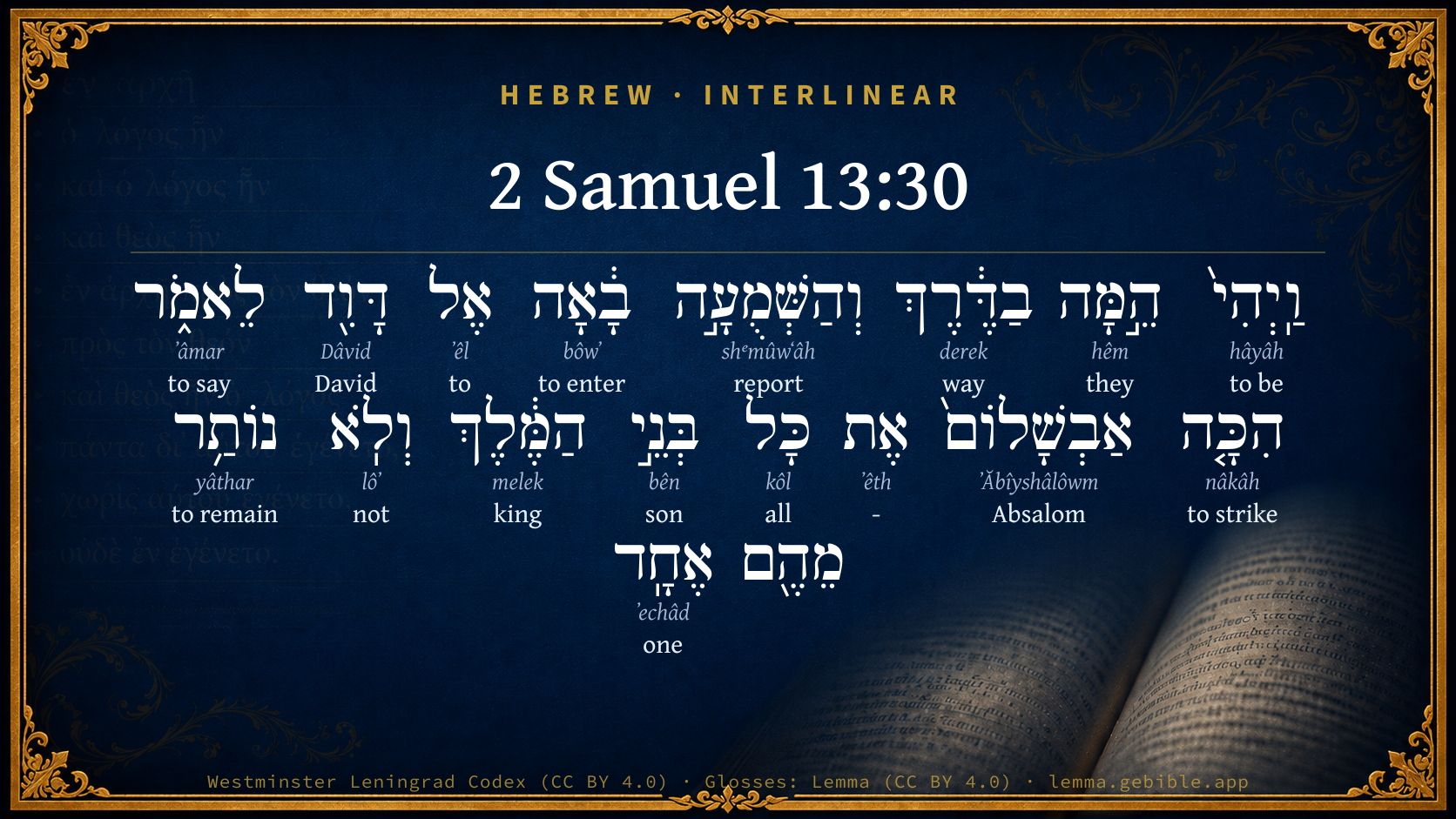
  1. וַֽיְהִי֙ hâyâh H1961 “and · to be” Conjunction + Verb, Qal, Sequential Imperfect, 3rd Person, Masculine, Singular
  2. הֵ֣מָּה hêm H1992 “they” Pronoun, Personal, 3rd Person, Masculine, Plural
  3. בַדֶּ֔רֶךְ derek H1870 “in/at the · way” Preposition, Determined + Noun, Common, Both, Singular, Absolute
  4. בָ֔אָה bôwʼ H935 “to enter” Verb, Qal, Perfect, 3rd Person, Feminine, Singular
  5. אֶל ʼêl H413 “to” Preposition
  6. דָּוִ֖ד Dâvid H1732 “David” Noun, Proper
  7. לֵאמֹ֑ר ʼâmar H559 “to say” Preposition + Verb, Qal, Infinitive Construct
  8. הִכָּ֤ה nâkâh H5221 “to strike” Verb, Hiphil, Perfect, 3rd Person, Masculine, Singular
  9. אַבְשָׁלוֹם֙ ʼĂbîyshâlôwm H53 “Absalom” Noun, Proper
  10. אֶת ʼêth H853 “-” Particle, Direct Object
  11. כָּל kôl H3605 “all of” Noun, Common, Masculine, Singular, Construct
  12. בְּנֵ֣י bên H1121 “sons of” Noun, Common, Masculine, Plural, Construct
  13. הַמֶּ֔לֶךְ melek H4428 “the · king” Particle, Definite Article + Noun, Common, Masculine, Singular, Absolute
  14. וְלֹֽא lôʼ H3808 “and · not” Conjunction + Particle, Negative
  15. נוֹתַ֥ר yâthar H3498 “to remain” Verb, Niphal, Perfect, 3rd Person, Masculine, Singular
  16. אֶחָֽד ʼechâd H259 “one” Adjective, Cardinal number, Masculine, Singular, Absolute

About this verse

These counts appear in no published source. They are computed here, from the morphology-tagged text and Lemma’s own curated glosses. What Lemma adds →

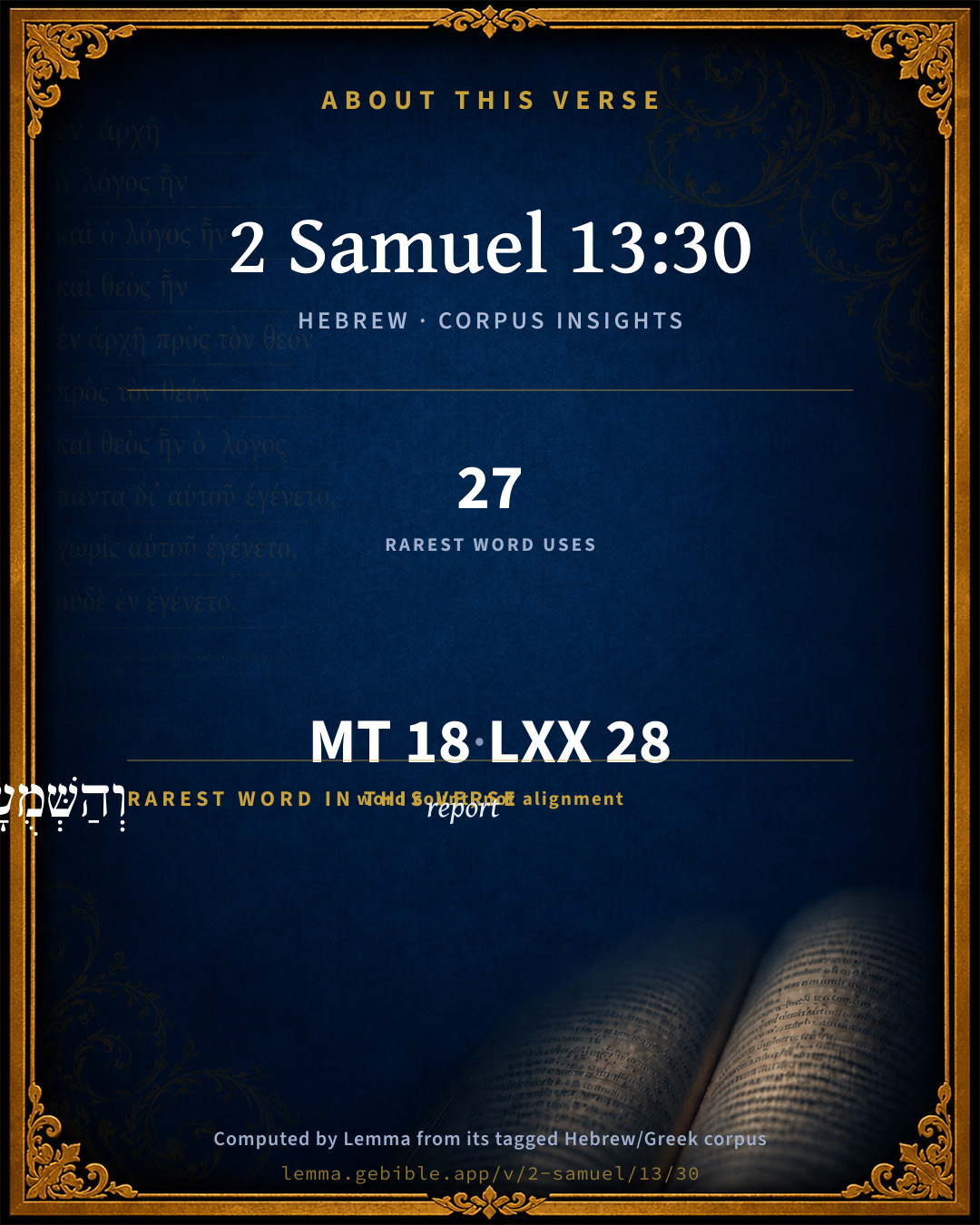
18
words
17
distinct lemmas
Historical
section

Shared distinctive vocabulary

וְהַשְּׁמֻעָ֣ה report H8052 occurs in 24 verses of the Hebrew Bible. Also found in:

Grammatical profile

  • 5 verbs
  • 7 nouns
  • 1 adjective
  • 1 pronoun
  • 2 prepositions
  • 2 particles

Verb forms

  • וַֽיְהִי֙ Qal · Sequential Imperfect
  • בָ֔אָה Qal · Perfect
  • לֵאמֹ֑ר Qal · Infinitive Construct
  • הִכָּ֤ה Hiphil · Perfect
  • נוֹתַ֥ר Niphal · Perfect

Hebrew & Septuagint length

In English translation the verse runs 30 words from the Hebrew and 33 from the Septuagint (LXX English) — closely comparable.

A rough comparison of the two English renderings, which tokenize alike — not a word-level alignment.

Word counts can differ between the Hebrew and the Greek without any difference in meaning — e.g. the Hebrew direct-object marker אֵת has no separate Greek word, and Greek often adds the article ὁ.

In the original languages it is 18 Hebrew tokens and 28 Greek tokens — but the two are counted differently (Hebrew bundles its prefixes and suffixes into one token; the Greek is in lemma form), so that isn’t a like-for-like length.

Hebrew and Greek witnesses Masoretic Hebrew ↔ Greek Septuagint

The same verse in the two great witnesses to the Old Testament, shown verse-for-verse.

These are two independent witnesses, not word-aligned to each other, and the Septuagint is shown in lemma (dictionary) form.

Hebrew 2 Samuel 13:30 Masoretic · Westminster Leningrad Codex

וַֽיְהִי֙ הֵ֣מָּה בַדֶּ֔רֶךְ וְהַשְּׁמֻעָ֣ה בָ֔אָה אֶל דָּוִ֖ד לֵאמֹ֑ר הִכָּ֤ה אַבְשָׁלוֹם֙ אֶת כָּל בְּנֵ֣י הַמֶּ֔לֶךְ וְלֹֽא נוֹתַ֥ר מֵהֶ֖ם אֶחָֽד

It happened, while they were in the way, that the news came to David, saying, Absalom has slain all the king's sons, and there is not one of them left.

World English Bible · Public Domain

Greek LXX 2 Samuel 13:30 Septuagint · lemma form

καί γίγνομαι αὐτός εἰμί ἐν ὁ ὁδός καί ὁ ἀκοή ἔρχομαι πρός δαυίδ λέγω πατάσσω αβεσσαλωμ πᾶς ὁ υἱός ὁ βασιλεύς καί οὐ καταλείπω ἐκ αὐτός οὐδέ εἷς

And it came to pass, when they were in the way, that a report came to David, saying, Abessalom has slain all the king's sons, and there is not one of them left.

LXX2012 (modern English Septuagint) · Public Domain

Hebrew: Westminster Leningrad Codex (CC BY 4.0). Greek: Septuagint (public domain); English from LXX2012 (modern English Septuagint) (Public Domain). How the Septuagint differs from the Hebrew →

Targum (Aramaic paraphrase)

1

The Targum is the ancient Jewish Aramaic paraphrase of the Hebrew Scriptures — an interpretive translation, not the Hebrew text itself. Onkelos (literal) and Pseudo-Jonathan (expansive) render the Torah, and Jonathan the Prophets. Coverage is partial: where no permissively-licensed English translation exists for a verse, only the Aramaic is shown. This is verse-level text, not a word-by-word alignment to the Hebrew.

  1. Targum Jonathan Prophets (Joshua–Malachi)
    וַהֲוָה עַד דְאִינוּן בְּאוֹרְחָא וּשְׁמוּעֲתָא אָתַת לְוַת דָוִד לְמֵימַר קְטַל אַבְשָׁלוֹם יַת כָּל בְּנֵי מַלְכָּא וְלָא אִשְׁתָּאַר מִנְהוֹן חָד:

    (no public-domain English translation for this verse)

    Targum Jonathan — Aramaic: “Mikraot Gedolot” (public domain). English: “Sefaria Community Translation” (CC0 1.0 (public-domain dedication)); “London "Chaldee Paraphrase," 1871” (public domain). Text via Sefaria.

Commentary

Notes on 2 Samuel 13:30 from classic Christian and Jewish commentators (each source and its license shown beneath its notes). The classic Christian expositions comment on the surrounding passage and are grouped to its opening verse, so a note may address several verses; the Jewish commentaries on the Tanakh (Rashi and others) are per-verse, so they appear only where the commentator wrote on this verse.

Lemma curates 59 commentaries, every one of them public domain or Creative Commons licensed, each selected and text-cleaned for this edition rather than reprinted as found. About our sources →

Matthew Henry's Commentary

Here is, I. The fright that David was put into by a false report brought to Jerusalem that Absalom had slain all the king's sons, Sa2 13:30. It is common for fame to make bad worse; and the first news of such a thing as this represents it as more dreadful than afterwards it proves. Let us not therefore be afraid of evil tidings, while they want confirmation, but, when we hear the worst, hope the best, at least hope better. However, this false news gave as much affliction to David, for the present, as if it had been true; he tore his garments, and lay on the earth, while as yet it was only a flying story, Sa2 13:31. It was well that David had grace; he had need enough of it, for he had strong passions.

II. The rectifying of the mistake in two ways: - 1. By the sly suggestions of Jonadab, David's nephew, who could tell him, Amnon only is dead, and not all the king's sons (Sa2 13:32, Sa2 13:33), and could tell him too that it was done by the appointment of Absalom, and designed from the day Amnon forced his sister Tamar. What a wicked man was he, if he knew all this or had any cause to suspect it, that he did not make David acquainted with it sooner, that means might be used to make up the quarrel, or at least that David might not throw Amnon into the mouth of danger by letting him go to Absalom's house. If we do not our utmost to prevent mischief, we make ourselves accessory to it. If we say, Behold, we knew it not; doth not he that pondereth the heart consider whether we did or no? See Pro 24:11, Pro 24:12. It is well if Jonadab was not as guilty of Amnon's death as he was of his sin; such friends do those prove who are hearkened to as counsellors to do wickedly: he that would not be so kind as to prevent Amnon's sin would not be so kind as to prevent his ruin, when, it should seem, he might have done both. 2. By the safe return of all the king's sons except Amnon. They and their attendants were speedily discovered by the watch (Sa2 13:34, Sa2 13:35), and soon arrived, to show themselves alive, but to bring the certain sad news that Absalom had murdered their brother Amnon. The grief David had been in for that which was not made him the better able to bear that which was, by giving him a sensible occasion, when he was undeceived, to thank God that all his sons were not dead: yet that Amnon was dead, and slain by his own brother is such a treacherous barbarous manner, was enough to put the king and court, the king and kingdom, into real mourning. Sorrow is never more reasonable than when there is sin in the case.

III. Absalom's flight from justice: Absalom immediately fled, Sa2 13:34. He was now as much afraid of the king's sons as they were of him; they fled from his malice, he from their justice. No part of the land of Israel could shelter him. The cities of refuge gave no protection to a wilful murderer. Though David had let Amnon's incest go unpunished, Absalom could not promise himself his pardon for this murder; so express was the law in this case, and so well known David's justice, and his dread of blood-guiltiness. He therefore made the best of his way to his mother's relations, and was entertained by his grandfather Talmai, king of Geshur (Sa2 13:37), and there he was protected three years (Sa2 13:38), David not demanding him, and Talmai not thinking himself obliged to send him back unless he were demanded.

IV. David's uneasiness for his absence. He mourned for Amnon a good while (Sa2 13:37), but, he being past recall, time wore off that grief: he was comforted concerning Amnon. It also wore off too much his detestation of Absalom's sin; instead of loathing him as a murderer, he longs to go forth to him, Sa2 13:39. At first he could not find in his heart to do justice on him; now he can almost find in his heart to take him into his favour again. This was David's infirmity. Something God saw in his heart that made a difference, else we should have thought that he, as much as Eli, honoured his sons more than God.

Matthew Henry's Commentary on the Whole Bible (1708–1710) — public domain (CC PDM 1.0). Text via the HelloAO Bible API.

Trapp's Complete Commentary

John Trapp

2Sa 13:30 And it came to pass, while they were in the way, that tidings came to David, saying, Absalom hath slain all the king’s sons, and there is not one of them left.

Ver. 30. Absalom hath slain all the king’s sons.] Rumour is a loud liar, like a snowball that gathereth as it goeth,

“ Mobilitate viget, viresque acquirit eundo. ” - Virgil.

Thales the Milesian being asked how far truth differeth from a lie, answered, As far as the eyes are distant from the ears: intimating, that there is little trust to be given to tales and reports, further than a man is an eye-witness of what he hath by hearsay. Meanwhile David, as he took on more than needed, so by this false report he was the better prepared to bear the loss of Amnon only, seeing the rest of his sons were in safety.

And there is not one of them left.] Heavy news to so tender a father. Mauritius the emperor cried out in like case, ‘Righteous art thou, O Lord, and just are thy judgments,’ taking up David’s words but whether at this time he said so, it appeareth not.

John Trapp, A Commentary or Exposition upon All the Books of the Old and New Testament (1647–1656) — public domain. Text from a community e-Sword module.

The Biblical Illustrator

Joseph S. Exell

2Sa_13:30-37

Absalom hath slain all the kings sons.

Chastisement

The fulfilment of the curse on Davids house now begun.

I. Observe the justice of Gods dealings in chastisement. A comparison of Davids sin and its punishment shows that free forgiveness does not remove consequences in this life.

1. David had wounded Uriah in his best affections. He himself was allowed to suffer the keenest sorrow through the son he best loved.

2. He had to see the evil heritage of lust develope in that favourite child.

3. He took the one ewe lamb. Absalom stole the hearts of all Israel.

4. David made Joab his tool to carry out his treachery. Henceforth he was Joabs tool, obliged to bear with him, and leave his punishment to Solomon.

II. Sin had weakened his power. He no longer possessed the respect of the nation. The reins of government were dropping from his hands. Yet he recognised love in it all, and God meant it in love. (R. E. Faulkner.)

.

The Biblical Illustrator, edited by Joseph S. Exell (c. 1880s–1900s) — public domain. Text from a community e-Sword module.

Jamieson, Fausset & Brown

Robert Jamieson, A. R. Fausset & David Brown

tidings came to David, saying, Absalom hath slain all the king's sons--It was natural that in the consternation and tumult caused by so atrocious a deed, an exaggerated report should reach the court, which was at once plunged into the depths of grief and despair. But the information of Jonadab, who seems to have been aware of the plan, and the arrival of the other princes, made known the real extent of the catastrophe.

Jamieson, Fausset & Brown — Commentary Critical and Explanatory on the Whole Bible (1871) — public domain (CC PDM 1.0). Text via the HelloAO Bible API.

Adam Clarke's Commentary

Verse 30. Absalom hath slain all the king's sons] Fame never lessens but always magnifies a fact. Report, contrary to the nature of all other things, gains strength by going.

Virgil has given, in his best manner, a fine personification of Fame or Evil Report. - AEN. iv., 173.

Extemplo Libyae magnas it Fama per urbes;

Fama, malum qua non aliud velocius ullum,

Mobilitate viget, viresque adquirit eundo, c.

"Now Fame, tremendous fiend! without delay,

Through Libyan cities took her rapid way

Fame, the swift plague, that every moment grows,

And gains new strength and vigour as she goes," &c.

Adam Clarke's Commentary on the Bible (1810–1826) — public domain. Text from a community e-Sword/MySword module.

Ellicott's Commentary for English Readers

(30) There is not one of them left.—The story of this exaggerated report, so true to the life, indicates contemporaneous authorship.

A Bible Commentary for English Readers, edited by Charles John Ellicott (1878–1897) — public domain. Text from a community e-Sword module.

The Cambridge Bible for Schools and Colleges

gen. ed. J. J. S. Perowne

30–39. The news brought to David. Absalom’s flight

31. tare his garments] Rent his clothes. The E. V. has introduced a distinction which does not exist in the Hebrew. Cp. ch. 2Sa_1:11.

lay on the earth] Cp. ch. 2Sa_12:16.

and all his servants, &c.] The Sept. and Vulg. represent a slightly different reading; “And all his servants, who stood by him, rent their clothes.”

The Cambridge Bible for Schools and Colleges (gen. ed. J. J. S. Perowne; Cambridge University Press, 1878–1918) — public domain. Text from a community e-Sword module.

John Gill's Exposition

And it came to pass while they were in the way,.... On their road homewards, before they got to Jerusalem:

that tidings came to David; perhaps brought by one who was at the entertainment, who upon seeing Amnon smitten, immediately rose up and fled with the news of it to David:

saying, Absalom hath slain all the king's sons, and there is not one of them left; which he might suppose was the design of Absalom, and was done before that time; however, so it was ordered in Providence, that David, that rejoiced at the news of the death of Uriah, might be terrified with the tidings of the death of all his sons; and for a while it was as if it was really so, which occasioned the following behaviour in him.

John Gill's Exposition of the Whole Bible (1746–1763) — public domain (CC PDM 1.0). Text via the HelloAO Bible API.

Haydock's Catholic Bible Commentary

Left. Fame often magnifies. (Menochius) --- Crescit eundo. (Haydock)

George Leo Haydock (1774–1849), Haydock's Catholic Family Bible and Commentary, 1859 edition — public domain. Excludes Psalms (Douay-Rheims chapter numbering differs from Protestant) and Deuterocanonical books (Catholic canon only).

Matthew Poole's English Annotations

Which was not improbable, when the sword was once drawn among them, and one of them killed, which might provoke the rest to draw their swords, both to defend themselves, and to revenge their brother’s death, and thereby occasion the death of all. And God suffered this false report to be spread for David’s greater terror and humiliation, that he who had formerly rejoiced in the tidings of Uriah’s death, might now be tormented with the report of the death of all his sons.

Matthew Poole's English Annotations on the Holy Bible (1683–1685) — public domain. Text from a community e-Sword/MySword module.

Whedon's Commentary on the Bible

Daniel D. Whedon

30. Tidings came — Some excited person, seeing Amnon fall, and expecting that all the other sons would share the same fate, ran to Jerusalem at once to bear the awful news.

Daniel D. Whedon (gen. ed.), Commentary on the Old and New Testaments (1874–1909) — public domain. Text from a community e-Sword module.

The Pulpit Commentary

Tidings came. Some of the servants seem to have fled immediately that the attack was made, and in their terror reported, not what had really happened, but what they assumed was Absalom"s purpose. It shows, however, how thoroughly Absalom had dissembled when thus they entirely forgot that he had a grudge against Amnon. And David, in utter misery, tears his robes, and throws himself prostrate on the ground, while his courtiers, with rent garments, stand speechless round him. But the guilty Jonadab guesses more correctly the truth. He had probably watched Absalom closely, and distrusted his silence. Nothing, perhaps, had happened to justify his suspicions, but as soon as the tidings came he divined the real meaning. And, wicked as he was, he could never have supposed that Amnon would turn upon the woman he had wronged, and insult and disgrace her. He probably imagined that Amnon really loved her, and that the matter would be patched up. But when the wretched youth acted so shamelessly, Jonadab probably felt sure that Absalom would sooner or later take his revenge.

Vers. 30-39. (JERUSALEM)

Parental sorrows.

the king also and all his servants wept very sore" (ver. 36). David"s intense feeling appears in his affection (vers. 6, 25, 39), his wrath (ver. 21), and his grief (ver. 31). The delight which a father finds in his children is seldom unalloyed. His sorrows, on their account, are

I OFTTIMES PECULIARLY SEVERE.

1. Their misbehaviour. "A "house cross" is the heaviest of all earthly crosses. The gall which is mingled in our cup by those who are nearest to us surpasses all others in bitterness" (Krummacher).

How sharper than a serpent"s tooth it is To have a thankless child! ("King Lear. )

1. Their misfortune (ver. 19).

2. Their disappointment of his hopes; his consternation, tremblinganxieties, exaggerated fears (ver. 30); his bereavement by death (ver. 32) and by enforced exile through crime (ver. 34); his son a fratricide, like

Cain, alive yet dead. What a heavy burden of trouble was thus laid upon David! It is not surprising that it was followed by serious and protracted bodily affliction, favourable to the designs of his enemies and conducive to still deeper distress, (2Sa_15:4, 2Sa_15:30) as several psalms seem to indicate. (Ps 38 Ps 39 Ps 41 Ps 55)

O Jehovah, rebuke me not in thine anger, Nor chasten me in thy hot displeasure. For thine arrows stick fast in me, And thy hand presseth me sore," etc. (Psa_38:1, Psa_38:2)

II SOMETIMES DUE TO HIS OWN FAULT.

1. His sinful example. Children are more ready to imitate their father"svices than his virtues.

2. His defective discipline. "David"s failure in the government of his familywas due in part to the excessive, even morbid, tenderness of his feelings towards his children, especially some of them. He may also have thought of his family circle as too exclusively a scene for relaxation and enjoyment; he may have forgotten that even there there is a call for much vigilance and self-denial" (Blaikie). "By this example we see that children whom their parents spare to correct will in the end be a grief unto them" (Wilier). "Chastisement without love is an outrage; no father is at liberty to plague or torture his child; but a love that cannot chastise is no love, and reaps a poor reward. A child that does not at the proper time feel the father"s rod becomes at last a rod for his father" (Schlier). "Ofttimes the child whom the father loves most (as David did Amnon) becomes his greatest grief by too much indulgence" (Guild).

3. His culpable clemency in the case of a great crime (ver. 21). Even ifDavid did inflict some punishment on Amnon, as it has been supposed (Chandler), yet it was altogether inadequate to the offence. The sorrows of a father over the sins and sufferings of his children are intensified by the knowledge that they are, in some degree, the result of his own errors and transgressions. "A parent can have no sharper pang than the sight of his own sin reappearing in his child. David saw the ghastly reflection of his unbridled passion in his eldest son"s foul crime (and even a gleam of it in his unhappy daughter) and of his murderous craft in his second son"s bloody revenge" (Maclaren).

III NOT WITHOUT MERCIFUL ALLEVIATION.

1. The occasion of trouble is less calamitous than it might have been; lessthan it was feared to be (ver. 32).

2. Grief is assuaged by the lapse of time (vers. 37, 38).

3. It is vain to mourn over what is irreparable (ver. 39; 2Sa_12:23 2Sa_14:14)

4. These afflictions are chastisements from the heavenly Father"s hand, andshould be endured with patience and hope. (Psa_39:7, 9 38:15)

5. They are mingled with tokens of Divine favour (2Sa_12:13, 2Sa_12:25; Psa_41:1-3; Isa_27:8)

6. Their purpose is morally beneficial. (Heb_12:11) "It may seem strange to say it, but it is most true, that the tears which flow from the eyelids of a man are as needful to the fruitfulness of his heart as the dews which descend from the eyelids of the morning are to the thirsty ground" (E. Irving). D.

The Pulpit Commentary (1880–1919), ed. H.D.M. Spence-Jones & Joseph S. Exell — public domain. Text from a community e-Sword module.

unfoldingWord translationNotes

Door43 World Missions Community

So it came about

"It happened that." This phrase is used here to introduce the next event in the story line. (See: Introduction of a New Event)

on the road

"travelling along the road"

that the news came to David saying

Here it says that the news came, when really someone came and told David the news. AT: "that someone came and reported the news to David saying" (See: Metonymy)

Then the king arose

"Then the king stood up"

tore his clothes, and lay on the floor

He did these things to show that he was extremely sad. AT: "tore his clothes, and threw himself on the floor grieving" (See: Symbolic Action)

with their clothes torn

They did this to show their sadness and to mourn with their king. AT: "and tore their clothes, mourning with the king" (See: Symbolic Action)

translationWords

David

Absalom

king

son

raise

unfoldingWord translationNotes — © Distant Shores Media and the Door43 World Missions Community, licensed CC BY-SA 4.0. Source: git.door43.org/Door43/en_tn.

Lesson kit

Teaching starters — assembled from the data on this page, not authored interpretation. Every prompt links to the verse data it draws on. Edit before teaching.

2 Samuel, in the Historical, opens this verse with 18 words (17 distinct Hebrew lemmas). Its most distinctive word is shᵉmûwʻâh (“report”). A historical commentator’s framing appears above. Read the whole chapter for the surrounding context.

Discussion questions

  1. What does “report” (shᵉmûwʻâh) contribute to the verse as a whole?
  2. 1 Samuel 2:24 shares the word «report» with this verse. How do the two illuminate each other?
  3. The translations on this page render this verse differently — a whole-verse word diff, not a word-by-word alignment. What might account for the different wordings?
  4. The verb «וַֽיְהִי֙» is Qal Sequential Imperfect. How does its form color the action?
  5. Reading how Matthew Henry's Commentary and Trapp's Complete Commentary read this verse, where do the two commentators agree and where do they part?

Things to notice

Reading settings

Reading text

Shown beneath each verse's original-language words.

Old Testament
Old Testament edition

Read the OT as the Masoretic Hebrew (MT) or the Greek Septuagint (LXX).

English shown for the Greek Septuagint (in the Hebrew ↔ Greek comparison).

Comparing translations? Open the Compare panel on any verse page to stack up to four side by side.