
Leviticus 11:10

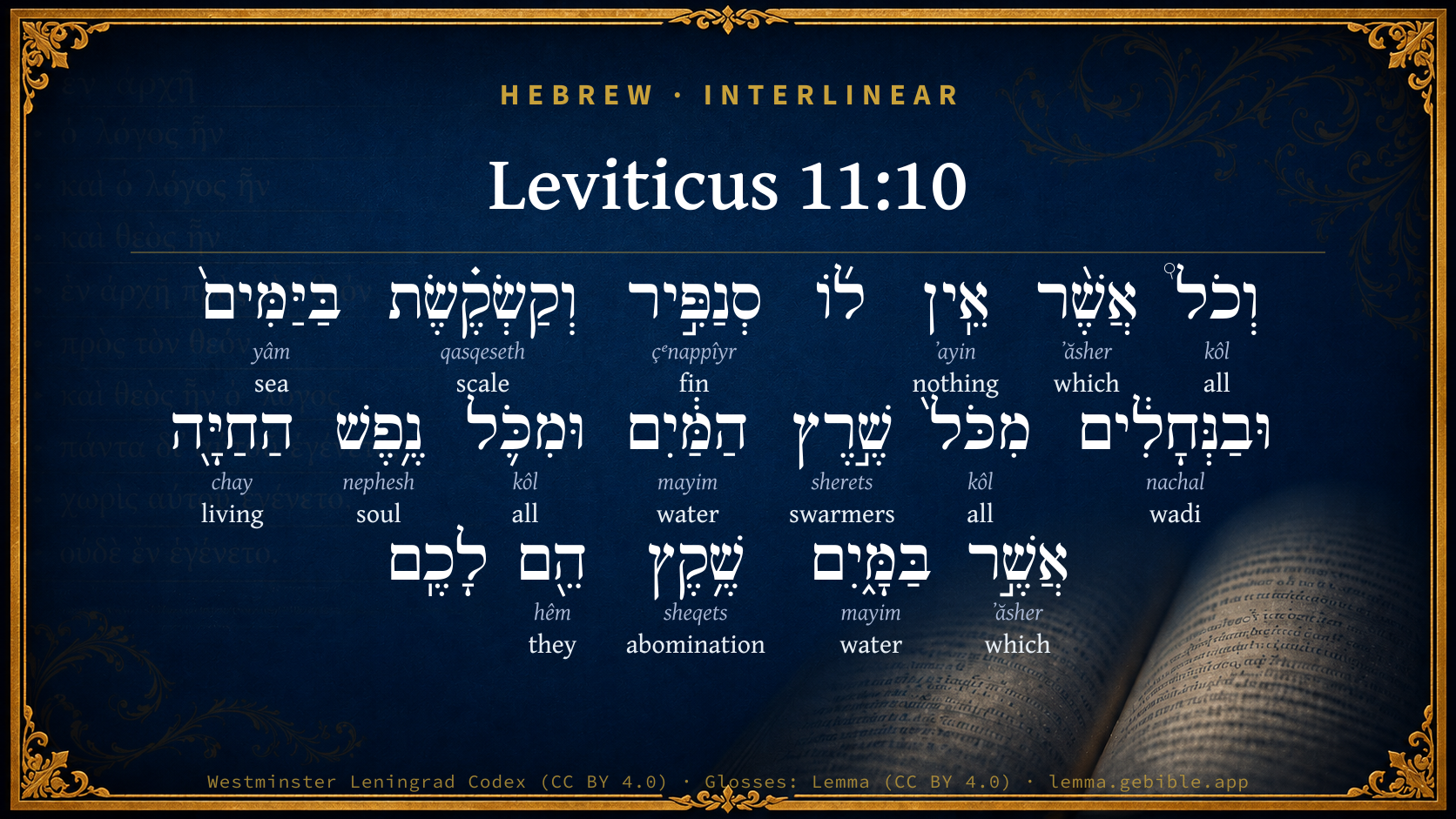
Hebrew (Westminster Leningrad Codex) Leviticus 11:10 appears in the Hebrew Old Testament. The text above is from the Westminster Leningrad Codex. Each word links to its Strong’s number, a concise gloss, and parsing drawn from the Open Scriptures Hebrew Bible morphology. Click any word for its full Brown-Driver-Briggs (BDB) entry.
Download image
Cite this verse

Leviticus 11:10 (World English Bible). Public Domain. Lemma interlinear Bible study tool, https://lemma.gebible.app/v/leviticus/11/10.

Show BibTeX & RIS
BibTeX
RIS
English Translation
All that don't have fins and scales in the seas, and in the rivers, of all that move in the waters, and of all the living creatures that are in the waters, they are an abomination to you,
World English Bible · Public Domain
Download a study sheet

One document with this verse’s original text, its word-by-word gloss line, the meaning frame, cross-references with their text, attributed commentary, and full source and license credits — printable, and it pastes into notes with its structure intact.

This verse Autodidact and up

Study sheet (.html) Plain text (.txt)

A passage Seminary Student

Up to 50 verses in one chapter. A passage sheet keeps up to 6 commentary sources and 12 cross-references per verse, in the order this page ranks them, and says so on the sheet whenever that leaves anything out. Ask for a single verse and you get the Autodidact verse sheet above.

Everything on this page stays free to read, with no account — the sheet is a download of what is already on screen, not access to it.

Want to remove ads? Support Godless Engineer
Compare translations 3

The same verse in 3 English versions, stacked beneath the original-language interlinear above. Click any original word for its lexicon entry.

Each is an independent rendering of the whole verse — the interlinear is not word-aligned to these translations.

Highlighted words mark where these versions differ — a whole-verse word diff, not a word-by-word alignment.

  • World English Bible Public Domain
    All that don't have fins and scales in the seas, and in the rivers, of all that move in the waters, and of all the living creatures that are in the waters, they are an abomination to you,
  • King James Version Public Domain
    And all that have not fins and scales in the seas, and in the rivers, of all that move in the waters, and of any living thing which is in the waters, they shall be an abomination unto you:
  • unfoldingWord Literal Text CC BY-SA 4.0
    But everything that there is not to it fins and scales in the seas or in the rivers, from every swarming thing of the water and from every life of a living thing that is in the water—they are a detestable thing to you.

unfoldingWord Literal Text — © unfoldingWord, licensed CC BY-SA 4.0. Word-aligned USFM3 via Door43 (git.door43.org/unfoldingWord/en_ult).

Versions to compare (up to 4)

3 of 4 selected

Show all 18 translations

Every available English version of this verse, each an independent rendering of the whole verse.

  • World English Bible Public Domain
    All that don't have fins and scales in the seas, and in the rivers, of all that move in the waters, and of all the living creatures that are in the waters, they are an abomination to you,
  • Berean Standard Bible Public Domain
    But the following among all the teeming life and creatures in the water are detestable to you: everything in the seas or streams that does not have fins and scales.
  • Majority Standard Bible Public Domain
    But the following among all the teeming life and creatures in the water are detestable to you: everything in the seas or streams that does not have fins and scales.
  • King James Version Public Domain
    And all that have not fins and scales in the seas, and in the rivers, of all that move in the waters, and of any living thing which is in the waters, they shall be an abomination unto you:
  • American Standard Version (1901) Public Domain
    And all that have not fins and scales in the seas, and in the rivers, of all that move in the waters, and of all the living creatures that are in the waters, they are an abomination unto you,
  • Revised Version (1885) Public Domain
    And all that have not fins and scales in the seas, and in the rivers, of all that move in the waters, and of all the living creatures that are in the waters, they are an abomination unto you,
  • Geneva Bible (1599) Public Domain
    But all that haue not finnes nor skales in the seas, or in the riuers, of all that moueth in the waters, and of al liuing things that are in the waters, they shalbe an abomination vnto you.
  • Douay-Rheims (1899) Public Domain
    But whatsoever hath not fins and scales, of those things that move and live in the waters, shall be an abomination to you,
  • Young's Literal Translation Public Domain
    and any one that hath not fins and scales in the seas, and in the brooks, of any teeming creature of the waters, and of any creature which liveth, which `is' in the waters -- an abomination they `are' to you;
  • Literal Standard Version CC BY-SA 4.0
    and anything that does not have fins and scales in the seas, and in the brooks, of any teeming creature of the waters, and of any creature which lives, which [is] in the waters—they [are] an abomination to you;
  • Unlocked Literal Bible CC BY-SA 4.0
    But all living creatures that do not have fins and scales in the ocean or rivers, including all that move in the water and all the living creatures that are in the water— they must be detested by you.
  • unfoldingWord Literal Text CC BY-SA 4.0
    But everything that there is not to it fins and scales in the seas or in the rivers, from every swarming thing of the water and from every life of a living thing that is in the water—they are a detestable thing to you.
  • Darby Bible Public Domain
    but all that have not fins and scales in seas and in rivers, of all that swarm in the waters, and of every living soul which is in the waters -- they shall be an abomination unto you.
  • World Messianic Bible Public Domain
    All that don’t have fins and scales in the seas and rivers, all that move in the waters, and all the living creatures that are in the waters, they are an abomination to you,
  • Webster's Bible Public Domain
    And all that have not fins nor scales in the seas, and in the rivers, of all that move in the waters, and of any living animal which is in the waters, they shall be an abomination to you:
  • Free Bible Version CC BY-SA 4.0
    But you are not allowed to eat any of the many creatures that don't have fins and scales that live in the water, whether in the sea or in fresh water.
  • Bible in Basic English Public Domain
    All other things living and moving in the water, in the sea or in the rivers, are a disgusting thing to you;
  • JPS Tanakh (1917) Public Domain
    And all that have not fins and scales in the seas, and in the rivers, of all that swarm in the waters, and of all the living creatures that are in the waters, they are a detestable thing unto you,

Literal Standard Version (2020), Covenant Press — licensed CC BY-SA 4.0. Text via the HelloAO Bible API (eBible.org). Unlocked Literal Bible (unfoldingWord) — licensed CC BY-SA 4.0. Text via the HelloAO Bible API (eBible.org). unfoldingWord Literal Text — © unfoldingWord, licensed CC BY-SA 4.0. Word-aligned USFM3 via Door43 (git.door43.org/unfoldingWord/en_ult). Free Bible Version, Dr. Jonathan Gallagher — licensed CC BY-SA 4.0. Text via the HelloAO Bible API (eBible.org).

Word by word

More ways to search: Search by grammar → Find every occurrence → Compare this word →

Practice this passage: Drill this verse → Learn its vocabulary →

סְנַפִּ֣יר
çᵉnappîyr
H5579
“fin”
Noun, Common, Masculine, Singular, Absolute
Part of Speech
Noun
Type
Common
Gender
Masculine
Number
Singular
State
Absolute
Full BDB Definition

Origin: of uncertain derivation

TWOT: 1523

fin
  1. וְכֹל֩ kôl H3605 “and · all” Conjunction + Noun, Common, Masculine, Singular, Absolute
  2. אֲשֶׁ֨ר ʼăsher H834 “which” Particle, Relative
  3. אֵֽין ʼayin H369 “nothing” Particle, Negative
  4. וְקַשְׂקֶ֗שֶׂת qasqeseth H7193 “and · scale” Conjunction + Noun, Common, Feminine, Singular, Absolute
  5. בַּיַּמִּים֙ yâm H3220 “in/at the · seas” Preposition, Determined + Noun, Common, Masculine, Plural, Absolute
  6. וּבַנְּחָלִ֔ים nachal H5158 “and · in/at the · wadis” Conjunction + Preposition, Determined + Noun, Common, Masculine, Plural, Absolute
  7. מִכֹּל֙ kôl H3605 “from · all of” Preposition + Noun, Common, Masculine, Singular, Construct
  8. שֶׁ֣רֶץ sherets H8318 “swarmers of” Noun, Common, Masculine, Singular, Construct
  9. הַמַּ֔יִם mayim H4325 “the · water(s)” Particle, Definite Article + Noun, Common, Masculine, Plural, Absolute
  10. וּמִכֹּ֛ל kôl H3605 “and · from · all of” Conjunction + Preposition + Noun, Common, Masculine, Singular, Construct
  11. נֶ֥פֶשׁ nephesh H5315 “soul of” Noun, Common, Both, Singular, Construct
  12. הַחַיָּ֖ה chay H2416 “the · living” Particle, Definite Article + Adjective, Adjective, Feminine, Singular, Absolute
  13. אֲשֶׁ֣ר ʼăsher H834 “which” Particle, Relative
  14. בַּמָּ֑יִם mayim H4325 “in/at the · water(s)” Preposition, Determined + Noun, Common, Masculine, Plural, Absolute
  15. שֶׁ֥קֶץ sheqets H8263 “abomination” Noun, Common, Masculine, Singular, Absolute
  16. הֵ֖ם hêm H1992 “they” Pronoun, Personal, 3rd Person, Masculine, Plural

About this verse

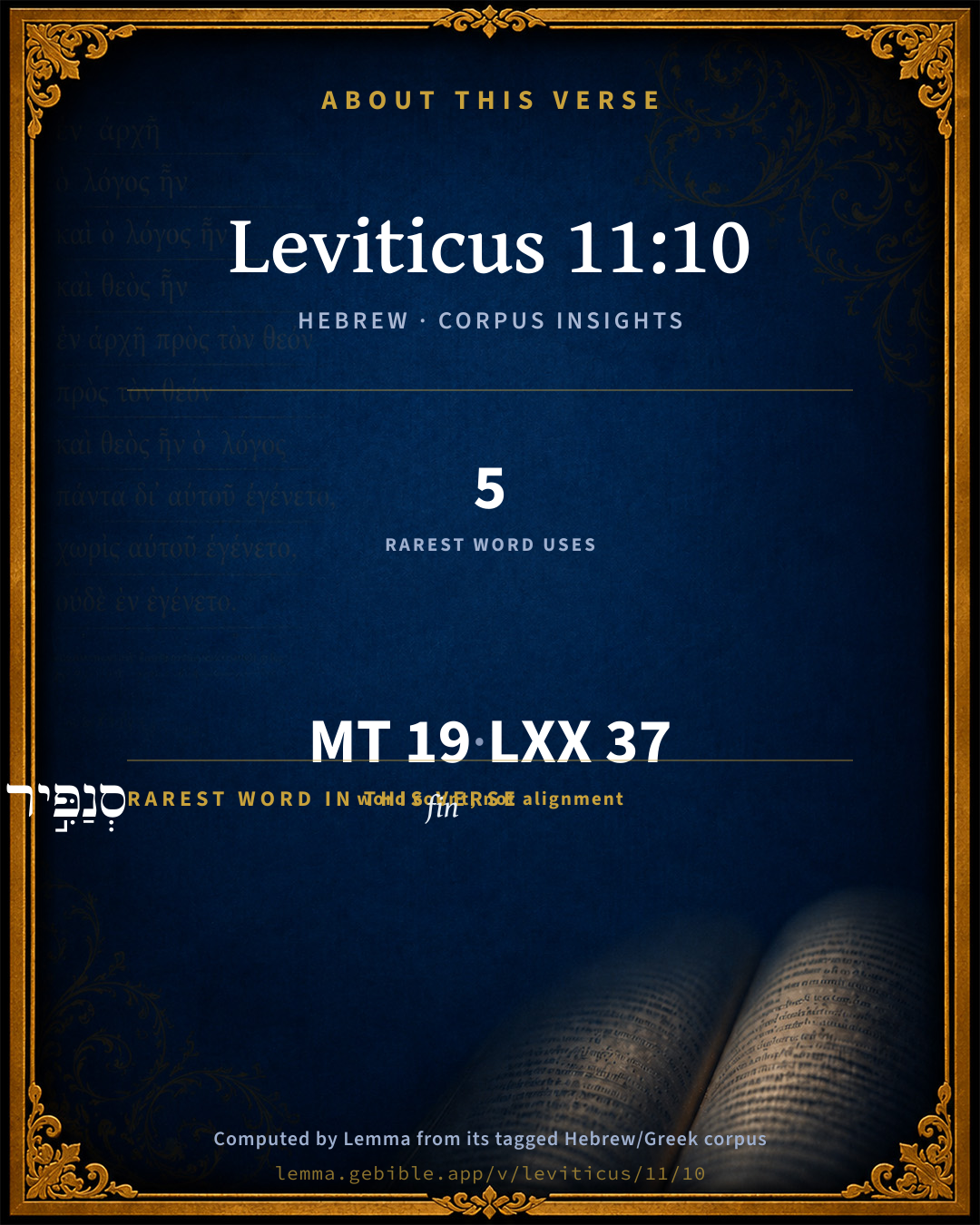
These counts appear in no published source. They are computed here, from the morphology-tagged text and Lemma’s own curated glosses. What Lemma adds →

19
words
13
distinct lemmas
Pentateuch
section

Notable vocabulary

The rarest word here is סְנַפִּ֣יר fin H5579 — appearing just 5 times in the whole Hebrew Bible.

Shared distinctive vocabulary

סְנַפִּ֣יר fin H5579 occurs in 5 verses of the Hebrew Bible. Also found in:

Grammatical profile

  • 12 nouns
  • 1 adjective
  • 1 pronoun
  • 2 prepositions
  • 3 particles

Repetition

Words recur within this verse — often emphatic in Hebrew:

  • וְכֹל֩ all H3605 ×3
  • הַמַּ֔יִם water H4325 ×2
  • אֲשֶׁ֨ר which H834 ×2

Hebrew & Septuagint length

In English translation the verse runs 38 words from the Hebrew and 44 from the Septuagint (LXX English) — closely comparable.

A rough comparison of the two English renderings, which tokenize alike — not a word-level alignment.

Word counts can differ between the Hebrew and the Greek without any difference in meaning — e.g. the Hebrew direct-object marker אֵת has no separate Greek word, and Greek often adds the article ὁ.

In the original languages it is 19 Hebrew tokens and 37 Greek tokens — but the two are counted differently (Hebrew bundles its prefixes and suffixes into one token; the Greek is in lemma form), so that isn’t a like-for-like length.

Cross-references

6

Topical passages linked to Leviticus 11:10 in the Treasury of Scripture Knowledge — connected by theme and wording, ordered by reader-vote popularity; previews shown in the World English Bible.

  • Leviticus 7:18 If any of the flesh of the sacrifice of his peace offerings is eaten on the third day, it will not be accepted, neither shall it be imputed to him who offers it. It will be an abomination, and the soul who eats any of it will bear his iniquity.
  • Proverbs 29:27 A dishonest man detests the righteous, And the upright in their ways detest the wicked.
  • Deuteronomy 14:3 You shall not eat any abominable thing.
  • Psalms 139:21–22 Yahweh, don't I hate those who hate you? Am I not grieved with those who rise up against you?
  • Proverbs 13:20 One who walks with wise men grows wise, But a companion of fools suffers harm.
  • Revelation 21:8 But for the cowardly, unbelieving, sinners, abominable, murderers, sexually immoral, sorcerers, idolaters, and all liars, their part is in the lake that burns with fire and sulfur, which is the second death."

Cross-references courtesy of OpenBible.info (CC BY 4.0).

Hebrew and Greek witnesses Masoretic Hebrew ↔ Greek Septuagint

The same verse in the two great witnesses to the Old Testament, shown verse-for-verse.

These are two independent witnesses, not word-aligned to each other, and the Septuagint is shown in lemma (dictionary) form.

Hebrew Leviticus 11:10 Masoretic · Westminster Leningrad Codex

וְכֹל֩ אֲשֶׁ֨ר אֵֽין ל֜וֹ סְנַפִּ֣יר וְקַשְׂקֶ֗שֶׂת בַּיַּמִּים֙ וּבַנְּחָלִ֔ים מִכֹּל֙ שֶׁ֣רֶץ הַמַּ֔יִם וּמִכֹּ֛ל נֶ֥פֶשׁ הַחַיָּ֖ה אֲשֶׁ֣ר בַּמָּ֑יִם שֶׁ֥קֶץ הֵ֖ם לָכֶֽם

All that don't have fins and scales in the seas, and in the rivers, of all that move in the waters, and of all the living creatures that are in the waters, they are an abomination to you,

World English Bible · Public Domain

Greek LXX Leviticus 11:10 Septuagint · lemma form

καί πᾶς ὅσος οὐ εἰμί αὐτός πτερυγίον οὐδέ λεπίς ἐν ὁ ὕδωρ ἤ ἐν ὁ θάλασσα καί ἐν ὁ χειμάρρους ἀπό πᾶς ὅς ἐρεύγομαι ὁ ὕδωρ καί ἀπό πᾶς ψυχή ζάω ὁ ἐν ὁ ὕδωρ βδέλυγμα εἰμί

And all things which have not fins or scales in the water, or in the seas, and in the brooks, of all which the waters produce, and of every soul living in the water, are an abomination; and they shall be abominations to you.

LXX2012 (modern English Septuagint) · Public Domain

Hebrew: Westminster Leningrad Codex (CC BY 4.0). Greek: Septuagint (public domain); English from LXX2012 (modern English Septuagint) (Public Domain). How the Septuagint differs from the Hebrew →

Targum (Aramaic paraphrase)

2

The Targum is the ancient Jewish Aramaic paraphrase of the Hebrew Scriptures — an interpretive translation, not the Hebrew text itself. Onkelos (literal) and Pseudo-Jonathan (expansive) render the Torah, and Jonathan the Prophets. Coverage is partial: where no permissively-licensed English translation exists for a verse, only the Aramaic is shown. This is verse-level text, not a word-by-word alignment to the Hebrew.

  1. Targum Onkelos Torah (Genesis–Deuteronomy)
    וְכֹל דִי לֵית לֵהּ צִיצִין וְקַלְפִין בְּיַמְמַיָא וּבְנַחֲלַיָא מִכֹּל רִחֲשָׁא דְמַיָא וּמִכֹּל נַפְשָׁא חַיְתָא דִי בְמַיָא שִׁקְצָא אִנוּן לְכוֹן

    (no public-domain English translation for this verse)

    Targum Onkelos — Aramaic: “Onkelos Genesis” (public domain); “Onkelos Exodus” (public domain); “Onkelos Leviticus” (public domain); “Onkelos Numbers” (public domain); “Onkelos Deuteronomy” (public domain). English: “Sefaria Community Translation” (CC0 1.0 (public-domain dedication)); “J.W. Etheridge. The Targums of Onkelos and Jonathan Ben Uzziel on the Pentateuch. London: Longmans, Green, 1862” (public domain). Text via Sefaria.

  2. Targum Pseudo-Jonathan Torah (Genesis–Deuteronomy)
    וְכָל דְלֵית לֵיהּ צִיצִין וְחַרְסְפִיתִין בְּיַמְמַיָא וּבְנַחֲלַיָא מִן כָּל רִיחֲשָׁא דִי בְּמַיָא שִׁיקְצָא הִינוּן לְכוֹן

    and of anything that is in the sea that crawleth, shall be an abomination to you,

    Targum Pseudo-Jonathan — Aramaic: “Targum Jonathan on Genesis” (public domain); “Targum Jonathan on Exodus” (public domain); “Targum Jonathan on Leviticus” (public domain); “Targum Jonathan on Numbers” (public domain); “Targum Jonathan on Deuteronomy” (public domain). English: “The Targum of Jonathan ben Uzziel, trans. J. W. Etheridge, London, 1862” (public domain). Text via Sefaria.

Commentary

Notes on Leviticus 11:10 from classic Christian and Jewish commentators (each source and its license shown beneath its notes). The classic Christian expositions comment on the surrounding passage and are grouped to its opening verse, so a note may address several verses; the Jewish commentaries on the Tanakh (Rashi and others) are per-verse, so they appear only where the commentator wrote on this verse.

Lemma curates 59 commentaries, every one of them public domain or Creative Commons licensed, each selected and text-cleaned for this edition rather than reprinted as found. About our sources →

Trapp's Complete Commentary

John Trapp

Lev 11:10 And all that have not fins and scales in the seas, and in the rivers, of all that move in the waters, and of any living thing which [is] in the waters, they [shall be] an abomination unto you:

Ver. 10. Of all that move in the waters.] And yet swim also in the air. Like to these is the temporary believer: for that seeming to mount up in spiritual joys, yet he withal swimmeth, yea, batheth himself in the waters of sensual delights.

John Trapp, A Commentary or Exposition upon All the Books of the Old and New Testament (1647–1656) — public domain. Text from a community e-Sword module.

Tyndale Open Study Notes

Tyndale Open Resources

11:10 The prohibition included fish such as eels and sharks that have fins but not scales, as well as crustaceans and mollusks, which have neither fins nor scales.

Tyndale Open Study Notes — © Tyndale Open Resources, licensed CC BY-SA 4.0. Text via the HelloAO Bible API.

Geneva Bible (1599)

Geneva Bible translators

As little fish engendered of the slime.

As they which come of generation.

Geneva Bible (1599) marginal notes — public domain. Text via Bolls.life.

Ellicott's Commentary for English Readers

(10) Of all that move in the waters.—That is, apart from the fishes exhibiting the above-named signs, all other inhabitants of the water are forbidden. Hence all shell-fish, whether molluscs or crustaceans, and cetaceous animals, are unclean.

A Bible Commentary for English Readers, edited by Charles John Ellicott (1878–1897) — public domain. Text from a community e-Sword module.

John Gill's Exposition

And all that have not fins nor scales in the seas, and in the rivers,.... Such as eels, lampreys, &c.

of all that move in the waters, and of any living thing which is in the waters; the former of these are interpreted by Aben Ezra and Ben Gersom of little fishes that have but a small body, and such as are created out of the waters; and the latter, of such as are produced of a male and female; or, as Maimonides (r) explains it, the one signifies the lesser creatures, such as worms and horse leeches; the other greater ones, sea beasts, as sea dogs, &c.

they shall be an abomination to you; not only unclean, and so unfit to eat, but to be had in abhorrence and detestation, as being exceeding disagreeable and unwholesome; and, as a learned man observes (s), to these prohibited in general belong all those animals in lakes, rivers, or seas, which are of a slow motion, and which, because of the slow motion of their bodies, do not so well digest their food; and for that may be compared with four footed beasts that have but one belly, and so unwholesome as they.

(r) Hilchot Maacolot Asuret, l. 1. c. 2. sect. 12. (s) Scheuchzer. ut supra, (Physic. Sacr. vol. 2.) p. 287.

John Gill's Exposition of the Whole Bible (1746–1763) — public domain (CC PDM 1.0). Text via the HelloAO Bible API.

Haydock's Catholic Bible Commentary

Scales. Numa forbade fish without scales to be used in the sacred feasts. (Pliny, [Natural History?] xxxii. 2.)

George Leo Haydock (1774–1849), Haydock's Catholic Family Bible and Commentary, 1859 edition — public domain. Excludes Psalms (Douay-Rheims chapter numbering differs from Protestant) and Deuterocanonical books (Catholic canon only).

Matthew Poole's English Annotations

i.e. Either of the smaller sort of fishes, or of the greater, which are called here living creatures or beasts, as some of them are called the beasts of the sea by other authors.

Matthew Poole's English Annotations on the Holy Bible (1683–1685) — public domain. Text from a community e-Sword/MySword module.

Rashi

Rabbi Shlomo Yitzchaki (Rashi)

שרץ THE PROLIFIC CREATURES — Everywhere this word denotes a low (small) being that creeps and moves along upon the ground (cf. Rashi on Genesis 1:20).

Rashi on the Tanakh — English translations: “The Judaica Press complete Tanach with Rashi, translated by A. J. Rosenberg” (CC BY 4.0); “Pentateuch with Rashi's commentary by M. Rosenbaum and A.M. Silbermann, 1929-1934” (public domain); “The Metsudah Tanach series, Lakewood, N.J” (CC BY 4.0); and “The Book of Joshua, Metsudah Publications, 1997” (CC BY 4.0). Text via Sefaria.

Ramban (Nachmanides)

Rabbi Moshe ben Nachman (Ramban / Nachmanides)

OF ALL THAT SWARM (‘SHERETZ’) IN THE WATERS, AND OF ALL THE LIVING CREATURES THAT ARE IN THE WATERS. Rabbi Abraham ibn Ezra wrote that sheretz (“swarming” things) are the small species that are born [and bred] in the waters, while “the living creatures” are the species of male and female. But in my opinion the term ‘sheretz’ that swarm in the waters denotes the fish which swim in the waters, for every expression of sheretz means movement, and the term all the living creatures that are in the waters, refers to the sea-animals, some of which have legs which they walk upon like creatures of the field. Thus there is one law alike for all of them [namely that those which do not have fins and scales are forbidden to be eaten]. The interpretation of the Torath Kohanim is: 4:7. “Living, this denotes the sea-animal. Creature, this includes the siren. I might think that its carcass conveys impurity in a tent [like that of a human body], as Ben Chachinai indeed says? Scripture therefore says [in the verse before us], they are detestable” [as food, but they do not convey impurity to a person who comes into the tent where their carcass lies].

Ramban (Nachmanides) on the Tanakh — English translation: “Commentary on the Torah by Ramban (Nachmanides). Translated and annotated by Charles B. Chavel. New York, Shilo Pub. House, 1971-1976” (CC BY 4.0). Text via Sefaria.

Lesson kit

Teaching starters — assembled from the data on this page, not authored interpretation. Every prompt links to the verse data it draws on. Edit before teaching.

Leviticus, in the Pentateuch, opens this verse with 19 words (13 distinct Hebrew lemmas). Its most distinctive word is çᵉnappîyr (“fin”). A historical commentator’s framing appears above. Read the whole chapter for the surrounding context.

Discussion questions

  1. What does “fin” (çᵉnappîyr) contribute to the verse as a whole?
  2. How does Leviticus 11:9, which shares the word «fin», read alongside this verse?
  3. What does the repetition of “all” (3× in this one verse) do in this verse?
  4. These translations render this verse differently. What is at stake in choosing one wording over another?
  5. Compare how Trapp's Complete Commentary and Tyndale Open Study Notes read this verse. Where do they agree or differ?

Things to notice

Reading settings

Reading text

Shown beneath each verse's original-language words.

Old Testament
Old Testament edition

Read the OT as the Masoretic Hebrew (MT) or the Greek Septuagint (LXX).

English shown for the Greek Septuagint (in the Hebrew ↔ Greek comparison).

Comparing translations? Open the Compare panel on any verse page to stack up to four side by side.