
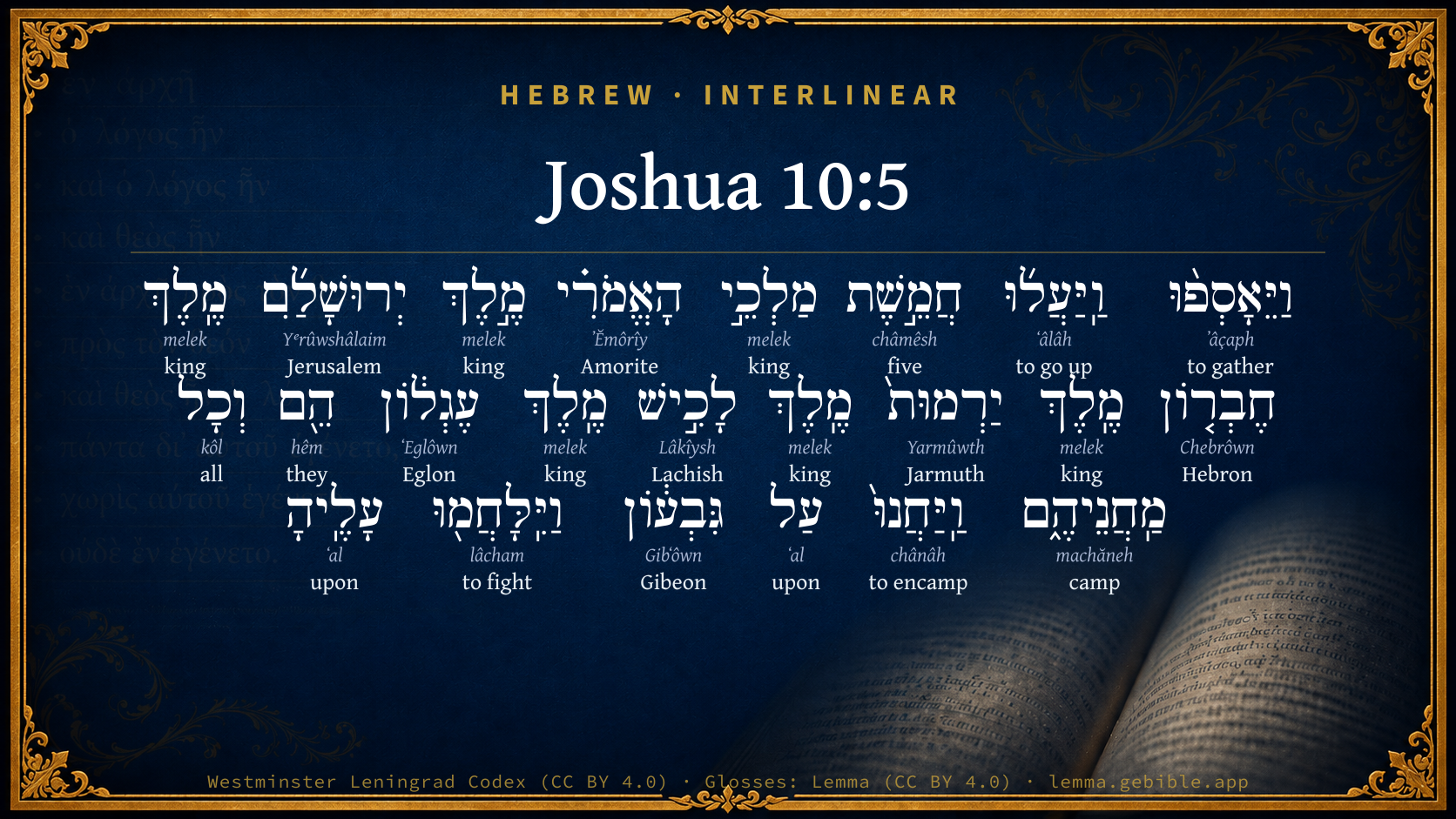
Joshua 10:5

Hebrew (Westminster Leningrad Codex) Joshua 10:5 appears in the Hebrew Old Testament. The text above is from the Westminster Leningrad Codex. Each word links to its Strong’s number, a concise gloss, and parsing drawn from the Open Scriptures Hebrew Bible morphology. Click any word for its full Brown-Driver-Briggs (BDB) entry.
Download image
Cite this verse

Joshua 10:5 (World English Bible). Public Domain. Lemma interlinear Bible study tool, https://lemma.gebible.app/v/joshua/10/5.

Show BibTeX & RIS
BibTeX
RIS
English Translation
Therefore the five kings of the Amorites, the king of Jerusalem, the king of Hebron, the king of Jarmuth, the king of Lachish, the king of Eglon, gathered themselves together, and went up, they and all their hosts, and encamped against Gibeon, and made war against it.
World English Bible · Public Domain
Download a study sheet

One document with this verse’s original text, its word-by-word gloss line, the meaning frame, cross-references with their text, attributed commentary, and full source and license credits — printable, and it pastes into notes with its structure intact.

This verse Autodidact and up

Study sheet (.html) Plain text (.txt)

A passage Seminary Student

Up to 50 verses in one chapter. A passage sheet keeps up to 6 commentary sources and 12 cross-references per verse, in the order this page ranks them, and says so on the sheet whenever that leaves anything out. Ask for a single verse and you get the Autodidact verse sheet above.

Everything on this page stays free to read, with no account — the sheet is a download of what is already on screen, not access to it.

Want to remove ads? Support Godless Engineer
Compare translations 3

The same verse in 3 English versions, stacked beneath the original-language interlinear above. Click any original word for its lexicon entry.

Each is an independent rendering of the whole verse — the interlinear is not word-aligned to these translations.

Highlighted words mark where these versions differ — a whole-verse word diff, not a word-by-word alignment.

  • World English Bible Public Domain
    Therefore the five kings of the Amorites, the king of Jerusalem, the king of Hebron, the king of Jarmuth, the king of Lachish, the king of Eglon, gathered themselves together, and went up, they and all their hosts, and encamped against Gibeon, and made war against it.
  • King James Version Public Domain
    Therefore the five kings of the Amorites, the king of Jerusalem, the king of Hebron, the king of Jarmuth, the king of Lachish, the king of Eglon, gathered themselves together, and went up, they and all their hosts, and encamped before Gibeon, and made war against it.
  • unfoldingWord Literal Text CC BY-SA 4.0
    And the five of the kings of the Amorite gathered and went up, the king of Jerusalem, the king of Hebron, the king of Jarmuth, the king of Lachish, the king of Eglon, they and all of their camps. And they camped against Gibeon and fought against it.

unfoldingWord Literal Text — © unfoldingWord, licensed CC BY-SA 4.0. Word-aligned USFM3 via Door43 (git.door43.org/unfoldingWord/en_ult).

Versions to compare (up to 4)

3 of 4 selected

Show all 18 translations

Every available English version of this verse, each an independent rendering of the whole verse.

  • World English Bible Public Domain
    Therefore the five kings of the Amorites, the king of Jerusalem, the king of Hebron, the king of Jarmuth, the king of Lachish, the king of Eglon, gathered themselves together, and went up, they and all their hosts, and encamped against Gibeon, and made war against it.
  • Berean Standard Bible Public Domain
    So the five kings of the Amorites—the kings of Jerusalem, Hebron, Jarmuth, Lachish, and Eglon—joined forces and advanced with all their armies. They camped before Gibeon and made war against it.
  • Majority Standard Bible Public Domain
    So the five kings of the Amorites—the kings of Jerusalem, Hebron, Jarmuth, Lachish, and Eglon—joined forces and advanced with all their armies. They camped before Gibeon and made war against it.
  • King James Version Public Domain
    Therefore the five kings of the Amorites, the king of Jerusalem, the king of Hebron, the king of Jarmuth, the king of Lachish, the king of Eglon, gathered themselves together, and went up, they and all their hosts, and encamped before Gibeon, and made war against it.
  • American Standard Version (1901) Public Domain
    Therefore the five kings of the Amorites, the king of Jerusalem, the king of Hebron, the king of Jarmuth, the king of Lachish, the king of Eglon, gathered themselves together, and went up, they and all their hosts, and encamped against Gibeon, and made war against it.
  • Revised Version (1885) Public Domain
    Therefore the five kings of the Amorites, the king of Jerusalem, the king of Hebron, the king of Jarmuth, the king of Lachish, the king of Eglon, gathered themselves together, and went up, they and all their hosts, and encamped against Gibeon, and made war against it.
  • Geneva Bible (1599) Public Domain
    Therefore the fiue Kings of the Amorites, the King of Ierusalem, the King of Hebron, the King of Iarmuth, the King of Lachish, and the King of Eglon gathered themselues together, and went vp, they with all their hostes, and besieged Gibeon, and made warre against it.
  • Douay-Rheims (1899) Public Domain
    So the five kings of the Amorrhites being assembled together went up: the king of Jerusalem, the king of Hebron, the king of Jerimoth, the king of Lachis, the king of Eglon, they and their armies, and camped about Gabaon, laying siege to it.
  • Young's Literal Translation Public Domain
    And five kings of the Amorite (the king of Jerusalem, the king of Hebron, the king of Jarmuth, the king of Lachish, the king of Eglon) are gathered together, and go up, they and all their camps, and encamp against Gibeon, and fight against it.
  • Literal Standard Version CC BY-SA 4.0
    And five kings of the Amorite (the king of Jerusalem, the king of Hebron, the king of Jarmuth, the king of Lachish, the king of Eglon) are gathered together, and go up, they and all their camps, and encamp against Gibeon, and fight against it.
  • Unlocked Literal Bible CC BY-SA 4.0
    The five kings of the Amorites, the king of Jerusalem, the king of Hebron, the king of Jarmuth, the king of Lachish, and the king of Eglon came up, they and all their armies. They set up their positions against Gibeon, and they attacked it.
  • unfoldingWord Literal Text CC BY-SA 4.0
    And the five of the kings of the Amorite gathered and went up, the king of Jerusalem, the king of Hebron, the king of Jarmuth, the king of Lachish, the king of Eglon, they and all of their camps. And they camped against Gibeon and fought against it.
  • Darby Bible Public Domain
    And the five kings of the Amorites, the king of Jerusalem, the king of Hebron, the king of Jarmuth, the king of Lachish, [and] the king of Eglon, gathered themselves together, and went up, they and all their armies, and they encamped before Gibeon, and made war against it.
  • World Messianic Bible Public Domain
    Therefore the five kings of the Amorites, the king of Jerusalem, the king of Hebron, the king of Jarmuth, the king of Lachish, and the king of Eglon, gathered themselves together and went up, they and all their armies, and encamped against Gibeon, and made war against it.
  • Webster's Bible Public Domain
    Therefore the five kings of the Amorites, the king of Jerusalem, the king of Hebron, the king of Jarmuth, the king of Lachish, the king of Eglon, assembled themselves, and went up, they and all their hosts, and encamped before Gibeon, and made war against it.
  • Free Bible Version CC BY-SA 4.0
    So these five Amorite kings (the kings of Jerusalem, Hebron, Jarmuth, Lachish, and Eglon) and their armies gathered and set off. They surrounded Gibeon and then began their attack.
  • Bible in Basic English Public Domain
    So the five kings of the Amorites, the king of Jerusalem, the king of Hebron, the king of Jarmuth, the king of Lachish, and the king of Eglon, were banded together, and went up with all their armies and took up their position before Gibeon and made war against it.
  • JPS Tanakh (1917) Public Domain
    Therefore the five kings of the Amorites, the king of Jerusalem, the king of Hebron, the king of Jarmuth, the king of Lachish, the king of Eglon, gathered themselves together, and went up, they and all their hosts, and encamped against Gibeon, and made war against it.

Literal Standard Version (2020), Covenant Press — licensed CC BY-SA 4.0. Text via the HelloAO Bible API (eBible.org). Unlocked Literal Bible (unfoldingWord) — licensed CC BY-SA 4.0. Text via the HelloAO Bible API (eBible.org). unfoldingWord Literal Text — © unfoldingWord, licensed CC BY-SA 4.0. Word-aligned USFM3 via Door43 (git.door43.org/unfoldingWord/en_ult). Free Bible Version, Dr. Jonathan Gallagher — licensed CC BY-SA 4.0. Text via the HelloAO Bible API (eBible.org).

Word by word

More ways to search: Search by grammar → Find every occurrence → Compare this word →

Practice this passage: Drill this verse → Learn its vocabulary →

יַרְמוּת֙
Yarmûwth
H3412
“Jarmuth”
Noun, Proper
Part of Speech
Noun
Type
Proper
Full BDB Definition

Origin: from H7311

TWOT: None

Jarmuth = "heights" - a Canaanitish city in the lowlands of Judah with a king and located between Hebron and Lachish - a Levitical city of Issachar allocated to the Gershonite Levites
  1. וַיֵּאָסְפ֨וּ ʼâçaph H622 “and · to gather” Conjunction + Verb, Niphal, Sequential Imperfect, 3rd Person, Masculine, Plural
  2. וַֽיַּעֲל֜וּ ʻâlâh H5927 “and · to go up” Conjunction + Verb, Qal, Sequential Imperfect, 3rd Person, Masculine, Plural
  3. חֲמֵ֣שֶׁת châmêsh H2568 “five” Adjective, Cardinal number, Masculine, Singular, Construct
  4. מַלְכֵ֣י melek H4428 “kings of” Noun, Common, Masculine, Plural, Construct
  5. הָאֱמֹרִ֗י ʼĔmôrîy H567 “the · Amorite” Particle, Definite Article + Noun, Gentilic, Masculine, Singular, Absolute
  6. מֶ֣לֶךְ melek H4428 “king of” Noun, Common, Masculine, Singular, Construct
  7. יְרוּשָׁלִַ֜ם Yᵉrûwshâlaim H3389 “Jerusalem” Noun, Proper
  8. מֶֽלֶךְ melek H4428 “king of” Noun, Common, Masculine, Singular, Construct
  9. חֶבְר֤וֹן Chebrôwn H2275 “Hebron” Noun, Proper
  10. מֶֽלֶךְ melek H4428 “king of” Noun, Common, Masculine, Singular, Construct
  11. מֶֽלֶךְ melek H4428 “king of” Noun, Common, Masculine, Singular, Construct
  12. לָכִ֣ישׁ Lâkîysh H3923 “Lachish” Noun, Proper
  13. מֶֽלֶךְ melek H4428 “king of” Noun, Common, Masculine, Singular, Construct
  14. עֶגְל֔וֹן ʻEglôwn H5700 “Eglon” Noun, Proper
  15. הֵ֖ם hêm H1992 “they” Pronoun, Personal, 3rd Person, Masculine, Plural
  16. וְכָל kôl H3605 “and · all of” Conjunction + Noun, Common, Masculine, Singular, Construct
  17. מַֽחֲנֵיהֶ֑ם machăneh H4264 “camps · their” Noun, Common, Both, Plural, Construct + Suffix, Personal, 3rd Person, Masculine, Plural
  18. וַֽיַּחֲנוּ֙ chânâh H2583 “and · to encamp” Conjunction + Verb, Qal, Sequential Imperfect, 3rd Person, Masculine, Plural
  19. עַל ʻal H5921 “upon” Preposition
  20. גִּבְע֔וֹן Gibʻôwn H1391 “Gibeon” Noun, Proper
  21. וַיִּֽלָּחֲמ֖וּ lâcham H3898 “and · to fight” Conjunction + Verb, Niphal, Sequential Imperfect, 3rd Person, Masculine, Plural
  22. עָלֶֽיהָ ʻal H5921 “upon · her” Preposition + Suffix, Personal, 3rd Person, Feminine, Singular

About this verse

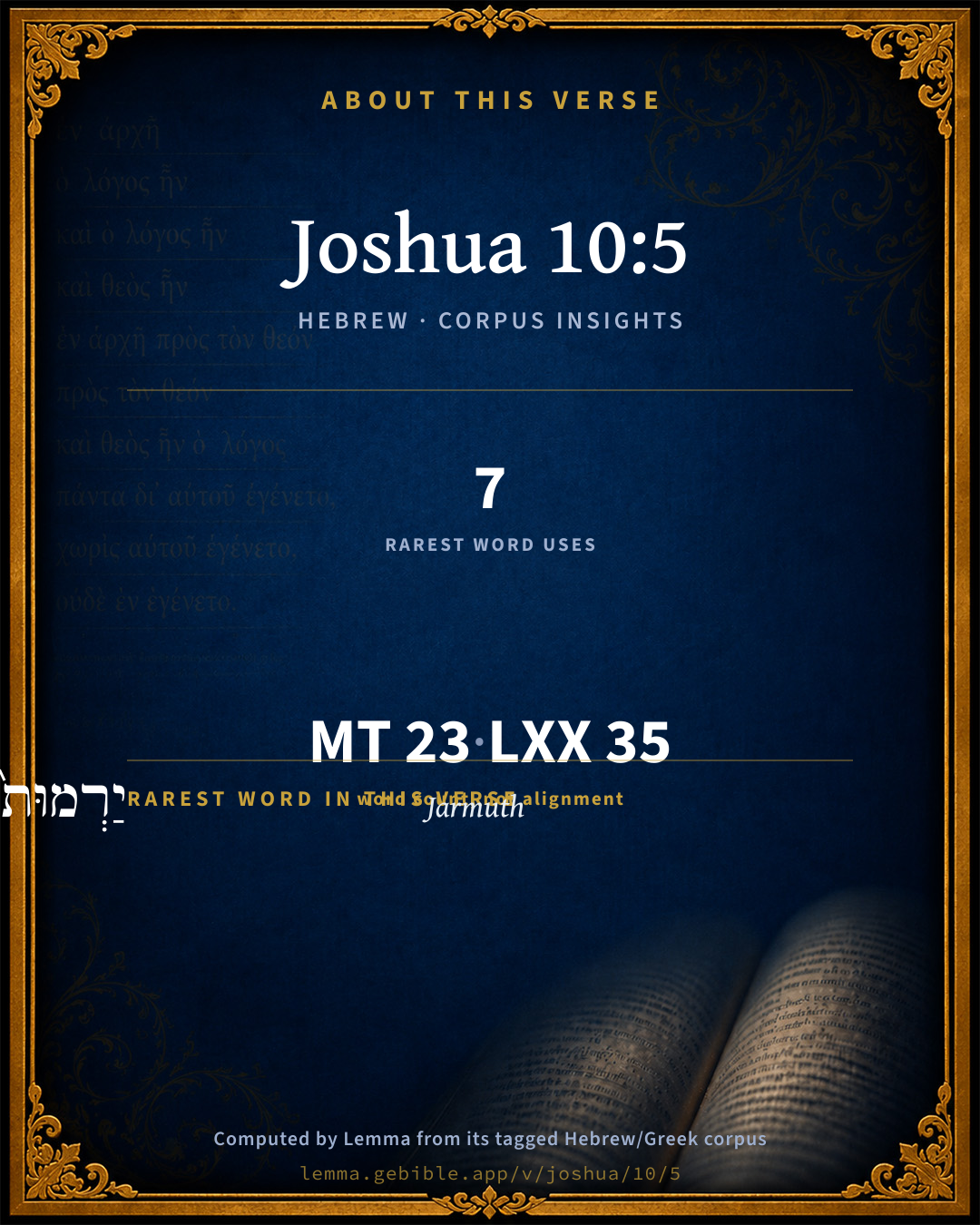
These counts appear in no published source. They are computed here, from the morphology-tagged text and Lemma’s own curated glosses. What Lemma adds →

23
words
17
distinct lemmas
Historical
section

Notable vocabulary

The rarest word here is יַרְמוּת֙ Jarmuth H3412 — appearing just 7 times in the whole Hebrew Bible.

Shared distinctive vocabulary

יַרְמוּת֙ Jarmuth H3412 occurs in 7 verses of the Hebrew Bible. Also found in:

Grammatical profile

  • 4 verbs
  • 15 nouns
  • 1 adjective
  • 1 pronoun
  • 2 prepositions

Verb forms

  • וַיֵּאָסְפ֨וּ Niphal · Sequential Imperfect
  • וַֽיַּעֲל֜וּ Qal · Sequential Imperfect
  • וַֽיַּחֲנוּ֙ Qal · Sequential Imperfect
  • וַיִּֽלָּחֲמ֖וּ Niphal · Sequential Imperfect

Repetition

Words recur within this verse — often emphatic in Hebrew:

  • מַלְכֵ֣י king H4428 ×6
  • עַל upon H5921 ×2

Hebrew & Septuagint length

In English translation the verse runs 47 words from the Hebrew and 45 from the Septuagint (LXX English) — closely comparable.

A rough comparison of the two English renderings, which tokenize alike — not a word-level alignment.

Word counts can differ between the Hebrew and the Greek without any difference in meaning — e.g. the Hebrew direct-object marker אֵת has no separate Greek word, and Greek often adds the article ὁ.

In the original languages it is 23 Hebrew tokens and 35 Greek tokens — but the two are counted differently (Hebrew bundles its prefixes and suffixes into one token; the Greek is in lemma form), so that isn’t a like-for-like length.

Cross-references

5

Topical passages linked to Joshua 10:5 in the Treasury of Scripture Knowledge — connected by theme and wording, ordered by reader-vote popularity; previews shown in the World English Bible.

  • Genesis 15:16 In the fourth generation they will come here again, for the iniquity of the Amorite is not yet full."
  • Numbers 13:29 Amalek dwells in the land of the South: and the Hittite, and the Jebusite, and the Amorite, dwell in the hill-country; and the Canaanite dwells by the sea, and along by the side of the Jordan.
  • Joshua 9:1–2 It happened, when all the kings who were beyond the Jordan, in the hill-country, and in the lowland, and on all the shore of the great sea in front of Lebanon, the Hittite, and the Amorite, the Canaanite, the Perizzite, the Hivite, and the Jebusite, heard of it;
  • Joshua 10:6 The men of Gibeon sent to Joshua to the camp to Gilgal, saying, Don't slack your hand from your servants; come up to us quickly, and save us, and help us: for all the kings of the Amorites that dwell in the hill-country are gathered together against us.
  • Isaiah 8:9–10 Make an uproar, O you peoples, and be broken in pieces! And give ear, all you of far countries: gird yourselves, and be broken in pieces! Gird yourselves, and be broken in pieces!

Cross-references courtesy of OpenBible.info (CC BY 4.0).

Hebrew and Greek witnesses Masoretic Hebrew ↔ Greek Septuagint

The same verse in the two great witnesses to the Old Testament, shown verse-for-verse.

These are two independent witnesses, not word-aligned to each other, and the Septuagint is shown in lemma (dictionary) form.

Hebrew Joshua 10:5 Masoretic · Westminster Leningrad Codex

וַיֵּאָסְפ֨וּ וַֽיַּעֲל֜וּ חֲמֵ֣שֶׁת מַלְכֵ֣י הָאֱמֹרִ֗י מֶ֣לֶךְ יְרוּשָׁלִַ֜ם מֶֽלֶךְ חֶבְר֤וֹן מֶֽלֶךְ יַרְמוּת֙ מֶֽלֶךְ לָכִ֣ישׁ מֶֽלֶךְ עֶגְל֔וֹן הֵ֖ם וְכָל מַֽחֲנֵיהֶ֑ם וַֽיַּחֲנוּ֙ עַל גִּבְע֔וֹן וַיִּֽלָּחֲמ֖וּ עָלֶֽיהָ

Therefore the five kings of the Amorites, the king of Jerusalem, the king of Hebron, the king of Jarmuth, the king of Lachish, the king of Eglon, gathered themselves together, and went up, they and all their hosts, and encamped against Gibeon, and made war against it.

World English Bible · Public Domain

Greek LXX Joshua 10:5 Septuagint · lemma form

καί ἀναβαίνω ὁ πέντε βασιλεύς ὁ ιεβουσαῖος βασιλεύς ἰερουσαλήμ καί βασιλεύς χεβρων καί βασιλεύς ιεριμουθ καί βασιλεύς λαχις καί βασιλεύς οδολλαμ αὐτός καί πᾶς ὁ λαός αὐτός καί περι καταἵζω ὁ γαβαων καί ἐκπολιορκέω αὐτός

And the five kings of the Jebusites went up, the king of Jerusalem, and the king of Chebron, and the king of Jerimuth, and the king of Lachis, and the king of Odollam, they and all their people; and encamped around Gabaon, and besieged it.

LXX2012 (modern English Septuagint) · Public Domain

Hebrew: Westminster Leningrad Codex (CC BY 4.0). Greek: Septuagint (public domain); English from LXX2012 (modern English Septuagint) (Public Domain). How the Septuagint differs from the Hebrew →

Targum (Aramaic paraphrase)

1

The Targum is the ancient Jewish Aramaic paraphrase of the Hebrew Scriptures — an interpretive translation, not the Hebrew text itself. Onkelos (literal) and Pseudo-Jonathan (expansive) render the Torah, and Jonathan the Prophets. Coverage is partial: where no permissively-licensed English translation exists for a verse, only the Aramaic is shown. This is verse-level text, not a word-by-word alignment to the Hebrew.

  1. Targum Jonathan Prophets (Joshua–Malachi)
    וְאִתְכְּנָשׁוּ וּסְלִיקוּ חַמְשָׁא מַלְכֵי אֱמוֹרָאָה מַלְכָּא דִירוּשְׁלֵם מַלְכָּא דְחֶבְרוֹן מַלְכָּא דְיַרְמוּת מַלְכָּא דְלָכִישׁ מַלְכָּא דְעֶגְלוֹן אִינוּן וְכָל מַשִׁרְיַתְהוֹן וּשְׁרוֹ עַל גִבְעוֹן וְאַגִיחוּ קְרָבָא עֲלָה:

    (no public-domain English translation for this verse)

    Targum Jonathan — Aramaic: “Mikraot Gedolot” (public domain). English: “Sefaria Community Translation” (CC0 1.0 (public-domain dedication)); “London "Chaldee Paraphrase," 1871” (public domain). Text via Sefaria.

Commentary

Notes on Joshua 10:5 from classic Christian and Jewish commentators (each source and its license shown beneath its notes). The classic Christian expositions comment on the surrounding passage and are grouped to its opening verse, so a note may address several verses; the Jewish commentaries on the Tanakh (Rashi and others) are per-verse, so they appear only where the commentator wrote on this verse.

Lemma curates 59 commentaries, every one of them public domain or Creative Commons licensed, each selected and text-cleaned for this edition rather than reprinted as found. About our sources →

Trapp's Complete Commentary

John Trapp

Jos 10:5 Therefore the five kings of the Amorites, the king of Jerusalem, the king of Hebron, the king of Jarmuth, the king of Lachish, the king of Eglon, gathered themselves together, and went up, they and all their hosts, and encamped before Gibeon, and made war against it.

Ver. 5. And encamped before Gibeon, and made war against it.] Opposition is evangelii genius, saith Calvin: and the Church is haeres crucis, the heir of the Cross, saith Luther. "All that will live godly shall suffer persecution." {2Ti 3:12} But Christ, the true Joshua, will rescue and deliver them that call to him for help as these did.

John Trapp, A Commentary or Exposition upon All the Books of the Old and New Testament (1647–1656) — public domain. Text from a community e-Sword module.

Joseph Benson's Commentary

Jos 10:5. The five kings of the Amorites — This name is here taken generally for any of the Canaanites. But, strictly speaking, the citizens of Hebron were Hittites, those of Jerusalem, Jebusites, and the Gibeonites made a part of the Hivites. It is reasonably supposed that the Amorites, being numerous and victorious beyond Jordan, had poured forth colonies into the land of Canaan, subdued divers places, and so communicated their name to all the rest.

Joseph Benson's Commentary on the Old and New Testaments (1811–1818) — public domain. Text from a community e-Sword module.

Tyndale Open Study Notes

Tyndale Open Resources

10:5 When the Old Testament makes a distinction between Amorites and Canaanites (see study note on 3:10), the Amorite kings controlled the hill country, while the Canaanites occupied the valleys and the coastal plain.

Tyndale Open Study Notes — © Tyndale Open Resources, licensed CC BY-SA 4.0. Text via the HelloAO Bible API.

Geneva Bible (1599)

Geneva Bible translators

So envious the wicked are, when any depart from their hand.

Geneva Bible (1599) marginal notes — public domain. Text via Bolls.life.

Jamieson, Fausset & Brown

Robert Jamieson, A. R. Fausset & David Brown

the five kings of the Amorites--The settlement of this powerful and warlike tribe lay within the confines of Moab; but having also acquired extensive possessions on the southwest of the Jordan, their name, as the ruling power, seems to have been given to the region generally (Sa2 21:2), although Hebron was inhabited by Hittites or Hivites (Jos 11:19), and Jerusalem by Jebusites (Jos 15:63).

Jamieson, Fausset & Brown — Commentary Critical and Explanatory on the Whole Bible (1871) — public domain (CC PDM 1.0). Text via the HelloAO Bible API.

Adam Clarke's Commentary

Verse 5. The five kings of the Amorites] This is a general name for the inhabitants of Canaan, otherwise called Canaanites; and it is very likely that they had this appellation because the Amorites were the most powerful tribe or nation in that country. The inhabitants of Jerusalem were Jebusites, Jos 15:63; those of Hebron were Hittites, Ge 23:2-3; Ge 25:9-10; and the Gibeonites were Hivites, Jos 9:7; and yet all these are called Amorites occasionally, probably for the reason already mentioned, viz., because that tribe was most numerous and powerful.

Adam Clarke's Commentary on the Bible (1810–1826) — public domain. Text from a community e-Sword/MySword module.

The Cambridge Bible for Schools and Colleges

gen. ed. J. J. S. Perowne

5. the five kings] The names of the kings are not given here a second time, but of the cities over which they held sway, and they are mentioned in the same order.

The Cambridge Bible for Schools and Colleges (gen. ed. J. J. S. Perowne; Cambridge University Press, 1878–1918) — public domain. Text from a community e-Sword module.

John Gill's Exposition

Therefore the five kings of the Amorites,.... For though they were chiefly Hittites that dwelt in Hebron, and Jebusites who inhabited Jerusalem; yet as the Amorites were the most powerful people in the land, and had dispersed themselves in the several parts of it, and seem to have the greatest authority in it, they were all called Amorites, and perhaps the kings of those cities were of them, and set over them by them; so we find that the Gibeonites, who were Hivites, are said to be of the remnant of the Amorite, Sa2 21:2,

the king of Jerusalem, the king of Hebron, the king of Jarmuth, the king of Lachish, the king of Eglon, gathered themselves together, and went up, they, and all their hosts; that is, to Jerusalem, the place of their rendezvous, and from thence they marched:

and encamped before Gibeon, and made war against it: by besieging it, and attacking it in some of its forts.

John Gill's Exposition of the Whole Bible (1746–1763) — public domain (CC PDM 1.0). Text via the HelloAO Bible API.

Haydock's Catholic Bible Commentary

Amorrhites is a generical term, as well as Chanaanite, to denote the people of the country. The other kings did not come to the assistance (Calmet) of these five, ver. 40. (Haydock) --- Yet the people of Gabaon might suspect the worst, or exaggerate, in order to make Josue come with greater expedition. He was then at Galgal, above twenty miles distant, and set off the next night, coming unexpectedly upon the confederate kings early in the morning, ver. 9.

George Leo Haydock (1774–1849), Haydock's Catholic Family Bible and Commentary, 1859 edition — public domain. Excludes Psalms (Douay-Rheims chapter numbering differs from Protestant) and Deuterocanonical books (Catholic canon only).

Matthew Poole's English Annotations

Amorites; this name being here taken largely or generally for any of the Canaanites, as is frequent; for, to speak strictly, the citizens of Hebron, here mentioned, Jos 10:3, were Hittites; thus the Gibeonites, who were Hivites, Jos 10:19, are called Amorites, 2Sa 21:2. It is reasonably supposed that the Amorites, being numerous and victorious beyond Jordan, did pour forth colonies or forces into the land of Canaan, and there subdued divers places, and so communicated their name to all the rest.

Matthew Poole's English Annotations on the Holy Bible (1683–1685) — public domain. Text from a community e-Sword/MySword module.

John Wesley's Explanatory Notes

Of the Amorites - This name being here taken largely for any of the Canaanites, as is frequent; for, to speak strictly, the citizens of Hebron here mentioned, ver. 3, were Hittites. It is reasonably supposed, that the Amorites being numerous and victorious beyond Jordan poured forth colonies into the land of Canaan, subdued divers places, and so communicated their name to all the rest.

John Wesley, Explanatory Notes Upon the Whole Bible (1754–1765) — public domain. Text via the GEBible commentary corpus.

Keil & Delitzsch

C. F. Keil & F. Delitzsch

These five kings marched against Gibeon and besieged the town. The king of Jerusalem headed the expedition, as his town was so near to Gibeon that he was the first to fear an attack from the Israelites.

Keil & Delitzsch — Biblical Commentary on the Old Testament (1861–1891) — public domain (CC PDM 1.0). Text via the HelloAO Bible API. (Old Testament only.)

unfoldingWord translationNotes

Door43 World Missions Community

five kings

"5 kings" (See: Numbers)

Jarmuth ... Lachish ... Eglon

These are the names of cities. (See: How to Translate Names)

They set up their positions against Gibeon

This means they set up their camp around their city. This was a way of weakening those in the city. It prevented people from escaping the city, and it prevented others from bringing food and water to them in the city.

translationWords

king

Amorite

Jerusalem

Hebron

Gibeon

unfoldingWord translationNotes — © Distant Shores Media and the Door43 World Missions Community, licensed CC BY-SA 4.0. Source: git.door43.org/Door43/en_tn.

Lesson kit

Teaching starters — assembled from the data on this page, not authored interpretation. Every prompt links to the verse data it draws on. Edit before teaching.

Joshua, in the Historical, opens this verse with 23 words (17 distinct Hebrew lemmas). Its most distinctive word is Yarmûwth (“Jarmuth”). A historical commentator’s framing appears above. Read the whole chapter for the surrounding context.

Discussion questions

  1. What does “Jarmuth” (Yarmûwth) contribute to the verse as a whole?
  2. Joshua 10:3 shares the word «Jarmuth» with this verse. How do the two illuminate each other?
  3. “king” occurs 6× in this one verse. What is the effect of the repetition?
  4. The translations on this page render this verse differently — a whole-verse word diff, not a word-by-word alignment. What might account for the different wordings?
  5. The verb «וַיֵּאָסְפ֨וּ» is Niphal Sequential Imperfect. How does its form color the action?
  6. Reading how Trapp's Complete Commentary and Joseph Benson's Commentary read this verse, where do the two commentators agree and where do they part?

Things to notice

Reading settings

Reading text

Shown beneath each verse's original-language words.

Old Testament
Old Testament edition

Read the OT as the Masoretic Hebrew (MT) or the Greek Septuagint (LXX).

English shown for the Greek Septuagint (in the Hebrew ↔ Greek comparison).

Comparing translations? Open the Compare panel on any verse page to stack up to four side by side.