Judges 2:22

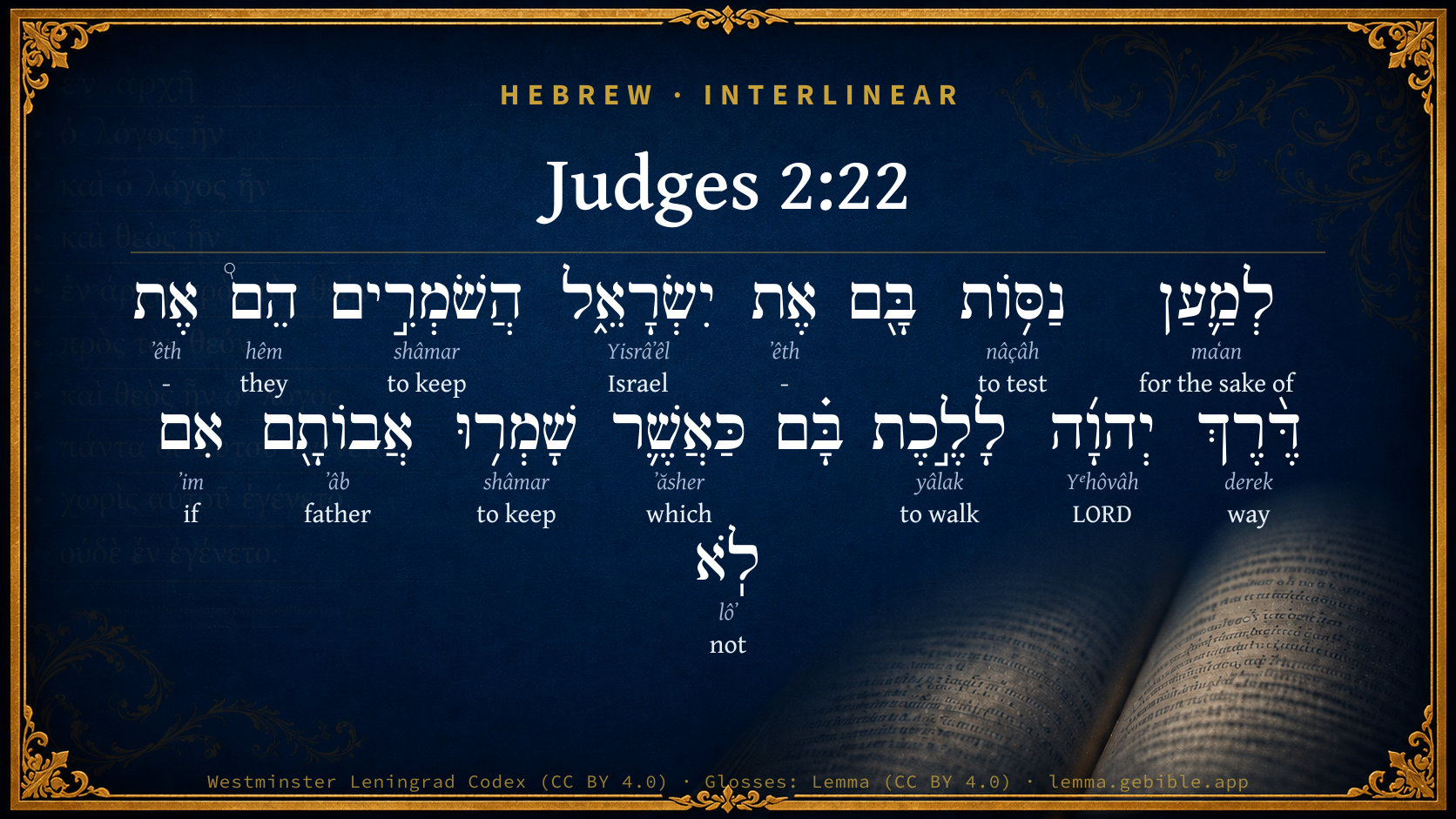
Hebrew (Westminster Leningrad Codex) Judges 2:22 appears in the Hebrew Old Testament. The text above is from the Westminster Leningrad Codex. Each word links to its Strong’s number, a concise gloss, and parsing drawn from the Open Scriptures Hebrew Bible morphology. Click any word for its full Brown-Driver-Briggs (BDB) entry.
Download image
Cite this verse

Judges 2:22 (World English Bible). Public Domain. Lemma interlinear Bible study tool, https://lemma.gebible.app/v/judges/2/22.

Show BibTeX & RIS
BibTeX
RIS
English Translation
that by them I may prove Israel, whether they will keep the way of Yahweh to walk therein, as their fathers did keep it, or not.
World English Bible · Public Domain
Download a study sheet

One document with this verse’s original text, its word-by-word gloss line, the meaning frame, cross-references with their text, attributed commentary, and full source and license credits — printable, and it pastes into notes with its structure intact.

This verse Autodidact and up

Study sheet (.html) Plain text (.txt)

A passage Seminary Student

Up to 50 verses in one chapter. A passage sheet keeps up to 6 commentary sources and 12 cross-references per verse, in the order this page ranks them, and says so on the sheet whenever that leaves anything out. Ask for a single verse and you get the Autodidact verse sheet above.

Everything on this page stays free to read, with no account — the sheet is a download of what is already on screen, not access to it.

Want to remove ads? Support Godless Engineer
Compare translations 3

The same verse in 3 English versions, stacked beneath the original-language interlinear above. Click any original word for its lexicon entry.

Each is an independent rendering of the whole verse — the interlinear is not word-aligned to these translations.

Highlighted words mark where these versions differ — a whole-verse word diff, not a word-by-word alignment.

  • World English Bible Public Domain
    that by them I may prove Israel, whether they will keep the way of Yahweh to walk therein, as their fathers did keep it, or not.
  • King James Version Public Domain
    That through them I may prove Israel, whether they will keep the way of the LORD to walk therein, as their fathers did keep it, or not.
  • unfoldingWord Literal Text CC BY-SA 4.0
    for the testing of Israel by them, whether they will be keeping the way of Yahweh, to walk in them just as their fathers kept, or not.”

unfoldingWord Literal Text — © unfoldingWord, licensed CC BY-SA 4.0. Word-aligned USFM3 via Door43 (git.door43.org/unfoldingWord/en_ult).

Versions to compare (up to 4)

3 of 4 selected

Show all 18 translations

Every available English version of this verse, each an independent rendering of the whole verse.

  • World English Bible Public Domain
    that by them I may prove Israel, whether they will keep the way of Yahweh to walk therein, as their fathers did keep it, or not.
  • Berean Standard Bible Public Domain
    In this way I will test whether Israel will keep the way of the LORD by walking in it as their fathers did.”
  • Majority Standard Bible Public Domain
    In this way I will test whether Israel will keep the way of the LORD by walking in it as their fathers did.”
  • King James Version Public Domain
    That through them I may prove Israel, whether they will keep the way of the LORD to walk therein, as their fathers did keep it, or not.
  • American Standard Version (1901) Public Domain
    that by them I may prove Israel, whether they will keep the way of Jehovah to walk therein, as their fathers did keep it, or not.
  • Revised Version (1885) Public Domain
    that by them I may prove Israel, whether they will keep the way of the LORD to walk therein, as their fathers did keep it, or not.
  • Geneva Bible (1599) Public Domain
    That through them I may proue Israel, whether they wil keepe the way of the Lord, to walke therein, as their fathers kept it, or not.
  • Douay-Rheims (1899) Public Domain
    That through them I may try Israel, whether they will keep the way of the Lord, and walk in it, as their fathers kept it, or not.
  • Young's Literal Translation Public Domain
    in order to try Israel by them, whether they are keeping the way of Jehovah, to go in it, as their fathers kept `it' or not.'
  • Literal Standard Version CC BY-SA 4.0
    in order to try Israel by them, whether they are keeping the way of YHWH, to go in it, as their fathers kept [it], or not.”
  • Unlocked Literal Bible CC BY-SA 4.0
    I will do this so that I may test Israel, whether or not they will keep the way of Yahweh and walk in it, as their fathers kept it.”
  • unfoldingWord Literal Text CC BY-SA 4.0
    for the testing of Israel by them, whether they will be keeping the way of Yahweh, to walk in them just as their fathers kept, or not.”
  • Darby Bible Public Domain
    that by them I may test Israel, whether they will take care to walk in the way of the LORD as their fathers did, or not."
  • World Messianic Bible Public Domain
    that by them I may test Israel, to see if they will keep the LORD’s way to walk therein, as their fathers kept it, or not.”
  • Webster's Bible Public Domain
    That through them I may prove Israel, whether they will keep the way of the LORD to walk in it, as their fathers kept it, or not.
  • Free Bible Version CC BY-SA 4.0
    This is in order to use them to test Israel to see if they will keep the way of the Lord and follow it as their forefathers did.”
  • Bible in Basic English Public Domain
    In order to put Israel to the test, and see if they will keep the way of the Lord, walking in it as their fathers did, or not.
  • JPS Tanakh (1917) Public Domain
    that by them I may prove Israel, whether they will keep the way of the LORD to walk therein, as their fathers did keep it, or not.'

Literal Standard Version (2020), Covenant Press — licensed CC BY-SA 4.0. Text via the HelloAO Bible API (eBible.org). Unlocked Literal Bible (unfoldingWord) — licensed CC BY-SA 4.0. Text via the HelloAO Bible API (eBible.org). unfoldingWord Literal Text — © unfoldingWord, licensed CC BY-SA 4.0. Word-aligned USFM3 via Door43 (git.door43.org/unfoldingWord/en_ult). Free Bible Version, Dr. Jonathan Gallagher — licensed CC BY-SA 4.0. Text via the HelloAO Bible API (eBible.org).

Word by word

More ways to search: Search by grammar → Find every occurrence → Compare this word →

Practice this passage: Drill this verse → Learn its vocabulary →

נַסּ֥וֹת
nâçâh
H5254
“to test”
Verb, Piel, Infinitive Construct
Part of Speech
Verb
Stem
Piel
Form
Infinitive Construct
Full BDB Definition

Origin: a primitive root

TWOT: 1373

to test, try, prove, tempt, assay, put to the proof or test - (Piel) - to test, try - to attempt, assay, try - to test, try, prove, tempt
  1. לְמַ֛עַן maʻan H4616 “for the sake of” Preposition
  2. אֶת ʼêth H853 “-” Particle, Direct Object
  3. יִשְׂרָאֵ֑ל Yisrâʼêl H3478 “Israel” Noun, Proper
  4. הֲשֹׁמְרִ֣ים shâmar H8104 “keeping” Particle, Interrogative + Verb, Qal, Participle Active, Masculine, Plural, Absolute
  5. הֵם֩ hêm H1992 “they” Pronoun, Personal, 3rd Person, Masculine, Plural
  6. אֶת ʼêth H853 “-” Particle, Direct Object
  7. דֶּ֨רֶךְ derek H1870 “way of” Noun, Common, Both, Singular, Construct
  8. יְהוָ֜ה Yᵉhôvâh H3068 “LORD” Noun, Proper
  9. לָלֶ֣כֶת yâlak H3212 “to walk” Preposition + Verb, Qal, Infinitive Construct
  10. כַּאֲשֶׁ֛ר ʼăsher H834 “like/as · which” Preposition + Particle, Relative
  11. שָׁמְר֥וּ shâmar H8104 “to keep” Verb, Qal, Perfect, 3rd Person, Common, Plural
  12. אֲבוֹתָ֖ם ʼâb H1 “fathers · their” Noun, Common, Masculine, Plural, Construct + Suffix, Personal, 3rd Person, Masculine, Plural
  13. אִם ʼim H518 “if” Conjunction
  14. לֹֽא lôʼ H3808 “not” Particle, Negative

About this verse

These counts appear in no published source. They are computed here, from the morphology-tagged text and Lemma’s own curated glosses. What Lemma adds →

17
words
13
distinct lemmas
Historical
section

Shared distinctive vocabulary

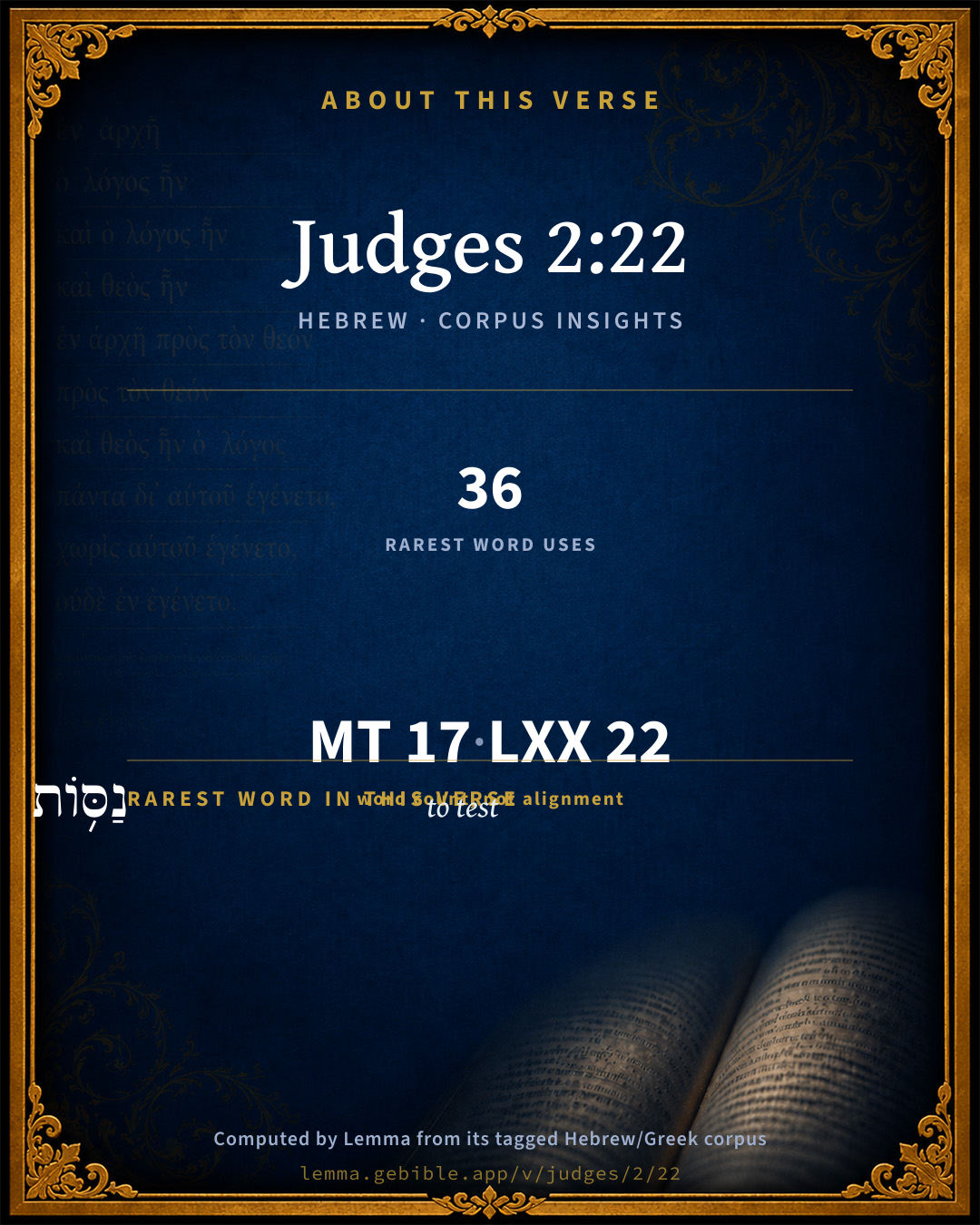
נַסּ֥וֹת to test H5254 occurs in 34 verses of the Hebrew Bible. Also found in:

Grammatical profile

  • 4 verbs
  • 4 nouns
  • 1 pronoun
  • 3 prepositions
  • 1 conjunction
  • 4 particles

Verb forms

  • נַסּ֥וֹת Piel · Infinitive Construct
  • הֲשֹׁמְרִ֣ים Qal · Participle Active
  • לָלֶ֣כֶת Qal · Infinitive Construct
  • שָׁמְר֥וּ Qal · Perfect

Repetition

A word recurs within this verse — often emphatic in Hebrew:

  • הֲשֹׁמְרִ֣ים to keep H8104 ×2

Hebrew & Septuagint length

In English translation the verse runs 26 words from the Hebrew and 25 from the Septuagint (LXX English) — closely comparable.

A rough comparison of the two English renderings, which tokenize alike — not a word-level alignment.

Word counts can differ between the Hebrew and the Greek without any difference in meaning — e.g. the Hebrew direct-object marker אֵת has no separate Greek word, and Greek often adds the article ὁ.

In the original languages it is 17 Hebrew tokens and 22 Greek tokens — but the two are counted differently (Hebrew bundles its prefixes and suffixes into one token; the Greek is in lemma form), so that isn’t a like-for-like length.

Cross-references

10

Topical passages linked to Judges 2:22 in the Treasury of Scripture Knowledge — connected by theme and wording, ordered by reader-vote popularity; previews shown in the World English Bible.

  • Deuteronomy 8:2 You shall remember all the way which Yahweh your God has led you these forty years in the wilderness, that he might humble you, to prove you, to know what was in your heart, whether you would keep his commandments, or not.
  • Deuteronomy 8:16 who fed you in the wilderness with manna, which your fathers didn't know; that he might humble you, and that he might prove you, to do you good at your latter end:
  • Deuteronomy 13:3 you shall not listen to the words of that prophet, or to that dreamer of dreams: for Yahweh your God proves you, to know whether you love Yahweh your God with all your heart and with all your soul.
  • Proverbs 17:3 The refining pot is for silver, and the furnace for gold, But Yahweh tests the hearts.
  • Genesis 22:1 It happened after these things, that God tested Abraham, and said to him, "Abraham!" He said, "Here I am."
  • Judges 3:1–4 Now these are the nations which Yahweh left, to prove Israel by them, even as many [of Israel] as had not known all the wars of Canaan;
  • 2 Chronicles 32:31 However in [the business of] the ambassadors of the princes of Babylon, who sent to him to inquire of the wonder that was done in the land, God left him, to try him, that he might know all that was in his heart.
  • Job 23:10 But he knows the way that I take. When he has tried me, I shall come forth like gold.
  • Psalms 66:10 For you, God, have tested us. You have refined us, as silver is refined.
  • Malachi 3:2–3 "But who can endure the day of his coming? And who will stand when he appears? For he is like a refiner's fire, and like launderer's soap;

Cross-references courtesy of OpenBible.info (CC BY 4.0).

Hebrew and Greek witnesses Masoretic Hebrew ↔ Greek Septuagint

The same verse in the two great witnesses to the Old Testament, shown verse-for-verse.

These are two independent witnesses, not word-aligned to each other, and the Septuagint is shown in lemma (dictionary) form.

Hebrew Judges 2:22 Masoretic · Westminster Leningrad Codex

לְמַ֛עַן נַסּ֥וֹת בָּ֖ם אֶת יִשְׂרָאֵ֑ל הֲשֹׁמְרִ֣ים הֵם֩ אֶת דֶּ֨רֶךְ יְהוָ֜ה לָלֶ֣כֶת בָּ֗ם כַּאֲשֶׁ֛ר שָׁמְר֥וּ אֲבוֹתָ֖ם אִם לֹֽא

that by them I may prove Israel, whether they will keep the way of Yahweh to walk therein, as their fathers did keep it, or not.

World English Bible · Public Domain

Greek LXX Judges 2:22 Septuagint · lemma form

ὁ πειράζω ἐν αὐτός ὁ ἰσραήλ εἰ φυλάσσω ὁ ὁδός κύριος πορεύομαι ἐν αὐτός ὅς τρόπος φυλάσσω ὁ πατήρ αὐτός ἤ οὐ

to prove Israel with them, whether they would keep the way of the Lord, to walk in it, as their fathers kept it, or no.

LXX2012 (modern English Septuagint) · Public Domain

Hebrew: Westminster Leningrad Codex (CC BY 4.0). Greek: Septuagint (public domain); English from LXX2012 (modern English Septuagint) (Public Domain). How the Septuagint differs from the Hebrew →

Targum (Aramaic paraphrase)

1

The Targum is the ancient Jewish Aramaic paraphrase of the Hebrew Scriptures — an interpretive translation, not the Hebrew text itself. Onkelos (literal) and Pseudo-Jonathan (expansive) render the Torah, and Jonathan the Prophets. Coverage is partial: where no permissively-licensed English translation exists for a verse, only the Aramaic is shown. This is verse-level text, not a word-by-word alignment to the Hebrew.

  1. Targum Jonathan Prophets (Joshua–Malachi)
    בְּדִיל לְנַסָאָה בְּהוֹן יַת יִשְׂרָאֵל הֲנַטְרִין אִינוּן יַת אוֹרְחָן דְתַקְנַן קֳדָם יְיָ לִמְהַךְ בְּהוֹן כְּמָא דִי נְטַרוּ אֲבָהַתְהוֹן אִם לָא:

    (no public-domain English translation for this verse)

    Targum Jonathan — Aramaic: “Mikraot Gedolot” (public domain). English: “Sefaria Community Translation” (CC0 1.0 (public-domain dedication)); “London "Chaldee Paraphrase," 1871” (public domain). Text via Sefaria.

Commentary

Notes on Judges 2:22 from classic Christian and Jewish commentators (each source and its license shown beneath its notes). The classic Christian expositions comment on the surrounding passage and are grouped to its opening verse, so a note may address several verses; the Jewish commentaries on the Tanakh (Rashi and others) are per-verse, so they appear only where the commentator wrote on this verse.

Lemma curates 59 commentaries, every one of them public domain or Creative Commons licensed, each selected and text-cleaned for this edition rather than reprinted as found. About our sources →

The Cambridge Bible for Schools and Colleges

gen. ed. J. J. S. Perowne

22. prove Israel] Jdg_3:1; Jdg_3:4, as He had proved them in the wilderness, Exo_16:4 J, Exo_15:25, Exo_20:20 E, Deu_8:2; Deu_8:16; Deu_13:3. The purpose of God’s proving is to test man’s loyalty and to perfect the character, Gen_22:1; Psa_26:2; Jas_1:2-4. In Jdg_2:20-21 the nations were not driven out because Israel must be punished, in Jdg_2:22 because Israel must be tested. The two ideas are not irreconcileable in thought; but it is probable that Jdg_2:22 was not written by the author of Jdg_2:20-21; at any rate the form of the sentence whether they will keep … or not is Deuteronomic; see the refs. to Deut. just given. In the Hebrew way must be corrected to ways to agree with therein (plur.).

The Cambridge Bible for Schools and Colleges (gen. ed. J. J. S. Perowne; Cambridge University Press, 1878–1918) — public domain. Text from a community e-Sword module.

Trapp's Complete Commentary

John Trapp

Jdg 2:22 That through them I may prove Israel, whether they will keep the way of the LORD to walk therein, as their fathers did keep [it], or not.

Ver. 22. That through them I may prove Israel.] But whenas upon trial he found them to be no better than "reprobate silver," {Jer 6:30} those nations served no longer for trials, but for scourges, and instruments of revenge.

John Trapp, A Commentary or Exposition upon All the Books of the Old and New Testament (1647–1656) — public domain. Text from a community e-Sword module.

Joseph Benson's Commentary

Jdg 2:22. That through them I may prove Israel — That I may try and see whether Israel will be true and faithful to me, or whether they will suffer themselves to be corrupted by the counsels and examples of their bad neighbours.

Joseph Benson's Commentary on the Old and New Testaments (1811–1818) — public domain. Text from a community e-Sword module.

Geneva Bible (1599)

Geneva Bible translators

So that both outward enemies and false prophets are but a trial to prove our faith, Deut. 13:3 and Judg. 3:1.

Geneva Bible (1599) marginal notes — public domain. Text via Bolls.life.

Adam Clarke's Commentary

Verse 22. That through them I may prove Israel] There appeared to be no other way to induce this people to acknowledge the true God, but by permitting them to fall into straits from which they could not be delivered but by his especial providence. These words are spoken after the manner of men; and the metaphor is taken from the case of a master or father, who distrusts the fidelity or obedience of his servant or son, and places him in such circumstances that, by his good or evil conduct, he may justify his suspicions, or give him proofs of his fidelity.

Adam Clarke's Commentary on the Bible (1810–1826) — public domain. Text from a community e-Sword/MySword module.

Ellicott's Commentary for English Readers

(22) That through them I may prove Israel.—Yet in this as in all God’s punishments there was an element of mercy mingled with the judgment, as we see from Exo_23:29-30; Deu_7:22; and infr. Jdg_3:1-2. If in one point of view the non-extermination of Canaan at first led the Israelites into temptation and brought down retributive punishments upon them, yet out of these evils God raised the two-fold good, that they meanwhile increased sufficiently in numbers to be able effectually to till the soil and keep down the wild beasts, and were also being trained in bravery and warlike skill, while the aborigines were being driven out “by little and by little.” Further, we see that a real growth was going on during this period of suffering and anarchy. The peril of internal discord was partly averted by the noble life, and inspiring memories, and treasures of infinite truth which they had acquired in the free air of the desert. “They learned by perpetual struggle to defend their new home, and the free exercise of their religion, and so they prepared for coming generations a sacred place where that religion and national culture might develop. During the long pause of apparent inaction a hidden movement was going on, and the principles and truths so marvellously brought to light were taking firm root.” (Ewald.)

A Bible Commentary for English Readers, edited by Charles John Ellicott (1878–1897) — public domain. Text from a community e-Sword module.

John Gill's Exposition

That through them I may prove Israel,.... Afflict them by them, and so prove or try them, their faith and patience, which are tried by afflictions; and such were the Canaanites to them, as afflictions and temptations are to the spiritual Israel of God; or rather, whether they would keep in the ways of God, or walk in those the Canaanites did, as follows:

whether they will keep the way of the Lord, as their fathers did keep it, or not; whether they would worship the true God their fathers did, or the gods of the Canaanites; not that the Lord was ignorant of what they would do, and so made the experiment; but that the sincerity and faithfulness, or insincerity and unfaithfulness of their hearts, might appear to themselves and others.

John Gill's Exposition of the Whole Bible (1746–1763) — public domain (CC PDM 1.0). Text via the HelloAO Bible API.

Haydock's Catholic Bible Commentary

Or not. The secrets of hearts cannot be hidden from the omniscience of God. (Calmet) --- But he would have an experimental knowledge of the fidelity of his people, by leaving these nations in the midst of them. It was partly on this account that he withdrew the sword of Josue, who would otherwise have easily followed up his victories, and exterminated all the inhabitants. The cowardice and secret indispositions of the people was another obstacle. (Haydock) --- God acted like a person who distrusted the fidelity of his servant, and left something in his way to see if we would steal it. (Calmet)

George Leo Haydock (1774–1849), Haydock's Catholic Family Bible and Commentary, 1859 edition — public domain. Excludes Psalms (Douay-Rheims chapter numbering differs from Protestant) and Deuterocanonical books (Catholic canon only).

Matthew Poole's English Annotations

That I may prove Israel; either, first, That I may try, and see whether Israel will be true and faithful to me, or whether they will suffer themselves to be corrupted by the evil counsels and examples of their bad neighbours, whom I will leave among them for their trial and exercise. Or, secondly, That by them I may afflict and punish Israel; for afflictions are commonly and justly called trials. But the former sense suits better with the following words.

Matthew Poole's English Annotations on the Holy Bible (1683–1685) — public domain. Text from a community e-Sword/MySword module.

Whedon's Commentary on the Bible

Daniel D. Whedon

22. That through them I may prove Israel — The presence of wicked men in society constitutes a part of the trial of the good. The Hebrews, by sparing their idolatrous enemies, multiplied and intensified their own temptations to sin. Jehovah used the heathen tribes that were left in the land to chastise the Israelites when the latter went out of the way. Of these chastisements and the deliverances wrought upon Israel’s repentance, the Book of Judges is largely the history.

Daniel D. Whedon (gen. ed.), Commentary on the Old and New Testaments (1874–1909) — public domain. Text from a community e-Sword module.

The Pulpit Commentary

To walk therein. The Hebrew has in them. Probably for way we should read ways, as Deu_8:6 Deu_10:12, etc. This verse does not seem to be part of what the Lord said, but to be the comment of the writer. The A.V that through them I may prove inserts an I which is not in the original. Ver. 22 depends upon ver. 23. The literal rendering is, For the sake of proving Israel, etc... the Lord left those nations. The writer, after rehearsing the Lord"s reason for not completing the extirpation of the nations after the death of Joshua, adds the further information why they had not been delivered into Joshua"s hand in his lifetime. (cf. Jos_3:1, Jos_3:4) In Exo_23:29, 30 Deu_7:22, an additional reason is given for the gradual extirpation of the Canaaniteslest the beasts of the field increase upon thee. "

The Pulpit Commentary (1880–1919), ed. H.D.M. Spence-Jones & Joseph S. Exell — public domain. Text from a community e-Sword module.

John Wesley's Explanatory Notes

May prove - That I may try and see whether Israel will be true and faithful to me, or whether they will suffer themselves to be corrupted by the counsels and examples of their bad neighbours.

John Wesley, Explanatory Notes Upon the Whole Bible (1754–1765) — public domain. Text via the GEBible commentary corpus.

Keil & Delitzsch

C. F. Keil & F. Delitzsch

The purpose of God in this resolution was "to prove Israel through them (the tribes that were not exterminated), whether they (the Israelites) would keep the way of the Lord to walk therein (cf. Deu 8:2), as their fathers did keep it, or not." נסּות למען is not dependent upon the verb עזב, as Studer supposes, which yields no fitting sense; nor can the clause be separated from the preceding one, as Bertheau suggests, and connected as a protasis with Jdg 2:23 (this would be a thoroughly unnatural construction, for which Isa 45:4 does not furnish any true parallel); but the clause is attached in the simplest possible manner to the main thought in Jdg 2:20, Jdg 2:21, that is to say, to the words "and He said" in Jdg 2:20 : Jehovah said, i.e., resolved, that He would not exterminate the remaining nations any further, to tempt Israel through them. The plural בּם, in the place of the singular בּהּ, which the foregoing דּרך requires, is to be regarded as a constructio ad sensum, i.e., to be attributed to the fact, that keeping the way of God really consists in observing the commandments of God, and that this was the thought which floated before the writer's mind. The thought expressed in this verse, that Jehovah would not exterminate the Canaanites before Israel any more, to try them whether they would keep His commandments, just as He had previously caused the people whom He brought out of Egypt to wander in the wilderness for forty years with the very same intention (Deu 8:2), is not at variance with the design of God, expressed in Exo 23:29-30, and Deu 7:22, not to exterminate the Canaanites all at once, lest the land should become waste, and the wild beasts multiply therein, nor yet with the motive assigned in Jdg 3:1-2. For the determination not to exterminate the Canaanite sin one single year, was a different thing from the purpose of God to suspend their gradual extermination altogether. The former purpose had immediate regard to the well-being of Israel; the latter, on the contrary, was primarily intended as a chastisement for its transgression of the covenants, although even this chastisement was intended to lead the rebellious nation to repentance, and promote its prosperity by a true conversion to the Lord. And the motive assigned in Jdg 2:2 is in perfect harmony with this intention, as our explanation of this passage will clearly show.

Keil & Delitzsch — Biblical Commentary on the Old Testament (1861–1891) — public domain (CC PDM 1.0). Text via the HelloAO Bible API. (Old Testament only.)

Rashi

Rabbi Shlomo Yitzchaki (Rashi)

Whether they observe. The letter ה is vocalized with the abridged pasach, as it expresses the inquiry involved in testing.

Rashi on the Tanakh — English translations: “The Judaica Press complete Tanach with Rashi, translated by A. J. Rosenberg” (CC BY 4.0); “Pentateuch with Rashi's commentary by M. Rosenbaum and A.M. Silbermann, 1929-1934” (public domain); “The Metsudah Tanach series, Lakewood, N.J” (CC BY 4.0); and “The Book of Joshua, Metsudah Publications, 1997” (CC BY 4.0). Text via Sefaria.

Lesson kit

Teaching starters — assembled from the data on this page, not authored interpretation. Every prompt links to the verse data it draws on. Edit before teaching.

Judges, in the Historical, opens this verse with 17 words (13 distinct Hebrew lemmas). Its most distinctive word is nâçâh (“to test”). A historical commentator’s framing appears above. Read the whole chapter for the surrounding context.

Discussion questions

  1. What does “to test” (nâçâh) contribute to the verse as a whole?
  2. Genesis 22:1 shares the word «to test» with this verse. How do the two illuminate each other?
  3. “to keep” occurs 2× in this one verse. What is the effect of the repetition?
  4. These translations render this verse differently; the difference is in the English rendering, not the original. What questions does that raise?
  5. The verb «נַסּ֥וֹת» is Piel Infinitive Construct. How does its form color the action?
  6. Reading how The Cambridge Bible for Schools and Colleges and Trapp's Complete Commentary read this verse, where do the two commentators agree and where do they part?

Things to notice

Reading settings

Reading text

Shown beneath each verse's original-language words.

Old Testament
Old Testament edition

Read the OT as the Masoretic Hebrew (MT) or the Greek Septuagint (LXX).

English shown for the Greek Septuagint (in the Hebrew ↔ Greek comparison).

Comparing translations? Open the Compare panel on any verse page to stack up to four side by side.