
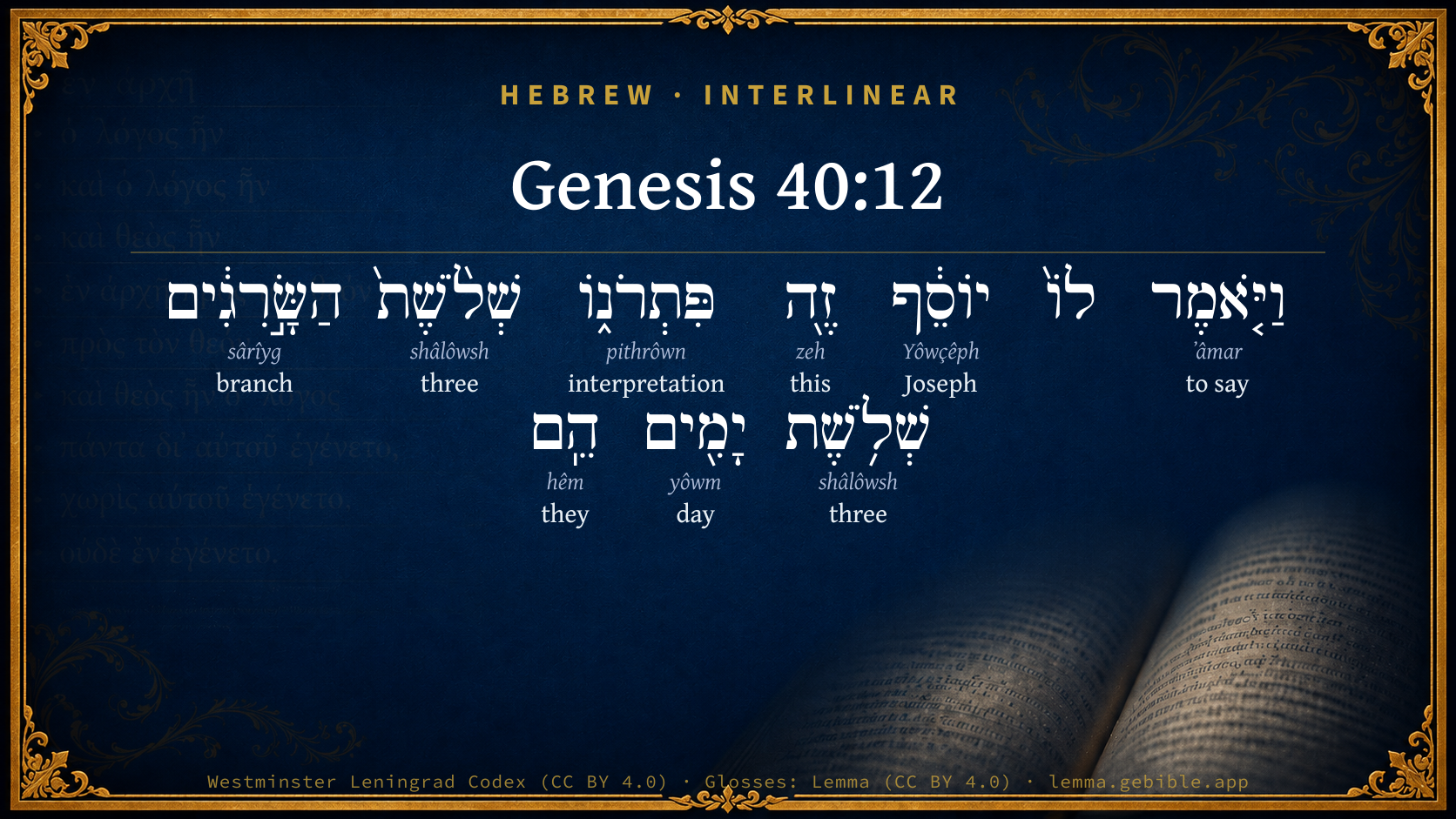
Genesis 40:12

Hebrew (Westminster Leningrad Codex) Genesis 40:12 appears in the Hebrew Old Testament. The text above is from the Westminster Leningrad Codex. Each word links to its Strong’s number, a concise gloss, and parsing drawn from the Open Scriptures Hebrew Bible morphology. Click any word for its full Brown-Driver-Briggs (BDB) entry.
Download image
Cite this verse

Genesis 40:12 (World English Bible). Public Domain. Lemma interlinear Bible study tool, https://lemma.gebible.app/v/genesis/40/12.

Show BibTeX & RIS
BibTeX
RIS
English Translation
Joseph said to him, "This is the interpretation of it: the three branches are three days.
World English Bible · Public Domain
Download a study sheet

One document with this verse’s original text, its word-by-word gloss line, the meaning frame, cross-references with their text, attributed commentary, and full source and license credits — printable, and it pastes into notes with its structure intact.

This verse Autodidact and up

Study sheet (.html) Plain text (.txt)

A passage Seminary Student

Up to 50 verses in one chapter. A passage sheet keeps up to 6 commentary sources and 12 cross-references per verse, in the order this page ranks them, and says so on the sheet whenever that leaves anything out. Ask for a single verse and you get the Autodidact verse sheet above.

Everything on this page stays free to read, with no account — the sheet is a download of what is already on screen, not access to it.

Want to remove ads? Support Godless Engineer
Compare translations 3

The same verse in 3 English versions, stacked beneath the original-language interlinear above. Click any original word for its lexicon entry.

Each is an independent rendering of the whole verse — the interlinear is not word-aligned to these translations.

Highlighted words mark where these versions differ — a whole-verse word diff, not a word-by-word alignment.

  • World English Bible Public Domain
    Joseph said to him, "This is the interpretation of it: the three branches are three days.
  • King James Version Public Domain
    And Joseph said unto him, This is the interpretation of it: The three branches are three days:
  • unfoldingWord Literal Text CC BY-SA 4.0
    Then Joseph said to him, “This its interpretation: The three branches three days.

unfoldingWord Literal Text — © unfoldingWord, licensed CC BY-SA 4.0. Word-aligned USFM3 via Door43 (git.door43.org/unfoldingWord/en_ult).

Versions to compare (up to 4)

3 of 4 selected

Show all 18 translations

Every available English version of this verse, each an independent rendering of the whole verse.

  • World English Bible Public Domain
    Joseph said to him, "This is the interpretation of it: the three branches are three days.
  • Berean Standard Bible Public Domain
    Joseph replied, “This is the interpretation: The three branches are three days.
  • Majority Standard Bible Public Domain
    Joseph replied, “This is the interpretation: The three branches are three days.
  • King James Version Public Domain
    And Joseph said unto him, This is the interpretation of it: The three branches are three days:
  • American Standard Version (1901) Public Domain
    And Joseph said unto him, This is the interpretation of it: the three branches are three days;
  • Revised Version (1885) Public Domain
    And Joseph said unto him, This is the interpretation of it: the three branches are three days;
  • Geneva Bible (1599) Public Domain
    Then Ioseph sayde vnto him, This is the interpretation of it: The three braunches are three dayes.
  • Douay-Rheims (1899) Public Domain
    Joseph answered: This is the interpretation of the dream: The three branches are yet three days:
  • Young's Literal Translation Public Domain
    And Joseph saith to him, `This `is' its interpretation: the three branches are three days;
  • Literal Standard Version CC BY-SA 4.0
    And Joseph says to him, “This [is] its interpretation: the three branches are three days;
  • Unlocked Literal Bible CC BY-SA 4.0
    Joseph said to him, “This is the interpretation of it. The three branches are three days.
  • unfoldingWord Literal Text CC BY-SA 4.0
    Then Joseph said to him, “This its interpretation: The three branches three days.
  • Darby Bible Public Domain
    And Joseph said to him, This is the interpretation of it: the three branches are three days.
  • World Messianic Bible Public Domain
    Joseph said to him, “This is its interpretation: the three branches are three days.
  • Webster's Bible Public Domain
    And Joseph said to him, This is the interpretation of it: The three branches are three days;
  • Free Bible Version CC BY-SA 4.0
    “This is the meaning,” Joseph told him. “The three branches represent three days.
  • Bible in Basic English Public Domain
    Then Joseph said, This is the sense of your dream: the three branches are three days;
  • JPS Tanakh (1917) Public Domain
    And Joseph said unto him: 'This is the interpretation of it: the three branches are three days;

Literal Standard Version (2020), Covenant Press — licensed CC BY-SA 4.0. Text via the HelloAO Bible API (eBible.org). Unlocked Literal Bible (unfoldingWord) — licensed CC BY-SA 4.0. Text via the HelloAO Bible API (eBible.org). unfoldingWord Literal Text — © unfoldingWord, licensed CC BY-SA 4.0. Word-aligned USFM3 via Door43 (git.door43.org/unfoldingWord/en_ult). Free Bible Version, Dr. Jonathan Gallagher — licensed CC BY-SA 4.0. Text via the HelloAO Bible API (eBible.org).

Word by word

More ways to search: Search by grammar → Find every occurrence → Compare this word →

Practice this passage: Drill this verse → Learn its vocabulary →

הַשָּׂ֣רִגִ֔ים
sârîyg
H8299
“the · branches”
Particle, Definite Article + Noun, Common, Masculine, Plural, Absolute
Part of Speech
Particle + Noun
Type
Common
Gender
Masculine
Number
Plural
State
Absolute
Full BDB Definition

Origin: from H8276

TWOT: 2284a

tendril, twig, branch
  1. וַיֹּ֤אמֶר ʼâmar H559 “and · to say” Conjunction + Verb, Qal, Sequential Imperfect, 3rd Person, Masculine, Singular
  2. יוֹסֵ֔ף Yôwçêph H3130 “Joseph” Noun, Proper
  3. זֶ֖ה zeh H2088 “this” Pronoun, Demonstrative, Masculine, Singular
  4. פִּתְרֹנ֑וֹ pithrôwn H6623 “interpretation · his” Noun, Common, Masculine, Singular, Construct + Suffix, Personal, 3rd Person, Masculine, Singular
  5. שְׁלֹ֨שֶׁת֙ shâlôwsh H7969 “three” Adjective, Cardinal number, Masculine, Singular, Construct
  6. שְׁלֹ֥שֶׁת shâlôwsh H7969 “three” Adjective, Cardinal number, Masculine, Singular, Construct
  7. יָמִ֖ים yôwm H3117 “days” Noun, Common, Masculine, Plural, Absolute
  8. הֵֽם hêm H1992 “they” Pronoun, Personal, 3rd Person, Masculine, Plural

About this verse

These counts appear in no published source. They are computed here, from the morphology-tagged text and Lemma’s own curated glosses. What Lemma adds →

10
words
8
distinct lemmas
Pentateuch
section

Notable vocabulary

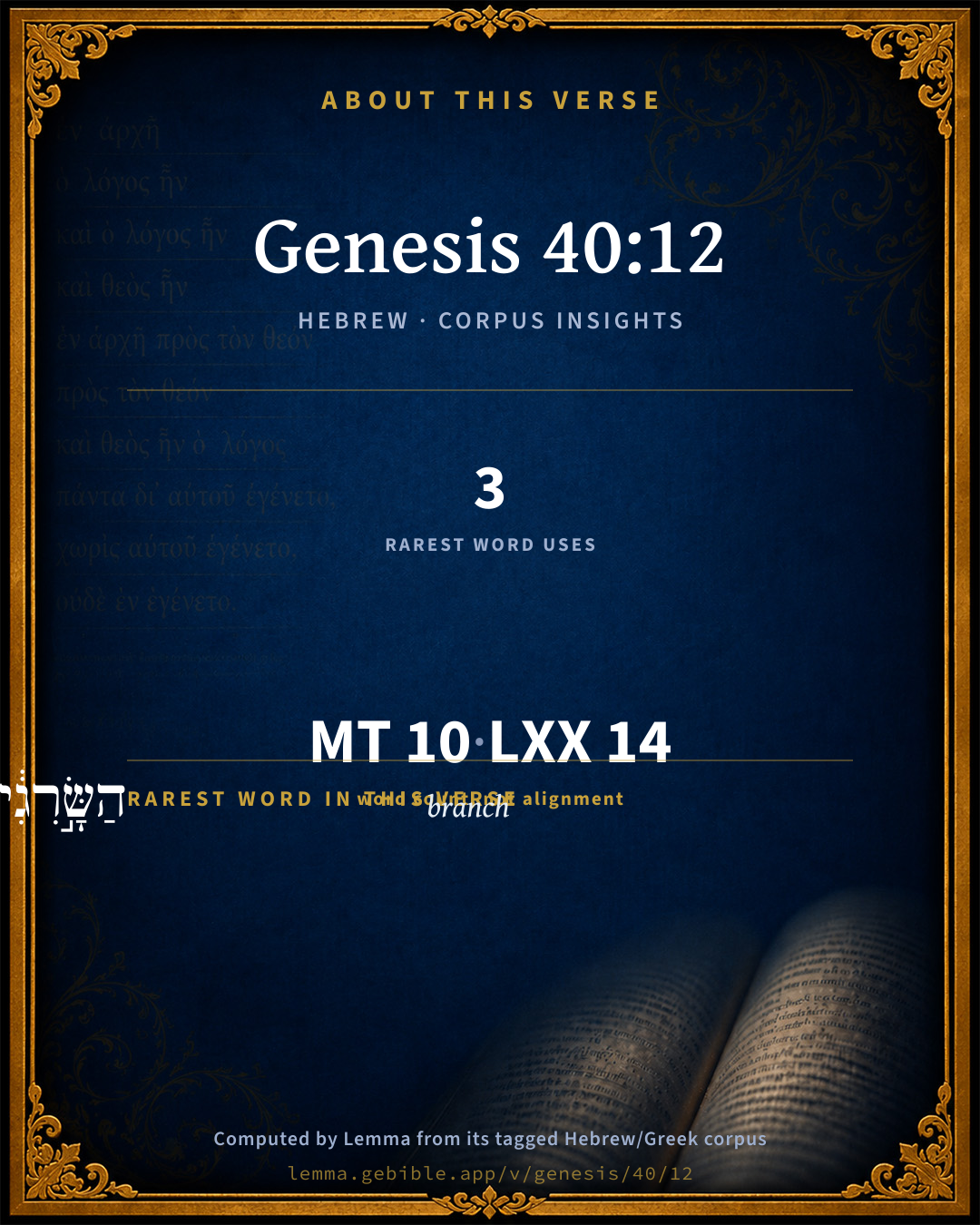
The rarest word here is הַשָּׂ֣רִגִ֔ים branch H8299 — appearing just 3 times in the whole Hebrew Bible.

Shared distinctive vocabulary

הַשָּׂ֣רִגִ֔ים branch H8299 occurs in 3 verses of the Hebrew Bible. Also found in:

Grammatical profile

  • 1 verb
  • 4 nouns
  • 2 adjectives
  • 2 pronouns
  • 1 preposition

Verb forms

  • וַיֹּ֤אמֶר Qal · Sequential Imperfect

Repetition

A word recurs within this verse — often emphatic in Hebrew:

  • שְׁלֹ֨שֶׁת֙ three H7969 ×2

Hebrew & Septuagint length

In English translation the verse runs 16 words from the Hebrew and 17 from the Septuagint (LXX English) — closely comparable.

A rough comparison of the two English renderings, which tokenize alike — not a word-level alignment.

Word counts can differ between the Hebrew and the Greek without any difference in meaning — e.g. the Hebrew direct-object marker אֵת has no separate Greek word, and Greek often adds the article ὁ.

In the original languages it is 10 Hebrew tokens and 14 Greek tokens — but the two are counted differently (Hebrew bundles its prefixes and suffixes into one token; the Greek is in lemma form), so that isn’t a like-for-like length.

Cross-references

9

Topical passages linked to Genesis 40:12 in the Treasury of Scripture Knowledge — connected by theme and wording, ordered by reader-vote popularity; previews shown in the World English Bible.

  • Genesis 41:12 There was with us there a young man, a Hebrew, servant to the captain of the guard, and we told him, and he interpreted to us our dreams. To each man according to his dream he interpreted.
  • Judges 7:14 His fellow answered, This is nothing else save the sword of Gideon the son of Joash, a man of Israel: into his hand God has delivered Midian, and all the host.
  • Genesis 40:18 Joseph answered, "This is the interpretation of it. The three baskets are three days.
  • Genesis 41:25–26 Joseph said to Pharaoh, "The dream of Pharaoh is one. What God is about to do he has declared to Pharaoh.
  • Daniel 2:36–45 This is the dream; and we will tell the interpretation of it before the king.
  • Daniel 4:19–33 Then Daniel, whose name was Belteshazzar, was stricken mute for a while, and his thoughts troubled him. The king answered, Belteshazzar, don't let the dream, or the interpretation, trouble you. Belteshazzar answered, My lord, the dream be to those who hate you, and the interpretation of it to your adversaries.
  • Matthew 26:26 As they were eating, Jesus took bread, gave thanks for it, and broke it. He gave to the disciples, and said, "Take, eat; this is my body."
  • 1 Corinthians 10:4 and all drank the same spiritual drink. For they drank of a spiritual rock that followed them, and the rock was Christ.
  • Galatians 4:25 For this Hagar is Mount Sinai in Arabia, and answers to the Jerusalem that exists now, for she is in bondage with her children.

Cross-references courtesy of OpenBible.info (CC BY 4.0).

Hebrew and Greek witnesses Masoretic Hebrew ↔ Greek Septuagint

The same verse in the two great witnesses to the Old Testament, shown verse-for-verse.

These are two independent witnesses, not word-aligned to each other, and the Septuagint is shown in lemma (dictionary) form.

Hebrew Genesis 40:12 Masoretic · Westminster Leningrad Codex

וַיֹּ֤אמֶר לוֹ֙ יוֹסֵ֔ף זֶ֖ה פִּתְרֹנ֑וֹ שְׁלֹ֨שֶׁת֙ הַשָּׂ֣רִגִ֔ים שְׁלֹ֥שֶׁת יָמִ֖ים הֵֽם

Joseph said to him, "This is the interpretation of it: the three branches are three days.

World English Bible · Public Domain

Greek LXX Genesis 40:12 Septuagint · lemma form

καί εἶπον αὐτός ιωσηφ οὗτος ὁ σύγκρισις αὐτός ὁ τρεῖς πυθμήν τρεῖς ἡμέρα εἰμί

And Joseph said to him, This is the interpretation of it. The three stems are three days.

LXX2012 (modern English Septuagint) · Public Domain

On this verse, The Pulpit Commentary discusses the Septuagint’s reading. Read the note in Commentary ↓

Hebrew: Westminster Leningrad Codex (CC BY 4.0). Greek: Septuagint (public domain); English from LXX2012 (modern English Septuagint) (Public Domain). How the Septuagint differs from the Hebrew →

Targum (Aramaic paraphrase)

2

The Targum is the ancient Jewish Aramaic paraphrase of the Hebrew Scriptures — an interpretive translation, not the Hebrew text itself. Onkelos (literal) and Pseudo-Jonathan (expansive) render the Torah, and Jonathan the Prophets. Coverage is partial: where no permissively-licensed English translation exists for a verse, only the Aramaic is shown. This is verse-level text, not a word-by-word alignment to the Hebrew.

  1. Targum Onkelos Torah (Genesis–Deuteronomy)
    וַאֲמַר לֵהּ יוֹסֵף דֵּין פִּשְׁרָנֵהּ תְּלָתָא שִׁבְשִׁין תְּלָתָא יוֹמִין אִנּוּן

    (no public-domain English translation for this verse)

    Targum Onkelos — Aramaic: “Onkelos Genesis” (public domain); “Onkelos Exodus” (public domain); “Onkelos Leviticus” (public domain); “Onkelos Numbers” (public domain); “Onkelos Deuteronomy” (public domain). English: “Sefaria Community Translation” (CC0 1.0 (public-domain dedication)); “J.W. Etheridge. The Targums of Onkelos and Jonathan Ben Uzziel on the Pentateuch. London: Longmans, Green, 1862” (public domain). Text via Sefaria.

  2. Targum Pseudo-Jonathan Torah (Genesis–Deuteronomy)
    וַאֲמַר לֵיהּ יוֹסֵף דֵין סוֹף פּוֹשְׁרָנָא דְחֶלְמָא תְּלָתֵי מְצוֹגְיָא תְּלָתֵי אַבְהַת עַלְמָא אִינוּן אַבְרָהָם יִצְחָק וְיַעֲקב דְמִן בְּנֵי בְנֵיהוֹן עֲתִידִין לְמִישְׁתַּעְבְּדָא לְמִצְרַיִם בְּטִינָא וּבְלִיבְנָא וּבְכָל פּוּלְחָנָהָא בְּאַנְפֵּי בְרָא וּמִן בָּתַר כְּדוֹן מִתְפָּרְקִין עַל יַד תְּלַת רַעֲיָין וְדִי אֲמַרְתְּ נְסִיבִית יַת עִינְבַיָיא וְעַצְרִית יַתְהוֹם לְכַסָא דְפַרְעה וִיהָבִית יַת כַּסָא לִידָא דְפַרְעה הוּא פְיָילָא דְרוּגְזָא דְעָתִיד פַּרְעה שָׁתֵי בְּעִקְבָא וְאַתְּ רַב מְזוֹגַיָא תְּקַבֵּל אֲגַר טַב עַל חֶלְמָךְ טַב דְחָלַמְתָּא וּפוֹשְרָנֵיהּ דֵין הוּא לָךְ תְּלָתֵי מְצוֹגְיָיא תְּלָתָא יוֹמִין הִינוּן לְפוּרְקָנָךְ

    And Joseph said to him, This is the end of the interpretations of the dream. The three branches are the three Fathers of the world, Abraham, Izhak, and Jakob, the children of whose sons are to be enslaved in Mizraim in clay and brick (work,) and in all labour of the face of the field: but afterwards shall the be delivered by the hand of three shepherds. As thou hast said, I took the grapes and expressed them into Pharoh's cup, and gave the cup Into Pharoh's hand: It is the vial of wrath which Paroh (himself) is to drink at the last. But thou, the chief butler shalt receive a good reward concerning the good dream which thou hast dreamed; and the interpretation of it, to thyself, is this: The three branches are three days until thy liberation.

    Targum Pseudo-Jonathan — Aramaic: “Targum Jonathan on Genesis” (public domain); “Targum Jonathan on Exodus” (public domain); “Targum Jonathan on Leviticus” (public domain); “Targum Jonathan on Numbers” (public domain); “Targum Jonathan on Deuteronomy” (public domain). English: “The Targum of Jonathan ben Uzziel, trans. J. W. Etheridge, London, 1862” (public domain). Text via Sefaria.

Commentary

Notes on Genesis 40:12 from classic Christian and Jewish commentators (each source and its license shown beneath its notes). The classic Christian expositions comment on the surrounding passage and are grouped to its opening verse, so a note may address several verses; the Jewish commentaries on the Tanakh (Rashi and others) are per-verse, so they appear only where the commentator wrote on this verse.

Lemma curates 59 commentaries, every one of them public domain or Creative Commons licensed, each selected and text-cleaned for this edition rather than reprinted as found. About our sources →

Trapp's Complete Commentary

John Trapp

Gen 40:12 And Joseph said unto him, This [is] the interpretation of it: The three branches [are] three days:

Ver. 12. The three branches are three days.] That is, They signify three days. So Gen 41:26. "The seven kine are seven years." So, "this is my body": that is, This signifieth my body, saith Zuinglius, after Augustine and Ambrose. Or, This is the sign and figure of my body, saith Calvin, after Augustine and Tertullian; whatsoever Bellarmine and Hunnius {a} prate to the contrary. It is an ordinary metonymy, whereby the name of a thing signified is given to the sign, for the analogy that is between them, and for the certainty of signification. Homer and Virgil have the like. {b} As for those Christians that eat their God, let my soul be with the philosophers, rather than with them, saith Averroes, the learned Arabian. When it was objected to Nicolas Shetterden, martyr, by Archdeacon Harpsfield, that the words of Christ, when he said, Hoc est corpus meum, did change the substance, without any other interpretation, or spiritual meaning, he answered: Then like when Christ said, "This cup is my blood," the substance of the cup was changed into his blood, without any other meaning; and so the cup was changed, and not the wine. Harpsfield hereupon was forced to confess that Christ’s testament was broken, and his institution changed from that he left it; but he said, they had power so to do. {c}

{a} Hun., De Sacram., cap. 14.

{b} Hom. (Iliad, iii. 280) victimas quibus faedera sanciebantur ορκια, i.e., faedera vocat. - Virgil, "fallere dextram" dixit, i.e., fidem et iusiurandum, quod datis dextris concipitur.

{c} Act. and Mon., fol 1515.

John Trapp, A Commentary or Exposition upon All the Books of the Old and New Testament (1647–1656) — public domain. Text from a community e-Sword module.

Geneva Bible (1599)

Geneva Bible translators

He was assured by the spirit of God, that his interpretation was true.

Geneva Bible (1599) marginal notes — public domain. Text via Bolls.life.

Jamieson, Fausset & Brown

Robert Jamieson, A. R. Fausset & David Brown

Joseph said, . . . This is the interpretation--Speaking as an inspired interpreter, he told the butler that within three days he would be restored to all the honors and privileges of his office; and while making that joyful announcement, he earnestly bespoke the officer's influence for his own liberation. Nothing has hitherto met us in the record indicative of Joseph's feelings; but this earnest appeal reveals a sadness and impatient longing for release, which not all his piety and faith in God could dispel.

Jamieson, Fausset & Brown — Commentary Critical and Explanatory on the Whole Bible (1871) — public domain (CC PDM 1.0). Text via the HelloAO Bible API.

Adam Clarke's Commentary

Verse 12. The three branches are three days] That is, The three branches signify three days; so, this IS my body, that is, this bread signifies or represents my body; this cup IS my blood, REPRESENTS my blood; a form of speech frequently used in the sacred writings, for the Hebrew has no proper word by which our terms signifies, represents, c., are expressed therefore it says such a thing IS, for represents, points out, &c. And because several of our ancestors would understand such words in their true, genuine, critical, and sole meaning, Queen Mary, Bishops Gardiner, Bonner, and the rest of that demoniacal crew, reduced them to ashes in Smithfield and elsewhere!

Adam Clarke's Commentary on the Bible (1810–1826) — public domain. Text from a community e-Sword/MySword module.

John Calvin's Commentaries

12. The three branches are three days. Joseph does not here offer what he thought to be probable, like some ambiguous conjecturer; but asserts, by the revelation of the Spirit, the meaning of the dream. For why does he say, that by the three branches, three days rather than years are signified, unless because the Spirit of God had suggested it? Joseph, therefore, proceeds, by a special impulse above nature, to expound the dream; and by immediately commending himself to the butler, as if he was already restored, shows how certain and indubitable was the truth of his interpretation: as if he had said, “Be convinced that what thou hast heard of me has come from God.” Where also he shows how honorably he thinks of the oracles of God, seeing that he pronounces concerning the future effect with as much confidence as if it had already taken place. But it may be deemed absurd, that Joseph asks for a reward of his prophecy. I answer, that he did not speak as one who would set the gift of God to sale: but it came into his mind, that a method of deliverance was now set before him by God, which it was not lawful for him to reject. Indeed, I do not doubt that a hope of better fortune had been divinely imparted to him. For God, who, even from his childhood, had twice promised him dominion, did not leave him, amidst so many straits, entirely destitute of all consolation. Now this opportunity of seeking deliverance was offered to him by none but God. Wherefore, it is not surprising that Joseph should thus make use of it. With respect to the expression, Lift up thine head; it signifies to raise any one from a low and contemptible condition, to one of some reputation. Therefore, “Pharaoh will lift up thine head,” means, he will bring thee forth from the darkness of the prisons, or he will raise thee who art fallen, and restore thee to thy former rank. For I take the word to mean simply place or rank, and not basis

John Calvin's Commentaries (1540-1563) — public domain. Text from the Calvin Translation Society English edition (1840s-50s) via the Christian Classics Ethereal Library (ccel.org). Calvin's coverage is partial (roughly two-thirds of the Bible); uncommented books and verses are honest gaps, never fabricated. The 19th-century editor's footnotes and remarks are omitted so the notes are faithfully Calvin's own voice.

John Gill's Exposition

And Joseph said unto him, this is the interpretation of it,.... Of the dream:

the three branches are three days; signify three days, or, as Jarchi expresses it, are a sign of three days; which Joseph could know only by divine revelation; for there is no more likeness between branches and days, than between them and months or years, and bid as fair to signify one as the other, if the interpretation depended on similarity, or bare conjecture.

John Gill's Exposition of the Whole Bible (1746–1763) — public domain (CC PDM 1.0). Text via the HelloAO Bible API.

Matthew Poole's English Annotations

i.e. Signify

three days. So that word is oft used, as Gen 40:18; 41:26,27; Da 2:38; 4:22; Mat 13:19,38; 26:26,28; Lu 8:11; 1Co 10:4. And indeed there is no proper Hebrew word which answers to signify.

Matthew Poole's English Annotations on the Holy Bible (1683–1685) — public domain. Text from a community e-Sword/MySword module.

The Pulpit Commentary

Vers. 12-15. And Joseph (acting no doubt under a Divine impulse) said unto him, This is the interpretation of it (cf. ver. 18; 41:12, 25; Jud_1:7:14; Dan_2:36 Dan_4:19) The three branches (vide supra, ver. 10) are three days: literally, three days these (cf. Gen_41:26) yet within three days (literally, in yet three days, i.e. within three more days, before the third day is over) shall Pharaoh lift up thine head, not mnhsqhsetai thv ajrchv sou (LXX), record-abitur ministerii tui (Vulgate), a rendering which has the sanction of Onkelos, Samaritan, Jarchi, Rosenm and others; but shall promote thee from the depths of thy humiliation (Gesenius, Furst, Keil, Kalisch, &c.), to which there is an assonance, and upon which there is an intentional play, in the opposite phrase employed to depict the fortunes of the baker (;vide infra, ver. 19) and restore thee unto thy place: epexegetic of the preceding clause, the Ke (or pedestal, from gK; unused, to stand upright, or stand fast as a base) upon which the butler was to be set being his former dignity and office, as is next explainedand thou shalt deliver Pharaoh"s cup into his hand, after the former manner when thou wast his butler. After which Joseph adds a request for himself. But think on me when it shall be well with thee (literally, but, or only, thou shalt remember me with thee, according as, or when, it goes well with thee), and show kindness, I pray thee, unto me (cf. Jos_2:12; 1Sa_20:14, 1Sa_20:15; 2Sa_9:1; 1Ki_2:7) and make mention of me unto Pharaoh, literally, bring me to remembrance before Pharaoh (cf. 1Ki_17:18; Jer_4:16; Eze_21:28) and bring me out of this house: for indeed I was stolen (literally, for stolen I was stolen, i.e. I was furtively abducted, without my knowledge or consent, and did not voluntarily abscond in consequence of having perpetrated any crime) away out (literally, from) of the land of the Hebrews :i.e. the land where the labrum live (Keil); an expression which Joseph never could have used, since the Hebrews were strangers and sojourners in the land, and had no settled possession in it, and therefore a certain index of the lateness of the composition of this portion of the narrative (Block, "Introd.," but if Abram, nearly two centuries earlier, was recognized as a Hebrew, (Gen_14:13) and if Potiphar"s wife could, in speaking to her Egyptian husband and domestics, describe Joseph as a Hebrew, (Gen_39:14, Gen_39:17) there does not appear sufficient reason why Joseph should not be able to characterize his country as the land of the Hebrews. The Hebrews had through Abraham become known at least to Pharaoh and his Court as belonging to the land of Canaan; (Gen_12:15-20) and it is not a violent supposition that in Joseph s time the land of the Hebrews" was a phrase quite intelligible to an Egyptian, as signifying not perhaps the entire extent of Palestine, but the region round about Hebron and Mamre (Nachmanides, Clericus, Rosenm scarcely as suggesting that the Hebrews had possession of the land prior to the Canaanites (Murphy). And here also have I done nothing (i.e. committed no crime) that they should (literally, that they have) put me into the dungeon. The term rwOB is here used to describe Joseph"s place of confinement, because pits or cisterns or cesspools, when empty, were frequently employed in primitive times for the incarceration of offenders. (cf. Jer_38:6; Zec_9:11)

The Pulpit Commentary (1880–1919), ed. H.D.M. Spence-Jones & Joseph S. Exell — public domain. Text from a community e-Sword module.

Keil & Delitzsch

C. F. Keil & F. Delitzsch

Joseph then gave this interpretation: The three branches were three days, in which time Pharaoh would restore him to his post again ("lift up his head," i.e., raise him from his degradation, send and fetch him from prison, Kg2 25:27). And he added this request (Gen 40:14): "Only think of me, as it goes well with thee, and show favour to me...for I was stolen (i.e., carried away secretly and by force; I did not abscond because of any crime) out of the land of the Hebrews (the land where the Ibrim live); and here also I have done nothing (committed no crime) for which they should put me into the hole." בּור: the cell, applied to a prison as a miserable hole, because often dry cess-pools were used as prisons.

Keil & Delitzsch — Biblical Commentary on the Old Testament (1861–1891) — public domain (CC PDM 1.0). Text via the HelloAO Bible API. (Old Testament only.)

unfoldingWord translationNotes

Door43 World Missions Community

This is the interpretation of it

"Here is what the dream means"

The three branches are three days

"The three branches represent three days"

Within three days

"In three more days"

will lift up your head

Here Joseph speaks of Pharaoh releasing the cupbearer from prison as if Pharaoh were causing him to lift up his head. AT: "will release you from prison" (See: Metaphor)

restore you to your office

"will give you back your job"

just as when

"just as you did when"

unfoldingWord translationNotes — © Distant Shores Media and the Door43 World Missions Community, licensed CC BY-SA 4.0. Source: git.door43.org/Door43/en_tn.

Rashi

Rabbi Shlomo Yitzchaki (Rashi)

שלשת ימים ARE THREE DAYS — They are a symbol to you of three days. There are many Midrashic explanations of these words (cf. Chullin 92a).

Rashi on the Tanakh — English translations: “The Judaica Press complete Tanach with Rashi, translated by A. J. Rosenberg” (CC BY 4.0); “Pentateuch with Rashi's commentary by M. Rosenbaum and A.M. Silbermann, 1929-1934” (public domain); “The Metsudah Tanach series, Lakewood, N.J” (CC BY 4.0); and “The Book of Joshua, Metsudah Publications, 1997” (CC BY 4.0). Text via Sefaria.

Radak

Rabbi David Kimhi (Radak)

שלשת ימים, when reflecting on the meaning of the dream Joseph realised that whatever it presaged would occur very soon. He surmised this from the speed with which the blossom on the vine in the dream had turned into fully ripened grapes and wine. He therefore interpreted the number 3 which occurred in the dream as not referring to years or months but to days.

Radak on the Tanakh — English translations: “Sefaria Community Translation” (CC0 1.0 (public-domain dedication)); “Eliyahu Munk, HaChut Hameshulash” (CC BY 4.0); “Rabbi Mike Feuer, Jerusalem Anthology” (CC BY 4.0); and “R. David Kimhi on the first book of Psalms, Translated by R.G. Finch, London, 1919” (public domain). Text via Sefaria.

Lesson kit

Teaching starters — assembled from the data on this page, not authored interpretation. Every prompt links to the verse data it draws on. Edit before teaching.

Genesis, in the Pentateuch, opens this verse with 10 words (8 distinct Hebrew lemmas). Its most distinctive word is sârîyg (“branch”). A historical commentator’s framing appears above. Read the whole chapter for the surrounding context.

Discussion questions

  1. The word sârîyg carries the sense “branch.” How does it shape the verse?
  2. How does Genesis 40:10, which shares the word «branch», read alongside this verse?
  3. What does the repetition of “three” (2× in this one verse) do in this verse?
  4. «וַיֹּ֤אמֶר» is a Qal Sequential Imperfect verb. How does that grammatical form shape the action described?
  5. Compare how Trapp's Complete Commentary and Geneva Bible (1599) read this verse. Where do they agree or differ?

Things to notice

Reading settings

Reading text

Shown beneath each verse's original-language words.

Old Testament
Old Testament edition

Read the OT as the Masoretic Hebrew (MT) or the Greek Septuagint (LXX).

English shown for the Greek Septuagint (in the Hebrew ↔ Greek comparison).

Comparing translations? Open the Compare panel on any verse page to stack up to four side by side.