
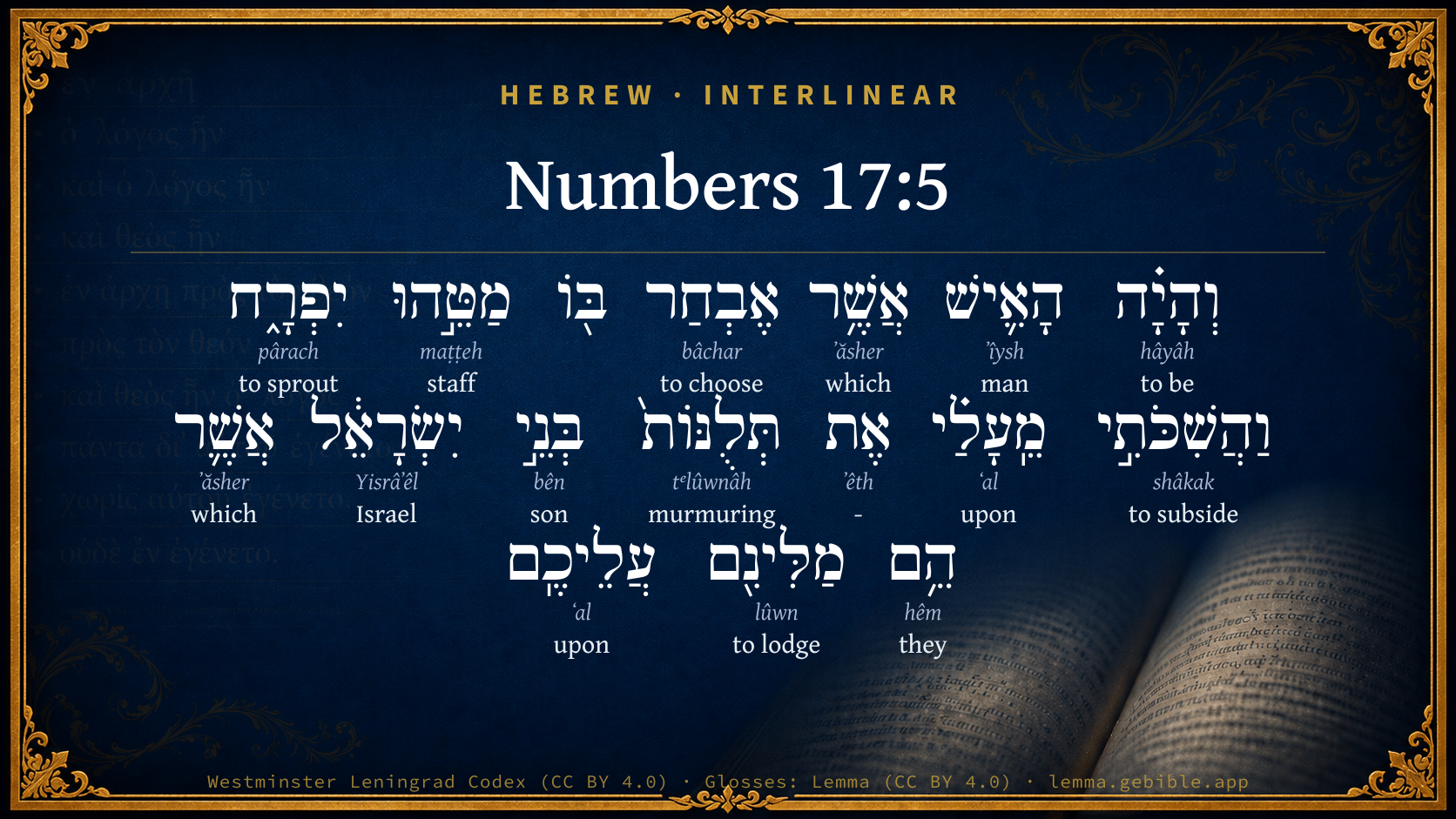
Numbers 17:5

Hebrew (Westminster Leningrad Codex) Numbers 17:5 appears in the Hebrew Old Testament. The text above is from the Westminster Leningrad Codex. Each word links to its Strong’s number, a concise gloss, and parsing drawn from the Open Scriptures Hebrew Bible morphology. Click any word for its full Brown-Driver-Briggs (BDB) entry.
Download image
Cite this verse

Numbers 17:5 (World English Bible). Public Domain. Lemma interlinear Bible study tool, https://lemma.gebible.app/v/numbers/17/5.

Show BibTeX & RIS
BibTeX
RIS
English Translation
It shall happen, that the rod of the man whom I shall choose shall bud: and I will make to cease from me the murmurings of the children of Israel, which they murmur against you.
World English Bible · Public Domain
Download a study sheet

One document with this verse’s original text, its word-by-word gloss line, the meaning frame, cross-references with their text, attributed commentary, and full source and license credits — printable, and it pastes into notes with its structure intact.

This verse Autodidact and up

Study sheet (.html) Plain text (.txt)

A passage Seminary Student

Up to 50 verses in one chapter. A passage sheet keeps up to 6 commentary sources and 12 cross-references per verse, in the order this page ranks them, and says so on the sheet whenever that leaves anything out. Ask for a single verse and you get the Autodidact verse sheet above.

Everything on this page stays free to read, with no account — the sheet is a download of what is already on screen, not access to it.

Want to remove ads? Support Godless Engineer
Compare translations 3

The same verse in 3 English versions, stacked beneath the original-language interlinear above. Click any original word for its lexicon entry.

Each is an independent rendering of the whole verse — the interlinear is not word-aligned to these translations.

Highlighted words mark where these versions differ — a whole-verse word diff, not a word-by-word alignment.

  • World English Bible Public Domain
    It shall happen, that the rod of the man whom I shall choose shall bud: and I will make to cease from me the murmurings of the children of Israel, which they murmur against you.
  • King James Version Public Domain
    And it shall come to pass, that the man's rod, whom I shall choose, shall blossom: and I will make to cease from me the murmurings of the children of Israel, whereby they murmur against you.
  • unfoldingWord Literal Text CC BY-SA 4.0
    And it will be the man whom I choose, his staff will sprout. And I will cause to subside from upon me the murmurings of the sons of Israel, which they are murmuring against you.”

unfoldingWord Literal Text — © unfoldingWord, licensed CC BY-SA 4.0. Word-aligned USFM3 via Door43 (git.door43.org/unfoldingWord/en_ult).

Versions to compare (up to 4)

3 of 4 selected

Show all 18 translations

Every available English version of this verse, each an independent rendering of the whole verse.

  • World English Bible Public Domain
    It shall happen, that the rod of the man whom I shall choose shall bud: and I will make to cease from me the murmurings of the children of Israel, which they murmur against you.
  • Berean Standard Bible Public Domain
    The staff belonging to the man I choose will sprout, and I will rid Myself of the constant grumbling of the Israelites against you.”
  • Majority Standard Bible Public Domain
    The staff belonging to the man I choose will sprout, and I will rid Myself of the constant grumbling of the Israelites against you.”
  • King James Version Public Domain
    And it shall come to pass, that the man's rod, whom I shall choose, shall blossom: and I will make to cease from me the murmurings of the children of Israel, whereby they murmur against you.
  • American Standard Version (1901) Public Domain
    And it shall come to pass, that the rod of the man whom I shall choose shall bud: and I will make to cease from me the murmurings of the children of Israel, which they murmur against you.
  • Revised Version (1885) Public Domain
    And it shall come to pass, that the man whom I shall choose, his rod shall bud: and I will make to cease from me the murmurings of the children of Israel, which they murmur against you.
  • Geneva Bible (1599) Public Domain
    And the mans rod, whome I chuse, shall blossome: and I will make cease from mee the grudgings of the children of Israel, which grudge against you.
  • Douay-Rheims (1899) Public Domain
    Whomsoever of these I shall choose, his rod shall blossom: and I will make to cease from me the murmurings of the children of Israel, wherewith they murmur against you.
  • Young's Literal Translation Public Domain
    `And it hath come to pass, the man's rod on whom I fix doth flourish, and I have caused to cease from off me the murmurings of the sons of Israel, which they are murmuring against you.'
  • Literal Standard Version CC BY-SA 4.0
    And it has come to pass, the man’s rod on whom I fix flourishes, and I have caused the murmurings of the sons of Israel, which they are murmuring against you, to cease from off Me.”
  • Unlocked Literal Bible CC BY-SA 4.0
    It will happen that the staff of the man whom I choose will bud. I will cause the complaints from the people of Israel to stop, which they are speaking against you.”
  • unfoldingWord Literal Text CC BY-SA 4.0
    And it will be the man whom I choose, his staff will sprout. And I will cause to subside from upon me the murmurings of the sons of Israel, which they are murmuring against you.”
  • Darby Bible Public Domain
    And it shall come to pass, that the man whom I shall choose, his staff shall bud forth; and I will make to cease from before me the murmurings of the children of Israel, that they murmur against you.
  • World Messianic Bible Public Domain
    It shall happen that the rod of the man whom I shall choose shall bud. I will make the murmurings of the children of Israel, which they murmur against you, cease from me.”
  • Webster's Bible Public Domain
    And it shall come to pass, that the man's rod, whom I shall choose, shall blossom: and I will make to cease from me the murmurings of the children of Israel, by which they murmur against you.
  • Free Bible Version CC BY-SA 4.0
    The walking stick that belongs to the man I choose will sprout buds, and I will put a stop to the Israelites' constant complaints against you.”
  • Bible in Basic English Public Domain
    And the rod of that man who is marked out by me for myself will have buds on it; so I will put a stop to the outcries which the children of Israel make to me against you.
  • JPS Tanakh (1917) Public Domain
    (17-20) And it shall come to pass, that the man whom I shall choose, his rod shall bud; and I will make to cease from Me the murmurings of the children of Israel, which they murmur against you.'

Literal Standard Version (2020), Covenant Press — licensed CC BY-SA 4.0. Text via the HelloAO Bible API (eBible.org). Unlocked Literal Bible (unfoldingWord) — licensed CC BY-SA 4.0. Text via the HelloAO Bible API (eBible.org). unfoldingWord Literal Text — © unfoldingWord, licensed CC BY-SA 4.0. Word-aligned USFM3 via Door43 (git.door43.org/unfoldingWord/en_ult). Free Bible Version, Dr. Jonathan Gallagher — licensed CC BY-SA 4.0. Text via the HelloAO Bible API (eBible.org).

Word by word

More ways to search: Search by grammar → Find every occurrence → Compare this word →

Practice this passage: Drill this verse → Learn its vocabulary →

וַהֲשִׁכֹּתִ֣י
shâkak
H7918
“and · to subside”
Conjunction + Verb, Hiphil, Sequential Perfect, 1st Person, Common, Singular
Part of Speech
Conjunction + Verb
Stem
Hiphil
Form
Sequential Perfect
Person
1st Person
Gender
Common
Number
Singular
Full BDB Definition

Origin: a primitive root

TWOT: 2384

to subside, abate, decrease - (Qal) to abate - (Hiphil) to allay
  1. וְהָיָ֗ה hâyâh H1961 “and · to be” Conjunction + Verb, Qal, Sequential Perfect, 3rd Person, Masculine, Singular
  2. הָאִ֛ישׁ ʼîysh H376 “the · man” Particle, Definite Article + Noun, Common, Masculine, Singular, Absolute
  3. אֲשֶׁ֥ר ʼăsher H834 “which” Particle, Relative
  4. אֶבְחַר bâchar H977 “to choose” Verb, Qal, Imperfect, 1st Person, Common, Singular
  5. מַטֵּ֣הוּ maṭṭeh H4294 “staff · his” Noun, Common, Masculine, Singular, Construct + Suffix, Personal, 3rd Person, Masculine, Singular
  6. יִפְרָ֑ח pârach H6524 “to sprout” Verb, Qal, Imperfect, 3rd Person, Masculine, Singular
  7. מֵֽעָלַ֗י ʻal H5921 “from · upon · me” Preposition + Preposition + Suffix, Personal, 1st Person, Common, Singular
  8. אֶת ʼêth H853 “-” Particle, Direct Object
  9. תְּלֻנּוֹת֙ tᵉlûwnâh H8519 “murmurings of” Noun, Common, Feminine, Plural, Construct
  10. בְּנֵ֣י bên H1121 “sons of” Noun, Common, Masculine, Plural, Construct
  11. יִשְׂרָאֵ֔ל Yisrâʼêl H3478 “Israel” Noun, Proper
  12. אֲשֶׁ֛ר ʼăsher H834 “which” Particle, Relative
  13. הֵ֥ם hêm H1992 “they” Pronoun, Personal, 3rd Person, Masculine, Plural
  14. מַלִּינִ֖ם lûwn H3885 “lodging” Verb, Hiphil, Participle Active, Masculine, Plural, Absolute
  15. עֲלֵיכֶֽם ʻal H5921 “upon · you” Preposition + Suffix, Personal, 2nd Person, Masculine, Plural

About this verse

These counts appear in no published source. They are computed here, from the morphology-tagged text and Lemma’s own curated glosses. What Lemma adds →

17
words
14
distinct lemmas
Pentateuch
section

Notable vocabulary

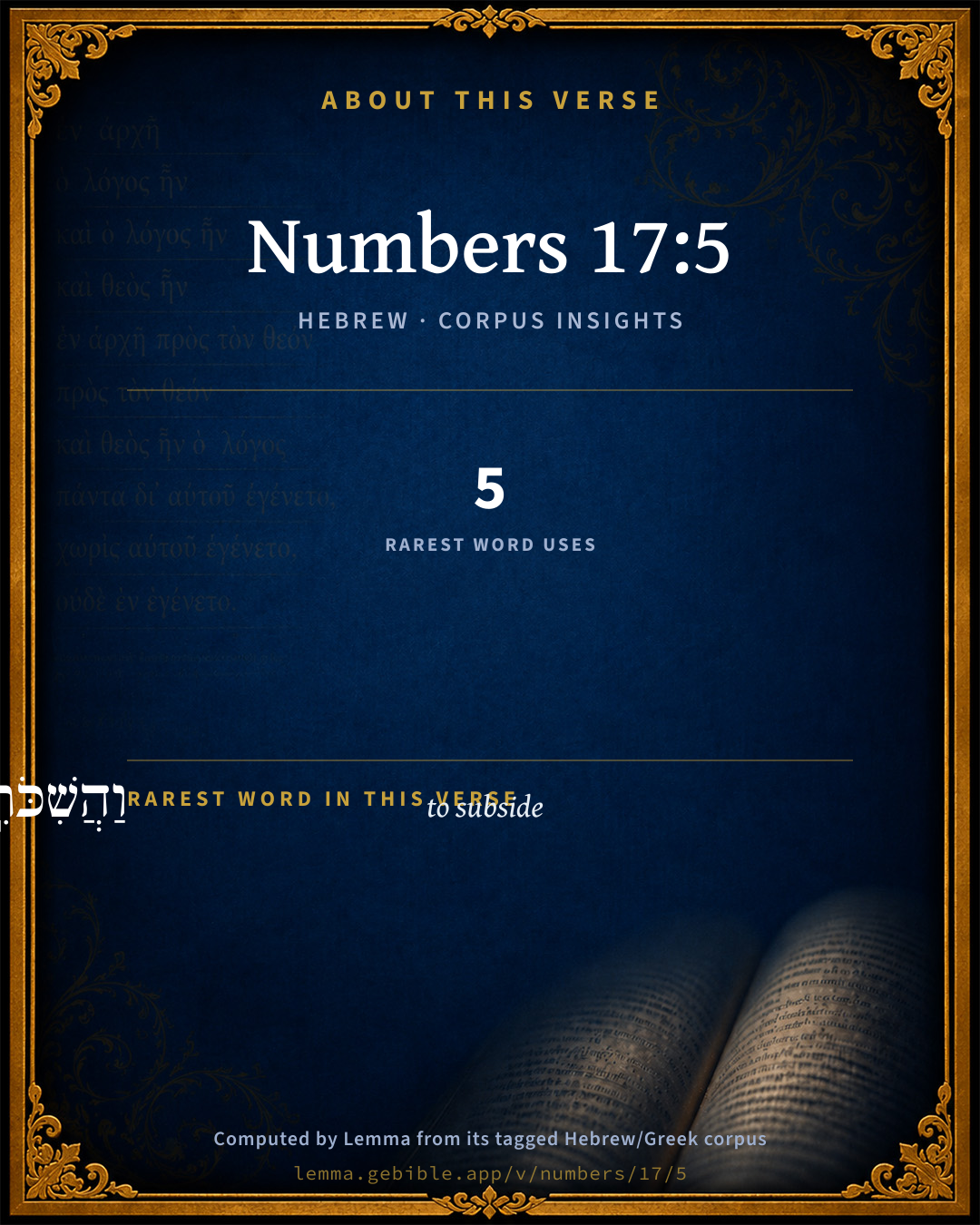
The rarest word here is וַהֲשִׁכֹּתִ֣י to subside H7918 — appearing just 5 times in the whole Hebrew Bible.

Shared distinctive vocabulary

וַהֲשִׁכֹּתִ֣י to subside H7918 occurs in 5 verses of the Hebrew Bible. Also found in:

Grammatical profile

  • 5 verbs
  • 5 nouns
  • 1 pronoun
  • 3 prepositions
  • 3 particles

Verb forms

  • וְהָיָ֗ה Qal · Sequential Perfect
  • אֶבְחַר Qal · Imperfect
  • יִפְרָ֑ח Qal · Imperfect
  • וַהֲשִׁכֹּתִ֣י Hiphil · Sequential Perfect
  • מַלִּינִ֖ם Hiphil · Participle Active

Repetition

Words recur within this verse — often emphatic in Hebrew:

  • מֵֽעָלַ֗י upon H5921 ×2
  • אֲשֶׁ֥ר which H834 ×2

Hebrew & Septuagint length

In English translation the verse runs 35 words from the Hebrew and 32 from the Septuagint (LXX English) — closely comparable.

A rough comparison of the two English renderings, which tokenize alike — not a word-level alignment.

Word counts can differ between the Hebrew and the Greek without any difference in meaning — e.g. the Hebrew direct-object marker אֵת has no separate Greek word, and Greek often adds the article ὁ.

Cross-references

12

Topical passages linked to Numbers 17:5 in the Treasury of Scripture Knowledge — connected by theme and wording, ordered by reader-vote popularity; previews shown in the World English Bible.

  • Numbers 16:5 and he spoke to Korah and to all his company, saying, In the morning Yahweh will show who are his, and who is holy, and will cause him to come near to him: even him whom he shall choose will he cause to come near to him.
  • Numbers 16:11 Therefore you and all your company are gathered together against Yahweh: and Aaron, what is he who you murmur against him?
  • Numbers 17:8 It happened on the next day, that Moses went into the tent of the testimony; and, behold, the rod of Aaron for the house of Levi was budded, and put forth buds, and produced blossoms, and bore ripe almonds.
  • Isaiah 35:1–2 The wilderness and the dry land shall be glad; and the desert shall rejoice, and blossom as the rose.
  • Ezekiel 16:41 They shall burn your houses with fire, and execute judgments on you in the sight of many women; and I will cause you to cease from playing the prostitute, and you shall also give no hire any more.
  • Hosea 14:5 I will be like the dew to Israel. He will blossom like the lily, And send down his roots like Lebanon.
  • Numbers 17:10 Yahweh said to Moses, Put back the rod of Aaron before the testimony, to be kept for a token against the children of rebellion; that you may make an end of their murmurings against me, that they not die.
  • Isaiah 5:24 Therefore as the tongue of fire devours the stubble, And as the dry grass sinks down in the flame, So their root shall be as rottenness, And their blossom shall go up as dust; Because they have rejected the law of Yahweh of Hosts, And despised the word of the Holy One of Israel.
  • Isaiah 11:1 There shall come forth a shoot out of the stock of Jesse, and a branch out of his roots shall bear fruit.
  • Isaiah 13:11 I will punish the world for [their] evil, and the wicked for their iniquity: and I will cause the arrogance of the proud to cease, and will lay low the haughtiness of the terrible.
  • Isaiah 27:6 In days to come shall Jacob take root; Israel shall blossom and bud; and they shall fill the surface of the world with fruit.
  • Ezekiel 23:27 Thus will I make your lewdness to cease from you, and your prostitution [brought] from the land of Egypt; so that you shall not lift up your eyes to them, nor remember Egypt any more.

Cross-references courtesy of OpenBible.info (CC BY 4.0).

Hebrew and Greek witnesses Masoretic Hebrew ↔ Greek Septuagint

The same verse in the two great witnesses to the Old Testament, shown verse-for-verse.

These are two independent witnesses, not word-aligned to each other, and the Septuagint is shown in lemma (dictionary) form.

Hebrew Numbers 17:5 Masoretic · Westminster Leningrad Codex

וְהָיָ֗ה הָאִ֛ישׁ אֲשֶׁ֥ר אֶבְחַר בּ֖וֹ מַטֵּ֣הוּ יִפְרָ֑ח וַהֲשִׁכֹּתִ֣י מֵֽעָלַ֗י אֶת תְּלֻנּוֹת֙ בְּנֵ֣י יִשְׂרָאֵ֔ל אֲשֶׁ֛ר הֵ֥ם מַלִּינִ֖ם עֲלֵיכֶֽם

It shall happen, that the rod of the man whom I shall choose shall bud: and I will make to cease from me the murmurings of the children of Israel, which they murmur against you.

World English Bible · Public Domain

Greek LXX Numbers 17:5 Septuagint · lemma form

μνημόσυνον ὁ υἱός ἰσραήλ ὅπως ἄν μή προςἔρχομαι μηδείς ἀλλογενής ὅς οὐ εἰμί ἐκ ὁ σπέρμα ἀαρών ἐπιτίθημι θυμίαμα ἔναντι κύριος καί οὐ εἰμί ὥσπερ κορε καί ὁ ἐπισύστασις αὐτός καθά λαλέω κύριος ἐν χείρ μωυσῆς

And it shall be, the man whom I shall choose, his rod shall blossom; and I will remove from me the murmuring of the children of Israel, which they murmur against you.

LXX2012 (modern English Septuagint) · Public Domain

Hebrew: Westminster Leningrad Codex (CC BY 4.0). Greek: Septuagint (public domain); English from LXX2012 (modern English Septuagint) (Public Domain). How the Septuagint differs from the Hebrew →

Targum (Aramaic paraphrase)

2

The Targum is the ancient Jewish Aramaic paraphrase of the Hebrew Scriptures — an interpretive translation, not the Hebrew text itself. Onkelos (literal) and Pseudo-Jonathan (expansive) render the Torah, and Jonathan the Prophets. Coverage is partial: where no permissively-licensed English translation exists for a verse, only the Aramaic is shown. This is verse-level text, not a word-by-word alignment to the Hebrew.

  1. Targum Onkelos Torah (Genesis–Deuteronomy)
    דָכְרָנָא לִבְנֵי יִשְׂרָאֵל בְּדִיל דִי לָא יִקְרַב גְבַר חִלוֹנַי דִי לָא מִזַרְעָא דְאַהֲרֹן הוּא לְאַסָקָא קְטוֹרֶת בּוּסְמִין קֳדָם יְיָ וְלָא יְהֵי כְקֹרַח וְכִכְנִשְׁתֵּיהּ כְּמָא דִי מַלֵיל יְיָ בִּידָא דְמשֶׁה לֵיהּ

    (no public-domain English translation for this verse)

    Targum Onkelos — Aramaic: “Onkelos Genesis” (public domain); “Onkelos Exodus” (public domain); “Onkelos Leviticus” (public domain); “Onkelos Numbers” (public domain); “Onkelos Deuteronomy” (public domain). English: “Sefaria Community Translation” (CC0 1.0 (public-domain dedication)); “J.W. Etheridge. The Targums of Onkelos and Jonathan Ben Uzziel on the Pentateuch. London: Longmans, Green, 1862” (public domain). Text via Sefaria.

  2. Targum Pseudo-Jonathan Torah (Genesis–Deuteronomy)
    דוּכְרָנָא לִבְנֵי יִשְרָאֵל מִן בִּגְלַל דְלָא יִקְרַב גְבַר חִלוֹנַי דְלָא מִן בְּנֵי אַהֲרן לְאַסָקָא קְטוֹרֶת בּוּסְמִין קֳדָם יְיָ וְלָא יְהֵי גְבַר מִתְנַטֵל לְמִפְלוֹג עַל עֵיסַק כְּהוּנְתָּא כְּקרַח וְכִכְנִישַׁת סַעֲדוֹי וְסוֹפֵיהּ לְהוֹבָדָא וְלָא כְמִיתוּתָא דְקרַח וְכִכְנִשְׁתֵּיהּ בִּיקִידַת אֵשָׁא וּבְלִיעַת אַרְעָא אֱלָהֵן לְמִלְקֵי בִּסְגִירוּתָא הֵיכְמָא דְמַלֵיל יְיָ לְמשֶׁה שַׁוֵי יְדָךְ בְּעִיטְפָךְ וְלָקַת יְדֵיהּ בְּצוֹרְעָא הֵיכְדֵין יִמְטֵי לֵיהּ

    for a memorial to the sons of Israel, that no common man, who is not of the sons of Aharon, may offer incense before the Lord; and that no man should behave himself factiously to obtain the priesthood, as did Korach and the company of his helpers; and whose end would be to perish, not (indeed) with a death like that of Korach and his company, by being burned by fire, and being swallowed up by the earth, but punished with leprosy: as when the Lord said to Mosheh, Put thy hand into thy bosom, and his hand was stricken with leprosy; so would it be with him.

    Targum Pseudo-Jonathan — Aramaic: “Targum Jonathan on Genesis” (public domain); “Targum Jonathan on Exodus” (public domain); “Targum Jonathan on Leviticus” (public domain); “Targum Jonathan on Numbers” (public domain); “Targum Jonathan on Deuteronomy” (public domain). English: “The Targum of Jonathan ben Uzziel, trans. J. W. Etheridge, London, 1862” (public domain). Text via Sefaria.

Commentary

Notes on Numbers 17:5 from classic Christian and Jewish commentators (each source and its license shown beneath its notes). The classic Christian expositions comment on the surrounding passage and are grouped to its opening verse, so a note may address several verses; the Jewish commentaries on the Tanakh (Rashi and others) are per-verse, so they appear only where the commentator wrote on this verse.

Lemma curates 59 commentaries, every one of them public domain or Creative Commons licensed, each selected and text-cleaned for this edition rather than reprinted as found. About our sources →

Trapp's Complete Commentary

John Trapp

Num 17:5 And it shall come to pass, [that] the man’s rod, whom I shall choose, shall blossom: and I will make to cease from me the murmurings of the children of Israel, whereby they murmur against you.

Ver. 5. And I will make to cease.] But then he must do more than work miracles. For such is the habitual hardness of men’s hearts, as neither ministry, nor misery, nor miracle, nor mercy, can possibly mollify. Nothing can do it, but an extraordinary touch from the hand of Heaven.

John Trapp, A Commentary or Exposition upon All the Books of the Old and New Testament (1647–1656) — public domain. Text from a community e-Sword module.

Geneva Bible (1599)

Geneva Bible translators

To be the chief Priest.

Geneva Bible (1599) marginal notes — public domain. Text via Bolls.life.

Adam Clarke's Commentary

Verse 5. The man's rod, whom I shall choose, shall blossom] It was necessary that something farther should be done to quiet the minds of the people, and for ever to settle the dispute, in what tribe the priesthood should be fixed. God therefore took the method described in the text, and it had the desired effect; the Aaronical priesthood was never after disputed.

Adam Clarke's Commentary on the Bible (1810–1826) — public domain. Text from a community e-Sword/MySword module.

Ellicott's Commentary for English Readers

(5) The man’s rod, whom I shall choose, shall blossom.—Or, shall sprout forth or put forth—i.e., leaves or blossoms. Achilles, when enraged against Agamemnon, is made to swear a solemn oath by his sceptre which, having once left its stock on the mountains, shall never again grow. King Latinus is represented by Virgil as confirming his covenant with Æneas by a similar oath.

A Bible Commentary for English Readers, edited by Charles John Ellicott (1878–1897) — public domain. Text from a community e-Sword module.

John Gill's Exposition

And it shall come to pass, that the man's rod whom I shall choose,.... Or make it manifest that he had chosen him, and so confirm the choice he had made of him and his family, for the priesthood to be and continue in:

shall blossom; bud and blossom, and yield fruit, as it afterwards did, which is here declared beforehand, that the miracle might appear the greater, exactly answering to a prediction delivered out before of it:

and I will make to cease from me the murmurings of the children of Israel, whereby they murmur against you; against Moses for setting up his brother as an high priest, and establishing the priesthood in his family; and against Aaron for accepting of it, and officiating in it; but by this method now taken, God would for ever silence their murmurings, so that they should never be able, with any face, to object any more to the authority of the Aaronic priesthood, which should appear by the predicted miracle beyond all dispute and contradiction.

John Gill's Exposition of the Whole Bible (1746–1763) — public domain (CC PDM 1.0). Text via the HelloAO Bible API.

Haydock's Catholic Bible Commentary

They murmur. Hence it seems this miracle was not unnecessary, as the people were still inclined to murmur at the pre-eminence given to Aaron. (Haydock)

George Leo Haydock (1774–1849), Haydock's Catholic Family Bible and Commentary, 1859 edition — public domain. Excludes Psalms (Douay-Rheims chapter numbering differs from Protestant) and Deuterocanonical books (Catholic canon only).

Whedon's Commentary on the Bible

Daniel D. Whedon

5. Whom I shall choose — That is, select for the priesthood.

Cease… murmurings — Suppress them beyond all possibility of a revival. Jehovah’s claims are set forth in his word with such cogency that there is no just ground for gainsaying. On all questions of duty there is a redundancy of evidence.

Daniel D. Whedon (gen. ed.), Commentary on the Old and New Testaments (1874–1909) — public domain. Text from a community e-Sword module.

The Pulpit Commentary

Whom I shall choose. For the special duty and service of the priesthood. (cf. Num_16:5) I will make to cease. ylome ytiKovih. I will cause to sink so that they shall not rise again.

The Pulpit Commentary (1880–1919), ed. H.D.M. Spence-Jones & Joseph S. Exell — public domain. Text from a community e-Sword module.

Rashi

Rabbi Shlomo Yitzchaki (Rashi)

ולא יהיה כקרח means in order that he be not as Korah.

כאשר דבר ה' ביד משה לו AS THE LORD HAD SPOKEN BY THE AGENCY OF MOSES לו — The latter word is the same as עליו, “with regard to him”, i.e. “with regard to Aaron”: He had spoken to Moses that he and his sons should be priests; therefore a layman, who is not of the seed of Aaron, shall not approach etc. Similarly in every instance of the words לי or לו or להם which are connected with forms of the verb דבר, their meaning is the same as על, “concerning”. A Midrashic explanation is that לו, “with regard to him”, means: with regard to Korah (not to Aaron). But what, then, is meant by the expression “by the hand of Moses”; why does it not write “unto Moses”? It is used as an intimation to those who rebel against the institution of the priesthood: that they will become stricken with leprosy, just as Moses was stricken with it on his hand, as it is said, (Exodus 4:6) “and he took it (the hand) forth and, behold, it was leprous, white as snow”. And on account of this (that he insisted on offering incense in spite of the priests’ protest) Uzziah was stricken with leprosy (II Chronicles 26:19) (Midrash Tanchuma, Tzav 1 on צו; cf. also Sanhedrin 110a and Rashi on Isaiah 6:4).

Rashi on the Tanakh — English translations: “The Judaica Press complete Tanach with Rashi, translated by A. J. Rosenberg” (CC BY 4.0); “Pentateuch with Rashi's commentary by M. Rosenbaum and A.M. Silbermann, 1929-1934” (public domain); “The Metsudah Tanach series, Lakewood, N.J” (CC BY 4.0); and “The Book of Joshua, Metsudah Publications, 1997” (CC BY 4.0). Text via Sefaria.

Ramban (Nachmanides)

Rabbi Moshe ben Nachman (Ramban / Nachmanides)

THAT HE BE NOT AS KORACH, AND AS HIS COMPANY, AS THE ETERNAL SPOKE BY THE HAND OF MOSES ‘LO.’ “The word lo [literally: ‘to him’] is like alav (‘about him’), that is, about Korach. And what is the meaning of by ‘the hand’ of Moses, and why is it not written ‘unto Moses’ [as is written elsewhere]? It is a hint to those who dispute the priesthood, that they will be stricken with leprosy, just as Moses was stricken [with it] on ‘his hand.’ It was for this reason that Uzziah [king of Judah] was stricken with leprosy [when he attempted to usurp the function of the priests and to offer incense]. And according to the plain meaning of Scripture, [the interpretation is as follows: if anybody disputes the priesthood and claims it for himself, his punishment] will not be that of being swallowed up and burnt, as happened to Korach and his company; instead, [his punishment] will be like that which Moses received on his hand when it was stricken with leprosy. And some scholars interpret [the verse to mean]: that no common man, that is not of the seed of Aaron, draw near to burn incense before the Eternal — as the Eternal spoke by the hand of Moses with regard to Aaron, that he and his sons should be priests, and not a layman.” This is Rashi’s language. The correct interpretation is that [the word lo (to him)] refers to Eleazar who is mentioned [at the beginning of the section], when Scripture said, Speak unto Eleazar the son of Aaron the priest etc., and the correct order [in meaning] of the verses [before us] is as follows: And Eleazar the priest took the copper censers wherewith they that were burnt had offered, and they beat them out for a covering of the altar — as the Eternal spoke to him by the hand of Moses — to be a memorial unto the children of Israel etc.

Ramban (Nachmanides) on the Tanakh — English translation: “Commentary on the Torah by Ramban (Nachmanides). Translated and annotated by Charles B. Chavel. New York, Shilo Pub. House, 1971-1976” (CC BY 4.0). Text via Sefaria.

Lesson kit

Teaching starters — assembled from the data on this page, not authored interpretation. Every prompt links to the verse data it draws on. Edit before teaching.

Numbers, in the Pentateuch, opens this verse with 17 words (14 distinct Hebrew lemmas). Its most distinctive word is shâkak (“to subside”). A historical commentator’s framing appears above. Read the whole chapter for the surrounding context.

Discussion questions

  1. What does “to subside” (shâkak) contribute to the verse as a whole?
  2. How does Genesis 8:1, which shares the word «to subside», read alongside this verse?
  3. What does the repetition of “upon” (2× in this one verse) do in this verse?
  4. These translations render this verse differently; the difference is in the English rendering, not the original. What questions does that raise?
  5. «וְהָיָ֗ה» is a Qal Sequential Perfect verb. How does that grammatical form shape the action described?
  6. Compare how Trapp's Complete Commentary and Geneva Bible (1599) read this verse. Where do they agree or differ?

Things to notice

Reading settings

Reading text

Shown beneath each verse's original-language words.

Old Testament
Old Testament edition

Read the OT as the Masoretic Hebrew (MT) or the Greek Septuagint (LXX).

English shown for the Greek Septuagint (in the Hebrew ↔ Greek comparison).

Comparing translations? Open the Compare panel on any verse page to stack up to four side by side.