Exodus 15:23

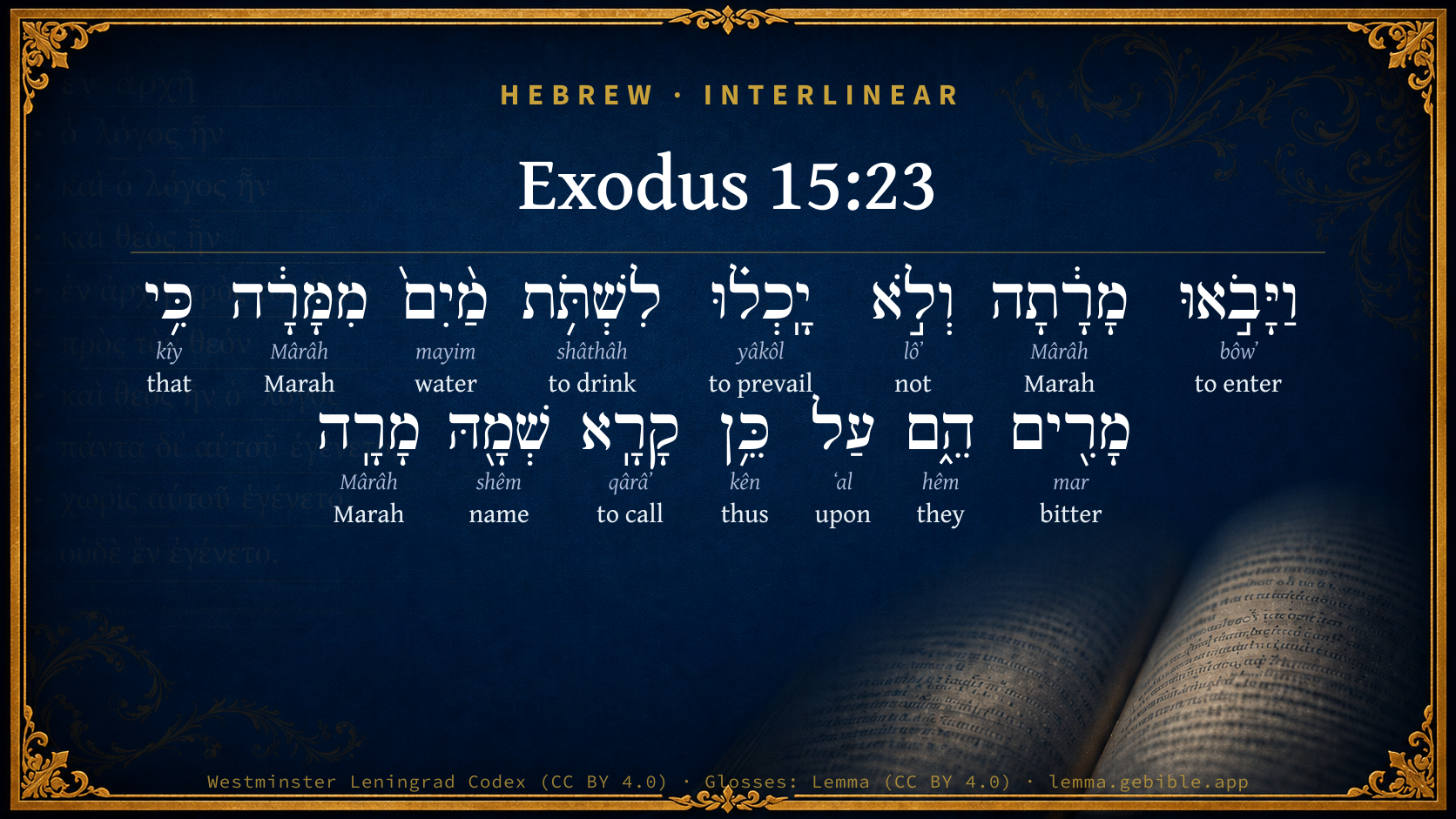
Hebrew (Westminster Leningrad Codex) Exodus 15:23 appears in the Hebrew Old Testament. The text above is from the Westminster Leningrad Codex. Each word links to its Strong’s number, a concise gloss, and parsing drawn from the Open Scriptures Hebrew Bible morphology. Click any word for its full Brown-Driver-Briggs (BDB) entry.
Download image
Cite this verse

Exodus 15:23 (World English Bible). Public Domain. Lemma interlinear Bible study tool, https://lemma.gebible.app/v/exodus/15/23.

Show BibTeX & RIS
BibTeX
RIS
English Translation
When they came to Marah, they couldn't drink from the waters of Marah, for they were bitter. Therefore the name of it was called Marah.
World English Bible · Public Domain
Highlights
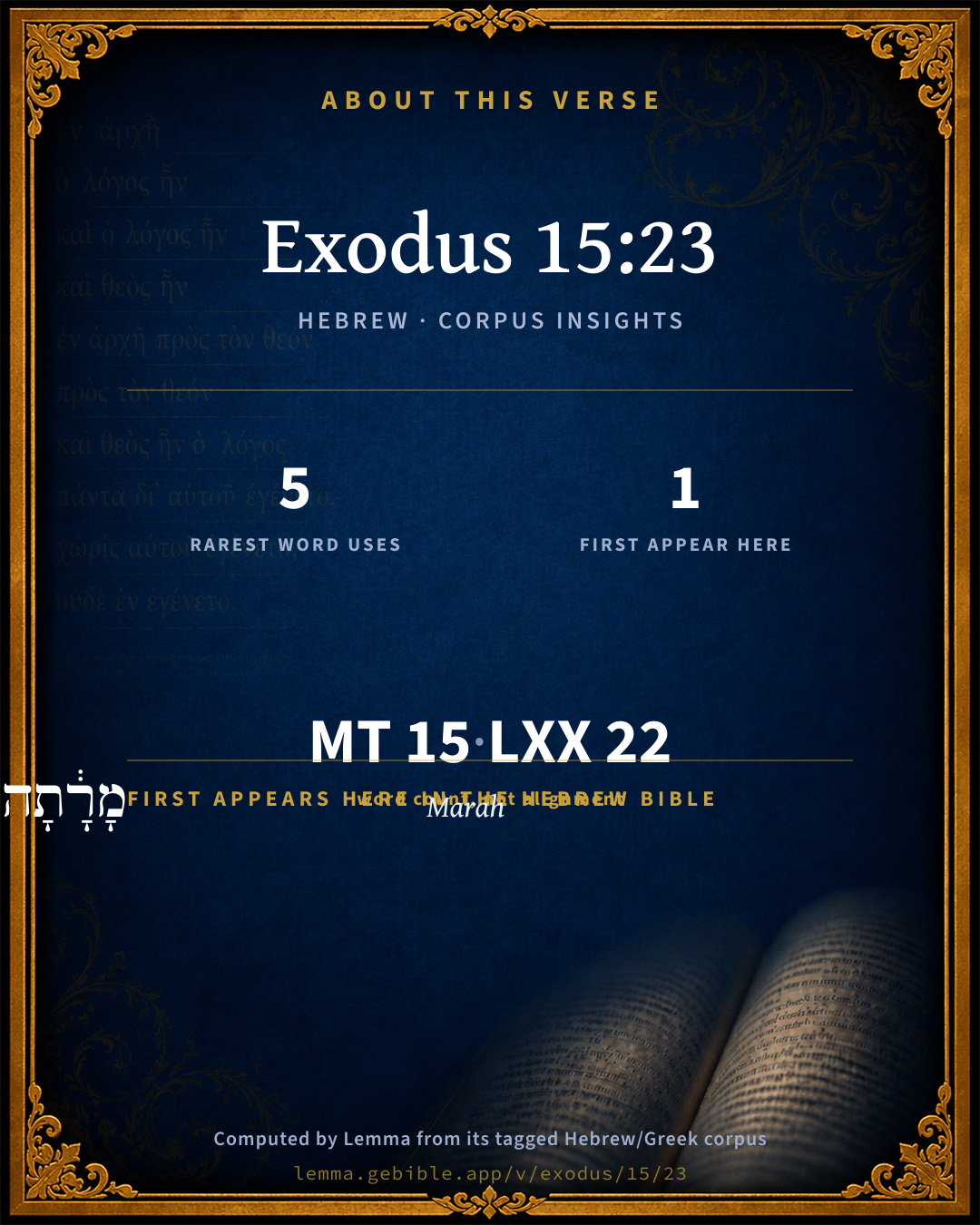
  • 1 first appearance in the Hebrew Bible
Full analysis ↓
Download a study sheet

One document with this verse’s original text, its word-by-word gloss line, the meaning frame, cross-references with their text, attributed commentary, and full source and license credits — printable, and it pastes into notes with its structure intact.

This verse Autodidact and up

Study sheet (.html) Plain text (.txt)

A passage Seminary Student

Up to 50 verses in one chapter. A passage sheet keeps up to 6 commentary sources and 12 cross-references per verse, in the order this page ranks them, and says so on the sheet whenever that leaves anything out. Ask for a single verse and you get the Autodidact verse sheet above.

Everything on this page stays free to read, with no account — the sheet is a download of what is already on screen, not access to it.

Want to remove ads? Support Godless Engineer
Compare translations 3

The same verse in 3 English versions, stacked beneath the original-language interlinear above. Click any original word for its lexicon entry.

Each is an independent rendering of the whole verse — the interlinear is not word-aligned to these translations.

Highlighted words mark where these versions differ — a whole-verse word diff, not a word-by-word alignment.

  • World English Bible Public Domain
    When they came to Marah, they couldn't drink from the waters of Marah, for they were bitter. Therefore the name of it was called Marah.
  • King James Version Public Domain
    And when they came to Marah, they could not drink of the waters of Marah, for they were bitter: therefore the name of it was called Marah.
  • unfoldingWord Literal Text CC BY-SA 4.0
    And they came to Marah, and they were not able to drink the waters of Marah, because they were bitter. So he called its name Marah.

unfoldingWord Literal Text — © unfoldingWord, licensed CC BY-SA 4.0. Word-aligned USFM3 via Door43 (git.door43.org/unfoldingWord/en_ult).

Versions to compare (up to 4)

3 of 4 selected

Show all 18 translations

Every available English version of this verse, each an independent rendering of the whole verse.

  • World English Bible Public Domain
    When they came to Marah, they couldn't drink from the waters of Marah, for they were bitter. Therefore the name of it was called Marah.
  • Berean Standard Bible Public Domain
    And when they came to Marah, they could not drink the water there because it was bitter. (That is why it was named Marah.)
  • Majority Standard Bible Public Domain
    And when they came to Marah, they could not drink the water there because it was bitter. (That is why it was named Marah.)
  • King James Version Public Domain
    And when they came to Marah, they could not drink of the waters of Marah, for they were bitter: therefore the name of it was called Marah.
  • American Standard Version (1901) Public Domain
    And when they came to Marah, they could not drink of the waters of Marah, for they were bitter: therefore the name of it was called Marah.
  • Revised Version (1885) Public Domain
    And when they came to Marah, they could not drink of the waters of Marah, for they were bitter: therefore the name of it was called Marah.
  • Geneva Bible (1599) Public Domain
    And whe they came to Marah, they could not drinke of the waters of Marah, for they were bitter: therefore the name of the place was called Marah.
  • Douay-Rheims (1899) Public Domain
    And they came into Mara, and they could not drink the waters of Mara, because they were bitter: whereupon he gave a name also agreeable to the place, calling it Mara, that is, bitterness.
  • Young's Literal Translation Public Domain
    and they come in to Marah, and have not been able to drink the waters of Marah, for they `are' bitter; therefore hath `one' called its name Marah.
  • Literal Standard Version CC BY-SA 4.0
    and they come to Marah, and have not been able to drink the waters of Marah, for they [are] bitter; therefore [one] has called its name Marah.
  • Unlocked Literal Bible CC BY-SA 4.0
    Then they came to Marah, but they could not drink the water there because it was bitter. So they called that place Marah.
  • unfoldingWord Literal Text CC BY-SA 4.0
    And they came to Marah, and they were not able to drink the waters of Marah, because they were bitter. So he called its name Marah.
  • Darby Bible Public Domain
    And they came to Marah, and could not drink the waters of Marah, for they were bitter; therefore the name of it was called Marah.
  • World Messianic Bible Public Domain
    When they came to Marah, they couldn’t drink from the waters of Marah, for they were bitter. Therefore its name was called Marah.
  • Webster's Bible Public Domain
    And when they came to Marah, they could not drink of the waters of Marah; for they were bitter: therefore the name of it was called Marah.
  • Free Bible Version CC BY-SA 4.0
    When they arrived at Marah, the water there was too bitter to drink. (That's why the place is called Marah.)
  • Bible in Basic English Public Domain
    And when they came to Marah, the water was no good for drinking, for the waters of Marah were bitter, which is why it was named Marah.
  • JPS Tanakh (1917) Public Domain
    And when they came to Marah, they could not drink of the waters of Marah, for they were bitter. Therefore the name of it was called Marah.

Literal Standard Version (2020), Covenant Press — licensed CC BY-SA 4.0. Text via the HelloAO Bible API (eBible.org). Unlocked Literal Bible (unfoldingWord) — licensed CC BY-SA 4.0. Text via the HelloAO Bible API (eBible.org). unfoldingWord Literal Text — © unfoldingWord, licensed CC BY-SA 4.0. Word-aligned USFM3 via Door43 (git.door43.org/unfoldingWord/en_ult). Free Bible Version, Dr. Jonathan Gallagher — licensed CC BY-SA 4.0. Text via the HelloAO Bible API (eBible.org).

Word by word

More ways to search: Search by grammar → Find every occurrence → Compare this word →

Practice this passage: Drill this verse → Learn its vocabulary →

מָרָ֔תָה
Mârâh
H4785
“Marah · toward”
Noun, Proper + Suffix, Demonstrative
Part of Speech
Noun
Type
Proper
Full BDB Definition

Origin: the same as H4751

TWOT: None

Marah = "bitter" - the spring with bitter water which was 3 days travel from the crossing place of the Red Sea in the peninsula of Sinai
  1. וַיָּבֹ֣אוּ bôwʼ H935 “and · to enter” Conjunction + Verb, Qal, Sequential Imperfect, 3rd Person, Masculine, Plural
  2. וְלֹ֣א lôʼ H3808 “and · not” Conjunction + Particle, Negative
  3. יָֽכְל֗וּ yâkôl H3201 “to prevail” Verb, Qal, Perfect, 3rd Person, Common, Plural
  4. לִשְׁתֹּ֥ת shâthâh H8354 “to drink” Preposition + Verb, Qal, Infinitive Construct
  5. מַ֨יִם֙ mayim H4325 “water(s)” Noun, Common, Masculine, Plural, Absolute
  6. מִמָּרָ֔ה Mârâh H4785 “from · Marah” Preposition + Noun, Proper
  7. כִּ֥י kîy H3588 “that” Conjunction
  8. מָרִ֖ים mar H4751 “bitter” Adjective, Adjective, Masculine, Plural, Absolute
  9. הֵ֑ם hêm H1992 “they” Pronoun, Personal, 3rd Person, Masculine, Plural
  10. עַל ʻal H5921 “upon” Preposition
  11. כֵּ֥ן kên H3651 “thus” Particle, Demonstrative
  12. קָרָֽא qârâʼ H7121 “to call” Verb, Qal, Perfect, 3rd Person, Masculine, Singular
  13. שְׁמָ֖הּ shêm H8034 “name · her” Noun, Common, Masculine, Singular, Construct + Suffix, Personal, 3rd Person, Feminine, Singular
  14. מָרָֽה Mârâh H4785 “Marah” Noun, Proper

About this verse

These counts appear in no published source. They are computed here, from the morphology-tagged text and Lemma’s own curated glosses. What Lemma adds →

15
words
13
distinct lemmas
Pentateuch
section

Notable vocabulary

The rarest word here is מָרָ֔תָה Marah H4785 — appearing just 5 times in the whole Hebrew Bible.

First appearance in Scripture

This word makes its first canonical appearance in the Hebrew Bible here:

  • מָרָ֔תָה Marah H4785

Shared distinctive vocabulary

מָרָ֔תָה Marah H4785 occurs in 3 verses of the Hebrew Bible. Also found in:

Grammatical profile

  • 4 verbs
  • 5 nouns
  • 1 adjective
  • 1 pronoun
  • 1 preposition
  • 1 conjunction
  • 2 particles

Verb forms

  • וַיָּבֹ֣אוּ Qal · Sequential Imperfect
  • יָֽכְל֗וּ Qal · Perfect
  • לִשְׁתֹּ֥ת Qal · Infinitive Construct
  • קָרָֽא Qal · Perfect

Repetition

A word recurs within this verse — often emphatic in Hebrew:

  • מָרָ֔תָה Marah H4785 ×3

Hebrew & Septuagint length

In English translation the verse runs 25 words from the Hebrew and 24 from the Septuagint (LXX English) — closely comparable.

A rough comparison of the two English renderings, which tokenize alike — not a word-level alignment.

Word counts can differ between the Hebrew and the Greek without any difference in meaning — e.g. the Hebrew direct-object marker אֵת has no separate Greek word, and Greek often adds the article ὁ.

In the original languages it is 15 Hebrew tokens and 22 Greek tokens — but the two are counted differently (Hebrew bundles its prefixes and suffixes into one token; the Greek is in lemma form), so that isn’t a like-for-like length.

Cross-references

2

Topical passages linked to Exodus 15:23 in the Treasury of Scripture Knowledge — connected by theme and wording, ordered by reader-vote popularity; previews shown in the World English Bible.

  • Numbers 33:8 They traveled from before Hahiroth, and passed through the midst of the sea into the wilderness: and they went three days' journey in the wilderness of Etham, and encamped in Marah.
  • Ruth 1:20 She said to them, "Don't call me Naomi, call me Mara; for the Almighty has dealt very bitterly with me.

Cross-references courtesy of OpenBible.info (CC BY 4.0).

Hebrew and Greek witnesses Masoretic Hebrew ↔ Greek Septuagint

The same verse in the two great witnesses to the Old Testament, shown verse-for-verse.

These are two independent witnesses, not word-aligned to each other, and the Septuagint is shown in lemma (dictionary) form.

Hebrew Exodus 15:23 Masoretic · Westminster Leningrad Codex

וַיָּבֹ֣אוּ מָרָ֔תָה וְלֹ֣א יָֽכְל֗וּ לִשְׁתֹּ֥ת מַ֨יִם֙ מִמָּרָ֔ה כִּ֥י מָרִ֖ים הֵ֑ם עַל כֵּ֥ן קָרָֽא שְׁמָ֖הּ מָרָֽה

When they came to Marah, they couldn't drink from the waters of Marah, for they were bitter. Therefore the name of it was called Marah.

World English Bible · Public Domain

Greek LXX Exodus 15:23 Septuagint · lemma form

ἔρχομαι δέ εἰς μερρα καί οὐ δύναμαι πίνω ἐκ μερρα πικρός γάρ εἰμί διά οὗτος ἐπιὀνομάζω ὁ ὄνομα ὁ τόπος ἐκεῖνος πικρία

and they came to Merrha, and could not drink of Merrha, for it was bitter; therefore he named the name of that place, Bitterness.

LXX2012 (modern English Septuagint) · Public Domain

Hebrew: Westminster Leningrad Codex (CC BY 4.0). Greek: Septuagint (public domain); English from LXX2012 (modern English Septuagint) (Public Domain). How the Septuagint differs from the Hebrew →

Targum (Aramaic paraphrase)

2

The Targum is the ancient Jewish Aramaic paraphrase of the Hebrew Scriptures — an interpretive translation, not the Hebrew text itself. Onkelos (literal) and Pseudo-Jonathan (expansive) render the Torah, and Jonathan the Prophets. Coverage is partial: where no permissively-licensed English translation exists for a verse, only the Aramaic is shown. This is verse-level text, not a word-by-word alignment to the Hebrew.

  1. Targum Onkelos Torah (Genesis–Deuteronomy)
    וַאֲתוֹ לְמָרָה וְלָא יְכִילוּ לְמִשְׁתֵּי מַיָא מִמָרָה אֲרֵי מְרִירִין אִנוּן עַל כֵּן קְרָא שְׁמַהּ מָרָה:

    (no public-domain English translation for this verse)

    Targum Onkelos — Aramaic: “Onkelos Genesis” (public domain); “Onkelos Exodus” (public domain); “Onkelos Leviticus” (public domain); “Onkelos Numbers” (public domain); “Onkelos Deuteronomy” (public domain). English: “Sefaria Community Translation” (CC0 1.0 (public-domain dedication)); “J.W. Etheridge. The Targums of Onkelos and Jonathan Ben Uzziel on the Pentateuch. London: Longmans, Green, 1862” (public domain). Text via Sefaria.

  2. Targum Pseudo-Jonathan Torah (Genesis–Deuteronomy)
    וְאָתוּ לְמָרָה וְלָא יָכִילוּ לְמִשְׁתֵּי מוֹי מִמָּרָה אֲרוּם מְרִירִין הִינוּן בְּגִין כֵּן קְרָא שְׁמֵיהּ מָרָה

    And they came to Marah, but could not drink the waters of Marah because they were bitter; therefore he called the name of it Marah.

    Targum Pseudo-Jonathan — Aramaic: “Targum Jonathan on Genesis” (public domain); “Targum Jonathan on Exodus” (public domain); “Targum Jonathan on Leviticus” (public domain); “Targum Jonathan on Numbers” (public domain); “Targum Jonathan on Deuteronomy” (public domain). English: “The Targum of Jonathan ben Uzziel, trans. J. W. Etheridge, London, 1862” (public domain). Text via Sefaria.

Commentary

Notes on Exodus 15:23 from classic Christian and Jewish commentators (each source and its license shown beneath its notes). The classic Christian expositions comment on the surrounding passage and are grouped to its opening verse, so a note may address several verses; the Jewish commentaries on the Tanakh (Rashi and others) are per-verse, so they appear only where the commentator wrote on this verse.

Lemma curates 59 commentaries, every one of them public domain or Creative Commons licensed, each selected and text-cleaned for this edition rather than reprinted as found. About our sources →

Trapp's Complete Commentary

John Trapp

Exo 15:23 And when they came to Marah, they could not drink of the waters of Marah, for they [were] bitter: therefore the name of it was called Marah.

Ver. 23. They could not drink.] Water they now had, but what the better? God can give us blessings, but with such a tang, that we shall have no great joy of them.

John Trapp, A Commentary or Exposition upon All the Books of the Old and New Testament (1647–1656) — public domain. Text from a community e-Sword module.

The Preacher's Complete Homiletical Commentary

Joseph S. Exell (gen. ed.)

CRITICAL NOTES.—

Exo_15:27. Elim.]—Probably = “palms,” Ges. Fü. Dav. By many identified with Wadi Gharendel, “situated 2½ miles S. of Howarah, and 2 miles N. of Tor, in a very beautiful valley of almost one English mile in length, and abounding in good water. Even according to the most recent travellers, excellent fountains, and a great number of trees, especially tamerisks and palm-trees, are still found in that valley, so that it is generally chosen as one of chief stations on the journey to Sinai.”—Kalisch.

MAIN HOMILETICS OF THE PARAGRAPH.—Exo_15:23-26

THE DISAPPOINTMENTS OF HUMAN LIFE

The children of Israel are now in joyful mood. God has won for them a great, and, as it would appear, a final victory over their inveterate enemy. They appreciate the deliverance, and have celebrated it in song. The last notes of the hymn have died away. The Israelites are now travelling onwards. But new needs arise. They require water to quench their thirst. Life is not a long-continued song of triumph, it soon turns to want again. The experiences of life are varied and changeful, and soon pass from joy to sorrow.

I. That the disappointments which men experience frequently occur in connection with the apparently trivial things of life. “They could not drink of the waters of Marah.” The Israelites had passed three days in the wilderness without finding water. The march long. The climate hot. The fatigue great. And so men have frequently to pursue life for a time in the absence of needful things. This shows them their dependence upon God. If man never lacked any good thing, he would imagine that life was self-supporting, and that he could do without the aid of heaven. The absence of needful good teaches men to value its return. In this country we have plenty of water, it comes to us through unnumbered channels. If we were called to journey without it we should prize it more. The common gifts of God are beyond price. Israel, no doubt, watched eagerly for water. Men soon become anxious when the temporal supplies of life fail. Now it is found. What joy in the camp, as the news is conveyed from one rank to another. But the water is bitter! We cannot judge of earthly things according to their appearance. The water looked all right. It tasted bitter. Many things in the world look well, but experience proves them bitter to the taste. The world itself appears as though it would quench the moral thirst of man, he welcomes it with song, but soon finds it bitter to his soul. It is well that some things are bitter, or men would take them in poisonous draughts. All the waters of life are embittered by sin. They look well, but are vanity and vexation of spirit. Thus we see that men are disappointed in reference to the ordinary things of daily life. We are not often disappointed in great things. Life has not many great occasions in it. Little things fret and perplex us. We are disappointed by the appearance of things; the business, the friendship, and the pleasure looked well, but taste badly. Sin looks well; but tastes bitter. Men are deceived in the commonest things of life. Israel did not expect trial, they had only just finished singing their hymn of praise. Disappointment comes soon upon joy. It is the way of God thus to exercise the faith and patience of His people. At Marah the cloud was before Israel. God is with the good in their sorrows.

II. That the disappointments of life seem far more frequently to lead men to murmuring than to prayer. “And the people murmured against Moses, saying, What shall we drink?” Thus the Israelites gave way to murmuring; only one man amongst them prayed. And in the disappointments of life only one man in a crowd will seek communion with Heaven. Grumbling is more natural than prayer. The former is folly. The latter is healing. Man likes to have all his own way. He ought to submit to the will of God. The best servants of God are complained against. The healing ministries of life are revealed to the praying spirit. When men murmur they are deaf to the voice of God; they are blind to the remedy He would disclose to them. Prayer will sweeten bitter waters more quickly than aught else. Men murmur at the disappointments of life, recall not the desponding memories of past help. Men soon murmur when they are displeased. Would it not have been wiser if these Israelites had called to mind the deliverance which God had wrought out for them in the past? Had He not brought them out of Egypt, and through the waters of the Red Sea as on dry land, and saved them from life-long enemies? Had He done this that He might destroy them with thirst a few days afterwards? Certainly not. But unbelief views things on the dark side. It only looks at the bitter waters it cannot sweeten. And shall we murmur at the disappointments of life, when we remember the Divine mercies of the past? Men often murmur about the disappointments of life to those who are the least to blame for them, and who perhaps are likewise suffering from them. The Israelites murmured at Moses. He was a good man. He was their best friend. He had not made the waters bitter. He was as thirsty as any of them. How cowardly. How cruel. How discouraging. But Moses was a true man, and found his refuge in prayer. Ministers should imitate his example. Crowds are fickle in their moods.

III. That the disappointments of life are often removed and made a blessing to them by the kindly aid of Heaven. “And the Lord showed him a tree, which when he had cast into “the waters, the waters were made sweet.” Moses prayed when the people murmured. He did not hold an altercation with them. In answer to prayer the remedy was revealed, and the waters became all the sweeter for having been bitter. The tree had no healing virtue in it. It was the means used by God, and shows His rule over all the things of His universe. We must not abuse a single tree in God’s universe, it contains sacred possibilities. Men must employ secondary causes to heal their disappointments. Prayer shows where they are to be found. God can make a way out of the greatest trial. We must do as Heaven tells us in the hour of grief, for if we refuse to cast the tree into the bitter waters they will not be sweetened.

IV. That when the disappointments of life are removed, then God admonishes men in reference to their future conduct. “And said, If thou wilt diligently hearken to the voice of the Lord thy God, and will do that which is right in His sight, and will give ear to His commandments, and keep all His statutes, I will put none of these diseases upon thee, which I have brought upon the Egyptians; for I am the Lord that healeth thee.”

SUGGESTIVE COMMENTS ON THE VERSES

Exo_15:23-24. After worship done in memory of mercies, the Church must go on its pilgrimage.

Monuments of trial God sometimes sets up in the names of places for posterity.

Carnal Israelites soon exchange worship for discontent.

Foolish unbelieving creatures are running to creatures for drink rather than to God.

Exo_15:25-27. When unbelievers are murmuring under trial, God’s servants are praying.

God’s faithful ones shall never seek His face in vain.

God will show His servants how to turn bitter into sweet, when they truly seek Him.

Obedience must use the appointed means to receive the desired issue.

Where God gives mercies to His people, He also gives laws and judgments.

Marah and Elim. The alternating experiences of human life.

ILLUSTRATIONS

BY

REV. WM. ADAMSON

Marah-waters! Exo_15:23. Captain Palmer says that for three days’ journey southward along the coast, the desert plain is, practically speaking, waterless, there being only a few wretched brackish springs, about one in every hundred square miles, of which the water is unfit for use. It was after three days that the minstrels became murmurers for water. The sensation which we call thirst is no more like the mad and raging fever-thirst of the desert, than our cool and verdant plains are like the baked and blistering rocks of that burning wilderness. So that Israel might well be bitter in their spirit when they came upon a bitter spring. There is still a salt and bitter fountain here. The “Speaker’s Commentary” says that Wellstead tasted the waters and muttered the word “Marah!” whereon his Bedawin guide exclaimed, “You speak the word of truth; they are indeed marah.” The early Christian Church met with their marah as they first entered on the pilgrim-way. That marah is still in the wilderness-life of the Church, so that her successive members taste and cry, “Marah!” But there is a tree whose leaves drop sweetness, and whose taste is balm. Bedawin had no tree to cast into Wellstead’s marah, but the Christian has. Jesus, the Tree of Life, extends His bending branches to the anxious touch, making each stagnant marsh a rivulet of health, turning the bitterest brook into a fountain of living waters—

“The Cross on which the Saviour died

And conquer’d for His saints,

This is the tree, by faith applied,

Which sweetens all complaints.”

Marah-bitterness! Exo_15:25. Pure, cool, and pellucid Water is the gift of God. As it comes from heaven, it is always clear and uncontaminated. It is only in earth’s reservoirs that it sometimes gets muddied. There are salts of copper in the soil through which the current percolates—the smoke and soot of city-life defile its excellence—the manchineel sheds its deadly fruits into the fountain. Adam’s life was a pure gift from God; but he defiled it. Man sullies the purity of God’s blessing—turns them into Marah-bitterness. The blessing was good enough till once it came to man; but the bitter soil made the fountain bitter. If the cup which catches the morning shower was clear as crystal, and if the atmosphere were not already contaminated by the smoke and soot of human desires, the blessings would remain pure. But man makes them marah.

“Yet there’s a wonder-working wood,

I’ve heard believers say,

Can make those bitter waters good,

And take the curse away.”

Elim—Symbolism! Exo_15:27. This is now called “Gharandel.” It is still a pleasant place, having water in abundance, grass, and palm-trees. Kalisch beautifully applies Elim to the Lord’s-day. The traveller, on a rough and dusty road, when from time to time he finds by the wayside a quiet green resting-place, from which he may look back on the way he has come, and also forward to the end of his journey, will surely stop at it for a little with thankfulness. And what are Thy Sabbaths, O Lord, with their sweet services and their solemn hours, but fresh and peaceful oases such as these, inviting me to put away for a moment the troubles and the fatigues of the highway of life, that I may breathe awhile and gather new strength for my journey. Ye giddy crowd, who run and run on, without looking round, until ye slide into the grave, Oh! look at these oases provided for you by God, who pities you more than you do yourselves: “If I forget thee, O Jerusalem, let my right hand forget its cunning!” says the Psalmist. And “let my right hand forget its cunning, and let my tongue cleave to the roof of my mouth,” if I ever forget you, ye solemn, holy hours prepared for me by God in the place where His glory dwells, and where He invites me to enjoy His own rest!

“Elim I sweet foretaste of rest and of blessing,

Soon must be left for the lengthening way;

But it is well that Thy pilgrims should gather

Courage and strength for the wearisome day.”

The Preacher's Complete Homiletical Commentary (gen. ed. Joseph S. Exell; Funk & Wagnalls, c. 1892) — public domain (pre-1929). A full-Bible homiletical/sermon-outline anthology covering 65 of 66 books (2 John is absent from the source module). Text from a community e-Sword module.

MacLaren's Expositions of Holy Scripture

Alexander MacLaren

Exodus

MARAH

Exo 15:23 - - Exo 15:25.

I. The time of reaching Marah-just after the Red Sea. The Israelites were encamped for a few days on the shore to shake themselves together, and then at this, their very first station, they began to experience the privations which were to be their lot for forty years. Their course was like that of a ship that is in the stormy Channel as soon as it leaves the shelter of the pier at Dover, not like that of one that glides down the Thames for miles.

After great moments and high triumphs in life comes Marah.

Marah was just before Elim-the alternation, how blessed! The shade of palms and cool water of the wells, one for each tribe and one for each ‘elder.’ So we have alternations in life and experience.

II. The wrong and the right ways of taking the bitter experience. The people grumbled: Moses cried to the Lord. The quick forgetfulness of deliverances. The true use of speech is not complaint, but prayer.

III. The power that changes bitter to sweet. The manner of the miracle is singular. God hides Himself behind Moses, and His miraculous power behind the material agent. Perhaps the manner of the miracle was intended to suggest a parallel with the first plague. There the rod made the Nile water undrinkable. There is a characteristic economy in the miraculous, and outward things are used, as Christ used the pool and the saliva and the touch, to help the weak faith of the deaf and dumb man.

What changes bitter to sweet for us?-the Cross, the remembrance of Christ’s death. ‘Consider Him that endured.’ The Cross is the true tree which, when ‘cast into the waters, the waters were made sweet.’

Recognition of and yielding to God’s will: that is the one thing which for us changes all. The one secret of peace and of getting sweetness out of bitterness is loving acceptance of the will of God.

Discernment of purpose in God’s ‘bitter’ dealings-’for our profit.’ The dry rod ‘budded.’ The Prophet’s roll was first bitter, then sweet. Affliction ‘afterwards yieldeth the peaceable fruit.’

Alexander MacLaren, Expositions of Holy Scripture (1904–1910) — public domain. Text from a community e-Sword module.

Tyndale Open Study Notes

Tyndale Open Resources

15:23 The water was probably heavily alkaline, as is typical in the Sinai Desert.

Tyndale Open Study Notes — © Tyndale Open Resources, licensed CC BY-SA 4.0. Text via the HelloAO Bible API.

Geneva Bible (1599)

Geneva Bible translators

Or, bitterness.

Geneva Bible (1599) marginal notes — public domain. Text via Bolls.life.

Jamieson, Fausset & Brown

Robert Jamieson, A. R. Fausset & David Brown

when they came to Marah, they could not drink of the waters--Following the general route of all travellers southward, between the sea and the tableland of the Tih ("valley of wandering"), Marah is almost universally believed to be what is now called Howarah, in Wady Amarah, about thirty miles from the place where the Israelites landed on the eastern shore of the Red Sea--a distance quite sufficient for their march of three days. There is no other perennial spring in the intermediate space. The water still retains its ancient character, and has a bad name among the Arabs, who seldom allow their camels to partake of it.

Jamieson, Fausset & Brown — Commentary Critical and Explanatory on the Whole Bible (1871) — public domain (CC PDM 1.0). Text via the HelloAO Bible API.

Adam Clarke's Commentary

Verse 23. Marah] So called from the bitter waters found there. Dr. Shaw conjectures that this place is the same as that now called Corondel, where there is still a small rill which, if not diluted with dews or rain, continues brackish. See his account at the end of Exodus. See Clarke on Ex 40:38.

Adam Clarke's Commentary on the Bible (1810–1826) — public domain. Text from a community e-Sword/MySword module.

Ellicott's Commentary for English Readers

(23) The waters of Marah . . . were bitter.—The extreme bitterness of the springs at the southern extremity of the wilderness of Shur is witnessed to by all travellers. (Burckhardt: Travels in Syria, p. 777; Robinson: Palestine, vol. i., p. 106; Wellsted, Arabia, vol. ii., p. 38, &c.) There are several such springs, that called Ain Howarah being the most copious, but scarcely so bitter as some others.

Therefore the name of it was called Marah.—“Marah” means “bitterness” both in Hebrew and in Arabic. It appears to be a form of the root which we find also in mare and amarus.

A Bible Commentary for English Readers, edited by Charles John Ellicott (1878–1897) — public domain. Text from a community e-Sword module.

The Cambridge Bible for Schools and Colleges

gen. ed. J. J. S. Perowne

23. Marah] Burckhardt, Travels [1810–11] in Syria, &c., 1822, p. 472, suggested that this might be the well of Howarah (or [Palmer] Hawwárah), about 47 miles SE. of ‘Ayûn Mûsâ, and 7 miles from the coast, on the usual route to Mt. Sinai, with water so bitter as to be undrinkable,—though at times (Palmer, Des. Exodus 40) it is palatable. It is ‘a solitary spring of bitter water with a stunted palm-tree growing near it, and affording a delicious shade.’ The identification has been accepted by many since Burckhardt: but it is far from certain (it need hardly be said that there is no etym. connexion between Hawwárah [said by Palmer to mean a small pool of undrinkable water] and Marah), In itself the site would be suitable, supposing that the Israelites crossed the sea at or near Suez: but it agrees badly with Num_33:8 (P), if Marah is here correctly placed in the ‘wilderness of Etham’ (see on Exo_13:20), and it would be much too far, if the Israelites made their crossing at or near the Bitter Lakes: by those who adopt the latter view, ‘Ain Nâba (also called el-Ghŭrkŭdeh), a fountain with a considerable supply of brackish water (Rob. i. 61 f.), about 10 miles SE. of Suez, and 50 miles from Lake Timsâḥ, has been suggested for Marah, and ‘Ayûn Mûsâ (though this is only 6 miles SW. of ‘Ain Nâba) for Elim (v. 27). Under the circumstances, as Di. says, it is impossible to speak with an certainty respecting the site of Marah.

The Cambridge Bible for Schools and Colleges (gen. ed. J. J. S. Perowne; Cambridge University Press, 1878–1918) — public domain. Text from a community e-Sword module.

John Gill's Exposition

And the people murmured against Moses,.... For bringing them into a wilderness where they could find no water fit to drink; saying:

what shall we drink? what shall we do for drink? where can we drink? this water is not drinkable, and, unless we have something to drink, we, and our wives, and children, and servants, and cattle, must all perish.

John Gill's Exposition of the Whole Bible (1746–1763) — public domain (CC PDM 1.0). Text via the HelloAO Bible API.

Albert Barnes' Notes on the Bible

Marah - Now identified with the fount of Huwara. The fountain rises from a large mound, a whitish petrifaction, deposited by the water, and is considered by the Arabians to be the worst in the whole district.

Albert Barnes' Notes on the Bible (1834–1885) — public domain. Text from a community e-Sword/MySword module.

Haydock's Catholic Bible Commentary

Mara, about halfway between Suez and Mt. Sinai. The waters are said to be still potable, though of a disagreeable nitrous taste. (Calmet)

George Leo Haydock (1774–1849), Haydock's Catholic Family Bible and Commentary, 1859 edition — public domain. Excludes Psalms (Douay-Rheims chapter numbering differs from Protestant) and Deuterocanonical books (Catholic canon only).

Whedon's Commentary on the Bible

Daniel D. Whedon

23. Marah — Bitterness, a place of bitter or brackish water. This does not enable us to locate the station, since all the springs of the region are saltish. Since the time of Burckhardt Marah has been generally identified with Hawwara, a little over forty miles, or about three days’ journey, from Ayun Musa, and the first spring after leaving that station. But whether Marah be here, or five miles farther on, as Lepsius supposes, at Gharandel, or three miles back, at Wady Amarah, is of comparatively little moment, seeing that we certainly know that all of these spots are on the track of the great host of Israel as they moved towards Mount Sinai. Between the long white mountain wall of er-Rahah on their left, and the blue Red Sea waters on their right, they moved southeasterly across a great whitish gravelly plain, at times amid sand mounds and low, flat, barren hills of limestone and chalk, sparkling now and then with crystals of gypsum, and at other times crossing wadies, or dry water-courses, running from the mountain range across their course, and fringed occasionally with dwarf palms, stunted tamarisks, shrubby broom, and other hardy plants of the desert. There was no shade, and the sun’s rays were reflected hot and dazzling from the white hills and plains. Across the sea on their right the dark form of the promontory of Attaka reminded them of the Egypt that they had left. Accustomed all their lives to the sweet Nile water, which the Egyptians deem unsurpassed in the world, they had now for three days been drinking from their water-skins of the supply laid in at the last station, which was most likely Ayun Musa, anticipating the fountains, of which Moses had probably told them, at this oasis. And now they find the springs so bitter that they cannot drink of them.

Hawwara is now a spring but about eight feet across, within a calcareous mound which has been formed from its deposits. Two stunted palm trees grow near it, affording the weary traveller a delicious shade, and a number of ghurkud bushes straggle around it — low thorny shrubs, bearing small juicy berries, much like our barberry. Murray says, “Should the thirsty traveller hasten forward now to drink at the fountain, his Arabs will restrain him by the cry, Murr! murr! ‘Bitter! bitter!’” The water is strongly impregnated with salt and alum, and yet it is frequently quite drinkable. Holland says it is often more palatable than that which has been brought down in skins from Suez.

Daniel D. Whedon (gen. ed.), Commentary on the Old and New Testaments (1874–1909) — public domain. Text from a community e-Sword module.

The Pulpit Commentary

And when they came to Marah. It is not clear whether the place already bore the name on the arrival of the Israelites, or only received it from them. Marah would mean "bitter" in Arabic no less than in Hebrew.

The identification of Marah with the present Ain Howarah, in which most modem writers acquiesce, is uncertain from the fact that there are several bitter springs in the vicinity one of them even bitterer than Howarah. (See Winer, Realworterbuch, ad voc. MARAH) We may, however, feel confident that the bitter waters of which the Israelites "would not drink" were in this neighbourhood, a little north of the Wady Ghurundel.

Vers. 23-27. The trials and vicissitudes of life.

Israel in the wilderness is a type of our pilgrimage through life.

I MONOTONY. The long weary sameness of days each exactly resembling the last (ver. 22) the desert all around us and no water! No refreshing draughts from that living spring, which becomes in them that drink it "a well of water springing up into everlasting life". (Joh_4:14) Israel was afflicted by want of earthly water for three days. Many poor pilgrims through the wilderness of life are debarred the spiritual draughts of which Jesus spoke to the Samaritan woman for twenty, thirty, forty years Debarred, it may be, by no fault of their own, born in heathenism, bred up in heathenism, uneducated in what it most concerns a man to know. How sad their condition! How thankful those should be who may draw of the water of life freely

(a) from the written word;

(b) from the Living and Eternal Word who has said any man thirst, let him come unto me and drink!

II DISAPPOINTMENT. Hopes long cherished seem about, at last, to be satisfied. The long sought for treasure of whatever kind it may be is announced as found. Now we are about to enjoy ourselves, to take our fill of the delight long denied us. Alas! the dainty morsel as we taste it proves to be

As Dead Sea fruit, which, fair to view, Yet turns to ashes on the lips.

The delicious draught, as we expected it to be, is "Marah," "bitterness." Most of life is to most men made up of such disappointments. Men crave happiness, and expect it here, and seek it through some earthly, some temporal means wealth, or power, or fame, or a peaceful domestic life, or social success, or literary eminence and no sooner do they obtain their desire, and hold it in their grasp, than they find its savour gone its taste so bitter that they do not care to drink. Then, how often do they turn to vent the anguish of their heart on some quite innocent person, who, they say, has led them wrong! Their disappointment should take them with humbled spirits to God. It actually takes them with furious words to the presence of some man, whom it is a relief to them to load with abuse and obloquy. They imitate the Israelites, not Moses they murmur, instead of crying to the Almighty.

III UNEXPECTED RELIEF. God can turn bitter to sweet. Often, out of the bitter agony of disappointment God makes gladness to arise. Sometimes, as in the miracle of Marah, he reverses the disappointment itself, turning defeat into victory, giving us the gratification of the desire which had been baulked of fruition. But more often he relieves by compensating. He gives something unexpected instead of the expected joy which he has withheld, lie makes a temporal evil work for our spiritual good. He takes away the sting from worldly loss, by pouring into our hearts the spirit of contentment. lie causes ill-success to wean us from the world and fix our thoughts on him.

IV A TIME OF REFRESHMENT. Marah led to Elim. If there are times of severe trial in life, there are also "times of refreshing from the Lord" (Act_3:19) times of enjoyment even times of mirth (Ecc_3:4; Psa_126:2) But lately toiling wearily through an arid wilderness, only to reach waters of bitterness, on a sudden the Israelites found themselves amid groves of palms, stretched themselves at length on the soft herbage under the shadow of tall trees, and listened to the breeze sighing through the acacias, or to the murmur of the babbling rill which flowed from the "twelve springs" adown the dale. "Encamped there by the waters" (ver. 27) they were allowed to rest for a while, secure from foes, screened from the heat, their eyes charmed by the verdure, their ears soothed by gentle sounds, their every sense lapped in soft enjoyment by the charms of a scene which, after the wilderness, must have appeared "altogether lovely." And so it is in our lives. God does give us, even here in this world, seasons of repose, of satisfaction, of calm content. It were ingratitude in us not to accept with thankfulness such occasions when they arise, lie knows what is best for us; and if he appoints us an Elim, we were churlish to withdraw ourselves from it. The Church has its festivals. Christ attended more than one banquet. "Times of refreshing" are to be received joyously, gratefully, as "coming from the Lord," and designed by him to support, strengthen, comfort us. They are, as it were, glimpses into the future life.

The Pulpit Commentary (1880–1919), ed. H.D.M. Spence-Jones & Joseph S. Exell — public domain. Text from a community e-Sword module.

John Wesley's Explanatory Notes

The name of it was called Marah - That is, Bitterness.

John Wesley, Explanatory Notes Upon the Whole Bible (1754–1765) — public domain. Text via the GEBible commentary corpus.

Rashi

Rabbi Shlomo Yitzchaki (Rashi)

ויבאו מרתה AND THEY CAME TO MARAH — The word מרתה is the same as למרה: a ה at the end of a word (as a suffix) replaces a ל at its beginning (as a prefix). The ת takes the place of the ה which is rooted in (an integral part of) the word מרה; when it is joined with another letter, viz., when it is attached to the ה which is added to the word in place of the ל, the ה of the primary form (the ordinary form of the noun from which longer forms are made by the addition of suffixes) is changed into a ת. Thus, also, every ה which is a root-letter (a letter in the primary form of the noun) is changed into a ת when it is joined to another letter. E. g., we have (Isaiah 27:4) “Fury (חמה) is not in Me”, but (Esther 1:12) “And his fury (חמתו) burned within him”; you see that the ה of the ground-form is changed into a ת because it is to be joined to the ו which has been added. Similar are: (Leviticus 25:44) “Manservant and handmaid (אמה)”, but (Genesis 30:3) “Behold, my handmaid (אמתי) Bilhah”; (Genesis 2:7) “a creature of life (חיה)”, but (Job 33:20) “His life (חיתו) maketh him to abhor bread”; (Judges 4:5) “Between Ramah (רמה) [and Beth-el]”, but (I Samuel 7:17) “And his return was to Ramah (הרמתה)” the latter example being exactly parallel to that in this verse (מרתה - מרה‎).

Rashi on the Tanakh — English translations: “The Judaica Press complete Tanach with Rashi, translated by A. J. Rosenberg” (CC BY 4.0); “Pentateuch with Rashi's commentary by M. Rosenbaum and A.M. Silbermann, 1929-1934” (public domain); “The Metsudah Tanach series, Lakewood, N.J” (CC BY 4.0); and “The Book of Joshua, Metsudah Publications, 1997” (CC BY 4.0). Text via Sefaria.

Lesson kit

Teaching starters — assembled from the data on this page, not authored interpretation. Every prompt links to the verse data it draws on. Edit before teaching.

Exodus, in the Pentateuch, opens this verse with 15 words (13 distinct Hebrew lemmas). Its most distinctive word is Mârâh (“Marah”). A historical commentator’s framing appears above. Read the whole chapter for the surrounding context.

Discussion questions

  1. The word Mârâh carries the sense “Marah.” How does it shape the verse?
  2. This is the first place “Marah” appears in Scripture (first appears here). What does its debut here establish?
  3. How does Numbers 33:8, which shares the word «Marah», read alongside this verse?
  4. What does the repetition of “Marah” (3× in this one verse) do in this verse?
  5. The translations on this page render this verse differently — a whole-verse word diff, not a word-by-word alignment. What might account for the different wordings?
  6. «וַיָּבֹ֣אוּ» is a Qal Sequential Imperfect verb. How does that grammatical form shape the action described?
  7. Compare how Trapp's Complete Commentary and The Preacher's Complete Homiletical Commentary read this verse. Where do they agree or differ?

Things to notice

Reading settings

Reading text

Shown beneath each verse's original-language words.

Old Testament
Old Testament edition

Read the OT as the Masoretic Hebrew (MT) or the Greek Septuagint (LXX).

English shown for the Greek Septuagint (in the Hebrew ↔ Greek comparison).

Comparing translations? Open the Compare panel on any verse page to stack up to four side by side.