
Numbers 8:16

Hebrew (Westminster Leningrad Codex) Numbers 8:16 appears in the Hebrew Old Testament. The text above is from the Westminster Leningrad Codex. Each word links to its Strong’s number, a concise gloss, and parsing drawn from the Open Scriptures Hebrew Bible morphology. Click any word for its full Brown-Driver-Briggs (BDB) entry.
Download image
Cite this verse

Numbers 8:16 (World English Bible). Public Domain. Lemma interlinear Bible study tool, https://lemma.gebible.app/v/numbers/8/16.

Show BibTeX & RIS
BibTeX
RIS
English Translation
For they are wholly given to me from among the children of Israel; instead of all who open the womb, even the firstborn of all the children of Israel, I have taken them to me.
World English Bible · Public Domain
Download a study sheet

One document with this verse’s original text, its word-by-word gloss line, the meaning frame, cross-references with their text, attributed commentary, and full source and license credits — printable, and it pastes into notes with its structure intact.

This verse Autodidact and up

Study sheet (.html) Plain text (.txt)

A passage Seminary Student

Up to 50 verses in one chapter. A passage sheet keeps up to 6 commentary sources and 12 cross-references per verse, in the order this page ranks them, and says so on the sheet whenever that leaves anything out. Ask for a single verse and you get the Autodidact verse sheet above.

Everything on this page stays free to read, with no account — the sheet is a download of what is already on screen, not access to it.

Want to remove ads? Support Godless Engineer
Compare translations 3

The same verse in 3 English versions, stacked beneath the original-language interlinear above. Click any original word for its lexicon entry.

Each is an independent rendering of the whole verse — the interlinear is not word-aligned to these translations.

Highlighted words mark where these versions differ — a whole-verse word diff, not a word-by-word alignment.

  • World English Bible Public Domain
    For they are wholly given to me from among the children of Israel; instead of all who open the womb, even the firstborn of all the children of Israel, I have taken them to me.
  • King James Version Public Domain
    For they are wholly given unto me from among the children of Israel; instead of such as open every womb, even instead of the firstborn of all the children of Israel, have I taken them unto me.
  • unfoldingWord Literal Text CC BY-SA 4.0
    For they given, given to me from the midst of the sons of Israel. Instead of the opener of every womb, the firstborn of all from the sons of Israel, I have taken them for me.

unfoldingWord Literal Text — © unfoldingWord, licensed CC BY-SA 4.0. Word-aligned USFM3 via Door43 (git.door43.org/unfoldingWord/en_ult).

Versions to compare (up to 4)

3 of 4 selected

Show all 18 translations

Every available English version of this verse, each an independent rendering of the whole verse.

  • World English Bible Public Domain
    For they are wholly given to me from among the children of Israel; instead of all who open the womb, even the firstborn of all the children of Israel, I have taken them to me.
  • Berean Standard Bible Public Domain
    For the Levites have been wholly given to Me from among the sons of Israel. I have taken them for Myself in place of all who come first from the womb, the firstborn of all the sons of Israel.
  • Majority Standard Bible Public Domain
    For the Levites have been wholly given to Me from among the sons of Israel. I have taken them for Myself in place of all who come first from the womb, the firstborn of all the sons of Israel.
  • King James Version Public Domain
    For they are wholly given unto me from among the children of Israel; instead of such as open every womb, even instead of the firstborn of all the children of Israel, have I taken them unto me.
  • American Standard Version (1901) Public Domain
    For they are wholly given unto me from among the children of Israel; instead of all that openeth the womb, even the first-born of all the children of Israel, have I taken them unto me.
  • Revised Version (1885) Public Domain
    For they are wholly given unto me from among the children of Israel; instead of all that openeth the womb, even the firstborn of all the children of Israel, have I taken them unto me.
  • Geneva Bible (1599) Public Domain
    For they are freely giuen vnto me from among the children of Israel, for such as open any wombe: for all the first borne of the children of Israel haue I taken them vnto me.
  • Douay-Rheims (1899) Public Domain
    I have taken them instead of the firstborn that open every womb in Israel,
  • Young's Literal Translation Public Domain
    `For they are certainly given to Me out of the midst of the sons of Israel, instead of him who openeth any womb -- the first-born of all -- from the sons of Israel I have taken them to Myself;
  • Literal Standard Version CC BY-SA 4.0
    For they are certainly given to Me out of the midst of the sons of Israel, instead of him who opens any womb—the firstborn of all; I have taken them for Myself from the sons of Israel;
  • Unlocked Literal Bible CC BY-SA 4.0
    Do this, because they are entirely mine from among the people of Israel. They will take the place of each male child who opens the womb, the firstborn of all the descendants of Israel. I have taken the Levites for myself.
  • unfoldingWord Literal Text CC BY-SA 4.0
    For they given, given to me from the midst of the sons of Israel. Instead of the opener of every womb, the firstborn of all from the sons of Israel, I have taken them for me.
  • Darby Bible Public Domain
    For they are wholly given unto me from among the children of Israel; instead of every one that breaketh open the womb, instead of every firstborn among the children of Israel, have I taken them unto me.
  • World Messianic Bible Public Domain
    For they are wholly given to me from among the children of Israel; instead of all who open the womb, even the firstborn of all the children of Israel, I have taken them to me.
  • Webster's Bible Public Domain
    For they are wholly given to me from among the children of Israel; instead of such as open every womb, even instead of the first-born of all the children of Israel, have I taken them to me.
  • Free Bible Version CC BY-SA 4.0
    The Levites have been completely given over to me by the Israelites. I have accepted them as mine in place of all the firstborn sons of the Israelites.
  • Bible in Basic English Public Domain
    For they have been given to me from among the children of Israel; in place of every mother's first son, the first to come to birth in Israel, I have taken them for myself.
  • JPS Tanakh (1917) Public Domain
    For they are wholly given unto Me from among the children of Israel; instead of all that openeth the womb, even the first-born of all the children of Israel, have I taken them unto Me.

Literal Standard Version (2020), Covenant Press — licensed CC BY-SA 4.0. Text via the HelloAO Bible API (eBible.org). Unlocked Literal Bible (unfoldingWord) — licensed CC BY-SA 4.0. Text via the HelloAO Bible API (eBible.org). unfoldingWord Literal Text — © unfoldingWord, licensed CC BY-SA 4.0. Word-aligned USFM3 via Door43 (git.door43.org/unfoldingWord/en_ult). Free Bible Version, Dr. Jonathan Gallagher — licensed CC BY-SA 4.0. Text via the HelloAO Bible API (eBible.org).

Word by word

More ways to search: Search by grammar → Find every occurrence → Compare this word →

Practice this passage: Drill this verse → Learn its vocabulary →

פִּטְרַ֨ת
peṭer
H6363
“firstborn of”
Noun, Common, Feminine, Singular, Construct
Part of Speech
Noun
Type
Common
Gender
Feminine
Number
Singular
State
Construct
Full BDB Definition

Origin: from H6362

TWOT: 1764a , 1764b

firstborn, firstling, that which separates or first opens
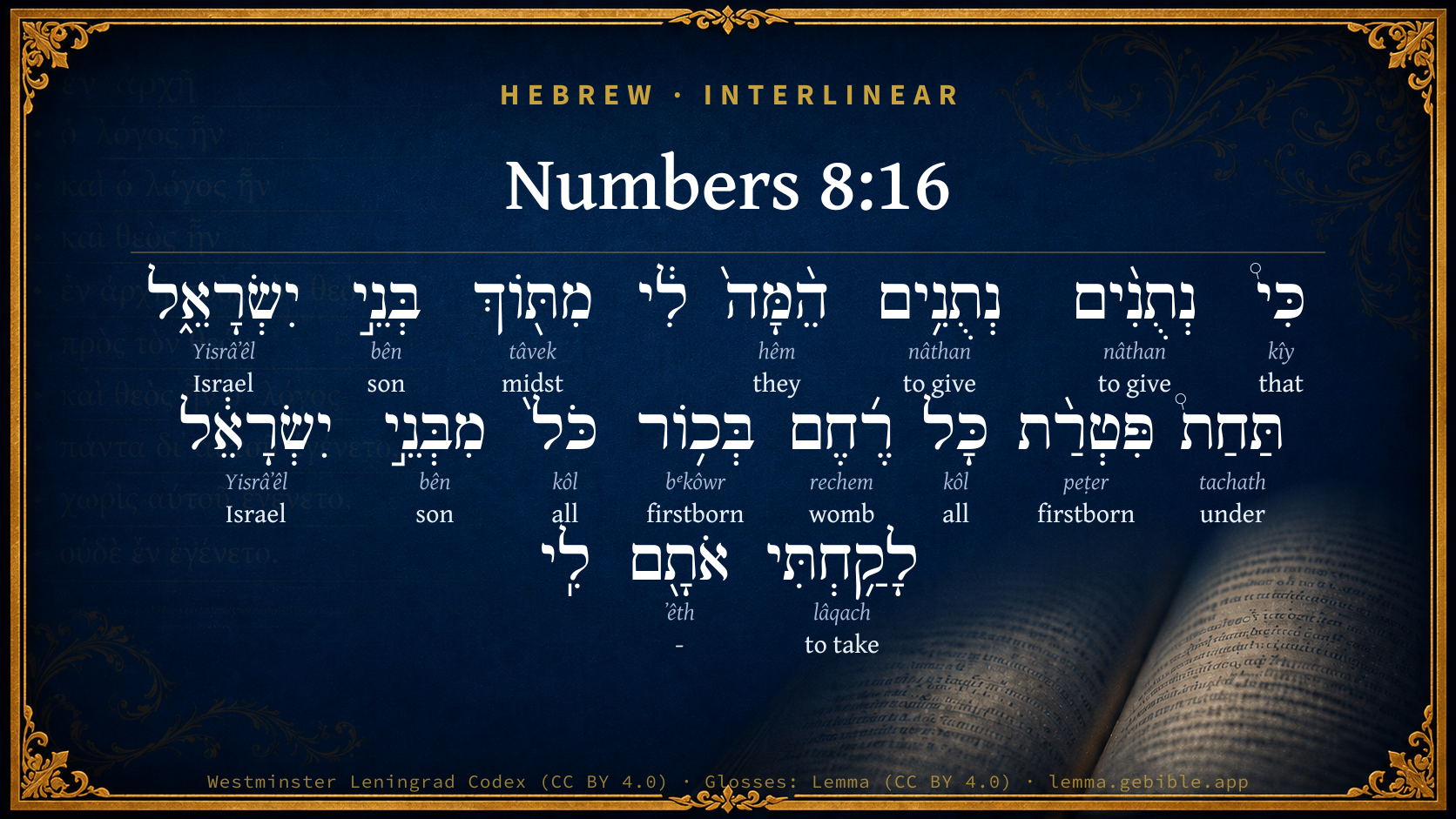
  1. כִּי֩ kîy H3588 “that” Conjunction
  2. נְתֻנִ֨ים nâthan H5414 “given” Verb, Qal, Participle Passive, Masculine, Plural, Absolute
  3. נְתֻנִ֥ים nâthan H5414 “given” Verb, Qal, Participle Passive, Masculine, Plural, Absolute
  4. הֵ֨מָּה֙ hêm H1992 “they” Pronoun, Personal, 3rd Person, Masculine, Plural
  5. מִתּ֖וֹךְ tâvek H8432 “from · midst of” Preposition + Noun, Common, Masculine, Singular, Construct
  6. בְּנֵ֣י bên H1121 “sons of” Noun, Common, Masculine, Plural, Construct
  7. יִשְׂרָאֵ֑ל Yisrâʼêl H3478 “Israel” Noun, Proper
  8. תַּחַת֩ tachath H8478 “under” Preposition
  9. כָּל kôl H3605 “all of” Noun, Common, Masculine, Singular, Construct
  10. רֶ֜חֶם rechem H7358 “womb” Noun, Common, Masculine, Singular, Absolute
  11. בְּכ֥וֹר bᵉkôwr H1060 “firstborn of” Noun, Common, Masculine, Singular, Construct
  12. כֹּל֙ kôl H3605 “all” Noun, Common, Masculine, Singular, Absolute
  13. מִבְּנֵ֣י bên H1121 “from · sons of” Preposition + Noun, Common, Masculine, Plural, Construct
  14. יִשְׂרָאֵ֔ל Yisrâʼêl H3478 “Israel” Noun, Proper
  15. לָקַ֥חְתִּי lâqach H3947 “to take” Verb, Qal, Perfect, 1st Person, Common, Singular
  16. אֹתָ֖ם ʼêth H853 “- · them” Particle, Direct Object + Suffix, Personal, 3rd Person, Masculine, Plural

About this verse

These counts appear in no published source. They are computed here, from the morphology-tagged text and Lemma’s own curated glosses. What Lemma adds →

19
words
13
distinct lemmas
Pentateuch
section

Notable vocabulary

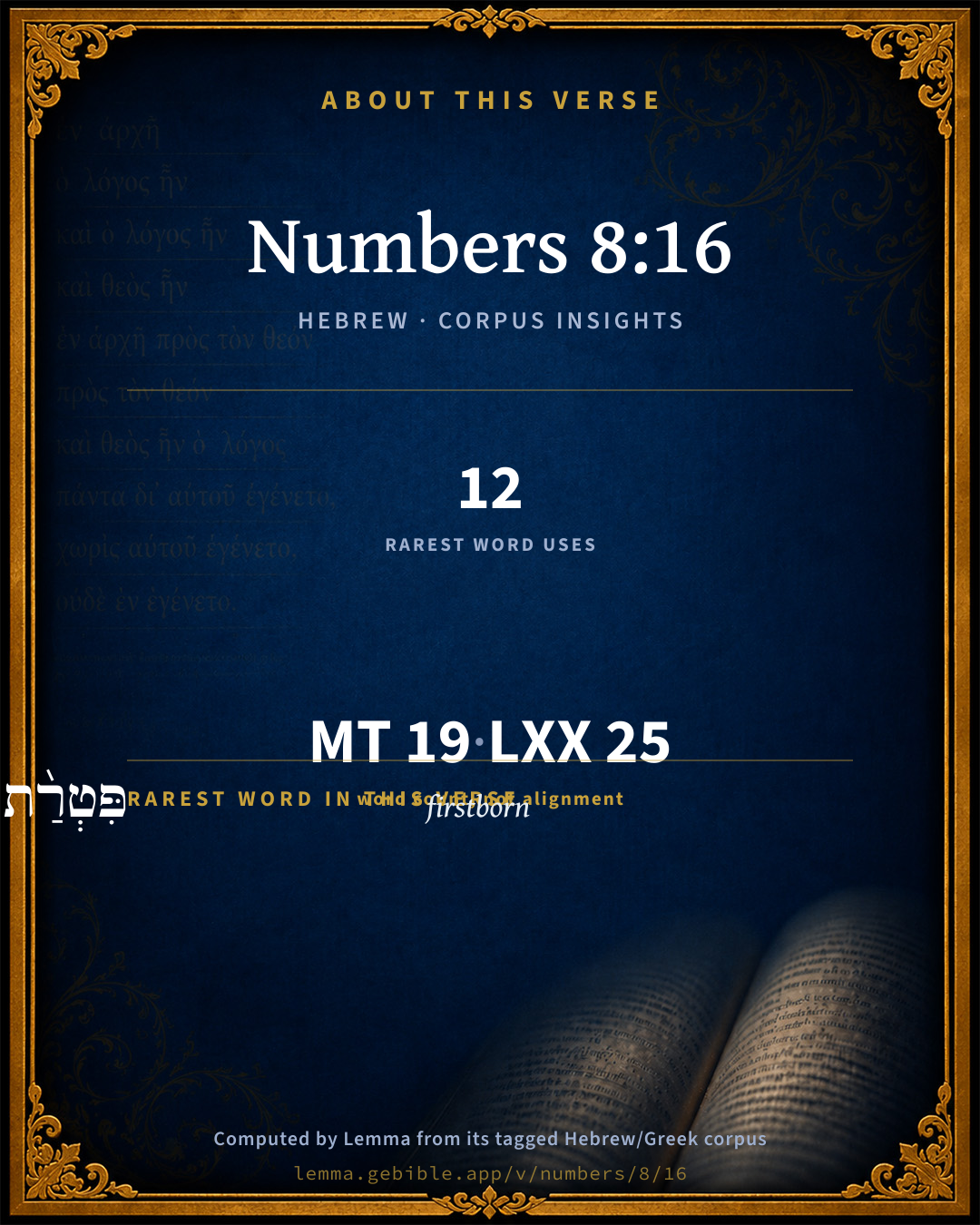
The rarest word here is פִּטְרַ֨ת firstborn H6363 — appearing just 12 times in the whole Hebrew Bible.

Shared distinctive vocabulary

פִּטְרַ֨ת firstborn H6363 occurs in 10 verses of the Hebrew Bible. Also found in:

Grammatical profile

  • 3 verbs
  • 10 nouns
  • 1 pronoun
  • 3 prepositions
  • 1 conjunction
  • 1 particle

Verb forms

  • נְתֻנִ֨ים Qal · Participle Passive
  • נְתֻנִ֥ים Qal · Participle Passive
  • לָקַ֥חְתִּי Qal · Perfect

Repetition

Words recur within this verse — often emphatic in Hebrew:

  • נְתֻנִ֨ים to give H5414 ×2
  • בְּנֵ֣י son H1121 ×2
  • יִשְׂרָאֵ֑ל Israel H3478 ×2
  • כָּל all H3605 ×2

Hebrew & Septuagint length

In English translation the verse runs 35 words from the Hebrew and 38 from the Septuagint (LXX English) — closely comparable.

A rough comparison of the two English renderings, which tokenize alike — not a word-level alignment.

Word counts can differ between the Hebrew and the Greek without any difference in meaning — e.g. the Hebrew direct-object marker אֵת has no separate Greek word, and Greek often adds the article ὁ.

In the original languages it is 19 Hebrew tokens and 25 Greek tokens — but the two are counted differently (Hebrew bundles its prefixes and suffixes into one token; the Greek is in lemma form), so that isn’t a like-for-like length.

Cross-references

3

Topical passages linked to Numbers 8:16 in the Treasury of Scripture Knowledge — connected by theme and wording, ordered by reader-vote popularity; previews shown in the World English Bible.

  • Numbers 3:12 "Behold, I have taken the Levites from among the children of Israel instead of all the firstborn who open the womb among the children of Israel; and the Levites shall be mine:
  • Numbers 3:45 "Take the Levites instead of all the firstborn among the children of Israel, and the cattle of the Levites instead of their cattle; and the Levites shall be mine. I am Yahweh.
  • Numbers 3:9 You shall give the Levites to Aaron and to his sons. They are wholly given to him on the behalf of the children of Israel.

Cross-references courtesy of OpenBible.info (CC BY 4.0).

Hebrew and Greek witnesses Masoretic Hebrew ↔ Greek Septuagint

The same verse in the two great witnesses to the Old Testament, shown verse-for-verse.

These are two independent witnesses, not word-aligned to each other, and the Septuagint is shown in lemma (dictionary) form.

Hebrew Numbers 8:16 Masoretic · Westminster Leningrad Codex

כִּי֩ נְתֻנִ֨ים נְתֻנִ֥ים הֵ֨מָּה֙ לִ֔י מִתּ֖וֹךְ בְּנֵ֣י יִשְׂרָאֵ֑ל תַּחַת֩ פִּטְרַ֨ת כָּל רֶ֜חֶם בְּכ֥וֹר כֹּל֙ מִבְּנֵ֣י יִשְׂרָאֵ֔ל לָקַ֥חְתִּי אֹתָ֖ם לִֽי

For they are wholly given to me from among the children of Israel; instead of all who open the womb, even the firstborn of all the children of Israel, I have taken them to me.

World English Bible · Public Domain

Greek LXX Numbers 8:16 Septuagint · lemma form

ὅτι ἀπόδομα ἀποδίδωμι οὗτος ἐγώ εἰμί ἐκ μέσος υἱός ἰσραήλ ἀντί ὁ δια ἀναοἴγω πᾶς μήτρα πρωτότοκος πᾶς ἐκ ὁ υἱός ἰσραήλ λαμβάνω αὐτός ἐγώ

For these are given to me for a present out of the midst of the children of Israel: I have taken them to myself instead of all the firstborn of the sons of Israel that open every womb.

LXX2012 (modern English Septuagint) · Public Domain

Hebrew: Westminster Leningrad Codex (CC BY 4.0). Greek: Septuagint (public domain); English from LXX2012 (modern English Septuagint) (Public Domain). How the Septuagint differs from the Hebrew →

Targum (Aramaic paraphrase)

2

The Targum is the ancient Jewish Aramaic paraphrase of the Hebrew Scriptures — an interpretive translation, not the Hebrew text itself. Onkelos (literal) and Pseudo-Jonathan (expansive) render the Torah, and Jonathan the Prophets. Coverage is partial: where no permissively-licensed English translation exists for a verse, only the Aramaic is shown. This is verse-level text, not a word-by-word alignment to the Hebrew.

  1. Targum Onkelos Torah (Genesis–Deuteronomy)
    אֲרֵי אַפְרָשָׁא מַפְרְשִׁין אִנוּן לִי מִגוֹ בְּנֵי יִשְׂרָאֵל חֲלַף פְּתַח כָּל וַלְדָא בּוּכְרָא כֹלָא מִבְּנֵי יִשְׂרָאֵל קָרֵבִית יָתְהוֹן קֳדָמָי

    (no public-domain English translation for this verse)

    Targum Onkelos — Aramaic: “Onkelos Genesis” (public domain); “Onkelos Exodus” (public domain); “Onkelos Leviticus” (public domain); “Onkelos Numbers” (public domain); “Onkelos Deuteronomy” (public domain). English: “Sefaria Community Translation” (CC0 1.0 (public-domain dedication)); “J.W. Etheridge. The Targums of Onkelos and Jonathan Ben Uzziel on the Pentateuch. London: Longmans, Green, 1862” (public domain). Text via Sefaria.

  2. Targum Pseudo-Jonathan Torah (Genesis–Deuteronomy)
    אֲרוּם מַפְרְשָׁא מְפַרְשִׁין הִינוּן קֳדָמַי מִגוֹ בְּנֵי יִשְרָאֵל חוֹלַף פְּתַח כָּל וַלְדָא בּוּכְרַיָא כֻּלְהוֹן דְמִבְּנֵי יִשְרָאֵל קָרֵיבִית יַתְהוֹן קֳדָמַי

    for separated they are separate before Me from among the sons of Israel, instead of every one who openeth the womb; the first-born of all who are of the sons of Israel have I taken (to be) before Me.

    Targum Pseudo-Jonathan — Aramaic: “Targum Jonathan on Genesis” (public domain); “Targum Jonathan on Exodus” (public domain); “Targum Jonathan on Leviticus” (public domain); “Targum Jonathan on Numbers” (public domain); “Targum Jonathan on Deuteronomy” (public domain). English: “The Targum of Jonathan ben Uzziel, trans. J. W. Etheridge, London, 1862” (public domain). Text via Sefaria.

Commentary

Notes on Numbers 8:16 from classic Christian and Jewish commentators (each source and its license shown beneath its notes). The classic Christian expositions comment on the surrounding passage and are grouped to its opening verse, so a note may address several verses; the Jewish commentaries on the Tanakh (Rashi and others) are per-verse, so they appear only where the commentator wrote on this verse.

Lemma curates 59 commentaries, every one of them public domain or Creative Commons licensed, each selected and text-cleaned for this edition rather than reprinted as found. About our sources →

Geneva Bible (1599)

Geneva Bible translators

That is, they that are the firstborn.

Geneva Bible (1599) marginal notes — public domain. Text via Bolls.life.

Ellicott's Commentary for English Readers

(16) Instead of such as open every womb, even instead of the firstborn of all the children of Israel.—It is difficult to determine whether the second clause is to be regarded as an exact equivalent, or as a limitation of the first. If an exact equivalent, a different meaning must be assigned to the firstborn from that which it commonly bears in the Pentateuch, where it appears to be restricted to the firstborn son on the father’s side. (Cf. Exo_13:2.)

A Bible Commentary for English Readers, edited by Charles John Ellicott (1878–1897) — public domain. Text from a community e-Sword module.

John Gill's Exposition

For they are wholly given unto me from among the children of Israel,.... All of them, entirely, and most certainly; or, "given, given" (u), which is repeated for the confirmation of it; or because of their being twice given, first to the Lord by the children of Israel, and then by the Lord to Aaron and his sons, as Chaskuni; though Jarchi interprets it of the different parts of their service they were devoted to, given for bearing and carrying the vessels of the sanctuary, and given for the song, or to be singers in the temple:

instead of such as open, every womb, even instead of the firstborn of all the children of Israel have I taken them unto me; See Gill on Num 3:12, and See Gill on Num 3:13.

(u) "dati, dati", Pagninus, Montanus, Vatablus; so Drusius and Ainsworth.

John Gill's Exposition of the Whole Bible (1746–1763) — public domain (CC PDM 1.0). Text via the HelloAO Bible API.

Matthew Poole's English Annotations

They are given unto me by the people’s consent, as well as taken (as it follows) by my choice and command. See Num 3:9.

Matthew Poole's English Annotations on the Holy Bible (1683–1685) — public domain. Text from a community e-Sword/MySword module.

Whedon's Commentary on the Bible

Daniel D. Whedon

16. Wholly given — The Hebrew nethunim, nethunim, given, given, is emphatic by repetition. (See Num_3:9, note.) At first they were the only attendants of the priests, and performed all the menial service.

Subsequently they were re-enforced by three hundred and twenty captive Midianites, (Num_31:47,) and still later by the condemned Gibeonites. Jos_9:27, note. When the service became more stately and onerous David and the princes further strengthened the Levites by the gift of the Nethinim, either prisoners of war or a remnant of the Canaanites, to live within the enclosure of the temple and to do its rougher work. Ezr_8:20. Two hundred and twenty of these were enrolled by Ezra among the Levites to supply their lack of service through a decline of their zeal for Jehovah.

Daniel D. Whedon (gen. ed.), Commentary on the Old and New Testaments (1874–1909) — public domain. Text from a community e-Sword module.

The Pulpit Commentary

For they are wholly given unto me. See Num_3:5-13, the substance of which is emphatically repeated here.

The Pulpit Commentary (1880–1919), ed. H.D.M. Spence-Jones & Joseph S. Exell — public domain. Text from a community e-Sword module.

unfoldingWord translationNotes

Door43 World Missions Community

each male child who opens the womb, the firstborn

These two phrases mean basically the same thing and are combined for emphasize the firstborn sons. (See: Parallelism)

male child who opens the womb

This is an idiom. "To open the womb" means to give birth for the first time. Here this refers to the first male child to which a mother gives birth. AT: "child who is the firstborn son of his mother" (See: Idiom)

I took the lives

This is a polite way of referring to when a person kills someone. AT: "I killed" (See: Euphemism)

I set them apart

Here "them" refers to "the firstborn from among the people of Israel."

translationWords

womb

firstborn

descend

life

Egypt

set apart

unfoldingWord translationNotes — © Distant Shores Media and the Door43 World Missions Community, licensed CC BY-SA 4.0. Source: git.door43.org/Door43/en_tn.

Rashi

Rabbi Shlomo Yitzchaki (Rashi)

נתנים נתנים FOR THEY ARE GIVEN, GIVEN ARE THEY [UNTO ME] — i.e., given twice: dedicated for bearing the holy objects and dedicated to sing in chorus in the Sanctuary.

פטרת means OPENING OF (such that open the womb, i. e. firstborn).

Rashi on the Tanakh — English translations: “The Judaica Press complete Tanach with Rashi, translated by A. J. Rosenberg” (CC BY 4.0); “Pentateuch with Rashi's commentary by M. Rosenbaum and A.M. Silbermann, 1929-1934” (public domain); “The Metsudah Tanach series, Lakewood, N.J” (CC BY 4.0); and “The Book of Joshua, Metsudah Publications, 1997” (CC BY 4.0). Text via Sefaria.

Sforno

Rabbi Ovadia Sforno

For they are given. They gave themselves over to Hashem for His service, as the verse testifies: “Whoever is for Hashem, [come] to me. All the sons of Levi gathered around him” (Shemos 32:26). Also, they are given from within the Bnei Yisroel, for the Israelites support the Levites with the first tithes in exchange for their service. In this way, the Divine service is accomplished through all the Jewish people together.

Sforno on the Tanakh — English translation: “Yalkut, Sifsei Chachomim Chumash, Metsudah Publications, 2009” (CC BY 4.0). Text via Sefaria.

Lesson kit

Teaching starters — assembled from the data on this page, not authored interpretation. Every prompt links to the verse data it draws on. Edit before teaching.

Numbers, in the Pentateuch, opens this verse with 19 words (13 distinct Hebrew lemmas). Its most distinctive word is peṭer (“firstborn”). A historical commentator’s framing appears above. Read the whole chapter for the surrounding context.

Discussion questions

  1. What does “firstborn” (peṭer) contribute to the verse as a whole?
  2. How does Exodus 13:2, which shares the word «firstborn», read alongside this verse?
  3. What does the repetition of “to give” (2× in this one verse) do in this verse?
  4. The translations on this page render this verse differently — a whole-verse word diff, not a word-by-word alignment. What might account for the different wordings?
  5. «נְתֻנִ֨ים» is a Qal Participle Passive verb. How does that grammatical form shape the action described?
  6. Compare how Geneva Bible (1599) and Ellicott's Commentary for English Readers read this verse. Where do they agree or differ?

Things to notice

Reading settings

Reading text

Shown beneath each verse's original-language words.

Old Testament
Old Testament edition

Read the OT as the Masoretic Hebrew (MT) or the Greek Septuagint (LXX).

English shown for the Greek Septuagint (in the Hebrew ↔ Greek comparison).

Comparing translations? Open the Compare panel on any verse page to stack up to four side by side.