
Exodus 5:8

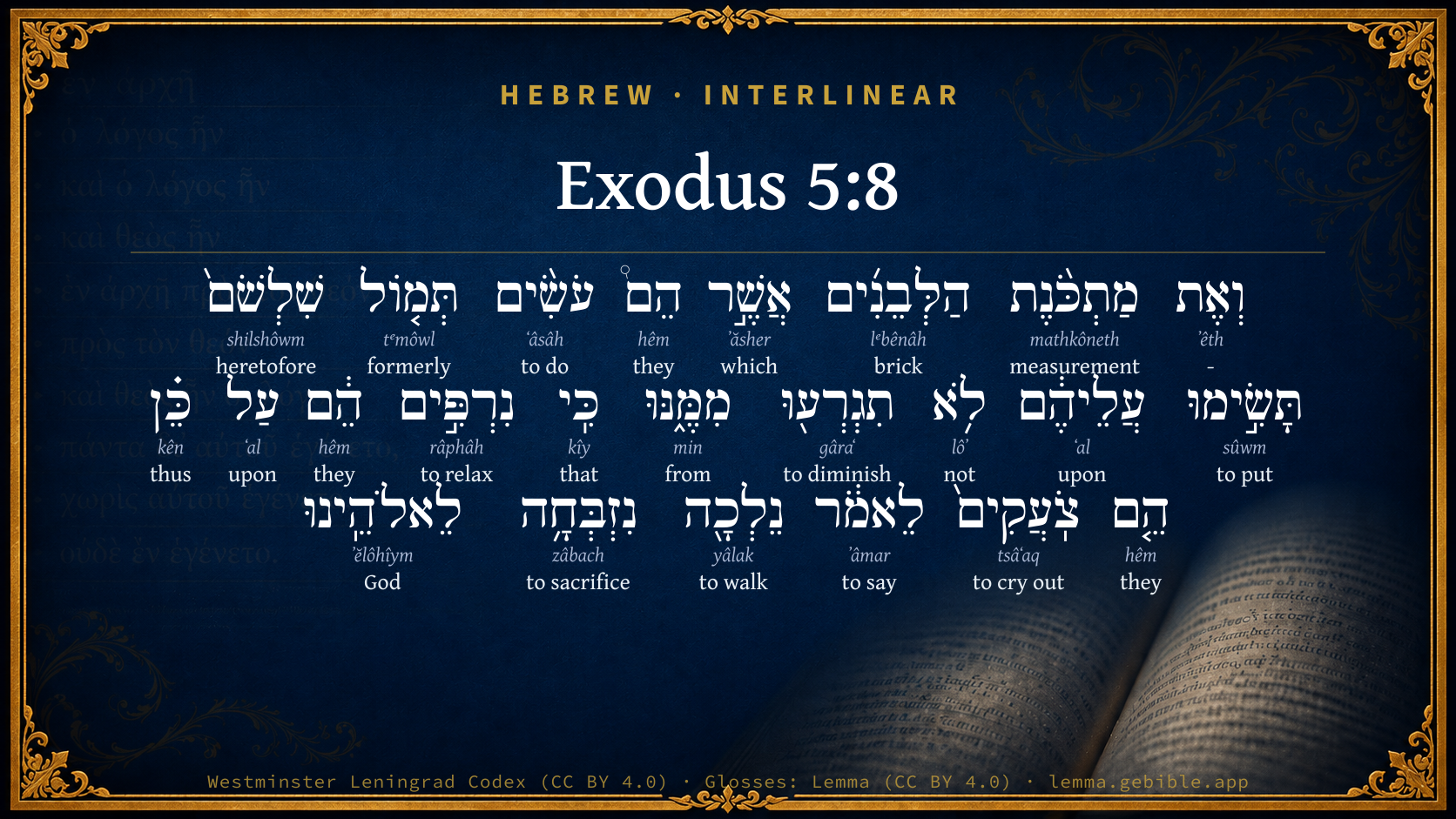
Hebrew (Westminster Leningrad Codex) Exodus 5:8 appears in the Hebrew Old Testament. The text above is from the Westminster Leningrad Codex. Each word links to its Strong’s number, a concise gloss, and parsing drawn from the Open Scriptures Hebrew Bible morphology. Click any word for its full Brown-Driver-Briggs (BDB) entry.
Download image
Cite this verse

Exodus 5:8 (World English Bible). Public Domain. Lemma interlinear Bible study tool, https://lemma.gebible.app/v/exodus/5/8.

Show BibTeX & RIS
BibTeX
RIS
English Translation
The number of the bricks, which they made before, you require from them. You shall not diminish anything of it, for they are idle; therefore they cry, saying, 'Let us go and sacrifice to our God.'
World English Bible · Public Domain
Highlights
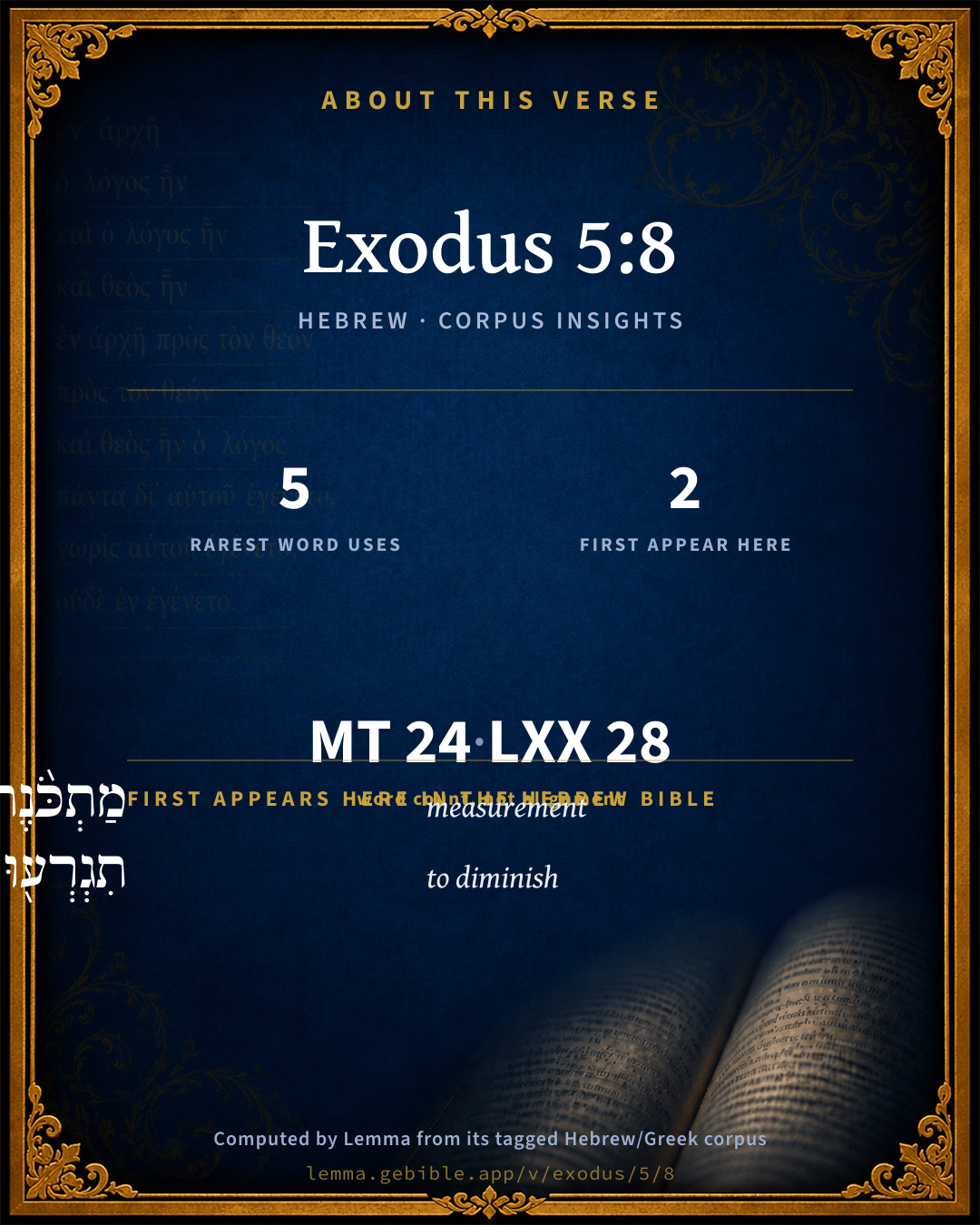
  • 2 first appearances in the Hebrew Bible
Full analysis ↓
Download a study sheet

One document with this verse’s original text, its word-by-word gloss line, the meaning frame, cross-references with their text, attributed commentary, and full source and license credits — printable, and it pastes into notes with its structure intact.

This verse Autodidact and up

Study sheet (.html) Plain text (.txt)

A passage Seminary Student

Up to 50 verses in one chapter. A passage sheet keeps up to 6 commentary sources and 12 cross-references per verse, in the order this page ranks them, and says so on the sheet whenever that leaves anything out. Ask for a single verse and you get the Autodidact verse sheet above.

Everything on this page stays free to read, with no account — the sheet is a download of what is already on screen, not access to it.

Want to remove ads? Support Godless Engineer
Compare translations 3

The same verse in 3 English versions, stacked beneath the original-language interlinear above. Click any original word for its lexicon entry.

Each is an independent rendering of the whole verse — the interlinear is not word-aligned to these translations.

Highlighted words mark where these versions differ — a whole-verse word diff, not a word-by-word alignment.

  • World English Bible Public Domain
    The number of the bricks, which they made before, you require from them. You shall not diminish anything of it, for they are idle; therefore they cry, saying, 'Let us go and sacrifice to our God.'
  • King James Version Public Domain
    And the tale of the bricks, which they did make heretofore, ye shall lay upon them; ye shall not diminish ought thereof: for they be idle; therefore they cry, saying, Let us go and sacrifice to our God.
  • unfoldingWord Literal Text CC BY-SA 4.0
    But you shall put on them the quota of the bricks which they were making yesterday and the day before yesterday; do not diminish from it. For they are idle. Therefore they are crying, saying, ‘Let us go, let us sacrifice to our God.’

unfoldingWord Literal Text — © unfoldingWord, licensed CC BY-SA 4.0. Word-aligned USFM3 via Door43 (git.door43.org/unfoldingWord/en_ult).

Versions to compare (up to 4)

3 of 4 selected

Show all 18 translations

Every available English version of this verse, each an independent rendering of the whole verse.

  • World English Bible Public Domain
    The number of the bricks, which they made before, you require from them. You shall not diminish anything of it, for they are idle; therefore they cry, saying, 'Let us go and sacrifice to our God.'
  • Berean Standard Bible Public Domain
    But require of them the same quota of bricks as before; do not reduce it. For they are lazy; that is why they are crying out, ‘Let us go and sacrifice to our God.’
  • Majority Standard Bible Public Domain
    But require of them the same quota of bricks as before; do not reduce it. For they are lazy; that is why they are crying out, ‘Let us go and sacrifice to our God.’
  • King James Version Public Domain
    And the tale of the bricks, which they did make heretofore, ye shall lay upon them; ye shall not diminish ought thereof: for they be idle; therefore they cry, saying, Let us go and sacrifice to our God.
  • American Standard Version (1901) Public Domain
    And the number of the bricks, which they did make heretofore, ye shall lay upon them; ye shall not diminish aught thereof: for they are idle; therefore they cry, saying, Let us go and sacrifice to our God.
  • Revised Version (1885) Public Domain
    And the tale of the bricks, which they did make heretofore, ye shall lay upon them; ye shall not diminish aught thereof: for they be idle; therefore they cry, saying, Let us go and sacrifice to our God.
  • Geneva Bible (1599) Public Domain
    Notwithstanding lay vpon them the nober of bricke, which they made in time past, diminish nothing thereof: for they be idle, therefore they crie, saying, Let vs go to offer sacrifice vnto our God.
  • Douay-Rheims (1899) Public Domain
    And you shall lay upon them the task of bricks, which they did before, neither shall you diminish any thing thereof: for they are idle, and therefore they cry, saying: Let us go and sacrifice to our God.
  • Young's Literal Translation Public Domain
    and the proper quantity of the bricks which they are making heretofore ye do put on them, ye do not diminish from it, for they are remiss, therefore they are crying, saying, Let us go, let us sacrifice to our God;
  • Literal Standard Version CC BY-SA 4.0
    and you put on them the proper quantity of the bricks which they are making before, you do not diminish from it, for they are remiss, therefore they are crying, saying, Let us go, let us sacrifice to our God;
  • Unlocked Literal Bible CC BY-SA 4.0
    However, you must still demand from them the same number of bricks as they made before. Do not accept any fewer, because they are lazy. That is why they are calling out and saying, 'Allow us to go and sacrifice to our God.'
  • unfoldingWord Literal Text CC BY-SA 4.0
    But you shall put on them the quota of the bricks which they were making yesterday and the day before yesterday; do not diminish from it. For they are idle. Therefore they are crying, saying, ‘Let us go, let us sacrifice to our God.’
  • Darby Bible Public Domain
    And the number of the bricks they have made heretofore shall ye lay upon them: ye shall not diminish any of it, for they are idle; therefore they cry, saying, Let us go [and] sacrifice to our God.
  • World Messianic Bible Public Domain
    You shall require from them the number of the bricks which they made before. You shall not diminish anything of it, for they are idle. Therefore they cry, saying, ‘Let’s go and sacrifice to our God.’
  • Webster's Bible Public Domain
    And the number of the bricks which they made heretofore, ye shall lay upon them; ye shall not diminish aught thereof; for they are idle: therefore they cry, saying, Let us go and sacrifice to our God.
  • Free Bible Version CC BY-SA 4.0
    But still make them produce the same quantity of bricks as before. They're lazy people—that's why they're calling out, asking, ‘Please let us go and offer sacrifices to our god.’
  • Bible in Basic English Public Domain
    But see that they make the same number of bricks as before, and no less: for they have no love for work; and so they are crying out and saying, Let us go and make an offering to our God.
  • JPS Tanakh (1917) Public Domain
    And the tale of the bricks, which they did make heretofore, ye shall lay upon them; ye shall not diminish aught thereof; for they are idle; therefore they cry, saying: Let us go and sacrifice to our God.

Literal Standard Version (2020), Covenant Press — licensed CC BY-SA 4.0. Text via the HelloAO Bible API (eBible.org). Unlocked Literal Bible (unfoldingWord) — licensed CC BY-SA 4.0. Text via the HelloAO Bible API (eBible.org). unfoldingWord Literal Text — © unfoldingWord, licensed CC BY-SA 4.0. Word-aligned USFM3 via Door43 (git.door43.org/unfoldingWord/en_ult). Free Bible Version, Dr. Jonathan Gallagher — licensed CC BY-SA 4.0. Text via the HelloAO Bible API (eBible.org).

Word by word

More ways to search: Search by grammar → Find every occurrence → Compare this word →

Practice this passage: Drill this verse → Learn its vocabulary →

מַתְכֹּ֨נֶת
mathkôneth
H4971
“measurement of”
Noun, Common, Feminine, Singular, Construct
Part of Speech
Noun
Type
Common
Gender
Feminine
Number
Singular
State
Construct
Full BDB Definition

Origin: from H8505 in the transferred sense of measuring

TWOT: 2511c

measurement, proportion, tale - tale, tally (of bricks) - measurement, proportion
  1. וְאֶת ʼêth H853 “and · -” Conjunction + Particle, Direct Object
  2. הַלְּבֵנִ֜ים lᵉbênâh H3843 “the · bricks” Particle, Definite Article + Noun, Common, Feminine, Plural, Absolute
  3. אֲשֶׁ֣ר ʼăsher H834 “which” Particle, Relative
  4. הֵם֩ hêm H1992 “they” Pronoun, Personal, 3rd Person, Masculine, Plural
  5. עֹשִׂ֨ים ʻâsâh H6213 “doing” Verb, Qal, Participle Active, Masculine, Plural, Absolute
  6. תְּמ֤וֹל tᵉmôwl H8543 “formerly” Adverb
  7. שִׁלְשֹׁם֙ shilshôwm H8032 “heretofore” Adverb
  8. תָּשִׂ֣ימוּ sûwm H7760 “to put” Verb, Qal, Imperfect, 2nd Person, Masculine, Plural
  9. עֲלֵיהֶ֔ם ʻal H5921 “upon · them” Preposition + Suffix, Personal, 3rd Person, Masculine, Plural
  10. לֹ֥א lôʼ H3808 “not” Particle, Negative
  11. תִגְרְע֖וּ gâraʻ H1639 “to diminish” Verb, Qal, Imperfect, 2nd Person, Masculine, Plural
  12. מִמֶּ֑נּוּ min H4480 “from · us” Preposition + Suffix, Personal, 1st Person, Common, Plural
  13. כִּֽי kîy H3588 “that” Conjunction
  14. נִרְפִּ֣ים râphâh H7503 “relaxing” Verb, Niphal, Participle Active, Masculine, Plural, Absolute
  15. הֵ֔ם hêm H1992 “they” Pronoun, Personal, 3rd Person, Masculine, Plural
  16. עַל ʻal H5921 “upon” Preposition
  17. כֵּ֗ן kên H3651 “thus” Particle, Demonstrative
  18. הֵ֤ם hêm H1992 “they” Pronoun, Personal, 3rd Person, Masculine, Plural
  19. צֹֽעֲקִים֙ tsâʻaq H6817 “crying out” Verb, Qal, Participle Active, Masculine, Plural, Absolute
  20. לֵאמֹ֔ר ʼâmar H559 “to say” Preposition + Verb, Qal, Infinitive Construct
  21. נֵלְכָ֖ה yâlak H3212 “to walk” Verb, Qal, Cohortative, 1st Person, Common, Plural
  22. נִזְבְּחָ֥ה zâbach H2076 “to sacrifice” Verb, Qal, Cohortative, 1st Person, Common, Plural
  23. לֵאלֹהֵֽינוּ ʼĕlôhîym H430 “to/for · God(s) · our” Preposition + Noun, Common, Masculine, Plural, Construct + Suffix, Personal, 1st Person, Common, Plural

About this verse

These counts appear in no published source. They are computed here, from the morphology-tagged text and Lemma’s own curated glosses. What Lemma adds →

24
words
21
distinct lemmas
Pentateuch
section

Notable vocabulary

The rarest word here is מַתְכֹּ֨נֶת measurement H4971 — appearing just 5 times in the whole Hebrew Bible.

First appearance in Scripture

These words make their first canonical appearance in the Hebrew Bible here:

  • מַתְכֹּ֨נֶת measurement H4971
  • תִגְרְע֖וּ to diminish H1639

Shared distinctive vocabulary

מַתְכֹּ֨נֶת measurement H4971 occurs in 5 verses of the Hebrew Bible. Also found in:

Grammatical profile

  • 8 verbs
  • 3 nouns
  • 3 pronouns
  • 3 prepositions
  • 1 conjunction
  • 2 adverbs
  • 4 particles

Verb forms

  • עֹשִׂ֨ים Qal · Participle Active
  • תָּשִׂ֣ימוּ Qal · Imperfect
  • תִגְרְע֖וּ Qal · Imperfect
  • נִרְפִּ֣ים Niphal · Participle Active
  • צֹֽעֲקִים֙ Qal · Participle Active
  • לֵאמֹ֔ר Qal · Infinitive Construct
  • נֵלְכָ֖ה Qal · Cohortative
  • נִזְבְּחָ֥ה Qal · Cohortative

Repetition

Words recur within this verse — often emphatic in Hebrew:

  • עֲלֵיהֶ֔ם upon H5921 ×2
  • הֵם֩ they H1992 ×3

Hebrew & Septuagint length

In English translation the verse runs 36 words from the Hebrew and 37 from the Septuagint (LXX English) — closely comparable.

A rough comparison of the two English renderings, which tokenize alike — not a word-level alignment.

Word counts can differ between the Hebrew and the Greek without any difference in meaning — e.g. the Hebrew direct-object marker אֵת has no separate Greek word, and Greek often adds the article ὁ.

In the original languages it is 24 Hebrew tokens and 28 Greek tokens — but the two are counted differently (Hebrew bundles its prefixes and suffixes into one token; the Greek is in lemma form), so that isn’t a like-for-like length.

Cross-references

1

Topical passages linked to Exodus 5:8 in the Treasury of Scripture Knowledge — connected by theme and wording, ordered by reader-vote popularity; previews shown in the World English Bible.

  • Psalms 106:41 He gave them into the hand of the nations. Those who hated them ruled over them.

Cross-references courtesy of OpenBible.info (CC BY 4.0).

Hebrew and Greek witnesses Masoretic Hebrew ↔ Greek Septuagint

The same verse in the two great witnesses to the Old Testament, shown verse-for-verse.

These are two independent witnesses, not word-aligned to each other, and the Septuagint is shown in lemma (dictionary) form.

Hebrew Exodus 5:8 Masoretic · Westminster Leningrad Codex

וְאֶת מַתְכֹּ֨נֶת הַלְּבֵנִ֜ים אֲשֶׁ֣ר הֵם֩ עֹשִׂ֨ים תְּמ֤וֹל שִׁלְשֹׁם֙ תָּשִׂ֣ימוּ עֲלֵיהֶ֔ם לֹ֥א תִגְרְע֖וּ מִמֶּ֑נּוּ כִּֽי נִרְפִּ֣ים הֵ֔ם עַל כֵּ֗ן הֵ֤ם צֹֽעֲקִים֙ לֵאמֹ֔ר נֵלְכָ֖ה נִזְבְּחָ֥ה לֵאלֹהֵֽינוּ

The number of the bricks, which they made before, you require from them. You shall not diminish anything of it, for they are idle; therefore they cry, saying, 'Let us go and sacrifice to our God.'

World English Bible · Public Domain

Greek LXX Exodus 5:8 Septuagint · lemma form

καί ὁ σύνταξις ὁ πλινθεία ὅς αὐτός ποιέω κατά ἕκαστος ἡμέρα ἐπιβάλλω αὐτός οὐ ἀποαἱρέω οὐδείς σχολάζω γάρ διά οὗτος κράζω λέγω πορεύομαι καί θύω ὁ θεός ἐγώ

And you shall impose on them daily the rate of brick-making which they perform: you shall not abate anything, for they are idle; therefore have they cried, saying, Let us arise and do sacrifice to our God.

LXX2012 (modern English Septuagint) · Public Domain

Hebrew: Westminster Leningrad Codex (CC BY 4.0). Greek: Septuagint (public domain); English from LXX2012 (modern English Septuagint) (Public Domain). How the Septuagint differs from the Hebrew →

Targum (Aramaic paraphrase)

2

The Targum is the ancient Jewish Aramaic paraphrase of the Hebrew Scriptures — an interpretive translation, not the Hebrew text itself. Onkelos (literal) and Pseudo-Jonathan (expansive) render the Torah, and Jonathan the Prophets. Coverage is partial: where no permissively-licensed English translation exists for a verse, only the Aramaic is shown. This is verse-level text, not a word-by-word alignment to the Hebrew.

  1. Targum Onkelos Torah (Genesis–Deuteronomy)
    וְיָת סְכוֹם לְבֵנַיָא דִי אִנוּן עָבְדִין מִתְּמַלֵי וּמִדְקָמוֹהִי תְּמַנוּן עֲלֵיהוֹן לָא תִמְנְעוּן מִנֵהּ אֲרֵי בַטְלָנִין אִנוּן עַל כֵּן אִנוּן צָוְחִין לְמֵימַר נֵיזֵיל נְדַבַּח קֳדָם אֱלָהָנָא:

    (no public-domain English translation for this verse)

    Targum Onkelos — Aramaic: “Onkelos Genesis” (public domain); “Onkelos Exodus” (public domain); “Onkelos Leviticus” (public domain); “Onkelos Numbers” (public domain); “Onkelos Deuteronomy” (public domain). English: “Sefaria Community Translation” (CC0 1.0 (public-domain dedication)); “J.W. Etheridge. The Targums of Onkelos and Jonathan Ben Uzziel on the Pentateuch. London: Longmans, Green, 1862” (public domain). Text via Sefaria.

  2. Targum Pseudo-Jonathan Torah (Genesis–Deuteronomy)
    וְיַת סְכוּם לִבְנַיָא דְהִינוּן עָבְדִין מֵאִיתְמְלֵי וּמִדְקָדָמוֹי תְּמַנוּן עֲלֵיהוֹן לָא תִמְנְעוּן מִנֵיהּ אֲרוּם בַּטְלָנִין הִינוּן בְּגִין כֵּן הִינוּן צַוְוחִין לְמֵימַר נֵיזִיל נְדַבַּח נִיכְסַת חַגָא קֳדָם אֱלָהָנָא

    but the (same) number of bricks which they have heretofore made ye shall lay upon them, and not diminish from it, because they are idle; therefore they clamour, saying, Let us go to offer the sacrifice of a festival before our God.

    Targum Pseudo-Jonathan — Aramaic: “Targum Jonathan on Genesis” (public domain); “Targum Jonathan on Exodus” (public domain); “Targum Jonathan on Leviticus” (public domain); “Targum Jonathan on Numbers” (public domain); “Targum Jonathan on Deuteronomy” (public domain). English: “The Targum of Jonathan ben Uzziel, trans. J. W. Etheridge, London, 1862” (public domain). Text via Sefaria.

Commentary

Notes on Exodus 5:8 from classic Christian and Jewish commentators (each source and its license shown beneath its notes). The classic Christian expositions comment on the surrounding passage and are grouped to its opening verse, so a note may address several verses; the Jewish commentaries on the Tanakh (Rashi and others) are per-verse, so they appear only where the commentator wrote on this verse.

Lemma curates 59 commentaries, every one of them public domain or Creative Commons licensed, each selected and text-cleaned for this edition rather than reprinted as found. About our sources →

Trapp's Complete Commentary

John Trapp

Exo 5:8 And the tale of the bricks, which they did make heretofore, ye shall lay upon them; ye shall not diminish [ought] thereof: for they [be] idle; therefore they cry, saying, Let us go [and] sacrifice to our God.

Ver. 8. For they be idle.] I heard a great man once say, saith Luther, Necesse est otiosos esse homilies qui ista negotia religionis curant. They must needs be idle fellows that are so much taken up about the business of religion. {See Trapp on "Exo 5:4"}

John Trapp, A Commentary or Exposition upon All the Books of the Old and New Testament (1647–1656) — public domain. Text from a community e-Sword module.

Joseph Benson's Commentary

Exo 5:8. They are idle — The cities they built for Pharaoh were witnesses for them that they were not idle; yet he thus basely misrepresents them, that he might have a pretence to increase their burdens.

Joseph Benson's Commentary on the Old and New Testaments (1811–1818) — public domain. Text from a community e-Sword module.

Jamieson, Fausset & Brown

Robert Jamieson, A. R. Fausset & David Brown

tale--an appointed number of bricks. The materials of their labor were to be no longer supplied, and yet, as the same amount of produce was exacted daily, it is impossible to imagine more aggravated cruelty--a perfect specimen of Oriental despotism.

Jamieson, Fausset & Brown — Commentary Critical and Explanatory on the Whole Bible (1871) — public domain (CC PDM 1.0). Text via the HelloAO Bible API.

Adam Clarke's Commentary

Verse 8. And the tale of the bricks] Tale signifies the number, from the Anglo-Saxon [Anglo-Saxon], to number, to count, c.

For they be idle therefore they cry - Let us go and sacrifice] Thus their desire to worship the true God in a proper manner was attributed to their unwillingness to work; a reflection which the Egyptians (in principle) of the present day cast on these who, while they are fervent in spirit serving the Lord, are not slothful in business. See Clarke on Ex 5:17.

Adam Clarke's Commentary on the Bible (1810–1826) — public domain. Text from a community e-Sword/MySword module.

The Cambridge Bible for Schools and Colleges

gen. ed. J. J. S. Perowne

8. tale] that which is told or counted: an archaism for ‘number’ (= Germ. Zahl). So v. 18, 1Sa_18:27, 1Ch_9:28. Cf. Milton, L’Allegro, 67 f., ‘And every shepherd tells [i.e. counts: Psa_48:12; Psa_147:4] his tale [viz. of sheep] Under the hawthorn in the dale.’ The Heb. here means properly a rightly regulated amount.

therefore they cry, &c.] Their request to be allowed to make a pilgrimage to their God is merely a pretext for idleness.

The Cambridge Bible for Schools and Colleges (gen. ed. J. J. S. Perowne; Cambridge University Press, 1878–1918) — public domain. Text from a community e-Sword module.

John Gill's Exposition

And the tale of the bricks, which they did make heretofore, you shall lay upon them,.... Oblige them to make and bring in the same number of bricks they used to do, when straw was brought to them and given them; by which it appears, that their daily task was such a number of bricks:

you shall not diminish ought thereof; not make any abatement of the number of bricks, in consideration of their loss of time and their labour in going to fetch straw from other places:

for they be idle; and want to be indulged in a lazy disposition, which ought by no means to be connived at:

therefore they cry, let us go and sacrifice to our God; suggesting, that this request and cry of theirs did not proceed from a religious principle, or the great veneration they had for their God, but from the sloth and idleness they were addicted to.

John Gill's Exposition of the Whole Bible (1746–1763) — public domain (CC PDM 1.0). Text via the HelloAO Bible API.

Haydock's Catholic Bible Commentary

Idle. Thus the impious speak of those who consecrate any part of their time to the service of God: and thus Protestants often condemn the holy-days prescribed by the Catholic Church!

George Leo Haydock (1774–1849), Haydock's Catholic Family Bible and Commentary, 1859 edition — public domain. Excludes Psalms (Douay-Rheims chapter numbering differs from Protestant) and Deuterocanonical books (Catholic canon only).

The Pulpit Commentary

The tale of the bricksi.e. , the number of the bricks. Exactly as many were to be required of each batch of workmen under the new regulation as previously. The demand was one with which, as the king well know, it would be impossible to comply. For they be idle. There was so much ground for the charge as this that hitherto, their forced labours had not occupied the whole of their time. They had been able, apparently, to cultivate their own plots of ground, (Deu_11:10) to raise crops of cucumbers, melons, leeks, onions, and garlic, (Num_11:5) to catch fish (ibid.), and attend public meetings. (Exo_4:30, Exo_4:31) They had, in fact, had time which they could call their own. Now this was to be so no more. The Pharaoh, however, misrepresents and exaggerates, speaking as if their forced labours had been a mere nothing, and mere want of occupation had led them to raise the cry us go and sacrifice." It would have been far nearer the truth to say, that the severity and continuousness of their labours had made the notion of festival time, during which they would cease from their toils, generally popular.

The Pulpit Commentary (1880–1919), ed. H.D.M. Spence-Jones & Joseph S. Exell — public domain. Text from a community e-Sword module.

John Wesley's Explanatory Notes

They are idle - The cities they built for Pharaoh, were witnesses for them that they were not idle; yet he thus basely misrepresents them, that he might have a pretense to increase their burdens.

John Wesley, Explanatory Notes Upon the Whole Bible (1754–1765) — public domain. Text via the GEBible commentary corpus.

Rashi

Rabbi Shlomo Yitzchaki (Rashi)

ואת מתכנת הלבנים means the total number of bricks which each made per day when straw was being supplied to them — that total you shall impose upon them now also, in order that the service may be hard upon them.

כי נרפים signifies because they have loosened themselves from the work; therefore (this word in Rashi corresponds to על כן in the Hebrew text) their mind turns to idleness and they cry out, saying, נלכה וגו׳ LET US GO [AND SACRIFICE etc.].

מתכנת — This word, and ותכן (v. 18), and the words of the same root in (I Samuel 2:3) “And by Him actions are counted (נתכנו)” and in (2 Kings 12:12) “the money that was counted (המתכן)”, all have the meaning of counting.

נרפים — The work is loose (רפויה) in their hand and neglected by them so that they are loosened (הם נרפים) from it. In old French retrait.

Rashi on the Tanakh — English translations: “The Judaica Press complete Tanach with Rashi, translated by A. J. Rosenberg” (CC BY 4.0); “Pentateuch with Rashi's commentary by M. Rosenbaum and A.M. Silbermann, 1929-1934” (public domain); “The Metsudah Tanach series, Lakewood, N.J” (CC BY 4.0); and “The Book of Joshua, Metsudah Publications, 1997” (CC BY 4.0). Text via Sefaria.

Lesson kit

Teaching starters — assembled from the data on this page, not authored interpretation. Every prompt links to the verse data it draws on. Edit before teaching.

Exodus, in the Pentateuch, opens this verse with 24 words (21 distinct Hebrew lemmas). Its most distinctive word is mathkôneth (“measurement”). A historical commentator’s framing appears above. Read the whole chapter for the surrounding context.

Discussion questions

  1. What does “measurement” (mathkôneth) contribute to the verse as a whole?
  2. 2 words make their first appearance in Scripture here. What does this debut establish?
  3. How does Exodus 30:32, which shares the word «measurement», read alongside this verse?
  4. What does the repetition of “upon” (2× in this one verse) do in this verse?
  5. The translations on this page render this verse differently — a whole-verse word diff, not a word-by-word alignment. What might account for the different wordings?
  6. «עֹשִׂ֨ים» is a Qal Participle Active verb. How does that grammatical form shape the action described?
  7. Compare how Trapp's Complete Commentary and Joseph Benson's Commentary read this verse. Where do they agree or differ?

Things to notice

Reading settings

Reading text

Shown beneath each verse's original-language words.

Old Testament
Old Testament edition

Read the OT as the Masoretic Hebrew (MT) or the Greek Septuagint (LXX).

English shown for the Greek Septuagint (in the Hebrew ↔ Greek comparison).

Comparing translations? Open the Compare panel on any verse page to stack up to four side by side.