
Leviticus 11:8

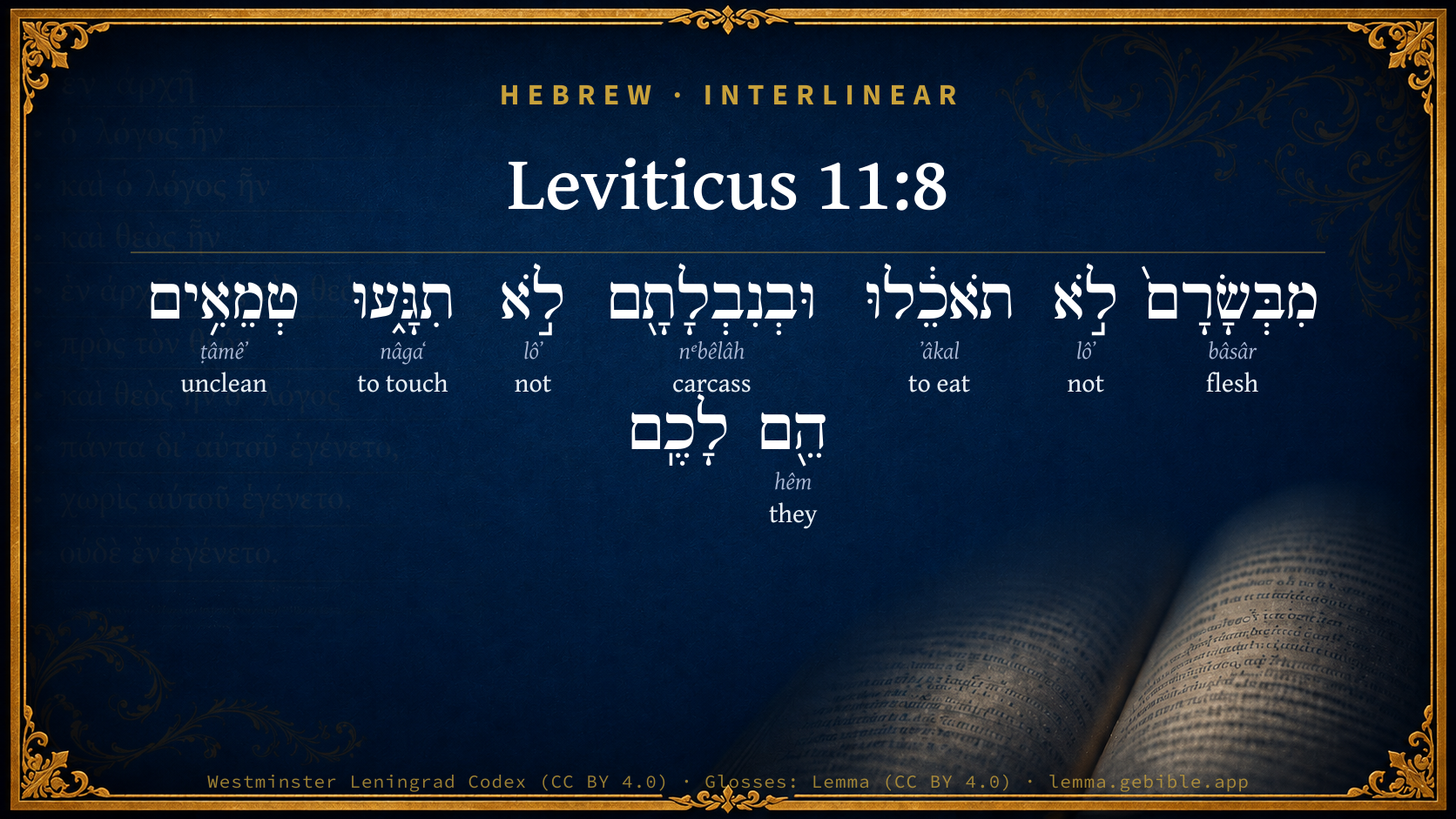
Hebrew (Westminster Leningrad Codex) Leviticus 11:8 appears in the Hebrew Old Testament. The text above is from the Westminster Leningrad Codex. Each word links to its Strong’s number, a concise gloss, and parsing drawn from the Open Scriptures Hebrew Bible morphology. Click any word for its full Brown-Driver-Briggs (BDB) entry.
Download image
Cite this verse

Leviticus 11:8 (World English Bible). Public Domain. Lemma interlinear Bible study tool, https://lemma.gebible.app/v/leviticus/11/8.

Show BibTeX & RIS
BibTeX
RIS
English Translation
Of their flesh you shall not eat, and their carcasses you shall not touch; they are unclean to you.
World English Bible · Public Domain
Download a study sheet

One document with this verse’s original text, its word-by-word gloss line, the meaning frame, cross-references with their text, attributed commentary, and full source and license credits — printable, and it pastes into notes with its structure intact.

This verse Autodidact and up

Study sheet (.html) Plain text (.txt)

A passage Seminary Student

Up to 50 verses in one chapter. A passage sheet keeps up to 6 commentary sources and 12 cross-references per verse, in the order this page ranks them, and says so on the sheet whenever that leaves anything out. Ask for a single verse and you get the Autodidact verse sheet above.

Everything on this page stays free to read, with no account — the sheet is a download of what is already on screen, not access to it.

Want to remove ads? Support Godless Engineer
Compare translations 3

The same verse in 3 English versions, stacked beneath the original-language interlinear above. Click any original word for its lexicon entry.

Each is an independent rendering of the whole verse — the interlinear is not word-aligned to these translations.

Highlighted words mark where these versions differ — a whole-verse word diff, not a word-by-word alignment.

  • World English Bible Public Domain
    Of their flesh you shall not eat, and their carcasses you shall not touch; they are unclean to you.
  • King James Version Public Domain
    Of their flesh shall ye not eat, and their carcass shall ye not touch; they are unclean to you.
  • unfoldingWord Literal Text CC BY-SA 4.0
    You shall not eat from their meat and you shall not touch their carcasses. They unclean to you.

unfoldingWord Literal Text — © unfoldingWord, licensed CC BY-SA 4.0. Word-aligned USFM3 via Door43 (git.door43.org/unfoldingWord/en_ult).

Versions to compare (up to 4)

3 of 4 selected

Show all 18 translations

Every available English version of this verse, each an independent rendering of the whole verse.

  • World English Bible Public Domain
    Of their flesh you shall not eat, and their carcasses you shall not touch; they are unclean to you.
  • Berean Standard Bible Public Domain
    You must not eat their meat or touch their carcasses; they are unclean for you.
  • Majority Standard Bible Public Domain
    You must not eat their meat or touch their carcasses; they are unclean for you.
  • King James Version Public Domain
    Of their flesh shall ye not eat, and their carcass shall ye not touch; they are unclean to you.
  • American Standard Version (1901) Public Domain
    Of their flesh ye shall not eat, and their carcasses ye shall not touch; they are unclean unto you.
  • Revised Version (1885) Public Domain
    Of their flesh ye shall not eat, and their carcases ye shall not touch; they are unclean unto you.
  • Geneva Bible (1599) Public Domain
    Of their flesh shall yee not eate, and their carkeise shall yee not touch: for they shall bee vncleane to you.
  • Douay-Rheims (1899) Public Domain
    The flesh of these you shall not eat, nor shall you touch their carcasses, because they are unclean to you.
  • Young's Literal Translation Public Domain
    `Of their flesh ye do not eat, and against their carcase ye do not come -- unclean they `are' to you.
  • Literal Standard Version CC BY-SA 4.0
    You do not eat of their flesh, and you do not come against their carcass—they [are] unclean to you.
  • Unlocked Literal Bible CC BY-SA 4.0
    You must not eat any of their meat, nor touch their carcasses. They are unclean to you.
  • unfoldingWord Literal Text CC BY-SA 4.0
    You shall not eat from their meat and you shall not touch their carcasses. They unclean to you.
  • Darby Bible Public Domain
    Of their flesh shall ye not eat, and their carcase shall ye not touch: they shall be unclean unto you.
  • World Messianic Bible Public Domain
    You shall not eat their meat. You shall not touch their carcasses. They are unclean to you.
  • Webster's Bible Public Domain
    Of their flesh shall ye not eat, and their carcass shall ye not touch; they are unclean to you.
  • Free Bible Version CC BY-SA 4.0
    You are not to eat their meat or touch their dead bodies. They are unclean for you.
  • Bible in Basic English Public Domain
    Their flesh may not be used for food, and their dead bodies may not even be touched; they are unclean to you.
  • JPS Tanakh (1917) Public Domain
    Of their flesh ye shall not eat, and their carcasses ye shall not touch; they are unclean unto you.

Literal Standard Version (2020), Covenant Press — licensed CC BY-SA 4.0. Text via the HelloAO Bible API (eBible.org). Unlocked Literal Bible (unfoldingWord) — licensed CC BY-SA 4.0. Text via the HelloAO Bible API (eBible.org). unfoldingWord Literal Text — © unfoldingWord, licensed CC BY-SA 4.0. Word-aligned USFM3 via Door43 (git.door43.org/unfoldingWord/en_ult). Free Bible Version, Dr. Jonathan Gallagher — licensed CC BY-SA 4.0. Text via the HelloAO Bible API (eBible.org).

Word by word

More ways to search: Search by grammar → Find every occurrence → Compare this word →

Practice this passage: Drill this verse → Learn its vocabulary →

וּבְנִבְלָתָ֖ם
nᵉbêlâh
H5038
“and · in/at · carcass · their”
Conjunction + Preposition + Noun, Common, Feminine, Singular, Construct + Suffix, Personal, 3rd Person, Masculine, Plural
Part of Speech
Conjunction + Preposition + Noun
Type
Common
Gender
Feminine
Number
Singular
State
Construct
Full BDB Definition

Origin: from H5034

TWOT: 1286a

carcass, corpse - of humans, idols, animals
  1. מִבְּשָׂרָם֙ bâsâr H1320 “from · flesh · their” Preposition + Noun, Common, Masculine, Singular, Construct + Suffix, Personal, 3rd Person, Masculine, Plural
  2. לֹ֣א lôʼ H3808 “not” Particle, Negative
  3. תֹאכֵ֔לוּ ʼâkal H398 “to eat” Verb, Qal, Imperfect, 2nd Person, Masculine, Plural
  4. לֹ֣א lôʼ H3808 “not” Particle, Negative
  5. תִגָּ֑עוּ nâgaʻ H5060 “to touch” Verb, Qal, Imperfect, 2nd Person, Masculine, Plural
  6. טְמֵאִ֥ים ṭâmêʼ H2931 “unclean” Adjective, Adjective, Masculine, Plural, Absolute
  7. הֵ֖ם hêm H1992 “they” Pronoun, Personal, 3rd Person, Masculine, Plural

About this verse

These counts appear in no published source. They are computed here, from the morphology-tagged text and Lemma’s own curated glosses. What Lemma adds →

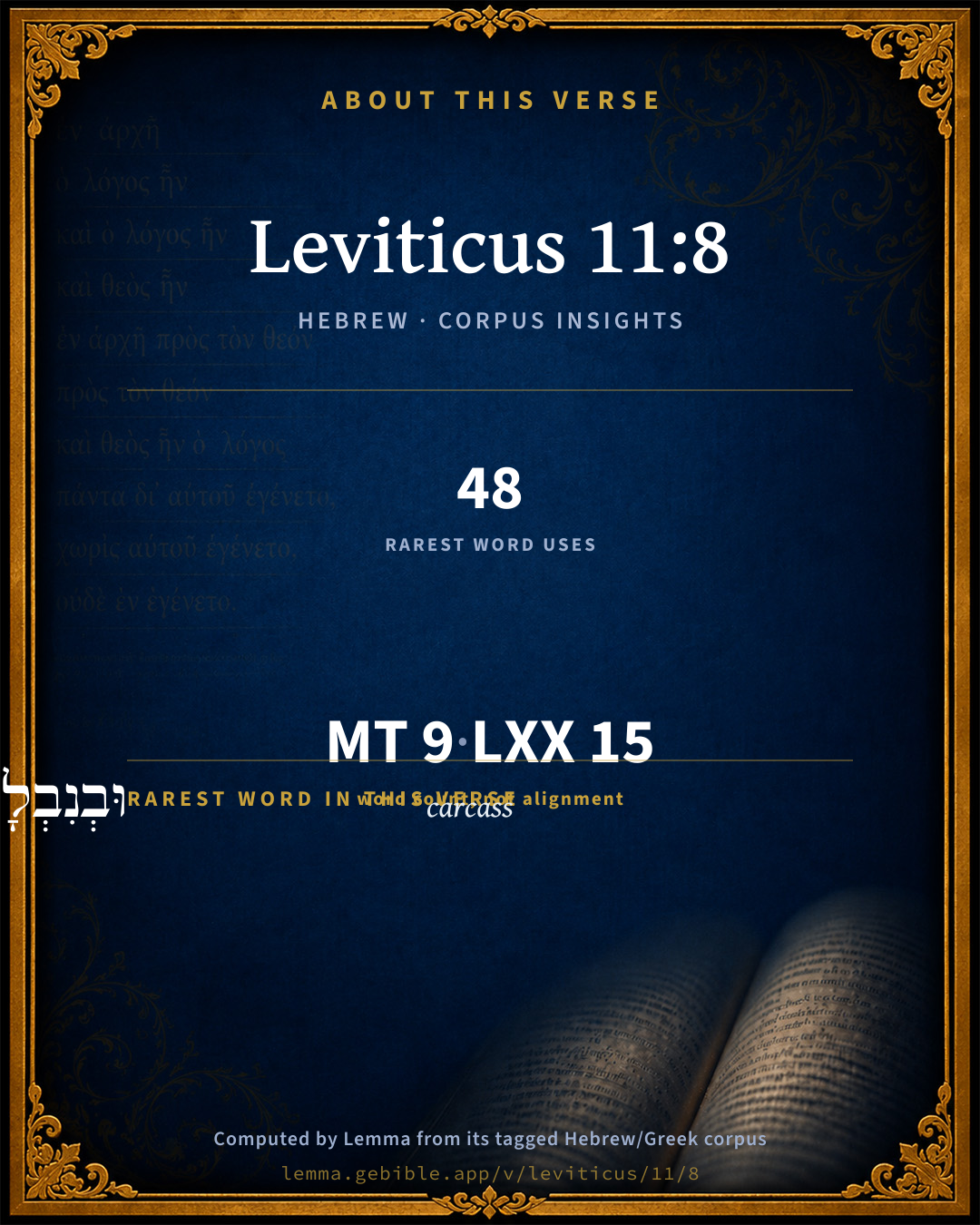
9
words
7
distinct lemmas
Pentateuch
section

Shared distinctive vocabulary

וּבְנִבְלָתָ֖ם carcass H5038 occurs in 41 verses of the Hebrew Bible. Also found in:

Grammatical profile

  • 2 verbs
  • 2 nouns
  • 1 adjective
  • 1 pronoun
  • 1 preposition
  • 2 particles

Verb forms

  • תֹאכֵ֔לוּ Qal · Imperfect
  • תִגָּ֑עוּ Qal · Imperfect

Repetition

A word recurs within this verse — often emphatic in Hebrew:

Hebrew & Septuagint length

In English translation the verse runs 19 words from the Hebrew and 19 from the Septuagint (LXX English) — the same length.

A rough comparison of the two English renderings, which tokenize alike — not a word-level alignment.

Word counts can differ between the Hebrew and the Greek without any difference in meaning — e.g. the Hebrew direct-object marker אֵת has no separate Greek word, and Greek often adds the article ὁ.

In the original languages it is 9 Hebrew tokens and 15 Greek tokens — but the two are counted differently (Hebrew bundles its prefixes and suffixes into one token; the Greek is in lemma form), so that isn’t a like-for-like length.

Cross-references

20

Topical passages linked to Leviticus 11:8 in the Treasury of Scripture Knowledge — connected by theme and wording, ordered by reader-vote popularity; previews shown in the World English Bible.

  • Colossians 2:16 Let no man therefore judge you in eating, or in drinking, or with respect to a feast day or a new moon or a Sabbath day,
  • Hebrews 9:10 being only (with meats and drinks and various washings) fleshly ordinances, imposed until a time of reformation.
  • Leviticus 5:2 "'Or if anyone touches any unclean thing, whether it is the carcass of an unclean animal, or the carcass of unclean cattle, or the carcass of unclean creeping things, and it is hidden from him, and he is unclean, then he shall be guilty.
  • Isaiah 52:11 Depart you, depart you, go you out from there, touch no unclean thing; go you out of the midst of her; cleanse yourselves, you who bear the vessels of Yahweh.
  • Hosea 9:3 They won't dwell in Yahweh's land; But Ephraim will return to Egypt, And they will eat unclean food in Assyria.
  • Matthew 15:11 That which enters into the mouth doesn't defile the man; but that which proceeds out of the mouth, this defiles the man."
  • Matthew 15:20 These are the things which defile the man; but to eat with unwashed hands doesn't defile the man."
  • Mark 7:2 Now when they saw some of his disciples eating bread with defiled, that is, unwashed, hands, they found fault.
  • Mark 7:15 There is nothing from outside of the man, that going into him can defile him; but the things which proceed out of the man are those that defile the man.
  • Mark 7:18 He said to them, "Are you thus without understanding also? Don't you perceive that whatever goes into the man from outside can't defile him,
  • Acts 10:10–15 He became hungry and desired to eat, but while they were preparing, he fell into a trance.
  • Acts 10:28 He said to them, "You yourselves know how it is an unlawful thing for a man who is a Jew to join himself or come to one of another nation, but God has shown me that I shouldn't call any man unholy or unclean.
  • Acts 15:29 that you abstain from things sacrificed to idols, from blood, from things strangled, and from sexual immorality, from which if you keep yourselves, it will be well with you. Farewell."
  • Romans 14:14–17 I know, and am persuaded in the Lord Jesus, that nothing is unclean of itself; except that to him who considers anything to be unclean, to him it is unclean.
  • Romans 14:21 It is good to not eat meat, drink wine, nor do anything by which your brother stumbles, is offended, or is made weak.
  • 1 Corinthians 8:8 But food will not commend us to God. For neither, if we don't eat, are we the worse; nor, if we eat, are we the better.
  • 2 Corinthians 6:17 Therefore, "'Come out from among them, And be separate,' says the Lord, 'Touch no unclean thing. I will receive you.
  • Ephesians 5:7 Therefore don't be partakers with them.
  • Ephesians 5:11 Have no fellowship with the unfruitful works of darkness, but rather even reprove them.
  • Colossians 2:21–23 "Don't handle, nor taste, nor touch"

Cross-references courtesy of OpenBible.info (CC BY 4.0).

Hebrew and Greek witnesses Masoretic Hebrew ↔ Greek Septuagint

The same verse in the two great witnesses to the Old Testament, shown verse-for-verse.

These are two independent witnesses, not word-aligned to each other, and the Septuagint is shown in lemma (dictionary) form.

Hebrew Leviticus 11:8 Masoretic · Westminster Leningrad Codex

מִבְּשָׂרָם֙ לֹ֣א תֹאכֵ֔לוּ וּבְנִבְלָתָ֖ם לֹ֣א תִגָּ֑עוּ טְמֵאִ֥ים הֵ֖ם לָכֶֽם

Of their flesh you shall not eat, and their carcasses you shall not touch; they are unclean to you.

World English Bible · Public Domain

Greek LXX Leviticus 11:8 Septuagint · lemma form

ἀπό ὁ κρέας αὐτός οὐ ἐσθίω καί ὁ θνησιμαῖος αὐτός οὐ ἅπτομαι ἀκάθαρτος οὗτος σύ

You⌃ shall not eat of their flesh, and you⌃ shall not touch their carcasses; these are unclean to you.

LXX2012 (modern English Septuagint) · Public Domain

Hebrew: Westminster Leningrad Codex (CC BY 4.0). Greek: Septuagint (public domain); English from LXX2012 (modern English Septuagint) (Public Domain). How the Septuagint differs from the Hebrew →

Targum (Aramaic paraphrase)

2

The Targum is the ancient Jewish Aramaic paraphrase of the Hebrew Scriptures — an interpretive translation, not the Hebrew text itself. Onkelos (literal) and Pseudo-Jonathan (expansive) render the Torah, and Jonathan the Prophets. Coverage is partial: where no permissively-licensed English translation exists for a verse, only the Aramaic is shown. This is verse-level text, not a word-by-word alignment to the Hebrew.

  1. Targum Onkelos Torah (Genesis–Deuteronomy)
    מִבִּסְרְהוֹן לָא תֵיכְלוּן וּבִנְבִלְתְּהוֹן לָא תִקְרְבוּן מְסָאֲבִין אִנוּן לְכוֹן

    (no public-domain English translation for this verse)

    Targum Onkelos — Aramaic: “Onkelos Genesis” (public domain); “Onkelos Exodus” (public domain); “Onkelos Leviticus” (public domain); “Onkelos Numbers” (public domain); “Onkelos Deuteronomy” (public domain). English: “Sefaria Community Translation” (CC0 1.0 (public-domain dedication)); “J.W. Etheridge. The Targums of Onkelos and Jonathan Ben Uzziel on the Pentateuch. London: Longmans, Green, 1862” (public domain). Text via Sefaria.

  2. Targum Pseudo-Jonathan Torah (Genesis–Deuteronomy)
    מִבִּשְרֵיהוֹן לָא תֵיכְלוּן וּבִנְבֵילְתְּהוֹן לָא תְקַרְבוּן מְסָאֲבִין אִינוּן לְכוֹן

    Of their flesh you shall not eat, nor touch their carcase; they are abominable to you.

    Targum Pseudo-Jonathan — Aramaic: “Targum Jonathan on Genesis” (public domain); “Targum Jonathan on Exodus” (public domain); “Targum Jonathan on Leviticus” (public domain); “Targum Jonathan on Numbers” (public domain); “Targum Jonathan on Deuteronomy” (public domain). English: “The Targum of Jonathan ben Uzziel, trans. J. W. Etheridge, London, 1862” (public domain). Text via Sefaria.

Commentary

Notes on Leviticus 11:8 from classic Christian and Jewish commentators (each source and its license shown beneath its notes). The classic Christian expositions comment on the surrounding passage and are grouped to its opening verse, so a note may address several verses; the Jewish commentaries on the Tanakh (Rashi and others) are per-verse, so they appear only where the commentator wrote on this verse.

Lemma curates 59 commentaries, every one of them public domain or Creative Commons licensed, each selected and text-cleaned for this edition rather than reprinted as found. About our sources →

Trapp's Complete Commentary

John Trapp

Lev 11:8 Of their flesh shall ye not eat, and their carcase shall ye not touch; they [are] unclean to you.

Ver. 8. Of their flesh shall ye not eat.] Not above the quantity of an olive, say the Jew doctors, who will needs be mending magnificat, adding to the law.

John Trapp, A Commentary or Exposition upon All the Books of the Old and New Testament (1647–1656) — public domain. Text from a community e-Sword module.

Joseph Benson's Commentary

Lev 11:8. Ye shall not touch — Not in order to eating. But the fat and skins of some of the forbidden creatures were useful, and might be used by them.

Joseph Benson's Commentary on the Old and New Testaments (1811–1818) — public domain. Text from a community e-Sword module.

Geneva Bible (1599)

Geneva Bible translators

God would that hereby for a time they should be discerned as his people from the Gentiles.

Geneva Bible (1599) marginal notes — public domain. Text via Bolls.life.

Ellicott's Commentary for English Readers

(8) Of their flesh ye shall not eat.—During the second Temple the prohibition was defined to extend to the smallest quantity. If any one ate a piece of flesh less even than the size of an olive he was chastised with stripes.

And their carcase shall ye not touch.—As contact with a human dead body, which was regarded as the most defiling of all, was only forbidden to the priests (see Lev_21:1-3), hence the prohibition here addressed to the whole nation was interpreted during the second Temple to apply simply to the occasions when the Israelites came to Jerusalem on the pilgrimage festivals. Contact with a carcase of an unclean animal on these visits precluded the worshipper from entering the sanctuary, from touching sacred things, and from partaking of the sacrificial meats.

A Bible Commentary for English Readers, edited by Charles John Ellicott (1878–1897) — public domain. Text from a community e-Sword module.

The Cambridge Bible for Schools and Colleges

gen. ed. J. J. S. Perowne

8. their carcases ye shall not touch] The word carcase is the same as that translated ‘that which dieth of itself’ (Lev_17:15; Deu_14:21). Here and in Deu_14:8 contact with the dead bodies of these unclean animals is prohibited.

The Cambridge Bible for Schools and Colleges (gen. ed. J. J. S. Perowne; Cambridge University Press, 1878–1918) — public domain. Text from a community e-Sword module.

John Gill's Exposition

Of their flesh shall ye not eat,.... Meaning, not of swine only, but of the camel, coney, and hare:

and their carcass shall ye not touch; which must not be understood of touching them in any sense; for then it would have been unlawful for a Jew to have rode upon a camel, or to take out and make use of hog's lard in medicine; but of touching them in order to kill them, and prepare them for food, and eat them; and indeed all unnecessary touching of them is forbidden, lest it should bring them to the eating of them; though perhaps it may chiefly respect the touching of them dead:

they are unclean to you: one and all of them; for as this was said of each of them in particular, so now of all of them together; and which holds good of all wild creatures not named, to whom the description above belongs, and which used to be eaten by other nations; some of which were called Pamphagi, from eating all sorts, and others Agriophagi, from eating wild creatures, as lions, panthers, elephants (l), &c.

(l) Plin. l. 6. c. 30. Solinus, c. 43.

John Gill's Exposition of the Whole Bible (1746–1763) — public domain (CC PDM 1.0). Text via the HelloAO Bible API.

Haydock's Catholic Bible Commentary

Carcasses. They might be touched while alive, ver. 24.

George Leo Haydock (1774–1849), Haydock's Catholic Family Bible and Commentary, 1859 edition — public domain. Excludes Psalms (Douay-Rheims chapter numbering differs from Protestant) and Deuterocanonical books (Catholic canon only).

Matthew Poole's English Annotations

Ye shall not touch, to wit, in order to eating, as may be gathered by comparing this with Gen 3:3; Col 2:21. For since the fat and the skins of some of the forbidden creatures were useful for medicinal and other good uses, and were used by good men; see Mat 3:4; it is not probable that God would have them cast away. Thus God forbad the making of images, Exo 20, not absolutely and universally, but in order to the worshipping of them, as Christian interpreters agree. Or, they were here forbidden to touch them, to wit, unnecessarily; and if he that touched them for some necessary use were polluted by it, it was but a slight and transient pollution, ending at evening, as appears from Lev 11:24,25, &c.

Matthew Poole's English Annotations on the Holy Bible (1683–1685) — public domain. Text from a community e-Sword/MySword module.

The Pulpit Commentary

Of their carcass shall ye not touch. This prohibition is founded upon the same feeling of disgust as the prohibition of eating their flesh. Whatever is foal must be avoided.

The Pulpit Commentary (1880–1919), ed. H.D.M. Spence-Jones & Joseph S. Exell — public domain. Text from a community e-Sword module.

John Wesley's Explanatory Notes

Ye shall not touch - Not in order to eating, as may be gathered by comparing this with Gen. iii, 3. But since the fat and skins of some of the forbidden creatures were useful, for medicinal and other good purposes, and were used by good men, it is not probable that God would have them cast away. Thus God forbad the making of images, Exod. xx, 4, not universally, but in order to the worshipping them, as Christian interpreters agree.

John Wesley, Explanatory Notes Upon the Whole Bible (1754–1765) — public domain. Text via the GEBible commentary corpus.

Rashi

Rabbi Shlomo Yitzchaki (Rashi)

מבשרם לא תאכלו OF THEIR FLESH SHALL YE NOT EAT — I have here only a law about these animals mentioned here! Whence can I derive that the same applies to other unclean animals which have no sign of cleanness at all? You must admit that it is a conclusion a fortiori: How is it with these that have some signs of cleanness? They are forbidden! how much the more must this be so in the case of cattle which do not possess even one sign of cleanness! (Sifra, Shemini, Chapter 3 2).

מבשרם OF THEIR FLESH [SHALL YE NOT EAT] — with respect to their flesh one is placed under a prohibition to eat, but not in respect to the bones, sinews, horns and claws (Sifra, Shemini, Chapter 4 8).

ובנבלתם לא תגעו AND THEIR CARRION SHALL YE NOT TOUCH — One might think that Israelites (i. e. non-priests) are prohibited from touching a carcass at any time! It, however, states, (Leviticus 21:1) in reference to uncleanness in touching a corpse: “Speak unto the priests etc.” — priests are prohibited (from touching it) and Israelites in general are not prohibited. Well, you can draw a conclusion a fortiori from now (i. e. consequent upon what you have now stated): How is it in the case of uncleanness caused by a corpse, which is a stringent kind of uncleanness? The Torah prohibits it only to priests, but ordinary Israelites may touch a corpse. Surely in the case of uncleanness caused by a carcass which is less stringent this is all the more so! Then why does it state here: “[and their carrion] shall ye not touch”? — It means on a festival when every male Israelite was obliged to appear in the Sanctuary and should therefore be in a state of cleanness (Sifra, Shemini, Chapter 4 8-9; Rosh Hashanah 16b).

Rashi on the Tanakh — English translations: “The Judaica Press complete Tanach with Rashi, translated by A. J. Rosenberg” (CC BY 4.0); “Pentateuch with Rashi's commentary by M. Rosenbaum and A.M. Silbermann, 1929-1934” (public domain); “The Metsudah Tanach series, Lakewood, N.J” (CC BY 4.0); and “The Book of Joshua, Metsudah Publications, 1997” (CC BY 4.0). Text via Sefaria.

Ramban (Nachmanides)

Rabbi Moshe ben Nachman (Ramban / Nachmanides)

AND THEIR CARCASSES YE SHALL NOT TOUCH. This is not a prohibition [saying that] we are not to touch these carcasses [of the animals that we are forbidden to eat]. Rather, Scripture states, and their carcasses ye shall not touch, for they are unclean to you, meaning to say, “you cannot touch them without becoming unclean.” The meaning thereof is to state that all those who touch them should be aware that they have become unclean and should therefore be careful not to enter the Sanctuary nor [to eat] of the hallowed offerings. Perhaps the meaning of the interpretation which our Rabbis have said: “And their carcasses ye shall not touch — on a festival” is to say that “you should not touch them at a time when you want to be clean, for they are unclean [and by touching them you will also become unclean] and you will not be able to go up to the Sanctuary on the festival.” But the [mere] act of touching them is not forbidden by means of a negative commandment, for he who touches carrion [even] on a festival does not incur whipping [by law of the Torah]. Thus that which the Rabbis have said: “One is dutybound to purify oneself on a festival,” is a commandment of Rabbinic authority, there being according to Scriptural law neither a positive nor a negative commandment, concerning the touching of carrion, except that of going up to the Sanctuary. Or it may be that the interpretation, “And their carcasses ye shall not touch — on a festival,” is a Scriptural text used as a support for the Rabbinical enactment, p. 314, Note 449. like many other laws of the Sages taught there in the Torath Kohanim, which use Biblical texts as a “support.” It is also taught there: 2:6. “Other Rabbis (others). See Horayoth 13 b, for the reason of this name. say: One might think that if a person touches a carcass [he violates a negative commandment and] is liable to whipping? Scripture therefore says, By these ye shall become unclean. From this one might think that if a person sees a carcass he must go and render himself unclean by [touching] it? Scripture therefore says, and their carcasses ye shall not touch. How are we to reconcile these two verses? We must conclude that [touching a carcass] is optional” [i.e., neither obligatory, nor forbidden]. This is the main principle of the Scriptural law.

Ramban (Nachmanides) on the Tanakh — English translation: “Commentary on the Torah by Ramban (Nachmanides). Translated and annotated by Charles B. Chavel. New York, Shilo Pub. House, 1971-1976” (CC BY 4.0). Text via Sefaria.

Lesson kit

Teaching starters — assembled from the data on this page, not authored interpretation. Every prompt links to the verse data it draws on. Edit before teaching.

Leviticus, in the Pentateuch, opens this verse with 9 words (7 distinct Hebrew lemmas). Its most distinctive word is nᵉbêlâh (“carcass”). A historical commentator’s framing appears above. Read the whole chapter for the surrounding context.

Discussion questions

  1. What does “carcass” (nᵉbêlâh) contribute to the verse as a whole?
  2. Leviticus 5:2 shares the word «carcass» with this verse. How do the two illuminate each other?
  3. “not” occurs 2× in this one verse. What is the effect of the repetition?
  4. These translations render this verse differently; the difference is in the English rendering, not the original. What questions does that raise?
  5. The verb «תֹאכֵ֔לוּ» is Qal Imperfect. How does its form color the action?
  6. Reading how Trapp's Complete Commentary and Joseph Benson's Commentary read this verse, where do the two commentators agree and where do they part?

Things to notice

Reading settings

Reading text

Shown beneath each verse's original-language words.

Old Testament
Old Testament edition

Read the OT as the Masoretic Hebrew (MT) or the Greek Septuagint (LXX).

English shown for the Greek Septuagint (in the Hebrew ↔ Greek comparison).

Comparing translations? Open the Compare panel on any verse page to stack up to four side by side.