
Deuteronomy 33:17

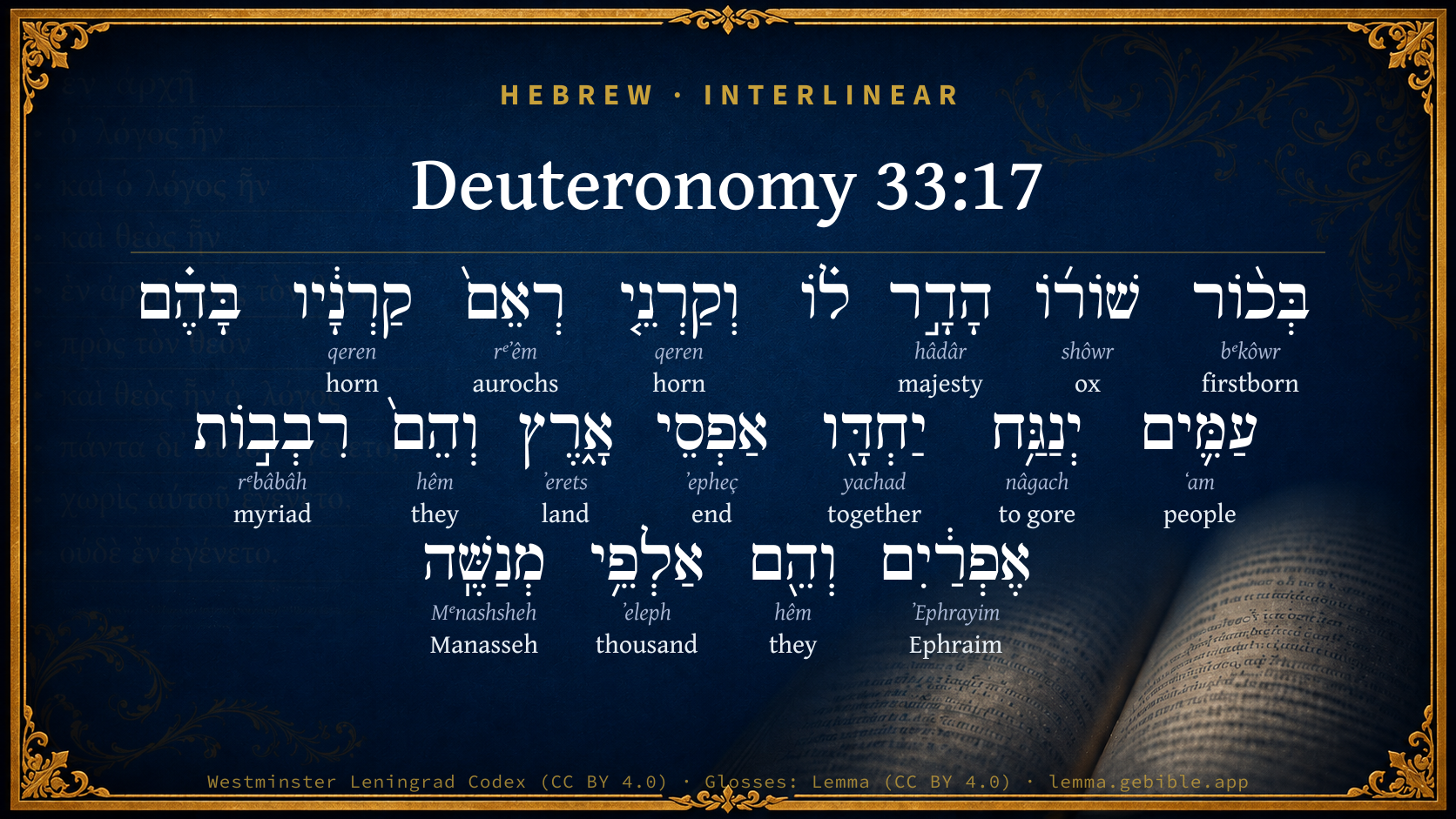
Hebrew (Westminster Leningrad Codex) Deuteronomy 33:17 appears in the Hebrew Old Testament. The text above is from the Westminster Leningrad Codex. Each word links to its Strong’s number, a concise gloss, and parsing drawn from the Open Scriptures Hebrew Bible morphology. Click any word for its full Brown-Driver-Briggs (BDB) entry.
Download image
Cite this verse

Deuteronomy 33:17 (World English Bible). Public Domain. Lemma interlinear Bible study tool, https://lemma.gebible.app/v/deuteronomy/33/17.

Show BibTeX & RIS
BibTeX
RIS
English Translation
The firstborn of his herd, majesty is his; His horns are the horns of the wild-ox: With them he shall push the peoples all of them, [even] the ends of the earth: They are the ten thousands of Ephraim, They are the thousands of Manasseh.
World English Bible · Public Domain
Download a study sheet

One document with this verse’s original text, its word-by-word gloss line, the meaning frame, cross-references with their text, attributed commentary, and full source and license credits — printable, and it pastes into notes with its structure intact.

This verse Autodidact and up

Study sheet (.html) Plain text (.txt)

A passage Seminary Student

Up to 50 verses in one chapter. A passage sheet keeps up to 6 commentary sources and 12 cross-references per verse, in the order this page ranks them, and says so on the sheet whenever that leaves anything out. Ask for a single verse and you get the Autodidact verse sheet above.

Everything on this page stays free to read, with no account — the sheet is a download of what is already on screen, not access to it.

Want to remove ads? Support Godless Engineer
Compare translations 3

The same verse in 3 English versions, stacked beneath the original-language interlinear above. Click any original word for its lexicon entry.

Each is an independent rendering of the whole verse — the interlinear is not word-aligned to these translations.

Highlighted words mark where these versions differ — a whole-verse word diff, not a word-by-word alignment.

  • World English Bible Public Domain
    The firstborn of his herd, majesty is his; His horns are the horns of the wild-ox: With them he shall push the peoples all of them, [even] the ends of the earth: They are the ten thousands of Ephraim, They are the thousands of Manasseh.
  • King James Version Public Domain
    His glory is like the firstling of his bullock, and his horns are like the horns of unicorns: with them he shall push the people together to the ends of the earth: and they are the ten thousands of Ephraim, and they are the thousands of Manasseh.
  • unfoldingWord Literal Text CC BY-SA 4.0
    His firstborn ox his majesty, and the horns of a wild ox his horns. With them he will ram the peoples together to the ends of the earth, And they the ten thousands of Ephraim, and they the thousands of Manasseh.”

unfoldingWord Literal Text — © unfoldingWord, licensed CC BY-SA 4.0. Word-aligned USFM3 via Door43 (git.door43.org/unfoldingWord/en_ult).

Versions to compare (up to 4)

3 of 4 selected

Show all 18 translations

Every available English version of this verse, each an independent rendering of the whole verse.

  • World English Bible Public Domain
    The firstborn of his herd, majesty is his; His horns are the horns of the wild-ox: With them he shall push the peoples all of them, [even] the ends of the earth: They are the ten thousands of Ephraim, They are the thousands of Manasseh.
  • Berean Standard Bible Public Domain
    His majesty is like a firstborn bull, and his horns are like those of a wild ox. With them he will gore the nations, even to the ends of the earth. Such are the myriads of Ephraim, and such are the thousands of Manasseh.”
  • Majority Standard Bible Public Domain
    His majesty is like a firstborn bull, and his horns are like those of a wild ox. With them he will gore the nations, even to the ends of the earth. Such are the myriads of Ephraim, and such are the thousands of Manasseh.”
  • King James Version Public Domain
    His glory is like the firstling of his bullock, and his horns are like the horns of unicorns: with them he shall push the people together to the ends of the earth: and they are the ten thousands of Ephraim, and they are the thousands of Manasseh.
  • American Standard Version (1901) Public Domain
    The firstling of his herd, majesty is his; And his horns are the horns of the wild-ox: With them he shall push the peoples all of them, `even' the ends of the earth: And they are the ten thousands of Ephraim, And they are the thousands of Manasseh.
  • Revised Version (1885) Public Domain
    The firstling of his bullock, majesty is his; And his horns are the horns of the wild-ox: With them he shall push the peoples all of them, even the ends of the earth: And they are the ten thousands of Ephraim, And they are the thousands of Manasseh.
  • Geneva Bible (1599) Public Domain
    His beautie shalbe like his first borne bullock, and his hornes as the hornes of an vnicorne: with them hee shall smite the people together, euen the endes of the world: these are also the ten thousands of Ephraim, and these are the thousands of Manasseh.
  • Douay-Rheims (1899) Public Domain
    His beauty as of the firstling of a bullock, his horns as the horns of a rhinoceros: with them shall he push the nations even to the ends of the earth These are the multitudes of Ephraim and these the thousands of Manasses.
  • Young's Literal Translation Public Domain
    His honour `is' a firstling of his ox, And his horns `are' horns of a reem; By them peoples he doth push together To the ends of earth; And they `are' the myriads of Ephraim, And they `are' the thousands of Manasseh.
  • Literal Standard Version CC BY-SA 4.0
    His splendor [is] a firstling of his ox, || And his horns [are] horns of a wild ox; With them he pushes the peoples || Altogether to the ends of the earth; And they [are] the myriads of Ephraim, || And they [are] the thousands of Manasseh.
  • Unlocked Literal Bible CC BY-SA 4.0
    The firstborn of an ox, majestic is he, and his horns are the horns of a wild ox. With them he will push the peoples, all of them, to the ends of the earth. These are the ten thousands of Ephraim; these are the thousands of Manasseh.
  • unfoldingWord Literal Text CC BY-SA 4.0
    His firstborn ox his majesty, and the horns of a wild ox his horns. With them he will ram the peoples together to the ends of the earth, And they the ten thousands of Ephraim, and they the thousands of Manasseh.”
  • Darby Bible Public Domain
    His majesty is as the firstling of his ox; And his horns are as the horns of a buffalo. With them shall he push the peoples Together to the ends of the earth. These are the myriads of Ephraim, And these are the thousands of Manasseh.
  • World Messianic Bible Public Domain
    Majesty belongs to the firstborn of his herd. His horns are the horns of the wild ox. With them he will push all the peoples to the ends of the earth. They are the ten thousands of Ephraim. They are the thousands of Manasseh.”
  • Webster's Bible Public Domain
    His glory is like the firstling of his bullock, and his horns are like the horns of unicorns: with them he shall push the people together to the ends of the earth: and they are the ten thousands of Ephraim, and they are the thousands of Manasseh.
  • Free Bible Version CC BY-SA 4.0
    He is as majestic as a firstborn bull; his horns are like those of a wild ox. He will use them to gore the nations, driving them to the ends of the earth. The horns represent the ten thousands of Ephraim, and the thousands of Manasseh.”
  • Bible in Basic English Public Domain
    He is a young ox, glory is his; his horns are the horns of the mountain ox, with which all peoples will be wounded, even to the ends of the earth: they are the ten thousands of Ephraim and the thousands of Manasseh.
  • JPS Tanakh (1917) Public Domain
    His firstling bullock, majesty is his; and his horns are the horns of the wild-ox; with them he shall gore the peoples all of them, even the ends of the earth; and they are the ten thousands of Ephraim, and they are the thousands of Manasseh.

Literal Standard Version (2020), Covenant Press — licensed CC BY-SA 4.0. Text via the HelloAO Bible API (eBible.org). Unlocked Literal Bible (unfoldingWord) — licensed CC BY-SA 4.0. Text via the HelloAO Bible API (eBible.org). unfoldingWord Literal Text — © unfoldingWord, licensed CC BY-SA 4.0. Word-aligned USFM3 via Door43 (git.door43.org/unfoldingWord/en_ult). Free Bible Version, Dr. Jonathan Gallagher — licensed CC BY-SA 4.0. Text via the HelloAO Bible API (eBible.org).

Word by word

More ways to search: Search by grammar → Find every occurrence → Compare this word →

Practice this passage: Drill this verse → Learn its vocabulary →

רְאֵם֙
rᵉʼêm
H7214
“aurochs”
Noun, Common, Masculine, Singular, Absolute
Part of Speech
Noun
Type
Common
Gender
Masculine
Number
Singular
State
Absolute
Full BDB Definition

Origin: from H7213

TWOT: 2096a

probably the great aurochs or wild bulls which are now extinct. The exact meaning is not known.
  1. בְּכ֨וֹר bᵉkôwr H1060 “firstborn of” Noun, Common, Masculine, Singular, Construct
  2. שׁוֹר֜וֹ shôwr H7794 “ox · his” Noun, Common, Masculine, Singular, Construct + Suffix, Personal, 3rd Person, Masculine, Singular
  3. הָדָ֣ר hâdâr H1926 “majesty” Noun, Common, Masculine, Singular, Absolute
  4. וְקַרְנֵ֤י qeren H7161 “and · horns of” Conjunction + Noun, Common, Both, Dual, Construct
  5. קַרְנָ֔יו qeren H7161 “horns · his” Noun, Common, Both, Dual, Construct + Suffix, Personal, 3rd Person, Masculine, Singular
  6. עַמִּ֛ים ʻam H5971 “peoples” Noun, Common, Masculine, Plural, Absolute
  7. יְנַגַּ֥ח nâgach H5055 “to gore” Verb, Piel, Imperfect, 3rd Person, Masculine, Singular
  8. יַחְדָּ֖ו yachad H3162 “together” Adverb
  9. אַפְסֵי ʼepheç H657 “ends of” Noun, Common, Masculine, Plural, Construct
  10. אָ֑רֶץ ʼerets H776 “land” Noun, Common, Both, Singular, Absolute
  11. וְהֵם֙ hêm H1992 “and · they” Conjunction + Pronoun, Personal, 3rd Person, Masculine, Plural
  12. רִבְב֣וֹת rᵉbâbâh H7233 “myriads of” Noun, Common, Feminine, Plural, Construct
  13. אֶפְרַ֔יִם ʼEphrayim H669 “Ephraim” Noun, Proper
  14. וְהֵ֖ם hêm H1992 “and · they” Conjunction + Pronoun, Personal, 3rd Person, Masculine, Plural
  15. אַלְפֵ֥י ʼeleph H505 “thousand” Adjective, Cardinal number, Both, Plural, Construct
  16. מְנַשֶּֽׁה Mᵉnashsheh H4519 “Manasseh” Noun, Proper

About this verse

These counts appear in no published source. They are computed here, from the morphology-tagged text and Lemma’s own curated glosses. What Lemma adds →

19
words
15
distinct lemmas
Pentateuch
section

Notable vocabulary

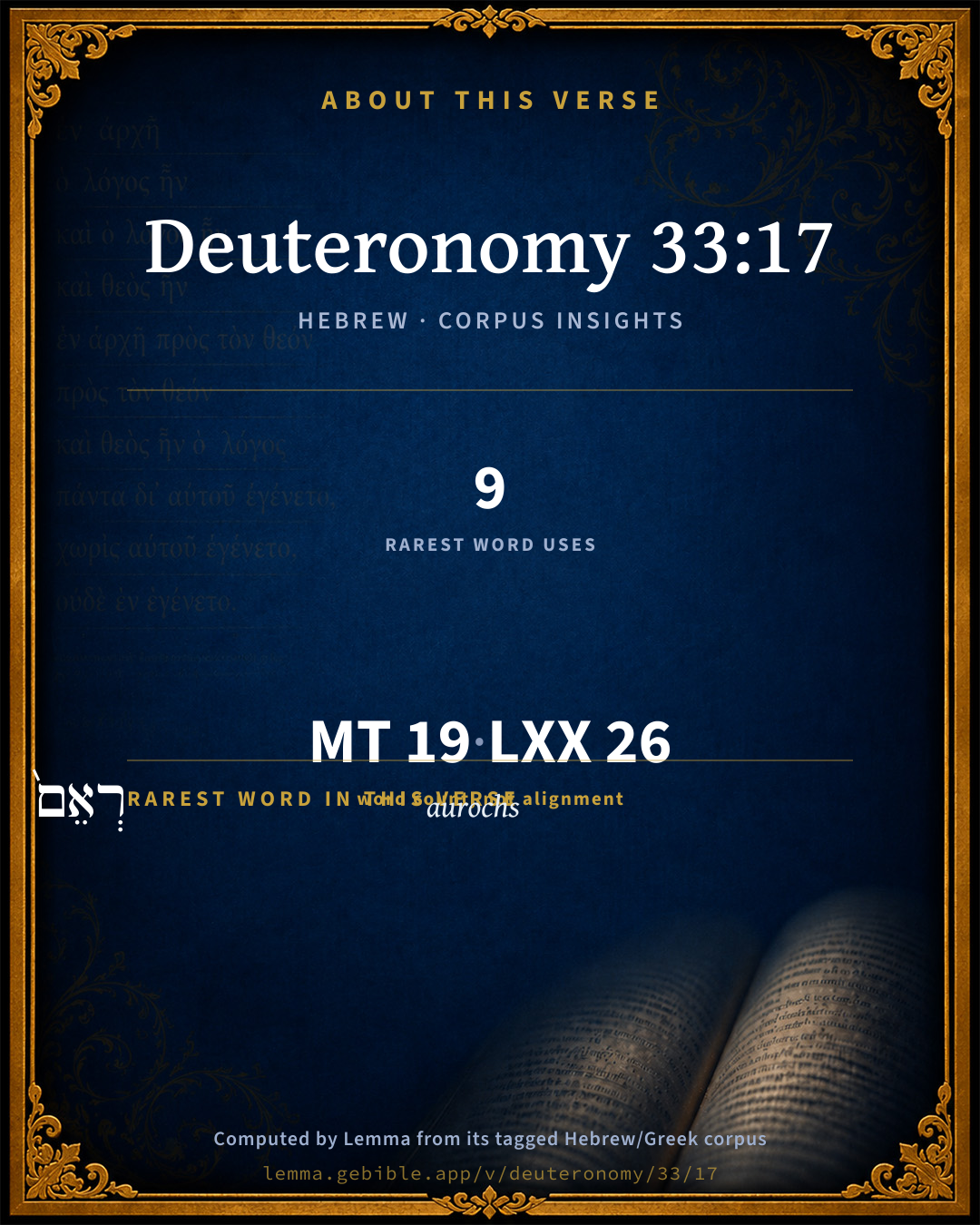
The rarest word here is רְאֵם֙ aurochs H7214 — appearing just 9 times in the whole Hebrew Bible.

Shared distinctive vocabulary

רְאֵם֙ aurochs H7214 occurs in 9 verses of the Hebrew Bible. Also found in:

Grammatical profile

  • 1 verb
  • 12 nouns
  • 1 adjective
  • 2 pronouns
  • 2 prepositions
  • 1 adverb

Verb forms

  • יְנַגַּ֥ח Piel · Imperfect

Repetition

Words recur within this verse — often emphatic in Hebrew:

  • וְקַרְנֵ֤י horn H7161 ×2
  • וְהֵם֙ they H1992 ×2

Hebrew & Septuagint length

In English translation the verse runs 45 words from the Hebrew and 47 from the Septuagint (LXX English) — closely comparable.

A rough comparison of the two English renderings, which tokenize alike — not a word-level alignment.

Word counts can differ between the Hebrew and the Greek without any difference in meaning — e.g. the Hebrew direct-object marker אֵת has no separate Greek word, and Greek often adds the article ὁ.

In the original languages it is 19 Hebrew tokens and 26 Greek tokens — but the two are counted differently (Hebrew bundles its prefixes and suffixes into one token; the Greek is in lemma form), so that isn’t a like-for-like length.

Cross-references

17

Topical passages linked to Deuteronomy 33:17 in the Treasury of Scripture Knowledge — connected by theme and wording, ordered by reader-vote popularity; previews shown in the World English Bible.

  • Numbers 23:22 God brings them forth out of Egypt; He has as it were the strength of the wild-ox.
  • 1 Kings 22:11 Zedekiah the son of Chenaanah made him horns of iron, and said, Thus says Yahweh, With these shall you push the Syrians, until they be consumed.
  • Psalms 44:5 Through you, will we push down our adversaries. Through your name, will we tread them under who rise up against us.
  • Genesis 48:19 His father refused, and said, "I know, my son, I know. He also will become a people, and he also will be great. However, his younger brother will be greater than he, and his seed will become a multitude of nations."
  • Numbers 24:8 God brings him forth out of Egypt; He has as it were the strength of the wild-ox: He shall eat up the nations his adversaries, Shall break their bones in pieces, Smite [them] through with his arrows.
  • Psalms 92:10 But you have exalted my horn like that of the wild ox. I am anointed with fresh oil.
  • Numbers 26:34 These are the families of Manasseh; and those who were numbered of them were fifty-two thousand seven hundred.
  • Numbers 26:37 These are the families of the sons of Ephraim according to those who were numbered of them, thirty-two thousand five hundred. These are the sons of Joseph after their families.
  • 1 Chronicles 5:1 The sons of Reuben the firstborn of Israel (for he was the firstborn; but, because he defiled his father's couch, his birthright was given to the sons of Joseph the son of Israel; and the genealogy is not to be reckoned after the birthright.
  • 2 Chronicles 18:10 Zedekiah the son of Chenaanah made him horns of iron, and said, Thus says Yahweh, With these shall you push the Syrians, until they be consumed.
  • Job 39:9–10 "Will the wild ox be content to serve you? Or will he stay by your feeding trough?
  • Psalms 22:21 Save me from the lion's mouth; Yes, from the horns of the wild oxen you have answered me.
  • Psalms 29:6 He makes them also to skip like a calf; Lebanon and Sirion like a young, wild ox.
  • Isaiah 34:7 The wild-oxen shall come down with them, and the bulls with the bulls: and their land shall be drunken with blood, and their dust made fat with fatness.
  • Hosea 5:3 I know Ephraim, And Israel is not hidden from me; For now, Ephraim, you have played the prostitute. Israel is defiled.
  • Hosea 6:4 "Ephraim, what shall I do to you? Judah, what shall I do to you? For your love is like a morning cloud, And like the dew that disappears early.
  • Hosea 7:1 When I would heal Israel, Then the iniquity of Ephraim is uncovered, Also the wickedness of Samaria; For they commit falsehood, And the thief enters in, And the gang of robbers ravages outside.

Cross-references courtesy of OpenBible.info (CC BY 4.0).

Hebrew and Greek witnesses Masoretic Hebrew ↔ Greek Septuagint

The same verse in the two great witnesses to the Old Testament, shown verse-for-verse.

These are two independent witnesses, not word-aligned to each other, and the Septuagint is shown in lemma (dictionary) form.

Hebrew Deuteronomy 33:17 Masoretic · Westminster Leningrad Codex

בְּכ֨וֹר שׁוֹר֜וֹ הָדָ֣ר ל֗וֹ וְקַרְנֵ֤י רְאֵם֙ קַרְנָ֔יו בָּהֶ֗ם עַמִּ֛ים יְנַגַּ֥ח יַחְדָּ֖ו אַפְסֵי אָ֑רֶץ וְהֵם֙ רִבְב֣וֹת אֶפְרַ֔יִם וְהֵ֖ם אַלְפֵ֥י מְנַשֶּֽׁה

The firstborn of his herd, majesty is his; His horns are the horns of the wild-ox: With them he shall push the peoples all of them, [even] the ends of the earth: They are the ten thousands of Ephraim, They are the thousands of Manasseh.

World English Bible · Public Domain

Greek LXX Deuteronomy 33:17 Septuagint · lemma form

πρωτότοκος ταῦρος ὁ κάλλος αὐτός κέρας μονόκερως ὁ κέρας αὐτός ἐν αὐτός ἔθνος κερατίζω ἅμα ἕως ἐπί ἄκρος γῆ οὗτος μυριάς ἐφράιμ καί οὗτος χιλιάς μανασσή

His beauty is as the firstling of his bull, his horns are the horns of a unicorn; with them he shall thrust the nations at once, even from the end of the earth: these are the ten thousands of Ephraim, and these are the thousands of Manasse.

LXX2012 (modern English Septuagint) · Public Domain

On this verse, Adam Clarke's Commentary discusses the Septuagint’s reading. Read the note in Commentary ↓

Hebrew: Westminster Leningrad Codex (CC BY 4.0). Greek: Septuagint (public domain); English from LXX2012 (modern English Septuagint) (Public Domain). How the Septuagint differs from the Hebrew →

Targum (Aramaic paraphrase)

2

The Targum is the ancient Jewish Aramaic paraphrase of the Hebrew Scriptures — an interpretive translation, not the Hebrew text itself. Onkelos (literal) and Pseudo-Jonathan (expansive) render the Torah, and Jonathan the Prophets. Coverage is partial: where no permissively-licensed English translation exists for a verse, only the Aramaic is shown. This is verse-level text, not a word-by-word alignment to the Hebrew.

  1. Targum Onkelos Torah (Genesis–Deuteronomy)
    רַבָּא דִבְנוֹהִי זִיוָא לֵהּ וּגְבוּרָן דְאִתְעֲבִידָא לֵהּ מִקֳדָם דְתוּקְפָא וְרוּמָא דִילֵהּ בִּגְבֻרְתֵּהּ עַמְמַיָא יִקְטֵל כַּחֲדָא עַד סְיָפֵי אַרְעָא וְאִנוּן רִבְוָתָא דְבֵית אֶפְרַיִם וְאִנוּן אַלְפַיָא דְבֵית מְנַשֶׁה

    (no public-domain English translation for this verse)

    Targum Onkelos — Aramaic: “Onkelos Genesis” (public domain); “Onkelos Exodus” (public domain); “Onkelos Leviticus” (public domain); “Onkelos Numbers” (public domain); “Onkelos Deuteronomy” (public domain). English: “Sefaria Community Translation” (CC0 1.0 (public-domain dedication)); “J.W. Etheridge. The Targums of Onkelos and Jonathan Ben Uzziel on the Pentateuch. London: Longmans, Green, 1862” (public domain). Text via Sefaria.

  2. Targum Pseudo-Jonathan Torah (Genesis–Deuteronomy)
    בְּכוֹרוֹתָא הֲוָת חַמְיָא לִרְאוּבֵן וְאִתְנְטִילַת וְהִינוּן רִבְוָותָא דִקְטוֹל יְהוֹשֻׁעַ בַּר נוּן בְּגִילְגְלָא דְהוּא מִדְבֵית אֶפְרַיִם וְהִנוּן אַלְפַיָא דִקְטוֹל גִדְעוֹן בַּר יוֹאָשׁ בִּמְדִינָאֵי דְהוּא מִדְבֵית מְנַשֶׁה

    The birthright had belonged to Reuben, but was taken from him and given to Joseph at the beginning; from thence comes the splendour of his glory and praise. For as it may not be that a man should work the ground with the firstling of his herd, so are not the children of Joseph to be reduced to servitude among the kingdoms; and as the reema pusheth with his horns the beasts of the wilderness, so will the sons of Joseph predominate together among the peoples in all the ends of the earth. Myriads will be slain in Gulgela by Hoshea bar Nun who hath arisen from the house of Ephraim, and thousands of the Midyance by Gideon bar Yoash who will be of the tribe of Menasheh.

    Targum Pseudo-Jonathan — Aramaic: “Targum Jonathan on Genesis” (public domain); “Targum Jonathan on Exodus” (public domain); “Targum Jonathan on Leviticus” (public domain); “Targum Jonathan on Numbers” (public domain); “Targum Jonathan on Deuteronomy” (public domain). English: “The Targum of Jonathan ben Uzziel, trans. J. W. Etheridge, London, 1862” (public domain). Text via Sefaria.

Commentary

Notes on Deuteronomy 33:17 from classic Christian and Jewish commentators (each source and its license shown beneath its notes). The classic Christian expositions comment on the surrounding passage and are grouped to its opening verse, so a note may address several verses; the Jewish commentaries on the Tanakh (Rashi and others) are per-verse, so they appear only where the commentator wrote on this verse.

Lemma curates 59 commentaries, every one of them public domain or Creative Commons licensed, each selected and text-cleaned for this edition rather than reprinted as found. About our sources →

Trapp's Complete Commentary

John Trapp

Deu 33:17 His glory [is like] the firstling of his bullock, and his horns [are like] the horns of unicorns: with them he shall push the people together to the ends of the earth: and they [are] the ten thousands of Ephraim, and they [are] the thousands of Manasseh.

Ver. 17. His horns are like the horns of unicorns.] Justin Martyr {a} and some other of the ancients {b} have strangely racked and wrested this text, to wring out of it the sign of the cross, resembled and represented by the horn of a unicorn. At nihil hic de Christo, nihil de cruce.

He shall push the people together.] As General Joshua, of this tribe, did notably; so that Phoenicians ran away into a far country, and renowned his valour by a monument set up in Africa. Howbeit, Gratius ei fuit nomen pietatis, quam potestatis, as Tertullian saith of Augustus: He is more famous for his piety than for his prowess.

{a} Advers. Tryph.

{b} Tertul. Adver. Judaeos, cap. 10. Ambrose, De Benedict. Pat.

John Trapp, A Commentary or Exposition upon All the Books of the Old and New Testament (1647–1656) — public domain. Text from a community e-Sword module.

Joseph Benson's Commentary

Deu 33:17. His glory is like the firstling of his bullock — Or the prime and fairest bullock of the herd. For things that excel in their kind are called firstborn in Scripture. The beauty and strength of this tribe are compared to this stately creature, and a bullock being the best emblem of power among the beasts of the pasture, it seems to be here used to denote the superior honour and dignity of the house of Joseph above the rest of the tribes of Israel. Indeed, a bullock, as Bochart shows, was formerly used as an image of kingly power and dignity, and therefore seems here to denote the kingdom which Ephraim should obtain in Jeroboam and his successors. His horns are like the horns of unicorns — A horn is a common Scripture emblem of power and force. So this is a further description of the house of Joseph. With them he shall push the people together — That is, throw down all that oppose him, particularly the Canaanites; to the ends of the earth — That is, of the land of Canaan. The ten thousands of Ephraim, and the thousands of Manasseh — Or, such are, &c.; that is, these blessings belong to the two numerous branches of the house of Joseph. Here he ascribes to Ephraim ten thousands, and to Manasseh only thousands; thus foreshowing, that Ephraim the younger was to be the more numerous of the two, as Jacob had before prophesied of them.

Joseph Benson's Commentary on the Old and New Testaments (1811–1818) — public domain. Text from a community e-Sword module.

Tyndale Open Study Notes

Tyndale Open Resources

33:17 Ephraim is listed first because he received the blessing of the firstborn over Manasseh (Gen 48:8-22). Manasseh, the firstborn, would normally have received the double portion belonging to the firstborn (cp. Deut 21:17), but Jacob gave it to Ephraim, Joseph’s younger son. Moses’ blessing reflects Jacob’s blessing by listing the tribe of Ephraim as numbering in multitudes (literally tens of thousands) and Manasseh in thousands. After the conquest and establishment of the nation, Ephraim became the dominant tribe of the north; later, after the kingdom was divided following Solomon’s death (1 Kgs 12), the name Ephraim was used interchangeably with Israel in speaking of the northern kingdom.

Tyndale Open Study Notes — © Tyndale Open Resources, licensed CC BY-SA 4.0. Text via the HelloAO Bible API.

Geneva Bible (1599)

Geneva Bible translators

Or, strength.

Geneva Bible (1599) marginal notes — public domain. Text via Bolls.life.

Adam Clarke's Commentary

Verse 17. His glory is like the firstling of his bullock] This similitude is very obscure. A bullock was the most excellent of animals among the Jews, not only because of its acceptableness in sacrifice to God, but because of its great usefulness in agriculture. There is something peculiarly noble and dignified in the appearance of the ox, and his greatest ornament are his fine horns; these the inspired penman has particularly in view, as the following clause proves; and it is well known that in Scriptural language horns are the emblem of strength, glory, and sovereignty; Ps 75:5; Ps 75:10; Ps 89:17; Ps 89:24; Ps 112:9; Dan 8:3, c. Lu 1:69; Re 17:3, c.

His horns are like the horns of unicorns] ראם reem, which we translate unicorn, from the μονοκερως monokeros of the Septuagint, signifies, according to Bochart, the mountain goat and according to others, the rhinoceros, a very large quadruped with one great horn on his nose, from which circumstance his name is derived. See the notes on Nu 23:22; Nu 24:8. Reem is in the singular number, and because the horns of a unicorn, a one-horned animal, would have appeared absurd, our translators, with an unfaithfulness not common to them, put the word in the plural number.

To the ends of the earth] Of the land of Canaan, for Joshua with his armies conquered all this land, and drove the ancient inhabitants out before him.

They are the ten thousands of Ephraim, c.] That is, The horns signify the ten thousands of Ephraim, and the thousands of Manasseh. Jacob prophesied, Ge 48:19, that the younger should be greater than the elder so here TENS of thousands are given to Ephraim, and only thousands to Manasseh. See the census, Nu 1:33-35.

Adam Clarke's Commentary on the Bible (1810–1826) — public domain. Text from a community e-Sword/MySword module.

Ellicott's Commentary for English Readers

(17) They are the ten thousands of Ephraim, and they are the thousands of Manasseh.—Rashi refers this to the ten thousands slain by Joshua, the Ephraimite leader, and the thousands slain by Gideon, who was of the tribe of Manasseh. He expounds nearly the whole of the verse in reference to Joshua and the conquest of Canaan. There is an obvious similarity in the song of the Israelitish women after the defeat of the Philistines, “Saul hath slain his thousands, and David his ten thousands.” The people “pushed to the ends of the earth” are taken to be the thousands and ten thousands of conquered Canaanites and Midianites. For a similar metaphor, see 1Ki_22:11. Otherwise the ten thousands of Ephraim and the thousands of Manasseh would be the two-horned power of Joseph. (Comp. Dan_8:3; Dan_8:20 for a simile of the same kind.)

A Bible Commentary for English Readers, edited by Charles John Ellicott (1878–1897) — public domain. Text from a community e-Sword module.

The Cambridge Bible for Schools and Colleges

gen. ed. J. J. S. Perowne

17. For these two hierodules the Heb. is ḳadesh (masc.) and ḳedeshah (fem.) and means simply set apari, consecrated (cp. above, pp. 108 ff.), the former being probably the unsexed man referred to in Deu_22:5, Deu_23:1.

17. The firstling of his bullock] Ephraim, Gen_48:13 ff.

wild-ox] Heb. re’em, Ar. ri’m = the white antelope, leucoryx (see on Deu_14:5), but the descriptions in the O.T. prove that the Heb. re’em was rather the Ass. rimu, a gigantic species of ox (‘Bos primigenius’) now extinct, though its teeth have been found in the valley of the Nahr el-Kelb, in the district where Tiglath Pileser i. (b.c. 1120 ff.) hunted the rimu (Tristr. Nat. Hist. of the Bible, 146 ff., Houghton, Trans. Soc. Bibl. Arch. v. 33, 326 ff.; see more fully Driver’s note).

These be] So (without and) Sam. LXX, etc.

The Cambridge Bible for Schools and Colleges (gen. ed. J. J. S. Perowne; Cambridge University Press, 1878–1918) — public domain. Text from a community e-Sword module.

John Gill's Exposition

And of Zebulun he said,.... The tribe of Zebulun, as the Targums of Jonathan and Jerusalem, with whom Issachar is joined, they being brethren, and of the same mother as well as father; though Zebulun the youngest is set before Issachar the older, as in Jacob's blessing, Gen 49:13,

rejoice, Zebulun, in thy going out; in their going out to sea, to merchandise, to traffic in foreign parts, it being a maritime tribe, see Gen 49:13; and so are called upon to rejoice and be thankful for their safe preservation on the seas, and success in trade; and to this sense are the paraphrases of Jonathan and Jerusalem: though Onkelos interprets it of their going out to war against their enemies, and certain it is that they were also a warlike as well as a seafaring tribe; see Jdg 5:18,

and Issachar, in thy tents; being a tribe that stayed at home, and attended to husbandry, and dwelt in tents, to take care of and feed their cattle; in doing which they should be prosperous, and have occasion to rejoice, and be thankful to the Lord: though the Targums of Jonathan and Jerusalem carry it to a different sense, to their schools, in which they dwelt: this tribe being, as supposed, a learned tribe, studious, in the law; which is gathered from Ch1 12:32.

John Gill's Exposition of the Whole Bible (1746–1763) — public domain (CC PDM 1.0). Text via the HelloAO Bible API.

Haydock's Catholic Bible Commentary

Bullock, or cow. Shor, denotes all the species, chap. xv. 19. --- Firstling, is likewise often put for the most excellent. Thus "his beauty, like the finest bullock." The Egyptians had a high esteem for bulls; and Elian (ii. 10,) informs us that Mnevis, one of their kings, ordered the people to adore the bull, as the most beautiful of animals. Moses points at the kingdom of Israel, which was chiefly governed by the tribe of Ephraim; or perhaps he alludes to Josue, (Calmet) who was to succeed him, and to conquer the nations on the other side of the Jordan, with so much resolution and ability. (Haydock) --- Rhinoceros, as stronger and more penetrating. See Numbers xxxii. 22. (Calmet) --- Horns, designate strength and beauty, Psalm lxxiv. (Menochius) --- Push, alluding to the manner in which bulls attack their opponents, and hurl them into the air, sparsa ad pugnam proludit arena. (Georg. iii.) (Calmet) --- Some of the Fathers have explained this passage of Jesus Christ, the first-born of the creation, who is possessed of all the treasures of wisdom (Haydock) and beauty, whose strength drew all things to himself, after he had lifted up the nations on his cross, as it were with horns, and rescued them from the power of the devil. (St. Augustine, q. ultra[last]) (Calmet) --- Manasses. To these two tribes, the blessings of their father, Joseph, belong; and their multitudes shall render them very formidable to the nations around them, as long as they obey their God. (Haydock) --- The younger brother, Ephraim, is preferred before the elder, Genesis xlviii. (Worthington)

George Leo Haydock (1774–1849), Haydock's Catholic Family Bible and Commentary, 1859 edition — public domain. Excludes Psalms (Douay-Rheims chapter numbering differs from Protestant) and Deuterocanonical books (Catholic canon only).

Matthew Poole's English Annotations

The firstling of his bullock; in whose countenance there is a kind of awful majesty and comely generosity, as Tully, Aelian, &c. observe. This seems to note the kingdom which Ephraim should obtain in Jeroboam and his successors.

His horns are like the horns of unicorns; his strength and power shall be very great.

He shall push the people, i.e. all that shall oppose him, and particularly the Canaanites.

To the ends of the earth, i.e. of the land of Canaan.

They are the ten thousands of Ephraim, and they are the thousands of Manasseh; though Manasseh be now more numerous, yet Ephraim shall shortly outstrip him, as was foretold, Gen 48:19.

Matthew Poole's English Annotations on the Holy Bible (1683–1685) — public domain. Text from a community e-Sword/MySword module.

Whedon's Commentary on the Bible

Daniel D. Whedon

17. The firstling of his bullock — The emblem of the tribe of Ephraim, a powerful tribe.

Horns of unicorns — Rather, wild bulls.

Daniel D. Whedon (gen. ed.), Commentary on the Old and New Testaments (1874–1909) — public domain. Text from a community e-Sword module.

John Wesley's Explanatory Notes

His glory is like the firstling of his bullock - Or young bull, which is a stately creature, and was therefore formerly used as an emblem of royal majesty. This seems to note the kingdom which Ephraim should obtain in Jeroboam and his successors. His horns - His strength and power shall be very great. The people - All that shall oppose him, and particularly the Canaanites. The ten thousands - Of the land of Canaan. Though Manasseh be now more numerous, yet Ephraim shall shortly outstrip him, as was foretold Gen. xlviii, 17-19.

John Wesley, Explanatory Notes Upon the Whole Bible (1754–1765) — public domain. Text via the GEBible commentary corpus.

Keil & Delitzsch

C. F. Keil & F. Delitzsch

"The first-born of his ox, majesty is to him, and buffalo-horns his horns: with them he thrusts down nations, all at once the ends of the earth. These are the myriads of Ephraim, and these the thousands of Manasseh." The "first-born of his (Joseph's) oxen" (shor, a collective noun, as in Deu 15:19) is not Joshua (Rabb., Schultz); still less is it Joseph (Bleek, Diestel), in which case the pronoun his ox would be quite out of place; nor is it King Jeroboam II, as Graf supposes. It is rather Ephraim, whom the patriarch Jacob raised into the position of the first-born of Joseph (Gen 48:4.). All the sons of Joseph resembled oxen, but Ephraim was the most powerful of them all. He was endowed with majesty; his horns, the strong weapon of oxen, in which all their strength is concentrated, were not the horns of common oxen, but horns of the wild buffalo (reem, Num 23:22), that strong indomitable beast (cf. Job 39:9.; Psa 22:22). With them he would thrust down nations, the ends of the earth, i.e., the most distant nations (vid., Psa 2:8; Psa 7:9; Psa 22:28). "Together," i.e., all at once, belongs rhythmically to "the ends of the earth." Such are the myriads of Ephraim, i.e., in such might will the myriads of Ephraim arise. To the tribe of Ephraim, as the more numerous, the ten thousands are assigned; to the tribe of Manasseh, the thousands.

Keil & Delitzsch — Biblical Commentary on the Old Testament (1861–1891) — public domain (CC PDM 1.0). Text via the HelloAO Bible API. (Old Testament only.)

unfoldingWord translationNotes

Door43 World Missions Community

General Information:

Moses continues to bless the tribes of Israel; the blessings are short poems. He continues to describe the tribe of Joseph, which he began to do in Deuteronomy 33:13. (See: Parallelism)

The firstborn of an ox, majestic is he

The ox is a metaphor for something large and strong. The word "firstborn" is a metaphor for honor. AT: "People will honor Joseph's descendants, who are many and powerful" (See: Metaphor)

his horns are the horns of

The horn is a metaphor for strength. AT: "he is as strong as" (See: Metaphor)

With them he will push

Pushing with his horns is a metaphor for strength. AT: "He is so strong that he will push" (See: Metaphor)

ten thousands of Ephraim ... the thousands of Manasseh

This means the tribe of Ephraim will be stronger than the tribe of Manasseh. AT: "the people of Ephraim, who number many times 10,000 ... the people of Manasseh, who number many times 1,000" (See: Numbers)

translationWords

firstborn

cow

majesty

Ephraim

Manasseh

unfoldingWord translationNotes — © Distant Shores Media and the Door43 World Missions Community, licensed CC BY-SA 4.0. Source: git.door43.org/Door43/en_tn.

Rashi

Rabbi Shlomo Yitzchaki (Rashi)

בכור שורו THE FIRSTBORN OF HIS OX — There is a usage of the word בכור that denotes greatness and sovereignty, as it is said, (Psalms 89:28) “I will also make him a בכור” (i.e., a man of rank), and similarly (Exodus 4:22) “My son, my firstborn (בכורי) is Israel”. The text means: the king who will issue from him, and that is Joshua, whose strength will be mighty as that of an ox to subdue many kings,

הדר לו HONOUR TO HIM — i.e., honour is given unto him, as it is said, (Numbers 27:20) “And thou shalt give of thy honour (הודך, a synonym of הדר) unto him” (Joshua).

וקרני ראם קרניו AND HIS HORNS ARE THE HORNS OF A RE’EM — The ox — its strength is mighty but its horns are not beautiful, a Re’em, however — its horns are beautiful but its strength is not mighty: therefore it ascribes to Joshua the strength of an ox and the beauty of a Re’em’s horns (Sifrei Devarim 353:10).

אפסי ארץ [NATIONS] OF THE ENDS OF THE EARTH — The thirty-one kings whom Joshua conquered — is it possible that they were all of the land of Israel? But there was no king or ruler who did not acquire for himself a palace and territory in the land of Israel because it was so estimable to all of them (Sifrei Devarim 353:12), as it is said of Palestine, (Jeremiah 3:19) “An inheritance, the desire of hosts of nations” (see Rashi on this verse).

והם רבבות אפרים AND THEY ARE THE MYRIADS OF EPHRAIM — i.e., those who are gored are the myriads whom Joshua, who was descended from Ephraim, slew.

והם אלפי מנשה AND THEY ARE THE THOUSANDS OF MANASSEH — they are the thousands whom Gideon, who was descended from Manasseh, slew of Midian, as it is said, (Judges 8:10) “And Zebah and Zalmunna were in Karkor [and their hosts with them, about fifteen thousand men, all that were left … for there had fallen a hundred and twenty thousand men that drew sword]”.

Rashi on the Tanakh — English translations: “The Judaica Press complete Tanach with Rashi, translated by A. J. Rosenberg” (CC BY 4.0); “Pentateuch with Rashi's commentary by M. Rosenbaum and A.M. Silbermann, 1929-1934” (public domain); “The Metsudah Tanach series, Lakewood, N.J” (CC BY 4.0); and “The Book of Joshua, Metsudah Publications, 1997” (CC BY 4.0). Text via Sefaria.

Ramban (Nachmanides)

Rabbi Moshe ben Nachman (Ramban / Nachmanides)

B’CHOR’ (THE FIRSTLING) OF HIS BULLOCK, MAJESTY IS HIS. “B’chor (firstborn) is sometimes used to denote greatness and sovereignty, as it is said, I also will appoint him [David] first born. Similarly, Israel is My son, My first born. [Hence, this verse means:] The strength of the king who will come forth from him [Joseph] — namely, Joshua — will be as great as that of an ox to subdue many kings. And his horns are the horns of the wild-ox. The ox has great strength but its horns are not beautiful; the wild-ox, on the other hand, has beautiful horns but its strength is not great. Moses then ascribed to Joshua the strength of an ox and the beauty of the horns of the wild-ox. And they are the ten thousands of Ephraim — those who are gored are the myriads whom Joshua, a descendant of Ephraim, slew. And they are the thousands of Menasheh — the thousands whom Gideon [a descendant of Menasheh] slew of Midian, as it is said, Now Zebah and Zalmunna were in Karkor. Many thousands are enumerated there.”. All these — a total of 135,000 — were defeated by Gideon. Thus far the language of Rashi. But this interpretation leaves the verse in disorder. Since the expression his horns are the horns of the wild-ox is a description of the firstling of the bullock, namely Joshua, how could it be said that he [a descendant of Ephraim] gore with them [the horns] the thousands of Menasheh, the victims of Gideon [a descendant of Menasheh]? And the language of the Sifre is as follows: 353. “Since Scripture has not made clear to us how many Canaanites were slain by Joshua, it states Now Zebah and Zalmunna were in Karkor — all one hundred and thirty-five thousand.. All these — a total of 135,000 — were defeated by Gideon. Therefore it is stated, and they are the thousands of Menasheh. ” The intent of the Rabbis is to interpret that the phrase with them he shall gore the peoples all of them, even the ends of the earth is also an allusion to Joshua. The verse says that these ends of the earth which he [the tribe of Joseph] will gore, are the ten thousands that Ephraim — meaning Joshua — slew, and they are the [same] thousands slain afterwards by Menasheh. For Joshua slew them all [the nations], and of their descendants who arose after them Menasheh slew thousands from among them. Similarly it is taught there [in the Sifre]: 353. “With them he shall gore the peoples all of them. But what [nations] did Joshua capture? Did he not subdue only thirty-one kings? The verse teaches [us] that Joshua subdued kings and rulers that were from one end of the world to the other. All of them, even the ends of the earth. But which lands did Joshua capture? Did he not conquer only this small portion [of the earth]? Only [this is to teach us] that all the kings that he subdued were sovereigns and rulers” [rather than insignificant, powerless figures].In line with the plain meaning of Scripture [the verse states]: Because Moses blessed Joseph with the increase of the field, he compared him [here] to an ox, for much increase is by the strength of the ox. He further stated that Joseph will be the firstborn that will beget the beauty of majesty — this being an allusion to Joshua, the first of all the house of Joseph — and that greatness and majesty will be his. His horns are the horns of the wild-ox — of the aforementioned ox — and with his horns, he shall gore the peoples all of them, even the ends of the earth. And he further states that his horns — which are two — are the ten thousands of Ephraim, and they are the thousands of Menasheh, the right horn [the stronger one] representing Ephraim and the left [the weaker one] representing Menasheh. Thus he mentioned in his blessing that they will become numerous, tribes consisting of myriads and thousands, similar to the expression, the myriads of thousands of Israel.

Ramban (Nachmanides) on the Tanakh — English translation: “Commentary on the Torah by Ramban (Nachmanides). Translated and annotated by Charles B. Chavel. New York, Shilo Pub. House, 1971-1976” (CC BY 4.0). Text via Sefaria.

Lesson kit

Teaching starters — assembled from the data on this page, not authored interpretation. Every prompt links to the verse data it draws on. Edit before teaching.

Deuteronomy, in the Pentateuch, opens this verse with 19 words (15 distinct Hebrew lemmas). Its most distinctive word is rᵉʼêm (“aurochs”). A historical commentator’s framing appears above. Read the whole chapter for the surrounding context.

Discussion questions

  1. What does “aurochs” (rᵉʼêm) contribute to the verse as a whole?
  2. How does Numbers 23:22, which shares the word «aurochs», read alongside this verse?
  3. What does the repetition of “horn” (2× in this one verse) do in this verse?
  4. The translations on this page render this verse differently — a whole-verse word diff, not a word-by-word alignment. What might account for the different wordings?
  5. «יְנַגַּ֥ח» is a Piel Imperfect verb. How does that grammatical form shape the action described?
  6. Compare how Trapp's Complete Commentary and Joseph Benson's Commentary read this verse. Where do they agree or differ?

Things to notice

Reading settings

Reading text

Shown beneath each verse's original-language words.

Old Testament
Old Testament edition

Read the OT as the Masoretic Hebrew (MT) or the Greek Septuagint (LXX).

English shown for the Greek Septuagint (in the Hebrew ↔ Greek comparison).

Comparing translations? Open the Compare panel on any verse page to stack up to four side by side.