
Judges 8:24

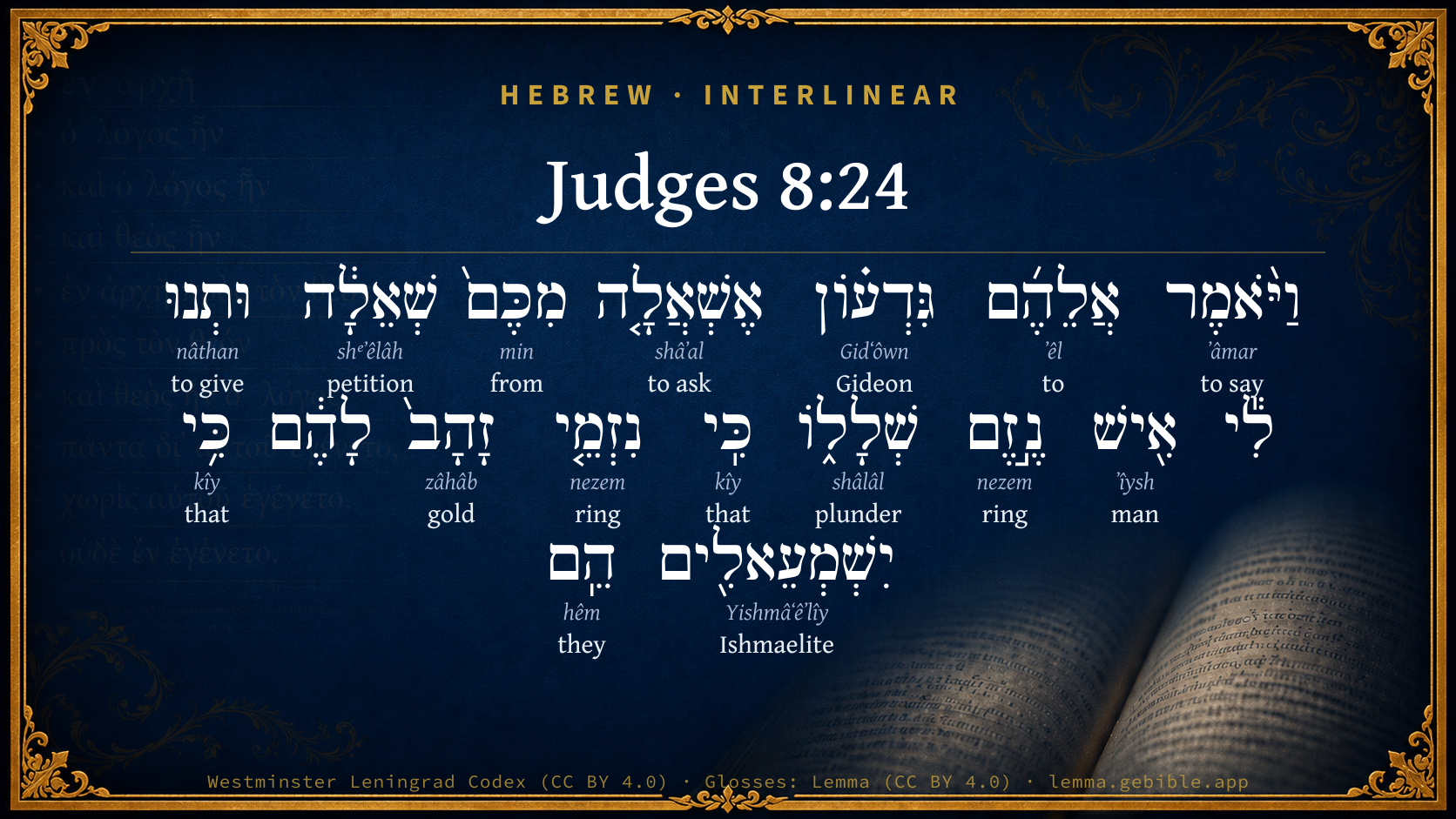
Hebrew (Westminster Leningrad Codex) Judges 8:24 appears in the Hebrew Old Testament. The text above is from the Westminster Leningrad Codex. Each word links to its Strong’s number, a concise gloss, and parsing drawn from the Open Scriptures Hebrew Bible morphology. Click any word for its full Brown-Driver-Briggs (BDB) entry.
Download image
Cite this verse

Judges 8:24 (World English Bible). Public Domain. Lemma interlinear Bible study tool, https://lemma.gebible.app/v/judges/8/24.

Show BibTeX & RIS
BibTeX
RIS
English Translation
Gideon said to them, I would make a request of you, that you would give me every man the ear-rings of his spoil. (For they had golden ear-rings, because they were Ishmaelites.)
World English Bible · Public Domain
Highlights
  • 1 first appearance in the Hebrew Bible
Full analysis ↓
Download a study sheet

One document with this verse’s original text, its word-by-word gloss line, the meaning frame, cross-references with their text, attributed commentary, and full source and license credits — printable, and it pastes into notes with its structure intact.

This verse Autodidact and up

Study sheet (.html) Plain text (.txt)

A passage Seminary Student

Up to 50 verses in one chapter. A passage sheet keeps up to 6 commentary sources and 12 cross-references per verse, in the order this page ranks them, and says so on the sheet whenever that leaves anything out. Ask for a single verse and you get the Autodidact verse sheet above.

Everything on this page stays free to read, with no account — the sheet is a download of what is already on screen, not access to it.

Want to remove ads? Support Godless Engineer
Compare translations 3

The same verse in 3 English versions, stacked beneath the original-language interlinear above. Click any original word for its lexicon entry.

Each is an independent rendering of the whole verse — the interlinear is not word-aligned to these translations.

Highlighted words mark where these versions differ — a whole-verse word diff, not a word-by-word alignment.

  • World English Bible Public Domain
    Gideon said to them, I would make a request of you, that you would give me every man the ear-rings of his spoil. (For they had golden ear-rings, because they were Ishmaelites.)
  • King James Version Public Domain
    And Gideon said unto them, I would desire a request of you, that ye would give me every man the earrings of his prey. (For they had golden earrings, because they were Ishmaelites.)
  • unfoldingWord Literal Text CC BY-SA 4.0
    But Gideon said to them, “Let me request a request from you, that a man give to me an earring of his spoil.” For earrings of gold to them, for they Ishmaelites.

unfoldingWord Literal Text — © unfoldingWord, licensed CC BY-SA 4.0. Word-aligned USFM3 via Door43 (git.door43.org/unfoldingWord/en_ult).

Versions to compare (up to 4)

3 of 4 selected

Show all 18 translations

Every available English version of this verse, each an independent rendering of the whole verse.

  • World English Bible Public Domain
    Gideon said to them, I would make a request of you, that you would give me every man the ear-rings of his spoil. (For they had golden ear-rings, because they were Ishmaelites.)
  • Berean Standard Bible Public Domain
    Then he added, “Let me make a request of you, that each of you give me an earring from his plunder.” (For the enemies had gold earrings because they were Ishmaelites.)
  • Majority Standard Bible Public Domain
    Then he added, “Let me make a request of you, that each of you give me an earring from his plunder.” (For the enemies had gold earrings because they were Ishmaelites.)
  • King James Version Public Domain
    And Gideon said unto them, I would desire a request of you, that ye would give me every man the earrings of his prey. (For they had golden earrings, because they were Ishmaelites.)
  • American Standard Version (1901) Public Domain
    And Gideon said unto them, I would make a request of you, that ye would give me every man the ear-rings of his spoil. (For they had golden ear-rings, because they were Ishmaelites.)
  • Revised Version (1885) Public Domain
    And Gideon said unto them, I would desire a request of you, that ye would give me every man the earrings of his spoil. (For they had golden earrings, because they were Ishmaelites.)
  • Geneva Bible (1599) Public Domain
    Againe Gideon sayd vnto them, I would desire a request of you, that you would giue mee euery man the earings of his pray (for they had golden earings because they were Ismaelites)
  • Douay-Rheims (1899) Public Domain
    And he said to them: I desire one request of you: Give me the earlets of your spoils. For the Ismaelites were accustomed to wear golden earlets.
  • Young's Literal Translation Public Domain
    And Gideon saith unto them, `Let me ask of you a petition, and give ye to me each the ring of his prey, for they have rings of gold, for they `are' Ishmaelites.'
  • Literal Standard Version CC BY-SA 4.0
    And Gideon says to them, “Let me ask a petition of you, and each give to me the ring of his prey, for they have rings of gold, for they [are] Ishmaelites.”
  • Unlocked Literal Bible CC BY-SA 4.0
    Gideon said to them, “Let me make a request of you: Every one of you would give me the earrings from his plunder.” (The Midianites had golden earrings because they were Ishmaelites.)
  • unfoldingWord Literal Text CC BY-SA 4.0
    But Gideon said to them, “Let me request a request from you, that a man give to me an earring of his spoil.” For earrings of gold to them, for they Ishmaelites.
  • Darby Bible Public Domain
    And Gideon said to them, "Let me make a request of you; give me every man of you the earrings of his spoil." (For they had golden earrings, because they were Ish'maelites.)
  • World Messianic Bible Public Domain
    Gideon said to them, “I do have a request: that you would each give me the earrings of his plunder.” (For they had golden earrings, because they were Ishmaelites.)
  • Webster's Bible Public Domain
    And Gideon said to them, I would desire a request of you, that you would give me every man the ear-rings of his prey. (For they had golden ear-rings, because they were Ishmaelites.)
  • Free Bible Version CC BY-SA 4.0
    Then Gideon said, “I have a request to ask of you: that each of you give me an earring from your plunder.” (Their enemies were Ishmaelites and wore gold earrings.)
  • Bible in Basic English Public Domain
    Then Gideon said to them, I have a request to make to you; let every man give me the ear-rings he has taken. (For they had gold ear-rings, because they were Ishmaelites.)
  • JPS Tanakh (1917) Public Domain
    And Gideon said unto them: 'I would make a request of you, that ye would give me every man the ear-rings of his spoil.' — For they had golden ear-rings, because they were Ishmaelites.

Literal Standard Version (2020), Covenant Press — licensed CC BY-SA 4.0. Text via the HelloAO Bible API (eBible.org). Unlocked Literal Bible (unfoldingWord) — licensed CC BY-SA 4.0. Text via the HelloAO Bible API (eBible.org). unfoldingWord Literal Text — © unfoldingWord, licensed CC BY-SA 4.0. Word-aligned USFM3 via Door43 (git.door43.org/unfoldingWord/en_ult). Free Bible Version, Dr. Jonathan Gallagher — licensed CC BY-SA 4.0. Text via the HelloAO Bible API (eBible.org).

Word by word

More ways to search: Search by grammar → Find every occurrence → Compare this word →

Practice this passage: Drill this verse → Learn its vocabulary →

יִשְׁמְעֵאלִ֖ים
Yishmâʻêʼlîy
H3459
“Ishmaelites”
Noun, Gentilic, Masculine, Plural, Absolute
Part of Speech
Noun
Type
Gentilic
Gender
Masculine
Number
Plural
State
Absolute
Full BDB Definition

Origin: patronymically from H3458

TWOT: None

Ishmaelite = see Ishmael " God will hear" - a descendant of Ishmael
  1. וַיֹּ֨אמֶר ʼâmar H559 “and · to say” Conjunction + Verb, Qal, Sequential Imperfect, 3rd Person, Masculine, Singular
  2. אֲלֵהֶ֜ם ʼêl H413 “to · them” Preposition + Suffix, Personal, 3rd Person, Masculine, Plural
  3. גִּדְע֗וֹן Gidʻôwn H1439 “Gideon” Noun, Proper
  4. אֶשְׁאֲלָ֤ה shâʼal H7592 “to ask” Verb, Qal, Cohortative, 1st Person, Common, Singular
  5. מִכֶּם֙ min H4480 “from · you” Preposition + Suffix, Personal, 2nd Person, Masculine, Plural
  6. שְׁאֵלָ֔ה shᵉʼêlâh H7596 “petition” Noun, Common, Feminine, Singular, Absolute
  7. וּתְנוּ nâthan H5414 “and · give” Conjunction + Verb, Qal, Imperative, 2nd Person, Masculine, Plural
  8. אִ֖ישׁ ʼîysh H376 “man” Noun, Common, Masculine, Singular, Absolute
  9. נֶ֣זֶם nezem H5141 “ring of” Noun, Common, Masculine, Singular, Construct
  10. שְׁלָל֑וֹ shâlâl H7998 “plunder · his” Noun, Common, Masculine, Singular, Construct + Suffix, Personal, 3rd Person, Masculine, Singular
  11. כִּֽי kîy H3588 “that” Conjunction
  12. נִזְמֵ֤י nezem H5141 “rings of” Noun, Common, Masculine, Plural, Construct
  13. זָהָב֙ zâhâb H2091 “gold” Noun, Common, Masculine, Singular, Absolute
  14. כִּ֥י kîy H3588 “that” Conjunction
  15. הֵֽם hêm H1992 “they” Pronoun, Personal, 3rd Person, Masculine, Plural

About this verse

These counts appear in no published source. They are computed here, from the morphology-tagged text and Lemma’s own curated glosses. What Lemma adds →

18
words
14
distinct lemmas
Historical
section

Notable vocabulary

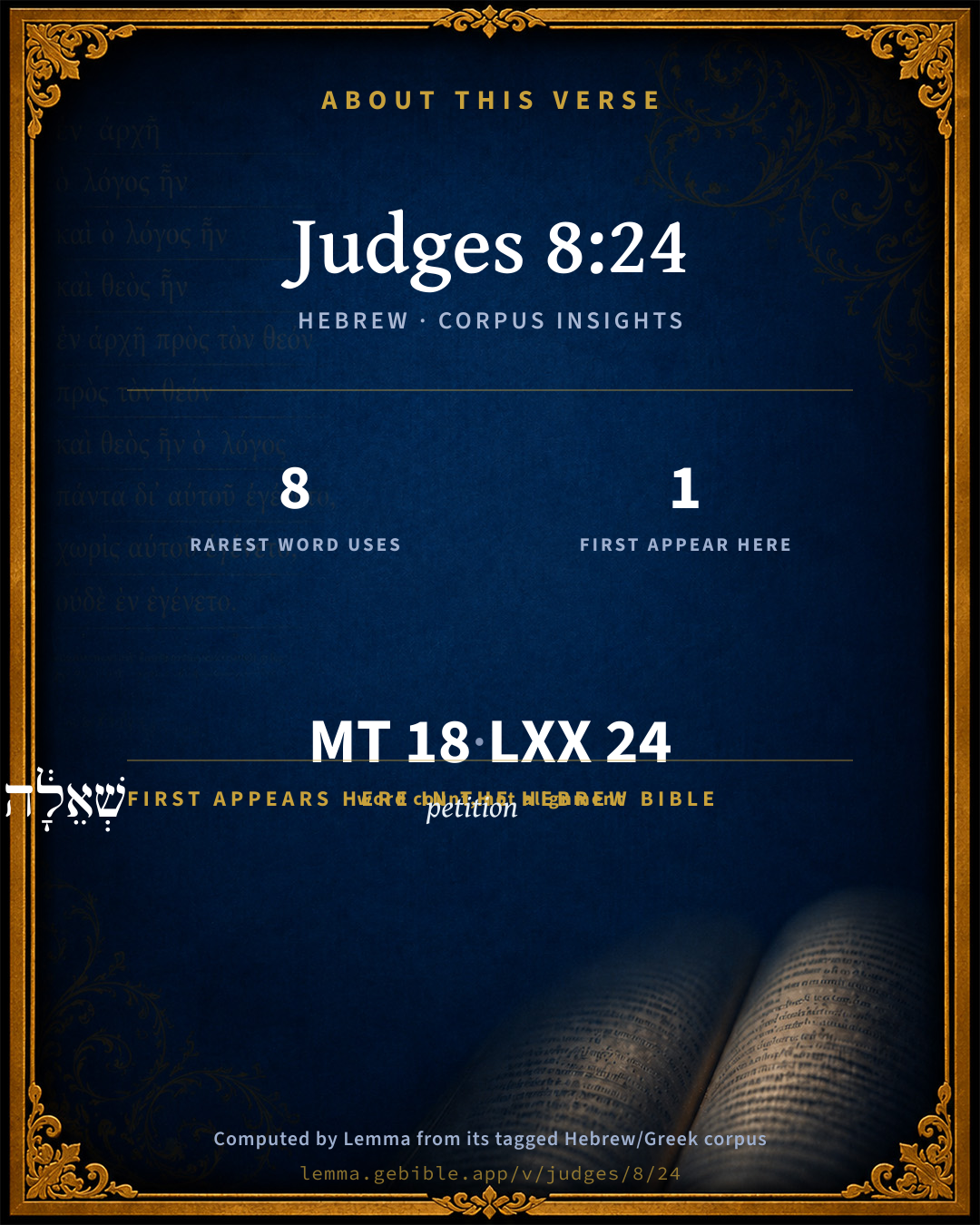
The rarest word here is יִשְׁמְעֵאלִ֖ים Ishmaelite H3459 — appearing just 8 times in the whole Hebrew Bible.

First appearance in Scripture

This word makes its first canonical appearance in the Hebrew Bible here:

  • שְׁאֵלָ֔ה petition H7596

Shared distinctive vocabulary

יִשְׁמְעֵאלִ֖ים Ishmaelite H3459 occurs in 8 verses of the Hebrew Bible. Also found in:

Grammatical profile

  • 3 verbs
  • 8 nouns
  • 1 pronoun
  • 4 prepositions
  • 2 conjunctions

Verb forms

  • וַיֹּ֨אמֶר Qal · Sequential Imperfect
  • אֶשְׁאֲלָ֤ה Qal · Cohortative
  • וּתְנוּ Qal · Imperative

Repetition

Words recur within this verse — often emphatic in Hebrew:

  • נֶ֣זֶם ring H5141 ×2
  • כִּֽי that H3588 ×2

Hebrew & Septuagint length

In English translation the verse runs 32 words from the Hebrew and 34 from the Septuagint (LXX English) — closely comparable.

A rough comparison of the two English renderings, which tokenize alike — not a word-level alignment.

Word counts can differ between the Hebrew and the Greek without any difference in meaning — e.g. the Hebrew direct-object marker אֵת has no separate Greek word, and Greek often adds the article ὁ.

In the original languages it is 18 Hebrew tokens and 24 Greek tokens — but the two are counted differently (Hebrew bundles its prefixes and suffixes into one token; the Greek is in lemma form), so that isn’t a like-for-like length.

Cross-references

11

Topical passages linked to Judges 8:24 in the Treasury of Scripture Knowledge — connected by theme and wording, ordered by reader-vote popularity; previews shown in the World English Bible.

  • Genesis 25:13 These are the names of the sons of Ishmael, by their names, according to the order of their birth: the firstborn of Ishmael, Nebaioth, then Kedar, Adbeel, Mibsam,
  • Genesis 37:25 They sat down to eat bread, and they lifted up their eyes and looked, and saw a caravan of Ishmaelites was coming from Gilead, with their camels bearing spices and balm and myrrh, going to carry it down to Egypt.
  • Genesis 37:28 Midianites who were merchants passed by, and they drew and lifted up Joseph out of the pit, and sold Joseph to the Ishmaelites for twenty pieces of silver. They brought Joseph into Egypt.
  • 1 Peter 3:3–5 Let your beauty be not just the outward adorning of braiding the hair, and of wearing jewels of gold, or of putting on fine clothing;
  • Genesis 16:10–11 The angel of Yahweh said to her, "I will greatly multiply your seed, that they will not be numbered for multitude."
  • Genesis 24:22 It happened, as the camels had done drinking, that the man took a golden ring of half a shekel weight, and two bracelets for her hands of ten shekels weight of gold,
  • Genesis 24:53 The servant brought forth jewels of silver, and jewels of gold, and clothing, and gave them to Rebekah. He gave also to her brother and to her mother precious things.
  • Exodus 12:35 The children of Israel did according to the word of Moses; and they asked of the Egyptians jewels of silver, and jewels of gold, and clothing.
  • Exodus 32:3 All the people took off the golden rings which were in their ears, and brought them to Aaron.
  • 1 Samuel 25:11 Shall I then take my bread, and my water, and my meat that I have killed for my shearers, and give it to men who I don't know where they come from?
  • 1 Kings 20:11 The king of Israel answered, Tell him, Don't let him who girds on [his armor] boast himself as he who puts it off.

Cross-references courtesy of OpenBible.info (CC BY 4.0).

Hebrew and Greek witnesses Masoretic Hebrew ↔ Greek Septuagint

The same verse in the two great witnesses to the Old Testament, shown verse-for-verse.

These are two independent witnesses, not word-aligned to each other, and the Septuagint is shown in lemma (dictionary) form.

Hebrew Judges 8:24 Masoretic · Westminster Leningrad Codex

וַיֹּ֨אמֶר אֲלֵהֶ֜ם גִּדְע֗וֹן אֶשְׁאֲלָ֤ה מִכֶּם֙ שְׁאֵלָ֔ה וּתְנוּ לִ֕י אִ֖ישׁ נֶ֣זֶם שְׁלָל֑וֹ כִּֽי נִזְמֵ֤י זָהָב֙ לָהֶ֔ם כִּ֥י יִשְׁמְעֵאלִ֖ים הֵֽם

Gideon said to them, I would make a request of you, that you would give me every man the ear-rings of his spoil. (For they had golden ear-rings, because they were Ishmaelites.)

World English Bible · Public Domain

Greek LXX Judges 8:24 Septuagint · lemma form

καί εἶπον γεδεων πρός αὐτός αἰτέω παρά σύ αἴτημα καί δίδωμι ἐγώ ἀνήρ ἐνώτιον ἐκ σκῦλον αὐτός ὅτι ἐνώτιον χρυσοῦς αὐτός ὅτι ισμαηλίτης εἰμί

And Gedeon said to them, I will make a request of you, and do you⌃ give me every man an earring out of his spoils: for they had golden earrings, for they were Ismaelites.

LXX2012 (modern English Septuagint) · Public Domain

On this verse, The Cambridge Bible for Schools and Colleges discusses the Septuagint’s reading. Read the note in Commentary ↓

Hebrew: Westminster Leningrad Codex (CC BY 4.0). Greek: Septuagint (public domain); English from LXX2012 (modern English Septuagint) (Public Domain). How the Septuagint differs from the Hebrew →

Targum (Aramaic paraphrase)

1

The Targum is the ancient Jewish Aramaic paraphrase of the Hebrew Scriptures — an interpretive translation, not the Hebrew text itself. Onkelos (literal) and Pseudo-Jonathan (expansive) render the Torah, and Jonathan the Prophets. Coverage is partial: where no permissively-licensed English translation exists for a verse, only the Aramaic is shown. This is verse-level text, not a word-by-word alignment to the Hebrew.

  1. Targum Jonathan Prophets (Joshua–Malachi)
    וַאֲמַר לְהוֹן גִדְעוֹן שָׁאֵיל אֲנָא מִנְכוֹן שְׁאֵילָה וְהָבוּ לִי גְבַר קָדָשֵׁיהּ מִן בִּזְתָא אֲרֵי קָדָשֵׁי דְדַהֲבָא לְהוֹן אֲרֵי עֲרָבָאֵי אִינוּן:

    (no public-domain English translation for this verse)

    Targum Jonathan — Aramaic: “Mikraot Gedolot” (public domain). English: “Sefaria Community Translation” (CC0 1.0 (public-domain dedication)); “London "Chaldee Paraphrase," 1871” (public domain). Text via Sefaria.

Commentary

Notes on Judges 8:24 from classic Christian and Jewish commentators (each source and its license shown beneath its notes). The classic Christian expositions comment on the surrounding passage and are grouped to its opening verse, so a note may address several verses; the Jewish commentaries on the Tanakh (Rashi and others) are per-verse, so they appear only where the commentator wrote on this verse.

Lemma curates 59 commentaries, every one of them public domain or Creative Commons licensed, each selected and text-cleaned for this edition rather than reprinted as found. About our sources →

The Cambridge Bible for Schools and Colleges

gen. ed. J. J. S. Perowne

24. The making of the ephod and the manner in which it is spoken of belong to an early stage of religious thought; Jdg_8:24-27 a may, therefore, belong to the early narrative Jdg_8:4-21; they have been skilfully connected with Jdg_8:22-23. The request shewed Gideon’s disinterestedness and piety. As chief he would have the right to choose some gift for himself before the spoil was divided among his followers; cf. Jdg_5:30, 1Sa_30:20. The custom prevailed in ancient Arabia; see Robertson Smith, Rel. of Sem., p. 440.

earrings] So when worn by men, LXX here, Gen_35:4, Job_42:11; but nose-rings when worn by women, Gen_24:47, Isa_3:21. Pliny mentions the wearing of earrings by men in the East, Hist. Nat. xi. 50.

Ishmaelites] i.e. in a general sense, Bedouin. Strictly, according to Gen_25:2, Ishmael was the half-brother of Midian; cf. the interchange of the names in Gen_37:25-36.

The Cambridge Bible for Schools and Colleges (gen. ed. J. J. S. Perowne; Cambridge University Press, 1878–1918) — public domain. Text from a community e-Sword module.

Trapp's Complete Commentary

John Trapp

Jdg 8:24 And Gideon said unto them, I would desire a request of you, that ye would give me every man the earrings of his prey. (For they had golden earrings, because they [were] Ishmaelites.)

Ver. 24. For they had golden earrings.] But an obedient ear {Pro 20:12; Pro 25:12} had been a far better ornament. These inaures aureae were ill bestowed upon such uncircumcised ears as Ishmaelites had.

John Trapp, A Commentary or Exposition upon All the Books of the Old and New Testament (1647–1656) — public domain. Text from a community e-Sword module.

The Biblical Illustrator

Joseph S. Exell

Jdg_8:24-27

Gideon made an ephod.

Gideon, the ecclesiastic

A strong but not spiritual religiousness is the chief note of Gideons character. It may be objected that such an one, if he seeks ecclesiastical office, does so unworthily; but to say so is an uncharitable error. It is not the devout temper alone that finds attraction in the ministry of sacred things; nor should a love of place and power be named as the only other leading motive. One who is not devout may in all sincerity covet the honour of standing for God before the congregation, leading the people in worship and interpreting the sacred oracles. A vulgar explanation of human desire is often a false one; it is so here. The ecclesiastic may show few tokens of the spiritual temper, the other-worldliness, the glowing and simple truth we rightly account to be the proper marks of a Christian ministry; yet he may by his own reckoning have obeyed a clear call. His function in this case is to maintain order and administer outward rites with dignity and care--a limited range of duty indeed, but not without utility, especially when there are inferior and less conscientious men in office not far away. He does not advance faith, but according to his power he maintains it. But the ecclesiastic must have the ephod. The man who feels the dignity of religion more than its humane simplicity, realising it as a great movement of absorbing interest, will naturally have regard to the means of increasing dignity and making the movement impressive. When it is supposed that Gideon fell away from his first faith in making this image the error lies in over-estimating his spirituality at the earlier stage. We must not think that at any time the use of a symbolic image would have seemed wrong to him. He acted at Ophrah as priest of the true God. And yet, pure, and for the time even elevated, in the motive, Gideons attempt at priestcraft led to his fall. The thing became a snare to Gideon and his house, perhaps in the way of bringing in riches and creating the desire for more. (R. A. Watson, M. A.)

Ruler or priest

Underlying Gideons desire to fill the office of priest there was a dull perception of the highest function of one man in relation to others. It appears to the common mind a great thing to rule, to direct secular affairs, to have the command of armies and the power of filling offices and conferring dignities; and no doubt to one who desires to serve his generation well, royalty, political power, even municipal office, offer many excellent opportunities. But set kingship on this side, kingship concerned with the temporal and earthly, or at best humane aspects of life, and on the other side priesthood of the true kind which has to do with the spiritual, by which God is revealed to man and the holy ardour and Divine aspirations of the human will are sustained, and there can be no question which is the more important. A clever, strong man may be a ruler. It needs a good man, a pious man, a man of heavenly power and insight, to be in any right sense a priest--one who really stands between God and men, bearing the sorrows of his kind, their trials, doubts, cries and prayers, on his heart, and presenting them to God, interpreting to the weary and sad and troubled the messages of heaven. (R. A. Watson, M. A.)

A mock ephod

In Pauls words, Gideon did not know what sin was. He knew suffering in plenty; but, shallow old soldier as he was, he did not know the secret of all suffering. Gideon was as ignorant as the mass of men are what Gods law really is, what sin really is, and what the only cure of sin really is. At bottom that was Gideons fall. And accordingly Gideon made a mock ephod at Ophra, while all the time God had made a true and sure ephod both for Himself and for Gideon and for all Israel at Shiloh. And Gods ephod had an altar connected with it, and a sacrifice for sin, and the blood of sprinkling, and the pardon of sin, and a clean heart, and a new life; all of which Israel so much needed, but all of which Gideon, with all his high services, knew nothing about. Sin was the cause of all the evil that Gideon in his bravery had all his life been battling with; but, instead of going himself, and taking his Ironsides and all his people up with him to Gods house against sin, Gideon set up a sham house of God of his own, and a sham service of God of his own, with the result to himself and to Israel that the sacred writer puts in such plain words. Think of Gideon, of all men in Israel, leading all Israel a-whoring away from God! The pleasure-loving people came up to Gideons pleasure-giving ephod, when both he and they should have gone to Gods penitential ephod. They forgot all about the Midianites as they came up to Ophra to eat and to drink and to dance. When, had they been well and wisely led, they would have gone to Shiloh with the Midianites ever before them, till the God of Israel would have kept the Midianites and all their other enemies for ever away from them. Gideon was a splendid soldier, but he was a very short-sighted priest. He put on a costly ephod indeed, but it takes a great deal more than a costly ephod to make a prevailing priest. I see, and you must see, men every day who are as brave and as bold as Gideon, and as full of anger and revenge against all the wrongs and all the miseries of their fellow-men; men and women who take their lives in their hands to do battle with ignorance and vice and all the other evils that the land lies under; and, all the time, they go on repeating Gideons fatal mistake; till, at the end of their life they leave all these wrongs and miseries very much as they found them: nothing better, but rather worse. And all because they set up an ephod of their own devising in the place of the ephod and the altar and the sacrifice and the intercession that God has set up for these and all other evils. They say, and in their goodness of heart they do far more than merely say--what shall the poor eat, and what shall they drink, and how shall they be housed? At great cost to themselves they put better houses for the working classes, and places of refreshment and amusement, and reading-rooms, and libraries, and baths, and open spaces, and secular schools and moderate churches in the room of the Cross and the Church and the gospel of Jesus Christ; and they complain that the Midianites do not remove but come back faster than they can chase them out. Either the Cross of Christ was an excess and a superfluity, or your expensive but maladroit nostrums for sin are an insult to Him and to His Cross. (A. Whyte, D. D.)

Gideons great error

1. Gideons sin injurious to himself. Scripture, unlike mere human biographies, tells faithfully the failings of its heroes. The record of the believers blemishes is as edifying as that of his graces. Good intentions are no excuse for self-willed inventions. An oracle of Gideons own contrivance, and made out of the golden amulets of idolaters, could never be pleasing to God, and was a bad return to make for the Divine favour in granting him victory. It became a snare unto Gideon himself, by lessening his zeal for the house of God in Shiloh. Still more so to his family.

2. Gideons sin had a deadly effect on the nation. One false step of a good man leads multitudes astray. If Gideon could have risen from the grave and seen the consequences of his one grand error, how he would have grieved! (A. R. Fausset, M. A.)

The Biblical Illustrator, edited by Joseph S. Exell (c. 1880s–1900s) — public domain. Text from a community e-Sword module.

Joseph Benson's Commentary

Jdg 8:24. Because they were Ishmaelites — A mixture of people all called by one general name, Ishmaelites or Arabians, who used to wear ear-rings; but the greatest and the ruling part of them were Midianites.

Joseph Benson's Commentary on the Old and New Testaments (1811–1818) — public domain. Text from a community e-Sword module.

Geneva Bible (1599)

Geneva Bible translators

His intent was to show himself thankful for this victory by restoring of religion, which because it was not according as God had commanded, turned to their destruction.

Geneva Bible (1599) marginal notes — public domain. Text via Bolls.life.

Jamieson, Fausset & Brown

Robert Jamieson, A. R. Fausset & David Brown

Gideon said unto them, I would desire a request of you--This was the contribution of an earring (singular). As the ancient Arabians (Ishmaelites and Midianites being synonymous terms, Gen 37:25, Gen 37:28) were gorgeously adorned with barbaric pearl and gold, an immense amount of such valuable booty had fallen into the hands of the Israelitish soldiers. The contribution was liberally made, and the quantity of gold given to him is estimated at £3113 sterling.

Jamieson, Fausset & Brown — Commentary Critical and Explanatory on the Whole Bible (1871) — public domain (CC PDM 1.0). Text via the HelloAO Bible API.

Adam Clarke's Commentary

Verse 24. Give me every man the ear-rings of his prey.] The spoils taken from their enemies in this warfare. This is a transaction very like to that of the Israelites and Aaron; when they brought him their golden ear-rings, out of which he made the molten calf, Ex 32:2, c. Whether Gideon designed this ephod for an instrument of worship, or merely as a trophy, is not very clear. It is most likely that he had intended to establish a place of worship at Ophrah and he took this occasion to provide the proper sacerdotal vestments.

Adam Clarke's Commentary on the Bible (1810–1826) — public domain. Text from a community e-Sword/MySword module.

Ellicott's Commentary for English Readers

(24) I would desire a request of you.—Not unfrequently the magnanimity which has just stood firm under a great trial succumbs to a weaker one. His case did not exactly resemble that of Abraham (Gen_14:21-23), but it would have been better for his glory if he had acted in a similar spirit.

The earrings of his prey.—Nezem means a ring which, sometimes at least, was worn, especially by women, in the nose (Gen_24:47; Isa_3:21; Eze_16:12; Job_42:11). In the absence of any regular currency, these gold rings served as a sort of coinage.

Because they were Ishmaelites.—“Ishmael-ites” and “Midianites” occur as convertible terms in Gen_37:28.

A Bible Commentary for English Readers, edited by Charles John Ellicott (1878–1897) — public domain. Text from a community e-Sword module.

John Gill's Exposition

And Gideon said unto them, I would desire a request of you,.... Which he thought they would scarcely deny, and it was now a fair opportunity to make it, since they had offered him a crown, or to be king over them: and the favour he asked was:

that you would give me every man the earrings of his prey; or, "an earring of his prey"; for it is in the singular number; every man one earring, as Abarbinel interprets it; for though they might have more, yet only one ear ring of every man is desired:

for they had golden earrings, because they were Ishmaelites; so the Midianites and Ishmaelites are spoken of as the same, they being mixed and dwelling together, or very near each other, Gen 37:25 and Kimchi accounts for it thus, why the Midianites are called Ishmaelites; because they were the sons of Keturah, and Keturah was Hagar the mother of Ishmael. The Targum calls them Arabians, and who it seems used to wear earrings, as men in the eastern countries did; see Gen 35:4. So Pliny says (c) in the east it was reckoned ornamental for men to wear gold in their ears.

(c) Nat. Hist. l. 11. c. 37.

John Gill's Exposition of the Whole Bible (1746–1763) — public domain (CC PDM 1.0). Text via the HelloAO Bible API.

Albert Barnes' Notes on the Bible

In this desire for gold Gideon falls to the level of ordinary men, and we may see in it the first decline of his glory, leading to a sad tarnishing of the luster of his bright name. The idolatrous honor paid to Gideon’s ephod was probably a source of revenue to his house. Contrast the conduct of Abraham Gen 14:21-23, and of Elisha 2Ki 5:16, 2Ki 5:26.

The “ear-ring” here mentioned is properly a “nose-ring” (compare Gen 24:22 note). The custom of wearing nose-rings prevails in Eastern countries to the present day. The circumstance of Job’s friends each contributing a nose-ring of gold (Job 42:11 note) is a remarkable parallel to the incident in Gideon’s history. Rings of gold were also used as money in Egypt, as appears on several early monuments, and by the Celts.

Albert Barnes' Notes on the Bible (1834–1885) — public domain. Text from a community e-Sword/MySword module.

Haydock's Catholic Bible Commentary

Request. It was not then thought dishonourable to ask nor to receive presents. The most precious part of the booty had been already presented to the general, according to the custom of the heroic times. But, as the people wished to make Gedeon king, he consents to receive the earlets, as a memorial of their affection. --- Earlets. Hebrew and Septuagint (Menochius) may also signify, "each an earlet," as if he would only accept one from each soldier. The original signifies also, the rings which women put under their noses; but, as men never did, it has not that meaning here, (Calmet) though there might be women in the camp of the Madianites. (Haydock) --- Ismaelites. By this title various nations are designated. It seems almost as general as the word Arab among us. These nations were no more distinguished by these ornaments than the Hebrews themselves, Exodus xxxii. 2., and xxxv. 12. The Persians, Africans, Lybians, &c., wore ear-rings. (Calmet)

George Leo Haydock (1774–1849), Haydock's Catholic Family Bible and Commentary, 1859 edition — public domain. Excludes Psalms (Douay-Rheims chapter numbering differs from Protestant) and Deuterocanonical books (Catholic canon only).

Matthew Poole's English Annotations

Object. They are called Midianites before.

Answ. Here seems to have been a mixture of people, Jdg 6:3, which are all called by one general name, Ishmaelites, or Arabians, who used to wear earrings, Gen 35:4; but the greatest, and the ruling part of them, were Midianites.

Matthew Poole's English Annotations on the Holy Bible (1683–1685) — public domain. Text from a community e-Sword/MySword module.

Whedon's Commentary on the Bible

Daniel D. Whedon

24. The earrings of his prey — Rings worn either in the ears or nose. Large quantifies of these and other ornaments were taken from the one hundred and twenty thousand (Jdg_8:10) who were left dead on the field of battle.

Because they were Ishmaelites — Hence it appears that the Ishmaelites were noted for wearing ornaments of gold. And, according to Thomson, it is “still the custom for men among these Bedouin Ishmaelites to wear gold earrings. I have often seen them, and among certain of the tribes it is quite the fashion; but these gold earrings belonged in part, no doubt, to the women. Bedouin women not only have them in their ears, but also large rings are suspended from the nose.” Ishmaelites was a name commonly given to the children of the East, (Jdg_7:12,) and included Midianites. See Gen_37:25; Gen_37:28. Ishmael was the great tribe-father of many of those sons of the desert; and the great territorial extent of his descendants (compare Gen_25:18) seems to have given the name Ishmaelites so extensive a usage.

Daniel D. Whedon (gen. ed.), Commentary on the Old and New Testaments (1874–1909) — public domain. Text from a community e-Sword module.

The Pulpit Commentary

I would desire a request of you. Again human weakness breaks out in this great man, and we seem to see the effect of great prosperity in stirring up selfish desires in his heart. It was perhaps not without significance that mention was made in ver. 21 of his taking the ornaments that were on the camels" necks in connection with the slaughter of the kings. Anyhow we have now a second instance of a love of spoil. It seems to have been a national custom with the Ishmaelites, among whom the Midianites are reckoned, (see Gen_37:25-28) to wear golden rings; hence when they came to strip the slain there was a vast booty of gold rings. These Gideon asked for as his share, and the people readily agreed to the request. Ear-rings. The word is singular in Hebrew, which agrees with its more proper signification of nose-ring, an ornament often worn by both men and women in the East. Gesenius mentions having seen at Leipsic some Indian dancing women with nose-rings. It is distinctly marked as a nose-ring in Gen_24:22, Gen_24:30, Gen_24:47, because in the last verse Abraham"s servant says that he put the ring (han-nezem) upon her nose" (face, A.V). Again, in Eze_16:12 the Hebrew is, "I placed a ring upon thy nose" (I put a jewel upon thy forehead, A.V). So also Job_42:11, one ring of gold," implies that it was a nose-ring, and not an ear-ring. In other passages, however, as Gen_35:4 Exo_32:2, it is expressly said that these rings were worn in the ears; while in others, again, there is nothing to mark whether they were worn in the ears or in the nose, as Pro_25:12 Hos_2:13, except that in the latter passage the singular number in the Hebrew is more favourable to the nose-ring than to the ear-rings, as the A.V translates it. It is thought by many, with some probability, that the nose-ring did not pierce the gristle of the nose, but hung down upon the nose from a fillet round the forehead. In every case they were of gold.

Vers. 24-27. The mistake of a good man.

I ORIGINATING IN MOTIVES FOR THE MOST PART NOBLE AND HONOURABLE.

(1) Desirous of a national testimony to God"s gracious deliverance, and a commemoration of it to future ages, he

(2) persuades the Israelites to make a national offering, and

(3) increases the means of grace in his own district.

II REFLECTING THE DEFECTS OF HIS CHARACTER AND BETRAYING ITS LATENT VICE. In his zeal for the religious reformation of Israel he did not sufficiently consider the bearings of the step he had taken. It was a hasty and crude expedient, from which greater experience or sage advice, or, above all, God"s Spirit, would have saved him. And therein lay the root of the mischief. He relied on his own wisdom, and forgot to ask God"s guidance. In getting to look upon himself as in a special sense the re-introducer of the Jehovah-worship, and the exponent of the mind of Jehovah, he forgot that it was only as he was taught of God that he could be preserved from error. Of all inventions, religious ones are to be most carefully scrutinised. And in the background of this assumption there lay a secret tendency to self-esteem because of his spiritual endowments and character, and the great achievements of the past. Pride because of his own humility is it not a failing that many have shared? By this mistake he sowed the seeds of grave evils: schism, superstition, hero-worship. But

III THE SUBSTANTIAL GOOD DONE WAS NOT WHOLLY DESTROYED, Whilst he lived a quiet, steadfast, righteous life the people observed the true worship of Jehovah. His own example was a guide and a deterrent. And when at his death superstition ran riot, and the old licentious idolatry flowed back in an obliterating wave over the land and the institutions of Jehovah"s worship, there were some things that could not be destroyed, remaining as germ ideas in the spiritual consciousness of Israel the immediate obligation of the moral law upon every one, the direct responsibility of every one to God, and faith in the personal help of Jehovah.

(1) God superintends the development of his truth, and

(2) restrains the evil that mingles with the good in men"s works. M.

The Pulpit Commentary (1880–1919), ed. H.D.M. Spence-Jones & Joseph S. Exell — public domain. Text from a community e-Sword module.

John Wesley's Explanatory Notes

Ishmaelites - A mixture of people all called by one general name, Ishmaelites or Arabians, who used to wear ear-rings; but the greatest, and the ruling part of them were Midianites.

John Wesley, Explanatory Notes Upon the Whole Bible (1754–1765) — public domain. Text via the GEBible commentary corpus.

Keil & Delitzsch

C. F. Keil & F. Delitzsch

Gideon resisted the temptation to put an earthly crown upon his head, from true fidelity to Jehovah; but he yielded to another temptation, which this appeal on the part of the people really involved, namely, the temptation to secure to himself for the future the position to which the Lord had called and exalted him. The Lord had called him to be the deliverer of Israel by visibly appearing in His angel, and had not only accepted the gift which he offered Him, as a well-pleasing sacrifice, but had also commanded him to build an altar, and by offering an atoning burnt-sacrifice to re-establish the worship of Jehovah in his family and tribe, and to restore the favour of God to His people once more. Lastly, the Lord had made His will known to him again and again; whilst by the glorious victory which He had given to him and to his small band over the powerful army of the foe, He had confirmed him as His chosen servant to be the deliverer and judge of Israel. The relation which Gideon thus sustained to the Lord he imagined that he ought to preserve; and therefore, after declining the royal dignity, he said to the people, "I will request of you one request, that ye give me every one the ring that he has received as booty." This request the historian explains by adding the remark: "for they (the enemy) had golden rings, for they were Ishmaelites," from whom therefore the Israelites were able to get an abundance of rings as booty. Ishmaelites is the general name for the nomad tribes of Arabia, to whom the Midianites also belonged (as in Gen 37:25).

Keil & Delitzsch — Biblical Commentary on the Old Testament (1861–1891) — public domain (CC PDM 1.0). Text via the HelloAO Bible API. (Old Testament only.)

unfoldingWord translationNotes

Door43 World Missions Community

Gideon said to them

"Gideon said to the men of Israel"

earrings

jewelry worn on the ear

plunder

things stolen by force or taken off of people killed in war

The Midianites had golden earrings because they were Ishmaelites

Here the narrator tells background information about the Midianites. (See: Background Information)

cloak

clothing made from a large piece of fabric and worn over the shoulders as a coat

translationWords

Gideon

Midian

Ishmael

unfoldingWord translationNotes — © Distant Shores Media and the Door43 World Missions Community, licensed CC BY-SA 4.0. Source: git.door43.org/Door43/en_tn.

Lesson kit

Teaching starters — assembled from the data on this page, not authored interpretation. Every prompt links to the verse data it draws on. Edit before teaching.

Judges, in the Historical, opens this verse with 18 words (14 distinct Hebrew lemmas). Its most distinctive word is Yishmâʻêʼlîy (“Ishmaelite”). A historical commentator’s framing appears above. Read the whole chapter for the surrounding context.

Discussion questions

  1. What does “Ishmaelite” (Yishmâʻêʼlîy) contribute to the verse as a whole?
  2. The word “petition” first appears here in Scripture. What is being introduced at this debut?
  3. Genesis 37:25 shares the word «Ishmaelite» with this verse. How do the two illuminate each other?
  4. “ring” occurs 2× in this one verse. What is the effect of the repetition?
  5. The translations on this page render this verse differently — a whole-verse word diff, not a word-by-word alignment. What might account for the different wordings?
  6. The verb «וַיֹּ֨אמֶר» is Qal Sequential Imperfect. How does its form color the action?
  7. Reading how The Cambridge Bible for Schools and Colleges and Trapp's Complete Commentary read this verse, where do the two commentators agree and where do they part?

Things to notice

Reading settings

Reading text

Shown beneath each verse's original-language words.

Old Testament
Old Testament edition

Read the OT as the Masoretic Hebrew (MT) or the Greek Septuagint (LXX).

English shown for the Greek Septuagint (in the Hebrew ↔ Greek comparison).

Comparing translations? Open the Compare panel on any verse page to stack up to four side by side.