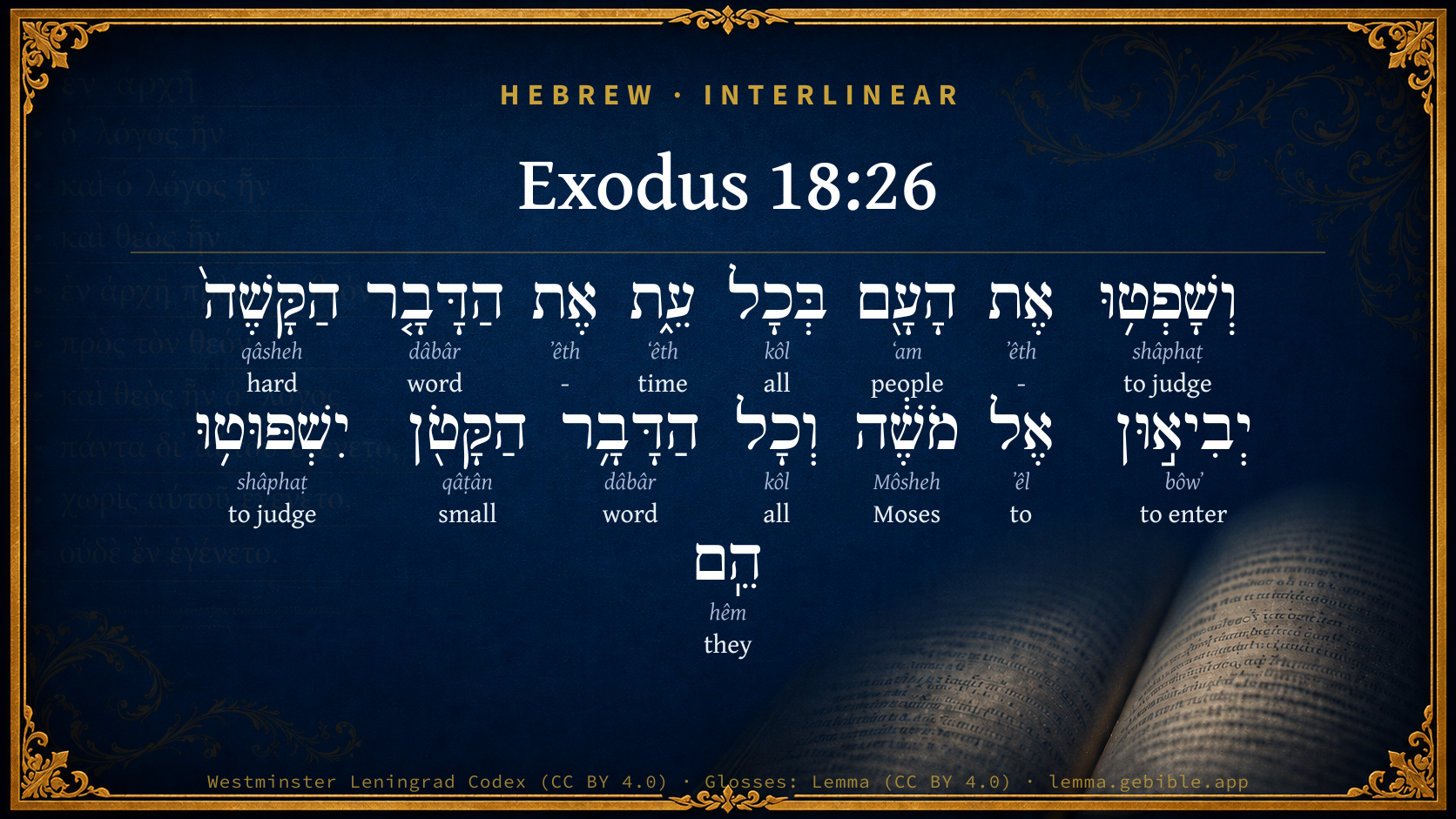
Exodus 18:26

Hebrew (Westminster Leningrad Codex) Exodus 18:26 appears in the Hebrew Old Testament. The text above is from the Westminster Leningrad Codex. Each word links to its Strong’s number, a concise gloss, and parsing drawn from the Open Scriptures Hebrew Bible morphology. Click any word for its full Brown-Driver-Briggs (BDB) entry.
Download image
Cite this verse

Exodus 18:26 (World English Bible). Public Domain. Lemma interlinear Bible study tool, https://lemma.gebible.app/v/exodus/18/26.

Show BibTeX & RIS
BibTeX
RIS
English Translation
They judged the people at all times. They brought the hard causes to Moses, but every small matter they judged themselves.
World English Bible · Public Domain
Download a study sheet

One document with this verse’s original text, its word-by-word gloss line, the meaning frame, cross-references with their text, attributed commentary, and full source and license credits — printable, and it pastes into notes with its structure intact.

This verse Autodidact and up

Study sheet (.html) Plain text (.txt)

A passage Seminary Student

Up to 50 verses in one chapter. A passage sheet keeps up to 6 commentary sources and 12 cross-references per verse, in the order this page ranks them, and says so on the sheet whenever that leaves anything out. Ask for a single verse and you get the Autodidact verse sheet above.

Everything on this page stays free to read, with no account — the sheet is a download of what is already on screen, not access to it.

Want to remove ads? Support Godless Engineer
Compare translations 3

The same verse in 3 English versions, stacked beneath the original-language interlinear above. Click any original word for its lexicon entry.

Each is an independent rendering of the whole verse — the interlinear is not word-aligned to these translations.

Highlighted words mark where these versions differ — a whole-verse word diff, not a word-by-word alignment.

  • World English Bible Public Domain
    They judged the people at all times. They brought the hard causes to Moses, but every small matter they judged themselves.
  • King James Version Public Domain
    And they judged the people at all seasons: the hard causes they brought unto Moses, but every small matter they judged themselves.
  • unfoldingWord Literal Text CC BY-SA 4.0
    And they judged the people at all times. They brought the difficult situations to Moses, and they judged each small situation themselves.

unfoldingWord Literal Text — © unfoldingWord, licensed CC BY-SA 4.0. Word-aligned USFM3 via Door43 (git.door43.org/unfoldingWord/en_ult).

Versions to compare (up to 4)

3 of 4 selected

Show all 18 translations

Every available English version of this verse, each an independent rendering of the whole verse.

  • World English Bible Public Domain
    They judged the people at all times. They brought the hard causes to Moses, but every small matter they judged themselves.
  • Berean Standard Bible Public Domain
    And they judged the people at all times; they would bring the difficult cases to Moses, but any minor issue they would judge themselves.
  • Majority Standard Bible Public Domain
    And they judged the people at all times; they would bring the difficult cases to Moses, but any minor issue they would judge themselves.
  • King James Version Public Domain
    And they judged the people at all seasons: the hard causes they brought unto Moses, but every small matter they judged themselves.
  • American Standard Version (1901) Public Domain
    And they judged the people at all seasons: the hard causes they brought unto Moses, but every small matter they judged themselves.
  • Revised Version (1885) Public Domain
    And they judged the people at all seasons: the hard causes they brought unto Moses, but every small matter they judged themselves.
  • Geneva Bible (1599) Public Domain
    And they iudged the people at all seasons, but they brought the hard causes vnto Moses: for they iudged all small matters themselues.
  • Douay-Rheims (1899) Public Domain
    And they judged the people at all times: and whatsoever was of greater difficulty they referred to him, and they judged the easier cases only.
  • Young's Literal Translation Public Domain
    and they have judged the people at all times; the hard matter they bring in unto Moses, and every small matter they judge themselves.
  • Literal Standard Version CC BY-SA 4.0
    and they have judged the people at all times; they bring the hard matter to Moses, and they judge every small matter themselves.
  • Unlocked Literal Bible CC BY-SA 4.0
    They judged the people in normal circumstances. The difficult cases they brought to Moses, but they themselves judged all the small cases.
  • unfoldingWord Literal Text CC BY-SA 4.0
    And they judged the people at all times. They brought the difficult situations to Moses, and they judged each small situation themselves.
  • Darby Bible Public Domain
    And they judged the people at all times: the hard matters they brought to Moses, but every small matter they judged.
  • World Messianic Bible Public Domain
    They judged the people at all times. They brought the hard cases to Moses, but every small matter they judged themselves.
  • Webster's Bible Public Domain
    And they judged the people at all seasons: the hard causes they brought to Moses, but every small matter they judged themselves.
  • Free Bible Version CC BY-SA 4.0
    They acted as judges for the people on a continuing basis. They brought the difficult cases to Moses, but they would judge the small matters themselves.
  • Bible in Basic English Public Domain
    And they were judges in the causes of the people at all times: the hard questions they put before Moses; but on every small point they gave decisions themselves.
  • JPS Tanakh (1917) Public Domain
    And they judged the people at all seasons: the hard causes they brought unto Moses, but every small matter they judged themselves.

Literal Standard Version (2020), Covenant Press — licensed CC BY-SA 4.0. Text via the HelloAO Bible API (eBible.org). Unlocked Literal Bible (unfoldingWord) — licensed CC BY-SA 4.0. Text via the HelloAO Bible API (eBible.org). unfoldingWord Literal Text — © unfoldingWord, licensed CC BY-SA 4.0. Word-aligned USFM3 via Door43 (git.door43.org/unfoldingWord/en_ult). Free Bible Version, Dr. Jonathan Gallagher — licensed CC BY-SA 4.0. Text via the HelloAO Bible API (eBible.org).

Word by word

More ways to search: Search by grammar → Find every occurrence → Compare this word →

Practice this passage: Drill this verse → Learn its vocabulary →

הַקָּשֶׁה֙
qâsheh
H7186
“the · hard”
Particle, Definite Article + Adjective, Adjective, Masculine, Singular, Absolute
Part of Speech
Particle + Adjective
Type
Adjective
Gender
Masculine
Number
Singular
State
Absolute
Full BDB Definition

Origin: from H7185

TWOT: 2085a

hard, cruel, severe, obstinate - hard, difficult - severe - fierce, intense, vehement - stubborn, stiff of neck, stiff-necked - rigorous (of battle)
  1. וְשָׁפְט֥וּ shâphaṭ H8199 “and · to judge” Conjunction + Verb, Qal, Sequential Perfect, 3rd Person, Common, Plural
  2. אֶת ʼêth H853 “-” Particle, Direct Object
  3. הָעָ֖ם ʻam H5971 “the · people” Particle, Definite Article + Noun, Common, Masculine, Singular, Absolute
  4. בְּכָל kôl H3605 “in/at · all of” Preposition + Noun, Common, Masculine, Singular, Construct
  5. עֵ֑ת ʻêth H6256 “time” Noun, Common, Both, Singular, Absolute
  6. אֶת ʼêth H853 “-” Particle, Direct Object
  7. הַדָּבָ֤ר dâbâr H1697 “the · word” Particle, Definite Article + Noun, Common, Masculine, Singular, Absolute
  8. יְבִיא֣וּן bôwʼ H935 “to enter” Verb, Hiphil, Imperfect, 3rd Person, Masculine, Plural + Suffix, n
  9. אֶל ʼêl H413 “to” Preposition
  10. מֹשֶׁ֔ה Môsheh H4872 “Moses” Noun, Proper
  11. וְכָל kôl H3605 “and · all of” Conjunction + Noun, Common, Masculine, Singular, Construct
  12. הַדָּבָ֥ר dâbâr H1697 “the · word” Particle, Definite Article + Noun, Common, Masculine, Singular, Absolute
  13. הַקָּטֹ֖ן qâṭân H6996 “the · small” Particle, Definite Article + Adjective, Adjective, Masculine, Singular, Absolute
  14. יִשְׁפּוּט֥וּ shâphaṭ H8199 “to judge” Verb, Qal, Imperfect, 3rd Person, Masculine, Plural
  15. הֵֽם hêm H1992 “they” Pronoun, Personal, 3rd Person, Masculine, Plural

About this verse

These counts appear in no published source. They are computed here, from the morphology-tagged text and Lemma’s own curated glosses. What Lemma adds →

16
words
12
distinct lemmas
Pentateuch
section

Shared distinctive vocabulary

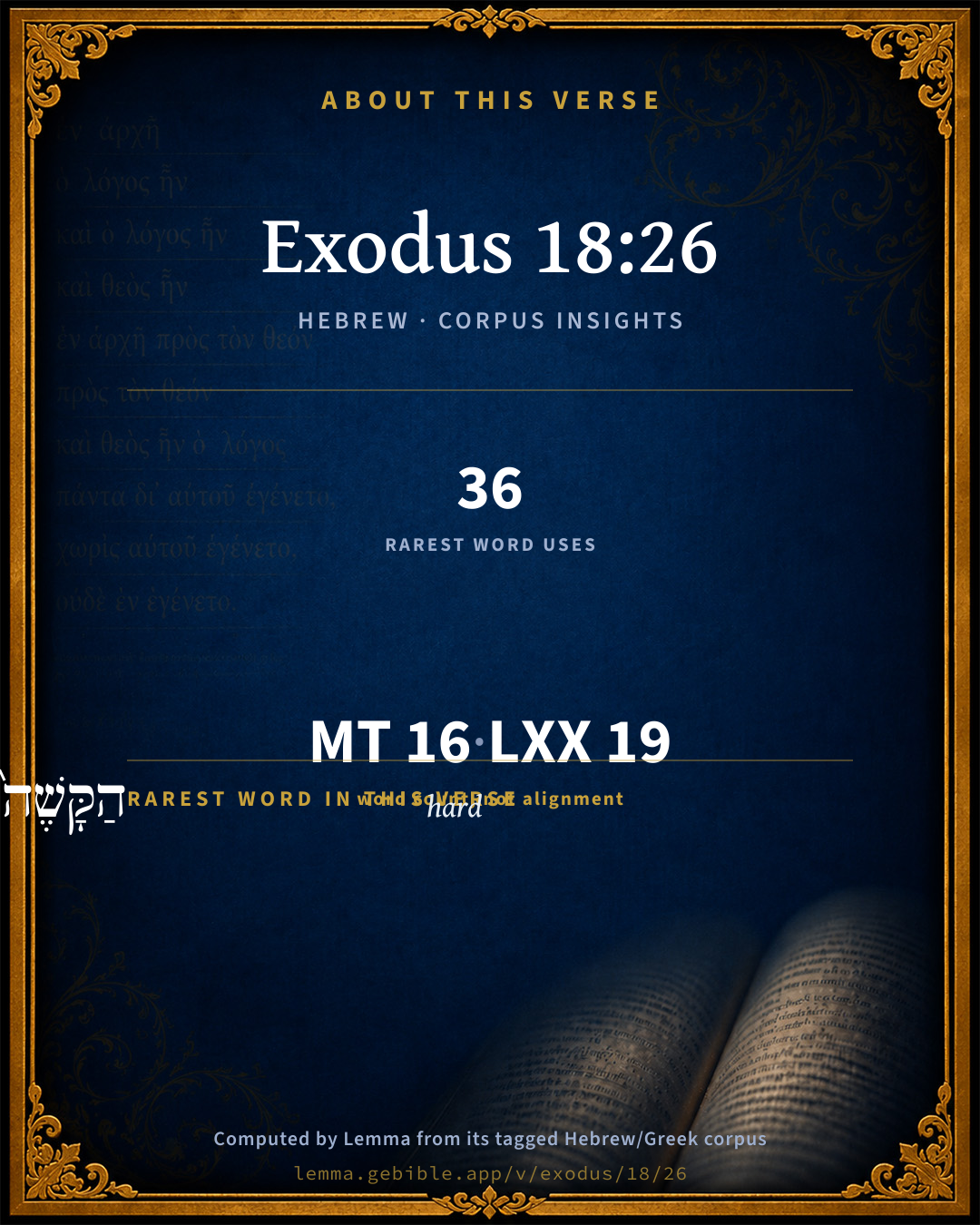
הַקָּשֶׁה֙ hard H7186 occurs in 36 verses of the Hebrew Bible. Also found in:

Grammatical profile

  • 3 verbs
  • 7 nouns
  • 2 adjectives
  • 1 pronoun
  • 1 preposition
  • 2 particles

Verb forms

  • וְשָׁפְט֥וּ Qal · Sequential Perfect
  • יְבִיא֣וּן Hiphil · Imperfect
  • יִשְׁפּוּט֥וּ Qal · Imperfect

Repetition

Words recur within this verse — often emphatic in Hebrew:

  • וְשָׁפְט֥וּ to judge H8199 ×2
  • בְּכָל all H3605 ×2
  • הַדָּבָ֤ר word H1697 ×2

Hebrew & Septuagint length

In English translation the verse runs 21 words from the Hebrew and 24 from the Septuagint (LXX English) — closely comparable.

A rough comparison of the two English renderings, which tokenize alike — not a word-level alignment.

Word counts can differ between the Hebrew and the Greek without any difference in meaning — e.g. the Hebrew direct-object marker אֵת has no separate Greek word, and Greek often adds the article ὁ.

In the original languages it is 16 Hebrew tokens and 19 Greek tokens — but the two are counted differently (Hebrew bundles its prefixes and suffixes into one token; the Greek is in lemma form), so that isn’t a like-for-like length.

Cross-references

6

Topical passages linked to Exodus 18:26 in the Treasury of Scripture Knowledge — connected by theme and wording, ordered by reader-vote popularity; previews shown in the World English Bible.

  • Exodus 18:22 Let them judge the people at all times. It shall be that every great matter they shall bring to you, but every small matter they shall judge themselves. So shall it be easier for you, and they shall share the load with you.
  • Exodus 18:14–15 When Moses' father-in-law saw all that he did to the people, he said, "What is this thing that you do for the people? Why do you sit alone, and all the people stand around you from morning to evening?"
  • Deuteronomy 17:8 If there arise a matter too hard for you in judgment, between blood and blood, between plea and plea, and between stroke and stroke, being matters of controversy within your gates; then shall you arise, and go up to the place which Yahweh your God shall choose;
  • 1 Kings 3:16–28 Then there came two women who were prostitutes, to the king, and stood before him.
  • 1 Kings 10:1 When the queen of Sheba heard of the fame of Solomon concerning the name of Yahweh, she came to prove him with hard questions.
  • Job 29:16 I was a father to the needy. The cause of him who I didn't know, I searched out.

Cross-references courtesy of OpenBible.info (CC BY 4.0).

Hebrew and Greek witnesses Masoretic Hebrew ↔ Greek Septuagint

The same verse in the two great witnesses to the Old Testament, shown verse-for-verse.

These are two independent witnesses, not word-aligned to each other, and the Septuagint is shown in lemma (dictionary) form.

Hebrew Exodus 18:26 Masoretic · Westminster Leningrad Codex

וְשָׁפְט֥וּ אֶת הָעָ֖ם בְּכָל עֵ֑ת אֶת הַדָּבָ֤ר הַקָּשֶׁה֙ יְבִיא֣וּן אֶל מֹשֶׁ֔ה וְכָל הַדָּבָ֥ר הַקָּטֹ֖ן יִשְׁפּוּט֥וּ הֵֽם

They judged the people at all times. They brought the hard causes to Moses, but every small matter they judged themselves.

World English Bible · Public Domain

Greek LXX Exodus 18:26 Septuagint · lemma form

καί κρίνω ὁ λαός πᾶς ὥρα πᾶς δέ ῥῆμα ὑπέρογκος ἀναφέρω ἐπί μωυσῆς πᾶς δέ ῥῆμα ἐλαφρός κρίνω αὐτός

And they judged the people at all times; and every too burdensome matter they brought to Moses, but every light matter they judged themselves.

LXX2012 (modern English Septuagint) · Public Domain

Hebrew: Westminster Leningrad Codex (CC BY 4.0). Greek: Septuagint (public domain); English from LXX2012 (modern English Septuagint) (Public Domain). How the Septuagint differs from the Hebrew →

Targum (Aramaic paraphrase)

2

The Targum is the ancient Jewish Aramaic paraphrase of the Hebrew Scriptures — an interpretive translation, not the Hebrew text itself. Onkelos (literal) and Pseudo-Jonathan (expansive) render the Torah, and Jonathan the Prophets. Coverage is partial: where no permissively-licensed English translation exists for a verse, only the Aramaic is shown. This is verse-level text, not a word-by-word alignment to the Hebrew.

  1. Targum Onkelos Torah (Genesis–Deuteronomy)
    וְדַיְנִין יָת עַמָא בְּכָל עִדָן יָת פִתְגַם קָשֵׁי מַיְתִין לְוָת משֶׁה וְכָל פִּתְגַם זְעֵיר דָיְנִין אִנוּן:

    (no public-domain English translation for this verse)

    Targum Onkelos — Aramaic: “Onkelos Genesis” (public domain); “Onkelos Exodus” (public domain); “Onkelos Leviticus” (public domain); “Onkelos Numbers” (public domain); “Onkelos Deuteronomy” (public domain). English: “Sefaria Community Translation” (CC0 1.0 (public-domain dedication)); “J.W. Etheridge. The Targums of Onkelos and Jonathan Ben Uzziel on the Pentateuch. London: Longmans, Green, 1862” (public domain). Text via Sefaria.

  2. Targum Pseudo-Jonathan Torah (Genesis–Deuteronomy)
    וַהֲווֹן דַּיְינִין יַת עַמָא בְּכָל עִידַן יַת פִּתְגַם קְשֵׁי מַיְיתוּן לְוַת משֶׁה וְכָל פִּתְגַם קָלִיל דַּיְינִין הִינוּן

    And they judged the people at all times; a bard case they, brought to Mosheh; but every light matter they judged it.

    Targum Pseudo-Jonathan — Aramaic: “Targum Jonathan on Genesis” (public domain); “Targum Jonathan on Exodus” (public domain); “Targum Jonathan on Leviticus” (public domain); “Targum Jonathan on Numbers” (public domain); “Targum Jonathan on Deuteronomy” (public domain). English: “The Targum of Jonathan ben Uzziel, trans. J. W. Etheridge, London, 1862” (public domain). Text via Sefaria.

Commentary

Notes on Exodus 18:26 from classic Christian and Jewish commentators (each source and its license shown beneath its notes). The classic Christian expositions comment on the surrounding passage and are grouped to its opening verse, so a note may address several verses; the Jewish commentaries on the Tanakh (Rashi and others) are per-verse, so they appear only where the commentator wrote on this verse.

Lemma curates 59 commentaries, every one of them public domain or Creative Commons licensed, each selected and text-cleaned for this edition rather than reprinted as found. About our sources →

The Cambridge Bible for Schools and Colleges

gen. ed. J. J. S. Perowne

26. The tenses are all frequentative; and describe their custom.

The Cambridge Bible for Schools and Colleges (gen. ed. J. J. S. Perowne; Cambridge University Press, 1878–1918) — public domain. Text from a community e-Sword module.

John Gill's Exposition

And Moses let his father in law depart,.... After he had been with him some time, and desired leave to go into his own country, which was granted; or he "dismissed" (y) him in an honourable way: and as he went out to meet him when he came, if he did not attend him, when he went, some way in person, yet sent a guard along with him, both for honour and for safety:

and he went his way into his own land; the land of Midian: the Targum of Jonathan,"he went to proselyte all the children of his own country;''or, as Jarchi expresses it, the children of his family; and it is plain that the Kenites and Rechabites descended from him, who in later times lived among the Jews, and were proselytes to their religion, Jdg 1:16.

(y) "et dimisit", V. L. Tigurine version, Montanus, Vatablus, Drusius, Piscator.

Next: Exodus Chapter 19

John Gill's Exposition of the Whole Bible (1746–1763) — public domain (CC PDM 1.0). Text via the HelloAO Bible API.

Haydock's Catholic Bible Commentary

To him. Whether they regarded religious or civil matters. No appeal was made from an inferior or any other tribunal, but that of the supreme magistrate. (Calmet)

George Leo Haydock (1774–1849), Haydock's Catholic Family Bible and Commentary, 1859 edition — public domain. Excludes Psalms (Douay-Rheims chapter numbering differs from Protestant) and Deuterocanonical books (Catholic canon only).

The Pulpit Commentary

At all seasons. See the comment on verse 22. The hard causes they brought unto Moses. It must have been left to the discretion of the judges to determine whether a cause was hard or easy, a great or a little matter. Probably only those causes which seemed "hard" to the "rulers of thousands" were brought before Moses for decision.

The Pulpit Commentary (1880–1919), ed. H.D.M. Spence-Jones & Joseph S. Exell — public domain. Text from a community e-Sword module.

Rashi

Rabbi Shlomo Yitzchaki (Rashi)

ושפטו — Onkelos translates by ודינין ית עמא “and they were judging the people” (cf. Rashi on v. 22).

יביאון — Onkelos translates this by מיתין (participle) “they were bringing” (or “they always brought”).

יִשְׁפּוּטוּ הֵם — This is the same as יִשְׁפְּטוּ; similar is (Ruth 2:8) לֹא תַעֲבוּרִי which is the same as לֹא תַעַבְרִי. Its translation in the Targum is דינין אינון “they were judging”. The above verses (i. e. the verbs in v. 22) express the command and consequently they are translated by וידונון and ייתון and ידונון, “and let them judge”, and “let them bring”, and “let them judge”; but these verses express the doing of what was commanded (they state that the command was actually carried out).

Rashi on the Tanakh — English translations: “The Judaica Press complete Tanach with Rashi, translated by A. J. Rosenberg” (CC BY 4.0); “Pentateuch with Rashi's commentary by M. Rosenbaum and A.M. Silbermann, 1929-1934” (public domain); “The Metsudah Tanach series, Lakewood, N.J” (CC BY 4.0); and “The Book of Joshua, Metsudah Publications, 1997” (CC BY 4.0). Text via Sefaria.

Lesson kit

Teaching starters — assembled from the data on this page, not authored interpretation. Every prompt links to the verse data it draws on. Edit before teaching.

Exodus, in the Pentateuch, opens this verse with 16 words (12 distinct Hebrew lemmas). Its most distinctive word is qâsheh (“hard”). A historical commentator’s framing appears above. Read the whole chapter for the surrounding context.

Discussion questions

  1. The word qâsheh carries the sense “hard.” How does it shape the verse?
  2. How does Genesis 42:7, which shares the word «hard», read alongside this verse?
  3. What does the repetition of “to judge” (2× in this one verse) do in this verse?
  4. These translations render this verse differently; the difference is in the English rendering, not the original. What questions does that raise?
  5. «וְשָׁפְט֥וּ» is a Qal Sequential Perfect verb. How does that grammatical form shape the action described?
  6. Compare how The Cambridge Bible for Schools and Colleges and John Gill's Exposition read this verse. Where do they agree or differ?

Things to notice

Reading settings

Reading text

Shown beneath each verse's original-language words.

Old Testament
Old Testament edition

Read the OT as the Masoretic Hebrew (MT) or the Greek Septuagint (LXX).

English shown for the Greek Septuagint (in the Hebrew ↔ Greek comparison).

Comparing translations? Open the Compare panel on any verse page to stack up to four side by side.