Deuteronomy 19:17

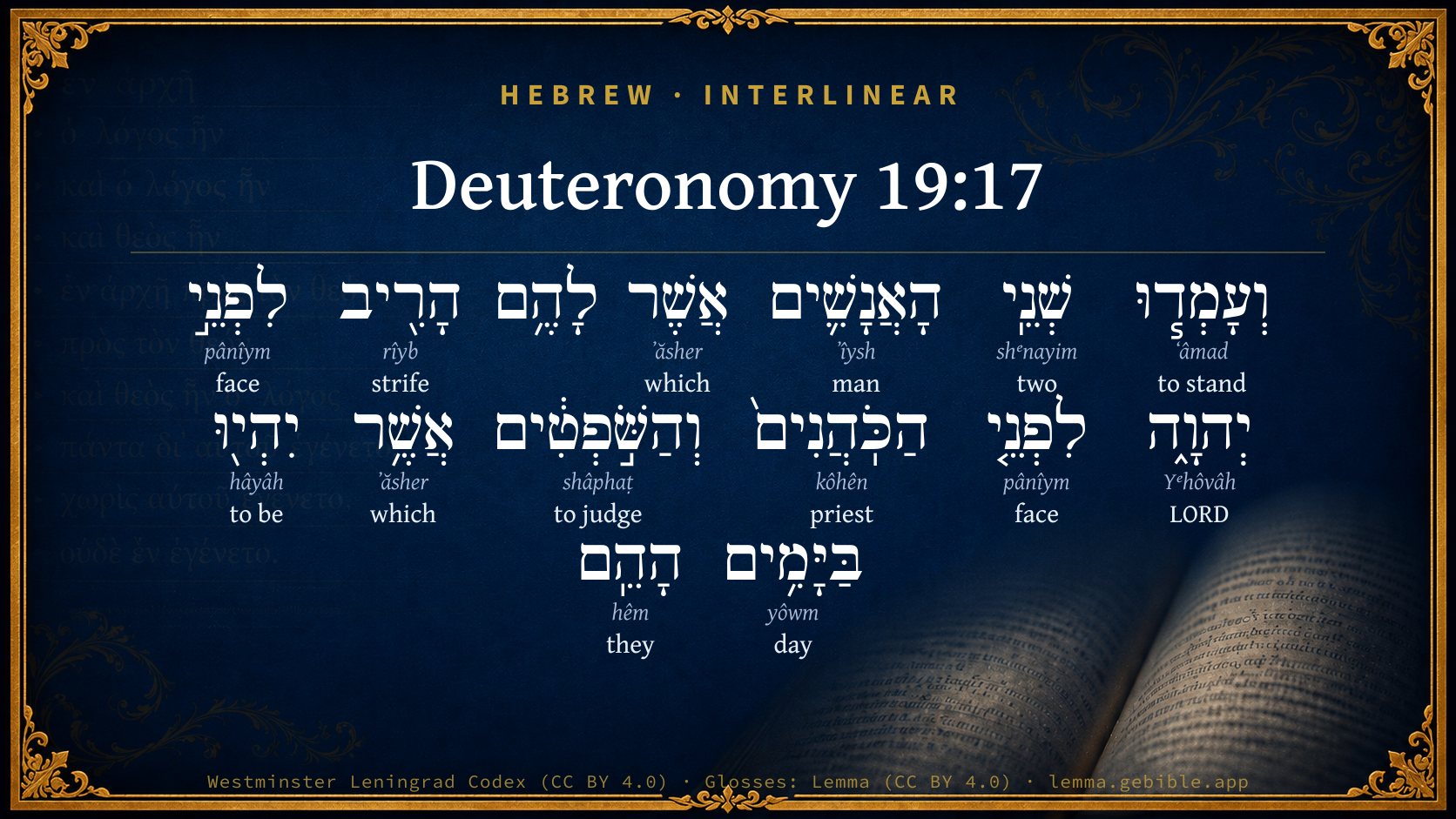
Hebrew (Westminster Leningrad Codex) Deuteronomy 19:17 appears in the Hebrew Old Testament. The text above is from the Westminster Leningrad Codex. Each word links to its Strong’s number, a concise gloss, and parsing drawn from the Open Scriptures Hebrew Bible morphology. Click any word for its full Brown-Driver-Briggs (BDB) entry.
Download image
Cite this verse

Deuteronomy 19:17 (World English Bible). Public Domain. Lemma interlinear Bible study tool, https://lemma.gebible.app/v/deuteronomy/19/17.

Show BibTeX & RIS
BibTeX
RIS
English Translation
then both the men, between whom the controversy is, shall stand before Yahweh, before the priests and the judges who shall be in those days;
World English Bible · Public Domain
Download a study sheet

One document with this verse’s original text, its word-by-word gloss line, the meaning frame, cross-references with their text, attributed commentary, and full source and license credits — printable, and it pastes into notes with its structure intact.

This verse Autodidact and up

Study sheet (.html) Plain text (.txt)

A passage Seminary Student

Up to 50 verses in one chapter. A passage sheet keeps up to 6 commentary sources and 12 cross-references per verse, in the order this page ranks them, and says so on the sheet whenever that leaves anything out. Ask for a single verse and you get the Autodidact verse sheet above.

Everything on this page stays free to read, with no account — the sheet is a download of what is already on screen, not access to it.

Want to remove ads? Support Godless Engineer
Compare translations 3

The same verse in 3 English versions, stacked beneath the original-language interlinear above. Click any original word for its lexicon entry.

Each is an independent rendering of the whole verse — the interlinear is not word-aligned to these translations.

Highlighted words mark where these versions differ — a whole-verse word diff, not a word-by-word alignment.

  • World English Bible Public Domain
    then both the men, between whom the controversy is, shall stand before Yahweh, before the priests and the judges who shall be in those days;
  • King James Version Public Domain
    Then both the men, between whom the controversy is, shall stand before the LORD, before the priests and the judges, which shall be in those days;
  • unfoldingWord Literal Text CC BY-SA 4.0
    then the two men who have the controversy shall stand to the face of Yahweh, to the faces of the priests and the judges who will be in those days.

unfoldingWord Literal Text — © unfoldingWord, licensed CC BY-SA 4.0. Word-aligned USFM3 via Door43 (git.door43.org/unfoldingWord/en_ult).

Versions to compare (up to 4)

3 of 4 selected

Show all 18 translations

Every available English version of this verse, each an independent rendering of the whole verse.

  • World English Bible Public Domain
    then both the men, between whom the controversy is, shall stand before Yahweh, before the priests and the judges who shall be in those days;
  • Berean Standard Bible Public Domain
    both parties to the dispute must stand in the presence of the LORD, before the priests and judges who are in office at that time.
  • Majority Standard Bible Public Domain
    both parties to the dispute must stand in the presence of the LORD, before the priests and judges who are in office at that time.
  • King James Version Public Domain
    Then both the men, between whom the controversy is, shall stand before the LORD, before the priests and the judges, which shall be in those days;
  • American Standard Version (1901) Public Domain
    then both the men, between whom the controversy is, shall stand before Jehovah, before the priests and the judges that shall be in those days;
  • Revised Version (1885) Public Domain
    then both the men, between whom the controversy is, shall stand before the LORD, before the priests and the judges which shall be in those days;
  • Geneva Bible (1599) Public Domain
    Then both the men which striue together, shall stand before ye Lord, euen before the Priests and the Iudges, which shall be in those daies,
  • Douay-Rheims (1899) Public Domain
    Both of them, between whom the controversy is, shall stand before the Lord in the sight of the priests and the judges that shall be in those days.
  • Young's Literal Translation Public Domain
    then have both the men who have the strife stood before Jehovah, before the priests and the judges who are in those days,
  • Literal Standard Version CC BY-SA 4.0
    then both of the men who have the strife have stood before YHWH, before the priests and the judges who are in those days,
  • Unlocked Literal Bible CC BY-SA 4.0
    Then both men, the ones between whom the controversy exists, must stand before Yahweh, before the priests and the judges who serve in those days.
  • unfoldingWord Literal Text CC BY-SA 4.0
    then the two men who have the controversy shall stand to the face of Yahweh, to the faces of the priests and the judges who will be in those days.
  • Darby Bible Public Domain
    then both the men between whom the controversy is shall stand before Jehovah, before the priests and the judges that shall be in those days;
  • World Messianic Bible Public Domain
    then both the men, between whom the controversy is, shall stand before the LORD, before the priests and the judges who shall be in those days;
  • Webster's Bible Public Domain
    Then both the men between whom the controversy is shall stand before the LORD, before the priests, and the judges, who shall be in those days;
  • Free Bible Version CC BY-SA 4.0
    both those involved must come to be judged in the presence of the Lord by the priests and judges who are then in office.
  • Bible in Basic English Public Domain
    Then the two men, between whom the argument has taken place, are to come before the Lord, before the priests and judges who are then in power;
  • JPS Tanakh (1917) Public Domain
    then both the men, between whom the controversy is, shall stand before the LORD, before the priests and the judges that shall be in those days.

Literal Standard Version (2020), Covenant Press — licensed CC BY-SA 4.0. Text via the HelloAO Bible API (eBible.org). Unlocked Literal Bible (unfoldingWord) — licensed CC BY-SA 4.0. Text via the HelloAO Bible API (eBible.org). unfoldingWord Literal Text — © unfoldingWord, licensed CC BY-SA 4.0. Word-aligned USFM3 via Door43 (git.door43.org/unfoldingWord/en_ult). Free Bible Version, Dr. Jonathan Gallagher — licensed CC BY-SA 4.0. Text via the HelloAO Bible API (eBible.org).

Word by word

More ways to search: Search by grammar → Find every occurrence → Compare this word →

Practice this passage: Drill this verse → Learn its vocabulary →

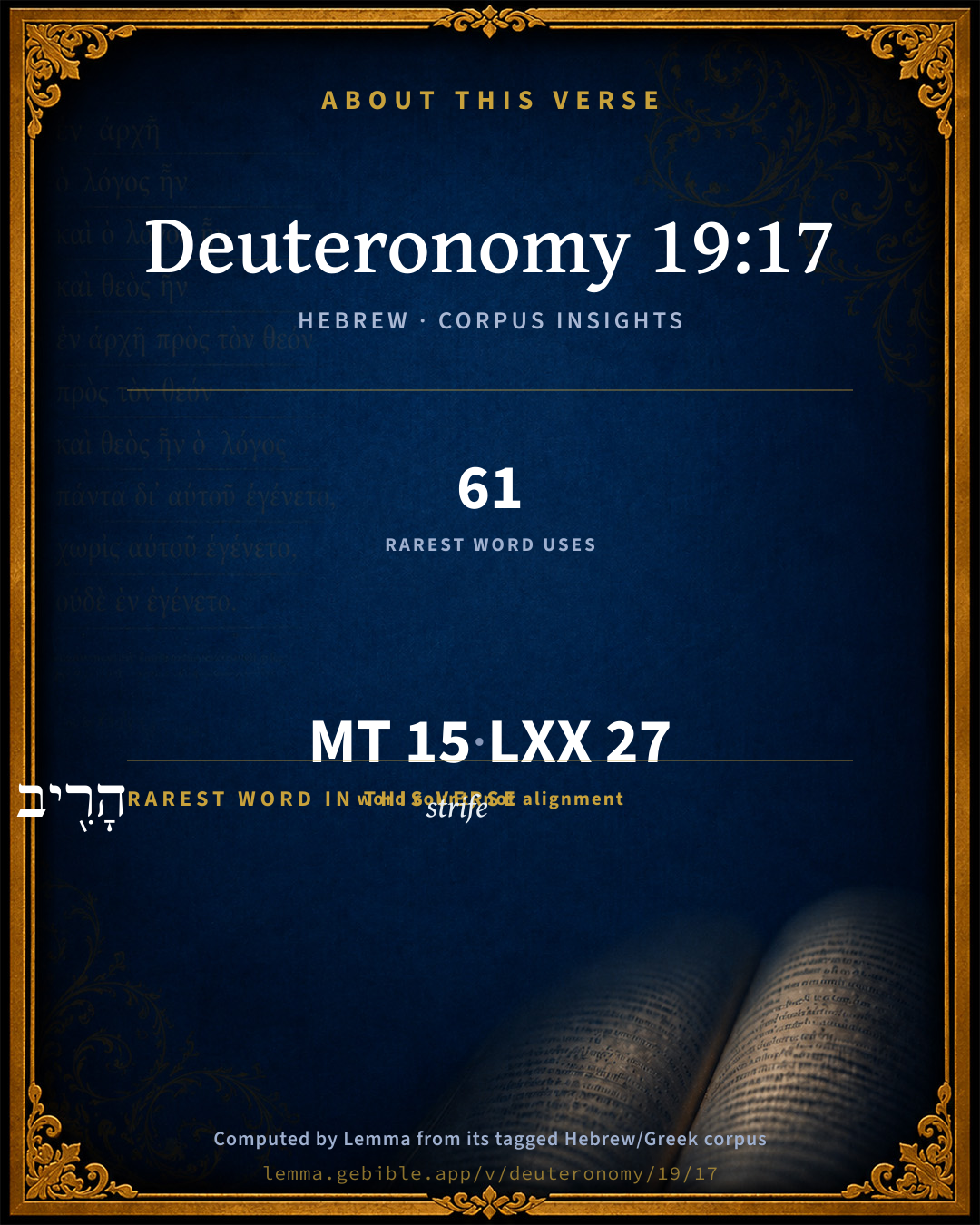
הָרִ֖יב
rîyb
H7379
“the · strife”
Particle, Definite Article + Noun, Common, Both, Singular, Absolute
Part of Speech
Particle + Noun
Type
Common
Gender
Both
Number
Singular
State
Absolute
Full BDB Definition

Origin: from H7378

TWOT: 2159a

strife, controversy, dispute - strife, quarrel - dispute, controversy, case at law
  1. וְעָמְד֧וּ ʻâmad H5975 “and · to stand” Conjunction + Verb, Qal, Sequential Perfect, 3rd Person, Common, Plural
  2. שְׁנֵֽי shᵉnayim H8147 “two” Adjective, Cardinal number, Masculine, Dual, Construct
  3. הָאֲנָשִׁ֛ים ʼîysh H376 “the · men” Particle, Definite Article + Noun, Common, Masculine, Plural, Absolute
  4. אֲשֶׁר ʼăsher H834 “which” Particle, Relative
  5. לִפְנֵ֣י pânîym H6440 “to/for · face(s) of” Preposition + Noun, Common, Both, Plural, Construct
  6. יְהוָ֑ה Yᵉhôvâh H3068 “LORD” Noun, Proper
  7. לִפְנֵ֤י pânîym H6440 “to/for · face(s) of” Preposition + Noun, Common, Both, Plural, Construct
  8. הַכֹּֽהֲנִים֙ kôhên H3548 “the · priests” Particle, Definite Article + Noun, Common, Masculine, Plural, Absolute
  9. וְהַשֹּׁ֣פְטִ֔ים shâphaṭ H8199 “and · the · judging” Conjunction + Particle, Definite Article + Verb, Qal, Participle Active, Masculine, Plural, Absolute
  10. אֲשֶׁ֥ר ʼăsher H834 “which” Particle, Relative
  11. יִהְי֖וּ hâyâh H1961 “to be” Verb, Qal, Imperfect, 3rd Person, Masculine, Plural
  12. בַּיָּמִ֥ים yôwm H3117 “in/at the · days” Preposition, Determined + Noun, Common, Masculine, Plural, Absolute
  13. הָהֵֽם hêm H1992 “the · they” Particle, Definite Article + Pronoun, Personal, 3rd Person, Masculine, Plural

About this verse

These counts appear in no published source. They are computed here, from the morphology-tagged text and Lemma’s own curated glosses. What Lemma adds →

15
words
12
distinct lemmas
Pentateuch
section

Grammatical profile

  • 3 verbs
  • 7 nouns
  • 1 adjective
  • 1 pronoun
  • 1 preposition
  • 2 particles

Verb forms

  • וְעָמְד֧וּ Qal · Sequential Perfect
  • וְהַשֹּׁ֣פְטִ֔ים Qal · Participle Active
  • יִהְי֖וּ Qal · Imperfect

Repetition

Words recur within this verse — often emphatic in Hebrew:

  • לִפְנֵ֣י face H6440 ×2
  • אֲשֶׁר which H834 ×2

Hebrew & Septuagint length

In English translation the verse runs 25 words from the Hebrew and 28 from the Septuagint (LXX English) — closely comparable.

A rough comparison of the two English renderings, which tokenize alike — not a word-level alignment.

Word counts can differ between the Hebrew and the Greek without any difference in meaning — e.g. the Hebrew direct-object marker אֵת has no separate Greek word, and Greek often adds the article ὁ.

In the original languages it is 15 Hebrew tokens and 27 Greek tokens — but the two are counted differently (Hebrew bundles its prefixes and suffixes into one token; the Greek is in lemma form), so that isn’t a like-for-like length.

Cross-references

3

Topical passages linked to Deuteronomy 19:17 in the Treasury of Scripture Knowledge — connected by theme and wording, ordered by reader-vote popularity; previews shown in the World English Bible.

  • Deuteronomy 17:9 and you shall come to the priests the Levites, and to the judge who shall be in those days: and you shall inquire; and they shall show you the sentence of judgment.
  • Deuteronomy 21:5 The priests the sons of Levi shall come near; for them Yahweh your God has chosen to minister to him, and to bless in the name of Yahweh; and according to their word shall every controversy and every stroke be.
  • Malachi 2:7 For the priest's lips should keep knowledge, and they should seek the law at his mouth; for he is the messenger of Yahweh of Hosts.

Cross-references courtesy of OpenBible.info (CC BY 4.0).

Hebrew and Greek witnesses Masoretic Hebrew ↔ Greek Septuagint

The same verse in the two great witnesses to the Old Testament, shown verse-for-verse.

These are two independent witnesses, not word-aligned to each other, and the Septuagint is shown in lemma (dictionary) form.

Hebrew Deuteronomy 19:17 Masoretic · Westminster Leningrad Codex

וְעָמְד֧וּ שְׁנֵֽי הָאֲנָשִׁ֛ים אֲשֶׁר לָהֶ֥ם הָרִ֖יב לִפְנֵ֣י יְהוָ֑ה לִפְנֵ֤י הַכֹּֽהֲנִים֙ וְהַשֹּׁ֣פְטִ֔ים אֲשֶׁ֥ר יִהְי֖וּ בַּיָּמִ֥ים הָהֵֽם

then both the men, between whom the controversy is, shall stand before Yahweh, before the priests and the judges who shall be in those days;

World English Bible · Public Domain

Greek LXX Deuteronomy 19:17 Septuagint · lemma form

καί ἵστημι ὁ δύο ἄνθρωπος ὅς εἰμί αὐτός ὁ ἀντιλογία ἔναντι κύριος καί ἔναντι ὁ ἱερεύς καί ἔναντι ὁ κριτής ὅς ἐάν εἰμί ἐν ὁ ἡμέρα ἐκεῖνος

then shall the two men between whom the controversy is, stand before the Lord, and before the priests, and before the judges, who may be in those days.

LXX2012 (modern English Septuagint) · Public Domain

Hebrew: Westminster Leningrad Codex (CC BY 4.0). Greek: Septuagint (public domain); English from LXX2012 (modern English Septuagint) (Public Domain). How the Septuagint differs from the Hebrew →

Targum (Aramaic paraphrase)

2

The Targum is the ancient Jewish Aramaic paraphrase of the Hebrew Scriptures — an interpretive translation, not the Hebrew text itself. Onkelos (literal) and Pseudo-Jonathan (expansive) render the Torah, and Jonathan the Prophets. Coverage is partial: where no permissively-licensed English translation exists for a verse, only the Aramaic is shown. This is verse-level text, not a word-by-word alignment to the Hebrew.

  1. Targum Onkelos Torah (Genesis–Deuteronomy)
    וִיקוּמוּן תְרֵין גֻבְרִין דִי לְהוֹן דִינָא קֳדָם יְיָ קֳדָם כָּהֲנַיָא וְדַיָנַיָא דִי יְהוֹן בְּיוֹמַיָא הָאִנוּן

    (no public-domain English translation for this verse)

    Targum Onkelos — Aramaic: “Onkelos Genesis” (public domain); “Onkelos Exodus” (public domain); “Onkelos Leviticus” (public domain); “Onkelos Numbers” (public domain); “Onkelos Deuteronomy” (public domain). English: “Sefaria Community Translation” (CC0 1.0 (public-domain dedication)); “J.W. Etheridge. The Targums of Onkelos and Jonathan Ben Uzziel on the Pentateuch. London: Longmans, Green, 1862” (public domain). Text via Sefaria.

  2. Targum Pseudo-Jonathan Torah (Genesis–Deuteronomy)
    וִיקוּמוּן תְּרֵין גּוּבְרִין דִּלְהוֹן תִּיגְרָא קֳדָם יְיָ קֳדָם כַּהֲנַיָא דַיָינַיָא דִיהוֹן בְּיוֹמַיָא הָאִינוּן

    then the two men between whom lies the subject of contention shall stand in the presence of the Lord, before the priests and judges who will be in those days:

    Targum Pseudo-Jonathan — Aramaic: “Targum Jonathan on Genesis” (public domain); “Targum Jonathan on Exodus” (public domain); “Targum Jonathan on Leviticus” (public domain); “Targum Jonathan on Numbers” (public domain); “Targum Jonathan on Deuteronomy” (public domain). English: “The Targum of Jonathan ben Uzziel, trans. J. W. Etheridge, London, 1862” (public domain). Text via Sefaria.

Commentary

Notes on Deuteronomy 19:17 from classic Christian and Jewish commentators (each source and its license shown beneath its notes). The classic Christian expositions comment on the surrounding passage and are grouped to its opening verse, so a note may address several verses; the Jewish commentaries on the Tanakh (Rashi and others) are per-verse, so they appear only where the commentator wrote on this verse.

Lemma curates 59 commentaries, every one of them public domain or Creative Commons licensed, each selected and text-cleaned for this edition rather than reprinted as found. About our sources →

Geneva Bible (1599)

Geneva Bible translators

God’s presence is where his true ministers are assembled.

Geneva Bible (1599) marginal notes — public domain. Text via Bolls.life.

The Cambridge Bible for Schools and Colleges

gen. ed. J. J. S. Perowne

17. shall stand before the Lord, before the priests and the judges, etc.] That is in the supreme court to be instituted at the One Altar, Deu_17:9. The construction is awkward and betrays expansion. Steuern. and Berth. and Marti take before the judges as alone original, as these only are mentioned in the next v., and understand the reference to be, not to the supreme court but to the newly instituted judges of Deu_16:18. But it is quite as probable that before the Lord was all that the original text of the law contained, and that the rest was added from Deu_17:9 by an editor. This is just one of the difficult cases, which in more primitive conditions were referred to some representative of the Deity and which, on the institution of the supreme court at Jerusalem, Israel was directed to take there (cp. Deu_17:8, between plea and plea, the same Heb. term as is here rendered controversy).

The Cambridge Bible for Schools and Colleges (gen. ed. J. J. S. Perowne; Cambridge University Press, 1878–1918) — public domain. Text from a community e-Sword module.

John Gill's Exposition

And the judges shall make diligent inquisition,.... Into the case before them, into the nature of the evidence and proof that each witness brings for or against; so the Targum of Jonathan,"the judges shall interrogate the witness, by whom these things are said, well;''shall thoroughly examine the testimony given, and look carefully into it:

and, behold, if the witness be a false witness, and hath testified falsely against his brother; it appears plainly by full evidence that he has testified a falsehood of him.

John Gill's Exposition of the Whole Bible (1746–1763) — public domain (CC PDM 1.0). Text via the HelloAO Bible API.

Albert Barnes' Notes on the Bible

Both the men, between whom the controversy is - Not the accused and the false witness, but the plaintiff and defendant (compare Exo 23:1) who were summoned before the supreme court held, as provided in Deut. 17, at the sanctuary. The judges acted as God’s representative; to lie to them was to lie to Him.

Albert Barnes' Notes on the Bible (1834–1885) — public domain. Text from a community e-Sword/MySword module.

Haydock's Catholic Bible Commentary

Lord, in the tabernacle. (Menochius) --- Judges. Hence it appears evidently that the priests were to pass sentence in all difficult questions, as well in those which regarded individuals, as in those which attacked the worship of God; since the false accuser is to lose his life or limb, according as he had attempted to injure his neighbour; (ver. 21,) and the Lord ratifies their sentence. (Calmet)

George Leo Haydock (1774–1849), Haydock's Catholic Family Bible and Commentary, 1859 edition — public domain. Excludes Psalms (Douay-Rheims chapter numbering differs from Protestant) and Deuterocanonical books (Catholic canon only).

Matthew Poole's English Annotations

See Poole "Deu 17:9,12", and observe that the controversies both here and there referred to, and to be determined by the priests and judges, are only between man and man, and not doctrines of faith and manners, as the papists for their own advantage pretend.

Matthew Poole's English Annotations on the Holy Bible (1683–1685) — public domain. Text from a community e-Sword/MySword module.

Whedon's Commentary on the Bible

Daniel D. Whedon

17. The men, between whom the controversy is — The original parties in the case, one of whom is supposed to have brought into court the false witness. But Keil thinks the accused and the false witness are the men referred to in this clause.

Before the Lord,… priests… judges — At the place appointed by Jehovah for the sanctuary, before the highest court, this judicial investigation was to be made. The crime of bearing false witness was of such grave moment that it was to be treated with the greatest solemnity.

Daniel D. Whedon (gen. ed.), Commentary on the Old and New Testaments (1874–1909) — public domain. Text from a community e-Sword module.

The Pulpit Commentary

Both the men, i.e. both parties at the bar, shall stand before the Lord; i.e. shall come to the sanctuary where Jehovah had his dwelling-place in the midst of his people, and where the supreme judges, who were his delegates and representatives, held their court. (Deu_17:9)

The Pulpit Commentary (1880–1919), ed. H.D.M. Spence-Jones & Joseph S. Exell — public domain. Text from a community e-Sword module.

Keil & Delitzsch

C. F. Keil & F. Delitzsch

The two men between whom the dispute lay, the accused and the witness, were to come before Jehovah, viz., before the priests and judges who should be in those days - namely, at the place of the sanctuary, where Jehovah dwelt among His people (cf. Deu 17:9), and not before the local courts, as Knobel supposes. These judges were to investigate the case most thoroughly (cf. Deu 13:15); and if the witness had spoken lies, they were to do to him as he thought to do to his brother. The words from "behold" to "his brother" are parenthetical circumstantial clauses: "And, behold, is the witness a false witness, has he spoken a lie against his brother? Ye shall do," etc. זמם, generally to meditate evil. On Deu 19:20, see Deu 13:12.

Keil & Delitzsch — Biblical Commentary on the Old Testament (1861–1891) — public domain (CC PDM 1.0). Text via the HelloAO Bible API. (Old Testament only.)

unfoldingWord translationNotes

Door43 World Missions Community

General Information:

Moses continues to speak to the people of Israel.

the ones between whom the controversy exists

"the ones who disagree with one another"

must stand before Yahweh, before the priests and the judges

This means the two persons must go to the sanctuary where Yahweh's presence dwells. At the sanctuary are priests and judges who have the authority to make legal decisions for Yahweh. (See: Assumed Knowledge and Implicit Information)

stand before Yahweh, before the priests and the judges

The phrase "stand before" is an idiom. It means to go to someone with authority and let him make a legal decision about a matter. (See: Idiom)

The judges must make diligent inquiries

"The judges must work very hard to determine what happened"

then must you do to him, as he had wished to do to his brother

"then you must punish the false witness in the same way as he wanted you to punish the other man"

you will remove the evil from among you

The nominal adjective "the evil" can be stated as an adjective. AT: "you will remove the evil practice from among you" (See: Nominal Adjectives)

translationWords

priest

judge

servant

day

inquire

testimony

corrupt witness

testimony

brother

evil

unfoldingWord translationNotes — © Distant Shores Media and the Door43 World Missions Community, licensed CC BY-SA 4.0. Source: git.door43.org/Door43/en_tn.

Rashi

Rabbi Shlomo Yitzchaki (Rashi)

ועמדו שני האנשים THEN BOTH THE MEN... SHALL STAND [BEFORE THE LORD] — Scripture here is referring to the witnesses, and teaches firstly that no evidence is valid when given by women, and teaches secondly that they (the witnesses) must submit their testimony while standing (Shevuot 30a; cf. Sifrei Devarim 190:1-3).

אשר להם הריב BETWEEN WHOM THE STRIFE IS — this refers to the contestants (Sanhedrin 19a).

'לפני ה BEFORE THE LORD — It should seem to them as though they are standing before the Omnipresent God, for it is said, (Psalms 82:1) “He (God) judges amongst the judges” (cf. Sifrei Devarim 190:5; Sanhedrin 6b).

אשר יהיו בימים ההם [AND THEY... SHALL STAND BEFORE... THE JUDGES] WHO SHALL BE IN THOSE DAYS — The apparently redundant words “who shall be in those days” suggest: Jephthah in his generation must be regarded as was Samuel in his generation: you must treat him with respect (Rosh Hashanah 25b; cf. Rashi on Deuteronomy 17:9 and Deuteronomy 26:3).

Rashi on the Tanakh — English translations: “The Judaica Press complete Tanach with Rashi, translated by A. J. Rosenberg” (CC BY 4.0); “Pentateuch with Rashi's commentary by M. Rosenbaum and A.M. Silbermann, 1929-1934” (public domain); “The Metsudah Tanach series, Lakewood, N.J” (CC BY 4.0); and “The Book of Joshua, Metsudah Publications, 1997” (CC BY 4.0). Text via Sefaria.

Lesson kit

Teaching starters — assembled from the data on this page, not authored interpretation. Every prompt links to the verse data it draws on. Edit before teaching.

Deuteronomy, in the Pentateuch, opens this verse with 15 words (12 distinct Hebrew lemmas). Its most distinctive word is rîyb (“strife”). A historical commentator’s framing appears above. Read the whole chapter for the surrounding context.

Discussion questions

  1. How does “strife” (rîyb) shape what this verse is saying?
  2. How does Deuteronomy 17:9, which shares this passage’s theme, read alongside this verse?
  3. What does the repetition of “face” (2× in this one verse) do in this verse?
  4. These translations render this verse differently; the difference is in the English rendering, not the original. What questions does that raise?
  5. «וְעָמְד֧וּ» is a Qal Sequential Perfect verb. How does that grammatical form shape the action described?
  6. Compare how Geneva Bible (1599) and The Cambridge Bible for Schools and Colleges read this verse. Where do they agree or differ?

Things to notice

Reading settings

Reading text

Shown beneath each verse's original-language words.

Old Testament
Old Testament edition

Read the OT as the Masoretic Hebrew (MT) or the Greek Septuagint (LXX).

English shown for the Greek Septuagint (in the Hebrew ↔ Greek comparison).

Comparing translations? Open the Compare panel on any verse page to stack up to four side by side.