
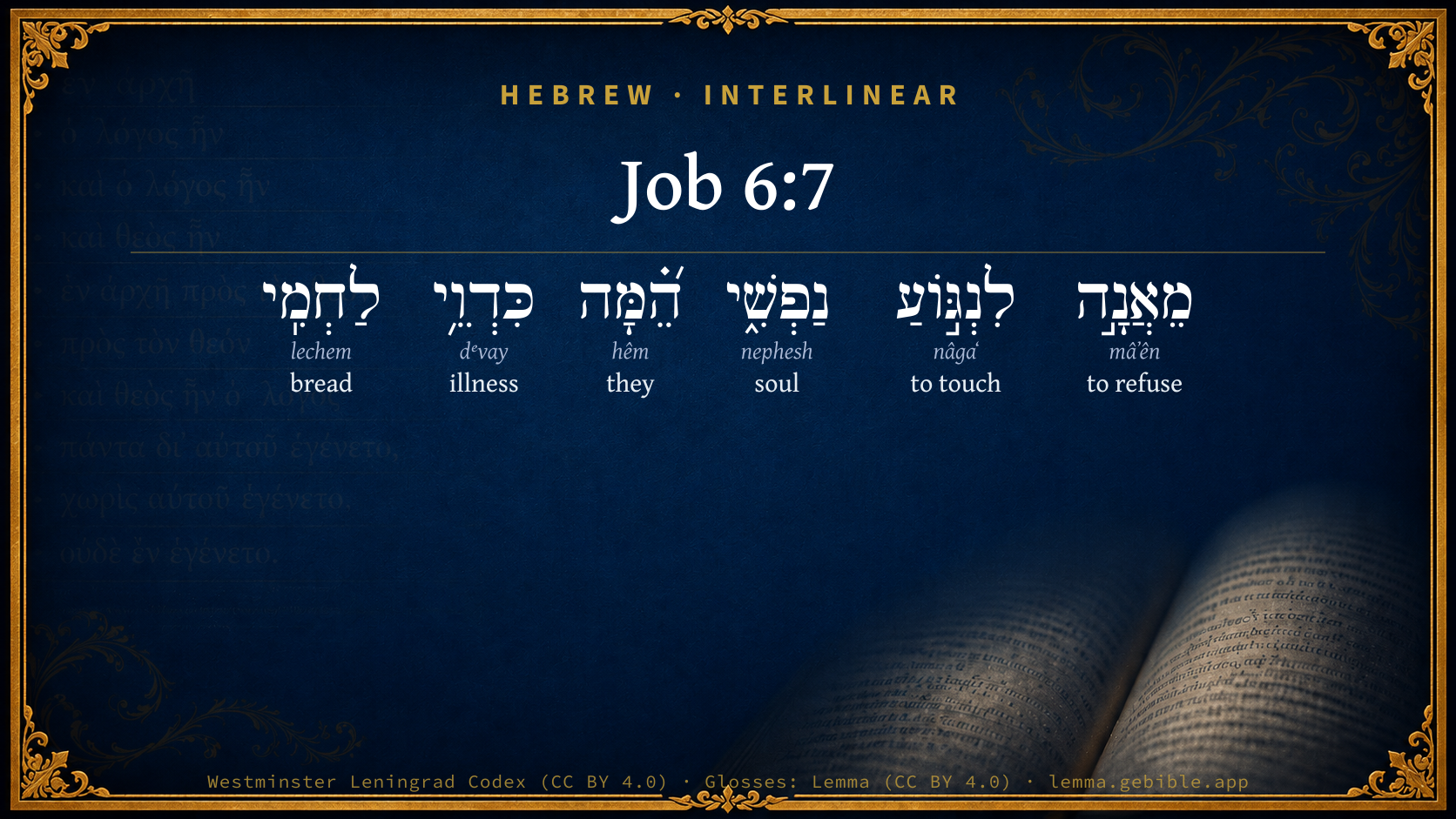
Job 6:7

Hebrew (Westminster Leningrad Codex) Job 6:7 appears in the Hebrew Old Testament. The text above is from the Westminster Leningrad Codex. Each word links to its Strong’s number, a concise gloss, and parsing drawn from the Open Scriptures Hebrew Bible morphology. Click any word for its full Brown-Driver-Briggs (BDB) entry.
Download image
Cite this verse

Job 6:7 (World English Bible). Public Domain. Lemma interlinear Bible study tool, https://lemma.gebible.app/v/job/6/7.

Show BibTeX & RIS
BibTeX
RIS
English Translation
My soul refuses to touch them; They are as loathsome food to me.
World English Bible · Public Domain
Highlights Full analysis ↓
Download a study sheet

One document with this verse’s original text, its word-by-word gloss line, the meaning frame, cross-references with their text, attributed commentary, and full source and license credits — printable, and it pastes into notes with its structure intact.

This verse Autodidact and up

Study sheet (.html) Plain text (.txt)

A passage Seminary Student

Up to 50 verses in one chapter. A passage sheet keeps up to 6 commentary sources and 12 cross-references per verse, in the order this page ranks them, and says so on the sheet whenever that leaves anything out. Ask for a single verse and you get the Autodidact verse sheet above.

Everything on this page stays free to read, with no account — the sheet is a download of what is already on screen, not access to it.

Want to remove ads? Support Godless Engineer
Compare translations 3

The same verse in 3 English versions, stacked beneath the original-language interlinear above. Click any original word for its lexicon entry.

Each is an independent rendering of the whole verse — the interlinear is not word-aligned to these translations.

Highlighted words mark where these versions differ — a whole-verse word diff, not a word-by-word alignment.

  • World English Bible Public Domain
    My soul refuses to touch them; They are as loathsome food to me.
  • King James Version Public Domain
    The things that my soul refused to touch are as my sorrowful meat.
  • unfoldingWord Literal Text CC BY-SA 4.0
    My soul has refused to touch; they like disease my food.

unfoldingWord Literal Text — © unfoldingWord, licensed CC BY-SA 4.0. Word-aligned USFM3 via Door43 (git.door43.org/unfoldingWord/en_ult).

Versions to compare (up to 4)

3 of 4 selected

Show all 18 translations

Every available English version of this verse, each an independent rendering of the whole verse.

  • World English Bible Public Domain
    My soul refuses to touch them; They are as loathsome food to me.
  • Berean Standard Bible Public Domain
    My soul refuses to touch them; they are loathsome food to me.
  • Majority Standard Bible Public Domain
    My soul refuses to touch them; they are loathsome food to me.
  • King James Version Public Domain
    The things that my soul refused to touch are as my sorrowful meat.
  • American Standard Version (1901) Public Domain
    My soul refuseth to touch `them'; They are as loathsome food to me.
  • Revised Version (1885) Public Domain
    My soul refuseth to touch them; they are as loathsome meat to me.
  • Geneva Bible (1599) Public Domain
    Such things as my soule refused to touch, as were sorowes, are my meate.
  • Douay-Rheims (1899) Public Domain
    The things which before my soul would not touch, now, through anguish are my meats.
  • Young's Literal Translation Public Domain
    My soul is refusing to touch! They `are' as my sickening food.
  • Literal Standard Version CC BY-SA 4.0
    My soul is refusing to touch! They [are] as my sickening food.
  • Unlocked Literal Bible CC BY-SA 4.0
    I refuse to touch them; they are like disgusting food to me.
  • unfoldingWord Literal Text CC BY-SA 4.0
    My soul has refused to touch; they like disease my food.
  • Darby Bible Public Domain
    What my soul refuseth to touch, that is as my loathsome food.
  • World Messianic Bible Public Domain
    My soul refuses to touch them. They are as loathsome food to me.
  • Webster's Bible Public Domain
    The things that my soul refused to touch are as my sorrowful food.
  • Free Bible Version CC BY-SA 4.0
    I just can't touch any food—even the thought makes me feel sick!
  • Bible in Basic English Public Domain
    My soul has no desire for such things, they are as disease in my food.
  • JPS Tanakh (1917) Public Domain
    My soul refuseth to touch them; they are as the sickness of my flesh.

Literal Standard Version (2020), Covenant Press — licensed CC BY-SA 4.0. Text via the HelloAO Bible API (eBible.org). Unlocked Literal Bible (unfoldingWord) — licensed CC BY-SA 4.0. Text via the HelloAO Bible API (eBible.org). unfoldingWord Literal Text — © unfoldingWord, licensed CC BY-SA 4.0. Word-aligned USFM3 via Door43 (git.door43.org/unfoldingWord/en_ult). Free Bible Version, Dr. Jonathan Gallagher — licensed CC BY-SA 4.0. Text via the HelloAO Bible API (eBible.org).

Word by word

More ways to search: Search by grammar → Find every occurrence → Compare this word →

Practice this passage: Drill this verse → Learn its vocabulary →

About this verse

These counts appear in no published source. They are computed here, from the morphology-tagged text and Lemma’s own curated glosses. What Lemma adds →

6
words
6
distinct lemmas
Wisdom
section

Notable vocabulary

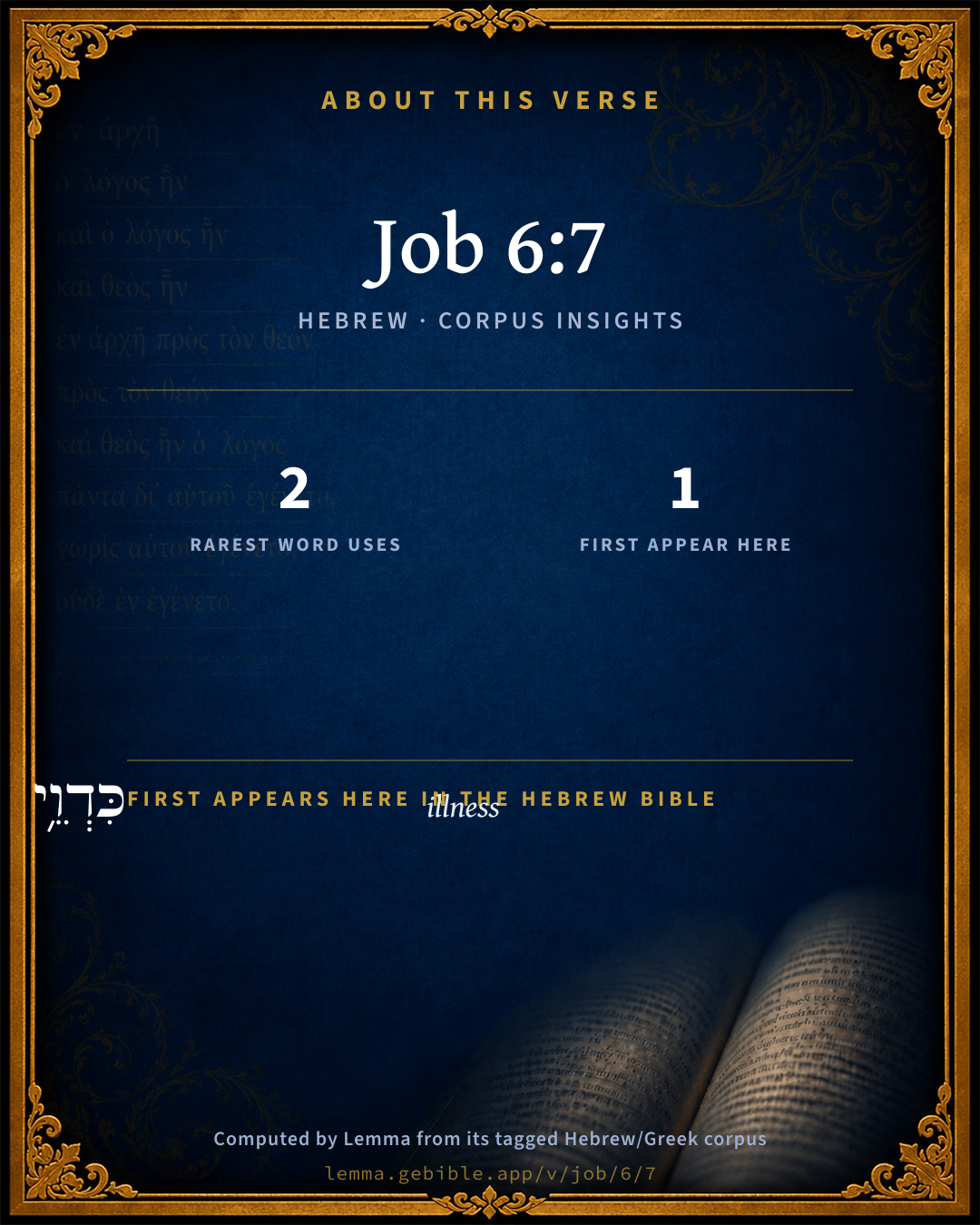
The rarest word here is כִּדְוֵ֥י illness H1741 — appearing just 2 times in the whole Hebrew Bible.

First appearance in Scripture

This word makes its first canonical appearance in the Hebrew Bible here:

  • כִּדְוֵ֥י illness H1741

Shared distinctive vocabulary

כִּדְוֵ֥י illness H1741 occurs in 2 verses of the Hebrew Bible. Also found in:

Grammatical profile

  • 2 verbs
  • 3 nouns
  • 1 pronoun

Verb forms

  • מֵאֲנָ֣ה Piel · Perfect
  • לִנְגּ֣וֹעַ Qal · Infinitive Construct

Hebrew & Septuagint length

In English translation the verse runs 13 words from the Hebrew and 19 from the Septuagint (LXX English) — the Septuagint runs noticeably longer here. See the side-by-side →

A rough comparison of the two English renderings, which tokenize alike — not a word-level alignment.

Word counts can differ between the Hebrew and the Greek without any difference in meaning — e.g. the Hebrew direct-object marker אֵת has no separate Greek word, and Greek often adds the article ὁ.

Cross-references

8

Topical passages linked to Job 6:7 in the Treasury of Scripture Knowledge — connected by theme and wording, ordered by reader-vote popularity; previews shown in the World English Bible.

  • 1 Kings 17:12 She said, As Yahweh your God lives, I don't have a cake, but a handful of meal in the jar, and a little oil in the jar: and, behold, I am gathering two sticks, that I may go in and bake it for me and my son, that we may eat it, and die.
  • 1 Kings 22:27 and say, Thus says the king, Put this fellow in the prison, and feed him with bread of affliction and with water of affliction, until I come in peace.
  • Job 3:24 For my sighing comes before I eat, My groanings are poured out like water.
  • Psalms 102:9 For I have eaten ashes like bread, And mixed my drink with tears,
  • Ezekiel 4:14 Then said I, Ah Lord Yahweh! behold, my soul has not been polluted; for from my youth up even until now have I not eaten of that which dies of itself, or is torn of animals; neither came there abominable flesh into my mouth.
  • Ezekiel 4:16 Moreover he said to me, Son of man, behold, I will break the staff of bread in Jerusalem: and they shall eat bread by weight, and with fearfulness; and they shall drink water by measure, and in dismay:
  • Ezekiel 12:18–19 Son of man, eat your bread with quaking, and drink your water with trembling and with fearfulness;
  • Daniel 10:3 I ate no pleasant bread, neither came flesh nor wine into my mouth, neither did I anoint myself at all, until three whole weeks were fulfilled.

Cross-references courtesy of OpenBible.info (CC BY 4.0).

Hebrew and Greek witnesses Masoretic Hebrew ↔ Greek Septuagint

The same verse in the two great witnesses to the Old Testament, shown verse-for-verse.

Here the Septuagint runs noticeably longer than the Hebrew — LXX2012 (modern English Septuagint) 19 words vs World English Bible 13. A rough length comparison of the two English translations, not a word-level alignment — read both below.

These are two independent witnesses, not word-aligned to each other, and the Septuagint is shown in lemma (dictionary) form.

Hebrew Job 6:7 Masoretic · Westminster Leningrad Codex

מֵאֲנָ֣ה לִנְגּ֣וֹעַ נַפְשִׁ֑י הֵ֝֗מָּה כִּדְוֵ֥י לַחְמִֽי

My soul refuses to touch them; They are as loathsome food to me.

World English Bible · Public Domain

Greek LXX Job 6:7 Septuagint · lemma form

οὐ δύναμαι γάρ παύω ἐγώ ὁ ψυχή βρόμος γάρ ὁράω ὁ σῖτος ἐγώ ὥσπερ ὀσμή λέων

For my wrath can’t cease; for I perceive my food as the smell of a lion to be loathsome.

LXX2012 (modern English Septuagint) · Public Domain

On this verse, Albert Barnes' Notes on the Bible discusses the Septuagint’s reading. Read the note in Commentary ↓

Hebrew: Westminster Leningrad Codex (CC BY 4.0). Greek: Septuagint (public domain); English from LXX2012 (modern English Septuagint) (Public Domain). How the Septuagint differs from the Hebrew →

Commentary

Notes on Job 6:7 from classic Christian and Jewish commentators (each source and its license shown beneath its notes). The classic Christian expositions comment on the surrounding passage and are grouped to its opening verse, so a note may address several verses; the Jewish commentaries on the Tanakh (Rashi and others) are per-verse, so they appear only where the commentator wrote on this verse.

Lemma curates 59 commentaries, every one of them public domain or Creative Commons licensed, each selected and text-cleaned for this edition rather than reprinted as found. About our sources →

Trapp's Complete Commentary

John Trapp

Job 6:7 The things [that] my soul refused to touch [are] as my sorrowful meat.

Ver. 7. The things that my soul refused to touch, &c.] I suffer such torments even in my very soul, as the very thought of them would heretofore have frightened me. Thus Mr Diodati. Others take soul here for the appetite, and so make this the sense: Those things which I exceedingly loathed, and would once have thought scorn to have touched, are now my sorrowful meat; I am forced with a heavy heart to feed upon them for want of better; and they go down the worse because you vex me with your hard words (who have little need of such choke pears), and will not allow me the liberty of a needful lamentation, which yet I must needs take (lest heart should break), and say, as before, Job 3:1-26, though with some more respect to God, the object of my present prayer:

John Trapp, A Commentary or Exposition upon All the Books of the Old and New Testament (1647–1656) — public domain. Text from a community e-Sword module.

Joseph Benson's Commentary

Job 6:7. The things that my soul refused, &c. — “Job, persisting in his allegory,” says Schultens, “goes on to show how disagreeable to his stomach the speech of Eliphaz had been.” This learned critic accordingly translates the verse thus: My soul refuseth to touch such things; they are to me as corrupted food. But Dr. Dodd, after quoting these words of Schultens, observes, he “cannot help thinking that this and the two preceding verses will bear another interpretation, and that Job means, in them, to offer a justification for himself; to declare that he had sufficient ground for complaint, without which it was no more usual for man to lament than for the ox or ass to low or bray, when they had sufficient food, &c.” The sense of the verse seems to be, Those grievous afflictions, which I dreaded the very thought of, are now my daily, though sorrowful, bread.

Joseph Benson's Commentary on the Old and New Testaments (1811–1818) — public domain. Text from a community e-Sword module.

Jamieson, Fausset & Brown

Robert Jamieson, A. R. Fausset & David Brown

To "touch" is contrasted with "meat." "My taste refused even to touch it, and yet am I fed with such meat of sickness." The second clause literally, is, "Such is like the sickness of my food." The natural taste abhors even to touch insipid food, and such forms my nourishment. For my sickness is like such nauseous food [UMBREIT]. (Psa 42:3; Psa 80:5; Psa 102:9). No wonder, then, I complain.

Jamieson, Fausset & Brown — Commentary Critical and Explanatory on the Whole Bible (1871) — public domain (CC PDM 1.0). Text via the HelloAO Bible API.

The Cambridge Bible for Schools and Colleges

gen. ed. J. J. S. Perowne

7. This verse may be rendered not quite literally,

My soul refuseth to touch them!

Such things are like loathsome food to me.

Literally, like my corrupted, or, diseased food. Job does not name his afflictions but refers to them indirectly as “they” and “such things.” He compared his sufferings to food in ch. Job_3:24.

The Cambridge Bible for Schools and Colleges (gen. ed. J. J. S. Perowne; Cambridge University Press, 1878–1918) — public domain. Text from a community e-Sword module.

John Gill's Exposition

And that I might have my request,.... Or that it "might come" (m); that it might go up to heaven, enter there, and come into the ears of the Lord, be attended to, admitted, and received by him, see Psa 18:6; or come to Job, be returned into his bosom, be answered and fulfilled; the same with the desire that "cometh", which is, when the thing desired is enjoyed, Pro 13:12; or that what he had requested would come, namely, death, which is sometimes represented as a person that looks in at the windows, and comes into the houses of men, and seizes on them, Jer 9:21; and this is what Job wishes for; this was his sole request; this was the thing, the one thing, that lay uppermost in his mind, and he was most importunately solicitous for:

and that God would grant me the thing that I long for! death, as the following words explain it; this is not desirable by nature, but contrary to it; it is itself a penal evil, the sanction and curse of the law; it is an enemy, and a very formidable one, the king of terrors; and, though a very formidable, one, is desired by good men from a principle of grace, and with right views, to be rid of sin, and to be with Christ; yet it often is done by persons in melancholy, sullen, and humorous fits, when they cannot have what they would, as in Rachel, Elijah, and Jonah, Gen 30:1; and because of sore troubles and afflictions, which was the present case of Job; though it must be said that it was not, as is frequently the case with wicked men, through the horrors of a guilty conscience, which he was free of; and he had faith, and hope of comfort in another world, and in some degree he submitted to the will and pleasure of God; though pressed with too much eagerness, importunity, and passion: and it may be observed, that Job did not make request to men, to his servants, or friends about him, to dispatch him, as Abimelech and Saul did; nor did he lay hands on himself, or attempt to do it, as Saul, Ahithophel, and Judas: the wretched philosophy of the stoics was not known in Job's time, which not only makes suicide lawful, but commends it as an heroic action; no, Job makes his, request to the God of his life, who had given it to him, and had maintained it hitherto, and who only had a right to dispose of it; he asks it as a favour, he desires it as a gift, he had nothing else to ask, nothing was more or so desirable to him as death.

(m) "ut veniat", V. L. Pagninus, Montanus, Schmidt, Michaelis; "utinam veniret", Schultens.

John Gill's Exposition of the Whole Bible (1746–1763) — public domain (CC PDM 1.0). Text via the HelloAO Bible API.

Albert Barnes' Notes on the Bible

The things that my soul refused to touch - That I refused to touch - the word “soul” here being used to denote himself. The idea here is, that those things which formerly were objects of loathing to him, had become his painful and distressing food. The idea may be either that he was reduced to the greatest pain and distress in partaking of his food, since he loathed that which he was obliged to eat (compare notes, Job 3:24), or more probably his calamity is described under the image of loathsome food in accordance with the Oriental usage, by which one is said to eat or taste anything; that is, to experience it. His sorrows were as sickening to him as the articles of food which he had mentioned were to the stomach. The Septuagint renders it strangely, “For my wrath - μοῦ ἡ ὀργή mou hē orgē - cannot cease. For I see my food offensive as the smell of a lion’ - ὥσπερ ὀσμὴν λέοντος hōsper osmēn leontos.

Albert Barnes' Notes on the Bible (1834–1885) — public domain. Text from a community e-Sword/MySword module.

Matthew Poole's English Annotations

Heb. As the sicknesses or sorrows of my meat, i.e. as my sorrowful meat, which I am constrained to eat with grief of heart. The particle as, either,

1. Notes not the similitude, but the truth of the thing, as it is oft used, as hath been formerly noted and proved. So the sense is, that such meat as formerly he should have abhorred to touch, either for the quality of it, or for his tears or ulcerous matter which mixed themselves with it, he was now forced by the necessities of nature, and his own poverty, to eat. Or,

2. Implies that the following words are not to be understood properly, but metaphorically. And so the sense may be this, Those grievous afflictions, which according to the principles and common inclinations of human nature I dreaded the very touch and thought of, they are now my daily, though sorrowful, bread; I am forced constantly to feed upon them; as other persons in great afflictions are said to be fed with bread of tears, Psa 80:5, and to eat ashes like bread, Psa 102:9. Others make this a censure of Eliphaz’s words, as ungrateful and loathsome to him. But that sense seems neither to agree with the words of this verse, nor with its scope and coherence with the former, of which See Poole "Job 6:6".

Matthew Poole's English Annotations on the Holy Bible (1683–1685) — public domain. Text from a community e-Sword/MySword module.

Whedon's Commentary on the Bible

Daniel D. Whedon

7. The things that my soul refused — The verse reads literally, My soul refuses to touch! They are as tainted food to me. Thus most of the recent commentators. Hitzig, however, renders דוי, crumbs; which, in connexion with “my food,” to say the least, makes very poor sense. Job’s soul recoils from, absolutely loathes, the sorrows of which he speaks in the fourth verse, and again, under a figure, in the sixth. They are to him “like putridity in his food.” — Furst.

Daniel D. Whedon (gen. ed.), Commentary on the Old and New Testaments (1874–1909) — public domain. Text from a community e-Sword module.

The Pulpit Commentary

The things that my soul refuse to touch are as my sorrowful meat; rather, as in the Revised Version, my soul refuseth to touch them; they are as loathsome meat to me. The doubt remains whether Job is speaking of the arguments of Eliphaz, or of the series of afflictions which have befallen him. Either explanation is possible.

The Pulpit Commentary (1880–1919), ed. H.D.M. Spence-Jones & Joseph S. Exell — public domain. Text from a community e-Sword module.

John Wesley's Explanatory Notes

The things, &c. - The sense may be, those grievous afflictions, which I dreaded the very thought of, are now my daily, though sorrowful bread.

John Wesley, Explanatory Notes Upon the Whole Bible (1754–1765) — public domain. Text via the GEBible commentary corpus.

unfoldingWord translationNotes

Door43 World Missions Community

General Information:

Job continues to use parallelisms in these verses as he speaks about his sufferings and his desire for death. (See: Parallelism)

I refuse to touch them

"Them" refers to bad tasting foods.

to crush me once

This means for God to cause him to die. AT: "to crush me and let me die" (See: Euphemism)

that he would let loose his hand and cut me off from this life

The phrases "let loose his hand" is an idiom that means to act quickly. Also, the phrase "cut me off from this life" is a euphemism for killing him. AT: "that he would act quickly and cut short my life" or "that he would act quickly and end my life" (See: Idiom and Euphemism)

translationWords

God

cut off

life

unfoldingWord translationNotes — © Distant Shores Media and the Door43 World Missions Community, licensed CC BY-SA 4.0. Source: git.door43.org/Door43/en_tn.

Rashi

Rabbi Shlomo Yitzchaki (Rashi)

What my body refused to touch That is to say, I have reason to cry increasingly, because things that my body refused [to touch] and was disgusted to touch... [לנגוֹע] is an expression of touching.

as cloths for my food Now they are prepared for me to touch them like my tablecloths upon which my food is placed. כִּדְוֵי is an expression like (II Sam. 10:4), “and he cut off their garments (מדויהם).” I heard this from Rabbi Meshullam the physician. Another interpretation: Like cloths with which they strain the cooked foods and the food runs out of them. דְוֵי is an expression of דָוֶה, running.

my food Heb. לחמי, lit. my bread. All food is called לחם, as in (Dan. 5:1), “made a great feast (לחם).” and as in (Jer. 11:19), “Let us destroy his food (בלחמו) with wood.” which Jonathan renders: poison into his food. Another explanation: They are as the sights of my food. That is to say: I am accustomed to looking at them, at the worms, as I look at my food. This is Mishnaic Hebrew: “and they walk when they look (דוי)” in Tractate Shabbath (53b).

Rashi on the Tanakh — English translations: “The Judaica Press complete Tanach with Rashi, translated by A. J. Rosenberg” (CC BY 4.0); “Pentateuch with Rashi's commentary by M. Rosenbaum and A.M. Silbermann, 1929-1934” (public domain); “The Metsudah Tanach series, Lakewood, N.J” (CC BY 4.0); and “The Book of Joshua, Metsudah Publications, 1997” (CC BY 4.0). Text via Sefaria.

Lesson kit

Teaching starters — assembled from the data on this page, not authored interpretation. Every prompt links to the verse data it draws on. Edit before teaching.

Job, in the Wisdom, opens this verse with 6 words (6 distinct Hebrew lemmas). Its most distinctive word is dᵉvay (“illness”). The Greek Septuagint runs longer here. A historical commentator’s framing appears above. Read the whole chapter for the surrounding context.

Discussion questions

  1. The word dᵉvay carries the sense “illness.” How does it shape the verse?
  2. The word “illness” first appears here in Scripture. What is being introduced at this debut?
  3. Psalms 41:3 shares the word «illness» with this verse. How do the two illuminate each other?
  4. Compared with the Hebrew, the Septuagint runs longer here. What questions does that raise?
  5. These translations render this verse differently; the difference is in the English rendering, not the original. What questions does that raise?
  6. The verb «מֵאֲנָ֣ה» is Piel Perfect. How does its form color the action?
  7. Reading how Trapp's Complete Commentary and Joseph Benson's Commentary read this verse, where do the two commentators agree and where do they part?

Things to notice

Reading settings

Reading text

Shown beneath each verse's original-language words.

Old Testament
Old Testament edition

Read the OT as the Masoretic Hebrew (MT) or the Greek Septuagint (LXX).

English shown for the Greek Septuagint (in the Hebrew ↔ Greek comparison).

Comparing translations? Open the Compare panel on any verse page to stack up to four side by side.