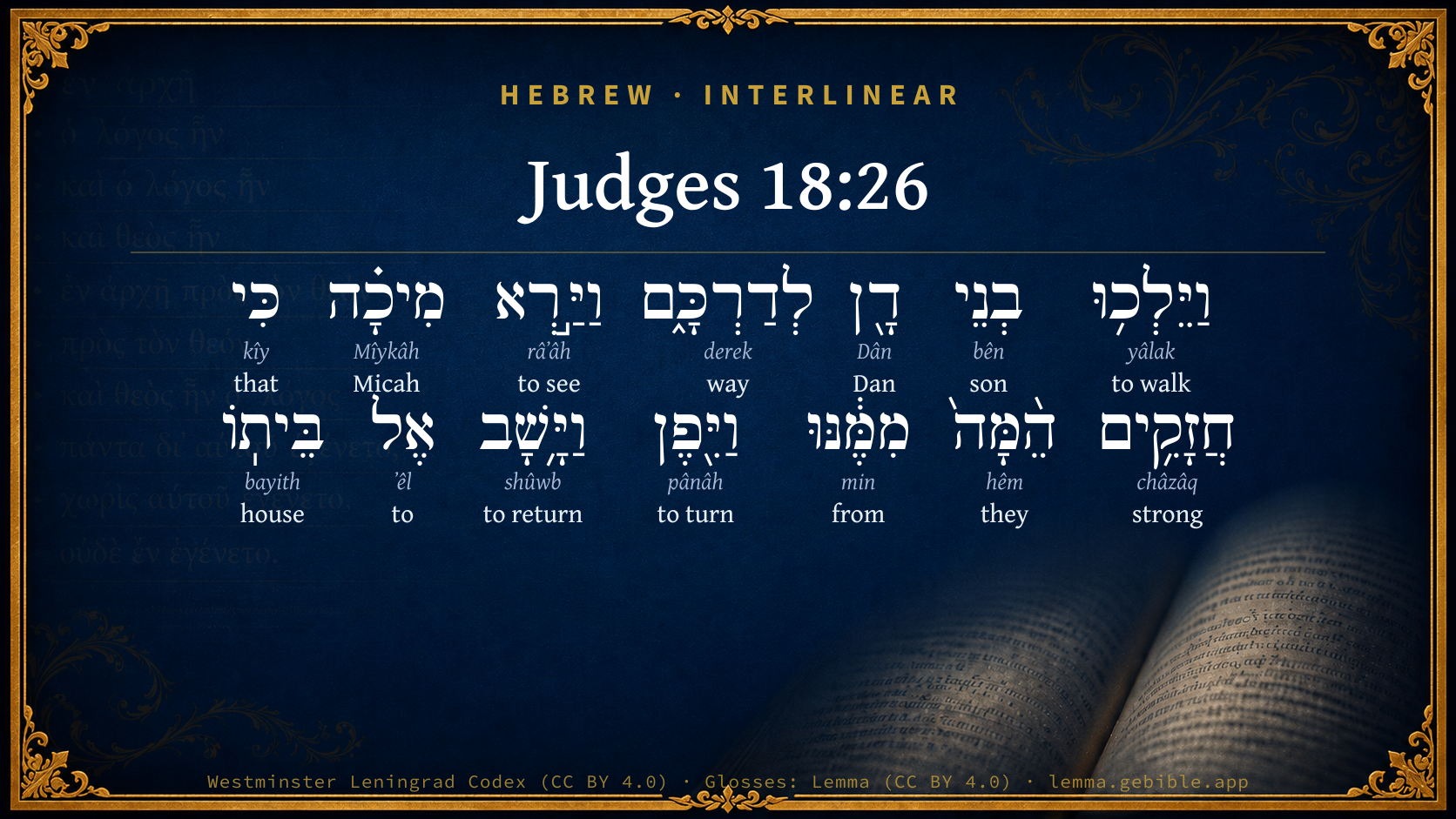
Judges 18:26

Hebrew (Westminster Leningrad Codex) Judges 18:26 appears in the Hebrew Old Testament. The text above is from the Westminster Leningrad Codex. Each word links to its Strong’s number, a concise gloss, and parsing drawn from the Open Scriptures Hebrew Bible morphology. Click any word for its full Brown-Driver-Briggs (BDB) entry.
Download image
Cite this verse

Judges 18:26 (World English Bible). Public Domain. Lemma interlinear Bible study tool, https://lemma.gebible.app/v/judges/18/26.

Show BibTeX & RIS
BibTeX
RIS
English Translation
The children of Dan went their way: and when Micah saw that they were too strong for him, he turned and went back to his house.
World English Bible · Public Domain
Download a study sheet

One document with this verse’s original text, its word-by-word gloss line, the meaning frame, cross-references with their text, attributed commentary, and full source and license credits — printable, and it pastes into notes with its structure intact.

This verse Autodidact and up

Study sheet (.html) Plain text (.txt)

A passage Seminary Student

Up to 50 verses in one chapter. A passage sheet keeps up to 6 commentary sources and 12 cross-references per verse, in the order this page ranks them, and says so on the sheet whenever that leaves anything out. Ask for a single verse and you get the Autodidact verse sheet above.

Everything on this page stays free to read, with no account — the sheet is a download of what is already on screen, not access to it.

Want to remove ads? Support Godless Engineer
Compare translations 3

The same verse in 3 English versions, stacked beneath the original-language interlinear above. Click any original word for its lexicon entry.

Each is an independent rendering of the whole verse — the interlinear is not word-aligned to these translations.

Highlighted words mark where these versions differ — a whole-verse word diff, not a word-by-word alignment.

  • World English Bible Public Domain
    The children of Dan went their way: and when Micah saw that they were too strong for him, he turned and went back to his house.
  • King James Version Public Domain
    And the children of Dan went their way: and when Micah saw that they were too strong for him, he turned and went back unto his house.
  • unfoldingWord Literal Text CC BY-SA 4.0
    And the sons of Dan went on their way, for Micah perceived that they were stronger than him. And he turned and returned to his house.

unfoldingWord Literal Text — © unfoldingWord, licensed CC BY-SA 4.0. Word-aligned USFM3 via Door43 (git.door43.org/unfoldingWord/en_ult).

Versions to compare (up to 4)

3 of 4 selected

Show all 18 translations

Every available English version of this verse, each an independent rendering of the whole verse.

  • World English Bible Public Domain
    The children of Dan went their way: and when Micah saw that they were too strong for him, he turned and went back to his house.
  • Berean Standard Bible Public Domain
    So the Danites went on their way, and Micah turned to go back home, because he saw that they were too strong for him.
  • Majority Standard Bible Public Domain
    So the Danites went on their way, and Micah turned to go back home, because he saw that they were too strong for him.
  • King James Version Public Domain
    And the children of Dan went their way: and when Micah saw that they were too strong for him, he turned and went back unto his house.
  • American Standard Version (1901) Public Domain
    And the children of Dan went their way: and when Micah saw that they were too strong for him, he turned and went back unto his house.
  • Revised Version (1885) Public Domain
    And the children of Dan went their way: and when Micah saw that they were too strong for him, he turned and went back unto his house.
  • Geneva Bible (1599) Public Domain
    So the children of Dan went their wayes: and when Michah saw that they were too strong for him, hee turned, and went backe vnto his house.
  • Douay-Rheims (1899) Public Domain
    And so they went on the journey they had begun. But Michas seeing that they were stronger than he, returned to his house.
  • Young's Literal Translation Public Domain
    and the sons of Dan go on their way, and Micah seeth that they are stronger than he, and turneth, and goeth back unto his house.
  • Literal Standard Version CC BY-SA 4.0
    and the sons of Dan go on their way, and Micah sees that they are stronger than he, and turns, and goes back to his house.
  • Unlocked Literal Bible CC BY-SA 4.0
    Then the people of Dan went their way. When Micah saw that they were too strong for him, he turned and went back to his house.
  • unfoldingWord Literal Text CC BY-SA 4.0
    And the sons of Dan went on their way, for Micah perceived that they were stronger than him. And he turned and returned to his house.
  • Darby Bible Public Domain
    Then the Danites went their way; and when Micah saw that they were too strong for him, he turned and went back to his home.
  • World Messianic Bible Public Domain
    The children of Dan went their way; and when Micah saw that they were too strong for him, he turned and went back to his house.
  • Webster's Bible Public Domain
    And the children of Dan departed: and when Micah saw that they were too strong for him, he turned and went back to his house.
  • Free Bible Version CC BY-SA 4.0
    The Danites carried on their way. Micah saw that they were too strong for him to fight so he turned around and went back home.
  • Bible in Basic English Public Domain
    Then the children of Dan went on their way; and when Micah saw that they were stronger than he, he went back to his house.
  • JPS Tanakh (1917) Public Domain
    And the children of Dan went their way; and when Micah saw that they were too strong for him, he turned and went back unto his house.

Literal Standard Version (2020), Covenant Press — licensed CC BY-SA 4.0. Text via the HelloAO Bible API (eBible.org). Unlocked Literal Bible (unfoldingWord) — licensed CC BY-SA 4.0. Text via the HelloAO Bible API (eBible.org). unfoldingWord Literal Text — © unfoldingWord, licensed CC BY-SA 4.0. Word-aligned USFM3 via Door43 (git.door43.org/unfoldingWord/en_ult). Free Bible Version, Dr. Jonathan Gallagher — licensed CC BY-SA 4.0. Text via the HelloAO Bible API (eBible.org).

Word by word

More ways to search: Search by grammar → Find every occurrence → Compare this word →

Practice this passage: Drill this verse → Learn its vocabulary →

מִיכָ֗ה
Mîykâh
H4318
“Micah”
Noun, Proper
Part of Speech
Noun
Type
Proper
Full BDB Definition

Origin: an abbrev. of H4320

TWOT: None

Micah or Micaiah or Michah = "who is like God" - the 6th in order of the minor prophets; a native of Moresheth, he prophesied during the reigns of Jotham, Ahaz, and Hezekiah of Judah, and was contemporary with the prophets Hosea, Amos, and Isaiah - an Ephraimite during the period of the judges - a descendant of Joel the Reubenite - son of Meribbaal and grandson of Jonathan - a Kohathite Levite, the eldest son of Uzziel the brother of Amram - father of Abdon, a man of high station in the reign of Josiah - son of Imlah and a prophet of Samaria who predicted the defeat and death of king Ahab of Israel
  1. וַיֵּלְכ֥וּ yâlak H3212 “and · to walk” Conjunction + Verb, Qal, Sequential Imperfect, 3rd Person, Masculine, Plural
  2. בְנֵי bên H1121 “sons of” Noun, Common, Masculine, Plural, Construct
  3. דָ֖ן Dân H1835 “Dan” Noun, Proper
  4. לְדַרְכָּ֑ם derek H1870 “to/for · way · their” Preposition + Noun, Common, Both, Singular, Construct + Suffix, Personal, 3rd Person, Masculine, Plural
  5. וַיַּ֣רְא râʼâh H7200 “and · to see” Conjunction + Verb, Qal, Sequential Imperfect, 3rd Person, Masculine, Singular
  6. כִּי kîy H3588 “that” Conjunction
  7. חֲזָקִ֥ים châzâq H2389 “strong” Adjective, Adjective, Masculine, Plural, Absolute
  8. הֵ֨מָּה֙ hêm H1992 “they” Pronoun, Personal, 3rd Person, Masculine, Plural
  9. מִמֶּ֔נּוּ min H4480 “from · us” Preposition + Suffix, Personal, 1st Person, Common, Plural
  10. וַיִּ֖פֶן pânâh H6437 “and · to turn” Conjunction + Verb, Qal, Sequential Imperfect, 3rd Person, Masculine, Singular
  11. וַיָּ֥שָׁב shûwb H7725 “and · to return” Conjunction + Verb, Qal, Sequential Imperfect, 3rd Person, Masculine, Singular
  12. אֶל ʼêl H413 “to” Preposition
  13. בֵּיתֽוֹ bayith H1004 “house · his” Noun, Common, Masculine, Singular, Construct + Suffix, Personal, 3rd Person, Masculine, Singular

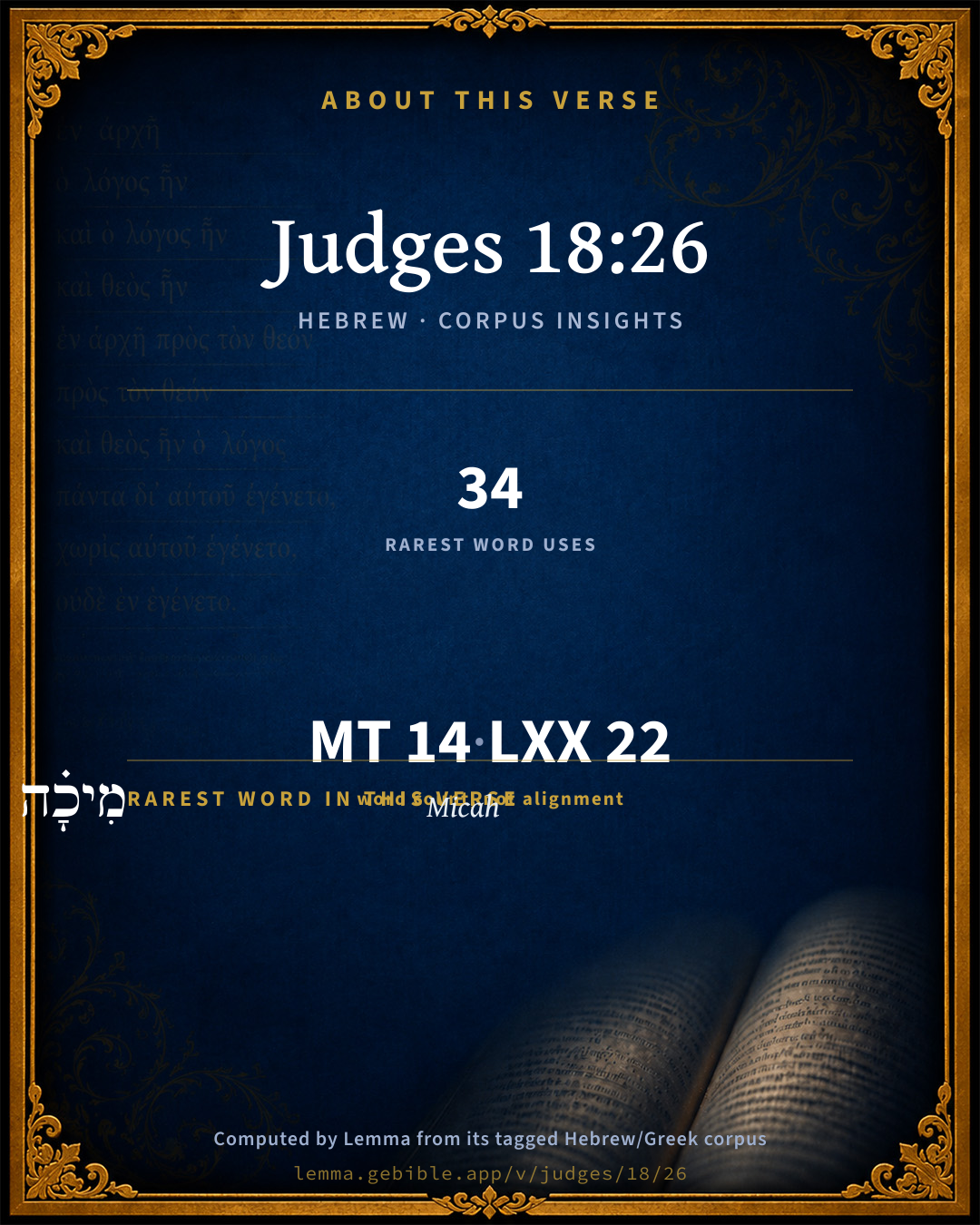
About this verse

These counts appear in no published source. They are computed here, from the morphology-tagged text and Lemma’s own curated glosses. What Lemma adds →

14
words
14
distinct lemmas
Historical
section

Shared distinctive vocabulary

מִיכָ֗ה Micah H4318 occurs in 31 verses of the Hebrew Bible. Also found in:

Grammatical profile

  • 4 verbs
  • 5 nouns
  • 1 adjective
  • 1 pronoun
  • 2 prepositions
  • 1 conjunction

Verb forms

  • וַיֵּלְכ֥וּ Qal · Sequential Imperfect
  • וַיַּ֣רְא Qal · Sequential Imperfect
  • וַיִּ֖פֶן Qal · Sequential Imperfect
  • וַיָּ֥שָׁב Qal · Sequential Imperfect

Hebrew & Septuagint length

In English translation the verse runs 26 words from the Hebrew and 23 from the Septuagint (LXX English) — closely comparable.

A rough comparison of the two English renderings, which tokenize alike — not a word-level alignment.

Word counts can differ between the Hebrew and the Greek without any difference in meaning — e.g. the Hebrew direct-object marker אֵת has no separate Greek word, and Greek often adds the article ὁ.

In the original languages it is 14 Hebrew tokens and 22 Greek tokens — but the two are counted differently (Hebrew bundles its prefixes and suffixes into one token; the Greek is in lemma form), so that isn’t a like-for-like length.

Hebrew and Greek witnesses Masoretic Hebrew ↔ Greek Septuagint

The same verse in the two great witnesses to the Old Testament, shown verse-for-verse.

These are two independent witnesses, not word-aligned to each other, and the Septuagint is shown in lemma (dictionary) form.

Hebrew Judges 18:26 Masoretic · Westminster Leningrad Codex

וַיֵּלְכ֥וּ בְנֵי דָ֖ן לְדַרְכָּ֑ם וַיַּ֣רְא מִיכָ֗ה כִּי חֲזָקִ֥ים הֵ֨מָּה֙ מִמֶּ֔נּוּ וַיִּ֖פֶן וַיָּ֥שָׁב אֶל בֵּיתֽוֹ

The children of Dan went their way: and when Micah saw that they were too strong for him, he turned and went back to his house.

World English Bible · Public Domain

Greek LXX Judges 18:26 Septuagint · lemma form

καί πορεύομαι ὁ υἱός δαν εἰς ὁδός αὐτός καί ὁράω μιχαιας ὅτι δυνατός εἰμί ὑπέρ αὐτός καί στρέφω εἰς ὁ οἶκος αὐτός

And the children of Dan went their way; and Michaias saw that they were stronger than himself, and he returned to his house.

LXX2012 (modern English Septuagint) · Public Domain

Hebrew: Westminster Leningrad Codex (CC BY 4.0). Greek: Septuagint (public domain); English from LXX2012 (modern English Septuagint) (Public Domain). How the Septuagint differs from the Hebrew →

Targum (Aramaic paraphrase)

1

The Targum is the ancient Jewish Aramaic paraphrase of the Hebrew Scriptures — an interpretive translation, not the Hebrew text itself. Onkelos (literal) and Pseudo-Jonathan (expansive) render the Torah, and Jonathan the Prophets. Coverage is partial: where no permissively-licensed English translation exists for a verse, only the Aramaic is shown. This is verse-level text, not a word-by-word alignment to the Hebrew.

  1. Targum Jonathan Prophets (Joshua–Malachi)
    וַאֲזַלוּ בְּנֵי דָן לְאוֹרְחֵיהוֹן וַחֲזָא מִיכָה אֲרֵי תַקִיפִין אִינוּן מִינֵיהּ וְאִתְפְּנֵי וְתַב לְבֵיתֵיהּ:

    (no public-domain English translation for this verse)

    Targum Jonathan — Aramaic: “Mikraot Gedolot” (public domain). English: “Sefaria Community Translation” (CC0 1.0 (public-domain dedication)); “London "Chaldee Paraphrase," 1871” (public domain). Text via Sefaria.

Commentary

Notes on Judges 18:26 from classic Christian and Jewish commentators (each source and its license shown beneath its notes). The classic Christian expositions comment on the surrounding passage and are grouped to its opening verse, so a note may address several verses; the Jewish commentaries on the Tanakh (Rashi and others) are per-verse, so they appear only where the commentator wrote on this verse.

Lemma curates 59 commentaries, every one of them public domain or Creative Commons licensed, each selected and text-cleaned for this edition rather than reprinted as found. About our sources →

Trapp's Complete Commentary

John Trapp

Jdg 18:26 And the children of Dan went their way: and when Micah saw that they [were] too strong for him, he turned and went back unto his house.

Ver. 26. He turned and went back unto his house.] But took no notice that God punished him for his idolatry by those injurious Danites. "Lord, when thy hand is lifted up, they will not see; but they shall see and be ashamed." {Isa 26:11}

John Trapp, A Commentary or Exposition upon All the Books of the Old and New Testament (1647–1656) — public domain. Text from a community e-Sword module.

John Gill's Exposition

And the children of Dan went their way,.... Went on their way, would not stay to have any further talk with him, as being an impertinent man, and unworthy of their regard, bidding him defiance, and do his worst, having nothing to fear from him:

and when Micah saw they were too strong for him; that he could not prevail upon them by words and arguments; to take up arms, and use them, he perceived it was to no purpose, since they were more numerous and more mighty than he and his neighbours:

he turned and went unto his own house; and if he returned from his idolatry to the true God, and the right worship of him, having lost his gods, it was well for him they were taken away.

John Gill's Exposition of the Whole Bible (1746–1763) — public domain (CC PDM 1.0). Text via the HelloAO Bible API.

The Pulpit Commentary

The verse tells us what the two parties did, but not in the Order in which an English writer would express it; for no doubt the Danites, encumbered with their women, and children, and baggage, did not go on their way till Micah and his party had turned back, though in English the contrary order is rather implied. The Hebrew merely puts the actions side by side, and leaves the order to be inferred.

The Pulpit Commentary (1880–1919), ed. H.D.M. Spence-Jones & Joseph S. Exell — public domain. Text from a community e-Sword module.

Keil & Delitzsch

C. F. Keil & F. Delitzsch

Then the Danites went their way; but Micah, seeing that they were stronger than he, turned back and returned home.

Keil & Delitzsch — Biblical Commentary on the Old Testament (1861–1891) — public domain (CC PDM 1.0). Text via the HelloAO Bible API. (Old Testament only.)

Lesson kit

Teaching starters — assembled from the data on this page, not authored interpretation. Every prompt links to the verse data it draws on. Edit before teaching.

Judges, in the Historical, opens this verse with 14 words (14 distinct Hebrew lemmas). Its most distinctive word is Mîykâh (“Micah”). A historical commentator’s framing appears above. Read the whole chapter for the surrounding context.

Discussion questions

  1. What does “Micah” (Mîykâh) contribute to the verse as a whole?
  2. How does Judges 17:5, which shares the word «Micah», read alongside this verse?
  3. The translations on this page render this verse differently — a whole-verse word diff, not a word-by-word alignment. What might account for the different wordings?
  4. «וַיֵּלְכ֥וּ» is a Qal Sequential Imperfect verb. How does that grammatical form shape the action described?
  5. Compare how Trapp's Complete Commentary and John Gill's Exposition read this verse. Where do they agree or differ?

Things to notice

Reading settings

Reading text

Shown beneath each verse's original-language words.

Old Testament
Old Testament edition

Read the OT as the Masoretic Hebrew (MT) or the Greek Septuagint (LXX).

English shown for the Greek Septuagint (in the Hebrew ↔ Greek comparison).

Comparing translations? Open the Compare panel on any verse page to stack up to four side by side.