Exodus 29:33

Hebrew (Westminster Leningrad Codex) Exodus 29:33 appears in the Hebrew Old Testament. The text above is from the Westminster Leningrad Codex. Each word links to its Strong’s number, a concise gloss, and parsing drawn from the Open Scriptures Hebrew Bible morphology. Click any word for its full Brown-Driver-Briggs (BDB) entry.
Download image
Cite this verse

Exodus 29:33 (World English Bible). Public Domain. Lemma interlinear Bible study tool, https://lemma.gebible.app/v/exodus/29/33.

Show BibTeX & RIS
BibTeX
RIS
English Translation
They shall eat those things with which atonement was made, to consecrate and sanctify them: but a stranger shall not eat of it, because they are holy.
World English Bible · Public Domain
Highlights
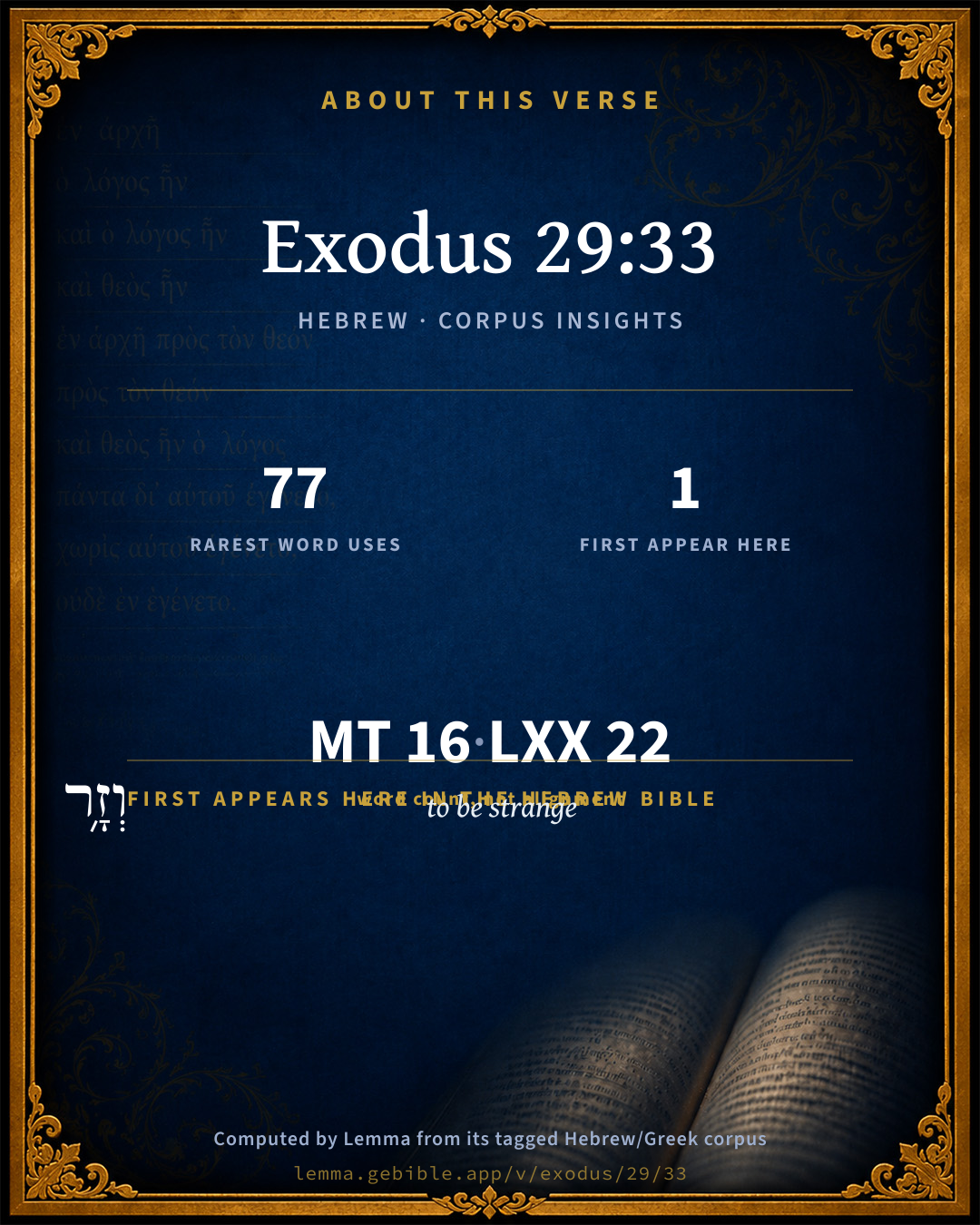
  • 1 first appearance in the Hebrew Bible
Full analysis ↓
Download a study sheet

One document with this verse’s original text, its word-by-word gloss line, the meaning frame, cross-references with their text, attributed commentary, and full source and license credits — printable, and it pastes into notes with its structure intact.

This verse Autodidact and up

Study sheet (.html) Plain text (.txt)

A passage Seminary Student

Up to 50 verses in one chapter. A passage sheet keeps up to 6 commentary sources and 12 cross-references per verse, in the order this page ranks them, and says so on the sheet whenever that leaves anything out. Ask for a single verse and you get the Autodidact verse sheet above.

Everything on this page stays free to read, with no account — the sheet is a download of what is already on screen, not access to it.

Want to remove ads? Support Godless Engineer
Compare translations 3

The same verse in 3 English versions, stacked beneath the original-language interlinear above. Click any original word for its lexicon entry.

Each is an independent rendering of the whole verse — the interlinear is not word-aligned to these translations.

Highlighted words mark where these versions differ — a whole-verse word diff, not a word-by-word alignment.

  • World English Bible Public Domain
    They shall eat those things with which atonement was made, to consecrate and sanctify them: but a stranger shall not eat of it, because they are holy.
  • King James Version Public Domain
    And they shall eat those things wherewith the atonement was made, to consecrate and to sanctify them: but a stranger shall not eat thereof, because they are holy.
  • unfoldingWord Literal Text CC BY-SA 4.0
    And they shall eat these that were for their atoning to fill their hand, to set them apart. But a stranger shall not eat them, because they are set apart.

unfoldingWord Literal Text — © unfoldingWord, licensed CC BY-SA 4.0. Word-aligned USFM3 via Door43 (git.door43.org/unfoldingWord/en_ult).

Versions to compare (up to 4)

3 of 4 selected

Show all 18 translations

Every available English version of this verse, each an independent rendering of the whole verse.

  • World English Bible Public Domain
    They shall eat those things with which atonement was made, to consecrate and sanctify them: but a stranger shall not eat of it, because they are holy.
  • Berean Standard Bible Public Domain
    They must eat those things by which atonement was made for their ordination and consecration. But no outsider may eat them, because these things are sacred.
  • Majority Standard Bible Public Domain
    They must eat those things by which atonement was made for their ordination and consecration. But no outsider may eat them, because these things are sacred.
  • King James Version Public Domain
    And they shall eat those things wherewith the atonement was made, to consecrate and to sanctify them: but a stranger shall not eat thereof, because they are holy.
  • American Standard Version (1901) Public Domain
    And they shall eat those things wherewith atonement was made, to consecrate `and' to sanctify them: but a stranger shall not eat thereof, because they are holy.
  • Revised Version (1885) Public Domain
    And they shall eat those things wherewith atonement was made, to consecrate and to sanctify them: but a stranger shall not eat thereof, because they are holy.
  • Geneva Bible (1599) Public Domain
    So they shall eate these thinges, whereby their attonement was made, to consecrate them, and to sanctifie them: but a stranger shall not eate thereof, because they are holy things.
  • Douay-Rheims (1899) Public Domain
    That it may be an atoning sacrifice, and the hands of the offerers may be sanctified. A stranger shall not eat of them, because they are holy.
  • Young's Literal Translation Public Domain
    and they have eaten those things by which there is atonement to consecrate their hand, to sanctify them; and a stranger doth not eat -- for they `are' holy;
  • Literal Standard Version CC BY-SA 4.0
    and they have eaten those things by which there is atonement to consecrate their hand, to sanctify them; and a stranger does not eat [them], for they [are] holy;
  • Unlocked Literal Bible CC BY-SA 4.0
    They must eat the meat and bread that were given to atone for them and to ordain them, to be set apart to me. No one else may eat that food, because they must treat it as consecrated to me, reserved for me.
  • unfoldingWord Literal Text CC BY-SA 4.0
    And they shall eat these that were for their atoning to fill their hand, to set them apart. But a stranger shall not eat them, because they are set apart.
  • Darby Bible Public Domain
    They shall eat the things with which the atonement was made, to consecrate [and] to hallow them; but a stranger shall not eat [of them], for they are holy.
  • World Messianic Bible Public Domain
    They shall eat those things with which atonement was made, to consecrate and sanctify them; but a stranger shall not eat of it, because they are holy.
  • Webster's Bible Public Domain
    And they shall eat those things with which the atonement was made, to consecrate and to sanctify them: but a stranger shall not eat of them, because they are holy.
  • Free Bible Version CC BY-SA 4.0
    They are to eat the meat and the bread that were part of the offerings that symbolized the forgiveness required for their ordination and dedication. No one else may eat them, because they are holy.
  • Bible in Basic English Public Domain
    All those things which were used as offerings to take away sin, and to make them holy to be priests, they may have for food: but no one who is not a priest may have them, for they are holy food.
  • JPS Tanakh (1917) Public Domain
    And they shall eat those things wherewith atonement was made, to consecrate and to sanctify them; but a stranger shall not eat thereof, because they are holy.

Literal Standard Version (2020), Covenant Press — licensed CC BY-SA 4.0. Text via the HelloAO Bible API (eBible.org). Unlocked Literal Bible (unfoldingWord) — licensed CC BY-SA 4.0. Text via the HelloAO Bible API (eBible.org). unfoldingWord Literal Text — © unfoldingWord, licensed CC BY-SA 4.0. Word-aligned USFM3 via Door43 (git.door43.org/unfoldingWord/en_ult). Free Bible Version, Dr. Jonathan Gallagher — licensed CC BY-SA 4.0. Text via the HelloAO Bible API (eBible.org).

Word by word

More ways to search: Search by grammar → Find every occurrence → Compare this word →

Practice this passage: Drill this verse → Learn its vocabulary →

וְזָ֥ר
zûwr
H2114
“and · strange”
Conjunction + Adjective, Adjective, Masculine, Singular, Absolute
Part of Speech
Conjunction + Adjective
Type
Adjective
Gender
Masculine
Number
Singular
State
Absolute
Full BDB Definition

Origin: a primitive root

TWOT: 541

to be strange, be a stranger - (Qal) - to become estranged - strange, another, stranger, foreigner, an enemy (participle) - loathsome (of breath) (participle) - strange woman, prostitute, harlot (metonymy) - (Niphal) to be estranged - (Hophal) to be a stranger, be one alienated
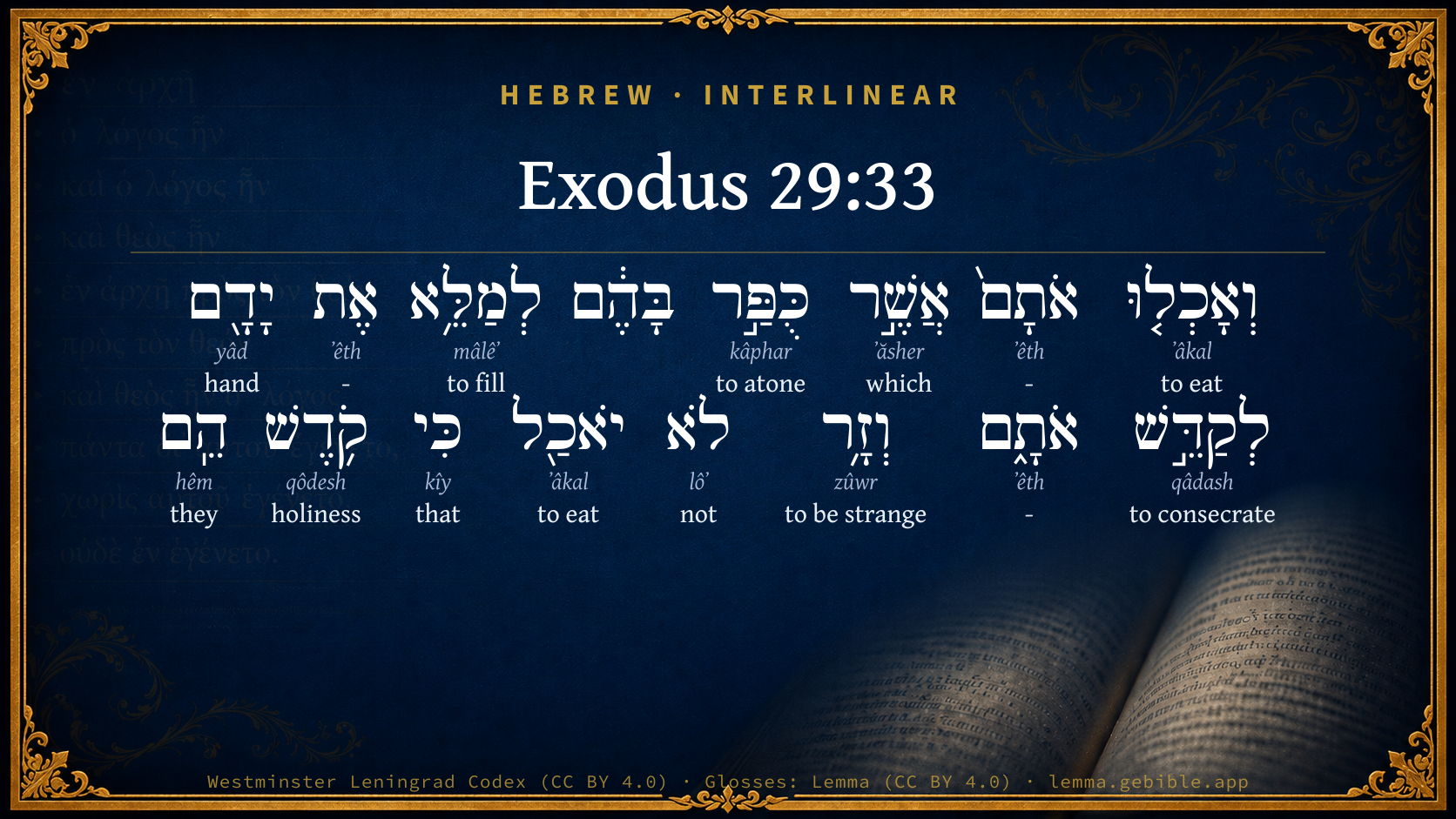
  1. וְאָכְל֤וּ ʼâkal H398 “and · to eat” Conjunction + Verb, Qal, Sequential Perfect, 3rd Person, Common, Plural
  2. אֹתָם֙ ʼêth H853 “- · them” Particle, Direct Object + Suffix, Personal, 3rd Person, Masculine, Plural
  3. אֲשֶׁ֣ר ʼăsher H834 “which” Particle, Relative
  4. כֻּפַּ֣ר kâphar H3722 “to atone” Verb, Pual, Perfect, 3rd Person, Masculine, Singular
  5. לְמַלֵּ֥א mâlêʼ H4390 “to fill” Preposition + Verb, Piel, Infinitive Construct
  6. אֶת ʼêth H853 “-” Particle, Direct Object
  7. יָדָ֖ם yâd H3027 “hand · their” Noun, Common, Both, Singular, Construct + Suffix, Personal, 3rd Person, Masculine, Plural
  8. לְקַדֵּ֣שׁ qâdash H6942 “to consecrate” Preposition + Verb, Piel, Infinitive Construct
  9. אֹתָ֑ם ʼêth H853 “- · them” Particle, Direct Object + Suffix, Personal, 3rd Person, Masculine, Plural
  10. לֹא lôʼ H3808 “not” Particle, Negative
  11. יֹאכַ֖ל ʼâkal H398 “to eat” Verb, Qal, Imperfect, 3rd Person, Masculine, Singular
  12. כִּי kîy H3588 “that” Conjunction
  13. קֹ֥דֶשׁ qôdesh H6944 “holiness” Noun, Common, Masculine, Singular, Absolute
  14. הֵֽם hêm H1992 “they” Pronoun, Personal, 3rd Person, Masculine, Plural

About this verse

These counts appear in no published source. They are computed here, from the morphology-tagged text and Lemma’s own curated glosses. What Lemma adds →

16
words
12
distinct lemmas
Pentateuch
section

First appearance in Scripture

This word makes its first canonical appearance in the Hebrew Bible here:

  • וְזָ֥ר to be strange H2114

Grammatical profile

  • 5 verbs
  • 2 nouns
  • 1 adjective
  • 1 pronoun
  • 1 preposition
  • 1 conjunction
  • 5 particles

Verb forms

  • וְאָכְל֤וּ Qal · Sequential Perfect
  • כֻּפַּ֣ר Pual · Perfect
  • לְמַלֵּ֥א Piel · Infinitive Construct
  • לְקַדֵּ֣שׁ Piel · Infinitive Construct
  • יֹאכַ֖ל Qal · Imperfect

Repetition

A word recurs within this verse — often emphatic in Hebrew:

  • וְאָכְל֤וּ to eat H398 ×2

Hebrew & Septuagint length

In English translation the verse runs 27 words from the Hebrew and 29 from the Septuagint (LXX English) — closely comparable.

A rough comparison of the two English renderings, which tokenize alike — not a word-level alignment.

Word counts can differ between the Hebrew and the Greek without any difference in meaning — e.g. the Hebrew direct-object marker אֵת has no separate Greek word, and Greek often adds the article ὁ.

In the original languages it is 16 Hebrew tokens and 22 Greek tokens — but the two are counted differently (Hebrew bundles its prefixes and suffixes into one token; the Greek is in lemma form), so that isn’t a like-for-like length.

Cross-references

13

Topical passages linked to Exodus 29:33 in the Treasury of Scripture Knowledge — connected by theme and wording, ordered by reader-vote popularity; previews shown in the World English Bible.

  • Numbers 18:4 They shall be joined to you, and keep the charge of the tent of meeting, for all the service of the Tent: and a stranger shall not come near to you.
  • Leviticus 10:13–18 and you shall eat it in a holy place, because it is your portion, and your sons' portion, of the offerings of Yahweh made by fire: for so I am commanded.
  • Leviticus 22:10–13 "'No stranger shall eat of the holy thing: a foreigner living with the priests, or a hired servant, shall not eat of the holy thing.
  • Numbers 1:51 When the tabernacle is to move, the Levites shall take it down; and when the tabernacle is to be set up, the Levites shall set it up. The stranger who comes near shall be put to death.
  • Numbers 3:10 You shall appoint Aaron and his sons, and they shall keep their priesthood. The stranger who comes near shall be put to death."
  • Numbers 3:38 Those who encamp before the tabernacle eastward, in front of the Tent of Meeting toward the sunrise, shall be Moses, and Aaron and his sons, keeping the charge of the sanctuary for the charge of the children of Israel. The stranger who comes near shall be put to death.
  • Numbers 16:5 and he spoke to Korah and to all his company, saying, In the morning Yahweh will show who are his, and who is holy, and will cause him to come near to him: even him whom he shall choose will he cause to come near to him.
  • Numbers 16:40 to be a memorial to the children of Israel, to the end that no stranger, who isn't of the seed of Aaron, comes near to burn incense before Yahweh; that he not be as Korah, and as his company: as Yahweh spoke to him by Moses.
  • Numbers 18:7 You and your sons with you shall keep your priesthood for everything of the altar, and for that within the veil; and you shall serve: I give you the priesthood as a service of gift: and the stranger who comes near shall be put to death.
  • Psalms 22:26 The humble shall eat and be satisfied. They shall praise Yahweh who seek after him. Let your hearts live forever.
  • John 6:53–55 Jesus therefore said to them, "Most assuredly I tell you, unless you eat the flesh of the Son of Man and drink his blood, you don't have life in yourselves.
  • 1 Corinthians 11:24 When he had given thanks, he broke it, and said, "Take, eat. This is my body, which is broken for you. Do this in memory of me."
  • 1 Corinthians 11:26 For as often as you eat this bread and drink this cup, you proclaim the Lord's death until he comes.

Cross-references courtesy of OpenBible.info (CC BY 4.0).

Hebrew and Greek witnesses Masoretic Hebrew ↔ Greek Septuagint

The same verse in the two great witnesses to the Old Testament, shown verse-for-verse.

These are two independent witnesses, not word-aligned to each other, and the Septuagint is shown in lemma (dictionary) form.

Hebrew Exodus 29:33 Masoretic · Westminster Leningrad Codex

וְאָכְל֤וּ אֹתָם֙ אֲשֶׁ֣ר כֻּפַּ֣ר בָּהֶ֔ם לְמַלֵּ֥א אֶת יָדָ֖ם לְקַדֵּ֣שׁ אֹתָ֑ם וְזָ֥ר לֹא יֹאכַ֖ל כִּי קֹ֥דֶשׁ הֵֽם

They shall eat those things with which atonement was made, to consecrate and sanctify them: but a stranger shall not eat of it, because they are holy.

World English Bible · Public Domain

Greek LXX Exodus 29:33 Septuagint · lemma form

ἐσθίω αὐτός ἐν ὅς ἁγιάζω ἐν αὐτός τελειόω ὁ χείρ αὐτός ἁγιάζω αὐτός καί ἀλλογενής οὐ ἐσθίω ἀπό αὐτός εἰμί γάρ ἅγιος

They shall eat the offerings with which they were sanctified to fill their hands, to sanctify them; and a stranger shall not eat of them, for they are holy.

LXX2012 (modern English Septuagint) · Public Domain

Hebrew: Westminster Leningrad Codex (CC BY 4.0). Greek: Septuagint (public domain); English from LXX2012 (modern English Septuagint) (Public Domain). How the Septuagint differs from the Hebrew →

Targum (Aramaic paraphrase)

2

The Targum is the ancient Jewish Aramaic paraphrase of the Hebrew Scriptures — an interpretive translation, not the Hebrew text itself. Onkelos (literal) and Pseudo-Jonathan (expansive) render the Torah, and Jonathan the Prophets. Coverage is partial: where no permissively-licensed English translation exists for a verse, only the Aramaic is shown. This is verse-level text, not a word-by-word alignment to the Hebrew.

  1. Targum Onkelos Torah (Genesis–Deuteronomy)
    וְיֵכְלוּן יָתְהוֹן דִי יִתְכַּפַּר בְּהוֹן לְקָרָבָא יָת קֻרְבָּנְהוֹן לְקַדָשָׁא יָתְהוֹן וְחִלוֹנַי לָא יֵיכוּל אֲרֵי קוּדְשָׁא אִנוּן:

    (no public-domain English translation for this verse)

    Targum Onkelos — Aramaic: “Onkelos Genesis” (public domain); “Onkelos Exodus” (public domain); “Onkelos Leviticus” (public domain); “Onkelos Numbers” (public domain); “Onkelos Deuteronomy” (public domain). English: “Sefaria Community Translation” (CC0 1.0 (public-domain dedication)); “J.W. Etheridge. The Targums of Onkelos and Jonathan Ben Uzziel on the Pentateuch. London: Longmans, Green, 1862” (public domain). Text via Sefaria.

  2. Targum Pseudo-Jonathan Torah (Genesis–Deuteronomy)
    וְיֵיכְלוּן יַתְהוֹן דְּאִתְכַּפֵּר בְּהוֹן לְקָרְבָא יַת קוּרְבַּנְהוֹן לְמַקְדְּשָׁא יַתְהוֹן לְשַׁמָּשָׁא קֳדָמַי וְחִילוֹנֵי לָא יֵיכוּל אֲרוּם קוּדְשָׁא הִינוּן

    And they shall eat those things by which atonemen, was made for them in offering their oblations to sanctify them to minister before Me: but the profane shall not eat; for they are holy.

    Targum Pseudo-Jonathan — Aramaic: “Targum Jonathan on Genesis” (public domain); “Targum Jonathan on Exodus” (public domain); “Targum Jonathan on Leviticus” (public domain); “Targum Jonathan on Numbers” (public domain); “Targum Jonathan on Deuteronomy” (public domain). English: “The Targum of Jonathan ben Uzziel, trans. J. W. Etheridge, London, 1862” (public domain). Text via Sefaria.

Commentary

Notes on Exodus 29:33 from classic Christian and Jewish commentators (each source and its license shown beneath its notes). The classic Christian expositions comment on the surrounding passage and are grouped to its opening verse, so a note may address several verses; the Jewish commentaries on the Tanakh (Rashi and others) are per-verse, so they appear only where the commentator wrote on this verse.

Lemma curates 59 commentaries, every one of them public domain or Creative Commons licensed, each selected and text-cleaned for this edition rather than reprinted as found. About our sources →

Trapp's Complete Commentary

John Trapp

Exo 29:33 And they shall eat those things wherewith the atonement was made, to consecrate [and] to sanctify them: but a stranger shall not eat [thereof], because they [are] holy.

Ver. 33. And they shall eat those things.] Apply Christ’s death by faith to their own souls. {Joh 6:51}

John Trapp, A Commentary or Exposition upon All the Books of the Old and New Testament (1647–1656) — public domain. Text from a community e-Sword module.

Tyndale Open Study Notes

Tyndale Open Resources

29:33 their purification: Or their atonement. Traditionally, atonement has been described as a “covering over.” Some more recent commentators seek to derive the term from another Semitic root (which does not occur elsewhere in the Hebrew Bible) and thus arrive at “blot out, erase, or cleanse.” In either case, the effect is the same: Persons and objects are made capable of surviving in God’s presence because of a negation of the effects of their sin.

Tyndale Open Study Notes — © Tyndale Open Resources, licensed CC BY-SA 4.0. Text via the HelloAO Bible API.

Geneva Bible (1599)

Geneva Bible translators

That is, by the sacrifices.

Geneva Bible (1599) marginal notes — public domain. Text via Bolls.life.

Adam Clarke's Commentary

Verse 33. But a stranger shall not eat thereof] That is, no person who was not of the family of Aaron - no Israelite, and not even a Levite.

Adam Clarke's Commentary on the Bible (1810–1826) — public domain. Text from a community e-Sword/MySword module.

The Cambridge Bible for Schools and Colleges

gen. ed. J. J. S. Perowne

33. those things] the flesh and the bread of v. 32.

atonement] i.e. at-one-ment, setting at one, reconciliation, as in Shakespeare (e.g. Rich. III. i. 3. 36). This is always the meaning of ‘atonement’ in the Bible (as in Old English generally): the idea of amends or reparation for a fault, which the word now mostly suggests, is not implied in either its Hebrew or its Greek equivalent. See further DB. iv. 128; and on Exo_30:10. The burnt-, the guilt-, and the sin offering are in P often said to ‘make atonement’ (see the references in DB. iv. 130a), but this is the only passage of P in which that is predicated of a peace-offering.

to consecrate] to install.

a stranger] Heb. zâr; i.e., here, one not a priest (see esp. Num_16:40), a frequent use of the word in P (Exo_30:33, Num_3:10; Num_3:38; Num_18:7 al.; see further DB. iv. 622a, near the bottom). Quite a different word from the ones rendered stranger in Exo_12:48 (gêr), and strange in Exo_2:22 (nokri): see the notes on these passages, and Strange, Stranger, in DB.

The Cambridge Bible for Schools and Colleges (gen. ed. J. J. S. Perowne; Cambridge University Press, 1878–1918) — public domain. Text from a community e-Sword module.

John Gill's Exposition

And they shall eat those things wherewith the atonement was made,.... For the sins of Aaron and his sons, for they were men of infirmity, and needed sacrifice for sin themselves; and herein Christ their antitype excelled them, that he had no sin of his own, and needed not to offer first for them, and then for the sins of others, as Aaron and his sons, the types of him, did; and their eating of the sacrifice for atonement points at the receiving of the atonement of Christ's sacrifice by faith, and the enjoyment of it and the blessings following on it:

to consecrate and to sanctify them; that they might be filled and fitted, and set apart and devoted to the office of the priesthood, and minister in it:

but a stranger shall not eat thereof, because they are holy; meaning not one of another nation, but of another family, though an Israelite; the Targum of Jonathan renders it, a profane and common person, a layman, one that was not a priest; who, though he was of the seed of Israel, yet not being of the seed of Aaron, as Aben Ezra interprets it, he might not eat of the above things, because they were devoted to holy uses; and therefore none but such who were sanctified or set apart to sacred service might partake of them.

John Gill's Exposition of the Whole Bible (1746–1763) — public domain (CC PDM 1.0). Text via the HelloAO Bible API.

Haydock's Catholic Bible Commentary

Stranger. The Levites themselves could not partake of these things.

George Leo Haydock (1774–1849), Haydock's Catholic Family Bible and Commentary, 1859 edition — public domain. Excludes Psalms (Douay-Rheims chapter numbering differs from Protestant) and Deuterocanonical books (Catholic canon only).

Matthew Poole's English Annotations

Those things, i.e. the remainders of the oblations mentioned Exo 29:32.

A stranger, i.e. one who is not of the priestly race, whereas in other peace-offerings the offerer did eat a part.

Matthew Poole's English Annotations on the Holy Bible (1683–1685) — public domain. Text from a community e-Sword/MySword module.

The Pulpit Commentary

They shall eat those things wherewith the atonement was made. An atoning force pervaded all sacrifice. Sin-offerings were wholly expiatory; burnt-offerings and peace-offerings partially so. (Lev_1:4) A stranger shall not eat thereof. "A stranger" in this place does not mean a foreigner, but anyone who is not a priest.

The Pulpit Commentary (1880–1919), ed. H.D.M. Spence-Jones & Joseph S. Exell — public domain. Text from a community e-Sword module.

Scofield Reference Notes

C. I. Scofield

atonement

Heb. kaphar, "to cover." The English word "atonement" (at-one-ment) is not a translation of the Heb. kaphar, but a translator’s interpretation. According to Scripture the legal sacrifice "covered" the offerer’s sin and secured the divine forgiveness; according to the translators it made God and the sinner at- one. But the O.T. sacrifices did not at-one the sinner and God. "It is not possible that the blood of bulls and goats should take away sins." Heb 10:4. The Israelite’s offering implied confession of sin and of its due desert, death; and God "covered" (passed over," Rom 3:25 his sin, in anticipation of Christ’s sacrifice, which did, finally, "put away" the sins "done aforetime in the forbearance of God."; Rom 3:25; Heb 9:15. (See Scofield "Rom 3:25"). The word "atonement" does not occur in the N.T.; Rom 5:11 meaning reconciliation, and so rendered in the R.V.

See "Sacrifice," Gen 4:4, and refs. (See Scofield "Gen 4:4")

(See Scofield "Lev 16:5")

The Scofield Reference Bible (1917 edition), notes by C. I. Scofield — public domain. Text from a community e-Sword module.

Rashi

Rabbi Shlomo Yitzchaki (Rashi)

ואכלו אתם AND THEY SHALL EAT THOSE THINGS i. e. Aaron and his sons because they are the “owners” of them (cf. Pesachim 59b).

אשד כפר בהם THROUGH WHOM THERE WAS EXPIATED everything that was strange and objectionable.

למלא את ידם TO INITIATE THEM INTO OFFICE by means of this ram and bread.

לקדש אתם TO SANCTIFY THEM — for by means of this initiation-sacrifice they were installed and sanctified to the priesthood.

כי קדש הם BECAUSE THEY ARE HOLY — i. e. holy in the highest degree. From this we derive the prohibition against a “stranger” (a non-priest) eating anything that is holy in the highest degree (Makkot 18b), since Scripture assigns a reason for the matter (why a stranger may not eat of these), viz., because they are holy in the highest degree (cf. Pesachim 24a).

Rashi on the Tanakh — English translations: “The Judaica Press complete Tanach with Rashi, translated by A. J. Rosenberg” (CC BY 4.0); “Pentateuch with Rashi's commentary by M. Rosenbaum and A.M. Silbermann, 1929-1934” (public domain); “The Metsudah Tanach series, Lakewood, N.J” (CC BY 4.0); and “The Book of Joshua, Metsudah Publications, 1997” (CC BY 4.0). Text via Sefaria.

Lesson kit

Teaching starters — assembled from the data on this page, not authored interpretation. Every prompt links to the verse data it draws on. Edit before teaching.

Exodus, in the Pentateuch, opens this verse with 16 words (12 distinct Hebrew lemmas). Its most distinctive word is zûwr (“to be strange”). A historical commentator’s framing appears above. Read the whole chapter for the surrounding context.

Discussion questions

  1. The word zûwr carries the sense “to be strange.” How does it shape the verse?
  2. This is the first place “to be strange” appears in Scripture (first appears here). What does its debut here establish?
  3. How does Numbers 18:4, which shares this passage’s theme, read alongside this verse?
  4. What does the repetition of “to eat” (2× in this one verse) do in this verse?
  5. These translations render this verse differently. What is at stake in choosing one wording over another?
  6. «וְאָכְל֤וּ» is a Qal Sequential Perfect verb. How does that grammatical form shape the action described?
  7. Compare how Trapp's Complete Commentary and Tyndale Open Study Notes read this verse. Where do they agree or differ?

Things to notice

Reading settings

Reading text

Shown beneath each verse's original-language words.

Old Testament
Old Testament edition

Read the OT as the Masoretic Hebrew (MT) or the Greek Septuagint (LXX).

English shown for the Greek Septuagint (in the Hebrew ↔ Greek comparison).

Comparing translations? Open the Compare panel on any verse page to stack up to four side by side.