
Malachi 1:4

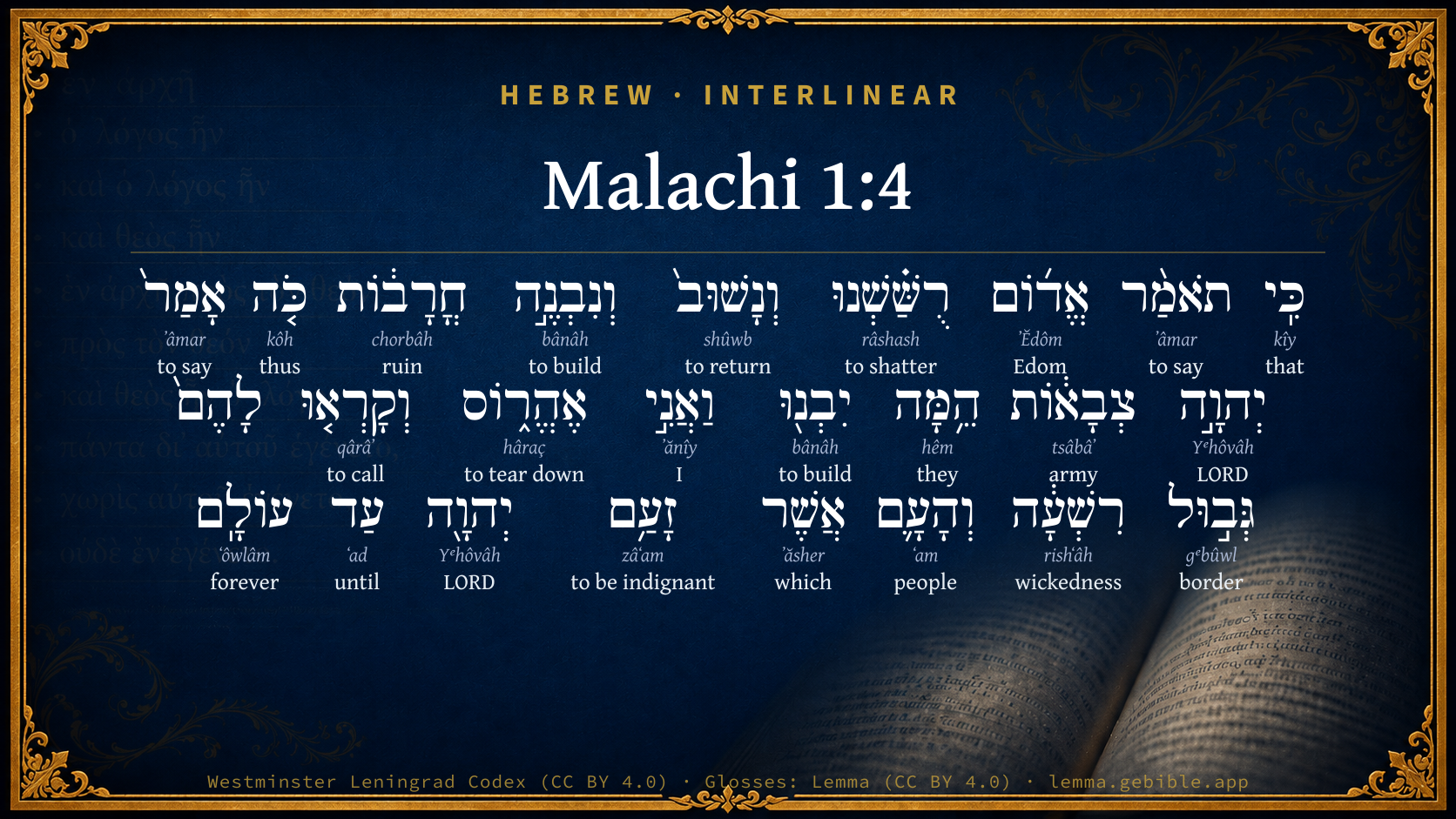
Hebrew (Westminster Leningrad Codex) Malachi 1:4 appears in the Hebrew Old Testament. The text above is from the Westminster Leningrad Codex. Each word links to its Strong’s number, a concise gloss, and parsing drawn from the Open Scriptures Hebrew Bible morphology. Click any word for its full Brown-Driver-Briggs (BDB) entry.
Download image
Cite this verse

Malachi 1:4 (World English Bible). Public Domain. Lemma interlinear Bible study tool, https://lemma.gebible.app/v/malachi/1/4.

Show BibTeX & RIS
BibTeX
RIS
English Translation
Whereas Edom says, "We are beaten down, but we will return and build the waste places;" thus says Yahweh of Hosts, "They shall build, but I will throw down; and men will call them 'The Wicked Land,' even the people against whom Yahweh shows wrath forever."
World English Bible · Public Domain
Download a study sheet

One document with this verse’s original text, its word-by-word gloss line, the meaning frame, cross-references with their text, attributed commentary, and full source and license credits — printable, and it pastes into notes with its structure intact.

This verse Autodidact and up

Study sheet (.html) Plain text (.txt)

A passage Seminary Student

Up to 50 verses in one chapter. A passage sheet keeps up to 6 commentary sources and 12 cross-references per verse, in the order this page ranks them, and says so on the sheet whenever that leaves anything out. Ask for a single verse and you get the Autodidact verse sheet above.

Everything on this page stays free to read, with no account — the sheet is a download of what is already on screen, not access to it.

Want to remove ads? Support Godless Engineer
Compare translations 3

The same verse in 3 English versions, stacked beneath the original-language interlinear above. Click any original word for its lexicon entry.

Each is an independent rendering of the whole verse — the interlinear is not word-aligned to these translations.

Highlighted words mark where these versions differ — a whole-verse word diff, not a word-by-word alignment.

  • World English Bible Public Domain
    Whereas Edom says, "We are beaten down, but we will return and build the waste places;" thus says Yahweh of Hosts, "They shall build, but I will throw down; and men will call them 'The Wicked Land,' even the people against whom Yahweh shows wrath forever."
  • King James Version Public Domain
    Whereas Edom saith, We are impoverished, but we will return and build the desolate places; thus saith the LORD of hosts, They shall build, but I will throw down; and they shall call them, The border of wickedness, and, The people against whom the LORD hath indignation for ever.
  • unfoldingWord Literal Text CC BY-SA 4.0
    Though Edom says, “We are beaten down, but we will return and build the ruins,” thus says Yahweh of Armies: “They themselves may build, but I myself will tear down. And they will call them ‘the territory of wickedness’ and ‘the people whom Yahweh abhors forever.’

unfoldingWord Literal Text — © unfoldingWord, licensed CC BY-SA 4.0. Word-aligned USFM3 via Door43 (git.door43.org/unfoldingWord/en_ult).

Versions to compare (up to 4)

3 of 4 selected

Show all 18 translations

Every available English version of this verse, each an independent rendering of the whole verse.

  • World English Bible Public Domain
    Whereas Edom says, "We are beaten down, but we will return and build the waste places;" thus says Yahweh of Hosts, "They shall build, but I will throw down; and men will call them 'The Wicked Land,' even the people against whom Yahweh shows wrath forever."
  • Berean Standard Bible Public Domain
    Though Edom may say, “We have been devastated, but we will rebuild the ruins,” this is what the LORD of Hosts says: “They may build, but I will demolish. They will be called the Land of Wickedness, and a people with whom the LORD is indignant forever.
  • Majority Standard Bible Public Domain
    Though Edom may say, “We have been devastated, but we will rebuild the ruins,” this is what the LORD of Hosts says: “They may build, but I will demolish. They will be called the Land of Wickedness, and a people with whom the LORD is indignant forever.
  • King James Version Public Domain
    Whereas Edom saith, We are impoverished, but we will return and build the desolate places; thus saith the LORD of hosts, They shall build, but I will throw down; and they shall call them, The border of wickedness, and, The people against whom the LORD hath indignation for ever.
  • American Standard Version (1901) Public Domain
    Whereas Edom saith, We are beaten down, but we will return and build the waste places; thus saith Jehovah of hosts, They shall build, but I will throw down; and men shall call them The border of wickedness, and The people against whom Jehovah hath indignation for ever.
  • Revised Version (1885) Public Domain
    Whereas Edom saith, We are beaten down, but we will return and build the waste places; thus saith the LORD of hosts, They shall build, but I will throw down: and men shall call them The border of wickedness, and The people against whom the LORD hath indignation for ever.
  • Geneva Bible (1599) Public Domain
    Though Edom say, wee are impouerished, but we will returne and build the desolate places, yet sayeth the Lord of hostes, they shall builde, but I will destroy it, and they shall call them, The border of wickednes, and the people, with whome the Lord is angrie for euer.
  • Douay-Rheims (1899) Public Domain
    But if Edom shall say: We are destroyed, but we will return and build up what hath been destroyed: thus saith the Lord of hosts: They shall build up, and I will throw down: and they shall be called the borders of wickedness, and the people with whom the Lord is angry for ever.
  • Young's Literal Translation Public Domain
    Because Edom saith, `We have been made poor, And we turn back and we build the wastes,' Thus said Jehovah of Hosts: They do build, and I do destroy, And `men' have called to them, `O region of wickedness,' `O people whom Jehovah defied to the age.'
  • Literal Standard Version CC BY-SA 4.0
    Because Edom says, We have been made poor, || And we return and we build the ruins, || Thus said YHWH of Hosts: They build, and I destroy, || And [men] have called to them, || O region of wickedness, || O people whom YHWH defied for all time.
  • Unlocked Literal Bible CC BY-SA 4.0
    If Edom says, “We are beaten down, but we will rebuild the ruins,” Yahweh of hosts will say, “They may rebuild, but I will throw down again. Others will call them 'The country of wickedness' and 'The people whom Yahweh has cursed forever.'
  • unfoldingWord Literal Text CC BY-SA 4.0
    Though Edom says, “We are beaten down, but we will return and build the ruins,” thus says Yahweh of Armies: “They themselves may build, but I myself will tear down. And they will call them ‘the territory of wickedness’ and ‘the people whom Yahweh abhors forever.’
  • Darby Bible Public Domain
    If Edom say, We are broken down, but we will build again the ruined places, -- thus saith Jehovah of hosts: They shall build, but I will throw down; and [men] shall call them the territory of wickedness, and the people against whom Jehovah hath indignation for ever.
  • World Messianic Bible Public Domain
    Whereas Edom says, “We are beaten down, but we will return and build the waste places,” the LORD of Hosts says, “They shall build, but I will throw down; and men will call them ‘The Wicked Land,’ even the people against whom the LORD shows wrath forever.”
  • Webster's Bible Public Domain
    Whereas Edom saith, We are impoverished, but we will return and build the desolate places; thus saith the LORD of hosts, They shall build, but I will throw down; and they shall call them, The border of wickedness, and, The people against whom the LORD hath indignation for ever.
  • Free Bible Version CC BY-SA 4.0
    The people of Edom may be saying: “We have been beaten down, but we will rebuild the ruins.” But this is what the Lord Almighty says, They may try and build, but I will tear down. They will be called a land of wickedness, and the people those who make the Lord angry forever.
  • Bible in Basic English Public Domain
    Though Edom says, We are crushed down but we will come back, building up the waste places; this is what the Lord of armies has said: They may put up buildings, but I will have them pulled down; and they will be named The land of evil-doing, and The people against whom the Lord keeps his wrath for ever.
  • JPS Tanakh (1917) Public Domain
    Whereas Edom saith: 'We are beaten down, but we will return and build the waste places'; thus saith the LORD of hosts: They shall build, but I will throw down; and they shall be called The border of wickedness, and The people whom the LORD execrateth for ever.

Literal Standard Version (2020), Covenant Press — licensed CC BY-SA 4.0. Text via the HelloAO Bible API (eBible.org). Unlocked Literal Bible (unfoldingWord) — licensed CC BY-SA 4.0. Text via the HelloAO Bible API (eBible.org). unfoldingWord Literal Text — © unfoldingWord, licensed CC BY-SA 4.0. Word-aligned USFM3 via Door43 (git.door43.org/unfoldingWord/en_ult). Free Bible Version, Dr. Jonathan Gallagher — licensed CC BY-SA 4.0. Text via the HelloAO Bible API (eBible.org).

Word by word

More ways to search: Search by grammar → Find every occurrence → Compare this word →

Practice this passage: Drill this verse → Learn its vocabulary →

רֻשַּׁ֗שְׁנוּ
râshash
H7567
“to shatter”
Verb, Pual, Perfect, 1st Person, Common, Plural
Part of Speech
Verb
Stem
Pual
Form
Perfect
Person
1st Person
Gender
Common
Number
Plural
Full BDB Definition

Origin: a primitive root

TWOT: 2224

to beat down, shatter - (Poel) to beat down, shatter - (Pual) to be beaten down
  1. כִּֽי kîy H3588 “that” Conjunction
  2. תֹאמַ֨ר ʼâmar H559 “to say” Verb, Qal, Imperfect, 3rd Person, Feminine, Singular
  3. אֱד֜וֹם ʼĔdôm H123 “Edom” Noun, Proper
  4. וְנָשׁוּב֙ shûwb H7725 “and · to return” Conjunction + Verb, Qal, Imperfect, 1st Person, Common, Plural
  5. וְנִבְנֶ֣ה bânâh H1129 “and · to build” Conjunction + Verb, Qal, Imperfect, 1st Person, Common, Plural
  6. חֳרָב֔וֹת chorbâh H2723 “ruins” Noun, Common, Feminine, Plural, Absolute
  7. כֹּ֤ה kôh H3541 “thus” Adverb
  8. אָמַר֙ ʼâmar H559 “to say” Verb, Qal, Perfect, 3rd Person, Masculine, Singular
  9. יְהוָ֣ה Yᵉhôvâh H3068 “LORD” Noun, Proper
  10. צְבָא֔וֹת tsâbâʼ H6635 “armies” Noun, Common, Both, Plural, Absolute
  11. הֵ֥מָּה hêm H1992 “they” Pronoun, Personal, 3rd Person, Masculine, Plural
  12. יִבְנ֖וּ bânâh H1129 “to build” Verb, Qal, Imperfect, 3rd Person, Masculine, Plural
  13. וַאֲנִ֣י ʼănîy H589 “and · I” Conjunction + Pronoun, Personal, 1st Person, Common, Singular
  14. אֶהֱר֑וֹס hâraç H2040 “to tear down” Verb, Qal, Imperfect, 1st Person, Common, Singular
  15. וְקָרְא֤וּ qârâʼ H7121 “and · to call” Conjunction + Verb, Qal, Sequential Perfect, 3rd Person, Common, Plural
  16. גְּב֣וּל gᵉbûwl H1366 “border of” Noun, Common, Masculine, Singular, Construct
  17. רִשְׁעָ֔ה rishʻâh H7564 “wickedness” Noun, Common, Feminine, Singular, Absolute
  18. וְהָעָ֛ם ʻam H5971 “and · the · people” Conjunction + Particle, Definite Article + Noun, Common, Masculine, Singular, Absolute
  19. אֲשֶׁר ʼăsher H834 “which” Particle, Relative
  20. זָעַ֥ם zâʻam H2194 “to be indignant” Verb, Qal, Perfect, 3rd Person, Masculine, Singular
  21. יְהוָ֖ה Yᵉhôvâh H3068 “LORD” Noun, Proper
  22. עַד ʻad H5704 “until” Preposition
  23. עוֹלָֽם ʻôwlâm H5769 “forever” Noun, Common, Masculine, Singular, Absolute

About this verse

These counts appear in no published source. They are computed here, from the morphology-tagged text and Lemma’s own curated glosses. What Lemma adds →

25
words
21
distinct lemmas
Prophets
section

Notable vocabulary

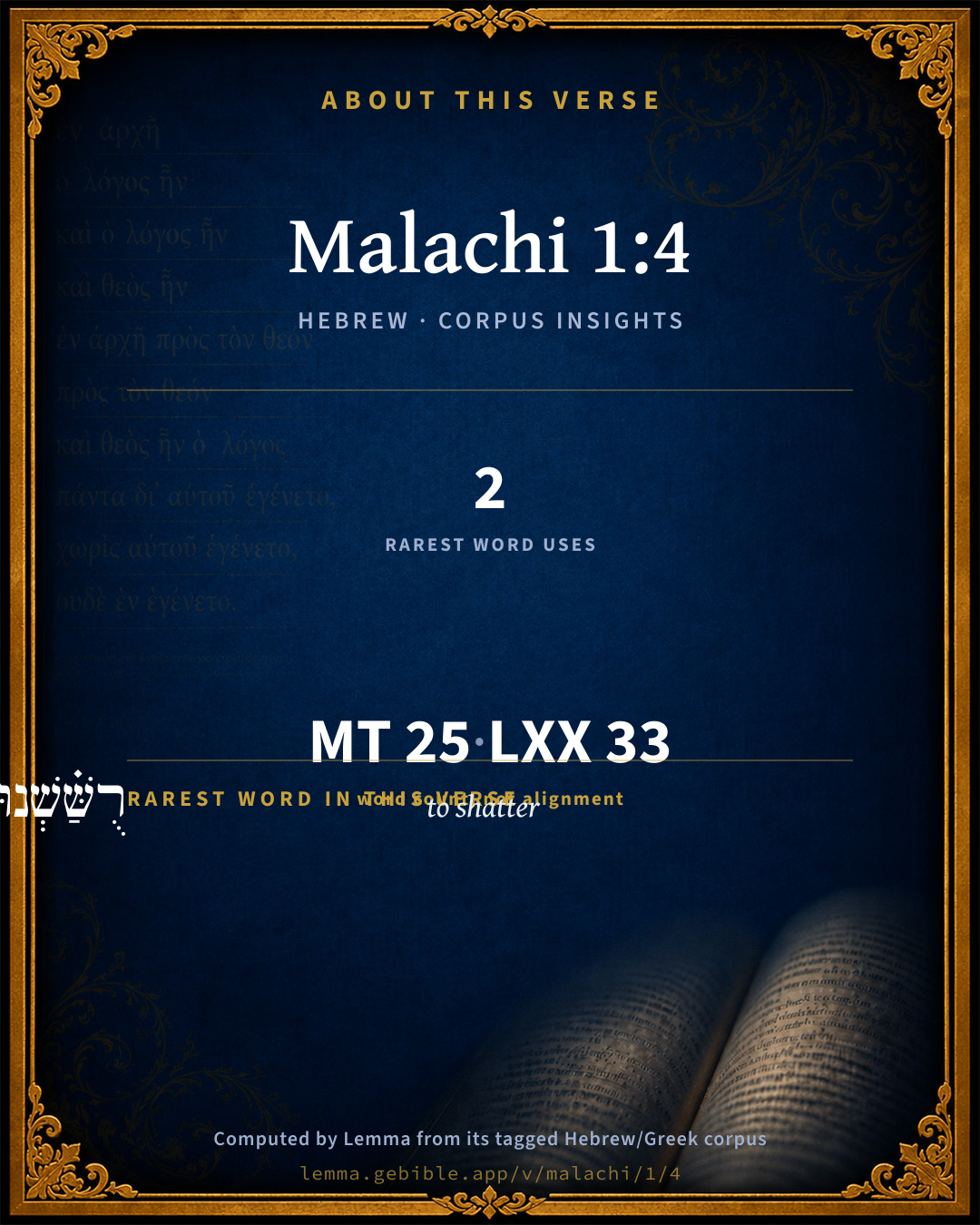
The rarest word here is רֻשַּׁ֗שְׁנוּ to shatter H7567 — appearing just 2 times in the whole Hebrew Bible.

Shared distinctive vocabulary

רֻשַּׁ֗שְׁנוּ to shatter H7567 occurs in 2 verses of the Hebrew Bible. Also found in:

Grammatical profile

  • 9 verbs
  • 9 nouns
  • 2 pronouns
  • 2 prepositions
  • 1 conjunction
  • 1 adverb
  • 1 particle

Verb forms

  • תֹאמַ֨ר Qal · Imperfect
  • רֻשַּׁ֗שְׁנוּ Pual · Perfect
  • וְנָשׁוּב֙ Qal · Imperfect
  • וְנִבְנֶ֣ה Qal · Imperfect
  • אָמַר֙ Qal · Perfect
  • יִבְנ֖וּ Qal · Imperfect
  • אֶהֱר֑וֹס Qal · Imperfect
  • וְקָרְא֤וּ Qal · Sequential Perfect
  • זָעַ֥ם Qal · Perfect

Repetition

Words recur within this verse — often emphatic in Hebrew:

  • תֹאמַ֨ר to say H559 ×2
  • וְנִבְנֶ֣ה to build H1129 ×2
  • יְהוָ֣ה LORD H3068 ×2

Hebrew & Septuagint length

In English translation the verse runs 46 words from the Hebrew and 51 from the Septuagint (LXX English) — closely comparable.

A rough comparison of the two English renderings, which tokenize alike — not a word-level alignment.

Word counts can differ between the Hebrew and the Greek without any difference in meaning — e.g. the Hebrew direct-object marker אֵת has no separate Greek word, and Greek often adds the article ὁ.

In the original languages it is 25 Hebrew tokens and 33 Greek tokens — but the two are counted differently (Hebrew bundles its prefixes and suffixes into one token; the Greek is in lemma form), so that isn’t a like-for-like length.

Cross-references

23

Topical passages linked to Malachi 1:4 in the Treasury of Scripture Knowledge — connected by theme and wording, ordered by reader-vote popularity; previews shown in the World English Bible.

  • Ezekiel 25:14 I will lay my vengeance on Edom by the hand of my people Israel; and they shall do in Edom according to my anger and according to my wrath; and they shall know my vengeance, says the Lord Yahweh.
  • Ezekiel 35:9 I will make you a perpetual desolation, and your cities shall not be inhabited; and you shall know that I am Yahweh.
  • Psalms 127:1 Unless Yahweh builds the house, They labor in vain who build it. Unless Yahweh watches over the city, The watchman guards it in vain.
  • Isaiah 9:9–10 All the people shall know, [even] Ephraim and the inhabitant of Samaria, who say in pride and in arrogance of heart,
  • Isaiah 10:15–16 Shall the axe boast itself against him who hews therewith? Shall the saw magnify itself against him who wields it? as if a rod should wield those who lift it up, [or] as if a staff should lift up [him who is] not wood.
  • Isaiah 11:14 They shall fly down on the shoulder of the Philistines on the west; together shall they despoil the children of the east: they shall put forth their hand on Edom and Moab; and the children of Ammon shall obey them.
  • Isaiah 34:5 For my sword has drunk its fill in the sky: behold, it shall come down on Edom, and on the people of my curse, to judgment.
  • Isaiah 63:1–6 Who is this who comes from Edom, with dyed garments from Bozrah? this who is glorious in his clothing, marching in the greatness of his strength? I who speak in righteousness, mighty to save.
  • Jeremiah 31:17 There is hope for your latter end, says Yahweh; and [your] children shall come again to their own border.
  • Lamentations 3:37 Who is he who says, and it comes to pass, when the Lord doesn't command it?
  • Lamentations 4:21–22 Rejoice and be glad, daughter of Edom, that dwell in the land of Uz: The cup shall pass through to you also; you shall be drunken, and shall make yourself naked.
  • Ezekiel 11:10 You shall fall by the sword; I will judge you in the border of Israel; and you shall know that I am Yahweh.
  • Job 9:4 God who is wise in heart, and mighty in strength: Who has hardened himself against him, and prospered?
  • Job 12:14 Behold, he breaks down, and it can't be built again; He imprisons a man, and there can be no release.
  • Job 34:29 When he gives quietness, who then can condemn? When he hides his face, who then can see him? Alike whether to a nation, or to a man:
  • Psalms 137:7 Remember, Yahweh, against the children of Edom, The day of Jerusalem; Who said, "Raze it! Raze it even to its foundation!"
  • Proverbs 21:30 There is no wisdom nor understanding Nor counsel against Yahweh.
  • Isaiah 10:4 They shall only bow down under the prisoners, and shall fall under the slain. For all this his anger is not turned away, but his hand is stretched out still.
  • Isaiah 34:10 It shall not be quenched night nor day; the smoke of it shall go up for ever; from generation to generation it shall lie waste; none shall pass through it forever and ever.
  • Amos 6:2 Go to Calneh, and see; And from there go to Hamath the great; Then go down to Gath of the Philistines. Are they better than these kingdoms? Or is their border greater than your border?
  • Malachi 1:3 but Esau I hated, and made his mountains a desolation, and gave his heritage to the jackals of the wilderness."
  • James 4:13–16 Come now, you who say, "Today or tomorrow let's go into this city, and spend a year there, trade, and make a profit."
  • Matthew 12:30 "He who is not with me is against me, and he who doesn't gather with me, scatters.

Cross-references courtesy of OpenBible.info (CC BY 4.0).

Hebrew and Greek witnesses Masoretic Hebrew ↔ Greek Septuagint

The same verse in the two great witnesses to the Old Testament, shown verse-for-verse.

These are two independent witnesses, not word-aligned to each other, and the Septuagint is shown in lemma (dictionary) form.

Hebrew Malachi 1:4 Masoretic · Westminster Leningrad Codex

כִּֽי תֹאמַ֨ר אֱד֜וֹם רֻשַּׁ֗שְׁנוּ וְנָשׁוּב֙ וְנִבְנֶ֣ה חֳרָב֔וֹת כֹּ֤ה אָמַר֙ יְהוָ֣ה צְבָא֔וֹת הֵ֥מָּה יִבְנ֖וּ וַאֲנִ֣י אֶהֱר֑וֹס וְקָרְא֤וּ לָהֶם֙ גְּב֣וּל רִשְׁעָ֔ה וְהָעָ֛ם אֲשֶׁר זָעַ֥ם יְהוָ֖ה עַד עוֹלָֽם

Whereas Edom says, "We are beaten down, but we will return and build the waste places;" thus says Yahweh of Hosts, "They shall build, but I will throw down; and men will call them 'The Wicked Land,' even the people against whom Yahweh shows wrath forever."

World English Bible · Public Domain

Greek LXX Malachi 1:4 Septuagint · lemma form

διότι εἶπον ὁ ιδουμαία καταστρέφω καί ἐπιστρέφω καί ἀναοἰκοδομέω ὁ ἔρημος ὅδε λέγω κύριος παντοκράτωρ αὐτός οἰκοδομέω καί ἐγώ καταστρέφω καί ἐπικαλέω αὐτός ὅριος ἀνομία καί λαός ἐπί ὅς παρατάσσω κύριος ἕως αἰών

Because one will say, Idumea has been overthrown, but let us return and rebuild the desolate places; thus says the Lord Almighty, They shall build, but I will throw down; and they shall be called The borders of wickedness, and, The people against whom the Lord has set himself for ever.

LXX2012 (modern English Septuagint) · Public Domain

On this verse, The Pulpit Commentary discusses the Septuagint’s reading. Read the note in Commentary ↓

Hebrew: Westminster Leningrad Codex (CC BY 4.0). Greek: Septuagint (public domain); English from LXX2012 (modern English Septuagint) (Public Domain). How the Septuagint differs from the Hebrew →

Targum (Aramaic paraphrase)

1

The Targum is the ancient Jewish Aramaic paraphrase of the Hebrew Scriptures — an interpretive translation, not the Hebrew text itself. Onkelos (literal) and Pseudo-Jonathan (expansive) render the Torah, and Jonathan the Prophets. Coverage is partial: where no permissively-licensed English translation exists for a verse, only the Aramaic is shown. This is verse-level text, not a word-by-word alignment to the Hebrew.

  1. Targum Jonathan Prophets (Joshua–Malachi)
    אֲרֵי יֵימְרוּן אֱדוֹמָאֵי אִתְמַסְכַּנָנָא כְּעַן עֲתַרְנָא נְתוּב וְנִבְנֵי חֳרְבָתָא כִּדְנַן אֲמַר יְיָ צְבָאוֹת אִינוּן יִבְנוּן וַאֲנָא אֲפַגַר וְיִקְרוֹן לְהוֹן תְּחוּמָא דְעַמָא רַשִׁיעָא וְעַמָא דְאַיְתֵי עֲלֵיהוֹן לְוָט עַד עָלְמָא:

    (no public-domain English translation for this verse)

    Targum Jonathan — Aramaic: “Mikraot Gedolot” (public domain). English: “Sefaria Community Translation” (CC0 1.0 (public-domain dedication)); “London "Chaldee Paraphrase," 1871” (public domain). Text via Sefaria.

Commentary

Notes on Malachi 1:4 from classic Christian and Jewish commentators (each source and its license shown beneath its notes). The classic Christian expositions comment on the surrounding passage and are grouped to its opening verse, so a note may address several verses; the Jewish commentaries on the Tanakh (Rashi and others) are per-verse, so they appear only where the commentator wrote on this verse.

Lemma curates 59 commentaries, every one of them public domain or Creative Commons licensed, each selected and text-cleaned for this edition rather than reprinted as found. About our sources →

Trapp's Complete Commentary

John Trapp

Mal 1:4 Whereas Edom saith, We are impoverished, but we will return and build the desolate places; thus saith the LORD of hosts, They shall build, but I will throw down; and they shall call them, The border of wickedness, and, The people against whom the LORD hath indignation for ever.

Ver. 4. Whereas Edom saith, We are impoverished] Or, thrust out of house and home, and reduced to extreme indigence; yet we will return, and build the desolate places. We will do it all, despite di Deo (as that profane pope said), if it be but to cross God’s prediction, and to withstand his power and providence. Thus these earthen pots will be dashing themselves against the rocks, against those mountains of brass (so God’s immutable decrees are called, Zec 6:1). Thus Lamech will have the odds of God seventy to seven (so Junius interprets it), Gen 4:24. Thus, when God had threatened to root out Ahab and his posterity, he would try that; and to prevent it, took more wives, and so followed the work of generation, that he left seventy sons behind him, 2Ki 10:1. Thus Pharaoh (that sturdy rebel) holds out against God to the utmost, and sends away his servant Moses, threatening death to him, even then when he was compassed on all hands with that palpable darkness. Thus the Philistine princes (while sore plagued) gather themselves together again against the humbling Israelites at Mizpeh; and so run to meet their bane, 1Sa 7:10. Thus the proud Ephraimites, Isa 9:10. The bricks indeed, say they, are fallen down, but we will build it again with hewn stones. The wild fig trees are cut down, but we will change them into cedars. Thus the Pharisees and lawyers rejected the counsel of God against themselves, Luk 7:30, yea, would needs be found fighters against God, as Gamaliel truly told them, Act 5:39. Thus those primitive persecutors would needs attempt to root our Christian religion; the Jews, by the leave and help of Julian, to despite the Christians, would rebuild their city and temple, but were hindered from heaven. Otho, the Emperor, would make the city of Rome his imperial seat (which was long before pointed and painted out for the nest of antichrist), but could not effect it. The Jesuits would fain heal the beast’s wounded head, and re-establish their kingdom of idolatry, but this they must never look for. Christ shall reign, and all his foes shall be his footstool: the Romish Edomites shall come to ruin.

Thus saith the Lord, They shall build, but I will throw down] Ruit alto a culmine Roma, "Babylon the great is fallen, is fallen"; her downfall is sure, sore, and sudden; Versa eris in cineres quasi nunquam Roma fuisses, said Sibylla of old. And there was something surely in that which we have read, that when the wars began in Germany, A. D. 1610, a great brass image of the apostle Peter (that had Tu es Petrus, &c., fairly imbossed upon it) standing in St Peter’s church at Rome, there was a great and massive stone fell down upon it, and so shattered it to pieces, that not a letter of all that sentence (whereon Rome founds her claim) was left whole so as to be read; saving that one piece of that sentence, Aedificabo Ecclesiam meam, I will build my Church, which was left fair and entire. Surely when Popish mountains and monasteries shall be desolated and demolished, when the Pope (who was wont to say that he could never want money as long as he was able to hold a pen in his hand) shall be miserably impoverished, and his Euphrates of revenues dried up, Rev 16:12, the mountain of the Lord’s house shall be set above all the mountains, and the Lord Christ alone shall reign in glory; he shall "overturn, overturn, overturn," all anti-christian power and policy, Eze 21:27, he will utterly destroy those crows’ nests (as Henry VIII called the religious houses that he pulled down), ne iterum ad cohabitandum convolent, lest those unclean birds should build again (Sanderus).

They shall build, but I will destroy] It is the Lord, then, that both plants and pulls up kingdoms, nations, and peoples; that makes and destroys states, public or private, at his pleasure: they are all in his hand and done by him, and fall not out by any fortune, or fatal revolution and vicissitude, Dan 2:21 Luk 1:52.

And they shall call them, The border of wickedness] Chiefly for their insulting over the people of God in their affliction, Oba 1:10. That wicked one, the Pope, is grossly guilty of this Edomitish inhumanity. What feasting and sending of gifts was there when the two witnesses were slain! What joy and jollity when the Waldenses (those ancient Protestants) were worsted in battle! What processions and bonfires at Rome upon the news of the Parisian massacre! Thuanus tells us, that the Pope caused it to be painted in his palace; and that the Cardinal of Lorrain gave him that brought the first tidings of it to Rome thirty thousand crowns for a reward. I do the rather parallel the Edomites and Romists, because the Rabbis usually by Edom understand Rome, and the Thargum renders "O daughter of Edom," Lam 4:21, thus: Romi Reshignah, O wicked Rome, which is answerable to this in the text, The border of wickedness, that is, the land of wickedness, haply called the border, or limit, as the non ultra of impiety, of unparalleled impiety: or else because men shall only come to the bounds and borders; and standing there aloof off, as abhorring to go farther, shall as it were point and say, Ah, wicked, Ah, wicked place, Terra de diables, as the Spaniards call one country in America, or the mouth of hell, as another place is named. Philip of Macedonia assembled all the infamous and wicked persons into a certain city of Thracia, and then called it Poneropolis. Italy is at this day little better: a second Sodom. M. Ascham, Queen Elizabeth’s tutor, was but seven days in Venice, but he saw more wickedness there than he had seen in seven years in London. As for Rome (that Radix omnium malorum), that once faithful city is now become a harlot; yea, the great harlot, Rev 17:5, yea, the mother of harlots and abominations of the earth, Rev 17:5, tota est iam Roma lupanar (Petrarch), it is turned into a great brothel house, the habitation of devils, and the hold of every foul spirit, Rev 18:2. Bethel is become Bethaven; the house of God, the border of wickedness; Har-hamishcah is become Har-hamaschith, the mount of unction, the mount of corruption, 2Ki 23:13 "What is the transgression of Jacob? is it not Samaria? and what are the high places of Judah? are they not Jerusalem?" Mic 1:5.

And, The people against whom the Lord hath indignation] The people of God’s wrath, Isa 10:6, and of his curse (so Idumea is called), Isa 34:5. And such a people was Amalek, with whom God (laid his hand upon his throne, and) swore that he would have perpetual war for their ill usage of his Israel, Exo 17:16. He charged also his people never to forget them, Deu 25:19. Neither did they: Saul was sent to make an utter end of them, 1Sa 15:1-3. And wherein he failed in doing it, God stirred up the Simeonites in Hezekiah’s days to smite the rest of the Amalekites that were escaped, 1Ch 4:42-43. The like judgment whereunto is befallen the Edomites long since: their very name is extinct, no memory of them being in posterity. The destiny of Doeg, their countryman, is come upon them, Psa 52:5, God hath beaten them down for ever: he hath taken them away, and plucked them out of their dwellingplace, and rooted them out of the land of the living. Selah. It is ill angering the Ancient of days. His wrath lasts longer than the coals of juniper, Psa 120:4; his judgments are severe and durable, as we use to say of winter; they never rot in the sky, but shall fall; if late, yet surely, yet seasonably. He that saith, "Vengeance is mine, I will repay," repayeth often times when we have forgiven, when we have forgotten; and calls to reckoning after our discharges, as he did Nabal. It is dangerous offending any favourite of him who can have (as here) indignation for ever; whose wrath and revenge is (as that of the Athenians is said to be) αειμνηστος, everlasting, whose destructions are perpetual.

John Trapp, A Commentary or Exposition upon All the Books of the Old and New Testament (1647–1656) — public domain. Text from a community e-Sword module.

The Biblical Illustrator

Joseph S. Exell

Mal_1:4

They shall build, but I will throw down.

Foolish builders

To separate our lives from God is folly; to live in opposition to Him is madness. Many not only disregard Him, but also oppose Him.

I. Who are these foolish builders?

1. Those who seek to build up a reputation with deceits.

2. Those who build up the fortunes of their houses with unrighteousness.

3. Those who build up a religious life without faith in Christ, the only foundation.

4. Those who build up their characters with evil principles and deeds.

5. Those who build up high positions by treachery and tyranny.

II. Consider the certainty of their overthrow. Woe be to the work that has God against it. It cannot stand. Think of His power, knowledge, and absolute control of all things. Everything that He does not smile upon must perish. History confirms this. Kingdoms created with great magnificence and might, but built in defiance of His laws, have, like Edom, fallen. Theological systems, and ecclesiastical despotisms that have been built up in opposition to Him, have been overthrown. Biography also confirms this. No life that has been spent in opposition to Him, however apparently influential, but has crumbled away like a falling tower. When God says, I will throw down, none can save. Experience also confirms it. Learn not to lay a stone in life without God. We should enter upon no work without first securing His aid and blessing. We can only erect a structure that will stand for ever, as we build in Gods way, and under the influence of the Spirit of Jesus. ( W. Osborne Lilley.)

The Biblical Illustrator, edited by Joseph S. Exell (c. 1880s–1900s) — public domain. Text from a community e-Sword module.

Joseph Benson's Commentary

Mal 1:4-5. Edom saith, We are empoverished, [or, brought low,] but we will return and build the desolate places — This they accordingly did, as we learn from the history of those times; and undoubtedly thought to become a flourishing people again, and to continue so. But God had determined otherwise, as is here declared. Thus saith the Lord, They shall build, but I will throw down — This was accordingly done by God’s giving success, first to the arms of Judas Maccabæus, and afterward to those of Hyrcanus, by whom Edom was spoiled and laid waste again. And they shall call them, The border of wickedness — They shall be called, or accounted by others, a wicked nation, or a country of wicked men, and therefore deservedly laid waste. And ye shall say, The Lord will be magnified — Or, rather, Let the Lord be magnified; from the border of Israel — Namely, from that border which extended even to Idumea.

Joseph Benson's Commentary on the Old and New Testaments (1811–1818) — public domain. Text from a community e-Sword module.

The Preacher's Complete Homiletical Commentary

Joseph S. Exell (gen. ed.)

CRITICAL NOTES.

Mal_1:4. Edom] cannot recover herself. Her perpetual ruins illustrate love to Israel rather than to her. Border] still the resort of marauding tribes of the desert. Indignation] Curse (cf. Isa_34:5).

Mal_1:5. See] the ineffectual attempts of Edom, and then acknowledge the greatness of Jehovah in and beyond the land of Israel.

Mal_1:6.] Expostulation to priests, who should love Jehovah as sons, and fear] him as servants (Exo_20:12). Say] Instead of confessing guilt, deny the charge and demand proofs.

Mal_1:7. Polluted] i.e. any sacrifices the bread or food of God (Lev_21:6; Lev_21:8; Lev_22:25; Num_28:2). Blind and lame were polluted bread.

Mal_1:8. Governor] If customary to offer heathen rulers presents proportionate to the dignity of the receiver the circumstances of the giver, and the value of the favour sought, should God be insulted by offering things which they would reject?

Mal_1:9. Pray] An earnest call to repentance say some; others, that it is ironical. Think you that God will be persuaded by polluted gifts? No; amend your ways. This] Contemptible offerings your doing. Means] Lit. from your hand. Will God regard] you?

Mal_1:10. Nought] So avaricious were they that the meanest things were not done without payment. Some say this frees the priests from excuse for carelessness, for the least service, such as shutting the door, was paid for. Others regard the words as a wish: “Oh that some among you would not open my sanctuary to such profane intruders (close the doors against such worshippers and sacrifices), and would not kindle the fire on mine altar to no purpose!” Better without worship than such as this [cf. Keil and Words.].

HOMILETICS

BUILDING UP WITHOUT GOD.—Mal_1:4

Edom’s temporal desolation and her resolve to repair it may be taken as a figure of our moral condition and the efforts of men to improve it.

I. Man’s moral condition is a ruin. “We are impoverished; lit. ruined.” Sin creates distance from God, and brings poverty and ruin. There is no misery like that which sin brings, and no misfortune so disastrous as that in which it ends. Sin “brought death and all our woe into the world;” and death is passed upon all men, for all have sinned.

II. Men try to repair their moral condition by wrong means. They are sensible of their misery,—“we are impoverished,”—feel their distance,—“we will return,”—and resolve to build up their broken fortunes,—we will “build the desolate places.”

1. Men’s efforts are directed to a wrong end. “We will return.” Return to what? Return to our kingdom and associations. Thus men cling to creeds, societies, and institutions, and not to God. “If thou wilt return, O Israel, saith the Lord, return unto me.”

2. Men’s efforts are put forth in a wrong spirit. “But we will return and build.” Here we have pride, presumption, and opposition to God. Men resolve, but God will hinder. At Babel men were frustrated in purpose, confused in tongues, and scattered over the earth.

3. Men’s efforts are built on a wrong foundation. “They shall call them the border of wickedness.” If the foundation be bad, the higher it is run up the more labour is lost, and the more tremendous the fall. Empires, houses, and fortunes built on selfish principles will never stand. “Woe unto him that buildeth his house by unrighteousness, and his chambers by wrong” (Jer_22:13).

III. When men try to repair their moral condition by wrong means God will overthrow their efforts. “They shall build, but I will throw down.” Providence pulls down as well as builds up (Ecc_3:3). God can crush every effort and break down every edifice of man. “I will work, and who shall let?” (hinder, turn it back, Isa_14:27) (Isa_43:13). He overturns our bodies by disease and death; our families by discord and bereavement; business by failure and loss; nations by famine and sword.

1. This overthrow is terrible. Places were desolate, buildings thrown down, broken into fragments. The firmest foundation, the most fortified walls of sin, will not avail before God. “The Lord hath stretched out a line (not to build, but destroy, 2Ki_21:13; Isa_34:11), he hath not withdrawn his hand from destroying: therefore he made the wall and the rampart to lament” (Lam_2:8).

2. This overthrow is irrevocable. The “indignation” is “for ever.” The destruction can never be repaired. This seen in the tower of Babel and the cities of the plain. Joshua’s curse fell upon the rebuilding of Jericho (cf. Jos_6:26; 1Ki_16:34). The apostate Julian could not contravene the word of God concerning Jerusalem. When he had gathered materials and commenced the work the tempest from heaven filled him with dismay, and forced him to confess the hand of God. “He breaketh down, and (so that) it cannot be built again” (Job_12:14). But is there no way of building that we may be secure and happy? Must our efforts to recover ourselves perpetually fail, and our hopes be for ever disappointed? Build on Christ, the true foundation, for no other foundation can any man lay; build by the aid of the Spirit, and in humble confidence in the promise of God, then your work shall abide. “Building up yourselves on your most holy faith.” “I commend you to God, and to the word of his grace, which is able to build you up, and to give you an inheritance among all them which are sanctified.”

TITLES WITHOUT HONOURS.—Mal_1:6

Upon the fact that respect is shown by inferiors to superiors Jehovah founds his right to honour and reverence due to him as Creator and Ruler. But God condemns the contempt priests and people displayed in offering blemished sacrifices.

I. God is our Father, and should be honoured. The prophet does not appeal to the law, but lays down the truth, which none will dispute, that Jehovah is the Father of Israel. If God, therefore, is a father, the honour of sons is due to him. Heathen philosophers taught that parents were household gods, and were to have all possible respect. “To God and our parents,” said Aristotle, “we can never make recompense.”

1. God claims honour from us. “Honour thy father and thy mother” (Exo_20:12). “Doubtless thou art our father” (Isa_63:16; Mal_2:10).

2. Men withhold the honour due to him. “Where is mine honour?” They do not honour him with their substance, but despise him in heart and act. “Do ye thus requite the Lord?”

II. God is our Master, and should be served. “If I be a master, where is my fear?” God is acknowledged to be our Lord. He should be served in filial not in slavish fear. We are not to find fault with his employment, or engage in it by force and constraint. “They say and do not.” Our service must be earnest and constant. In all fear should we obey and submit to him (1Pe_2:18). Fidelity to our conscience will ever be rewarded. “He that waiteth on his master shall be honoured;” here by the promise and presence of God, at length by the approval of God. “Well done,” &c. “If any man serve me him will my Father honour.”

“Bad servants wound their master’s fame” [Gay].

THE SINS OF THE PRIESTS.—Mal_1:6-10

Turning from the people, the prophet addresses the priests, who should be leaders in holiness, but are foremost in bringing the service of God into contempt. They were under special obligations to sanctify him, but they profaned his name and caused Israel to sin.

I. Their services were a violation of all law. A son should honour his father, and a servant obey his master (Mal_1:6); but they withheld from God what they-demanded from the people, and slighted him more than any creature.

1. The law of nature was dishonoured. Fair words and grand titles require consistent life. Nature teaches honour to parents and respect to masters, reproves want of reverence to God, and testifies against those who honour in word and dishonour in life. “Why call ye me Lord, Lord, and do not the things which I say?”

2. The law of God was violated. God expressly forbade the offering of the blind, the lame, or any evil-favoured sacrifice. “Whatsoever hath a blemish, that shall ye not offer: for it shall not be acceptable for you. Ye shall not offer unto the Lord that which is bruised, or crushed, or broken, or cut” (Lev_22:20; Lev_22:24). If it be lame, or blind, or have “any ill blemish, thou shalt not sacrifice it unto the Lord thy God” (Deu_15:21; Neh_5:14-15).

3. The law of common civility was disregarded. “Offer it now unto thy governor; will he be pleased with thee?” (Mal_1:8). What insult to offer God what a mortal would disdain! Yet what a contrast between God’s table and that of our princes! If an earthly monarch would neither accept our gift nor espouse our cause with such approach, can we expect God to bless? “Will he be pleased with thee or accept thy person?”

II. Their services were offensive to God. They despised his name and offered polluted bread upon his altar.

1. Their offerings were mean in substance. “Ye offer the blind for sacrifice; is it not evil?” They put God off with what was worth nothing. Darius probably supplied them plentifully with victims for sacrifice, but they offered the worst. “God despises not the widow’s mite, but he does despise the miser’s mite,” says Moore.

2. Their offerings were mercenary in spirit. They would neither kindle a fire nor shut the door without pay (Mal_1:10). “What will ye give me, and I will deliver him unto you?” How niggardly we are in God’s service! Ever crying, “What profit shall we have?” Thinking more of gain than duty. The meanest service for God will not be unrewarded. The servants of the temple had their tithes, cups of cold water have their benediction, and God is not unjust to forget labours of love. But if we become covetous and unfaithful, every one for his gain, from his quarter (Isa_56:11), then we pollute the altar and bring the service of God into contempt.

TRUE SPIRITUAL SERVICE.—Mal_1:7-8

In the condemnation of what was evil in the spirit and substance of ancient sacrifice we learn the right method of approaching God, the true nature of spiritual service.

I. It should be intelligent. We should never offer the blind or ignorant service, and worship we know not what. “For he hath no pleasure in fools.”

II. It should be earnest and hearty. Not lame and half-hearted, but upright and sincere; not sick and feeble, but vigorous and cheerful. The homage and communion of the highest part of man; for God is a spirit, and can only hold communion with spirit. “If my soul is not engaged in my worship, it is even as though I worshipped not” [Confucius].

III. It should be reverential. If heathens were careful to offer sacrifices without blemish, how reverential should we be in the sanctuary of God. Never enter without due preparation; never utter hasty and ill-arranged thoughts, nor offer slovenly prayers and praise. Be as anxious to worship God as to discharge secular functions. God deserves our best, let us not dishonour him with unsound and grudged gifts. “Neither will I offer burnt offerings unto the Lord my God of that which doth cost me nothing.”

HOMILETIC HINTS AND OUTLINES

Mal_1:6. It becomes us to do what God enjoins. First, because he has a right to command us. He is Sovereign, we are subjects; Master, we are servants; Father, we are children. Secondly, because all his commandments are reasonable. None arbitrary or tyrannical. Thirdly, because his commands are beneficial. All enjoined has special regard to our welfare. “In keeping his commandments there is great reward.” Fourthly, because God’s commands are practicable. All imply power to obey. If not possessed, yet attainable; if not in nature, yet in grace; if not in ourselves, yet in him whose authority we recognize, and who is always accessible [Jay]. God is the Father of the faithful—

(1) By creation;

(2) by preservation and governance;

(3) by alimony;

(4) by fatherly care and providence;

(5) by faith and grace, whereby he justifies and adopts us sons and heirs of his kingdom [Pusey].

Mal_1:7. Is it not evil? If we worship God ignorantly and without understanding we bring the blind for sacrifice; if we do it carelessly and without consideration, if we are cold, and dull, and dead in it, we bring the sick; if we rest in the bodily exercise, and do not make heart work of it, we bring the lame; and if we suffer vain thoughts and distractions to lodge within us, we bring the torn [Matt. Henry].

Polluted bread. Because—

1. It does not correspond with the requirements of God’s law.

2. It is offered with impure mind and life. If temple purifications were necessary of old, how much holiness is needful now! Contemptible table. In what way can we now pollute the table of the Lord?

(1) In the Sacrament, when we ourselves partake of it unworthily, or do not enough arouse the consciences of others.

(2) In life, when we allow in ourselves, or in others committed to us, a half-way devotedness to the Lord [Lange].

Mal_1:9-10. These words are difficult, but may contain—

1. A charge against the priests. You begun, and continued to insult God, by worthless sacrifices, and brought all the consequences upon the people. Not from aliens, not from the custom of your fathers, but from your hand hath this been.

2. “An ironical appeal, covering an implied menace.” Bring your maimed sacrifices, press God with your prayers, will he regard your persons, in the spirit in which you serve him? Some say—

3. A call to repentance and prayer for the mercy of God. “I pray you, beseech God, that he will be gracious unto you.”

4. A rejection of priestly intercession. An indignant appeal is made to their own consciences. If you have brought this evil upon the worship of God, if your hands are tainted with sinful offerings; are you fit to pray for the rest? Try it on, you will not succeed. God will reject you! “He sums up with an entire rejection of them, present and future: I have no pleasure in you; it is a term of repudiation (cf. 1Sa_18:25), sometimes of disgust (Jer_22:28; Jer_48:38; Hos_8:8), neither will I accept an offering at your hands” [Pusey].

5. To silence excuse. You have nothing to say for such careless offerings. You know what is right, and you are paid for the smallest service you perform.

6. A wish to close the doors against such proceedings. Who among you will shut the doors, and keep such worshippers out of the temple? Better close the sanctuary than open it to subserve selfish and hypocritical purposes—better have no offerings at all than vain offerings which God will not accept (Isa_1:11-15). “Away with your vain oblations! What purpose is the multitude of your sacrifices to me!”

ILLUSTRATIONS TO CHAPTER 1

Mal_1:2-5. Loved you. Ingratitude is too base to return a kindness, and too proud to regard it; much like the tops of mountains, barren indeed but yet lofty; they produce nothing, they feed nobody, they clothe nobody, yet are high and stately, and look down upon all the world about them [Dr. South].

Mal_1:6. Honoureth. One of the best elements of character as well in a child as in a man, is reverence. This is the feeling due to parents and to God, our Father in heaven. It is more than respect; it is respect blended with awe. One void of reverence unconsecrates all the mysteries and sanctities of life [Dulce Domum].

Mal_1:7-8; Mal_1:12-13. Accept person.

“When once thy foot enters the Church, be bare:

God is more there than thou, for thou art there

Only by his permission. Then beware;

And make thyself all reverence and fear.” [G. Herbert.]

Mal_1:10. Nought. “His money perish with him,” said the pious marquis of Vico, “who prefers not one hour’s communion with Christ before all the riches and pleasures of the world.” “Covetousness debaseth a man’s spirit” [Tillotson].

The Preacher's Complete Homiletical Commentary (gen. ed. Joseph S. Exell; Funk & Wagnalls, c. 1892) — public domain (pre-1929). A full-Bible homiletical/sermon-outline anthology covering 65 of 66 books (2 John is absent from the source module). Text from a community e-Sword module.

Tyndale Open Study Notes

Tyndale Open Resources

1:4 the Lord of Heaven’s Armies (Hebrew Yahweh tseba’oth): This name for God is prominent in Old Testament prophetic literature. Heaven’s Armies are the angelic armies at God’s command; the phrase emphasizes the invincible power of God. • The Land of Wickedness: Esau was selfish and contemptuous of the tokens of the Lord’s covenant (see Gen 25:34). The nation of Edom came to personify the pride of self-centered existence (see Jer 49:16). The Edomites were also allies of Babylon in the destruction of Jerusalem (see Ps 137:7-9; Obad 1:10, 12).

Tyndale Open Study Notes — © Tyndale Open Resources, licensed CC BY-SA 4.0. Text via the HelloAO Bible API.

Jamieson, Fausset & Brown

Robert Jamieson, A. R. Fausset & David Brown

Whereas--"But if" Edom say [MAURER]. Edom may strive as she may to recover herself, but it shall be in vain, for I doom her to perpetual desolation, whereas I restore Israel. This Jehovah states, to illustrate His gratuitous love to Israel, rather than to Edom.

border of wickedness--a region given over to the curse of reprobation [CALVIN]. For a time Judea seemed as desolate as Idumea; but though the latter was once the highway of Eastern commerce, now the lonely rock-houses of Petra attest the fulfilment of the prophecy. It is still "the border of wickedness," being the resort of the marauding tribes of the desert. Judea's restoration, though delayed, is yet certain.

the Lord hath indignation--"the people of My curse" (Isa 34:5).

Jamieson, Fausset & Brown — Commentary Critical and Explanatory on the Whole Bible (1871) — public domain (CC PDM 1.0). Text via the HelloAO Bible API.

Adam Clarke's Commentary

Verse 4. They shall build, but I will throw down] We have already seen enough of the wickedness of the Edomites to justify the utmost severity of Divine justice against them. The pulling down predicted here was by Judas Maccabeus; see 1Mac 5:65; and by John Hyrcanus; see Joseph. Antiq., lib. xiii. c. 9. s. 1.

They shall call them, The border of wickedness] A wicked land. Among this people scarcely any trace of good could ever be noted.

Adam Clarke's Commentary on the Bible (1810–1826) — public domain. Text from a community e-Sword/MySword module.

John Calvin's Commentaries

And to the same purpose he adds, If Edom shall say, We have been diminished, but we shall return and build houses; but if they build, I will pull down, saith God. He confirms what I have stated, that the posterity of Edom had no hope of restoration, for however they might gather courage and diligently labor in rebuilding their cities, they were not yet to succeed, for God would pull down all their buildings. This difference then was like a living representation, by which the Jews might see the love of God towards Jacob, and his hatred towards Esau. For since both people were overthrown by the same enemy, how was it that liberty was given to the Jews and no permission was given to the Idumeans to return to their own country? There was, as it has been said, a greater ill-will to the Jews, and yet the Chaldeans dealt with them more kindly. It then follows, that all this was owing to the wonderful purpose of God, and that hence it also appeared, that the adoption, which seemed to have been abolished when the Jews were driven into exile, was not in vain.

Thus then saith Jehovah of hosts, They shall build, that is, though they may build, I will overthrow; and it shall be said to them, Border of ungodliness, and a people with whom Jehovah is angry for ever. By the border of ungodliness he means an accursed border; as though he had said, “It will openly appear that you are reprobate, so that the whole world can form a judgment by the event itself.” By adding, A people with whom Jehovah is angry or displeased, he again confirms what I have said of love and hatred. God might indeed have been equally angry with the Jews as with the Edomites, but when God became pacified towards the Jews, while he continued inexorable to the posterity of Esau, the difference between the two people was hence quite manifest.

Noticed also must be the words, עד-עולם, od-oulam, for ever: for God seemed for a time to have rejected the Jews, and the Prophets adopt the same word זעם, som, angry, when they deplore the condition of the people, who found in various ways that God was angry with them. But the wrath of God towards the Jews was only for a time, for he did not wholly forget his covenant; but he became angry with the Edomites for ever, because their father had been rejected: and we know that this difference between the elect and the reprobate is ever pointed out, that when God visits sins in common, he ever moderates his wrath towards his elect, and sets limits to his severity, according to what he says, “If his posterity keep not my covenant, but profane my law, I will chastise them with the rod of man; but my mercy will I not take away from him.” (Psalm 89:31-33 2 Samuel 7:14.) But with regard to the reprobate, God’s vengeance ever pursues them, is ever suspended over their heads, and ever fixed as it were in their bones and marrow. For this reason it is that our Prophet says, that God would be angry with the posterity of Esau.

John Calvin's Commentaries (1540-1563) — public domain. Text from the Calvin Translation Society English edition (1840s-50s) via the Christian Classics Ethereal Library (ccel.org). Calvin's coverage is partial (roughly two-thirds of the Bible); uncommented books and verses are honest gaps, never fabricated. The 19th-century editor's footnotes and remarks are omitted so the notes are faithfully Calvin's own voice.

Ellicott's Commentary for English Readers

(4) Whereas . . . saith.—Better, If Edom say.

We are impoverished.—Better, we are broken to pieces. Edom’s ineffectual attempts to restore itself will be looked on as proofs of God’s wrath against the nation on account of its wickedness, and will acquire for it the titles “border of wickedness,” “the people against whom the Lord hath indignation for ever.” “Border” means “confines,” “territory;” Latin, fines.

Keith, Evidence of Prophecy, pp. 309, 310, in reference to the literal fulfilment of this prophecy, writes as follows:—“In recording the invasion of Demetrius, about three hundred years before the Christian era, into the land of Edom, Diodorus describes the country as a desert, and the inhabitants as living without houses; nor does he mention any city in that region but Petra alone. Yet the names of some of the cities of Arabia Petræa, enumerated by Josephus, as existing at the time when the Romans invaded Palestine—the names of eighteen cities of Palestina Tertia, of which Petra was the capital, and the metropolitan see, in the times of the Lower Empire—and the towns laid down in D’Anville’s map, together with the subsisting ruins of towns in Edom, specified by Burckhardt, and also by Laborde, give proof that Edom, after having been impoverished, did return, and build the desolate places, even as ‘the ruined towns and places,’ still visible and named, show that though the desolate places were built again according to the prophecy, they have, as likewise foretold, been thrown down, and are ‘ruined places’ lying in utter desolation.”

A Bible Commentary for English Readers, edited by Charles John Ellicott (1878–1897) — public domain. Text from a community e-Sword module.

The Cambridge Bible for Schools and Colleges

gen. ed. J. J. S. Perowne

4. impoverished] Rather (with R.V. text, and so in Jer_5:17), beaten down. “So Ephraim said of old ‘in the pride and stoutness of heart, The bricks are fallen down, but we will build with hewn stones: the sycomores are cut down, but we will change them into cedars.’ Isa_9:9-10.” Pusey.

return and build] This rendering is retained in R.V., but as there is no evidence that Edom was carried away captive ‘return and build’ is, probably, according to a well-known Heb. idiom =‘rebuild.’ (Comp. Eze_26:8; Eze_26:12-14.) This Israel ‘loved’ of God had done, but Esau ‘hated’ of Him should not do.

border] i.e. land, or territory, as in Mal_1:5 below. It is frequently rendered coasts, in A.V., e.g. 1Sa_11:3; 1Sa_11:7.

for ever] For the subsequent history of Edom, as fulfilling this prediction, see reference to Obadiah in note on Mal_1:3 above.

The Cambridge Bible for Schools and Colleges (gen. ed. J. J. S. Perowne; Cambridge University Press, 1878–1918) — public domain. Text from a community e-Sword module.

John Gill's Exposition

Whereas Edom saith, We are impoverished,.... Or the Idumeans, as the Targum; the posterity of Esau, who acknowledge themselves greatly reduced by the desolations made in their country, cities, towns, and houses, being plundered of all their valuable things. Kimchi interprets it, if the congregation of Edom should say, though we are become poor and low, and our land is laid waste:

but we will return; being now become rich, as the Targum adds; that is, as Jarchi explains it, with the spoils of Jerusalem:

and build the desolate places: as Israel did, as Kimchi observes, when they returned from their captivity; and so the Edomites hoped to do the same:

thus saith the Lord of hosts, They shall build, but I will throw down; they attempted to build again their cities and towns, but could not succeed, God was against them:

and they shall call them; or, "they shall be called" (u); this shall be the name they, shall go by among men, by way of proverb and reproach:

The border of wickedness; a wicked kingdom and nation, from one end to the other; this shall be said of them, as the reason of their utter and perpetual desolation:

and, The people against whom the Lord hath indignation for ever; not for seventy years only, as against the Jews, Zac 1:12, but forever; and these are now no more a people; they are utterly extinct; their name and nation are lost; there is not the least appearance of them; when the Jews, though they are scattered about in the world, yet they are still a people, and distinct from all others.

(u) "et vocabuntur", V. L. Junius & Tremellius, Piscator, Drusius, Grotius.

John Gill's Exposition of the Whole Bible (1746–1763) — public domain (CC PDM 1.0). Text via the HelloAO Bible API.

Albert Barnes' Notes on the Bible

Whereas Edom saith - o.

We are impoverished - o, ידשׁשׁ.), or, more probably, “we were crushed.” Either gives an adequate sense. Human self-confidence will admit anything, as to the past; nay, will even exaggerate past evil to itself, “Crush us how they may, we will arise and repair our losses.” So Ephraim said of old Isa 9:9-10, “in the pride and stoutness of heart, The bricks are fallen down, but we will build with hewn-stones: the sycamores are cut down, but we will change them into cedars.” It is the one language of what calls itself, “indomitable;” in other words, “untameable,” conquerors or every other gambler; “we will repair our losses.” All is again staked and lost.

“They shall call them the border of wickedness.” Formerly, it had its own proper name, “the border of Edom,” as other countries Exo 10:14, Exo 10:19, “all the border of Egypt Deu 2:18, the border of Moab 1Sa 11:3, 1Sa 11:7; 1Sa 27:1; 1Ch 21:12, the whole border of Israel 2Ch 11:13, the border of Israel Jdg 11:22, the whole border of the Amorite.” Henceforth, it should be known no more by its own name; but as “the border of wickedness,” where wickedness formerly dwelt, and, hence, the judgment of God and desolation from Him came upon it, “an accursed land.” In a similar manner, Jeremiah says somewhat of Jerusalem (Jer 22:8-9. Compare Deu 29:23-28.) “Many nations shall pass by this city, and they shall say, every man to his neighbor, Wherfore hath the Lord done this unto this great city? Then they shall answer, Because they have forsaken the covenant of the Lord their God, and worshiped other gods and served them.” Only Israel would retain its name, as it has; Edom should be blotted out wholly and forever.

Albert Barnes' Notes on the Bible (1834–1885) — public domain. Text from a community e-Sword/MySword module.

Haydock's Catholic Bible Commentary

Down, by the Machabees, who forced the people to receive circumcision, 1 Machabees v. 3. (Calmet) --- At that time the Jews were more pious, and glorified God. (Haydock) --- Ever. God’s gratuitous love appears in his leaving Edom in captivity, and restoring the Jews. (Worthington)

George Leo Haydock (1774–1849), Haydock's Catholic Family Bible and Commentary, 1859 edition — public domain. Excludes Psalms (Douay-Rheims chapter numbering differs from Protestant) and Deuterocanonical books (Catholic canon only).

Matthew Poole's English Annotations

We are impoverished: here the prophet introduceth Edom reflecting on its present low condition, and taking up resolutions of bettering their condition: We are now, as the Jews were five years before, exceedingly spoiled by Nebuchadnezzar, who hath rifled our houses, burnt our cities, and captivated our citizens.

We will return; this speaks their insolence: or shall; this speaks their hopes of such a return as Jacob’s posterity had after seventy years.

Build the desolate places; repair their cities, as Jerusalem was repaired by the returned captivity. They may do so for a while, but, saith God, I will throw it down; as he did in the times of the Maccabees.

They shall call them, The border of wickedness; they will be by their flagitious lives, after they a little recover themselves, a most wicked people, and so notorious that all their neighbours shall brand them for it, and presage a curse will follow them.

The people against whom the Lord hath indignation for ever; they will so highly provoke God, that his indignation will be kindled against them, and will burn for ever.

Matthew Poole's English Annotations on the Holy Bible (1683–1685) — public domain. Text from a community e-Sword/MySword module.

The Pulpit Commentary

Whereas; rather, if, or although; Vulgate, quod si. If Edom were to attempt to repair its desolation, the Lord would not permit it a striking contrast to the national restoration of Israel. We are impoverished; or, as the Revised Version, we are beaten; Septuagint, h Idoumaia katestraptai , "Idumea has been overthrown." Vulgate, destructl Sumus. the desolate places; Vulgate, quae destructa sunt, places once in habited and now deserted. Compare the boast of the Ephraimites. (Isa_9:9, Isa_9:10) I win throw down. Edom never recovered its power; it became the prey of the Per starts, the Nabatheans, the Jews under the Maccabees, the Macedonians, the Romans; and finally the Mohammedan conquest effected its utter ruin. They (men) shall call them, The border of wickedness. Edom shall be called, "The territory of iniquity," its miserable condition attesting the wicked ness of the inhabitants thus punished by Divine justice. Hath indignation; Septuagint, paratetaktai , "hath" been set in battle array;" St. Jerome, "My anger is proved by their enduring desolation; and in contrast to the evils experienced by your brother, ye shall experience the goodness of God towards you.

Vers. 4, 5. Divine judgments by disappointments.

The Lord"s dealings with Edom are here introduced as contrasting with the Lord"s dealings with Israel. And one chief point of contrast is this Israel"s expectations will be realized; but Edom"s expectations will be disappointed. "Thus saith the Lord of hosts. They shall build, but I will throw down." There was an exceedingly bitter feeling between Israel and Edom, dating from the time when Edom insultingly refused to allow the passage of Israel through her territory, and so compelled God"s people to take the weary and perilous way up the Arabah. Again and again we have hints of the unfriendly feeling between the kindred and neighbour nations; and that it was continued up to the time of the destruction of Jerusalem by Nebuchadnezzar is indicated by the exclamation of the poet, in Psa_137:7, "Remember, O Lord, the children of Edom in the day of Jerusalem; who said, Rase it, rase it, even to the foundation thereof." That Jehovah, as God and King of Israel, took its part against Edom is clearly intimated in the prophecy of Obadiah. The point of the passage before us is that on the efforts of Edom to recover itself as a nation no permanency would rest; whereas if Israel would but be faithful to its obligations, it as a kingdom should be established forever.

I FAILURE IN LIFE"S ENTERPRISES IS A SIGN OF DIVINE DEALING WITH US. However we may say that such failure attends

(1) particular dispositions; or

(2) imperfect, training and culture, it remains true that a deeper explanation is possible.

The promise to the good is, "Whatsoever he doeth shall prosper." The judgment on the evil may be, "Whatsoever he doeth shall fail." There is no experience of life more trying than the disappointment of failing again and again. There is no misery like the hopelessness of feeling as if we could not succeed, and it is no use to try any more. The man is lost who feels that.

II FAILURE IN LIFE"S ENTERPRISES MAY BE DIVINE DISCIPLINE, BUT IT MAY BE DIVINE JUDGMENT. Chastisement, to convince that we have done the thing wrongly. Judgment, as in the case of Edom, of some sin committed in early life, the spirit of which we have kept up through the long years. If we fail in life, we should searchingly inquire why God lets us fail. R.T.

The Pulpit Commentary (1880–1919), ed. H.D.M. Spence-Jones & Joseph S. Exell — public domain. Text from a community e-Sword module.

John Wesley's Explanatory Notes

Throw down - So he did in the times of the Maccabees. The border of wickedness - They will be a most wicked people, and so notorious, that all their neighbours shall brand them for it. Hath indignation - They will so highly provoke God, that his indignation will be kindled against them forever. 5. From the border of Israel - Let Israel from all his borders give God praise.

John Wesley, Explanatory Notes Upon the Whole Bible (1754–1765) — public domain. Text via the GEBible commentary corpus.

Scofield Reference Notes

C. I. Scofield

Edom

i.e. Esau’s descendants. See Gen 25:30.

The Scofield Reference Bible (1917 edition), notes by C. I. Scofield — public domain. Text from a community e-Sword module.

unfoldingWord translationNotes

Door43 World Missions Community

If Edom says

Here "Edom" stands for the people of Edom. AT: "If the people of Edom say" (See: Metonymy)

I will throw down

Here "throw down" stands for "destroy." AT: "I will destroy" (See: Metonymy)

country of wickedness

Here "wickedness" stands either for wicked people or for wicked actions. AT: "country of wicked people" (See: Abstract Nouns)

Your own eyes will see this

Here "your own eyes" stands for the people themselves. AT: "You yourselves will see this" (See: Synecdoche)

translationWords

Edom

Yahweh of hosts

evil

curse

eternity

Israel

unfoldingWord translationNotes — © Distant Shores Media and the Door43 World Missions Community, licensed CC BY-SA 4.0. Source: git.door43.org/Door43/en_tn.

Rashi

Rabbi Shlomo Yitzchaki (Rashi)

Should Edom say, “We were poor” And if Edom says, “At first we were poor, but from now on we will be rich from the spoils of Jerusalem.” but we will return and build the ruins Our ruins, so said the Lord, etc.

Rashi on the Tanakh — English translations: “The Judaica Press complete Tanach with Rashi, translated by A. J. Rosenberg” (CC BY 4.0); “Pentateuch with Rashi's commentary by M. Rosenbaum and A.M. Silbermann, 1929-1934” (public domain); “The Metsudah Tanach series, Lakewood, N.J” (CC BY 4.0); and “The Book of Joshua, Metsudah Publications, 1997” (CC BY 4.0). Text via Sefaria.

Lesson kit

Teaching starters — assembled from the data on this page, not authored interpretation. Every prompt links to the verse data it draws on. Edit before teaching.

Malachi, in the Prophets, opens this verse with 25 words (21 distinct Hebrew lemmas). Its most distinctive word is râshash (“to shatter”). A historical commentator’s framing appears above. Read the whole chapter for the surrounding context.

Discussion questions

  1. The word râshash carries the sense “to shatter.” How does it shape the verse?
  2. Jeremiah 5:17 shares the word «to shatter» with this verse. How do the two illuminate each other?
  3. “to say” occurs 2× in this one verse. What is the effect of the repetition?
  4. These translations render this verse differently. What is at stake in choosing one wording over another?
  5. The verb «תֹאמַ֨ר» is Qal Imperfect. How does its form color the action?
  6. Reading how Trapp's Complete Commentary and The Biblical Illustrator read this verse, where do the two commentators agree and where do they part?

Things to notice

Reading settings

Reading text

Shown beneath each verse's original-language words.

Old Testament
Old Testament edition

Read the OT as the Masoretic Hebrew (MT) or the Greek Septuagint (LXX).

English shown for the Greek Septuagint (in the Hebrew ↔ Greek comparison).

Comparing translations? Open the Compare panel on any verse page to stack up to four side by side.