
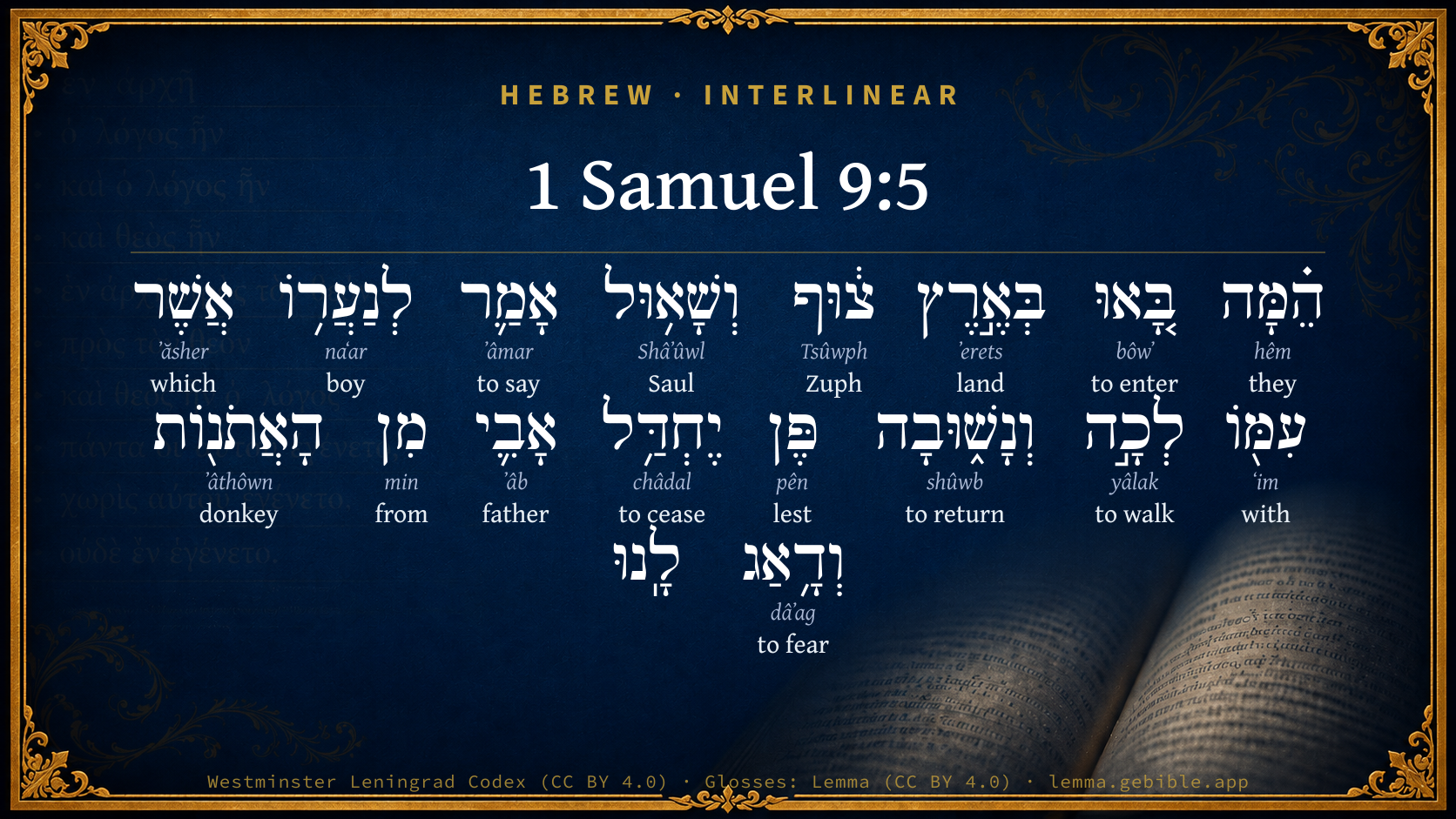
1 Samuel 9:5

Hebrew (Westminster Leningrad Codex) 1 Samuel 9:5 appears in the Hebrew Old Testament. The text above is from the Westminster Leningrad Codex. Each word links to its Strong’s number, a concise gloss, and parsing drawn from the Open Scriptures Hebrew Bible morphology. Click any word for its full Brown-Driver-Briggs (BDB) entry.
Download image
Cite this verse

1 Samuel 9:5 (World English Bible). Public Domain. Lemma interlinear Bible study tool, https://lemma.gebible.app/v/1-samuel/9/5.

Show BibTeX & RIS
BibTeX
RIS
English Translation
When they had come to the land of Zuph, Saul said to his servant who was with him, Come, and let us return, lest my father leave off caring for the donkeys, and be anxious for us.
World English Bible · Public Domain
Highlights
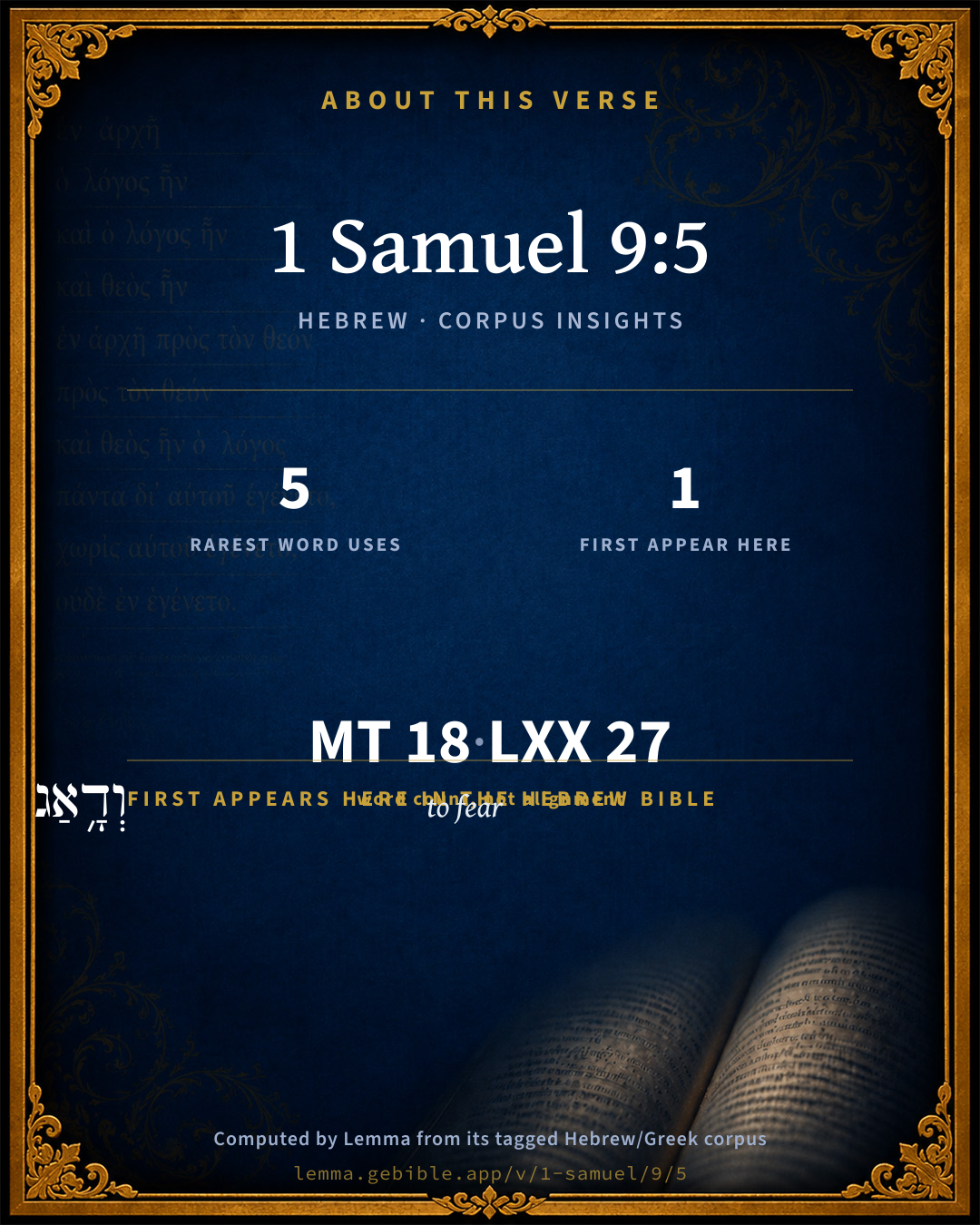
  • 1 first appearance in the Hebrew Bible
Full analysis ↓
Download a study sheet

One document with this verse’s original text, its word-by-word gloss line, the meaning frame, cross-references with their text, attributed commentary, and full source and license credits — printable, and it pastes into notes with its structure intact.

This verse Autodidact and up

Study sheet (.html) Plain text (.txt)

A passage Seminary Student

Up to 50 verses in one chapter. A passage sheet keeps up to 6 commentary sources and 12 cross-references per verse, in the order this page ranks them, and says so on the sheet whenever that leaves anything out. Ask for a single verse and you get the Autodidact verse sheet above.

Everything on this page stays free to read, with no account — the sheet is a download of what is already on screen, not access to it.

Want to remove ads? Support Godless Engineer
Compare translations 3

The same verse in 3 English versions, stacked beneath the original-language interlinear above. Click any original word for its lexicon entry.

Each is an independent rendering of the whole verse — the interlinear is not word-aligned to these translations.

Highlighted words mark where these versions differ — a whole-verse word diff, not a word-by-word alignment.

  • World English Bible Public Domain
    When they had come to the land of Zuph, Saul said to his servant who was with him, Come, and let us return, lest my father leave off caring for the donkeys, and be anxious for us.
  • King James Version Public Domain
    And when they were come to the land of Zuph, Saul said to his servant that was with him, Come, and let us return; lest my father leave caring for the asses, and take thought for us.
  • unfoldingWord Literal Text CC BY-SA 4.0
    They came into the land of Zuph, and Saul said to his servant who was with him, “Come, and let us return, lest my father cease from the female donkeys and become concerned about us.”

unfoldingWord Literal Text — © unfoldingWord, licensed CC BY-SA 4.0. Word-aligned USFM3 via Door43 (git.door43.org/unfoldingWord/en_ult).

Versions to compare (up to 4)

3 of 4 selected

Show all 18 translations

Every available English version of this verse, each an independent rendering of the whole verse.

  • World English Bible Public Domain
    When they had come to the land of Zuph, Saul said to his servant who was with him, Come, and let us return, lest my father leave off caring for the donkeys, and be anxious for us.
  • Berean Standard Bible Public Domain
    When they reached the land of Zuph, Saul said to his servant, “Come, let us go back, or my father will stop worrying about the donkeys and start worrying about us.”
  • Majority Standard Bible Public Domain
    When they reached the land of Zuph, Saul said to his servant, “Come, let us go back, or my father will stop worrying about the donkeys and start worrying about us.”
  • King James Version Public Domain
    And when they were come to the land of Zuph, Saul said to his servant that was with him, Come, and let us return; lest my father leave caring for the asses, and take thought for us.
  • American Standard Version (1901) Public Domain
    When they were come to the land of Zuph, Saul said to his servant that was with him, Come, and let us return, lest my father leave off caring for the asses, and be anxious for us.
  • Revised Version (1885) Public Domain
    When they were come to the land of Zuph, Saul said to his servant that was with him, Come and let us return; lest my father leave caring for the asses, and take thought for us.
  • Geneva Bible (1599) Public Domain
    When they came to the lande of Zuph, Saul saide vnto his seruant that was with him, Come and let vs returne, lest my father leaue the care of asses, and take thought for vs.
  • Douay-Rheims (1899) Public Domain
    And when they were come to the land of Suph, Saul said to the servant that was with him: Come, let us return, lest perhaps my father forget the asses, and be concerned for us.
  • Young's Literal Translation Public Domain
    They have come in unto the land of Zuph, and Saul hath said to his young man who `is' with him, `Come, and we turn back, lest my father leave off from the asses, and hath been sorrowful for us.'
  • Literal Standard Version CC BY-SA 4.0
    They have come to the land of Zuph, and Saul has said to his young man who [is] with him, “Come, and we return, lest my father leave off from the donkeys, and has been sorrowful for us.”
  • Unlocked Literal Bible CC BY-SA 4.0
    When they came to the land of Zuph, Saul said to his servant who was with him, “Come, let us go back, or my father may stop caring for the donkeys and begin to worry about us.”
  • unfoldingWord Literal Text CC BY-SA 4.0
    They came into the land of Zuph, and Saul said to his servant who was with him, “Come, and let us return, lest my father cease from the female donkeys and become concerned about us.”
  • Darby Bible Public Domain
    They had come to the land of Zuph when Saul said to his servant that was with him, Come and let us return; lest my father give up the asses, and be anxious about us.
  • World Messianic Bible Public Domain
    When they had come to the land of Zuph, Saul said to his servant who was with him, “Come! Let’s return, lest my father stop caring about the donkeys and be anxious for us.”
  • Webster's Bible Public Domain
    And when they had come to the land of Zuf, Saul said to his servant that was with him, Come, and let us return; lest my father leave caring for the asses, and be anxious for us.
  • Free Bible Version CC BY-SA 4.0
    When they got to the land of Zuph, Saul told his servant, “Come on, let's go back, otherwise my father won't be worrying about the donkeys, but about us.”
  • Bible in Basic English Public Domain
    And when they had come to the land of Zuph, Saul said to the servant who was with him, Come, let us go back, or my father may give up caring about the asses and be troubled about us.
  • JPS Tanakh (1917) Public Domain
    When they were come to the land of Zuph, Saul said to his servant that was with him: 'Come and let us return; lest my father leave caring for the asses, and become anxious concerning us.'

Literal Standard Version (2020), Covenant Press — licensed CC BY-SA 4.0. Text via the HelloAO Bible API (eBible.org). Unlocked Literal Bible (unfoldingWord) — licensed CC BY-SA 4.0. Text via the HelloAO Bible API (eBible.org). unfoldingWord Literal Text — © unfoldingWord, licensed CC BY-SA 4.0. Word-aligned USFM3 via Door43 (git.door43.org/unfoldingWord/en_ult). Free Bible Version, Dr. Jonathan Gallagher — licensed CC BY-SA 4.0. Text via the HelloAO Bible API (eBible.org).

Word by word

More ways to search: Search by grammar → Find every occurrence → Compare this word →

Practice this passage: Drill this verse → Learn its vocabulary →

צ֔וּף
Tsûwph
H6689
“Zuph”
Noun, Proper
Part of Speech
Noun
Type
Proper
Full BDB Definition

Origin: from H6688

TWOT: None

Zuph or Zophai = "honeycomb" - a Kohathite Levite, ancestor of Elkanah and Samuel (noun proper masculine) - a district northwest of Jerusalem where Saul encountered Samuel (noun proper locative)
  1. הֵ֗מָּה hêm H1992 “they” Pronoun, Personal, 3rd Person, Masculine, Plural
  2. בָּ֚אוּ bôwʼ H935 “to enter” Verb, Qal, Perfect, 3rd Person, Common, Plural
  3. בְּאֶ֣רֶץ ʼerets H776 “in/at · land of” Preposition + Noun, Common, Both, Singular, Construct
  4. וְשָׁא֥וּל Shâʼûwl H7586 “and · Saul” Conjunction + Noun, Proper
  5. אָמַ֛ר ʼâmar H559 “to say” Verb, Qal, Perfect, 3rd Person, Masculine, Singular
  6. לְנַעֲר֥וֹ naʻar H5288 “to/for · boy · his” Preposition + Noun, Common, Masculine, Singular, Construct + Suffix, Personal, 3rd Person, Masculine, Singular
  7. אֲשֶׁר ʼăsher H834 “which” Particle, Relative
  8. עִמּ֖וֹ ʻim H5973 “with · him” Preposition + Suffix, Personal, 3rd Person, Masculine, Singular
  9. לְכָ֣ה yâlak H3212 “walk” Verb, Qal, Imperative, 2nd Person, Masculine, Singular + Suffix, h
  10. וְנָשׁ֑וּבָה shûwb H7725 “and · to return” Conjunction + Verb, Qal, Cohortative, 1st Person, Common, Plural
  11. פֶּן pên H6435 “lest” Conjunction
  12. יֶחְדַּ֥ל châdal H2308 “to cease” Verb, Qal, Imperfect, 3rd Person, Masculine, Singular
  13. אָבִ֛י ʼâb H1 “father · my” Noun, Common, Masculine, Singular, Construct + Suffix, Personal, 1st Person, Common, Singular
  14. מִן min H4480 “from” Preposition
  15. הָאֲתֹנ֖וֹת ʼâthôwn H860 “the · donkeys” Particle, Definite Article + Noun, Common, Feminine, Plural, Absolute
  16. וְדָ֥אַג dâʼag H1672 “and · to fear” Conjunction + Verb, Qal, Perfect, 3rd Person, Masculine, Singular

About this verse

These counts appear in no published source. They are computed here, from the morphology-tagged text and Lemma’s own curated glosses. What Lemma adds →

18
words
17
distinct lemmas
Historical
section

Notable vocabulary

The rarest word here is צ֔וּף Zuph H6689 — appearing just 5 times in the whole Hebrew Bible.

First appearance in Scripture

This word makes its first canonical appearance in the Hebrew Bible here:

  • וְדָ֥אַג to fear H1672

Shared distinctive vocabulary

צ֔וּף Zuph H6689 occurs in 4 verses of the Hebrew Bible. Also found in:

Grammatical profile

  • 6 verbs
  • 6 nouns
  • 1 pronoun
  • 3 prepositions
  • 1 conjunction
  • 1 particle

Verb forms

  • בָּ֚אוּ Qal · Perfect
  • אָמַ֛ר Qal · Perfect
  • לְכָ֣ה Qal · Imperative
  • וְנָשׁ֑וּבָה Qal · Cohortative
  • יֶחְדַּ֥ל Qal · Imperfect
  • וְדָ֥אַג Qal · Perfect

Hebrew & Septuagint length

In English translation the verse runs 37 words from the Hebrew and 33 from the Septuagint (LXX English) — closely comparable.

A rough comparison of the two English renderings, which tokenize alike — not a word-level alignment.

Word counts can differ between the Hebrew and the Greek without any difference in meaning — e.g. the Hebrew direct-object marker אֵת has no separate Greek word, and Greek often adds the article ὁ.

In the original languages it is 18 Hebrew tokens and 27 Greek tokens — but the two are counted differently (Hebrew bundles its prefixes and suffixes into one token; the Greek is in lemma form), so that isn’t a like-for-like length.

Cross-references

7

Topical passages linked to 1 Samuel 9:5 in the Treasury of Scripture Knowledge — connected by theme and wording, ordered by reader-vote popularity; previews shown in the World English Bible.

  • 1 Samuel 10:2 When you are departed from me today, then you shall find two men by Rachel's tomb, in the border of Benjamin at Zelzah; and they will tell you, The donkeys which you went to seek are found; and, behold, your father has left off caring for the donkeys, and is anxious for you, saying, What shall I do for my son?
  • 1 Samuel 1:1 Now there was a certain man of Ramathaim Zophim, of the hill-country of Ephraim, and his name was Elkanah, the son of Jeroham, the son of Elihu, the son of Tohu, the son of Zuph, an Ephraimite:
  • Luke 12:11 When they bring you before the synagogues, the rulers, and the authorities, don't be anxious how or what you will answer, or what you will say;
  • Matthew 6:25 Therefore, I tell you, don't be anxious for your life: what you will eat, or what you will drink; nor yet for your body, what you will wear. Isn't life more than food, and the body more than clothing?
  • Matthew 6:28 Why are you anxious about clothing? Consider the lilies of the field, how they grow. They don't toil, neither do they spin,
  • Luke 12:22 He said to his disciples, "Therefore I tell you, don't be anxious for your life, what you will eat, nor yet for your body, what you will wear.
  • Matthew 6:34 Therefore don't be anxious for tomorrow, for tomorrow will be anxious for itself. Each day's own evil is sufficient.

Cross-references courtesy of OpenBible.info (CC BY 4.0).

Hebrew and Greek witnesses Masoretic Hebrew ↔ Greek Septuagint

The same verse in the two great witnesses to the Old Testament, shown verse-for-verse.

These are two independent witnesses, not word-aligned to each other, and the Septuagint is shown in lemma (dictionary) form.

Hebrew 1 Samuel 9:5 Masoretic · Westminster Leningrad Codex

הֵ֗מָּה בָּ֚אוּ בְּאֶ֣רֶץ צ֔וּף וְשָׁא֥וּל אָמַ֛ר לְנַעֲר֥וֹ אֲשֶׁר עִמּ֖וֹ לְכָ֣ה וְנָשׁ֑וּבָה פֶּן יֶחְדַּ֥ל אָבִ֛י מִן הָאֲתֹנ֖וֹת וְדָ֥אַג לָֽנוּ

When they had come to the land of Zuph, Saul said to his servant who was with him, Come, and let us return, lest my father leave off caring for the donkeys, and be anxious for us.

World English Bible · Public Domain

Greek LXX 1 Samuel 9:5 Septuagint · lemma form

αὐτός ἔρχομαι εἰς ὁ σιφ καί σαούλ εἶπον ὁ παιδάριον αὐτός ὁ μετά αὐτός δεῦρο καί ἀναστρέφω μή ἀναἵημι ὁ πατήρ ἐγώ ὁ ὄνος φροντίζω περί ἐγώ

And when they came to Siph, then Saul said to his young man that was with him, Come and let us return, lest my father leave the asses, and take care for us.

LXX2012 (modern English Septuagint) · Public Domain

Hebrew: Westminster Leningrad Codex (CC BY 4.0). Greek: Septuagint (public domain); English from LXX2012 (modern English Septuagint) (Public Domain). How the Septuagint differs from the Hebrew →

Targum (Aramaic paraphrase)

1

The Targum is the ancient Jewish Aramaic paraphrase of the Hebrew Scriptures — an interpretive translation, not the Hebrew text itself. Onkelos (literal) and Pseudo-Jonathan (expansive) render the Torah, and Jonathan the Prophets. Coverage is partial: where no permissively-licensed English translation exists for a verse, only the Aramaic is shown. This is verse-level text, not a word-by-word alignment to the Hebrew.

  1. Targum Jonathan Prophets (Joshua–Malachi)
    אִינוּן אָתוֹ בְּאַרְעָא דְבָּהּ נְבִיָא דַייָ וְשָׁאוּל אֲמַר לְעוּלֵימָא דְעִמֵיהּ אִיתָא וְנֵיתוּב דִלְמָא יִשְׁבּוֹק אַבָּא מִן עֵיסַק אֲתָנַיָא וְיַצִיף לָנָא:

    (no public-domain English translation for this verse)

    Targum Jonathan — Aramaic: “Mikraot Gedolot” (public domain). English: “Sefaria Community Translation” (CC0 1.0 (public-domain dedication)); “London "Chaldee Paraphrase," 1871” (public domain). Text via Sefaria.

Commentary

Notes on 1 Samuel 9:5 from classic Christian and Jewish commentators (each source and its license shown beneath its notes). The classic Christian expositions comment on the surrounding passage and are grouped to its opening verse, so a note may address several verses; the Jewish commentaries on the Tanakh (Rashi and others) are per-verse, so they appear only where the commentator wrote on this verse.

Lemma curates 59 commentaries, every one of them public domain or Creative Commons licensed, each selected and text-cleaned for this edition rather than reprinted as found. About our sources →

Trapp's Complete Commentary

John Trapp

1Sa 9:5 [And] when they were come to the land of Zuph, Saul said to his servant that [was] with him, Come, and let us return; lest my father leave [caring] for the asses, and take thought for us.

Ver. 5. And when they were come to the land of Zuph.] Samuel’s country. {1Sa 1:1} Saul’s city, Gibeah, is not once mentioned in the foregoing description of him: haply because infamous for the rape there committed upon the Levite’s concubine.

Lest my father leave caring for the asses, and take thought for us.] Saul was a better son than afterwards he proved a father; serviceable and solicitous of his father’s comfort: but to his good son Jonathan, currish and cruel.

John Trapp, A Commentary or Exposition upon All the Books of the Old and New Testament (1647–1656) — public domain. Text from a community e-Sword module.

Tyndale Open Study Notes

Tyndale Open Resources

9:5 Zuph, which was probably located in Ephraim, was Samuel’s home region (1:1). God’s providence led Saul there.

Tyndale Open Study Notes — © Tyndale Open Resources, licensed CC BY-SA 4.0. Text via the HelloAO Bible API.

Geneva Bible (1599)

Geneva Bible translators

Where was Ramathaim Zophim, the city of Samuel.

Geneva Bible (1599) marginal notes — public domain. Text via Bolls.life.

Adam Clarke's Commentary

Verse 5. Were come to the land of Zuph] Calmet supposes that Saul and his servant went from Gibeah to Shalisha, in the tribe of Dan; from thence to Shalim, near to Jerusalem; and thence, traversing the tribe of Benjamin, they purposed to return to Gibeah; but passing through the land of Zuph, in which Ramatha, the country of Samuel, was situated, they determined to call on this prophet to gain some directions from him; the whole of this circuit he supposes to have amounted to no more than about twenty-five leagues, or three days' journey. We do not know where the places were situated which are here mentioned: the Targum translates thus: "And he passed through the mount of the house of Ephraim, and went into the southern land, but did not meet with them. And he passed through the land of Mathbera, but they were not there; and he passed through the land of the tribe of Benjamin, but did not find them; then they came into the land where the prophet of the Lord dwelt. And Saul said to his servant," &c.

Adam Clarke's Commentary on the Bible (1810–1826) — public domain. Text from a community e-Sword/MySword module.

Ellicott's Commentary for English Readers

(5) The land of Zuph.—This was believed to be in the south-west of Benjamin.

Lest my father . . . take thought for us.—“Saul’s tender regard for his father’s feelings here is a favourable indication of character.”—Dr. Kitto.

A Bible Commentary for English Readers, edited by Charles John Ellicott (1878–1897) — public domain. Text from a community e-Sword module.

The Cambridge Bible for Schools and Colleges

gen. ed. J. J. S. Perowne

5. take thought for us] i.e. “be anxious,” as in Mat_6:25. Cp. 1Sa_10:2.

The Cambridge Bible for Schools and Colleges (gen. ed. J. J. S. Perowne; Cambridge University Press, 1878–1918) — public domain. Text from a community e-Sword module.

John Gill's Exposition

And when they were come to the land of Zuph,.... In which was Ramathaimzophim, the native place of Samuel, Sa1 1:1 and so the Targum here,"the land in which was the prophet"

Saul said to the servant that was with him, come, and let us return; home, despairing of finding the asses after so long a search in divers places:

lest my father leave caring for the asses, and take thought for us; fearing some evil should have befallen his son and his servant, in comparison of whom, and especially his son, the asses would be of no account, and so give himself no concern for them, but be in great care and uneasiness for his son and servant; wherefore Saul thought it most advisable to return home as soon as possible, lest his father should be overwhelmed with grief and trouble.

John Gill's Exposition of the Whole Bible (1746–1763) — public domain (CC PDM 1.0). Text via the HelloAO Bible API.

Haydock's Catholic Bible Commentary

Suph, where Ramatha, the birth-place of Samuel, was situated, chap. i. 1. (Calmet)

George Leo Haydock (1774–1849), Haydock's Catholic Family Bible and Commentary, 1859 edition — public domain. Excludes Psalms (Douay-Rheims chapter numbering differs from Protestant) and Deuterocanonical books (Catholic canon only).

Matthew Poole's English Annotations

The land of Ziph; in which was Ramah, called also

Ramah, or Ramathaim-zephim, the place of Samuel’s birth and habitation, 1Sa 1:1; 7:17.

Matthew Poole's English Annotations on the Holy Bible (1683–1685) — public domain. Text from a community e-Sword/MySword module.

Whedon's Commentary on the Bible

Daniel D. Whedon

5. Land of Zuph — Perhaps so called after one of Samuel’s ancestors who bore this name, 1Sa_1:1. It must have been situated south of Jerusalem, for when Saul started for his home in Gibeah he passed by Rachel’s sepulchre. 1Sa_10:2. We find a slight trace of the word in the modern Soba, which some regard as the Rama-thaim-Zophim of

1Sa_1:1; and probably the land of Zuph extended from this place southwards beyond Bethlehem.

Daniel D. Whedon (gen. ed.), Commentary on the Old and New Testaments (1874–1909) — public domain. Text from a community e-Sword module.

The Pulpit Commentary

The land of Zuph. See on 1Sa_1:1. This Levite ancestor of Samuel had probably occupied and colonised this district after the disasters recorded in the last chapters of the Book of Judges. Lest my father, etc. A mark of good feeling on Saul"s part, and a proof of the affectionate terms on which Kish and his family lived.

The Pulpit Commentary (1880–1919), ed. H.D.M. Spence-Jones & Joseph S. Exell — public domain. Text from a community e-Sword module.

unfoldingWord translationNotes

Door43 World Missions Community

land of Zuph

This is an area in Israel just north of Jerusalem. (See: How to Translate Names)

man of God

This phrase usually means a prophet of Yahweh. See how you translated this in 1 Samuel 2:27. AT: "a man who hears and tells words from God"

which way we should go on our journey

"which way we should go to find the donkeys"

translationWords

God

honor

true

unfoldingWord translationNotes — © Distant Shores Media and the Door43 World Missions Community, licensed CC BY-SA 4.0. Source: git.door43.org/Door43/en_tn.

Rashi

Rabbi Shlomo Yitzchaki (Rashi)

To the land of Tzuph. [Targum renders] 'into the land wherein there was a prophet.'

Tzuph. [צוּף] meaning a seer.

Lest my father stop worrying about the donkeys. Because his worry about us will grow so that he will forget the donkeys.

And worry. E dubitera in O.F.

Rashi on the Tanakh — English translations: “The Judaica Press complete Tanach with Rashi, translated by A. J. Rosenberg” (CC BY 4.0); “Pentateuch with Rashi's commentary by M. Rosenbaum and A.M. Silbermann, 1929-1934” (public domain); “The Metsudah Tanach series, Lakewood, N.J” (CC BY 4.0); and “The Book of Joshua, Metsudah Publications, 1997” (CC BY 4.0). Text via Sefaria.

Lesson kit

Teaching starters — assembled from the data on this page, not authored interpretation. Every prompt links to the verse data it draws on. Edit before teaching.

1 Samuel, in the Historical, opens this verse with 18 words (17 distinct Hebrew lemmas). Its most distinctive word is Tsûwph (“Zuph”). A historical commentator’s framing appears above. Read the whole chapter for the surrounding context.

Discussion questions

  1. The word Tsûwph carries the sense “Zuph.” How does it shape the verse?
  2. The word “to fear” first appears here in Scripture. What is being introduced at this debut?
  3. 1 Samuel 1:1 shares the word «Zuph» with this verse. How do the two illuminate each other?
  4. These translations render this verse differently. What is at stake in choosing one wording over another?
  5. The verb «בָּ֚אוּ» is Qal Perfect. How does its form color the action?
  6. Reading how Trapp's Complete Commentary and Tyndale Open Study Notes read this verse, where do the two commentators agree and where do they part?

Things to notice

Reading settings

Reading text

Shown beneath each verse's original-language words.

Old Testament
Old Testament edition

Read the OT as the Masoretic Hebrew (MT) or the Greek Septuagint (LXX).

English shown for the Greek Septuagint (in the Hebrew ↔ Greek comparison).

Comparing translations? Open the Compare panel on any verse page to stack up to four side by side.