
Daniel 10:2

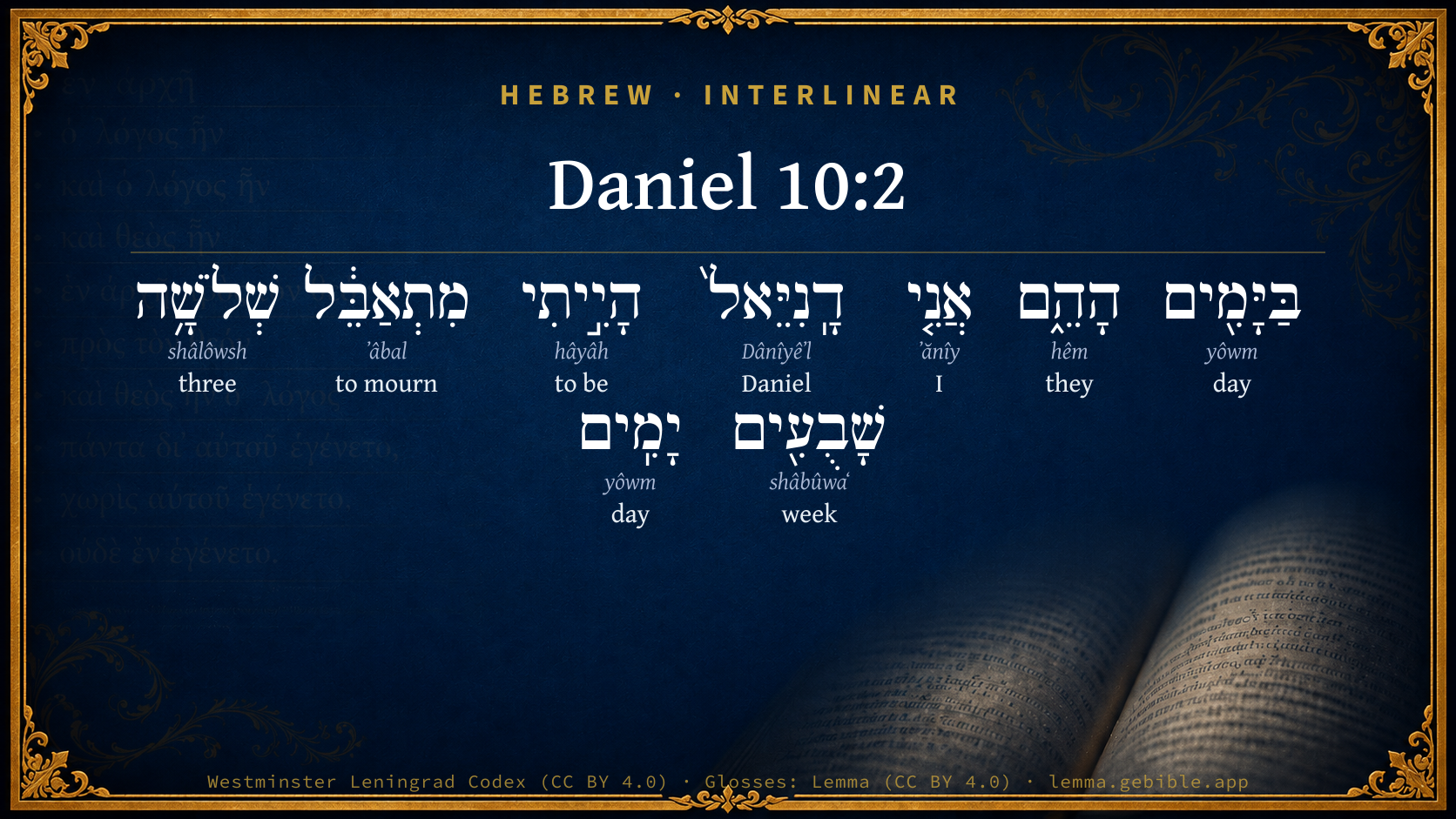
Hebrew (Westminster Leningrad Codex) Daniel 10:2 appears in the Hebrew Old Testament. The text above is from the Westminster Leningrad Codex. Each word links to its Strong’s number, a concise gloss, and parsing drawn from the Open Scriptures Hebrew Bible morphology. Click any word for its full Brown-Driver-Briggs (BDB) entry.
Download image
Cite this verse

Daniel 10:2 (World English Bible). Public Domain. Lemma interlinear Bible study tool, https://lemma.gebible.app/v/daniel/10/2.

Show BibTeX & RIS
BibTeX
RIS
English Translation
In those days I, Daniel, was mourning three whole weeks.
World English Bible · Public Domain
Download a study sheet

One document with this verse’s original text, its word-by-word gloss line, the meaning frame, cross-references with their text, attributed commentary, and full source and license credits — printable, and it pastes into notes with its structure intact.

This verse Autodidact and up

Study sheet (.html) Plain text (.txt)

A passage Seminary Student

Up to 50 verses in one chapter. A passage sheet keeps up to 6 commentary sources and 12 cross-references per verse, in the order this page ranks them, and says so on the sheet whenever that leaves anything out. Ask for a single verse and you get the Autodidact verse sheet above.

Everything on this page stays free to read, with no account — the sheet is a download of what is already on screen, not access to it.

Want to remove ads? Support Godless Engineer
Compare translations 3

The same verse in 3 English versions, stacked beneath the original-language interlinear above. Click any original word for its lexicon entry.

Each is an independent rendering of the whole verse — the interlinear is not word-aligned to these translations.

Highlighted words mark where these versions differ — a whole-verse word diff, not a word-by-word alignment.

  • World English Bible Public Domain
    In those days I, Daniel, was mourning three whole weeks.
  • King James Version Public Domain
    In those days I Daniel was mourning three full weeks.
  • unfoldingWord Literal Text CC BY-SA 4.0
    In those days I, Daniel, was mourning for three whole weeks.

unfoldingWord Literal Text — © unfoldingWord, licensed CC BY-SA 4.0. Word-aligned USFM3 via Door43 (git.door43.org/unfoldingWord/en_ult).

Versions to compare (up to 4)

3 of 4 selected

Show all 18 translations

Every available English version of this verse, each an independent rendering of the whole verse.

  • World English Bible Public Domain
    In those days I, Daniel, was mourning three whole weeks.
  • Berean Standard Bible Public Domain
    In those days I, Daniel, was mourning for three full weeks.
  • Majority Standard Bible Public Domain
    In those days I, Daniel, was mourning for three full weeks.
  • King James Version Public Domain
    In those days I Daniel was mourning three full weeks.
  • American Standard Version (1901) Public Domain
    In those days I, Daniel, was mourning three whole weeks.
  • Revised Version (1885) Public Domain
    In those days I Daniel was mourning three whole weeks.
  • Geneva Bible (1599) Public Domain
    At the same time I Daniel was in heauines for three weekes of dayes.
  • Douay-Rheims (1899) Public Domain
    In those days I Daniel mourned the days of three weeks.
  • Young's Literal Translation Public Domain
    `In those days, I, Daniel, have been mourning three weeks of days;
  • Literal Standard Version CC BY-SA 4.0
    “In those days, I, Daniel, have been mourning three weeks of days;
  • Unlocked Literal Bible CC BY-SA 4.0
    In those days I, Daniel, was in mourning for three weeks.
  • unfoldingWord Literal Text CC BY-SA 4.0
    In those days I, Daniel, was mourning for three whole weeks.
  • Darby Bible Public Domain
    In those days I Daniel was mourning three full weeks:
  • World Messianic Bible Public Domain
    In those days I, Daniel, was mourning three whole weeks.
  • Webster's Bible Public Domain
    In those days I Daniel was mourning three full weeks.
  • Free Bible Version CC BY-SA 4.0
    When this happened, I, Daniel, had been in mourning for three full weeks.
  • Bible in Basic English Public Domain
    In those days I, Daniel, gave myself up to grief for three full weeks.
  • JPS Tanakh (1917) Public Domain
    In those days I Daniel was mourning three whole weeks.

Literal Standard Version (2020), Covenant Press — licensed CC BY-SA 4.0. Text via the HelloAO Bible API (eBible.org). Unlocked Literal Bible (unfoldingWord) — licensed CC BY-SA 4.0. Text via the HelloAO Bible API (eBible.org). unfoldingWord Literal Text — © unfoldingWord, licensed CC BY-SA 4.0. Word-aligned USFM3 via Door43 (git.door43.org/unfoldingWord/en_ult). Free Bible Version, Dr. Jonathan Gallagher — licensed CC BY-SA 4.0. Text via the HelloAO Bible API (eBible.org).

Word by word

More ways to search: Search by grammar → Find every occurrence → Compare this word →

Practice this passage: Drill this verse → Learn its vocabulary →

About this verse

These counts appear in no published source. They are computed here, from the morphology-tagged text and Lemma’s own curated glosses. What Lemma adds →

9
words
8
distinct lemmas
Prophets
section

Notable vocabulary

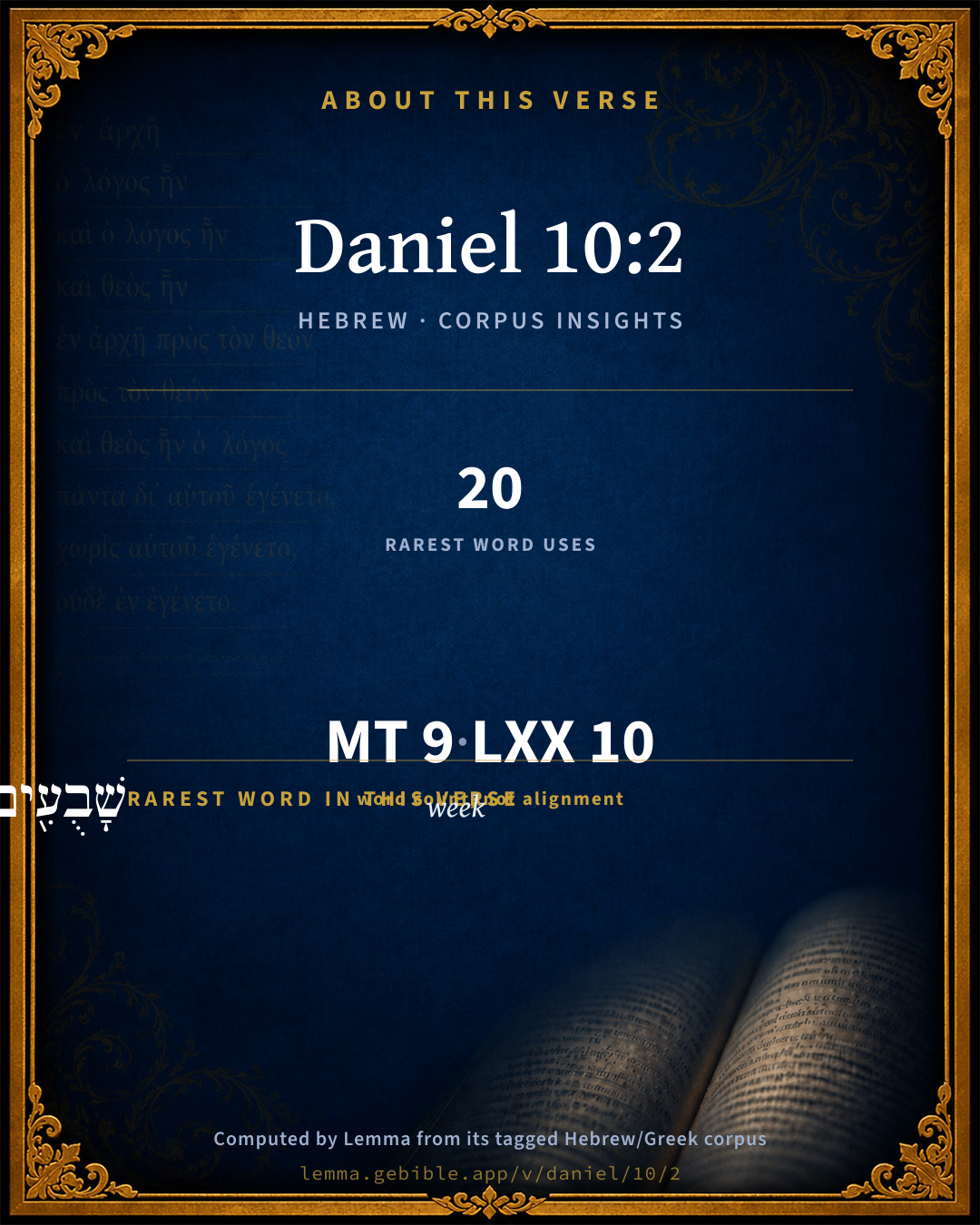
The rarest word here is שָׁבֻעִ֖ים week H7620 — appearing just 20 times in the whole Hebrew Bible.

Shared distinctive vocabulary

שָׁבֻעִ֖ים week H7620 occurs in 17 verses of the Hebrew Bible. Also found in:

Grammatical profile

  • 2 verbs
  • 4 nouns
  • 1 adjective
  • 2 pronouns

Verb forms

  • הָיִ֣יתִי Qal · Perfect
  • מִתְאַבֵּ֔ל Hithpael · Participle Active

Repetition

A word recurs within this verse — often emphatic in Hebrew:

  • בַּיָּמִ֖ים day H3117 ×2

Hebrew & Septuagint length

In English translation the verse runs 10 words from the Hebrew and 10 from the Septuagint (LXX English) — the same length.

A rough comparison of the two English renderings, which tokenize alike — not a word-level alignment.

Word counts can differ between the Hebrew and the Greek without any difference in meaning — e.g. the Hebrew direct-object marker אֵת has no separate Greek word, and Greek often adds the article ὁ.

In the original languages it is 9 Hebrew tokens and 10 Greek tokens — but the two are counted differently (Hebrew bundles its prefixes and suffixes into one token; the Greek is in lemma form), so that isn’t a like-for-like length.

Cross-references

12

Topical passages linked to Daniel 10:2 in the Treasury of Scripture Knowledge — connected by theme and wording, ordered by reader-vote popularity; previews shown in the World English Bible.

  • Nehemiah 1:4 It happened, when I heard these words, that I sat down and wept, and mourned certain days; and I fasted and prayed before the God of heaven,
  • Daniel 9:24–27 Seventy weeks are decreed on your people and on your holy city, to finish disobedience, and to make an end of sins, and to make reconciliation for iniquity, and to bring in everlasting righteousness, and to seal up vision and prophecy, and to anoint the most holy.
  • Ezra 9:4–5 Then were assembled to me everyone who trembled at the words of the God of Israel, because of the trespass of them of the captivity; and I sat confounded until the evening offering.
  • Psalms 42:9 I will ask God, my rock, "Why have you forgotten me? Why do I go mourning because of the oppression of the enemy?"
  • Psalms 43:2 For you are the God of my strength. Why have you rejected me? Why do I go mourning because of the oppression of the enemy?
  • Psalms 137:1–5 By the rivers of Babylon, there we sat down. Yes, we wept, when we remembered Zion.
  • Isaiah 66:10 Rejoice you with Jerusalem, and be glad for her, all you who love her: rejoice for joy with her, all you who mourn over her;
  • Jeremiah 9:1 Oh that my head were waters, and my eyes a spring of tears, that I might weep day and night for the slain of the daughter of my people!
  • Matthew 9:15 Jesus said to them, "Can the friends of the bridegroom mourn, as long as the bridegroom is with them? But the days will come when the bridegroom will be taken away from them, and then they will fast.
  • Romans 9:2 that I have great sorrow and unceasing pain in my heart.
  • Revelation 11:5 If anyone desires to harm them, fire proceeds out of their mouth and devours their enemies. If anyone desires to harm them, he must be killed in this way.
  • James 4:9 Lament, mourn, and weep. Let your laughter be turned to mourning, and your joy to gloom.

Cross-references courtesy of OpenBible.info (CC BY 4.0).

Hebrew and Greek witnesses Masoretic Hebrew ↔ Greek Septuagint

The same verse in the two great witnesses to the Old Testament, shown verse-for-verse.

These are two independent witnesses, not word-aligned to each other, and the Septuagint is shown in lemma (dictionary) form.

Hebrew Daniel 10:2 Masoretic · Westminster Leningrad Codex

בַּיָּמִ֖ים הָהֵ֑ם אֲנִ֤י דָֽנִיֵּאל֙ הָיִ֣יתִי מִתְאַבֵּ֔ל שְׁלֹשָׁ֥ה שָׁבֻעִ֖ים יָמִֽים

In those days I, Daniel, was mourning three whole weeks.

World English Bible · Public Domain

Greek LXX Daniel 10:2 Septuagint · lemma form

ἐν ὁ ἡμέρα ἐκεῖνος ἐγώ δανιηλ εἰμί πενθέω τρεῖς ἑβδομάς

In those days I Daniel was mourning three full weeks.

LXX2012 (modern English Septuagint) · Public Domain

On this verse, The Pulpit Commentary discusses the Septuagint’s reading. Read the note in Commentary ↓

Hebrew: Westminster Leningrad Codex (CC BY 4.0). Greek: Septuagint (public domain); English from LXX2012 (modern English Septuagint) (Public Domain). How the Septuagint differs from the Hebrew →

Commentary

Notes on Daniel 10:2 from classic Christian and Jewish commentators (each source and its license shown beneath its notes). The classic Christian expositions comment on the surrounding passage and are grouped to its opening verse, so a note may address several verses; the Jewish commentaries on the Tanakh (Rashi and others) are per-verse, so they appear only where the commentator wrote on this verse.

Lemma curates 59 commentaries, every one of them public domain or Creative Commons licensed, each selected and text-cleaned for this edition rather than reprinted as found. About our sources →

Trapp's Complete Commentary

John Trapp

Dan 10:2 In those days I Daniel was mourning three full weeks.

Ver. 2. In those days I Daniel was mourning.] Though a great man still, and in great account, yet not now so great at court as to hinder and defeat the malicious designs of Cambyses’s counsellors; who, being bribed by the Jews’ adversaries, put a stop to the temple work at Jerusalem. {Ezr 4:1-4} This disaster cast good Daniel into his dumps, so that he fasted three full weeks, a tanto et tali, sed non a toto, and longer might, had not the angel taken him off by an answer of peace. {Dan 10:12} Abstinet ab omni cura cultuque corporis, sua sponte. See the like, 1Sa 31:13.

Three full weeks.] Heb., Weeks of days, to distinguish them from those seventy weeks of years. {Dan 9:24}

John Trapp, A Commentary or Exposition upon All the Books of the Old and New Testament (1647–1656) — public domain. Text from a community e-Sword module.

Joseph Benson's Commentary

Dan 10:2-3. I Daniel was mourning — The reason of Daniel’s fasting and mourning might be, either because many of the Jews, through slothfulness and indifference, still remained in the land of their captivity, though they had liberty to return to their own land, not knowing how to value the privileges offered them; or, as Usher thinks, because he had heard that the adversaries of the Jews had begun to obstruct the building of the temple. Calmet, however, is of opinion, that his sorrow arose principally from the obscurity which the prophet found in the prophecies revealed to him; which, indeed, may be partly collected from the angel’s touching upon no other cause of mourning. In consequence of Daniel’s fasting, &c., the angel appears, and explains to him, in a clearer manner, what had been more obscurely revealed in the preceding visions. Three full weeks — Hebrew, three weeks of days. So we read of a month of days, Gen 29:4; Num 11:20, where the English reads, a whole month. But the phrase may be used here to distinguish them from the weeks of years prophesied of in chap. 9. I ate no pleasant bread — “There seems to have been two sorts of fasting among the Jews; either a total abstinence from food of all sorts for at least a whole day, which David observed at the funeral of Abner, 2Sa 3:35; or a partial abstinence from the better kinds of food, which lasted for a considerable time, as in the case before us. The prophet made likewise an alteration in his dress, and did not anoint himself as usual after the eastern manner, 2Sa 12:20; Mat 6:17; for the Jews never anointed themselves in times of mourning and humiliation.”

Joseph Benson's Commentary on the Old and New Testaments (1811–1818) — public domain. Text from a community e-Sword module.

Keil & Delitzsch

C. F. Keil & F. Delitzsch

Dan 10:2, Dan 10:3 introduce the following revelation by a statement of the occasion of it. ההם בּימים refers back to the date named in Dan 10:1. The ימים after שׁבעים does not serve to designate the three weeks as common day-weeks, in contrast to the שׁבעים of Dan 9:24., but is an accusative subordinated to the definition of time which expresses the idea of continuance: three weeks long, or three whole weeks, as Gen 41:1; cf. Gesen. Gramm. 118, 3. For three weeks Daniel mourned and fasted, i.e., abstained from the usual food. חמות לחם, precious food, delicacies; but Hv., v. Leng., Maur., Hitz., and Kran. interpret it of leavened bread, so called in contrast to the unleavened paschal bread, the bread of affliction (Deu 16:3). But this contrast is not well founded, for the מצּות (unleavened cakes) of the passover was not (notwithstanding Deu 16:3) bread of sorrow, but pure, holy bread, which Daniel did not eat, in opposition to the law, for three weeks. לחם is not to be limited to bread in its narrower sense, but denotes food generally. Flesh and wine are festival food, Isa 22:13; Gen 27:25, which is not had every day. The anointing with oil was the sign of joy and of a joyous frame of mind, as with guests at a banquet, Amo 6:6, and was intermitted in the time of sorrow; cf. Sa2 14:2. Fasting, as an abstaining from the better sustenance of common life, was the outward sign of sorrow of soul.

According to Dan 10:4, Daniel mourned and fasted in the first month of the year, the month in the middle of which the paschal feast was kept, in which Israel celebrated their deliverance from their state of slavery in Egypt and their advancement to be the people of God, and were joyful before their God. On the 24th day of this month occurred the Theophany (Dan 10:4.), with which, however, his fasting came to an end. According to this, it appears that he fasted from the third to the twenty-third of the month Nisan; thus it began immediately after the feast of the new moon, which was kept for two days (cf. Sa1 20:18., 27, 34 with 6:29; Dan 2:19). Thus Hv. and Hitzig conclude; while v. Leng. and Maurer argue, from Dan 10:13, that between the time of fasting and the appearance of the angel an interval elapsed, consequently that Daniel fasted from the first to the twenty-first of the month Nisan. But from Dan 10:13 nothing further follows than that the angel was detained twenty-one days; so that the question as to the beginning and the end of the fast is not certainly answered from the text, and, as being irrelevant to the matter, it can remain undecided. More important is the question as to the cause of such long-continued great sorrow, which is not answered by the remark that he was thus prepared for receiving a divine revelation. According to Dan 10:12, Daniel sought הבּין, i.e., understanding as to the state of the matter, or regarding the future of his people, which filled him with concern. The word about the restoration of Jerusalem which he had received through the angel Gabriel in the first year of Darius (Daniel 9) had come to pass since that revelation in the first year of Cyrus, but had had only little effect on the religious lukewarmness of the majority of the people. Of the whole people only a very small portion had returned to the land of their fathers, and had begun, after restoring the altar of burnt-offering, to build the house of God in Jerusalem. But while the foundation of the new temple was laid, there mingled with the joyful shoutings of the people also the loud wailings of the old men who had seen the former temple in its glory, when they beheld this building undertaken amid circumstances so depressing and sorrowful (Ezr 3:1-13). In addition to this, the Samaritans immediately, when the Jewish rulers refused for conscience sake to permit them to take part with them in the building, sought, by means of influences used at the Persian court, to prevent the carrying on of the building (Ezr 4:1-5). This sad state of matters could not but, at the beginning of the new year, fill the heart of Daniel with deep sorrow, and move him at the return of the time of the passover to mourn in fasting and prayer over the delay of the salvation promised to his people, and to supplicate in behalf of Israel the pardon of their sins, and their deliverance out of the hand of their enemies. Therefore he mourned and fasted before and during the paschal days for three weeks, until on the twenty-fourth day of the month he received a revelation from God.

Keil & Delitzsch — Biblical Commentary on the Old Testament (1861–1891) — public domain (CC PDM 1.0). Text via the HelloAO Bible API. (Old Testament only.)

Tyndale Open Study Notes

Tyndale Open Resources

10:2-3 Daniel was apparently in mourning because of his previous visions (10:14, 16).

Tyndale Open Study Notes — © Tyndale Open Resources, licensed CC BY-SA 4.0. Text via the HelloAO Bible API.

Jamieson, Fausset & Brown

Robert Jamieson, A. R. Fausset & David Brown

mourning--that is afflicting myself by fasting from "pleasant bread, flesh and wine" (Dan 10:3), as a sign of sorrow, not for its own sake. Compare Mat 9:14, "fast," answering to "mourn" (Dan 10:15). Compare Co1 8:8; Ti1 4:3, which prove that "fasting" is not an indispensable Christian obligation; but merely an outward expression of sorrow, and separation from ordinary worldly enjoyments, in order to give one's self to prayer (Act 13:2). Daniel's mourning was probably for his countrymen, who met with many obstructions to their building of the temple, from their adversaries in the Persian court.

Jamieson, Fausset & Brown — Commentary Critical and Explanatory on the Whole Bible (1871) — public domain (CC PDM 1.0). Text via the HelloAO Bible API.

Adam Clarke's Commentary

Verse 2. I-was mourning three full weeks.] The weeks are most probably dated from the time of the termination of the last vision. Calmet proves this by several reasons.

Adam Clarke's Commentary on the Bible (1810–1826) — public domain. Text from a community e-Sword/MySword module.

John Calvin's Commentaries

We gather from this passage why the angel appeared to the Prophet in the third year of Cyrus. He says, he was then in the greatest sorrow; and what was the cause of it? At that period we know an interruption of the work of rebuilding the temple and city to have taken place. Cyrus was gone to a distance; he had set out for Asia Minor, and was carrying on war with the Scythians. His son Cambyses was corrupted by his couriers, and forbade the Jews to proceed with the rebuilding of their city and temple. The freedom of the people might then seem in vain. For God had promised the Jews in glowing language a return to their country with their standards unfurled. Besides this, we know the splendid language of the prophets respecting the glory of the second temple. (Isaiah 52:12; Haggai 2:9, and elsewhere.) When thus deprived of all opportunity of rebuilding their temple, what could the Jews determine except that they had been deluded after returning to their country, and God had made a shew of disappointing expectations which had turned out a mere laughing-stock and deception? This was the cause of the grief and anxiety which oppressed the holy Prophet. We now understand why he mentions the third year of Cyrus, as the circumstances of that period, even at this day, point out the reason of his abstinence from all delicacies.

He says, He was in affliction for three weeks of days The Hebrews often use the phrase weeks or times of days for complete periods. Very possibly, Daniel uses the word “days” here, to prevent a mistake which might easily occur through his so lately speaking of weeks of years. The distinction is thus more clearly marked between the seventy weeks of years previously explained, and these three weeks of days here mentioned. And the angel appears to have dwelt purposely on the completion of these three weeks, as this was the third year of King Cyrus’s reign. He says, He did not eat delicate bread, and he abstained from flesh and wine, implying his practice of uniting fasting with mourning. The holy Prophet is here represented as freely using flesh and other food, while the Church of God remained in a state of tranquillity; but when there was danger, lest the few who had returned home should be diminished, and many were still suffering at Babylon those grievous calamities to which they were subject during their exile from neighboring enemies, then the Prophet abstained from all delicacies. In the beginning of this book, he had stated the contentment of himself and his companions with bread, and pulse, and water for meat and drink. This statement is not contrary to the present passage. There is no necessity to fly to that refinement, which allows an old man to use wine, which he never touched in his youth and the flower of his age. This comment is far too frigid. We have shewn, how at the beginning of his exile the only reason for the Prophet’s abstaining from the delicacies of the palace, was the desire of preserving himself free from all corruption. For what was the object of the king’s designing shrewdness in commanding Daniel and his companions to be treated thus daintily and luxuriously? He wished them to forget their nation by degrees, and to adopt the habits of the Chaldeans, and to be withdrawn by such enticements from the observance of the law, from the worship of God, and from the exercises of piety. When Daniel perceived the artful manner in which he and his companions were treated, he requested to be fed upon pulse, he refused to taste the king’s wine, and despised all his dainties. His reason, therefore, concerned the exigencies of the times, as I then pointed out at full length. Meanwhile, we need not hesitate to suppose, that after giving this proof of his constancy, and escaping from these snares of the devil and of the Chaldean monarch, he lived rather freely than frugally, and made use of better bread, and fresh, and wine than before. This passage, then, though it asserts his abstinence from flesh and wine, need not imply actual fasting. Daniel’s method of living was clearly after the common practice of the Chaldeans, and by no means implies the rejection of wine, or flesh, or viands of any kind. When he says, he did not eat delicate bread, this was a symbol of sorrow and mourning, like abstinence from flesh and wine. Daniel’s object in rejecting delicate bread and wine during those three weeks, was not merely the promotion of temperance, but suppliantly to implore the Almighty not to permit a repetition of those sufferings to his Church under which it had previously labored. But I cannot here treat at any length the object and use of fasting. I have done so elsewhere; even if I wished to do so, I have no time now. To-morrow, perhaps, I may say a few words on the subject, and then proceed with the rest of my observations.

John Calvin's Commentaries (1540-1563) — public domain. Text from the Calvin Translation Society English edition (1840s-50s) via the Christian Classics Ethereal Library (ccel.org). Calvin's coverage is partial (roughly two-thirds of the Bible); uncommented books and verses are honest gaps, never fabricated. The 19th-century editor's footnotes and remarks are omitted so the notes are faithfully Calvin's own voice.

The Cambridge Bible for Schools and Colleges

gen. ed. J. J. S. Perowne

2. was mourning] or, continued mourning. The motive of Daniel’s mourning is not stated; but it may be inferred from Dan_10:12 (cf. Dan_9:3) to have been grief for his people’s sin (cf. Ezr_10:6), and anxiety about its future (cf. Neh_1:4).

three full weeks] three weeks long. Lit. three weeks, days—a pleonastic idiom, which occurs elsewhere (e.g. Gen_41:1; Deu_21:13; 2Sa_13:23)[357]. ‘Full’ emphasizes the expression unduly.

[357] See Ges.-Kautzsch, § 131 d.

The Cambridge Bible for Schools and Colleges (gen. ed. J. J. S. Perowne; Cambridge University Press, 1878–1918) — public domain. Text from a community e-Sword module.

John Gill's Exposition

In those days I Daniel was mourning,.... Either on account of what had been revealed to him in the last vision or prophecy of the seventy weeks; by which it appeared what wickedness the people of the Jews would be guilty of in cutting off the Messiah; and what desolations would come upon their land, city, and temple, for such usage of him: as also because of the present case of his people; many of them continuing in the country of Babylon, when they had liberty to return to their land: or because of the hinderance the Jews met with in rebuilding their city and temple, who had returned thither; of which Daniel had an account, and which caused him to mourn in secret: and so he continued

three full weeks; or, "three weeks of days" (c); so called, to distinguish them from weeks of years, mentioned in the preceding chapter.

(c) "tribus hebdomadibus dierum", Munster, Calvin, Tigurine version; "trium hebdomadarum diebus", V. L. Pagninus, Montanus, so Junius & Tremellius, Medus.

John Gill's Exposition of the Whole Bible (1746–1763) — public domain (CC PDM 1.0). Text via the HelloAO Bible API.

Albert Barnes' Notes on the Bible

In those days I Daniel was mourning - I was afflicting myself; that is, he had set apart this time as an extraordinary fast. He was sad and troubled. He does not say on what account he was thus troubled, but there can be little doubt that it was on account of his people. This was two years after the order had been given by Cyrus for the restoration of the Hebrew people to their country, but it is not improbable that they met with many embarrassments in their efforts to return, and possibly there may have sprung up in Babylon some difficulties on the subject that greatly affected the mind of Daniel. The difficulties attending such an enterprise as that of restoring a captured people to their country, when the march lay across a vast desert, would at any time have been such as to have made an extraordinary season of prayer and fasting proper.

Three full weeks - Margin, “weeks of days.” Hebrew, “Three sevens of days.” He does not say whether he had designedly set apart that time to be occupied as a season of fasting, or whether he had, under the influence of deep feeling, continued his fast from day to day until it reached that period. Either supposition will accord with the circumstances of the case, and either would have justified such an act at anytime, for it would be undoubtedly proper to designate a time of extraordinary devotion, or, under the influence of deep feeling, of domestic trouble, of national affliction, to continue such religious exercises from day to day.

Albert Barnes' Notes on the Bible (1834–1885) — public domain. Text from a community e-Sword/MySword module.

Haydock's Catholic Bible Commentary

Weeks. Marsham says twenty-one years. But it means only so many days. He began to mourn on the third of Nisan, and continued fasting (verse 4) it seems even on the sabbaths, and on the feast of Passover, till the 24th. (Calmet) --- He was grieved that the people did not make use of the leave granted by Cyrus; (Theod.) or because the Samaritans had prevailed at court to have the temple forbidden; (Usher, A. 3470 [in the year of the world 3470], and 1 Esdras i. 14.) or rather because he could not fully understand the former visions. (Chap. ix. 30. and xii. 9. &c.) (Calmet)

George Leo Haydock (1774–1849), Haydock's Catholic Family Bible and Commentary, 1859 edition — public domain. Excludes Psalms (Douay-Rheims chapter numbering differs from Protestant) and Deuterocanonical books (Catholic canon only).

Matthew Poole's English Annotations

There are several causes of Daniel’s mourning.

1. Because the Jews had liberty to go out of captivity, yet many of them staid still in Babylon.

2. Because when they were building the temple, walls, and city they were greatly hindered and molested, Ezr 4:4.

3. Because he foresaw the many calamities of the Jews that would befall them for their sins, especially in destroying the Messiah, and rejecting his gospel.

Three full weeks; he fasted and mourned all that time, both to declare his deep sense of those calamities ensuing, and to be in a better posture to receive Divine impressions, which usually God reveals to humble souls.

Matthew Poole's English Annotations on the Holy Bible (1683–1685) — public domain. Text from a community e-Sword/MySword module.

Whedon's Commentary on the Bible

Daniel D. Whedon

2-4. Daniel observes another period of mourning over the sins of the people, the desolation of Jerusalem, and his own ignorance of the future (see Dan_10:14; compare Dan_9:3, etc.), and after three weeks, in which he had eaten no “dainties” and observed the usual external marks of one in great sorrow or of one who fasted before the Lord, hoping for some special divine token of favor (compare 2Sa_14:2), finally, on the 29th of Abib (Nisan), as he was on the bank of the great river Hiddekel, another vision burst upon him in answer to his prayers. It is interesting to remember that this was the month in which the great Passover Feast was held, and the date given shows that instead of feasting at the passover as was customary, he was fasting. This may be the reason why the date is given so explicitly. The Hiddekel (Gen_2:14) is without doubt the Tigris, one Assyrian form of that name being Idiglat.

Daniel D. Whedon (gen. ed.), Commentary on the Old and New Testaments (1874–1909) — public domain. Text from a community e-Sword module.

The Pulpit Commentary

In those days I Daniel was mourning three full weeks. The versions are close to the Massoretic, only the Septuagint, and, following it, the Vetus, as quoted by Tertullian, omit "days," in the literal rendering of the Hebrew phrase, "weeks of days". Mourning. Zockler and Fuller think this mourning due to the difficulties the released captives had in carrying out their desire of rebuilding the temple. It may have been that he was grieved that so few of the people were willing to avail themselves of the privilege. We are here assuming that the chronology of this passage reckons from the overthrow of Nabunahid, that is, from Cyrus"s accession to the throne of Babylon; but, as we have seen, this "third year" may be reckoned from his assumption of the title King of Persia, San Parsua, in which case it may be the same year with that vision narrated in the previous chapter. Three full weeks; literally, three weeks of days to mark off the duration of Daniel"s fast from the weeks of years referred to in the ninth chapter. Keil objects to this interpretation, but assigns no reason. At the same time, it is to be observed that "year of days" means a full year, but a week is such a short period that the necessity of saying that it was complete by defining it a "week of days" is not so obvious, and is unexampled.

HOMILETICS.

Vers. 2, 8.

Fasting.

The exercise of fasting seems to grow out of natural spiritual instincts, as it is found in nearly all religions, and is not forbidden but recognized and regulated in the teaching of Christ and his apostles (Luk_5:35; Act_13:2, 3 14:23) It is, however, an exercise which is surrounded with erroneous ideas, and which needs to be cleared of them before it can be admitted as healthy and profitable. Let us notice

I SOME ABUSES OF THE EXERCISE OF FASTING.

1. Ostentatious fasting. Such was the vulgar fasting of the Pharisees Ostentation in regard to an expression of deep spiritual feelings tends to destroy those very feelings. The study of "effect" and anxiety about the good opinion of men directly counteracts the influence of those emotions of spiritual grief and shame before God which fasting is supposed to express. Thus ostentatious lasting becomes hypocritical. (Mat_6:16)

2. Formal fasting. Fasting which implies no real self-denial, though certain rules of abstinence are observed, is a mockery, and, if it is relied on for religions efficacy, a superstitious rite. It is then only a bodily exercise, and can have no spiritual force. (1Ti_4:8)

3. Meritorious fasting.

(1) If we are to depend on God"s mercy, it is foolish to think that we can win this by any meritorious actions.

(2) Even if we could merit anything from God, it would be by useful service, not by merely putting ourselves to inconvenience. There is no merit in self-denial for its own sake. We cannot please God by simply displeasing ourselves. Any idea of the kind is a relic of the terror-worship of cruel deities.

4. Holiness in fasting. There is a foolish conceit with some people that fasting is more holy than natural living. But Christ teaches us that nature is holy and that joy is holy. Holiness does not imply abstinence, but purity and temperance.

II THE RIGHT EXERCISE OF FASTING.

1. Involuntary fasting. Strong emotion destroys natural bodily appetite. Sorrow, especially, has this purely physical effect. Thus fasting is often a natural result of certain religious emotions. There is a sense of harmony which makes lawful worldily pleasures distasteful at a season of spiritual darkness. At such times fasting is exercised by instinct. Daniel was in sorrow; therefore he fasted.

2. Fasting to assist repentance. This is not undertaken to win merit with God, but simply for its effect on our own souls. The feeling of repentance is often too ephemeral. It is soon counteracted by the influx of other influences from the world without. Yet there are times when a man becomes convinced of some great sin. He may then find his compunction deepened and his repentance strengthened if for a season he abstains from lawful bodily comforts.

3. Fasting to assist spiritual thought. This cannot be enforced as a duty nor recommended for universal practice. But experience teaches that there are persons whose spiritual perceptions are quickened while their bodily nature is restrained. For all of us the full indulgence of appetite even when this does not lead to what is called excess deadens the spiritual energies.

4. Mental fasting. It is sometimes well to abstain from active thinking, from the assertion of our own inclinations and reasonings, and to become passive recipients of truth, as it is borne in to the mind by the influences of nature and the active communings of the Divine Spirit. (Zec_2:13)

The Pulpit Commentary (1880–1919), ed. H.D.M. Spence-Jones & Joseph S. Exell — public domain. Text from a community e-Sword module.

John Wesley's Explanatory Notes

Was mourning - Because he foresaw the many calamities that would befall the Jews for their sins, especially for destroying the Messiah, and rejecting his gospel.

John Wesley, Explanatory Notes Upon the Whole Bible (1754–1765) — public domain. Text via the GEBible commentary corpus.

unfoldingWord translationNotes

Door43 World Missions Community

delicacies

These are expensive or rare kinds of food. AT: "fancy foods"

until the completion of three entire weeks

"until the end of three entire weeks"

translationWords

mourn

wine

anoint

oil

unfoldingWord translationNotes — © Distant Shores Media and the Door43 World Missions Community, licensed CC BY-SA 4.0. Source: git.door43.org/Door43/en_tn.

Rashi

Rabbi Shlomo Yitzchaki (Rashi)

had been mourning when he saw that Cyrus had curtailed the construction of the Temple, for he had ordered to commence it, and he reneged because of the missive of the adversaries of Judah and Benjamin: Rehum the adviser and Shimshai the scribe, as is written in the Book of Ezra (4:5).

three weeks of days twenty-one years. They are eighteen years from the one year of Darius the Mede, when he [Daniel] put to his heart to calculate the seventy years of the exile, as it is written: until the second year of Darius the Persian, the son of Esther, who built the Temple. As for the three extra years, I do not know whether he started to fast before them or whether the duration of the acceptance of the vow of his fasts terminated three years after the building.

Rashi on the Tanakh — English translations: “The Judaica Press complete Tanach with Rashi, translated by A. J. Rosenberg” (CC BY 4.0); “Pentateuch with Rashi's commentary by M. Rosenbaum and A.M. Silbermann, 1929-1934” (public domain); “The Metsudah Tanach series, Lakewood, N.J” (CC BY 4.0); and “The Book of Joshua, Metsudah Publications, 1997” (CC BY 4.0). Text via Sefaria.

Lesson kit

Teaching starters — assembled from the data on this page, not authored interpretation. Every prompt links to the verse data it draws on. Edit before teaching.

Daniel, in the Prophets, opens this verse with 9 words (8 distinct Hebrew lemmas). Its most distinctive word is shâbûwaʻ (“week”). A historical commentator’s framing appears above. Read the whole chapter for the surrounding context.

Discussion questions

  1. What does “week” (shâbûwaʻ) contribute to the verse as a whole?
  2. Genesis 29:27 shares the word «week» with this verse. How do the two illuminate each other?
  3. “day” occurs 2× in this one verse. What is the effect of the repetition?
  4. These translations render this verse differently; the difference is in the English rendering, not the original. What questions does that raise?
  5. The verb «הָיִ֣יתִי» is Qal Perfect. How does its form color the action?
  6. Reading how Trapp's Complete Commentary and Joseph Benson's Commentary read this verse, where do the two commentators agree and where do they part?

Things to notice

Reading settings

Reading text

Shown beneath each verse's original-language words.

Old Testament
Old Testament edition

Read the OT as the Masoretic Hebrew (MT) or the Greek Septuagint (LXX).

English shown for the Greek Septuagint (in the Hebrew ↔ Greek comparison).

Comparing translations? Open the Compare panel on any verse page to stack up to four side by side.