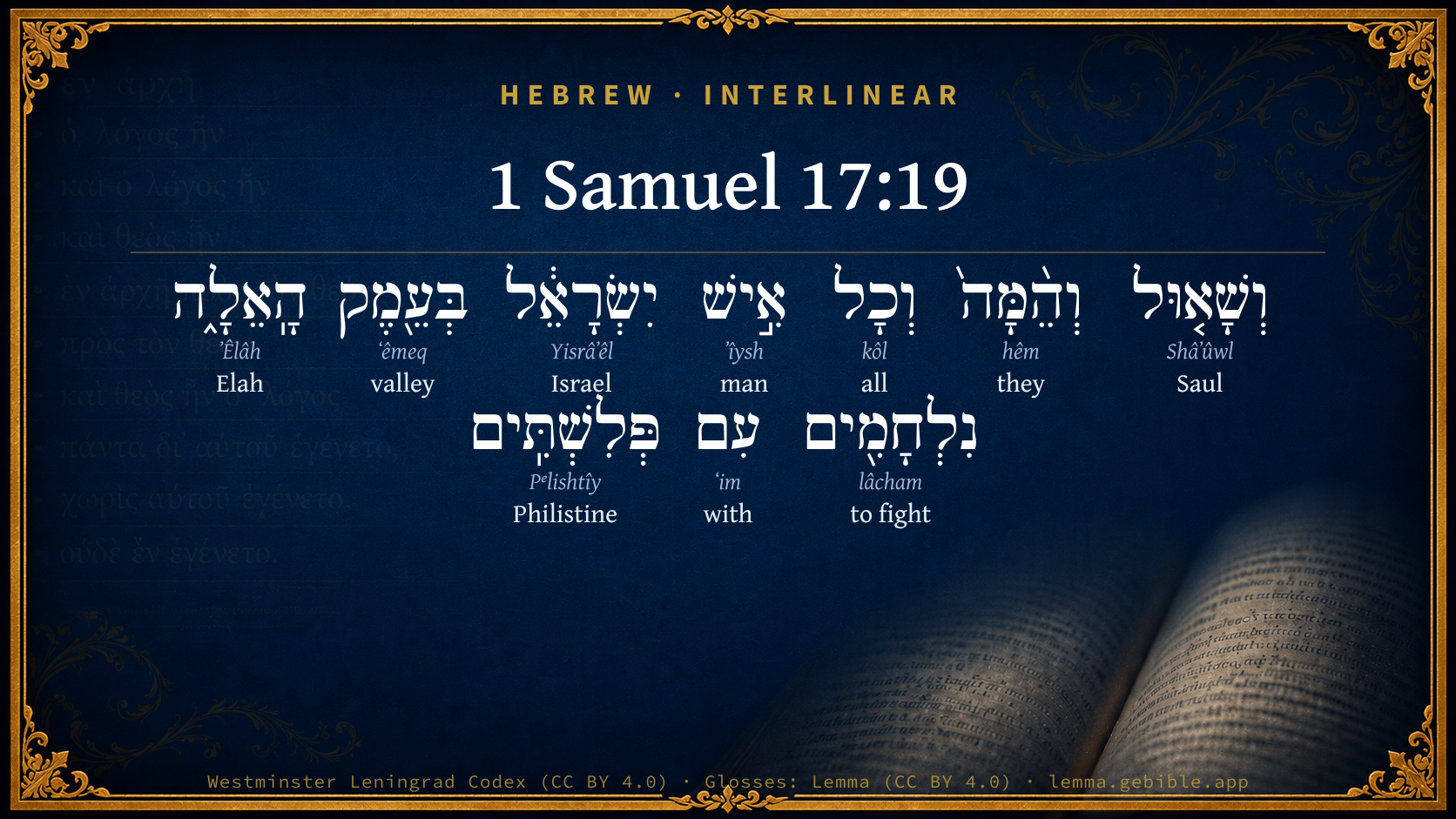
1 Samuel 17:19

Hebrew (Westminster Leningrad Codex) 1 Samuel 17:19 appears in the Hebrew Old Testament. The text above is from the Westminster Leningrad Codex. Each word links to its Strong’s number, a concise gloss, and parsing drawn from the Open Scriptures Hebrew Bible morphology. Click any word for its full Brown-Driver-Briggs (BDB) entry.
Download image
Cite this verse

1 Samuel 17:19 (World English Bible). Public Domain. Lemma interlinear Bible study tool, https://lemma.gebible.app/v/1-samuel/17/19.

Show BibTeX & RIS
BibTeX
RIS
English Translation
Now Saul, and they, and all the men of Israel, were in the valley of Elah, fighting with the Philistines.
World English Bible · Public Domain
Download a study sheet

One document with this verse’s original text, its word-by-word gloss line, the meaning frame, cross-references with their text, attributed commentary, and full source and license credits — printable, and it pastes into notes with its structure intact.

This verse Autodidact and up

Study sheet (.html) Plain text (.txt)

A passage Seminary Student

Up to 50 verses in one chapter. A passage sheet keeps up to 6 commentary sources and 12 cross-references per verse, in the order this page ranks them, and says so on the sheet whenever that leaves anything out. Ask for a single verse and you get the Autodidact verse sheet above.

Everything on this page stays free to read, with no account — the sheet is a download of what is already on screen, not access to it.

Want to remove ads? Support Godless Engineer
Compare translations 3

The same verse in 3 English versions, stacked beneath the original-language interlinear above. Click any original word for its lexicon entry.

Each is an independent rendering of the whole verse — the interlinear is not word-aligned to these translations.

Highlighted words mark where these versions differ — a whole-verse word diff, not a word-by-word alignment.

  • World English Bible Public Domain
    Now Saul, and they, and all the men of Israel, were in the valley of Elah, fighting with the Philistines.
  • King James Version Public Domain
    Now Saul, and they, and all the men of Israel, were in the valley of Elah, fighting with the Philistines.
  • unfoldingWord Literal Text CC BY-SA 4.0
    Now Saul and they and all of the men of Israel in the Valley of Elah, fighting with the Philistines.”

unfoldingWord Literal Text — © unfoldingWord, licensed CC BY-SA 4.0. Word-aligned USFM3 via Door43 (git.door43.org/unfoldingWord/en_ult).

Versions to compare (up to 4)

3 of 4 selected

Show all 18 translations

Every available English version of this verse, each an independent rendering of the whole verse.

  • World English Bible Public Domain
    Now Saul, and they, and all the men of Israel, were in the valley of Elah, fighting with the Philistines.
  • Berean Standard Bible Public Domain
    They are with Saul and all the men of Israel in the Valley of Elah, fighting against the Philistines.”
  • Majority Standard Bible Public Domain
    They are with Saul and all the men of Israel in the Valley of Elah, fighting against the Philistines.”
  • King James Version Public Domain
    Now Saul, and they, and all the men of Israel, were in the valley of Elah, fighting with the Philistines.
  • American Standard Version (1901) Public Domain
    Now Saul, and they, and all the men of Israel, were in the vale of Elah, fighting with the Philistines.
  • Revised Version (1885) Public Domain
    Now Saul, and they, and all the men of Israel, were in the vale of Elah, fighting with the Philistines.
  • Geneva Bible (1599) Public Domain
    (Then Saul and they, and all the men of Israel were in the valley of Elah, fighting with the Philistims)
  • Douay-Rheims (1899) Public Domain
    But Saul, and they, and all the children of Israel were in the valley of Terebinth fighting against the Philistines.
  • Young's Literal Translation Public Domain
    And Saul, and they, and all the men of Israel `are' in the valley of Elah, fighting with the Philistines.
  • Literal Standard Version CC BY-SA 4.0
    And Saul, and they, and all the men of Israel, [are] in the Valley of Elah, fighting with the Philistines.
  • Unlocked Literal Bible CC BY-SA 4.0
    Your brothers are with Saul and all the men of Israel in the Valley of Elah, fighting the Philistines.”
  • unfoldingWord Literal Text CC BY-SA 4.0
    Now Saul and they and all of the men of Israel in the Valley of Elah, fighting with the Philistines.”
  • Darby Bible Public Domain
    Now Saul, and they, and all the men of Israel [were] in the valley of terebinths, fighting against the Philistines.
  • World Messianic Bible Public Domain
    Now Saul, and they, and all the men of Israel were in the valley of Elah, fighting with the Philistines.
  • Webster's Bible Public Domain
    Now Saul, and they, and all the men of Israel, were in the valley of Elah, fighting with the Philistines.
  • Free Bible Version CC BY-SA 4.0
    They were with Saul and the whole Israelite army in the Valley of Elah, fighting the Philistines.
  • Bible in Basic English Public Domain
    Now Saul, and they, and all the men of Israel were in the valley of Elah, fighting with the Philistines.
  • JPS Tanakh (1917) Public Domain
    now Saul, and they, and all the men of Israel, are in the vale of Elah, fighting with the Philistines.'

Literal Standard Version (2020), Covenant Press — licensed CC BY-SA 4.0. Text via the HelloAO Bible API (eBible.org). Unlocked Literal Bible (unfoldingWord) — licensed CC BY-SA 4.0. Text via the HelloAO Bible API (eBible.org). unfoldingWord Literal Text — © unfoldingWord, licensed CC BY-SA 4.0. Word-aligned USFM3 via Door43 (git.door43.org/unfoldingWord/en_ult). Free Bible Version, Dr. Jonathan Gallagher — licensed CC BY-SA 4.0. Text via the HelloAO Bible API (eBible.org).

Word by word

More ways to search: Search by grammar → Find every occurrence → Compare this word →

Practice this passage: Drill this verse → Learn its vocabulary →

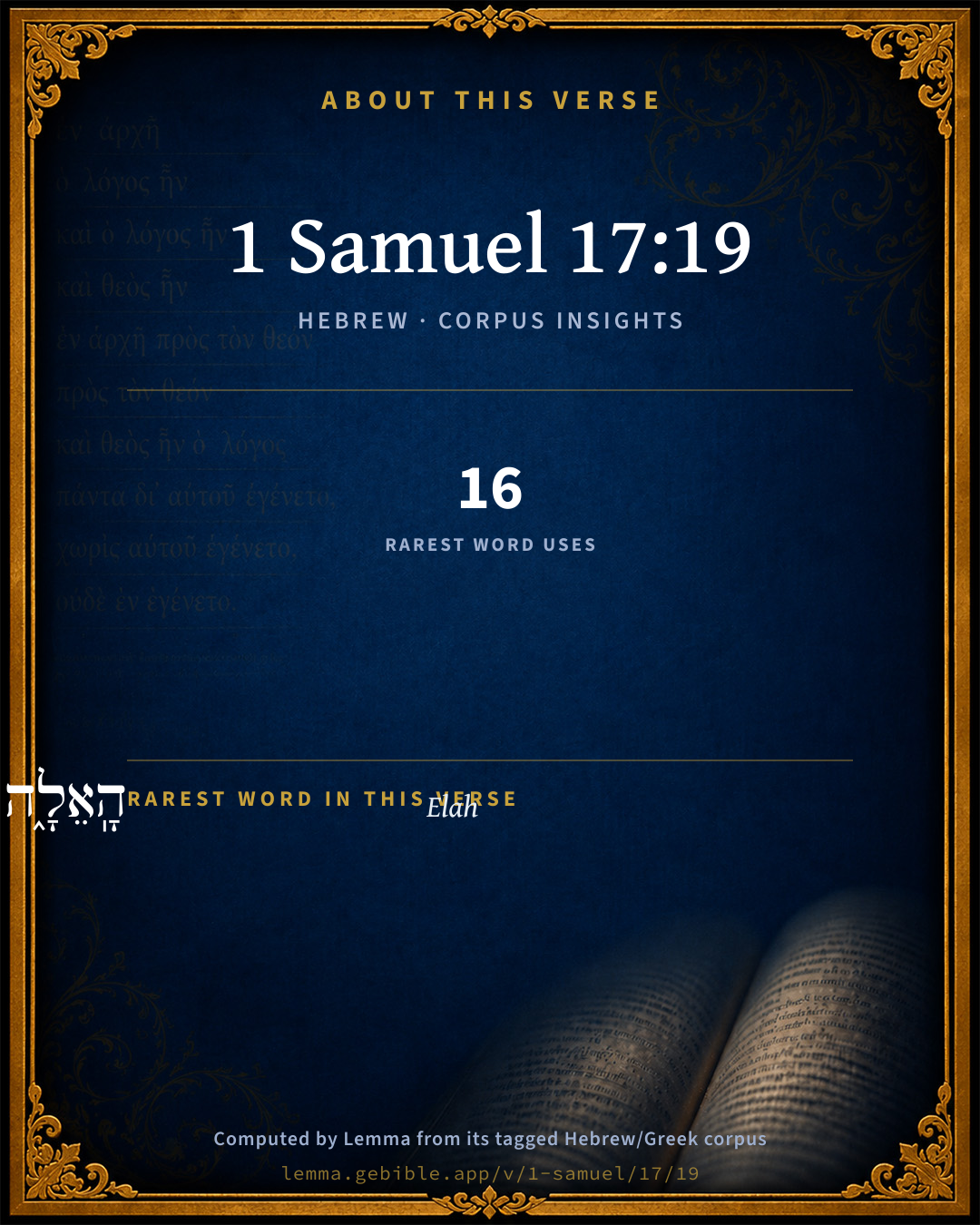
About this verse

These counts appear in no published source. They are computed here, from the morphology-tagged text and Lemma’s own curated glosses. What Lemma adds →

10
words
10
distinct lemmas
Historical
section

Notable vocabulary

The rarest word here is הָֽאֵלָ֑ה Elah H425 — appearing just 16 times in the whole Hebrew Bible.

Shared distinctive vocabulary

הָֽאֵלָ֑ה Elah H425 occurs in 15 verses of the Hebrew Bible. Also found in:

Grammatical profile

  • 1 verb
  • 7 nouns
  • 1 pronoun
  • 1 preposition

Verb forms

  • נִלְחָמִ֖ים Niphal · Participle Active

Hebrew & Septuagint length

In English translation the verse runs 20 words from the Hebrew and 20 from the Septuagint (LXX English) — the same length.

A rough comparison of the two English renderings, which tokenize alike — not a word-level alignment.

Word counts can differ between the Hebrew and the Greek without any difference in meaning — e.g. the Hebrew direct-object marker אֵת has no separate Greek word, and Greek often adds the article ὁ.

Hebrew and Greek witnesses Masoretic Hebrew ↔ Greek Septuagint

The same verse in the two great witnesses to the Old Testament, shown verse-for-verse.

These are two independent witnesses, not word-aligned to each other, and the Septuagint is shown in lemma (dictionary) form.

Hebrew 1 Samuel 17:19 Masoretic · Westminster Leningrad Codex

וְשָׁא֤וּל וְהֵ֨מָּה֙ וְכָל אִ֣ישׁ יִשְׂרָאֵ֔ל בְּעֵ֖מֶק הָֽאֵלָ֑ה נִלְחָמִ֖ים עִם פְּלִשְׁתִּֽים

Now Saul, and they, and all the men of Israel, were in the valley of Elah, fighting with the Philistines.

World English Bible · Public Domain

Greek LXX 1 Samuel 17:19 Septuagint · lemma form

καί ζώννυμι ὁ δαυίδ ὁ ῥομφαία αὐτός ἐπάνω ὁ μανδύας αὐτός καί κοπιάω περιπατέω ἅπαξ καί δίς καί εἶπον δαυίδ πρός σαούλ οὐ μή δύναμαι πορεύομαι ἐν οὗτος ὅτι οὐ πειράζω καί ἀποαἱρέω αὐτός ἀπό αὐτός

And Saul himself and all the men of Israel were in the valley of the Oak, warring with the Philistines.

LXX2012 (modern English Septuagint) · Public Domain

Hebrew: Westminster Leningrad Codex (CC BY 4.0). Greek: Septuagint (public domain); English from LXX2012 (modern English Septuagint) (Public Domain). How the Septuagint differs from the Hebrew →

Targum (Aramaic paraphrase)

1

The Targum is the ancient Jewish Aramaic paraphrase of the Hebrew Scriptures — an interpretive translation, not the Hebrew text itself. Onkelos (literal) and Pseudo-Jonathan (expansive) render the Torah, and Jonathan the Prophets. Coverage is partial: where no permissively-licensed English translation exists for a verse, only the Aramaic is shown. This is verse-level text, not a word-by-word alignment to the Hebrew.

  1. Targum Jonathan Prophets (Joshua–Malachi)
    וְשָׁאוּל וְאִינוּן וְכָל אֱנַשׁ יִשְׂרָאֵל בְּמֵישַׁר בּוּטְמָא מְגִיחִין קְרָבָא עִם פְּלִשְׁתָּאֵי:

    (no public-domain English translation for this verse)

    Targum Jonathan — Aramaic: “Mikraot Gedolot” (public domain). English: “Sefaria Community Translation” (CC0 1.0 (public-domain dedication)); “London "Chaldee Paraphrase," 1871” (public domain). Text via Sefaria.

Commentary

Notes on 1 Samuel 17:19 from classic Christian and Jewish commentators (each source and its license shown beneath its notes). The classic Christian expositions comment on the surrounding passage and are grouped to its opening verse, so a note may address several verses; the Jewish commentaries on the Tanakh (Rashi and others) are per-verse, so they appear only where the commentator wrote on this verse.

Lemma curates 59 commentaries, every one of them public domain or Creative Commons licensed, each selected and text-cleaned for this edition rather than reprinted as found. About our sources →

Trapp's Complete Commentary

John Trapp

1Sa 17:19 Now Saul, and they, and all the men of Israel, [were] in the valley of Elah, fighting with the Philistines.

Ver. 19. Fighting,] i.e., Skirmishing, and ready to join battle.

John Trapp, A Commentary or Exposition upon All the Books of the Old and New Testament (1647–1656) — public domain. Text from a community e-Sword module.

Joseph Benson's Commentary

1Sa 17:19. Fighting with the Philistines — That is, in a posture and readiness to fight with them, as it is explained 1Sa 17:20-21, being drawn up in battle array. In the valley of Elah — Not, strictly speaking, in the valley, but hard by it, on the side of the mountain, where they faced the Philistines, and showed themselves resolved to fight, if the latter came down from the other mountain to oppose them.

Joseph Benson's Commentary on the Old and New Testaments (1811–1818) — public domain. Text from a community e-Sword module.

Adam Clarke's Commentary

Verse 19. Fighting with the Philistines.] See at the end of the chapter. 1Sa 17:58.

Adam Clarke's Commentary on the Bible (1810–1826) — public domain. Text from a community e-Sword/MySword module.

Ellicott's Commentary for English Readers

(19) In the valley of Elan, fighting with the Philistines.—The words of this verse, which read in the English Version as an explanatory parenthesis, are really part of Jesse’s direction to his shepherd son, telling him where he would find his brethren. “They are in the valley of the Terebinth (Elah), fighting with the Philistines.”

A Bible Commentary for English Readers, edited by Charles John Ellicott (1878–1897) — public domain. Text from a community e-Sword module.

The Cambridge Bible for Schools and Colleges

gen. ed. J. J. S. Perowne

19. Now Saul, &c.] Probably, “Now Saul and they … are,” &c., i.e. it is Jesse’s direction to David where to find his brothers, not a remark of the historian.

The Cambridge Bible for Schools and Colleges (gen. ed. J. J. S. Perowne; Cambridge University Press, 1878–1918) — public domain. Text from a community e-Sword module.

John Gill's Exposition

Now Saul, and they,.... That is, the sons of Jesse, and brethren of David:

and all the men of Israel; the soldiers in the army:

were in the valley Elah; or "by" it, near unto it; for they were set in array on the mountain on the side of it:

fighting with the Philistines; not actually engaged in battle, but drawn up for it; prepared and in readiness to engage whenever it was necessary, or they were obliged to it; and perhaps there might be now and then some skirmishes in the outer parts of the camp.

John Gill's Exposition of the Whole Bible (1746–1763) — public domain (CC PDM 1.0). Text via the HelloAO Bible API.

Haydock's Catholic Bible Commentary

Fighting, or ready to engage. (Haydock)

George Leo Haydock (1774–1849), Haydock's Catholic Family Bible and Commentary, 1859 edition — public domain. Excludes Psalms (Douay-Rheims chapter numbering differs from Protestant) and Deuterocanonical books (Catholic canon only).

Matthew Poole's English Annotations

i.e. In a posture and readiness to fight with them; as it is explained, 1Sa 17:20,21. Men are oft said in Scripture to do what they intend and are prepared to do, as hath been showed formerly by instances.

Matthew Poole's English Annotations on the Holy Bible (1683–1685) — public domain. Text from a community e-Sword/MySword module.

Whedon's Commentary on the Bible

Daniel D. Whedon

19. Saul, and they… were in the valley of Elah — Better to supply are, instead of were, and understand this verse as a part of Jesse’s words to David. To the instructions which Jesse gives his son in the preceding verses, he here adds, for his further information, that he will find Saul, and his brothers, and all Israel, in the valley of Elah, engaged in war with the Philistines. This obviates the objection urged against the genuineness of this passage, that there was no fighting with the Philistines until after Goliath’s fall. The statement was but a casual remark of Jesse, who was not fully acquainted with the facts, and is not to be taken as literally correct.

Daniel D. Whedon (gen. ed.), Commentary on the Old and New Testaments (1874–1909) — public domain. Text from a community e-Sword module.

The Pulpit Commentary

HOMILIES BY B. DALE. Vers. 19-31. (THE VALLEY OF ELAH.)

Self-conquest.

have I now done? Is there not a cause?" (ver. 29. Was it not a word? or, Was it anything more than a word?). In the conflict of life the first victory which every one should seek to achieve is the victory over himself. Unless he gain this, he is not likely to gain others, or, if he gain them, to improve them aright; but if, on the ether hand, he gain it, he is thereby prepared to gain others, and to follow them up with the greatest advantage. Such a victory was David"s.

1. He arrived at the wagon rampart when the host was about to make anadvance; leaving there the things he carried, he ran into the ranks to seek his brethren; and, while talking with them, there stalked forth, as on previous days, the Philistine champion, at the sight of whom "all the men of Israel fled, and were sore afraid" (ver. 24). The shepherd youth alone was fearless. There was in him more faith than in the whole army. And in conversing with the men around him he intimated the possible overthrow of this boastful giant, and the "taking away of the reproach from Israel," and expressed his amazement at the audacity of the man in "defying the ranks of the living God" (whose presence and power all appear to have forgotten).

2. On hearing his words, and probably surmising that he entertained thethought of encountering the champion, Eliab was filled with envy and anger, and reproached him as being out of his proper place, as only fit to have the charge of a few sheep, and even neglectful of them, and as proud, discontented with his calling, bad-hearted, and delighting in the sight of strife and bloodshed, which, he said, he knew, however others might be deceived. Ah, how little did he really know of his brother"s heart! But angry men are more desirous of inflicting pain than of uttering the truth.

3. This language would have excited the fierce wrath of most persons. ButDavid maintained his self-control, and gave the soft answer which "turneth away wrath." He thus obtained a victory which was hardly less noble than that which he shortly afterwards obtained over Goliath. Consider his self-conquest (with respect to the passion of anger) as

I ACHIEVED UNDER SEVERE PROVOCATION.

1. The contemptuous reproach of a brother. From him at least better things might have been expected. But natural affection often vanishes before envy and anger, (Gen_4:8) and is transformed into intense hatred. "There is no enemy so ready or so spiteful as the domestical" (Hall).

2. An ungrateful return for kindness. David had come with valuable presents and kindly inquiries, and this was his reward.

3. An unjust impugning of motives. "Eliab sought for the splinter in his brother"s eye, and was not aware of the beam that was in his own; the very things with which he charged his brother were most apparent in his own scornful reproach" (Keil).

4. An open attack upon reputation. His words were intended to damage David in the eyes of others, as unworthy of their confidence and regard. All these things were calculated to exasperate. "Thus David was envied of his own brethren, herein being a type of Christ, who was rejected of the Jews, being as it were the eldest brethren, and was received of the Gentiles" (Wilier). The followers of Christ are often exposed to similar provocation. "And the strength of a good soldier of Jesus Christ appears in nothing more than in steadfastly maintaining the holy calm, meekness, sweetness, and benevolence of his mind amidst all the storms, injuries, strange behaviour, and surprising acts and events of this evil and unreasonable world (J. Edwards).

II EXHIBITING AN ADMIRABLE SPIRIT.

1. Extraordinary meekness and forbearance in enduring reproach. "He that is slow to wrath is of great understanding," etc. (Pro_14:29 Pro_15:18 Pro_25:28)

2. Firm and instant repression of angry passion. For it could hardly be but that a flash of indignation should glance into his breast; but "anger resteth in the bosom of fools". (Ecc_7:9)

3. Wise and gentle reserve in the language employed. It is as useless to reason with the wind as with an angry man. "Set a watch, O Lord, before my mouth," etc.. (Psa_141:3)

4. Continued and steadfast adherence to a noble purpose. David went on talking. after the same manner" (ver. 30). We ought not to suffer ourselves to be turned from the path of duty by the reproach which we may meet therein, but we should rather pursue it more diligently than ever, and prove by our conduct the sincerity and rectitude of our spirit. "He that is slow to anger is better than the mighty, and he that ruleth his spirit than he that taketh a city". (Pro_16:32) "It is better to conquer the deceitful lusts of the heart than to conquer Jerusalem" (St. Bernard).

The bravest trophy ever man obtained Is that which o"er himself, himself hath gained.

"When thou art offended by others, do not let thy mind dwell upon them, or on such thoughts as these: that they ought not so to have treated thee; who they are; or whom they think themselves to be, and the like; for all this is fuel, and a kindling of anger, wrath, and hatred. But in such eases turn instantly to the strength and commands of God, that thou mayest know what thou oughtest to do, and that thine error be not greater than theirs. So shalt thou return into the way of peace" (Scupoli). And of this spirit Christ is the supreme pattern. (1Pe_2:21-23)

III FOLLOWED BY A BENEFICIAL EFFECT.

1. A sense of peace and Divine approbation. "Angels came and ministered unto him". (Mat_4:11) It is always thus with those who conquer temptation.

2. The purifying and strengthening of faith, by means of the trial to which it is subjected (1Pe_1:7; Jam_1:2)

3. The commendation of character in the sight of others, who commonly judge of the truth of an accusation by the manner in which it is met, and naturally confide in a man of calmness, firmness, and lofty purpose. "They rehearsed them" (his words) "before Saul: and he sent for him" (ver. 31).

4. The preparation of the spirit for subsequent conflict. "Could the second victory have been achieved if he had failed in the first conflict? His combat with Goliath demanded an undimmed eye, a steady arm, and a calm heart, and if he had given way to stormy passion for only a brief season there would have been a lingering feverishness and nervousness, utterly unfitting him for the dread struggle on which the fate of two armies and two nations was depending" (C. Vince). D.

The Pulpit Commentary (1880–1919), ed. H.D.M. Spence-Jones & Joseph S. Exell — public domain. Text from a community e-Sword module.

John Wesley's Explanatory Notes

Fighting - That is, in a posture and readiness to fight with them; as it is explained, ver. 20, 21.

John Wesley, Explanatory Notes Upon the Whole Bible (1754–1765) — public domain. Text via the GEBible commentary corpus.

unfoldingWord translationNotes

Door43 World Missions Community

all the men of Israel

"all the soldiers of Israel"

the Valley of Elah

This is the name of a place. See how you translated it in 1 Samuel 17:2. (See: How to Translate Names)

translationWords

Saul (OT)

Israel

Philistines

David

flocks

shepherd

Jesse

command

unfoldingWord translationNotes — © Distant Shores Media and the Door43 World Missions Community, licensed CC BY-SA 4.0. Source: git.door43.org/Door43/en_tn.

Lesson kit

Teaching starters — assembled from the data on this page, not authored interpretation. Every prompt links to the verse data it draws on. Edit before teaching.

1 Samuel, in the Historical, opens this verse with 10 words (10 distinct Hebrew lemmas). Its most distinctive word is ʼÊlâh (“Elah”). A historical commentator’s framing appears above. Read the whole chapter for the surrounding context.

Discussion questions

  1. How does “Elah” (ʼÊlâh) shape what this verse is saying?
  2. Genesis 36:41 shares the word «Elah» with this verse. How do the two illuminate each other?
  3. The verb «נִלְחָמִ֖ים» is Niphal Participle Active. How does its form color the action?
  4. Reading how Trapp's Complete Commentary and Joseph Benson's Commentary read this verse, where do the two commentators agree and where do they part?

Reading settings

Reading text

Shown beneath each verse's original-language words.

Old Testament
Old Testament edition

Read the OT as the Masoretic Hebrew (MT) or the Greek Septuagint (LXX).

English shown for the Greek Septuagint (in the Hebrew ↔ Greek comparison).

Comparing translations? Open the Compare panel on any verse page to stack up to four side by side.