
Ezekiel 37:25

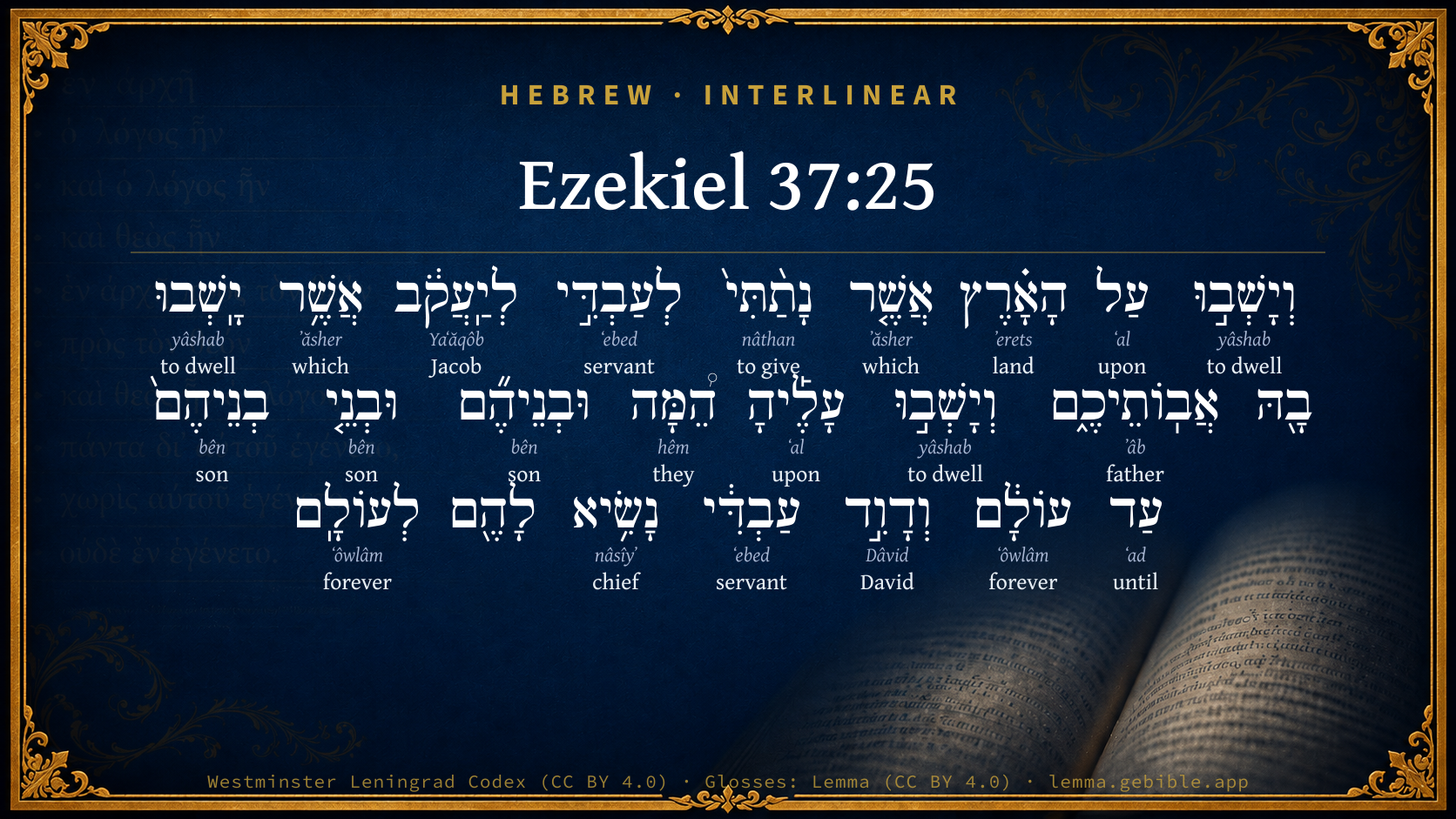
Hebrew (Westminster Leningrad Codex) Ezekiel 37:25 appears in the Hebrew Old Testament. The text above is from the Westminster Leningrad Codex. Each word links to its Strong’s number, a concise gloss, and parsing drawn from the Open Scriptures Hebrew Bible morphology. Click any word for its full Brown-Driver-Briggs (BDB) entry.
Download image
Cite this verse

Ezekiel 37:25 (World English Bible). Public Domain. Lemma interlinear Bible study tool, https://lemma.gebible.app/v/ezekiel/37/25.

Show BibTeX & RIS
BibTeX
RIS
English Translation
They shall dwell in the land that I have given to Jacob my servant, in which your fathers lived; and they shall dwell therein, they, and their children, and their children's children, forever: and David my servant shall be their prince for ever.
World English Bible · Public Domain
Download a study sheet

One document with this verse’s original text, its word-by-word gloss line, the meaning frame, cross-references with their text, attributed commentary, and full source and license credits — printable, and it pastes into notes with its structure intact.

This verse Autodidact and up

Study sheet (.html) Plain text (.txt)

A passage Seminary Student

Up to 50 verses in one chapter. A passage sheet keeps up to 6 commentary sources and 12 cross-references per verse, in the order this page ranks them, and says so on the sheet whenever that leaves anything out. Ask for a single verse and you get the Autodidact verse sheet above.

Everything on this page stays free to read, with no account — the sheet is a download of what is already on screen, not access to it.

Want to remove ads? Support Godless Engineer
Compare translations 3

The same verse in 3 English versions, stacked beneath the original-language interlinear above. Click any original word for its lexicon entry.

Each is an independent rendering of the whole verse — the interlinear is not word-aligned to these translations.

Highlighted words mark where these versions differ — a whole-verse word diff, not a word-by-word alignment.

  • World English Bible Public Domain
    They shall dwell in the land that I have given to Jacob my servant, in which your fathers lived; and they shall dwell therein, they, and their children, and their children's children, forever: and David my servant shall be their prince for ever.
  • King James Version Public Domain
    And they shall dwell in the land that I have given unto Jacob my servant, wherein your fathers have dwelt; and they shall dwell therein, even they, and their children, and their children's children for ever: and my servant David shall be their prince for ever.
  • unfoldingWord Literal Text CC BY-SA 4.0
    They will live in the land that I have given to my servant Jacob, where your fathers had stayed. They will live in it forever—they, their children, and their grandchildren, for David my servant will be their chief forever.

unfoldingWord Literal Text — © unfoldingWord, licensed CC BY-SA 4.0. Word-aligned USFM3 via Door43 (git.door43.org/unfoldingWord/en_ult).

Versions to compare (up to 4)

3 of 4 selected

Show all 18 translations

Every available English version of this verse, each an independent rendering of the whole verse.

  • World English Bible Public Domain
    They shall dwell in the land that I have given to Jacob my servant, in which your fathers lived; and they shall dwell therein, they, and their children, and their children's children, forever: and David my servant shall be their prince for ever.
  • Berean Standard Bible Public Domain
    They will live in the land that I gave to My servant Jacob, where your fathers lived. They will live there forever with their children and grandchildren, and My servant David will be their prince forever.
  • Majority Standard Bible Public Domain
    They will live in the land that I gave to My servant Jacob, where your fathers lived. They will live there forever with their children and grandchildren, and My servant David will be their prince forever.
  • King James Version Public Domain
    And they shall dwell in the land that I have given unto Jacob my servant, wherein your fathers have dwelt; and they shall dwell therein, even they, and their children, and their children's children for ever: and my servant David shall be their prince for ever.
  • American Standard Version (1901) Public Domain
    And they shall dwell in the land that I have given unto Jacob my servant, wherein your fathers dwelt; and they shall dwell therein, they, and their children, and their children's children, for ever: and David my servant shall be their prince for ever.
  • Revised Version (1885) Public Domain
    And they shall dwell in the land that I have given unto Jacob my servant, wherein your fathers dwelt; and they shall dwell therein, they, and their children, and their children’s children, for ever: and David my servant shall be their prince for ever.
  • Geneva Bible (1599) Public Domain
    And they shall dwell in the lande, that I haue giuen vnto Iaakob my seruant, where your fathers haue dwelt, and they shall dwel therein, euen they, and their sonnes, and their sonnes sonnes for euer, and my seruant Dauid shall bee their prince for euer.
  • Douay-Rheims (1899) Public Domain
    And they shall dwell in the land which I gave to my servant Jacob, wherein your fathers dwelt, and they shall dwell in it, they and their children, and their children's children, for ever: and David my servant shall be their prince for ever.
  • Young's Literal Translation Public Domain
    And they have dwelt on the land that I gave to My servant, to Jacob, In which your fathers have dwelt, And they have dwelt on it, they and their sons, And their son's sons -- unto the age, And David My servant `is' their prince -- to the age.
  • Literal Standard Version CC BY-SA 4.0
    And they have dwelt on the land that I gave to My servant, to Jacob, || In which your fathers have dwelt, || And they have dwelt on it, they and their sons, || And their son’s sons—for all time, || And My servant David [is] their prince for all time.
  • Unlocked Literal Bible CC BY-SA 4.0
    They will live in the land that I have given to my servant Jacob, where your fathers had stayed. They will live in it forever—they, their children, and their grandchildren, for David my servant will be their chief forever.
  • unfoldingWord Literal Text CC BY-SA 4.0
    They will live in the land that I have given to my servant Jacob, where your fathers had stayed. They will live in it forever—they, their children, and their grandchildren, for David my servant will be their chief forever.
  • Darby Bible Public Domain
    And they shall dwell in the land that I have given unto Jacob my servant, wherein your fathers have dwelt; and they shall dwell therein, they, and their children, and their children's children for ever: and David my servant shall be their prince for ever.
  • World Messianic Bible Public Domain
    They will dwell in the land that I have given to Jacob my servant, in which your fathers lived. They will dwell therein, they, and their children, and their children’s children, forever. David my servant will be their prince forever.
  • Webster's Bible Public Domain
    And they shall dwell in the land that I have given to Jacob my servant, in which your fathers have dwelt, and they shall dwell in it, even they, and their children, and their children's children for ever: and my servant David shall be their prince for ever.
  • Free Bible Version CC BY-SA 4.0
    They will live in the country I gave to my servant Jacob where your forefathers lived. They will live there with their children and grandchildren forever, and my servant David will be their prince forever.
  • Bible in Basic English Public Domain
    And they will be living in the land which I gave to Jacob, my servant, in which your fathers were living; and they will go on living there, they and their children and their children's children, for ever: and David, my servant, will be their ruler for ever.
  • JPS Tanakh (1917) Public Domain
    And they shall dwell in the land that I have given unto Jacob My servant, wherein your fathers dwelt; and they shall dwell therein, they, and their children, and their children's children, for ever; and David My servant shall be their prince for ever.

Literal Standard Version (2020), Covenant Press — licensed CC BY-SA 4.0. Text via the HelloAO Bible API (eBible.org). Unlocked Literal Bible (unfoldingWord) — licensed CC BY-SA 4.0. Text via the HelloAO Bible API (eBible.org). unfoldingWord Literal Text — © unfoldingWord, licensed CC BY-SA 4.0. Word-aligned USFM3 via Door43 (git.door43.org/unfoldingWord/en_ult). Free Bible Version, Dr. Jonathan Gallagher — licensed CC BY-SA 4.0. Text via the HelloAO Bible API (eBible.org).

Word by word

More ways to search: Search by grammar → Find every occurrence → Compare this word →

Practice this passage: Drill this verse → Learn its vocabulary →

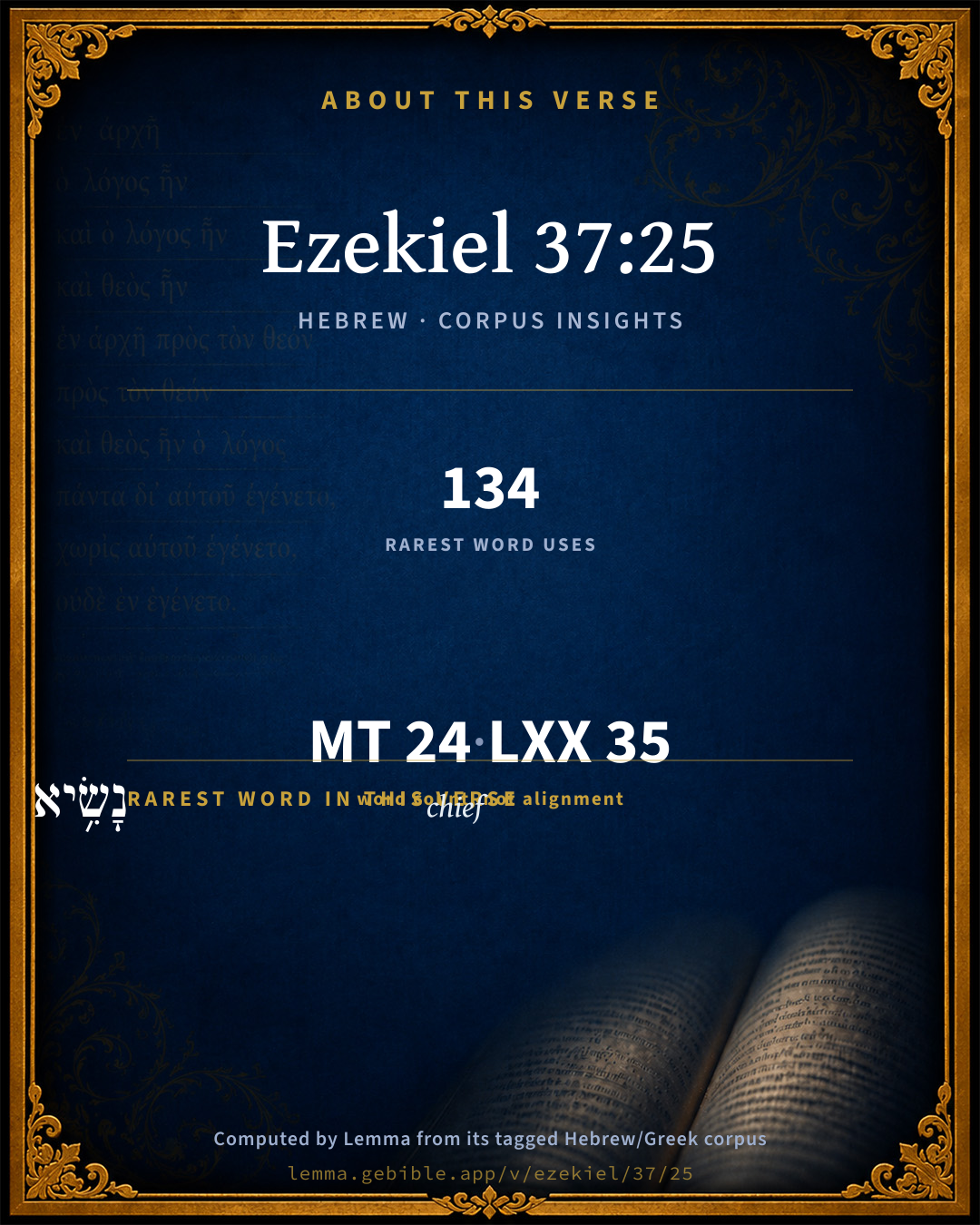
נָשִׂ֥יא
nâsîyʼ
H5387
“chief”
Noun, Common, Masculine, Singular, Absolute
Part of Speech
Noun
Type
Common
Gender
Masculine
Number
Singular
State
Absolute
Full BDB Definition

Origin: from H5375

TWOT: 1421b , 1421c

one lifted up, chief, prince, captain, leader - rising mist, vapour
  1. וְיָשְׁב֣וּ yâshab H3427 “and · to dwell” Conjunction + Verb, Qal, Sequential Perfect, 3rd Person, Common, Plural
  2. עַל ʻal H5921 “upon” Preposition
  3. הָאָ֗רֶץ ʼerets H776 “the · land” Particle, Definite Article + Noun, Common, Both, Singular, Absolute
  4. אֲשֶׁ֤ר ʼăsher H834 “which” Particle, Relative
  5. נָתַ֨תִּי֙ nâthan H5414 “to give” Verb, Qal, Perfect, 1st Person, Common, Singular
  6. לְעַבְדִּ֣י ʻebed H5650 “to/for · servant · my” Preposition + Noun, Common, Masculine, Singular, Construct + Suffix, Personal, 1st Person, Common, Singular
  7. לְיַֽעֲקֹ֔ב Yaʻăqôb H3290 “to/for · Jacob” Preposition + Noun, Proper
  8. אֲשֶׁ֥ר ʼăsher H834 “which” Particle, Relative
  9. יָֽשְׁבוּ yâshab H3427 “to dwell” Verb, Qal, Perfect, 3rd Person, Common, Plural
  10. אֲבֽוֹתֵיכֶ֑ם ʼâb H1 “fathers · your” Noun, Common, Masculine, Plural, Construct + Suffix, Personal, 2nd Person, Masculine, Plural
  11. וְיָשְׁב֣וּ yâshab H3427 “and · to dwell” Conjunction + Verb, Qal, Sequential Perfect, 3rd Person, Common, Plural
  12. עָלֶ֡יהָ ʻal H5921 “upon · her” Preposition + Suffix, Personal, 3rd Person, Feminine, Singular
  13. הֵ֠מָּה hêm H1992 “they” Pronoun, Personal, 3rd Person, Masculine, Plural
  14. וּבְנֵיהֶ֞ם bên H1121 “and · sons · their” Conjunction + Noun, Common, Masculine, Plural, Construct + Suffix, Personal, 3rd Person, Masculine, Plural
  15. וּבְנֵ֤י bên H1121 “and · sons of” Conjunction + Noun, Common, Masculine, Plural, Construct
  16. בְנֵיהֶם֙ bên H1121 “sons · their” Noun, Common, Masculine, Plural, Construct + Suffix, Personal, 3rd Person, Masculine, Plural
  17. עַד ʻad H5704 “until” Preposition
  18. עוֹלָ֔ם ʻôwlâm H5769 “forever” Noun, Common, Masculine, Singular, Absolute
  19. וְדָוִ֣ד Dâvid H1732 “and · David” Conjunction + Noun, Proper
  20. עַבְדִּ֔י ʻebed H5650 “servant · my” Noun, Common, Masculine, Singular, Construct + Suffix, Personal, 1st Person, Common, Singular
  21. לְעוֹלָֽם ʻôwlâm H5769 “to/for · forever” Preposition + Noun, Common, Masculine, Singular, Absolute

About this verse

These counts appear in no published source. They are computed here, from the morphology-tagged text and Lemma’s own curated glosses. What Lemma adds →

24
words
14
distinct lemmas
Prophets
section

Grammatical profile

  • 4 verbs
  • 12 nouns
  • 1 pronoun
  • 5 prepositions
  • 2 particles

Verb forms

  • וְיָשְׁב֣וּ Qal · Sequential Perfect
  • נָתַ֨תִּי֙ Qal · Perfect
  • יָֽשְׁבוּ Qal · Perfect
  • וְיָשְׁב֣וּ Qal · Sequential Perfect

Repetition

Words recur within this verse — often emphatic in Hebrew:

  • וְיָשְׁב֣וּ to dwell H3427 ×3
  • וּבְנֵיהֶ֞ם son H1121 ×3
  • עַל upon H5921 ×2
  • לְעַבְדִּ֣י servant H5650 ×2
  • עוֹלָ֔ם forever H5769 ×2
  • אֲשֶׁ֤ר which H834 ×2

Hebrew & Septuagint length

In English translation the verse runs 43 words from the Hebrew and 34 from the Septuagint (LXX English) — closely comparable.

A rough comparison of the two English renderings, which tokenize alike — not a word-level alignment.

Word counts can differ between the Hebrew and the Greek without any difference in meaning — e.g. the Hebrew direct-object marker אֵת has no separate Greek word, and Greek often adds the article ὁ.

In the original languages it is 24 Hebrew tokens and 35 Greek tokens — but the two are counted differently (Hebrew bundles its prefixes and suffixes into one token; the Greek is in lemma form), so that isn’t a like-for-like length.

Cross-references

22

Topical passages linked to Ezekiel 37:25 in the Treasury of Scripture Knowledge — connected by theme and wording, ordered by reader-vote popularity; previews shown in the World English Bible.

  • Ezekiel 37:24 My servant David shall be king over them; and they all shall have one shepherd: they shall also walk in my ordinances, and observe my statutes, and do them.
  • Amos 9:15 I will plant them on their land, And they will no more be plucked up out of their land which I have given them," says Yahweh your God.
  • Ezekiel 28:25 Thus says the Lord Yahweh: When I shall have gathered the house of Israel from the peoples among whom they are scattered, and shall be sanctified in them in the sight of the nations, then shall they dwell in their own land which I gave to my servant Jacob.
  • Ezekiel 36:28 You shall dwell in the land that I gave to your fathers; and you shall be my people, and I will be your God.
  • Isaiah 9:6–7 For to us a child is born, to us a son is given; and the government shall be on his shoulder: and his name shall be called Wonderful, Counselor, Mighty God, Everlasting Father, Prince of Peace.
  • Isaiah 11:1 There shall come forth a shoot out of the stock of Jesse, and a branch out of his roots shall bear fruit.
  • Isaiah 60:21 Your people also shall be all righteous; they shall inherit the land forever, the branch of my planting, the work of my hands, that I may be glorified.
  • Isaiah 66:22 For as the new heavens and the new earth, which I will make, shall remain before me, says Yahweh, so shall your seed and your name remain.
  • Jeremiah 30:3 For, behold, the days come, says Yahweh, that I will turn again the captivity of my people Israel and Judah, says Yahweh; and I will cause them to return to the land that I gave to their fathers, and they shall possess it.
  • Jeremiah 31:24 Judah and all the cities of it shall dwell therein together, the farmers, and those who go about with flocks.
  • Jeremiah 32:41 Yes, I will rejoice over them to do them good, and I will plant them in this land assuredly with my whole heart and with my whole soul.
  • Ezekiel 37:21 Say to them, Thus says the Lord Yahweh: Behold, I will take the children of Israel from among the nations, where they are gone, and will gather them on every side, and bring them into their own land:
  • Ezekiel 37:26 Moreover I will make a covenant of peace with them; it shall be an everlasting covenant with them; and I will place them, and multiply them, and will set my sanctuary in the midst of them forevermore.
  • Daniel 2:44–45 In the days of those kings shall the God of heaven set up a kingdom which shall never be destroyed, nor shall the sovereignty of it be left to another people; but it shall break in pieces and consume all these kingdoms, and it shall stand forever.
  • Joel 3:20 But Judah will be inhabited forever, And Jerusalem from generation to generation.
  • Zephaniah 3:14–15 Sing, daughter of Zion! Shout, Israel! Be glad and rejoice with all your heart, daughter of Jerusalem.
  • Hebrews 7:21 (for they indeed have been made priests without an oath), but he with an oath by him that says of him, "The Lord swore and will not change his mind, 'You are a priest forever, According to the order of Melchizedek'".
  • Zechariah 6:12–13 and speak to him, saying, 'Thus says Yahweh of Hosts, "Behold, the man whose name is the Branch: and he shall grow up out of his place; and he shall build the temple of Yahweh;
  • Zechariah 14:11 Men will dwell therein, and there will be no more curse; but Jerusalem will dwell safely.
  • Luke 1:32–33 He will be great, and will be called the Son of the Most High. The Lord God will give him the throne of his father, David,
  • John 12:34 The multitude answered him, "We have heard out of the law that the Christ remains forever. How do you say, 'The Son of Man must be lifted up?' Who is this Son of Man?"
  • Hebrews 7:2 to whom also Abraham divided a tenth part of all (being first, by interpretation, king of righteousness, and then also king of Salem, which is king of peace;

Cross-references courtesy of OpenBible.info (CC BY 4.0).

Hebrew and Greek witnesses Masoretic Hebrew ↔ Greek Septuagint

The same verse in the two great witnesses to the Old Testament, shown verse-for-verse.

These are two independent witnesses, not word-aligned to each other, and the Septuagint is shown in lemma (dictionary) form.

Hebrew Ezekiel 37:25 Masoretic · Westminster Leningrad Codex

וְיָשְׁב֣וּ עַל הָאָ֗רֶץ אֲשֶׁ֤ר נָתַ֨תִּי֙ לְעַבְדִּ֣י לְיַֽעֲקֹ֔ב אֲשֶׁ֥ר יָֽשְׁבוּ בָ֖הּ אֲבֽוֹתֵיכֶ֑ם וְיָשְׁב֣וּ עָלֶ֡יהָ הֵ֠מָּה וּבְנֵיהֶ֞ם וּבְנֵ֤י בְנֵיהֶם֙ עַד עוֹלָ֔ם וְדָוִ֣ד עַבְדִּ֔י נָשִׂ֥יא לָהֶ֖ם לְעוֹלָֽם

They shall dwell in the land that I have given to Jacob my servant, in which your fathers lived; and they shall dwell therein, they, and their children, and their children's children, forever: and David my servant shall be their prince for ever.

World English Bible · Public Domain

Greek LXX Ezekiel 37:25 Septuagint · lemma form

καί καταοἰκέω ἐπί ὁ γῆ αὐτός ὅς ἐγώ δίδωμι ὁ δοῦλος ἐγώ ἰακώβ ὅς καταοἰκέω ἐκεῖ ὁ πατήρ αὐτός καί καταοἰκέω ἐπί αὐτός αὐτός καί δαυίδ ὁ δοῦλος ἐγώ ἄρχων αὐτός εἰμί εἰς ὁ αἰών

And they shall dwell in their land, which I have given to my servant Jacob, where their fathers lived; and they shall dwell upon it: and David my servant shall be their prince forever.

LXX2012 (modern English Septuagint) · Public Domain

Hebrew: Westminster Leningrad Codex (CC BY 4.0). Greek: Septuagint (public domain); English from LXX2012 (modern English Septuagint) (Public Domain). How the Septuagint differs from the Hebrew →

Targum (Aramaic paraphrase)

1

The Targum is the ancient Jewish Aramaic paraphrase of the Hebrew Scriptures — an interpretive translation, not the Hebrew text itself. Onkelos (literal) and Pseudo-Jonathan (expansive) render the Torah, and Jonathan the Prophets. Coverage is partial: where no permissively-licensed English translation exists for a verse, only the Aramaic is shown. This is verse-level text, not a word-by-word alignment to the Hebrew.

  1. Targum Jonathan Prophets (Joshua–Malachi)
    וִיתִיבוּן עַל אַרְעָא דִיהָבִית לְעַבְדִי לְיַעֲקֹב דִיתִיבוּ בָהּ אֲבָהַתְכוֹן וְיַתְבוּן עֲלָהּ אִינוּן וּבְנֵיהוֹן וּבְנֵי בְנֵיהוֹן עַד עַלְמָא וְדָוִד עַבְדִי מַלְכָּא לְהוֹן לַעֲלָם:

    (no public-domain English translation for this verse)

    Targum Jonathan — Aramaic: “Mikraot Gedolot” (public domain). English: “Sefaria Community Translation” (CC0 1.0 (public-domain dedication)); “London "Chaldee Paraphrase," 1871” (public domain). Text via Sefaria.

Commentary

Notes on Ezekiel 37:25 from classic Christian and Jewish commentators (each source and its license shown beneath its notes). The classic Christian expositions comment on the surrounding passage and are grouped to its opening verse, so a note may address several verses; the Jewish commentaries on the Tanakh (Rashi and others) are per-verse, so they appear only where the commentator wrote on this verse.

Lemma curates 59 commentaries, every one of them public domain or Creative Commons licensed, each selected and text-cleaned for this edition rather than reprinted as found. About our sources →

Trapp's Complete Commentary

John Trapp

Eze 37:25 And they shall dwell in the land that I have given unto Jacob my servant, wherein your fathers have dwelt; and they shall dwell therein, [even] they, and their children, and their children’s children for ever: and my servant David [shall be] their prince for ever.

Ver. 25. And they shall dwell in the land.] So they did for six hundred years, or nearly so; and in heaven, whereof Canaan was a type, they shall live and reign for ever.

John Trapp, A Commentary or Exposition upon All the Books of the Old and New Testament (1647–1656) — public domain. Text from a community e-Sword module.

Tyndale Open Study Notes

Tyndale Open Resources

37:25-28 The covenant of peace, which is the blessing of covenant obedience, would be everlasting. The people’s earlier defilement had led to the Lord’s destruction of the Temple; now, their new purity would be matched by a renewed sanctuary, a Temple in which God could dwell in their midst forever. This final Temple would be the culmination of the success of God’s sanctifying program and demonstrate that the Lord is the one who makes Israel holy (see chs 40–48).

Tyndale Open Study Notes — © Tyndale Open Resources, licensed CC BY-SA 4.0. Text via the HelloAO Bible API.

Geneva Bible (1599)

Geneva Bible translators

Meaning, that the elect by Christ shall dwell in the heaven by Jerusalem, which is meant by the land of Canaan.

Geneva Bible (1599) marginal notes — public domain. Text via Bolls.life.

Jamieson, Fausset & Brown

Robert Jamieson, A. R. Fausset & David Brown

for ever-- (Isa 60:21; Joe 3:20; Amo 9:15).

Jamieson, Fausset & Brown — Commentary Critical and Explanatory on the Whole Bible (1871) — public domain (CC PDM 1.0). Text via the HelloAO Bible API.

Adam Clarke's Commentary

Verse 25. The land that I have given unto Jacob my servant] Jacob means here the twelve tribes; and the land given to them was the whole land of Palestine; consequently, the promise states that, when they return, they are to possess the whole of the Promised Land.

Adam Clarke's Commentary on the Bible (1810–1826) — public domain. Text from a community e-Sword/MySword module.

Ellicott's Commentary for English Readers

(25) For ever.—Strong emphasis is placed upon this declaration by its frequent repetition. In this verse, the occupancy of the land is to be for ever, and the kingship of David is to be for ever; and in Eze_37:26; Eze_37:28 the sanctuary is to be “in the midst of them for evermore,” and the covenant of peace is to be “an everlasting covenant.” Such promises are taken up continually in the New Testament, and explained of the everlasting reign of the King of kings, the Good Shepherd, over His people, and of the Temple of the Holy Ghost in the heart of the believer.

A Bible Commentary for English Readers, edited by Charles John Ellicott (1878–1897) — public domain. Text from a community e-Sword module.

The Cambridge Bible for Schools and Colleges

gen. ed. J. J. S. Perowne

25. Cf. Eze_36:28.

Jacob my servant] Jacob is here the patriarch himself, not as in Isaiah 40 seq. a name for the people. He is referred to as the ancestor cf Israel in Hos_12:12, as Abraham in Isa_29:22. Cf. ch. Eze_33:24; Isa_41:8; Isa_51:2; Isa_63:16.

their prince for ever] It is not at all probable that “David my servant” means either the Davidic house or a line of kings. But possibly the point whether the king would be one person living for ever is not before the prophet’s mind. It is the quality of the new people and the new ruler that he specially refers to; the point whether generation after generation of the people shall dwell in the land and prince succeed prince is hardly in his mind. The unity of the people and the unity of the ruler, one such as David; the character of the people (Eze_37:24) and their perpetual possession of the land—these are the elements of the prophet’s idea, and further questions are not touched. In Eze_43:7, Eze_45:8, a succession of princes appears presupposed, but the idea hardly belongs to the present passage.

The Cambridge Bible for Schools and Colleges (gen. ed. J. J. S. Perowne; Cambridge University Press, 1878–1918) — public domain. Text from a community e-Sword module.

John Gill's Exposition

And they shall dwell in the land which I have given to Jacob my servant,.... Abraham and Isaac are not mentioned, as Kimchi observes, because they had other children, who did not inherit the land; only Jacob, because the land was given to him, and his seed alter him:

wherein your fathers have dwelt; and so the more desirable to them; and whose inhabitation and possession of it were a pledge of theirs:

and they shall dwell therein, even they and their children, and their children's children for ever; unto the end of the world, or personal coming of Christ: and so everything after promised them is said to be for ever: this shows that this prophecy had not its accomplishment in the return of the Jews from Babylon to their own land; since they have been dispossessed of that again, in which state they now are; but that it refers to time to come, when, being converted to Christ, they shall possess their land again, and dwell in it, as long as the sun and moon endure:

and my servant David shall be their prince for ever; or their king, as the Targum; and which cannot be understood of any temporal prince, but of the King Messiah, whose throne is for ever and ever; whose kingdom is an everlasting kingdom; and who shall reign over the house of Jacob for ever and ever, Psa 45:6 and to whom it is applied by several Jewish writers (k).

(k) T. Bab. Sanhedrin. fol. 98. 2. Ben Melech in Psal. cxliv. 14. Abendana Not. in Miclol Yophi in Hagg. ii. 23. Abarbinel, Mashmiah Jeshuah, fol. 8. 4. & 26. 1.

John Gill's Exposition of the Whole Bible (1746–1763) — public domain (CC PDM 1.0). Text via the HelloAO Bible API.

Haydock's Catholic Bible Commentary

Ever. Let the Jews shew how this had been accomplished. We know that Christ preserves and rule his Church unto the end.

George Leo Haydock (1774–1849), Haydock's Catholic Family Bible and Commentary, 1859 edition — public domain. Excludes Psalms (Douay-Rheims chapter numbering differs from Protestant) and Deuterocanonical books (Catholic canon only).

Matthew Poole's English Annotations

They; the ten tribes and the two tribes. That I have given: see Eze 28:25.

Your fathers, Abraham, and Isaac, and Jacob, whose memory you venerate, and greatly affect to be heirs more of their lands and houses than of their virtues and piety. Their children’s children for ever: if this prophecy or promise be to be understood with the precedent verses in the letter of it, and not mystically and only spiritually, I doubt not but to the end of the world, till Christ’s coming to judgment, the Jews converted to Christ, and professing the gospel, shall, they and their seed after them, inherit this land of Canaan in much peace and glory. But I speak on supposition, not asserting any thing herein.

My servant David; typically understood it asserts the everlasting kingdom of our Messiah, and the everlasting happiness of all the faithful subjects of this King: see Eze 34:23,24.

Matthew Poole's English Annotations on the Holy Bible (1683–1685) — public domain. Text from a community e-Sword/MySword module.

The Pulpit Commentary

The phrase, my servant David (comp. Eze_34:23, Eze_34:24; Jer_33:21, Jer_33:22, Jer_33:26; Psa_78:70 Psa_89:3, 20 144:10) goes back to the Messianic promise of, 2Sa_7:12-16, and cannot be satisfactorily explained as signifying the Davidic house (Smend) or as pointing to "a line of true rulers, each faithfully representing the ideal David as the faithful Ruler, the true Shepherd of his people", (Plumptre, on Eze_34:23) inasmuch as Israel, after Ezekiel"s day, never possessed any such line of rulers, and certainly no such line continued forever. The only feasible exegesis is that which understands Jehovah"s servant David to be Messiah, or Jesus Christ, of whom the writer to the Hebrews (Heb_1:8) says. "Thy throne, O God, is forever and ever."

The Pulpit Commentary (1880–1919), ed. H.D.M. Spence-Jones & Joseph S. Exell — public domain. Text from a community e-Sword module.

John Wesley's Explanatory Notes

For ever - 'Till Christ's coming to judgment, the Jews converted to Christ, shall inherit Canaan.

John Wesley, Explanatory Notes Upon the Whole Bible (1754–1765) — public domain. Text via the GEBible commentary corpus.

Rashi

Rabbi Shlomo Yitzchaki (Rashi)

to My servant, to Jacob As I gave it to Jacob, without boundaries.

Rashi on the Tanakh — English translations: “The Judaica Press complete Tanach with Rashi, translated by A. J. Rosenberg” (CC BY 4.0); “Pentateuch with Rashi's commentary by M. Rosenbaum and A.M. Silbermann, 1929-1934” (public domain); “The Metsudah Tanach series, Lakewood, N.J” (CC BY 4.0); and “The Book of Joshua, Metsudah Publications, 1997” (CC BY 4.0). Text via Sefaria.

Lesson kit

Teaching starters — assembled from the data on this page, not authored interpretation. Every prompt links to the verse data it draws on. Edit before teaching.

Ezekiel, in the Prophets, opens this verse with 24 words (14 distinct Hebrew lemmas). Its most distinctive word is nâsîyʼ (“chief”). A historical commentator’s framing appears above. Read the whole chapter for the surrounding context.

Discussion questions

  1. The word nâsîyʼ carries the sense “chief.” How does it shape the verse?
  2. Ezekiel 37:24 shares this passage’s theme. How do the two illuminate each other?
  3. “to dwell” occurs 3× in this one verse. What is the effect of the repetition?
  4. These translations render this verse differently. What is at stake in choosing one wording over another?
  5. The verb «וְיָשְׁב֣וּ» is Qal Sequential Perfect. How does its form color the action?
  6. Reading how Trapp's Complete Commentary and Tyndale Open Study Notes read this verse, where do the two commentators agree and where do they part?

Things to notice

Reading settings

Reading text

Shown beneath each verse's original-language words.

Old Testament
Old Testament edition

Read the OT as the Masoretic Hebrew (MT) or the Greek Septuagint (LXX).

English shown for the Greek Septuagint (in the Hebrew ↔ Greek comparison).

Comparing translations? Open the Compare panel on any verse page to stack up to four side by side.