
Deuteronomy 4:10

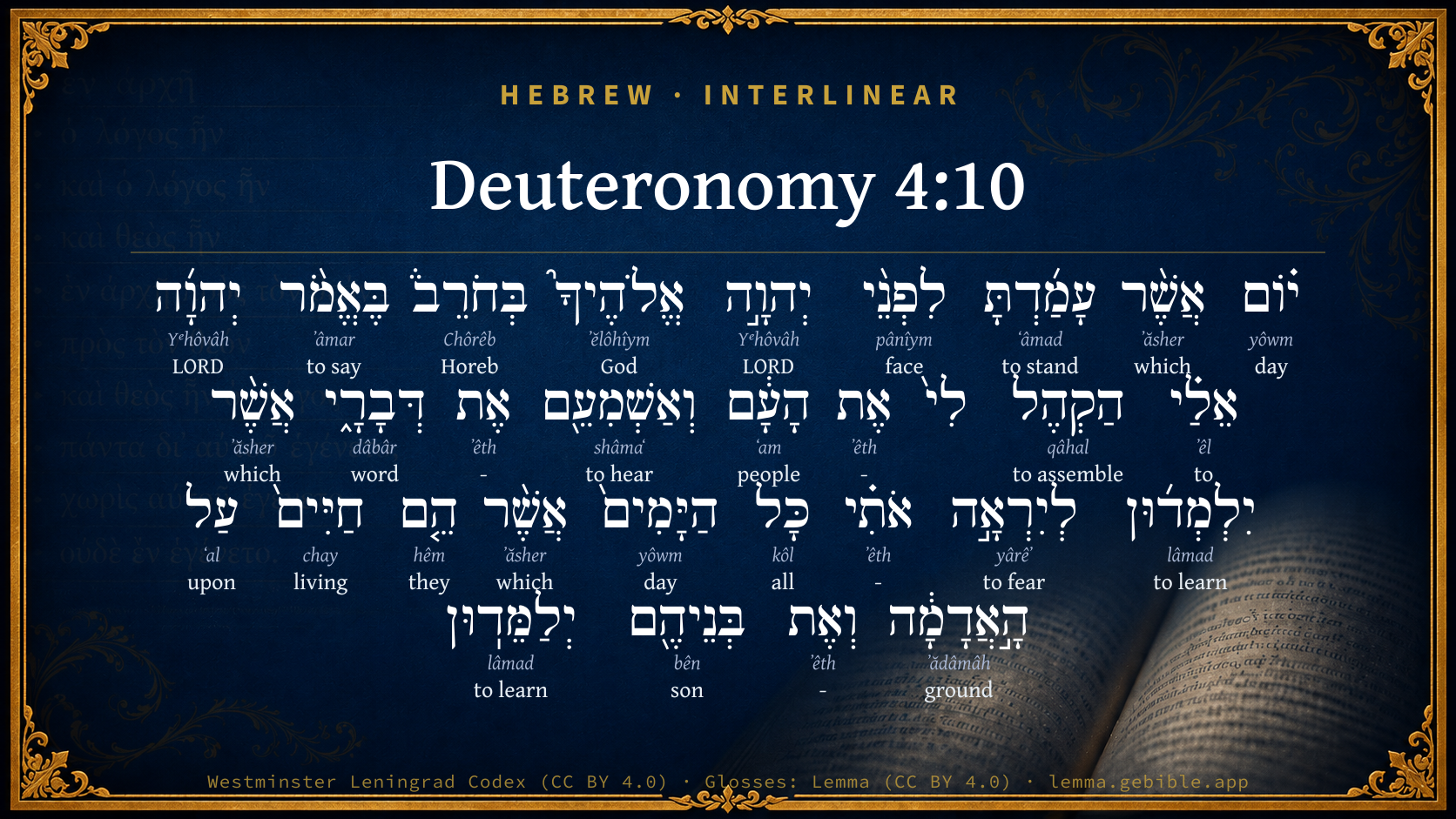
Hebrew (Westminster Leningrad Codex) Deuteronomy 4:10 appears in the Hebrew Old Testament. The text above is from the Westminster Leningrad Codex. Each word links to its Strong’s number, a concise gloss, and parsing drawn from the Open Scriptures Hebrew Bible morphology. Click any word for its full Brown-Driver-Briggs (BDB) entry.
Download image
Cite this verse

Deuteronomy 4:10 (World English Bible). Public Domain. Lemma interlinear Bible study tool, https://lemma.gebible.app/v/deuteronomy/4/10.

Show BibTeX & RIS
BibTeX
RIS
English Translation
the day that you stood before Yahweh your God in Horeb, when Yahweh said to me, Assemble me the people, and I will make them hear my words, that they may learn to fear me all the days that they live on the earth, and that they may teach their children.
World English Bible · Public Domain
Download a study sheet

One document with this verse’s original text, its word-by-word gloss line, the meaning frame, cross-references with their text, attributed commentary, and full source and license credits — printable, and it pastes into notes with its structure intact.

This verse Autodidact and up

Study sheet (.html) Plain text (.txt)

A passage Seminary Student

Up to 50 verses in one chapter. A passage sheet keeps up to 6 commentary sources and 12 cross-references per verse, in the order this page ranks them, and says so on the sheet whenever that leaves anything out. Ask for a single verse and you get the Autodidact verse sheet above.

Everything on this page stays free to read, with no account — the sheet is a download of what is already on screen, not access to it.

Want to remove ads? Support Godless Engineer
Compare translations 3

The same verse in 3 English versions, stacked beneath the original-language interlinear above. Click any original word for its lexicon entry.

Each is an independent rendering of the whole verse — the interlinear is not word-aligned to these translations.

Highlighted words mark where these versions differ — a whole-verse word diff, not a word-by-word alignment.

  • World English Bible Public Domain
    the day that you stood before Yahweh your God in Horeb, when Yahweh said to me, Assemble me the people, and I will make them hear my words, that they may learn to fear me all the days that they live on the earth, and that they may teach their children.
  • King James Version Public Domain
    Specially the day that thou stoodest before the LORD thy God in Horeb, when the LORD said unto me, Gather me the people together, and I will make them hear my words, that they may learn to fear me all the days that they shall live upon the earth, and that they may teach their children.
  • unfoldingWord Literal Text CC BY-SA 4.0
    day that you stood to the face of Yahweh your God at Horeb, when Yahweh said to me, ‘Assemble for me the people, and I will make them hear my words, that they will learn to fear me all the days that they live on the earth and may teach their sons.’

unfoldingWord Literal Text — © unfoldingWord, licensed CC BY-SA 4.0. Word-aligned USFM3 via Door43 (git.door43.org/unfoldingWord/en_ult).

Versions to compare (up to 4)

3 of 4 selected

Show all 18 translations

Every available English version of this verse, each an independent rendering of the whole verse.

  • World English Bible Public Domain
    the day that you stood before Yahweh your God in Horeb, when Yahweh said to me, Assemble me the people, and I will make them hear my words, that they may learn to fear me all the days that they live on the earth, and that they may teach their children.
  • Berean Standard Bible Public Domain
    The day you stood before the LORD your God at Horeb, the LORD said to me, “Gather the people before Me to hear My words, so that they may learn to fear Me all the days they live on the earth, and that they may teach them to their children.”
  • Majority Standard Bible Public Domain
    The day you stood before the LORD your God at Horeb, the LORD said to me, “Gather the people before Me to hear My words, so that they may learn to fear Me all the days they live on the earth, and that they may teach them to their children.”
  • King James Version Public Domain
    Specially the day that thou stoodest before the LORD thy God in Horeb, when the LORD said unto me, Gather me the people together, and I will make them hear my words, that they may learn to fear me all the days that they shall live upon the earth, and that they may teach their children.
  • American Standard Version (1901) Public Domain
    the day that thou stoodest before Jehovah thy God in Horeb, when Jehovah said unto me, Assemble me the people, and I will make them hear my words, that they may learn to fear me all the days that they live upon the earth, and that they may teach their children.
  • Revised Version (1885) Public Domain
    the day that thou stoodest before the LORD thy God in Horeb, when the LORD said unto me, Assemble me the people, and I will make them hear my words, that they may learn to fear me all the days that they live upon the earth, and that they may teach their children.
  • Geneva Bible (1599) Public Domain
    Forget not the day that thou stoodest before the Lord thy God in Horeb, when the Lord said vnto me, Gather me the people together, and I wil cause them heare my wordes, that they may learne to feare me all the dayes that they shall liue vpon the earth, and that they may teache their children:
  • Douay-Rheims (1899) Public Domain
    From the day in which thou didst stand before the Lord thy God in Horeb, when the Lord spoke to me, saying: Call together the people unto me, that they may hear my words, and may learn to fear me all the time that they live on the earth, and may teach their children.
  • Young's Literal Translation Public Domain
    `The day when thou hast stood before Jehovah thy God in Horeb -- in Jehovah's saying unto me, Assemble to Me the people, and I cause them to hear My words, so that they learn to fear Me all the days that they are alive on the ground, and their sons they teach; --
  • Literal Standard Version CC BY-SA 4.0
    [Never forget] the day when you have stood before your God YHWH in Horeb, in YHWH’s saying to me, Assemble the people to Me, and I cause them to hear My words, so that they learn to fear Me all the days that they are alive on the ground, and they teach their sons;
  • Unlocked Literal Bible CC BY-SA 4.0
    On the day that you stood before Yahweh your God at Horeb, when Yahweh said to me, 'Assemble me the people, and I will make them hear my words, that they may learn to fear me all the days that they live on the earth, and that they may teach their children.'
  • unfoldingWord Literal Text CC BY-SA 4.0
    day that you stood to the face of Yahweh your God at Horeb, when Yahweh said to me, ‘Assemble for me the people, and I will make them hear my words, that they will learn to fear me all the days that they live on the earth and may teach their sons.’
  • Darby Bible Public Domain
    the day that thou stoodest before Jehovah thy God in Horeb, when Jehovah said to me, Gather me the people together, that I may cause them to hear my words, that they may learn them, and fear me all the days that they live upon the earth, and teach them to their children.
  • World Messianic Bible Public Domain
    the day that you stood before the LORD your God in Horeb, when the LORD said to me, “Assemble the people to me, and I will make them hear my words, that they may learn to fear me all the days that they live on the earth, and that they may teach their children.”
  • Webster's Bible Public Domain
    Specially the day that thou stoodest before the LORD thy God in Horeb, when the LORD said to me, Assemble the people to me, and I will make them hear my words, that they may learn to fear me all the days that they shall live upon the earth, and that they may teach their children.
  • Free Bible Version CC BY-SA 4.0
    That day when you stood in the presence of the Lord your God at Horeb, the Lord told me, “Have the people come to me and to hear what I have to say, so they may learn to have respect for me throughout their lives here on earth, and so they may teach this to their children.”
  • Bible in Basic English Public Domain
    That day when you were waiting before the Lord your God in Horeb, and the Lord said to me, Make all the people come together, so that hearing my words they may go in fear of me all the days of their life on earth and give this teaching to their children.
  • JPS Tanakh (1917) Public Domain
    the day that thou stoodest before the LORD thy God in Horeb, when the LORD said unto me: 'Assemble Me the people, and I will make them hear My words that they may learn to fear Me all the days that they live upon the earth, and that they may teach their children.'

Literal Standard Version (2020), Covenant Press — licensed CC BY-SA 4.0. Text via the HelloAO Bible API (eBible.org). Unlocked Literal Bible (unfoldingWord) — licensed CC BY-SA 4.0. Text via the HelloAO Bible API (eBible.org). unfoldingWord Literal Text — © unfoldingWord, licensed CC BY-SA 4.0. Word-aligned USFM3 via Door43 (git.door43.org/unfoldingWord/en_ult). Free Bible Version, Dr. Jonathan Gallagher — licensed CC BY-SA 4.0. Text via the HelloAO Bible API (eBible.org).

Word by word

More ways to search: Search by grammar → Find every occurrence → Compare this word →

Practice this passage: Drill this verse → Learn its vocabulary →

בְּחֹרֵב֒
Chôrêb
H2722
“in/at · Horeb”
Preposition + Noun, Proper
Part of Speech
Preposition + Noun
Type
Proper
Full BDB Definition

Origin: from H2717

TWOT: 731c

Horeb = "desert" - another name for Mount Sinai from which God gave the law to Moses and the Israelites
  1. י֗וֹם yôwm H3117 “day” Noun, Common, Masculine, Singular, Absolute
  2. אֲשֶׁ֨ר ʼăsher H834 “which” Particle, Relative
  3. עָמַ֜דְתָּ ʻâmad H5975 “to stand” Verb, Qal, Perfect, 2nd Person, Masculine, Singular
  4. לִפְנֵ֨י pânîym H6440 “to/for · face(s) of” Preposition + Noun, Common, Both, Plural, Construct
  5. יְהוָ֣ה Yᵉhôvâh H3068 “LORD” Noun, Proper
  6. אֱלֹהֶיךָ֮ ʼĕlôhîym H430 “God(s) · your” Noun, Common, Masculine, Plural, Construct + Suffix, Personal, 2nd Person, Masculine, Singular
  7. בֶּאֱמֹ֨ר ʼâmar H559 “in/at · to say” Preposition + Verb, Qal, Infinitive Construct
  8. יְהוָ֜ה Yᵉhôvâh H3068 “LORD” Noun, Proper
  9. אֵלַ֗י ʼêl H413 “to · me” Preposition + Suffix, Personal, 1st Person, Common, Singular
  10. הַקְהֶל qâhal H6950 “assemble” Verb, Hiphil, Imperative, 2nd Person, Masculine, Singular
  11. אֶת ʼêth H853 “-” Particle, Direct Object
  12. הָעָ֔ם ʻam H5971 “the · people” Particle, Definite Article + Noun, Common, Masculine, Singular, Absolute
  13. וְאַשְׁמִעֵ֖ם shâmaʻ H8085 “and · to hear · them” Conjunction + Verb, Hiphil, Imperfect, 1st Person, Common, Singular + Suffix, Personal, 3rd Person, Masculine, Plural
  14. אֶת ʼêth H853 “-” Particle, Direct Object
  15. דְּבָרָ֑י dâbâr H1697 “words · my” Noun, Common, Masculine, Plural, Construct + Suffix, Personal, 1st Person, Common, Singular
  16. אֲשֶׁ֨ר ʼăsher H834 “which” Particle, Relative
  17. יִלְמְד֜וּן lâmad H3925 “to learn” Verb, Qal, Imperfect, 3rd Person, Masculine, Plural + Suffix, n
  18. לְיִרְאָ֣ה yârêʼ H3372 “to fear” Preposition + Verb, Qal, Infinitive Construct
  19. אֹתִ֗י ʼêth H853 “- · me” Particle, Direct Object + Suffix, Personal, 1st Person, Common, Singular
  20. כָּל kôl H3605 “all of” Noun, Common, Masculine, Singular, Construct
  21. הַיָּמִים֙ yôwm H3117 “the · days” Particle, Definite Article + Noun, Common, Masculine, Plural, Absolute
  22. אֲשֶׁ֨ר ʼăsher H834 “which” Particle, Relative
  23. הֵ֤ם hêm H1992 “they” Pronoun, Personal, 3rd Person, Masculine, Plural
  24. חַיִּים֙ chay H2416 “living” Adjective, Adjective, Masculine, Plural, Absolute
  25. עַל ʻal H5921 “upon” Preposition
  26. הָ֣אֲדָמָ֔ה ʼădâmâh H127 “the · ground” Particle, Definite Article + Noun, Common, Feminine, Singular, Absolute
  27. וְאֶת ʼêth H853 “and · -” Conjunction + Particle, Direct Object
  28. בְּנֵיהֶ֖ם bên H1121 “sons · their” Noun, Common, Masculine, Plural, Construct + Suffix, Personal, 3rd Person, Masculine, Plural
  29. יְלַמֵּדֽוּן lâmad H3925 “to learn” Verb, Piel, Imperfect, 3rd Person, Masculine, Plural + Suffix, n

About this verse

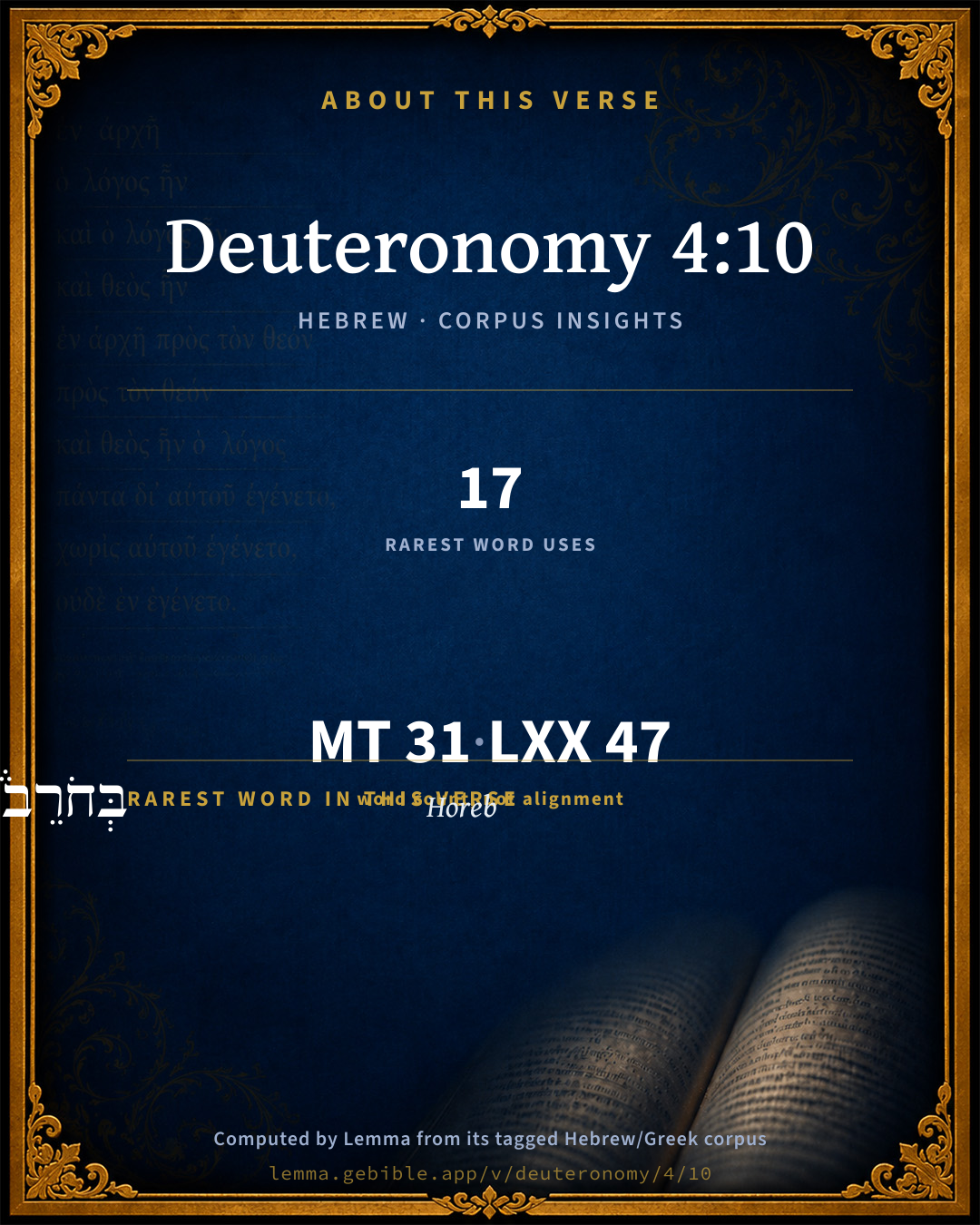
These counts appear in no published source. They are computed here, from the morphology-tagged text and Lemma’s own curated glosses. What Lemma adds →

31
words
22
distinct lemmas
Pentateuch
section

Notable vocabulary

The rarest word here is בְּחֹרֵב֒ Horeb H2722 — appearing just 17 times in the whole Hebrew Bible.

Shared distinctive vocabulary

בְּחֹרֵב֒ Horeb H2722 occurs in 17 verses of the Hebrew Bible. Also found in:

Grammatical profile

  • 7 verbs
  • 12 nouns
  • 1 adjective
  • 1 pronoun
  • 3 prepositions
  • 7 particles

Verb forms

  • עָמַ֜דְתָּ Qal · Perfect
  • בֶּאֱמֹ֨ר Qal · Infinitive Construct
  • הַקְהֶל Hiphil · Imperative
  • וְאַשְׁמִעֵ֖ם Hiphil · Imperfect
  • יִלְמְד֜וּן Qal · Imperfect
  • לְיִרְאָ֣ה Qal · Infinitive Construct
  • יְלַמֵּדֽוּן Piel · Imperfect

Repetition

Words recur within this verse — often emphatic in Hebrew:

  • י֗וֹם day H3117 ×2
  • יְהוָ֣ה LORD H3068 ×2
  • יִלְמְד֜וּן to learn H3925 ×2
  • אֲשֶׁ֨ר which H834 ×3

Hebrew & Septuagint length

In English translation the verse runs 51 words from the Hebrew and 64 from the Septuagint (LXX English) — closely comparable.

A rough comparison of the two English renderings, which tokenize alike — not a word-level alignment.

Word counts can differ between the Hebrew and the Greek without any difference in meaning — e.g. the Hebrew direct-object marker אֵת has no separate Greek word, and Greek often adds the article ὁ.

In the original languages it is 31 Hebrew tokens and 47 Greek tokens — but the two are counted differently (Hebrew bundles its prefixes and suffixes into one token; the Greek is in lemma form), so that isn’t a like-for-like length.

Cross-references

15

Topical passages linked to Deuteronomy 4:10 in the Treasury of Scripture Knowledge — connected by theme and wording, ordered by reader-vote popularity; previews shown in the World English Bible.

  • Exodus 19:9 Yahweh said to Moses, "Behold, I come to you in a thick cloud, that the people may hear when I speak with you, and may also believe you forever." Moses told the words of the people to Yahweh.
  • Hebrews 12:18–19 For you have not come to a mountain that might be touched, and that burned with fire, and to blackness, darkness, tempest,
  • Exodus 19:16 It happened on the third day, when it was morning, that there were thunders and lightnings, and a thick cloud on the mountain, and the sound of an exceedingly loud trumpet; and all the people who were in the camp trembled.
  • Deuteronomy 17:19 and it shall be with him, and he shall read therein all the days of his life; that he may learn to fear Yahweh his God, to keep all the words of this law and these statutes, to do them;
  • Exodus 20:18 All the people perceived the thunderings, the lightnings, the sound of the trumpet, and the mountain smoking. When the people saw it, they trembled, and stayed at a distance.
  • Exodus 20:20 Moses said to the people, "Don't be afraid, for God has come to test you, and that his fear may be before you, that you won't sin."
  • Deuteronomy 5:2 Yahweh our God made a covenant with us in Horeb.
  • Ecclesiastes 12:13 This is the end of the matter. All has been heard. Fear God, and keep his commandments; for this is the whole duty of man.
  • Deuteronomy 5:29 Oh that there were such a heart in them, that they would fear me, and keep all my commandments always, that it might be well with them, and with their children forever!
  • Deuteronomy 14:23 You shall eat before Yahweh your God, in the place which he shall choose, to cause his name to dwell there, the tithe of your grain, of your new wine, and of your oil, and the firstborn of your herd and of your flock; that you may learn to fear Yahweh your God always.
  • Deuteronomy 31:12–13 Assemble the people, the men and the women and the little ones, and your foreigner who is within your gates, that they may hear, and that they may learn, and fear Yahweh your God, and observe to do all the words of this law;
  • 1 Samuel 12:24 Only fear Yahweh, and serve him in truth with all your heart; for consider how great things he has done for you.
  • Luke 1:50 His mercy is for generations of generations on those who fear him.
  • Hebrews 12:25 See that you don't refuse him who speaks. For if they didn't escape when they refused him who warned on the Earth, how much more will we not escape who turn away from him who warns from heaven,
  • Revelation 19:5 A voice came forth from the throne, saying, "Give praise to our God, all you his servants, you who fear him, the small and the great!"

Cross-references courtesy of OpenBible.info (CC BY 4.0).

Hebrew and Greek witnesses Masoretic Hebrew ↔ Greek Septuagint

The same verse in the two great witnesses to the Old Testament, shown verse-for-verse.

These are two independent witnesses, not word-aligned to each other, and the Septuagint is shown in lemma (dictionary) form.

Hebrew Deuteronomy 4:10 Masoretic · Westminster Leningrad Codex

י֗וֹם אֲשֶׁ֨ר עָמַ֜דְתָּ לִפְנֵ֨י יְהוָ֣ה אֱלֹהֶיךָ֮ בְּחֹרֵב֒ בֶּאֱמֹ֨ר יְהוָ֜ה אֵלַ֗י הַקְהֶל לִי֙ אֶת הָעָ֔ם וְאַשְׁמִעֵ֖ם אֶת דְּבָרָ֑י אֲשֶׁ֨ר יִלְמְד֜וּן לְיִרְאָ֣ה אֹתִ֗י כָּל הַיָּמִים֙ אֲשֶׁ֨ר הֵ֤ם חַיִּים֙ עַל הָ֣אֲדָמָ֔ה וְאֶת בְּנֵיהֶ֖ם יְלַמֵּדֽוּן

the day that you stood before Yahweh your God in Horeb, when Yahweh said to me, Assemble me the people, and I will make them hear my words, that they may learn to fear me all the days that they live on the earth, and that they may teach their children.

World English Bible · Public Domain

Greek LXX Deuteronomy 4:10 Septuagint · lemma form

ἡμέρα ὅς ἵστημι ἐναντίον κύριος ὁ θεός σύ ἐν χωρηβ ὁ ἡμέρα ὁ ἐκκλησία ὅτε εἶπον κύριος πρός ἐγώ ἐκκλησιάζω πρός ἐγώ ὁ λαός καί ἀκούω ὁ ῥῆμα ἐγώ ὅπως μανθάνω φοβέω ἐγώ πᾶς ὁ ἡμέρα ὅς αὐτός ζάω ἐπί ὁ γῆ καί ὁ υἱός αὐτός διδάσκω

even the things that happened in the day in which you⌃ stood before the Lord our God in Choreb in the day of the assembly; for the Lord said to me, Gather the people to me, and let them hear my words, that they may learn to fear me all the days which they live upon the earth, and they shall teach their sons.

LXX2012 (modern English Septuagint) · Public Domain

On this verse, The Cambridge Bible for Schools and Colleges discusses the Septuagint’s reading. Read the note in Commentary ↓

Hebrew: Westminster Leningrad Codex (CC BY 4.0). Greek: Septuagint (public domain); English from LXX2012 (modern English Septuagint) (Public Domain). How the Septuagint differs from the Hebrew →

Targum (Aramaic paraphrase)

2

The Targum is the ancient Jewish Aramaic paraphrase of the Hebrew Scriptures — an interpretive translation, not the Hebrew text itself. Onkelos (literal) and Pseudo-Jonathan (expansive) render the Torah, and Jonathan the Prophets. Coverage is partial: where no permissively-licensed English translation exists for a verse, only the Aramaic is shown. This is verse-level text, not a word-by-word alignment to the Hebrew.

  1. Targum Onkelos Torah (Genesis–Deuteronomy)
    יוֹמָא דִי קַמְתָּא קֳדָם יְיָ אֱלָהָךְ בְּחֹרֵב כַּד אֲמַר יְיָ לִי כְּנוֹשׁ קֳדָמַי יָת עַמָא וְאַשְׁמְעִנוּן יָת פִּתְגָמָי דִי יֵלְפוּן לְמִדְחַל קֳדָמַי כָּל יוֹמַיָא דִי אִנוּן קַיָמִין עַל אַרְעָא וְיָת בְּנֵיהוֹן יְאַלְפוּן

    (no public-domain English translation for this verse)

    Targum Onkelos — Aramaic: “Onkelos Genesis” (public domain); “Onkelos Exodus” (public domain); “Onkelos Leviticus” (public domain); “Onkelos Numbers” (public domain); “Onkelos Deuteronomy” (public domain). English: “Sefaria Community Translation” (CC0 1.0 (public-domain dedication)); “J.W. Etheridge. The Targums of Onkelos and Jonathan Ben Uzziel on the Pentateuch. London: Longmans, Green, 1862” (public domain). Text via Sefaria.

  2. Targum Pseudo-Jonathan Torah (Genesis–Deuteronomy)
    וְתִדְכּוּן גַּרְמֵיכוֹן בְּמַעַסְקְכוֹן בָּהּ הֵי כְּיוֹמָא דְקַמְתּוּן קֳדָם יְיָ אֱלָהָכוֹן בְּחוֹרֵב בִּזְמַן דַּאֲמַר יְיָ לִי כְּנוֹשׁ קֳדָמַי יַת עַמָא וְאַשְׁמִיעִינוּן יַת פִּתְגָמַי דְּיֵלְפוּן לְמִדְחַל מִן קֳדָמַי כָּל יוֹמַיָא דְהִינוּן קַיְימִין עַל אַרְעָא וְיַת בְּנֵיהוֹן יְאַלִיפוּן

    and that you may make yourselves pure in your transactions thereby, as in the day when you stood before the Lord your God at Horeb, at the time when the Lord said to me: Gather the people before Me, that they may hear My words, by which they shall learn to fear before Me all the days that they remain upon the earth, and may teach their children.

    Targum Pseudo-Jonathan — Aramaic: “Targum Jonathan on Genesis” (public domain); “Targum Jonathan on Exodus” (public domain); “Targum Jonathan on Leviticus” (public domain); “Targum Jonathan on Numbers” (public domain); “Targum Jonathan on Deuteronomy” (public domain). English: “The Targum of Jonathan ben Uzziel, trans. J. W. Etheridge, London, 1862” (public domain). Text via Sefaria.

Commentary

Notes on Deuteronomy 4:10 from classic Christian and Jewish commentators (each source and its license shown beneath its notes). The classic Christian expositions comment on the surrounding passage and are grouped to its opening verse, so a note may address several verses; the Jewish commentaries on the Tanakh (Rashi and others) are per-verse, so they appear only where the commentator wrote on this verse.

Lemma curates 59 commentaries, every one of them public domain or Creative Commons licensed, each selected and text-cleaned for this edition rather than reprinted as found. About our sources →

Trapp's Complete Commentary

John Trapp

Deu 4:10 [Specially] the day that thou stoodest before the LORD thy God in Horeb, when the LORD said unto me, Gather me the people together, and I will make them hear my words, that they may learn to fear me all the days that they shall live upon the earth, and [that] they may teach their children.

Ver. 10. Specially the day.] A high favour, and most honourably mentioned. {Neh 9:13}

John Trapp, A Commentary or Exposition upon All the Books of the Old and New Testament (1647–1656) — public domain. Text from a community e-Sword module.

Jamieson, Fausset & Brown

Robert Jamieson, A. R. Fausset & David Brown

the day that thou stoodest before the Lord . . . in Horeb--The delivery of the law from Sinai was an era never to be forgotten in the history of Israel. Some of those whom Moses was addressing had been present, though very young; while the rest were federally represented by their parents, who in their name and for their interest entered into the national covenant.

Jamieson, Fausset & Brown — Commentary Critical and Explanatory on the Whole Bible (1871) — public domain (CC PDM 1.0). Text via the HelloAO Bible API.

Ellicott's Commentary for English Readers

(10) The day that thou stoodest before the Lord thy God in Horeb.—The Church of Israel dated from Sinai, as the Church of Christ does from Pentecost. It is noticeable that the giving of the Law appears to have taken place about fifty days after the Passover in Egypt. Jewish writers associate the Feast of Pentecost with the memory of the event. A similar association, and a contrast between the first and last Pentecost, appears to have been present to St. Paul’s mind in 2 Corinthians 3. The law given at Sinai is the “ministration of death,” and is contrasted with the “ministration of the Spirit”—the letter that killeth with the Spirit that giveth life. (Comp. also Gal_4:24-26, and Heb_12:18-24.) The word “specially” is not in the Hebrew of this verse.

The day . . . in Horeb is not only to be regarded as a special subject of instruction; it is the root of the whole matter.

Gather me the people together.—The Greek here is εκκλησίασον, which might be paraphrased according to New Testament language, “Form a Church of this people,” The “day of the assembly” alluded to in this and other passages (as Deu_10:4) may be similarly paraphrased as “the day of the Church.” It seems to be the source of the expression used by St. Stephen, “the Church in the wilderness” (Act_7:38). Thus the analogy between Israel’s receiving the letter of the law at Sinai, and the gift of the Holy Spirit in Jerusalem is still further brought out.

A Bible Commentary for English Readers, edited by Charles John Ellicott (1878–1897) — public domain. Text from a community e-Sword module.

The Cambridge Bible for Schools and Colleges

gen. ed. J. J. S. Perowne

10. the day] Governed by lest thou forget in Deu_4:9; or an acc. of time.

thou stoodest before … thy God] So Sam., the nation being still regarded as an individual; LXX ye stood.

Assemble me the people] See below on Deu_4:22.

may learn to fear] The frequent commands to fear, or learn to fear, God, Deu_5:29, Deu_6:24, Deu_8:6, Deu_10:12, Deu_14:23, Deu_17:19, Deu_28:58, Deu_31:13, associate that temper with hearing, reading, or doing God’s law, or walking in His ways. It is thus no inarticulate, brutish awe before the unknown, which we call superstition, but the vigilant, scrupulous temper of a servant to whom his lord’s will has been fully declared—cp. Lat. ‘religio’ and our general use of ‘religious’ and ‘religiously’—an earnest, anxious obedience; never a mere feeling, but the intelligent and loyal practice of a trust. See also on Deu_14:23.

The Cambridge Bible for Schools and Colleges (gen. ed. J. J. S. Perowne; Cambridge University Press, 1878–1918) — public domain. Text from a community e-Sword module.

John Gill's Exposition

Specially the day that thou stoodest before the Lord in Horeb,.... Above all things Moses would have them take care not to forget the day the law was given from Mount Sinai, which was so awful and solemn, when they saw the fire, the smoke, the lightning, and heard the thunder and the sound of the trumpet; all which were very shocking and terrifying: and though the men of this generation were but young then, being under twenty years of age, yet many of them were old enough to observe these things, and which one would think should never wear out of their minds:

when the Lord said unto me, gather me the people together; not the elders of the people only, but the whole body of the people, as he did, and brought them to the foot of Mount Sinai, Exo 19:17,

and I will make them hear my words; the ten commands which were spoken by the Lord himself aloud, with an articulate voice, in the hearing of all the people; and was such a terrible voice of words, that they that heard it entreated it might be spoken to them no more, Heb 12:19.

that they may learn to fear me all the days that they shall live upon the earth; to reverence him the lawgiver, who is able to save and to destroy; to fear to offend him by breaking his laws, so holy, just, and good, and delivered in such an awful and solemn manner:

and that they may teach their children; the words they had heard, teach them obedience to them, and to be careful not to act contrary to them; since that would bring down judgments upon them, and deprive them of the favour they enjoyed, of which they had seen instances.

John Gill's Exposition of the Whole Bible (1746–1763) — public domain (CC PDM 1.0). Text via the HelloAO Bible API.

Matthew Poole's English Annotations

Some of them stood in Horeb in their own persons, though then they were but young; the rest stood then in the loins of their parents, in whom they may well be said to stand there, because they are said to have entered into covenant with God, because their parents did so in their name and for their use.

Matthew Poole's English Annotations on the Holy Bible (1683–1685) — public domain. Text from a community e-Sword/MySword module.

Whedon's Commentary on the Bible

Daniel D. Whedon

10-12. The day that thou stoodest before the Lord — Here should commence a new sentence. Our translators have incorrectly brought into the text the word specially. In the day when you stood in the presence of Jehovah your God in Horeb, etc., then you drew near. Moses in these verses reminds the people of the chief events connected with the giving of the law.

The mountain burned… unto the midst of heaven — To the heart of heaven. “A rhetorical description of the awful majesty of the pillar of fire in which the glory of Jehovah appeared upon Sinai, intended to impress deeply upon the minds of the people the remembrance of this manifestation of God.” — Keil.

Daniel D. Whedon (gen. ed.), Commentary on the Old and New Testaments (1874–1909) — public domain. Text from a community e-Sword module.

The Pulpit Commentary

Specially the day. The word "specially," introduced by the translators into the Authorized Version, is a needless interpolation. With this verse begins a new sentence, which is continued in ver. 11 on to the end of ver. 13. Render, On the day i.e. at the time, the is an adverbial accusative when ye stood before Jehovah your God in Horeb... when ye came near and stood, then Jehovah spake to you, etc.

Vers. 10-14. The revelation at Horeb.

A revelation

I OF THE SPIRITUALITY OF GOD"S NATURE. "Ye saw no similitude" (ver. 12). A wonderful truth to be impressed on the minds of a people fresh from contact with the debasing idolatries of Egypt. A truth:

1. Difficult to grasp.

2. Elevating in its influence.

3. The apprehension of which is necessary for spiritual worship. (Joh_4:24)

II OF THE HOLINESS OF GOD"S CHARACTER. The lightnings that played about the mountain, the fire burning in the midst of it (ver. 11), the fiery law that was given, all bespoke the awful and terrible holiness of him whose voice was uttering words of dreadful import to transgressors.

III OF THE VERITIES OF GOD"S LAW. Then were spoken the ten commandments (vers. 10, 12) the sum and substance of moral duty the rule of life to believers the Law which condemns and slays transgressors. Christ is "the end of the Law of righteousness to every one that believeth," and only in him can we escape from its condemning power. (Rom_8:1 Rom_10:4)

IV OF THE TERRORS OF GOD"S MAJESTY, God surrounded himself with these signs of his greatness, power, wrath, and holiness:

1. That we may reverence and fear him.

2. That we may be kept from presumption in our approaches to him.

3. That we may feel the awfulness of his Word. Recalling this scene, the Israelites should have been preserved from ever trifling with it. God"s Word should be handled and read with a deep feeling of reverence.

4. These terrors suggested that the Law, in itself considered, is not a saving, but a destroying power. The whole manifestation was overcast with threatening. J.O.

The Pulpit Commentary (1880–1919), ed. H.D.M. Spence-Jones & Joseph S. Exell — public domain. Text from a community e-Sword module.

John Wesley's Explanatory Notes

Thou stoodest - Some of them stood there in their own persons, though then they were but young, the rest in the loins of their parents.

John Wesley, Explanatory Notes Upon the Whole Bible (1754–1765) — public domain. Text via the GEBible commentary corpus.

Scofield Reference Notes

C. I. Scofield

fear

(See Scofield "Psa 19:9").

The Scofield Reference Bible (1917 edition), notes by C. I. Scofield — public domain. Text from a community e-Sword module.

Rashi

Rabbi Shlomo Yitzchaki (Rashi)

יום אשר עמדת THE DAY THAT THOU STOODEST — This is to be connected with the preceding verse thus: [The things] which thine eyes saw … on the day that thou stoodest … at Horeb, — where thou didst perceive the thunder and lightning.

יִלְמְדוּן — The Targum is יֵלְפוּן, “They shall learn" (more lit., the action reverts to themselves), while —

יְלַמֵּדוּן the Targum is יְאַלְפוּן, “They shall teach" (more lit., the action reverts to others).

Rashi on the Tanakh — English translations: “The Judaica Press complete Tanach with Rashi, translated by A. J. Rosenberg” (CC BY 4.0); “Pentateuch with Rashi's commentary by M. Rosenbaum and A.M. Silbermann, 1929-1934” (public domain); “The Metsudah Tanach series, Lakewood, N.J” (CC BY 4.0); and “The Book of Joshua, Metsudah Publications, 1997” (CC BY 4.0). Text via Sefaria.

Lesson kit

Teaching starters — assembled from the data on this page, not authored interpretation. Every prompt links to the verse data it draws on. Edit before teaching.

Deuteronomy, in the Pentateuch, opens this verse with 31 words (22 distinct Hebrew lemmas). Its most distinctive word is Chôrêb (“Horeb”). A historical commentator’s framing appears above. Read the whole chapter for the surrounding context.

Discussion questions

  1. What does “Horeb” (Chôrêb) contribute to the verse as a whole?
  2. Exodus 3:1 shares the word «Horeb» with this verse. How do the two illuminate each other?
  3. “day” occurs 2× in this one verse. What is the effect of the repetition?
  4. These translations render this verse differently. What is at stake in choosing one wording over another?
  5. The verb «עָמַ֜דְתָּ» is Qal Perfect. How does its form color the action?
  6. Reading how Trapp's Complete Commentary and Jamieson, Fausset & Brown read this verse, where do the two commentators agree and where do they part?

Things to notice

Reading settings

Reading text

Shown beneath each verse's original-language words.

Old Testament
Old Testament edition

Read the OT as the Masoretic Hebrew (MT) or the Greek Septuagint (LXX).

English shown for the Greek Septuagint (in the Hebrew ↔ Greek comparison).

Comparing translations? Open the Compare panel on any verse page to stack up to four side by side.