Numbers 7:2

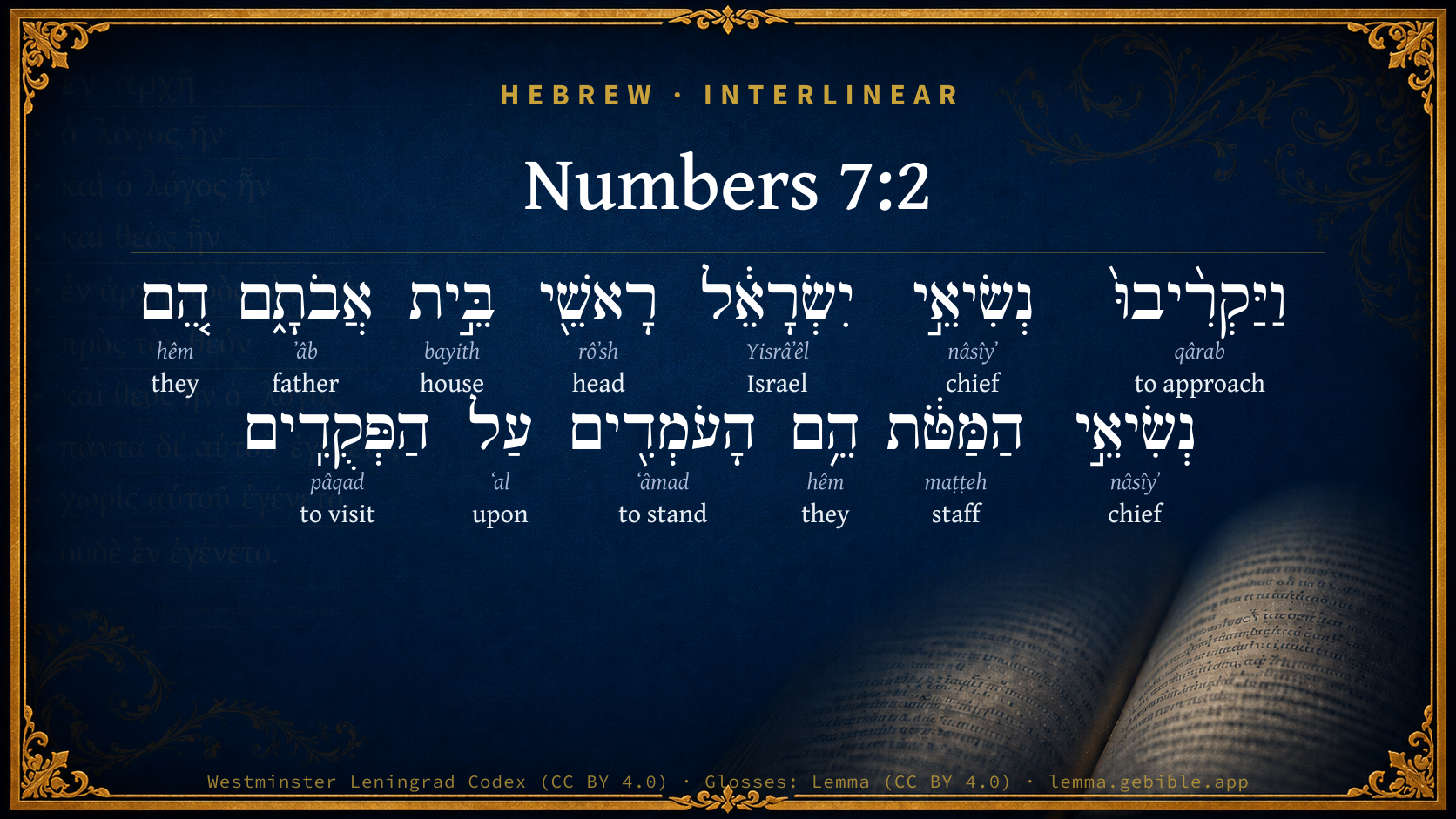
Hebrew (Westminster Leningrad Codex) Numbers 7:2 appears in the Hebrew Old Testament. The text above is from the Westminster Leningrad Codex. Each word links to its Strong’s number, a concise gloss, and parsing drawn from the Open Scriptures Hebrew Bible morphology. Click any word for its full Brown-Driver-Briggs (BDB) entry.
Download image
Cite this verse

Numbers 7:2 (World English Bible). Public Domain. Lemma interlinear Bible study tool, https://lemma.gebible.app/v/numbers/7/2.

Show BibTeX & RIS
BibTeX
RIS
English Translation
that the princes of Israel, the heads of their fathers' houses, offered. These were the princes of the tribes. These are they who were over those who were numbered:
World English Bible · Public Domain
Download a study sheet

One document with this verse’s original text, its word-by-word gloss line, the meaning frame, cross-references with their text, attributed commentary, and full source and license credits — printable, and it pastes into notes with its structure intact.

This verse Autodidact and up

Study sheet (.html) Plain text (.txt)

A passage Seminary Student

Up to 50 verses in one chapter. A passage sheet keeps up to 6 commentary sources and 12 cross-references per verse, in the order this page ranks them, and says so on the sheet whenever that leaves anything out. Ask for a single verse and you get the Autodidact verse sheet above.

Everything on this page stays free to read, with no account — the sheet is a download of what is already on screen, not access to it.

Want to remove ads? Support Godless Engineer
Compare translations 3

The same verse in 3 English versions, stacked beneath the original-language interlinear above. Click any original word for its lexicon entry.

Each is an independent rendering of the whole verse — the interlinear is not word-aligned to these translations.

Highlighted words mark where these versions differ — a whole-verse word diff, not a word-by-word alignment.

  • World English Bible Public Domain
    that the princes of Israel, the heads of their fathers' houses, offered. These were the princes of the tribes. These are they who were over those who were numbered:
  • King James Version Public Domain
    That the princes of Israel, heads of the house of their fathers, who were the princes of the tribes, and were over them that were numbered, offered:
  • unfoldingWord Literal Text CC BY-SA 4.0
    And the leaders of Israel, the heads of the houses of their fathers, presented. They the leaders of the tribes. They the ones standing over the counted ones.

unfoldingWord Literal Text — © unfoldingWord, licensed CC BY-SA 4.0. Word-aligned USFM3 via Door43 (git.door43.org/unfoldingWord/en_ult).

Versions to compare (up to 4)

3 of 4 selected

Show all 18 translations

Every available English version of this verse, each an independent rendering of the whole verse.

  • World English Bible Public Domain
    that the princes of Israel, the heads of their fathers' houses, offered. These were the princes of the tribes. These are they who were over those who were numbered:
  • Berean Standard Bible Public Domain
    And the leaders of Israel, the heads of their families, presented an offering. These men were the tribal leaders who had supervised the registration.
  • Majority Standard Bible Public Domain
    And the leaders of Israel, the heads of their families, presented an offering. These men were the tribal leaders who had supervised the registration.
  • King James Version Public Domain
    That the princes of Israel, heads of the house of their fathers, who were the princes of the tribes, and were over them that were numbered, offered:
  • American Standard Version (1901) Public Domain
    that the princes of Israel, the heads of their fathers' houses, offered. These were the princes of the tribes, these are they that were over them that were numbered:
  • Revised Version (1885) Public Domain
    that the princes of Israel, the heads of their fathers’ houses, offered; these were the princes of the tribes, these are they that were over them that were numbered:
  • Geneva Bible (1599) Public Domain
    Then the princes of Israel, heads ouer the houses of their fathers (they were the princes of the tribes, who were ouer them that were nombred) offred,
  • Douay-Rheims (1899) Public Domain
    The princes of Israel and the heads of the families, in every tribe, who were the rulers of them who had been numbered, offered
  • Young's Literal Translation Public Domain
    and the princes of Israel (heads of the house of their fathers, they `are' princes of the tribes, they who are standing over those numbered) bring near,
  • Literal Standard Version CC BY-SA 4.0
    and the princes of Israel (heads of the house of their fathers, they [are] princes of the tribes, they who are standing over those numbered) bring near,
  • Unlocked Literal Bible CC BY-SA 4.0
    On that day, the leaders of Israel, the heads of their ancestor's families, offered sacrifices. These men were leading the tribes. They had overseen the counting of the men in the census.
  • unfoldingWord Literal Text CC BY-SA 4.0
    And the leaders of Israel, the heads of the houses of their fathers, presented. They the leaders of the tribes. They the ones standing over the counted ones.
  • Darby Bible Public Domain
    that the princes of Israel, the heads of their fathers' houses, the princes of the tribes, they that were over them that had been numbered, offered;
  • World Messianic Bible Public Domain
    the princes of Israel, the heads of their fathers’ houses, gave offerings. These were the princes of the tribes. These are they who were over those who were counted;
  • Webster's Bible Public Domain
    That the princes of Israel, heads of the house of their fathers, who were the princes of the tribes, and were over them that were numbered, offered:
  • Free Bible Version CC BY-SA 4.0
    The Israelite leaders who were the heads of their families came and gave an offering. They were the same leaders of the tribes who had worked on the registration of the Israelites.
  • Bible in Basic English Public Domain
    Then the chiefs of Israel, the heads of their fathers' houses, made offerings; these were the chiefs of the tribes, who were over those who were numbered.
  • JPS Tanakh (1917) Public Domain
    that the princes of Israel, the heads of their fathers' houses, offered — these were the princes of the tribes, these are they that were over them that were numbered.

Literal Standard Version (2020), Covenant Press — licensed CC BY-SA 4.0. Text via the HelloAO Bible API (eBible.org). Unlocked Literal Bible (unfoldingWord) — licensed CC BY-SA 4.0. Text via the HelloAO Bible API (eBible.org). unfoldingWord Literal Text — © unfoldingWord, licensed CC BY-SA 4.0. Word-aligned USFM3 via Door43 (git.door43.org/unfoldingWord/en_ult). Free Bible Version, Dr. Jonathan Gallagher — licensed CC BY-SA 4.0. Text via the HelloAO Bible API (eBible.org).

Word by word

More ways to search: Search by grammar → Find every occurrence → Compare this word →

Practice this passage: Drill this verse → Learn its vocabulary →

נְשִׂיאֵ֣י
nâsîyʼ
H5387
“chiefs of”
Noun, Common, Masculine, Plural, Construct
Part of Speech
Noun
Type
Common
Gender
Masculine
Number
Plural
State
Construct
Full BDB Definition

Origin: from H5375

TWOT: 1421b , 1421c

one lifted up, chief, prince, captain, leader - rising mist, vapour
  1. וַיַּקְרִ֨יבוּ֙ qârab H7126 “and · to approach” Conjunction + Verb, Hiphil, Sequential Imperfect, 3rd Person, Masculine, Plural
  2. יִשְׂרָאֵ֔ל Yisrâʼêl H3478 “Israel” Noun, Proper
  3. רָאשֵׁ֖י rôʼsh H7218 “heads of” Noun, Common, Masculine, Plural, Construct
  4. בֵּ֣ית bayith H1004 “house of” Noun, Common, Masculine, Singular, Construct
  5. אֲבֹתָ֑ם ʼâb H1 “fathers · their” Noun, Common, Masculine, Plural, Construct + Suffix, Personal, 3rd Person, Masculine, Plural
  6. הֵ֚ם hêm H1992 “they” Pronoun, Personal, 3rd Person, Masculine, Plural
  7. נְשִׂיאֵ֣י nâsîyʼ H5387 “chiefs of” Noun, Common, Masculine, Plural, Construct
  8. הַמַּטֹּ֔ת maṭṭeh H4294 “the · staffs” Particle, Definite Article + Noun, Common, Masculine, Plural, Absolute
  9. הֵ֥ם hêm H1992 “they” Pronoun, Personal, 3rd Person, Masculine, Plural
  10. הָעֹמְדִ֖ים ʻâmad H5975 “the · standing” Particle, Definite Article + Verb, Qal, Participle Active, Masculine, Plural, Absolute
  11. עַל ʻal H5921 “upon” Preposition
  12. הַפְּקֻדִֽים pâqad H6485 “the · visited” Particle, Definite Article + Verb, Qal, Participle Passive, Masculine, Plural, Absolute

About this verse

These counts appear in no published source. They are computed here, from the morphology-tagged text and Lemma’s own curated glosses. What Lemma adds →

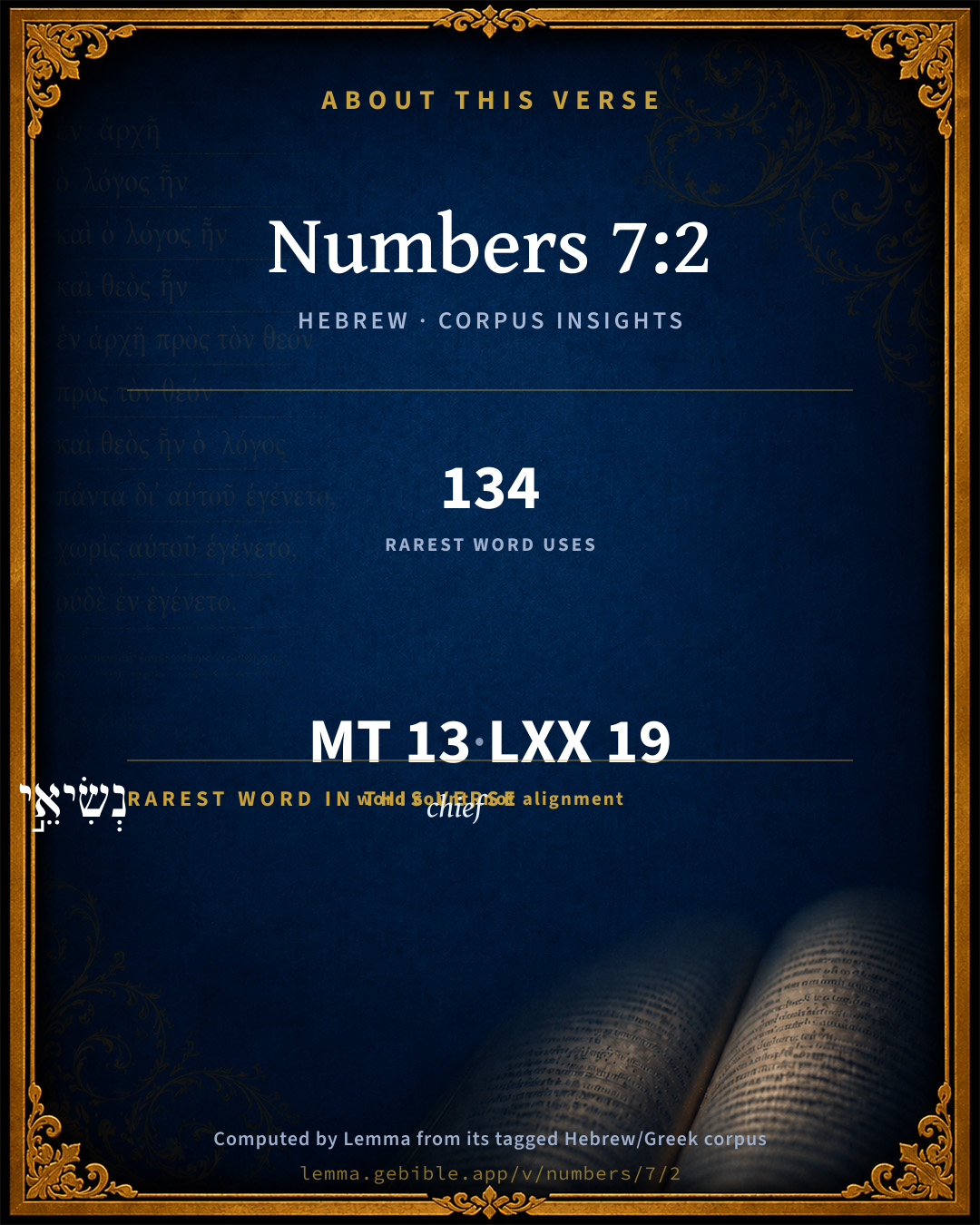
13
words
11
distinct lemmas
Pentateuch
section

Grammatical profile

  • 3 verbs
  • 7 nouns
  • 2 pronouns
  • 1 preposition

Verb forms

  • וַיַּקְרִ֨יבוּ֙ Hiphil · Sequential Imperfect
  • הָעֹמְדִ֖ים Qal · Participle Active
  • הַפְּקֻדִֽים Qal · Participle Passive

Repetition

Words recur within this verse — often emphatic in Hebrew:

  • נְשִׂיאֵ֣י chief H5387 ×2
  • הֵ֚ם they H1992 ×2

Hebrew & Septuagint length

In English translation the verse runs 29 words from the Hebrew and 27 from the Septuagint (LXX English) — closely comparable.

A rough comparison of the two English renderings, which tokenize alike — not a word-level alignment.

Word counts can differ between the Hebrew and the Greek without any difference in meaning — e.g. the Hebrew direct-object marker אֵת has no separate Greek word, and Greek often adds the article ὁ.

In the original languages it is 13 Hebrew tokens and 19 Greek tokens — but the two are counted differently (Hebrew bundles its prefixes and suffixes into one token; the Greek is in lemma form), so that isn’t a like-for-like length.

Cross-references

8

Topical passages linked to Numbers 7:2 in the Treasury of Scripture Knowledge — connected by theme and wording, ordered by reader-vote popularity; previews shown in the World English Bible.

  • Numbers 1:4–16 With you there shall be a man of every tribe; everyone head of his fathers' house.
  • Exodus 35:27 The rulers brought the onyx stones, and the stones to be set, for the ephod and for the breastplate;
  • Numbers 2:1–34 Yahweh spoke to Moses and to Aaron, saying,
  • Numbers 10:1–36 Yahweh spoke to Moses, saying,
  • 1 Chronicles 29:6–8 Then the princes of the fathers' [houses], and the princes of the tribes of Israel, and the captains of thousands and of hundreds, with the rulers over the king's work, offered willingly;
  • 2 Chronicles 35:8 His princes gave for a freewill-offering to the people, to the priests, and to the Levites. Hilkiah and Zechariah and Jehiel, the rulers of the house of God, gave to the priests for the Passover offerings two thousand and six hundred [small cattle], and three hundred oxen.
  • Ezra 2:68–69 Some of the heads of fathers' [houses], when they came to the house of Yahweh which is in Jerusalem, offered willingly for the house of God to set it up in its place:
  • Nehemiah 7:70–72 Some from among the heads of fathers' [houses] gave to the work. The governor gave to the treasury one thousand darics of gold, fifty basins, and five hundred thirty priests' garments.

Cross-references courtesy of OpenBible.info (CC BY 4.0).

Hebrew and Greek witnesses Masoretic Hebrew ↔ Greek Septuagint

The same verse in the two great witnesses to the Old Testament, shown verse-for-verse.

These are two independent witnesses, not word-aligned to each other, and the Septuagint is shown in lemma (dictionary) form.

Hebrew Numbers 7:2 Masoretic · Westminster Leningrad Codex

וַיַּקְרִ֨יבוּ֙ נְשִׂיאֵ֣י יִשְׂרָאֵ֔ל רָאשֵׁ֖י בֵּ֣ית אֲבֹתָ֑ם הֵ֚ם נְשִׂיאֵ֣י הַמַּטֹּ֔ת הֵ֥ם הָעֹמְדִ֖ים עַל הַפְּקֻדִֽים

that the princes of Israel, the heads of their fathers' houses, offered. These were the princes of the tribes. These are they who were over those who were numbered:

World English Bible · Public Domain

Greek LXX Numbers 7:2 Septuagint · lemma form

καί προςφέρω ὁ ἄρχων ἰσραήλ δώδεκα ἄρχων οἶκος πατριά αὐτός οὗτος ἄρχων φυλή οὗτος ὁ παραἵστημι ἐπί ὁ ἐπισκοπή

And the princes of Israel brought gifts, twelve princes of their fathers' houses: these were the heads of tribes, these are they that presided over the numbering.

LXX2012 (modern English Septuagint) · Public Domain

On this verse, The Cambridge Bible for Schools and Colleges discusses the Septuagint’s reading. Read the note in Commentary ↓

Hebrew: Westminster Leningrad Codex (CC BY 4.0). Greek: Septuagint (public domain); English from LXX2012 (modern English Septuagint) (Public Domain). How the Septuagint differs from the Hebrew →

Targum (Aramaic paraphrase)

2

The Targum is the ancient Jewish Aramaic paraphrase of the Hebrew Scriptures — an interpretive translation, not the Hebrew text itself. Onkelos (literal) and Pseudo-Jonathan (expansive) render the Torah, and Jonathan the Prophets. Coverage is partial: where no permissively-licensed English translation exists for a verse, only the Aramaic is shown. This is verse-level text, not a word-by-word alignment to the Hebrew.

  1. Targum Onkelos Torah (Genesis–Deuteronomy)
    וּקְרִיבוּ רַבְרְבֵי יִשְׂרָאֵל רֵישֵׁי בֵּית אֲבָהַתְהוֹן אִנוּן רַבְרְבֵי שִׁבְטַיָא אִנוּן דְקַיְמִין עַל מִנְיָנַיָא

    (no public-domain English translation for this verse)

    Targum Onkelos — Aramaic: “Onkelos Genesis” (public domain); “Onkelos Exodus” (public domain); “Onkelos Leviticus” (public domain); “Onkelos Numbers” (public domain); “Onkelos Deuteronomy” (public domain). English: “Sefaria Community Translation” (CC0 1.0 (public-domain dedication)); “J.W. Etheridge. The Targums of Onkelos and Jonathan Ben Uzziel on the Pentateuch. London: Longmans, Green, 1862” (public domain). Text via Sefaria.

  2. Targum Pseudo-Jonathan Torah (Genesis–Deuteronomy)
    וְקָרִיבוּ אֲמַרְכְּלַיָא דְיִשְרָאֵל רֵישֵׁי בֵּית אַבְהַתְהוֹן הִינוּן רַבְרְבֵי שִׁבְטַיָא הִינוּן דְמִתְמַנָן בְּמִצְרַיִם אֲמַרְכּוֹלִין עַל מִנְיָנַיָא

    then the leaders of Israel, who were the chiefs of the house of their fathers, brought their offerings. These were they who had been appointed in Mizraim chiefs over the numbered,

    Targum Pseudo-Jonathan — Aramaic: “Targum Jonathan on Genesis” (public domain); “Targum Jonathan on Exodus” (public domain); “Targum Jonathan on Leviticus” (public domain); “Targum Jonathan on Numbers” (public domain); “Targum Jonathan on Deuteronomy” (public domain). English: “The Targum of Jonathan ben Uzziel, trans. J. W. Etheridge, London, 1862” (public domain). Text via Sefaria.

Commentary

Notes on Numbers 7:2 from classic Christian and Jewish commentators (each source and its license shown beneath its notes). The classic Christian expositions comment on the surrounding passage and are grouped to its opening verse, so a note may address several verses; the Jewish commentaries on the Tanakh (Rashi and others) are per-verse, so they appear only where the commentator wrote on this verse.

Lemma curates 59 commentaries, every one of them public domain or Creative Commons licensed, each selected and text-cleaned for this edition rather than reprinted as found. About our sources →

Trapp's Complete Commentary

John Trapp

Num 7:2 That the princes of Israel, heads of the house of their fathers, who [were] the princes of the tribes, and were over them that were numbered, offered:

Ver. 2. The princes of Israel offered.] So they did at the making of the tabernacle, and at the building of the temple, {Exo 35:27 1Ch 29:6-8} which was but to give God of his own; as David aeknowledgeth with all thankfulness, {1Ch 29:14} τα σα εκ των σων σοι προσφερομεν. {a} Of thine own we offer unto thee, said Justinian, when he had offered up, in the temple of Sophia, at Constantinople, a communion table that had in it, saith the author, all the riches of land and sea.

{a} Cedrenus.

John Trapp, A Commentary or Exposition upon All the Books of the Old and New Testament (1647–1656) — public domain. Text from a community e-Sword module.

Joseph Benson's Commentary

Num 7:2-3. The princes of Israel — The heads or chiefs of the several tribes, mentioned Num 1:5-16. Offered — In the manner, and on the days hereafter mentioned. Before the Lord — That is, they were presented to God at the door of the tabernacle, as it follows; six covered wagons — Wagons that were covered above, for the convenience of carrying the heavier parts of the tabernacle, and preserving them from the injuries of the weather. They were probably very rich and sumptuous, since two of the great men joined in the present of one wagon.

Joseph Benson's Commentary on the Old and New Testaments (1811–1818) — public domain. Text from a community e-Sword module.

Tyndale Open Study Notes

Tyndale Open Resources

7:2-9 The same tribal leaders that assisted in the registration of ch 1 are found in 7:2-3. The non-Levitical tribes supplied the Gershonites and Merarites with the wagons and oxen needed to transport the heavy structural components of the Tabernacle and other items (cp. ch 4). • These vehicles and draft animals were the first offerings from the Hebrew tribes (7:2); these practical gifts were accompanied by more elaborate dedicatory offerings that were also presented by the tribal leaders (7:10, 12-83).

Tyndale Open Study Notes — © Tyndale Open Resources, licensed CC BY-SA 4.0. Text via the HelloAO Bible API.

Geneva Bible (1599)

Geneva Bible translators

Or, captains.

Geneva Bible (1599) marginal notes — public domain. Text via Bolls.life.

Jamieson, Fausset & Brown

Robert Jamieson, A. R. Fausset & David Brown

the princes of Israel . . . brought their offering before the Lord--The finishing of the sacred edifice would, it may well be imagined, be hailed as an auspicious occasion, diffusing great joy and thankfulness throughout the whole population of Israel. But the leading men, not content with participating in the general expression of satisfaction, distinguished themselves by a movement, which, while purely spontaneous, was at the same time so appropriate in the circumstances and so equal in character, as indicates it to have been the result of concerted and previous arrangement. It was an offer of the means of carriage, suitable to the migratory state of the nation in the wilderness, for transporting the tabernacle from place to place. In the pattern of that sacred tent exhibited on the mount, and to which its symbolic and typical character required a faithful adherence, no provision had been made for its removal in the frequent journeyings of the Israelites. That not being essential to the plan of the divine architect, it was left to be accomplished by voluntary liberality; and whether we look to the judicious character of the gifts, or to the public manner in which they were presented, we have unmistakable evidence of the pious and patriotic feelings from which they emanated and the extensive interest the occasion produced. The offerers were "the princes of Israel, heads of the house of their fathers," and the offering consisted of six covered wagons or little cars, and twelve oxen, two of the princes being partners in a wagon, and each furnishing an ox.

Jamieson, Fausset & Brown — Commentary Critical and Explanatory on the Whole Bible (1871) — public domain (CC PDM 1.0). Text via the HelloAO Bible API.

The Cambridge Bible for Schools and Colleges

gen. ed. J. J. S. Perowne

2. offered] The verb cannot, as in English, stand alone with an absolute force. It is intended to govern ‘their oblation’ in Num_7:3; but the remainder of the verse is a parenthesis, and the sentence is then resumed with another verb, ‘and they brought.’

covered wagons] The word zâbh, rendered ‘covered,’ is doubtful. It is the singular of a substantive found only in Isa_66:20 (R.V. ‘litters’). The expression may mean litter-wagons, i.e. wagons covered like a litter or palanquin. So LXX. ἁμάξας λαμπηνικάς, ‘wagons like covered chariots.’ But perhaps the text is corrupt.

The Cambridge Bible for Schools and Colleges (gen. ed. J. J. S. Perowne; Cambridge University Press, 1878–1918) — public domain. Text from a community e-Sword module.

John Gill's Exposition

That the princes of Israel,.... The princes of the twelve tribes of Israel:

heads of the house of their fathers; of the each of the houses and families the tribes were divided into, and took their name from each of their ancestors, as is next explained:

who were princes of the tribes; the twelve tribes, as before observed, Num 1:4,

and were over them that were numbered; over the children of Israel that were numbered, Num 1:19; by which it that these princes are the very same persons that are mentioned by name there, as they are here afterwards; and were with Moses and Aaron, and assisting to them when they took the number of them; but according to the Targum of Jonathan, and Jarchi, these were appointed over them in Egypt; but the former is right: these now

offered not sacrifices but gifts; they brought their presents to the Lord for the service of his sanctuary, and set them before him, as follows.

John Gill's Exposition of the Whole Bible (1746–1763) — public domain (CC PDM 1.0). Text via the HelloAO Bible API.

Matthew Poole's English Annotations

To wit, in the manner and days hereafter mentioned.

Matthew Poole's English Annotations on the Holy Bible (1683–1685) — public domain. Text from a community e-Sword/MySword module.

Whedon's Commentary on the Bible

Daniel D. Whedon

2. Princes of Israel — See Num_1:5-10, notes.

Daniel D. Whedon (gen. ed.), Commentary on the Old and New Testaments (1874–1909) — public domain. Text from a community e-Sword module.

The Pulpit Commentary

The princes of Israel. These arc the same men, and are called by the same titles, as those Divinely nominated in Num_1:4, sq. No doubt they were the heads of the nations according to some established rules of precedence before the exodus. And were over them that were numbered. Hebrew, "stood over." The most natural reference is to the fact of their presiding over the census, and so the Septuagint, outoi oi paresthkotev epi thv episkophv . But it may mean simply that they were the leaders of the numbered hosts, and offered as their natural representatives.

The Pulpit Commentary (1880–1919), ed. H.D.M. Spence-Jones & Joseph S. Exell — public domain. Text from a community e-Sword module.

John Wesley's Explanatory Notes

Offered - In the manner and days hereafter mentioned.

John Wesley, Explanatory Notes Upon the Whole Bible (1754–1765) — public domain. Text via the GEBible commentary corpus.

Keil & Delitzsch

C. F. Keil & F. Delitzsch

The presentation of six waggons and twelve oxen for the carriage of the materials of the tabernacle is mentioned first, and was no doubt the first thing that took place. The princes of Israel, viz., the heads of the tribe-houses (fathers' houses), or princes of the tribes (see Num 1:4.), "those who stood over those that were numbered," i.e., who were their leaders or rulers, offered as their sacrificial gift six covered waggons and twelve oxen, one ox for each prince, and a waggon for every two. צב עגלת, ἁμάξας λαμπηνίκας (lxx), i.e., according to Euseb. Emis., two-wheeled vehicles, though the Greek scholiasts explain λαμπήνη as signifying ἅμαξα περιφανής, βασιλικὴ and ῥέδιον περιφανὲς ὁ ἐστὶν ἅρμα σκεπαστόν (cf. Schleussner, Lex. in lxx s.v.), and Aquila, ἅμαξαι σκεπασταί, i.e., plaustra tecta (Vulg. and Rabb.). The meaning "litters," which Gesenius and De Wette support, can neither be defended etymologically, nor based upon צבּים in Isa 66:20.

Keil & Delitzsch — Biblical Commentary on the Old Testament (1861–1891) — public domain (CC PDM 1.0). Text via the HelloAO Bible API. (Old Testament only.)

Rashi

Rabbi Shlomo Yitzchaki (Rashi)

הם נשיאי המטת THESE ARE THE LEADERS OF THE TRIBES — They were the officers [appointed] over them in Egypt, and they were beaten on account of them, as it says (Exodus 5:14),“The officers of the children of Israel were beaten” (Sifrei Bamidbar 45).

הם העמדים על הפקדים THEY WHO STOOD OVER THE COUNTING — They stood with Moses and Aaron when they counted the Israelites, as it says,“With you [Moses and Aaron] there shall be [a man from each tribe]” (Numbers 1:4).

Rashi on the Tanakh — English translations: “The Judaica Press complete Tanach with Rashi, translated by A. J. Rosenberg” (CC BY 4.0); “Pentateuch with Rashi's commentary by M. Rosenbaum and A.M. Silbermann, 1929-1934” (public domain); “The Metsudah Tanach series, Lakewood, N.J” (CC BY 4.0); and “The Book of Joshua, Metsudah Publications, 1997” (CC BY 4.0). Text via Sefaria.

Lesson kit

Teaching starters — assembled from the data on this page, not authored interpretation. Every prompt links to the verse data it draws on. Edit before teaching.

Numbers, in the Pentateuch, opens this verse with 13 words (11 distinct Hebrew lemmas). Its most distinctive word is nâsîyʼ (“chief”). A historical commentator’s framing appears above. Read the whole chapter for the surrounding context.

Discussion questions

  1. The word nâsîyʼ carries the sense “chief.” How does it shape the verse?
  2. How does Numbers 1:4–16, which shares this passage’s theme, read alongside this verse?
  3. What does the repetition of “chief” (2× in this one verse) do in this verse?
  4. The translations on this page render this verse differently — a whole-verse word diff, not a word-by-word alignment. What might account for the different wordings?
  5. «וַיַּקְרִ֨יבוּ֙» is a Hiphil Sequential Imperfect verb. How does that grammatical form shape the action described?
  6. Compare how Trapp's Complete Commentary and Joseph Benson's Commentary read this verse. Where do they agree or differ?

Things to notice

Reading settings

Reading text

Shown beneath each verse's original-language words.

Old Testament
Old Testament edition

Read the OT as the Masoretic Hebrew (MT) or the Greek Septuagint (LXX).

English shown for the Greek Septuagint (in the Hebrew ↔ Greek comparison).

Comparing translations? Open the Compare panel on any verse page to stack up to four side by side.