Joshua 2:4

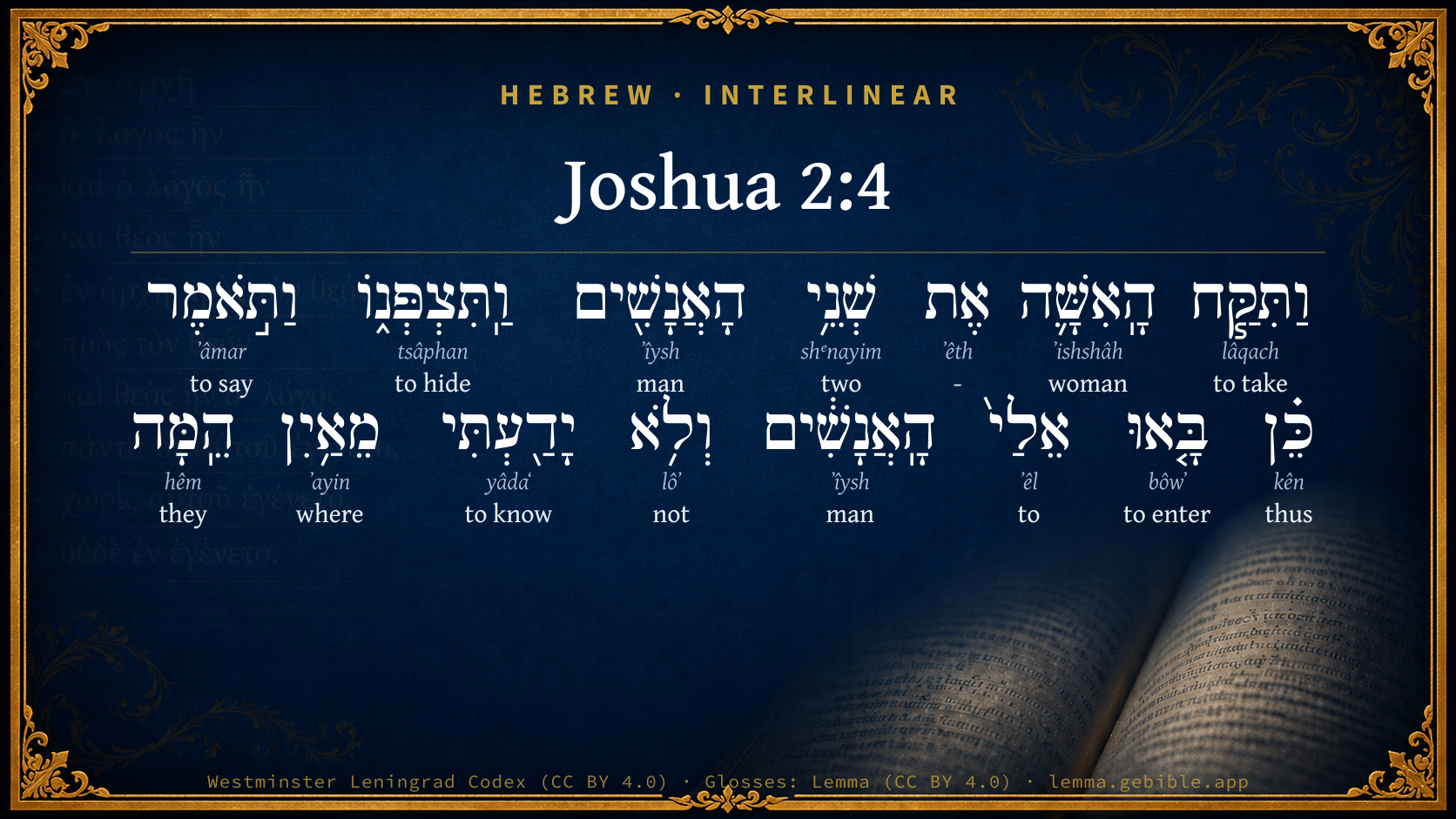
Hebrew (Westminster Leningrad Codex) Joshua 2:4 appears in the Hebrew Old Testament. The text above is from the Westminster Leningrad Codex. Each word links to its Strong’s number, a concise gloss, and parsing drawn from the Open Scriptures Hebrew Bible morphology. Click any word for its full Brown-Driver-Briggs (BDB) entry.
Download image
Cite this verse

Joshua 2:4 (World English Bible). Public Domain. Lemma interlinear Bible study tool, https://lemma.gebible.app/v/joshua/2/4.

Show BibTeX & RIS
BibTeX
RIS
English Translation
The woman took the two men, and hid them; and she said, Yes, the men came to me, but I didn't know whence they were:
World English Bible · Public Domain
Download a study sheet

One document with this verse’s original text, its word-by-word gloss line, the meaning frame, cross-references with their text, attributed commentary, and full source and license credits — printable, and it pastes into notes with its structure intact.

This verse Autodidact and up

Study sheet (.html) Plain text (.txt)

A passage Seminary Student

Up to 50 verses in one chapter. A passage sheet keeps up to 6 commentary sources and 12 cross-references per verse, in the order this page ranks them, and says so on the sheet whenever that leaves anything out. Ask for a single verse and you get the Autodidact verse sheet above.

Everything on this page stays free to read, with no account — the sheet is a download of what is already on screen, not access to it.

Want to remove ads? Support Godless Engineer
Compare translations 3

The same verse in 3 English versions, stacked beneath the original-language interlinear above. Click any original word for its lexicon entry.

Each is an independent rendering of the whole verse — the interlinear is not word-aligned to these translations.

Highlighted words mark where these versions differ — a whole-verse word diff, not a word-by-word alignment.

  • World English Bible Public Domain
    The woman took the two men, and hid them; and she said, Yes, the men came to me, but I didn't know whence they were:
  • King James Version Public Domain
    And the woman took the two men, and hid them, and said thus, There came men unto me, but I wist not whence they were:
  • unfoldingWord Literal Text CC BY-SA 4.0
    But the woman had taken the two men and had hidden them. And she said, “Indeed, the men came to me, but I did not know from where they.

unfoldingWord Literal Text — © unfoldingWord, licensed CC BY-SA 4.0. Word-aligned USFM3 via Door43 (git.door43.org/unfoldingWord/en_ult).

Versions to compare (up to 4)

3 of 4 selected

Show all 18 translations

Every available English version of this verse, each an independent rendering of the whole verse.

  • World English Bible Public Domain
    The woman took the two men, and hid them; and she said, Yes, the men came to me, but I didn't know whence they were:
  • Berean Standard Bible Public Domain
    But the woman had taken the two men and hidden them. So she said, “Yes, the men did come to me, but I did not know where they had come from.
  • Majority Standard Bible Public Domain
    But the woman had taken the two men and hidden them. So she said, “Yes, the men did come to me, but I did not know where they had come from.
  • King James Version Public Domain
    And the woman took the two men, and hid them, and said thus, There came men unto me, but I wist not whence they were:
  • American Standard Version (1901) Public Domain
    And the woman took the two men, and hid them; and she said, Yea, the men came unto me, but I knew not whence they were:
  • Revised Version (1885) Public Domain
    And the woman took the two men, and hid them; and she said, Yea, the men came unto me, but I wist not whence they were:
  • Geneva Bible (1599) Public Domain
    (But ye woman had taken the two men, and hid them) Therefore saide she thus, There came men vnto me, but I wist not whence they were.
  • Douay-Rheims (1899) Public Domain
    And the woman taking the men, hid them, and said: I confess they came to me, but I knew not whence they were:
  • Young's Literal Translation Public Domain
    And the woman taketh the two men, and hideth them, and saith thus: `The men came in unto me, and I have not known whence they `are';
  • Literal Standard Version CC BY-SA 4.0
    And the woman takes the two men, and hides them, and says thus: “The men came to me, and I have not known where they [are] from;
  • Unlocked Literal Bible CC BY-SA 4.0
    But the woman had taken the two men and hidden them. She replied, “Yes, the men came to me, but I did not know where they were from.
  • unfoldingWord Literal Text CC BY-SA 4.0
    But the woman had taken the two men and had hidden them. And she said, “Indeed, the men came to me, but I did not know from where they.
  • Darby Bible Public Domain
    And the woman had taken and concealed the two men; and she said, Yes, the men did come unto me, but I knew not whence they were;
  • World Messianic Bible Public Domain
    The woman took the two men and hid them. Then she said, “Yes, the men came to me, but I didn’t know where they came from.
  • Webster's Bible Public Domain
    And the woman took the two men, and hid them, and said thus, There came men to me, but I knew not whence they were:
  • Free Bible Version CC BY-SA 4.0
    The woman had taken the two men and had hidden them. She told the king's messengers, “Yes, it's true—the men did come to visit me, but I didn't know where they were from.
  • Bible in Basic English Public Domain
    And the woman took the two men and put them in a secret place; then she said, Yes, the men came to me, but I had no idea where they came from;
  • JPS Tanakh (1917) Public Domain
    And the woman took the two men, and hid them; and she said: 'Yea, the men came unto me, but I knew not whence they were;

Literal Standard Version (2020), Covenant Press — licensed CC BY-SA 4.0. Text via the HelloAO Bible API (eBible.org). Unlocked Literal Bible (unfoldingWord) — licensed CC BY-SA 4.0. Text via the HelloAO Bible API (eBible.org). unfoldingWord Literal Text — © unfoldingWord, licensed CC BY-SA 4.0. Word-aligned USFM3 via Door43 (git.door43.org/unfoldingWord/en_ult). Free Bible Version, Dr. Jonathan Gallagher — licensed CC BY-SA 4.0. Text via the HelloAO Bible API (eBible.org).

Word by word

More ways to search: Search by grammar → Find every occurrence → Compare this word →

Practice this passage: Drill this verse → Learn its vocabulary →

מֵאַ֥יִן
ʼayin
H370
“from · where”
Preposition + Particle, Interrogative
Part of Speech
Preposition + Particle
Type
Interrogative
Full BDB Definition

Origin: probably identical with H369 in the sense of query (compare H336 )

TWOT: 75f

where?, whence?
  1. וַתִּקַּ֧ח lâqach H3947 “and · to take” Conjunction + Verb, Qal, Sequential Imperfect, 3rd Person, Feminine, Singular
  2. הָֽאִשָּׁ֛ה ʼishshâh H802 “the · woman” Particle, Definite Article + Noun, Common, Feminine, Singular, Absolute
  3. אֶת ʼêth H853 “-” Particle, Direct Object
  4. שְׁנֵ֥י shᵉnayim H8147 “two” Adjective, Cardinal number, Masculine, Dual, Construct
  5. הָאֲנָשִׁ֖ים ʼîysh H376 “the · men” Particle, Definite Article + Noun, Common, Masculine, Plural, Absolute
  6. וַֽתִּצְפְּנ֑וֹ tsâphan H6845 “and · to hide · him” Conjunction + Verb, Qal, Sequential Imperfect, 3rd Person, Feminine, Singular + Suffix, Personal, 3rd Person, Masculine, Singular
  7. וַתֹּ֣אמֶר ʼâmar H559 “and · to say” Conjunction + Verb, Qal, Sequential Imperfect, 3rd Person, Feminine, Singular
  8. כֵּ֗ן kên H3651 “thus” Particle, Demonstrative
  9. בָּ֤אוּ bôwʼ H935 “to enter” Verb, Qal, Perfect, 3rd Person, Common, Plural
  10. אֵלַי֙ ʼêl H413 “to · me” Preposition + Suffix, Personal, 1st Person, Common, Singular
  11. הָֽאֲנָשִׁ֔ים ʼîysh H376 “the · men” Particle, Definite Article + Noun, Common, Masculine, Plural, Absolute
  12. וְלֹ֥א lôʼ H3808 “and · not” Conjunction + Particle, Negative
  13. יָדַ֖עְתִּי yâdaʻ H3045 “to know” Verb, Qal, Perfect, 1st Person, Common, Singular
  14. הֵֽמָּה hêm H1992 “they” Pronoun, Personal, 3rd Person, Masculine, Plural

About this verse

These counts appear in no published source. They are computed here, from the morphology-tagged text and Lemma’s own curated glosses. What Lemma adds →

15
words
14
distinct lemmas
Historical
section

Notable vocabulary

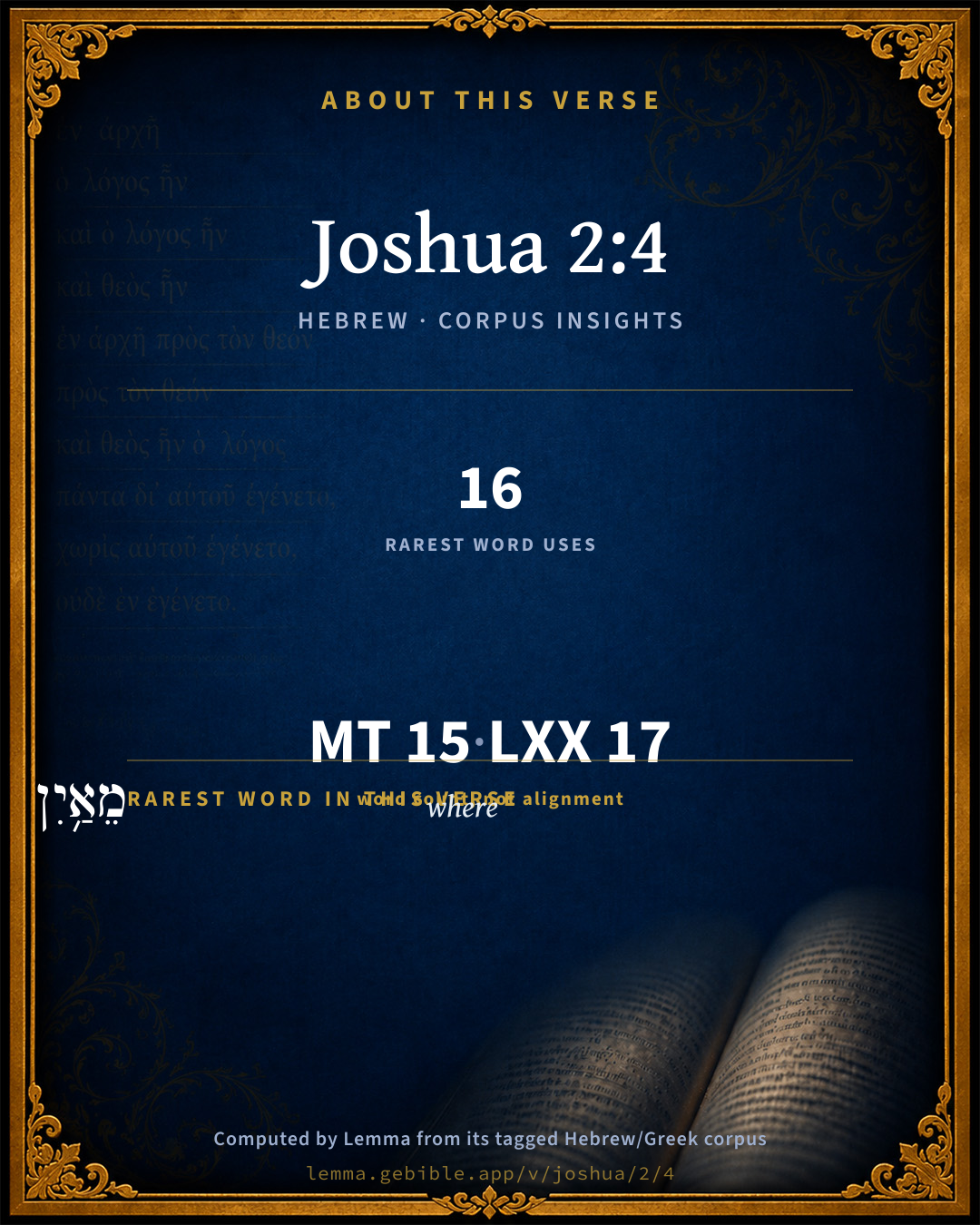
The rarest word here is מֵאַ֥יִן where H370 — appearing just 16 times in the whole Hebrew Bible.

Shared distinctive vocabulary

מֵאַ֥יִן where H370 occurs in 16 verses of the Hebrew Bible. Also found in:

Grammatical profile

  • 5 verbs
  • 3 nouns
  • 1 adjective
  • 1 pronoun
  • 1 preposition
  • 4 particles

Verb forms

  • וַתִּקַּ֧ח Qal · Sequential Imperfect
  • וַֽתִּצְפְּנ֑וֹ Qal · Sequential Imperfect
  • וַתֹּ֣אמֶר Qal · Sequential Imperfect
  • בָּ֤אוּ Qal · Perfect
  • יָדַ֖עְתִּי Qal · Perfect

Repetition

A word recurs within this verse — often emphatic in Hebrew:

  • הָאֲנָשִׁ֖ים man H376 ×2

Hebrew & Septuagint length

In English translation the verse runs 25 words from the Hebrew and 23 from the Septuagint (LXX English) — closely comparable.

A rough comparison of the two English renderings, which tokenize alike — not a word-level alignment.

Word counts can differ between the Hebrew and the Greek without any difference in meaning — e.g. the Hebrew direct-object marker אֵת has no separate Greek word, and Greek often adds the article ὁ.

In the original languages it is 15 Hebrew tokens and 17 Greek tokens — but the two are counted differently (Hebrew bundles its prefixes and suffixes into one token; the Greek is in lemma form), so that isn’t a like-for-like length.

Cross-references

4

Topical passages linked to Joshua 2:4 in the Treasury of Scripture Knowledge — connected by theme and wording, ordered by reader-vote popularity; previews shown in the World English Bible.

  • 2 Samuel 17:19–20 The woman took and spread the covering over the well's mouth, and strewed bruised grain thereon; and nothing was known.
  • 2 Kings 6:19 Elisha said to them, This is not the way, neither is this the city: follow me, and I will bring you to the man whom you seek. He led them to Samaria.
  • 2 Samuel 16:18–19 Hushai said to Absalom, No; but whom Yahweh, and this people, and all the men of Israel have chosen, his will I be, and with him will I abide.
  • Exodus 1:19 The midwives said to Pharaoh, "Because the Hebrew women aren't like the Egyptian women; for they are vigorous, and give birth before the midwife comes to them."

Cross-references courtesy of OpenBible.info (CC BY 4.0).

Hebrew and Greek witnesses Masoretic Hebrew ↔ Greek Septuagint

The same verse in the two great witnesses to the Old Testament, shown verse-for-verse.

These are two independent witnesses, not word-aligned to each other, and the Septuagint is shown in lemma (dictionary) form.

Hebrew Joshua 2:4 Masoretic · Westminster Leningrad Codex

וַתִּקַּ֧ח הָֽאִשָּׁ֛ה אֶת שְׁנֵ֥י הָאֲנָשִׁ֖ים וַֽתִּצְפְּנ֑וֹ וַתֹּ֣אמֶר כֵּ֗ן בָּ֤אוּ אֵלַי֙ הָֽאֲנָשִׁ֔ים וְלֹ֥א יָדַ֖עְתִּי מֵאַ֥יִן הֵֽמָּה

The woman took the two men, and hid them; and she said, Yes, the men came to me, but I didn't know whence they were:

World English Bible · Public Domain

Greek LXX Joshua 2:4 Septuagint · lemma form

καί λαμβάνω ὁ γυνή ὁ ἀνήρ κρύπτω αὐτός καί εἶπον αὐτός λέγω εἰςἔρχομαι πρός ἐγώ ὁ ἀνήρ

And the woman took the two men and hid them; and she spoke to the messengers, saying, The men came in to me,

LXX2012 (modern English Septuagint) · Public Domain

Hebrew: Westminster Leningrad Codex (CC BY 4.0). Greek: Septuagint (public domain); English from LXX2012 (modern English Septuagint) (Public Domain). How the Septuagint differs from the Hebrew →

Targum (Aramaic paraphrase)

1

The Targum is the ancient Jewish Aramaic paraphrase of the Hebrew Scriptures — an interpretive translation, not the Hebrew text itself. Onkelos (literal) and Pseudo-Jonathan (expansive) render the Torah, and Jonathan the Prophets. Coverage is partial: where no permissively-licensed English translation exists for a verse, only the Aramaic is shown. This is verse-level text, not a word-by-word alignment to the Hebrew.

  1. Targum Jonathan Prophets (Joshua–Malachi)
    וּדְבִירַת אִתְּתָא יַת תְּרֵין גֻבְרַיָא וְאַטְמַרַתְנוּן וַאֲמָרַת בְּקוּשְׁטָא אֲתוֹ לְוָתִי גֻבְרַיָא וְלָא יִדְעֵית אֵי מִנָן אִינוּן:

    (no public-domain English translation for this verse)

    Targum Jonathan — Aramaic: “Mikraot Gedolot” (public domain). English: “Sefaria Community Translation” (CC0 1.0 (public-domain dedication)); “London "Chaldee Paraphrase," 1871” (public domain). Text via Sefaria.

Commentary

Notes on Joshua 2:4 from classic Christian and Jewish commentators (each source and its license shown beneath its notes). The classic Christian expositions comment on the surrounding passage and are grouped to its opening verse, so a note may address several verses; the Jewish commentaries on the Tanakh (Rashi and others) are per-verse, so they appear only where the commentator wrote on this verse.

Lemma curates 59 commentaries, every one of them public domain or Creative Commons licensed, each selected and text-cleaned for this edition rather than reprinted as found. About our sources →

Trapp's Complete Commentary

John Trapp

Jos 2:4 And the woman took the two men, and hid them, and said thus, There came men unto me, but I wist not whence they [were]:

Ver. 4. And the woman took the two men, and hid them.] This was an act of her praiseworthy faith. See Heb 11:31, where it is honourably mentioned, but nothing is said of the lie she told. God layeth the finger of mercy on the scars of our sins; as that painter in the story.

But I wist not whence they were.] This was no better than an officious lie: yea, four lies she here uttereth together in a breath, - as Jacob also did three, {Gen 27:19-24} - neither can she be excused. That was a worthy speech of a good woman on the rack, as Jerome relateth it, Non ideo negare volo ne peream: sed ideo mentiri nolo, ne peccem. But Rahab was yet but a new convert.

John Trapp, A Commentary or Exposition upon All the Books of the Old and New Testament (1647–1656) — public domain. Text from a community e-Sword module.

Joseph Benson's Commentary

Jos 2:4. And the woman — Or, But the woman; had taken and hid them — Before the messengers came from the king; as soon as she understood from her neighbours that there was a suspicion of the matter, and guessed that search would be made. And this is justly mentioned as a great and generous act of faith, (Heb 11:31,) for she apparently ventured her life upon a steadfast persuasion of the truth of God’s word and promise given to the Israelites. Whence they were — Her answer, contained in these and the following words, was false, and therefore unquestionably sinful; though her intention was good therein. But it is very probable she, being a heathen, might think that an officious lie was not unlawful.

Joseph Benson's Commentary on the Old and New Testaments (1811–1818) — public domain. Text from a community e-Sword module.

Tyndale Open Study Notes

Tyndale Open Resources

2:4-5 It is not necessary either to condone or condemn Rahab’s lying to the king’s messengers. She might have had no concept of any ethical standards God had given Israel. Or the higher ethical value of saving lives might supersede the normal requirement to be truthful.

Tyndale Open Study Notes — © Tyndale Open Resources, licensed CC BY-SA 4.0. Text via the HelloAO Bible API.

Jamieson, Fausset & Brown

Robert Jamieson, A. R. Fausset & David Brown

the woman took the two men, and hid them--literally, "him," that is, each of them in separate places, of course previous to the appearance of the royal messengers and in anticipation of a speedy search after her guests. According to Eastern manners, which pay an almost superstitious respect to a woman's apartment, the royal messengers did not demand admittance to search but asked her to bring the foreigners out.

Jamieson, Fausset & Brown — Commentary Critical and Explanatory on the Whole Bible (1871) — public domain (CC PDM 1.0). Text via the HelloAO Bible API.

Adam Clarke's Commentary

Verse 4. And hid them] Probably she secreted them for the time being in some private corner, till she had the opportunity of concealing them on the house-top in the manner mentioned Jos 2:6.

Adam Clarke's Commentary on the Bible (1810–1826) — public domain. Text from a community e-Sword/MySword module.

John Calvin's Commentaries

4. And the woman took the two men, etc. We may presume that before Rahab was ordered to bring them forth the rumor of their arrival had been spread, and that thus some little time had been given for concealing them. And indeed on receiving the king’s command, had not measures for concealment been well taken, there would have been no room for denial; much less would she have dared to lie so coolly. But after she had thus hidden her guests, as the search would have been difficult, she comes boldly forward and escapes by a crafty answer.

Now, the questions which here arise are, first, Was treachery to her country excusable? Secondly, Could her lie be free from fault? We know that the love of our country, which is as it were our common mother, has been implanted in us by nature. When, therefore, Rahab knew that the object intended was the overthrow of the city in which she had been born and brought up, it seems a detestable act of inhumanity to give her aid and counsel to the spies. It is a puerile evasion to say, that they were not yet avowed enemies, inasmuch as war had not been declared; since it is plain enough that they had conspired the destruction of her fellow-citizens. It was therefore only the knowledge communicated to her mind by God which exempted her from fault, as having been set free from the common rule. Her faith is commended by two Apostles, who at the same time declare, (Hebrews 11:31; James 2:25,) that the service which she rendered to the spies was acceptable to God.

It is not wonderful, then, that when the Lord condescended to transfer a foreign female to his people, and to engraft her into the body of the Church, he separated her from a profane and accursed nation. Therefore, although she had been bound to her countrymen up to that very day, yet when she was adopted into the body of the Church, her new condition was a kind of manumission from the common law by which citizens are bound toward each other. In short, in order to pass by faith to a new people, she behooved to renounce her countrymen. And as in this she only acquiesced in the judgment of God, there was no criminality in abandoning them.

As to the falsehood, we must admit that though it was done for a good purpose, it was not free from fault. For those who hold what is called a dutiful lie to be altogether excusable, do not sufficiently consider how precious truth is in the sight of God. Therefore, although our purpose, be to assist our brethren, to consult for their safety and relieve them, it never can be lawful to lie, because that cannot be right which is contrary to the nature of God. And God is truth. And still the act of Rahab is not devoid of the praise of virtue, although it was not spotlessly pure. For it often happens that while the saints study to hold the right path, they deviate into circuitous courses.

Rebecca (Genesis 27. ) in procuring the blessing to her son Jacob, follows the prediction. In obedience of this description a pious and praiseworthy zeal is perceived. But it cannot be doubted that in substituting her son Jacob in the place of Esau, she deviated from the path of duty. The crafty proceeding, therefore, so far taints an act which was laudable in itself. And yet the particular fault does not wholly deprive the deed of the merit of holy zeal; for by the kindness of God the fault is suppressed and not taken into account. Rahab also does wrong when she falsely declares that the messengers were gone, and yet the principal action was agreeable to God, because the bad mixed up with the good was not imputed. On the whole, it was the will of God that the spies should be delivered, but he did not approve of saving their life by falsehood.

John Calvin's Commentaries (1540-1563) — public domain. Text from the Calvin Translation Society English edition (1840s-50s) via the Christian Classics Ethereal Library (ccel.org). Calvin's coverage is partial (roughly two-thirds of the Bible); uncommented books and verses are honest gaps, never fabricated. The 19th-century editor's footnotes and remarks are omitted so the notes are faithfully Calvin's own voice.

The Cambridge Bible for Schools and Colleges

gen. ed. J. J. S. Perowne

4. And the woman took the two men] Instead of timidly surrendering them to the king she resolved to shield and protect them.

I wist not] For this meaning of “wist,” comp. Exo_16:15, “And they said one to another, It is manna, for they wist not what it was;” Exo_34:29, and in many other passages both in the Old and New Testament. See Commentary on St Mark, ch. Jos_9:6, p. 100.

The Cambridge Bible for Schools and Colleges (gen. ed. J. J. S. Perowne; Cambridge University Press, 1878–1918) — public domain. Text from a community e-Sword module.

John Gill's Exposition

And the woman took the two men,.... Or "she had taken" them (z) before the messengers came, upon a rumour she understood was gone abroad, that she had got Israelitish spies in her house, and so might expect to be visited and searched by the king's officers, and therefore took this precaution:

and hid them; the Hebrew word is singular, "him" (a): hence the Jews, who take these two spies to be Caleb and Phinehas, say, that only Caleb was hid, and Phinehas, though he was before them, was not seen, being an angel, Mal 2:7; but the sense is, that she hid each of them, and very probably singly and apart, that if one was found, the other might escape, as Ben Gersom observes; and Abarbinel is of opinion that she hid them twice, now in the middle of her house, one in one place, and the other in another, for the reason before given, and after this hid them in the roof of her house, as afterwards related:

and said thus, there came men unto me; that is, into her house, this she owned:

but I wist not whence they were; of what country they were, whether Israelites or not; which whether she knew or not is not certain; it is probable she did, and told an untruth, as she also did in Jos 2:5.

(z) "duxerat, tulerat"; so Syr. Ar. Kimchi, & Ben Melech. (a) "et abscondit eum", Montanus; "abdiderat eum", Vatablus.

John Gill's Exposition of the Whole Bible (1746–1763) — public domain (CC PDM 1.0). Text via the HelloAO Bible API.

Albert Barnes' Notes on the Bible

I wist not whence they were - Rahab acted as she did from the belief in God’s declared word, and conviction that resistance to His will would be both vain and wicked Jos 2:9-11. Thus, she manifested a faith both sound and practical, and is praised accordingly Heb 11:31; Jam 2:25. The falsehood to which she had recourse may be excused by the pressure of circumstances and by her own antecedents, but cannot be defended.

Albert Barnes' Notes on the Bible (1834–1885) — public domain. Text from a community e-Sword/MySword module.

Haydock's Catholic Bible Commentary

Hid, or "had hidden," as (ver. 6,) she had made the men retire before she spoke to the messengers, and probably before they came to demand them. As soon as she was informed of their design, she took all prudent precautions both for her own and their safety, as she could not have escaped death, if she had been discovered affording shelter to the enemies of her country. She felt herself authorized by God, on this occasion, to abandon those upon whom he had declared war, and who could have derived no benefit from the spies being betrayed to them. (Haydock)

George Leo Haydock (1774–1849), Haydock's Catholic Family Bible and Commentary, 1859 edition — public domain. Excludes Psalms (Douay-Rheims chapter numbering differs from Protestant) and Deuterocanonical books (Catholic canon only).

Matthew Poole's English Annotations

Or, But the woman had taken—and had hid them, to wit, before the messengers came from the king; as soon as she understood from her neighbours, or common rumour, that there was a suspicion of the matter, and guessed that search would be made. And this is justly mentioned as a great and generous act of faith, Heb 11:31, for she did apparently venture her life upon a stedfast persuasion of the truth of God’s word and promise given to the Israelites.

I wist not whence they were: her answer, contained in these and the following words, was palpably false, and therefore unquestionably sinful; howsoever, her intention was good therein: see Rom 3:8. But it is very probable, she being a heathen, might think, what some Christians have thought and said, that an officious lie is not unlawful. Or, at worst. this was her infirmity, which was graciously pardoned by God, and her faith was amply rewarded.

Matthew Poole's English Annotations on the Holy Bible (1683–1685) — public domain. Text from a community e-Sword/MySword module.

Whedon's Commentary on the Bible

Daniel D. Whedon

4. Hid them — Literally, hid him. Hebrew usage shows many such sudden transitions from plural to singular. Perhaps we may see in this instance an intimation of the haste with which she concealed the men, hiding one of them herself with the flax (Jos_2:6) and leaving the other to cover himself. Some think she had taken the precaution to conceal the men before the king’s messengers arrived, and Jos_2:6 seems to favor the supposition.

I wist not whence they were — Better, I knew not, for the verb wist is obsolete. Rahab could not safely deny that the men had entered her house, for other eyes than hers had seen them; but it is difficult to believe that she knew not whence they were. She may not, however, have had positive knowledge that they were spies.

Daniel D. Whedon (gen. ed.), Commentary on the Old and New Testaments (1874–1909) — public domain. Text from a community e-Sword module.

The Pulpit Commentary

And the woman took the two men. The majority of commentators are of opinion that here, as in ver. 1, we must render by the pluperfect. For, as Calvin remarks, Rahab would hardly have dared to lie so coolly had she not previously taken precautions to conceal her guests. And therefore she must have told a twofold falsehood. She must have discovered, or been made acquainted with, their errand, and therefore have "known whence they were," in addition to her assertion that she did not know where they were now. And hid them. The original is remarkable and very vivid. And hid him, i.e., each one in a separate place. No doubt the detail comes from an eyewitness, so that if the Book of Joshua he not a contemporary work, the writer must have had access to some contemporary document.

HOMILIES BY R. GLOVER Ver. 4. The harlot Rahab.

A peculiar interest has always attached to this woman"s case. Of thedoomed nations with whom Israel came into collision, she is the first to be known, and the first to escape the doom ordained for them: an early type of the calling of the Gentiles; a whisper that the faith which was a sacred secret for Israel would yet become the heritage of the world; a study for early theologians on the sovereign grace of God, which can call those farthest off and make them vessels of His grace and mercy. While theologians learnt charity and hope from her experience, the historian and the patriot looked back with hardly less of interest to her, as to one whose simple service and womanly hospitality were a national boon. At the moment when the difficulties and perils of theft undertaking were conspicuous, when the bravest people might have shrunk from an encounter with such foes, Rahab"s greeting heartened them. Like the Midianite"s dream of the cake of barley bread which heartened Gideon, so this woman"s acknowledgment of Israel"s God, and prediction of their success, was itself an inspiration. "A cup of cold water" given in the name of Jehovah, her act refreshed a nation. And so her name, cleared of the dishonour which had clung to it, was enrolled amongst those of the worthies who had deserved well of Israel. And all the thoughtful, whether their interest lay in creed or country, were glad to note that "a great reward" was given her by the God under whose wings she had come to trust. The deliverance of herself, of her family; a noble marriage, a royal progeny these were dwelt upon by the devout of Israel, as examples of what all might expect who lived for the service of the Lord. Let us consider her story.

I THE WAKING OF THE SOUL. There has been an attempt made to take off the stigma which, to point the marvels of grace, all the centuries had attached to her. One of the earliest versions of the Jewish Scriptures renders the word which describes her calling innkeeper. And one commentator (Adam Clarke) shows that women were the tavern-keepers in Greece and Egypt in ancient days; and points out many items in the narrative which would comport with such a view. We adhere more strictly to both letter and spirit of the narrative when we accept the usual rendering, and seek for mitigation of her ill repute in other less questionable considerations. It is right to remember that amongst her own people, probably, there was no stigma in the name; that she was probably a priestess of the Phoenician Venus, like the priestesses of Bhowani, in India, today, consecrate to the goddess; float she was hard-working, attached to her kindred, and apparently treated with respect by her people. But applying such considerations to modify the revulsion which every pure mind feels at the name given her, we still cannot avoid feeling that there is a vast gulf between Rahab as she had been, and the Rahab that can say, "Jehovah, your God, He is God in heaven above and in earth beneath." A former faith for the heathen have faith had disappeared; in stern and terrible questionings it had broken up and melted away; a new God had risen on her soul; a deity of indulgence had sunk into the disregard of true repentance, and the Jewish deity of mercy and of duty had risen on her heart. For us to change one thought about our God for another involves often a painful and protracted embarrassment; but for one to change her goddess in spite of all the centuries of tradition commending her her acceptance by the people, and to be in Jericho a solitary believer in Jehovah such a change was not wrought easily or lightly, and was not wrought out, one fancies, while she still pursued a course of wrong. "The fountains of the great deep were broken up," and her soul went through the experience of earthquake and fire, before the small still voice could calm her into faith. This was a soul waking. How it came about none can tell. The external influences that prepare for such changes may be roughly traced, but the inward "moving" is too deep and subtle to be seen. Jericho lay on the route of a caravan trade, which was even then carried on between Babylon and Egypt. (see Babylonish garment, Jos_7:21) And so she had heard of all God"s wonders in Egypt, and of "the strong hand and mighty arm" with which He had brought them out. The overthrow of the inhabitants of Bashan and the Amontes, the warlike people the remains of whose cities excite the marvel of all today had seemed too wonderful to be the result of unaided human strength or skill. And these, likely enough, started the deeper thoughts. But they only occasioned, they did not produce them. There must have been a deeper work going on. Dubiety had risen in her about the Godhead of Deity that sanctioned the life she led; a sense that her country"s gods exerted no hallowing or elevating influence that they sanctioned all vile indulgences, but inspired no virtue; she had grown weary of worldliness; restless with the longing for a God pure and strong enough to trust. The God of Israel who alone among all deities then worshipped, stood forth as the God of help and duty looked in her face, breathed on her heart, and she was His. We must not miss the lessons of such a waking. We must despair of none. The soul, like the body, may sometimes be easily killed, but sometimes it takes a great deal of killing. And from sins, and vices, and unbelief, which wound the soul and apparently leave no chance of life, ofttimes it will recover, and its health will come again like the health of a little child. God can travel where no teacher comes, and can enter where no truth is known, and can commend Himself to hearts that seem incapable of appreciating His charms. And so here, without guide, teacher, or companion, she rises to the light of God. Have you waked thus to the greatness, the nearness, and the claims of a redeeming God? Observe secondly

II THE ACTION OF FAITH. Here we have not quite so easy a theme; for the mixture of good and evil which always marks human action is provokingly obvious here. With clear faith falsehood is mingled; with devotion to Israel, something like treason to her people. And persons who can do addition, but cannot balance accounts, are apt to reject her altogether. They forget that morality has its chronology, and that the sanctity of truth dates from the Christian era. They forget, too, what ought to be obvious, that the charge of not doing all she can to save her country hardly lies against a person who has the conviction that her country cannot be saved, and that her city is for its sins a very City of Destruction; and that in rewarding her, God rewards, not her lie, but her hospitality, her courage, her taking the part of Israel, her confession of His name; and that what we have here is not nineteenth century Christianity, but incipient Israelitism. Considering these things, mark the action of faith in her case. When these considerations have their weight, it is very Striking how many of the characteristics of Christian faith are found here.

1. Her faith sees clearly all that it is needful to see. She has the purged eye which discerns the great lines on which God works, and the great lines on which our safety and bliss are to be found. Fortune and probabilities fade from her view, and she sees all things depending on God, and all bliss depending on following Him.

2. Her faith braves every danger in the way or duty. Think you a weak or timorous woman would have risked her life as she did? The King was nearer than the hosts of Israel: it were easy to have her falsehood discovered; and if so she dies. But faith dares what nought else dares. An inward moral courage is its continual mark, and at the risk of life she makes her choice.

3. Her faith leads her to cast in her lot with the people of God, and seek to share their fortune. An earthborn faith makes a person trim and endeavour to stand neutral to avoid the fate of Jericho without identifying one"s self with the fortunes of Israel. Rut she says in effect to the men, "Your people shall be my people, and your God my God." And by hiding them, aiding their escape, counselling for their safety, entering into covenant with them, she chooses her part with the people of God. To this she may be moved by fear more than by love. And love is better than fear. But the fear of God is infinitely better than listlessness, and is the beginning of wisdom. Happy they who see with the clearness, who venture with the courage, who choose with the piety of God"s believing people. Shrink thou from no risk in following Christ. Choose thou the heritage of the people of God: His grace, His pardon, His eternal love. Lastly, observe

III THE REWARDS OF HER FAITH. Faith has always an exceeding great reward. It passes tremblingly along its anxious path to peace and rest. And so here. Observe how, answering the workings of her heart, God brings nigh His help.

1. She has an open door set before her. Not casually, but by God"sguidance, the spies come for lodging to her house.

2. All needed wisdom is given where she has the will to use it.

3. She is kept safe from the men of Jericho by God.

4. While miraculous incidents in the destruction of Jericho leave her noroom for thought of having helped it, she is herself saved, with her father, mother, brethren, and all that she had.

5. An honoured guest of Israel, she becomes the wife of the head of the tribe of Judah, Salomon. Probably he was one of the two spies, Ephraim and Judah being the leading tribes, and heads of the tribes being chosen for such work.

6. Her child was Boaz, one of the brightest and most honourable of Israel"s saints; her daughter-in-law, Ruth the Moabitess; her grandchild"s grandchild, David; and Jesus of Nazareth had her blood in His veins. How little she had dreamt of all that satisfaction, that gracious wealth, and sweet renown! And so it ever is! Cast in thy lot with the people of God. Like them, follow Him, His conscience oracle, and there will be a growing benediction on your life, a various mercy pardon, peace, joy of His love, hope of His heaven till, so exceeding and abundantly above what you asked or thought, His mercy will come to you, that you will be "like them that dream;" and when others say, "The Lord hath done great things for us," your heart will reply, "The Lord hath done great things for us, whereof we axe glad. G.

The Pulpit Commentary (1880–1919), ed. H.D.M. Spence-Jones & Joseph S. Exell — public domain. Text from a community e-Sword module.

John Wesley's Explanatory Notes

And the woman - Or, But the woman had taken - and had hid them, before the messengers came from the king; as soon as she understood from her neighbours, that there was a suspicion of the matter, and guessed that search would be made. And this is justly mentioned as a great and generous act of faith, Heb. xi, 31, for she apparently ventured her life upon a steadfast persuasion of the truth of God's word and promise given to the Israelites. Whence they were - Her answer contained in these and the following words, was false, and therefore unquestionably sinful; tho' her intention was good therein. But it is very probable, she being an Heathen, might think, that an officious lie is not unlawful.

John Wesley, Explanatory Notes Upon the Whole Bible (1754–1765) — public domain. Text via the GEBible commentary corpus.

unfoldingWord translationNotes

Door43 World Missions Community

General Information:

Rahab the prostitute protects the two Israelite spies from harm.

But the woman had taken the two men and hidden them

This happened before the king's messenger spoke to her.

the woman

This refers to Rahab, the prostitute.

dusk

This is the time that day begins to change to the darkness of night.

translationWords

gate

unfoldingWord translationNotes — © Distant Shores Media and the Door43 World Missions Community, licensed CC BY-SA 4.0. Source: git.door43.org/Door43/en_tn.

Rashi

Rabbi Shlomo Yitzchaki (Rashi)

And she hid them. There are scriptural verses that speak of the plural as if it were singular. Since she was in a hurry to hide them and she hid them in a narrow place it was as though they were one person. The Midrash of Rabbi Tanchuma states ‘That these two men were Pinchos and Caleiv, and Pinchos stood before them but they did not see him because he was [invisible] like an angel.’ Another interpretation: She hid each of them separately. We find a similar verse: ‘Oil and incense gladden the heart’ and it does not say יְשַׂמְחוּ לֵב, in the plural.

Rashi on the Tanakh — English translations: “The Judaica Press complete Tanach with Rashi, translated by A. J. Rosenberg” (CC BY 4.0); “Pentateuch with Rashi's commentary by M. Rosenbaum and A.M. Silbermann, 1929-1934” (public domain); “The Metsudah Tanach series, Lakewood, N.J” (CC BY 4.0); and “The Book of Joshua, Metsudah Publications, 1997” (CC BY 4.0). Text via Sefaria.

Lesson kit

Teaching starters — assembled from the data on this page, not authored interpretation. Every prompt links to the verse data it draws on. Edit before teaching.

Joshua, in the Historical, opens this verse with 15 words (14 distinct Hebrew lemmas). Its most distinctive word is ʼayin (“where”). A historical commentator’s framing appears above. Read the whole chapter for the surrounding context.

Discussion questions

  1. What does “where” (ʼayin) contribute to the verse as a whole?
  2. Genesis 29:4 shares the word «where» with this verse. How do the two illuminate each other?
  3. “man” occurs 2× in this one verse. What is the effect of the repetition?
  4. The translations on this page render this verse differently — a whole-verse word diff, not a word-by-word alignment. What might account for the different wordings?
  5. The verb «וַתִּקַּ֧ח» is Qal Sequential Imperfect. How does its form color the action?
  6. Reading how Trapp's Complete Commentary and Joseph Benson's Commentary read this verse, where do the two commentators agree and where do they part?

Things to notice

Reading settings

Reading text

Shown beneath each verse's original-language words.

Old Testament
Old Testament edition

Read the OT as the Masoretic Hebrew (MT) or the Greek Septuagint (LXX).

English shown for the Greek Septuagint (in the Hebrew ↔ Greek comparison).

Comparing translations? Open the Compare panel on any verse page to stack up to four side by side.