
Exodus 36:3

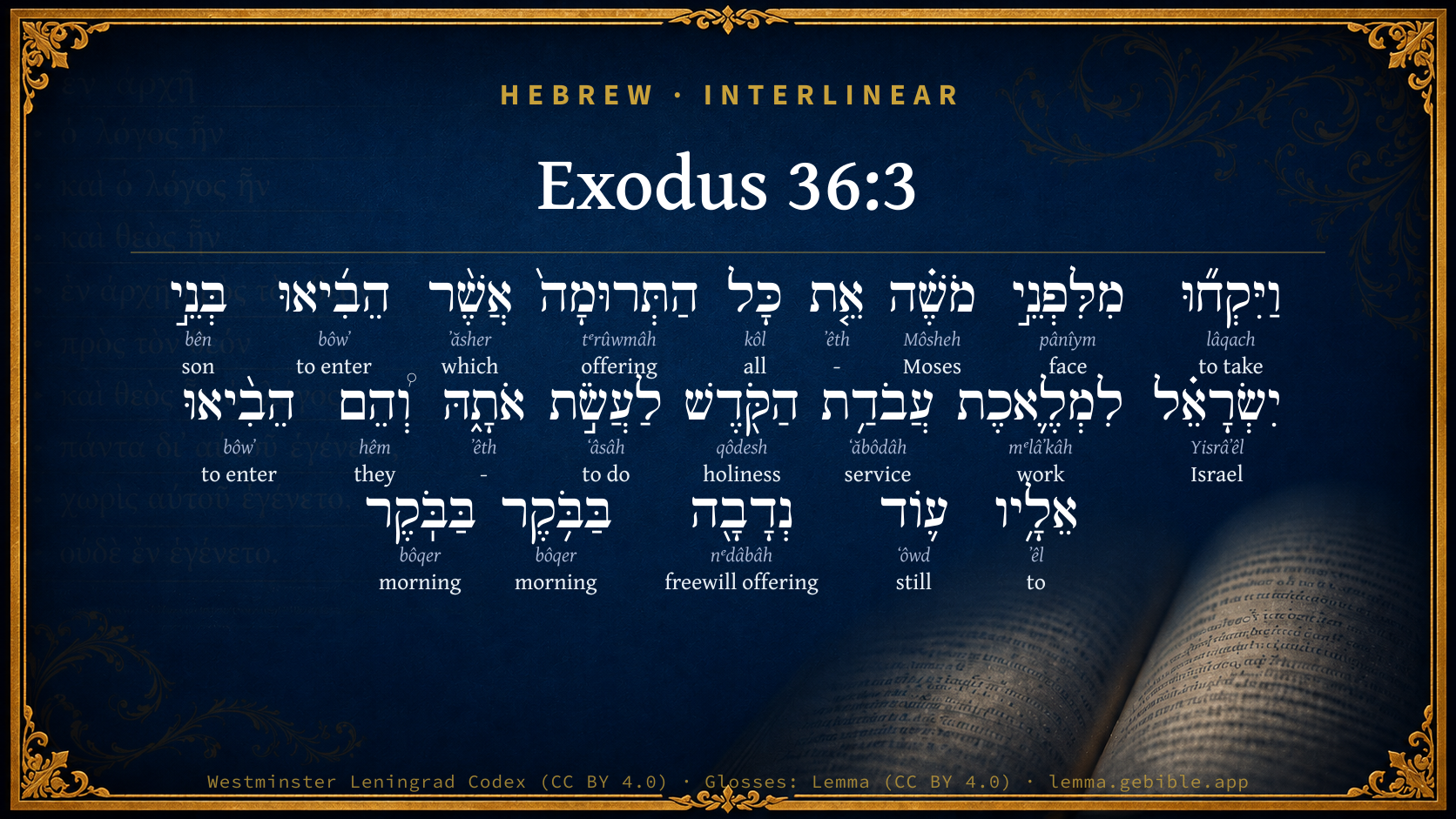
Hebrew (Westminster Leningrad Codex) Exodus 36:3 appears in the Hebrew Old Testament. The text above is from the Westminster Leningrad Codex. Each word links to its Strong’s number, a concise gloss, and parsing drawn from the Open Scriptures Hebrew Bible morphology. Click any word for its full Brown-Driver-Briggs (BDB) entry.
Download image
Cite this verse

Exodus 36:3 (World English Bible). Public Domain. Lemma interlinear Bible study tool, https://lemma.gebible.app/v/exodus/36/3.

Show BibTeX & RIS
BibTeX
RIS
English Translation
and they received from Moses all the offering which the children of Israel had brought for the work of the service of the sanctuary, with which to make it. They brought yet to him freewill-offerings every morning.
World English Bible · Public Domain
Download a study sheet

One document with this verse’s original text, its word-by-word gloss line, the meaning frame, cross-references with their text, attributed commentary, and full source and license credits — printable, and it pastes into notes with its structure intact.

This verse Autodidact and up

Study sheet (.html) Plain text (.txt)

A passage Seminary Student

Up to 50 verses in one chapter. A passage sheet keeps up to 6 commentary sources and 12 cross-references per verse, in the order this page ranks them, and says so on the sheet whenever that leaves anything out. Ask for a single verse and you get the Autodidact verse sheet above.

Everything on this page stays free to read, with no account — the sheet is a download of what is already on screen, not access to it.

Want to remove ads? Support Godless Engineer
Compare translations 3

The same verse in 3 English versions, stacked beneath the original-language interlinear above. Click any original word for its lexicon entry.

Each is an independent rendering of the whole verse — the interlinear is not word-aligned to these translations.

Highlighted words mark where these versions differ — a whole-verse word diff, not a word-by-word alignment.

  • World English Bible Public Domain
    and they received from Moses all the offering which the children of Israel had brought for the work of the service of the sanctuary, with which to make it. They brought yet to him freewill-offerings every morning.
  • King James Version Public Domain
    And they received of Moses all the offering, which the children of Israel had brought for the work of the service of the sanctuary, to make it withal. And they brought yet unto him free offerings every morning.
  • unfoldingWord Literal Text CC BY-SA 4.0
    and they took from before the face of Moses all of the contributions that the sons of Israel had brought for doing the work of the service of the Holy Place. And they continually brought a freewill offering to him in the morning in the morning.

unfoldingWord Literal Text — © unfoldingWord, licensed CC BY-SA 4.0. Word-aligned USFM3 via Door43 (git.door43.org/unfoldingWord/en_ult).

Versions to compare (up to 4)

3 of 4 selected

Show all 18 translations

Every available English version of this verse, each an independent rendering of the whole verse.

  • World English Bible Public Domain
    and they received from Moses all the offering which the children of Israel had brought for the work of the service of the sanctuary, with which to make it. They brought yet to him freewill-offerings every morning.
  • Berean Standard Bible Public Domain
    They received from Moses all the contributions that the Israelites had brought to carry out the service of constructing the sanctuary. Meanwhile, the people continued to bring freewill offerings morning after morning,
  • Majority Standard Bible Public Domain
    They received from Moses all the contributions that the Israelites had brought to carry out the service of constructing the sanctuary. Meanwhile, the people continued to bring freewill offerings morning after morning,
  • King James Version Public Domain
    And they received of Moses all the offering, which the children of Israel had brought for the work of the service of the sanctuary, to make it withal. And they brought yet unto him free offerings every morning.
  • American Standard Version (1901) Public Domain
    and they received of Moses all the offering which the children of Israel had brought for the work of the service of the sanctuary, wherewith to make it. And they brought yet unto him freewill-offerings every morning.
  • Revised Version (1885) Public Domain
    and they received of Moses all the offering, which the children of Israel had brought for the work of the service of the sanctuary, to make it withal. And they brought yet unto him freewill offerings every morning.
  • Geneva Bible (1599) Public Domain
    And they receiued of Moses all the offering which the children of Israel had brought for the worke of the seruice of the Sanctuary, to make it: also they brought still vnto him free giftes euery morning.
  • Douay-Rheims (1899) Public Domain
    He delivered all the offerings of the children of Israel unto them. And while they were earnest about the work, the people daily in the morning offered their vows.
  • Young's Literal Translation Public Domain
    And they take from before Moses all the heave-offering which the sons of Israel have brought in for the work of the service of the sanctuary to do it; and still they have brought in unto him a willing-offering morning by morning.
  • Literal Standard Version CC BY-SA 4.0
    And they take from before Moses all the raised-offering which the sons of Israel have brought in for the work of the service of the holy place to do it; and still they have brought to him a willing-offering morning by morning.
  • Unlocked Literal Bible CC BY-SA 4.0
    They received from Moses all the offerings that the Israelites had brought for constructing the holy place. The people were still bringing freewill offerings every morning to Moses.
  • unfoldingWord Literal Text CC BY-SA 4.0
    and they took from before the face of Moses all of the contributions that the sons of Israel had brought for doing the work of the service of the Holy Place. And they continually brought a freewill offering to him in the morning in the morning.
  • Darby Bible Public Domain
    And they took from Moses every heave-offering that the children of Israel had brought for the work of the service of the sanctuary, to make it. And they still brought him voluntary offerings morning by morning.
  • World Messianic Bible Public Domain
    They received from Moses all the offering which the children of Israel had brought for the work of the service of the sanctuary, with which to make it. They kept bringing free will offerings to him every morning.
  • Webster's Bible Public Domain
    And they received from Moses all the offering which the children of Israel had brought for the work of the service of the sanctuary, to make it. And they brought yet to him free-offerings every morning.
  • Free Bible Version CC BY-SA 4.0
    Moses gave them everything the Israelites had contributed to carry out the work of constructing the sanctuary. In the meantime the people went on bringing freewill offerings every morning,
  • Bible in Basic English Public Domain
    And they took from Moses all the offerings which the children of Israel had given for the building of the holy place. And still they went on giving him more free offerings every morning.
  • JPS Tanakh (1917) Public Domain
    And they received of Moses all the offering, which the children of Israel had brought for the work of the service of the sanctuary, wherewith to make it. And they brought yet unto him freewill-offerings every morning.

Literal Standard Version (2020), Covenant Press — licensed CC BY-SA 4.0. Text via the HelloAO Bible API (eBible.org). Unlocked Literal Bible (unfoldingWord) — licensed CC BY-SA 4.0. Text via the HelloAO Bible API (eBible.org). unfoldingWord Literal Text — © unfoldingWord, licensed CC BY-SA 4.0. Word-aligned USFM3 via Door43 (git.door43.org/unfoldingWord/en_ult). Free Bible Version, Dr. Jonathan Gallagher — licensed CC BY-SA 4.0. Text via the HelloAO Bible API (eBible.org).

Word by word

More ways to search: Search by grammar → Find every occurrence → Compare this word →

Practice this passage: Drill this verse → Learn its vocabulary →

נְדָבָ֖ה
nᵉdâbâh
H5071
“freewill offering”
Noun, Common, Feminine, Singular, Absolute
Part of Speech
Noun
Type
Common
Gender
Feminine
Number
Singular
State
Absolute
Full BDB Definition

Origin: from H5068

TWOT: 1299a

voluntariness, free-will offering - voluntariness - freewill, voluntary, offering
  1. וַיִּקְח֞וּ lâqach H3947 “and · to take” Conjunction + Verb, Qal, Sequential Imperfect, 3rd Person, Masculine, Plural
  2. מִלִּפְנֵ֣י pânîym H6440 “from · to/for · face(s) of” Preposition + Preposition + Noun, Common, Both, Plural, Construct
  3. מֹשֶׁ֗ה Môsheh H4872 “Moses” Noun, Proper
  4. אֵ֤ת ʼêth H853 “-” Particle, Direct Object
  5. כָּל kôl H3605 “all of” Noun, Common, Masculine, Singular, Construct
  6. הַתְּרוּמָה֙ tᵉrûwmâh H8641 “the · offering” Particle, Definite Article + Noun, Common, Feminine, Singular, Absolute
  7. אֲשֶׁ֨ר ʼăsher H834 “which” Particle, Relative
  8. הֵבִ֜יאוּ bôwʼ H935 “to enter” Verb, Hiphil, Perfect, 3rd Person, Common, Plural
  9. בְּנֵ֣י bên H1121 “sons of” Noun, Common, Masculine, Plural, Construct
  10. יִשְׂרָאֵ֗ל Yisrâʼêl H3478 “Israel” Noun, Proper
  11. לִמְלֶ֛אכֶת mᵉlâʼkâh H4399 “to/for · work of” Preposition + Noun, Common, Feminine, Singular, Construct
  12. עֲבֹדַ֥ת ʻăbôdâh H5656 “service of” Noun, Common, Feminine, Singular, Construct
  13. הַקֹּ֖דֶשׁ qôdesh H6944 “the · holiness” Particle, Definite Article + Noun, Common, Masculine, Singular, Absolute
  14. לַעֲשֹׂ֣ת ʻâsâh H6213 “to do” Preposition + Verb, Qal, Infinitive Construct
  15. אֹתָ֑הּ ʼêth H853 “- · her” Particle, Direct Object + Suffix, Personal, 3rd Person, Feminine, Singular
  16. וְ֠הֵם hêm H1992 “and · they” Conjunction + Pronoun, Personal, 3rd Person, Masculine, Plural
  17. הֵבִ֨יאוּ bôwʼ H935 “to enter” Verb, Hiphil, Perfect, 3rd Person, Common, Plural
  18. אֵלָ֥יו ʼêl H413 “to · him” Preposition + Suffix, Personal, 3rd Person, Masculine, Singular
  19. ע֛וֹד ʻôwd H5750 “still” Adverb
  20. בַּבֹּ֥קֶר bôqer H1242 “in/at the · morning” Preposition, Determined + Noun, Common, Masculine, Singular, Absolute
  21. בַּבֹּֽקֶר bôqer H1242 “in/at the · morning” Preposition, Determined + Noun, Common, Masculine, Singular, Absolute

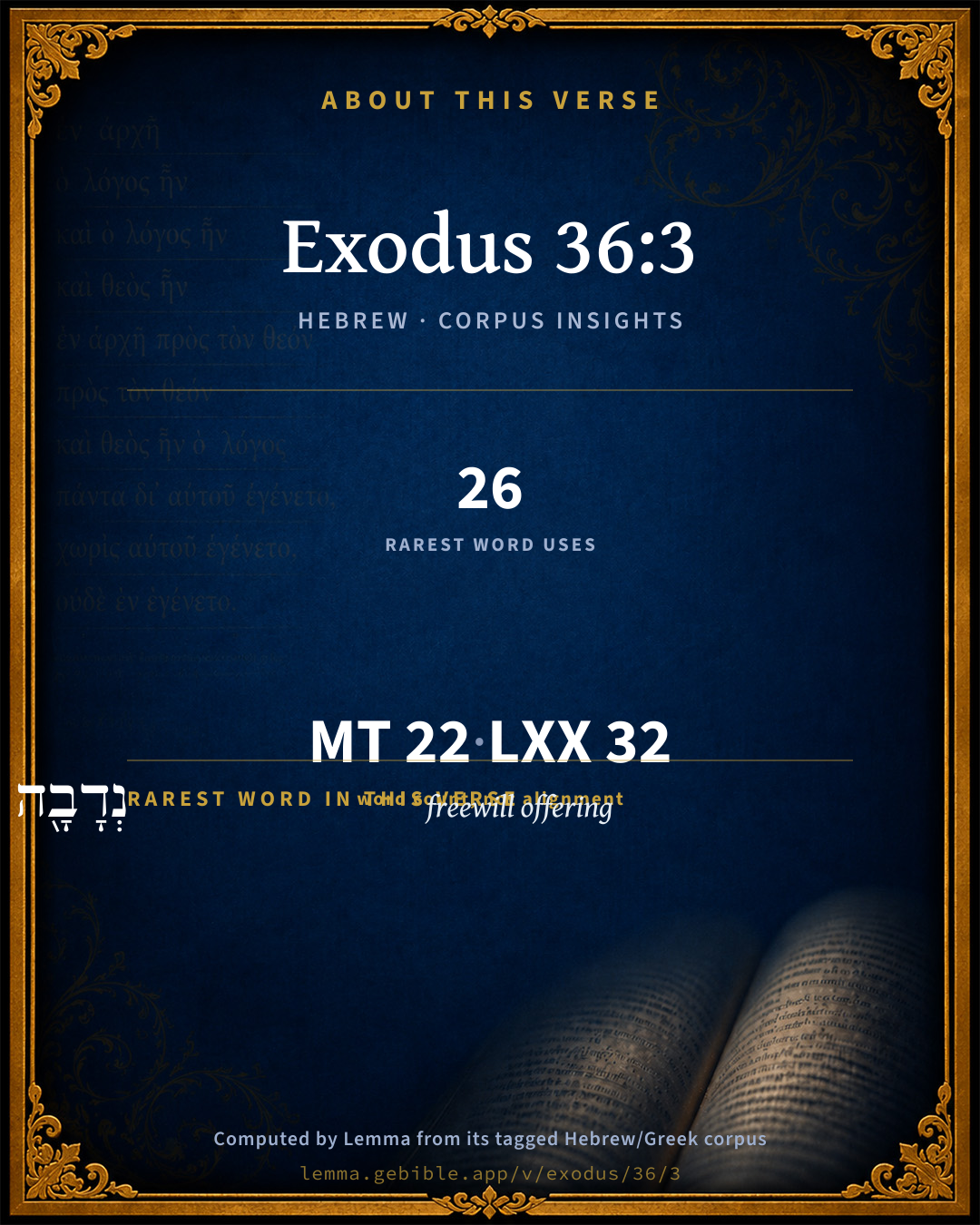
About this verse

These counts appear in no published source. They are computed here, from the morphology-tagged text and Lemma’s own curated glosses. What Lemma adds →

22
words
19
distinct lemmas
Pentateuch
section

Shared distinctive vocabulary

נְדָבָ֖ה freewill offering H5071 occurs in 25 verses of the Hebrew Bible. Also found in:

Grammatical profile

  • 4 verbs
  • 12 nouns
  • 1 pronoun
  • 1 preposition
  • 1 adverb
  • 3 particles

Verb forms

  • וַיִּקְח֞וּ Qal · Sequential Imperfect
  • הֵבִ֜יאוּ Hiphil · Perfect
  • לַעֲשֹׂ֣ת Qal · Infinitive Construct
  • הֵבִ֨יאוּ Hiphil · Perfect

Repetition

Words recur within this verse — often emphatic in Hebrew:

  • הֵבִ֜יאוּ to enter H935 ×2
  • בַּבֹּ֥קֶר morning H1242 ×2

Hebrew & Septuagint length

In English translation the verse runs 37 words from the Hebrew and 40 from the Septuagint (LXX English) — closely comparable.

A rough comparison of the two English renderings, which tokenize alike — not a word-level alignment.

Word counts can differ between the Hebrew and the Greek without any difference in meaning — e.g. the Hebrew direct-object marker אֵת has no separate Greek word, and Greek often adds the article ὁ.

In the original languages it is 22 Hebrew tokens and 32 Greek tokens — but the two are counted differently (Hebrew bundles its prefixes and suffixes into one token; the Greek is in lemma form), so that isn’t a like-for-like length.

Cross-references

8

Topical passages linked to Exodus 36:3 in the Treasury of Scripture Knowledge — connected by theme and wording, ordered by reader-vote popularity; previews shown in the World English Bible.

  • Exodus 35:29 The children of Israel brought a freewill offering to Yahweh; every man and woman, whose heart made them willing to bring for all the work, which Yahweh had commanded to be made by Moses.
  • Exodus 35:5–21 'Take from among you an offering to Yahweh. Whoever is of a willing heart, let him bring it, Yahweh's offering: gold, silver, brass,
  • Exodus 35:27 The rulers brought the onyx stones, and the stones to be set, for the ephod and for the breastplate;
  • Psalms 5:3 Yahweh, in the morning you shall hear my voice. In the morning I will lay my requests before you, and will watch expectantly.
  • Psalms 101:8 Morning by morning, I will destroy all the wicked of the land; To cut off all the workers of iniquity from Yahweh's city.
  • Proverbs 8:15 By me kings reign, And princes decree justice.
  • Isaiah 50:4 The Lord Yahweh has given me the tongue of those who are taught, that I may know how to sustain with words him who is weary: he wakens morning by morning, he wakens my ear to hear as those who are taught.
  • Jeremiah 21:12 House of David, thus says Yahweh, Execute justice in the morning, and deliver him who is robbed out of the hand of the oppressor, lest my wrath go forth like fire, and burn so that none can quench it, because of the evil of your doings.

Cross-references courtesy of OpenBible.info (CC BY 4.0).

Hebrew and Greek witnesses Masoretic Hebrew ↔ Greek Septuagint

The same verse in the two great witnesses to the Old Testament, shown verse-for-verse.

These are two independent witnesses, not word-aligned to each other, and the Septuagint is shown in lemma (dictionary) form.

Hebrew Exodus 36:3 Masoretic · Westminster Leningrad Codex

וַיִּקְח֞וּ מִלִּפְנֵ֣י מֹשֶׁ֗ה אֵ֤ת כָּל הַתְּרוּמָה֙ אֲשֶׁ֨ר הֵבִ֜יאוּ בְּנֵ֣י יִשְׂרָאֵ֗ל לִמְלֶ֛אכֶת עֲבֹדַ֥ת הַקֹּ֖דֶשׁ לַעֲשֹׂ֣ת אֹתָ֑הּ וְ֠הֵם הֵבִ֨יאוּ אֵלָ֥יו ע֛וֹד נְדָבָ֖ה בַּבֹּ֥קֶר בַּבֹּֽקֶר

and they received from Moses all the offering which the children of Israel had brought for the work of the service of the sanctuary, with which to make it. They brought yet to him freewill-offerings every morning.

World English Bible · Public Domain

Greek LXX Exodus 36:3 Septuagint · lemma form

καί λαμβάνω παρά μωυσῆς πᾶς ὁ ἀφαίρεμα ὅς φέρω ὁ υἱός ἰσραήλ εἰς πᾶς ὁ ἔργον ὁ ἅγιος ποιέω αὐτός καί αὐτός προςδέχομαι ἔτι ὁ προςφέρω παρά ὁ φέρω ὁ πρωΐ πρωΐ

And they received from Moses all the offerings, which the children of Israel brought for all the works of the sanctuary to do them; and they continued to receive the gifts brought, from those who brought them in the morning.

LXX2012 (modern English Septuagint) · Public Domain

On this verse, Haydock's Catholic Bible Commentary discusses the Septuagint’s reading. Read the note in Commentary ↓

Hebrew: Westminster Leningrad Codex (CC BY 4.0). Greek: Septuagint (public domain); English from LXX2012 (modern English Septuagint) (Public Domain). How the Septuagint differs from the Hebrew →

Targum (Aramaic paraphrase)

2

The Targum is the ancient Jewish Aramaic paraphrase of the Hebrew Scriptures — an interpretive translation, not the Hebrew text itself. Onkelos (literal) and Pseudo-Jonathan (expansive) render the Torah, and Jonathan the Prophets. Coverage is partial: where no permissively-licensed English translation exists for a verse, only the Aramaic is shown. This is verse-level text, not a word-by-word alignment to the Hebrew.

  1. Targum Onkelos Torah (Genesis–Deuteronomy)
    וּנְסִיבוּ מִן קֳדָם משֶׁה יָת כָּל אַפְרָשׁוּתָא דִי אַיְתִיאוּ בְּנֵי יִשְׂרָאֵל לְעִבִידַת פָּלְחַן קוּדְשָׁא לְמֶעְבַּד יָתַהּ וְאִנוּן מַיְתַן לֵהּ עוֹד נְדַבְתָּא בִּצְפַר בִּצְפָר:

    (no public-domain English translation for this verse)

    Targum Onkelos — Aramaic: “Onkelos Genesis” (public domain); “Onkelos Exodus” (public domain); “Onkelos Leviticus” (public domain); “Onkelos Numbers” (public domain); “Onkelos Deuteronomy” (public domain). English: “Sefaria Community Translation” (CC0 1.0 (public-domain dedication)); “J.W. Etheridge. The Targums of Onkelos and Jonathan Ben Uzziel on the Pentateuch. London: Longmans, Green, 1862” (public domain). Text via Sefaria.

  2. Targum Pseudo-Jonathan Torah (Genesis–Deuteronomy)
    וּנְסִיבוּ מִן קֳדָם משֶׁה יַת כָּל אַפְרָשׁוּתָא דְאַיְיתִיוּ בְּנֵי יִשְרָאֵל לְעִיבִידַת פּוּלְחַן קוּדְשָׁא לְמֶעֱבַד יָתָהּ וְהִינוּן מַיְיתִין לֵיהּ תּוּב נְדַבְתָּא בִּצְפַר בִּצְפָר מִן מָמוֹנְהוֹן

    And they took from before Mosheh all the separation that the children of Israel had brought for the work of the service of the sanctuary, to make it. And they still brought to him the voluntary gift, morning after morning from their possessions.

    Targum Pseudo-Jonathan — Aramaic: “Targum Jonathan on Genesis” (public domain); “Targum Jonathan on Exodus” (public domain); “Targum Jonathan on Leviticus” (public domain); “Targum Jonathan on Numbers” (public domain); “Targum Jonathan on Deuteronomy” (public domain). English: “The Targum of Jonathan ben Uzziel, trans. J. W. Etheridge, London, 1862” (public domain). Text via Sefaria.

Commentary

Notes on Exodus 36:3 from classic Christian and Jewish commentators (each source and its license shown beneath its notes). The classic Christian expositions comment on the surrounding passage and are grouped to its opening verse, so a note may address several verses; the Jewish commentaries on the Tanakh (Rashi and others) are per-verse, so they appear only where the commentator wrote on this verse.

Lemma curates 59 commentaries, every one of them public domain or Creative Commons licensed, each selected and text-cleaned for this edition rather than reprinted as found. About our sources →

Geneva Bible (1599)

Geneva Bible translators

Meaning, the Israelites.

Geneva Bible (1599) marginal notes — public domain. Text via Bolls.life.

Jamieson, Fausset & Brown

Robert Jamieson, A. R. Fausset & David Brown

they (the workmen)

received of Moses all the offering, which the children of Israel had brought, &c.--It appears that the building was begun after the first few contributions were made; it was progressively carried on, and no necessity occurred to suspend operations even for the shortest interval, from want of the requisite materials.

they brought yet unto him free offerings every morning, &c.--Moses, in common with other Oriental magistrates, had his morning levees for receiving the people (see on Exo 18:13); and it was while he was performing his magisterial duties that the people brought unto him freewill offerings every morning. Some who had nothing but their manual labor to give would spend a great part of the night in hastening to complete their self-imposed task before the early dawn; others might find their hearts constrained by silent meditations on their beds to open their coffers and give a part of their hoarded treasure to the pious object. All whose hearts were touched by piety, penitence, or gratitude, repaired with eager haste into the presence of Moses, not as heretofore, to have their controversies settled, but to lay on his tribunal their contributions to the sanctuary of God (Co2 9:7).

Jamieson, Fausset & Brown — Commentary Critical and Explanatory on the Whole Bible (1871) — public domain (CC PDM 1.0). Text via the HelloAO Bible API.

Ellicott's Commentary for English Readers

(3) They brought yet unto him free offerings.—The liberality of the people continued. After the work was taken in hand, and making progress, they kept still bringing in fresh offerings morning after morning, until the workmen found that they had more than enough. Compare the liberality shown when David was collecting materials for the Temple (1Ch_29:6-9); and, again, when Zerubbabel was about to rear up the second Temple on the return from the Captivity (Ezr_2:68-70; Neh_7:70-72).

A Bible Commentary for English Readers, edited by Charles John Ellicott (1878–1897) — public domain. Text from a community e-Sword module.

The Cambridge Bible for Schools and Colleges

gen. ed. J. J. S. Perowne

3. received of] took from before. ‘Of’ is incorrect and inadequate: the picture is of the heap of materials lying before Moses.

offering] contribution, as Exo_25:2, Exo_35:5; Exo_35:21; Exo_35:24. So v. 6.

And they] They, however (i.e. the Israelites): the pron. is emphatic.

The Cambridge Bible for Schools and Colleges (gen. ed. J. J. S. Perowne; Cambridge University Press, 1878–1918) — public domain. Text from a community e-Sword module.

John Gill's Exposition

And they received of Moses all the offering,.... That is, Bezaleel and Aholiab received it of him, who delivered it to the several workmen, as the nature of their work required, some one thing, and some another: to some gold, to others silver, to others brass, and to some they delivered out fine linen, and blue, purple, and scarlet yarn, and to others shittim wood; Moses gave all out faithfully that he received, and kept back nothing for his own use or private advantage, even all the above things of which the offering consisted:

which the children of Israel had brought for the work of the service of the sanctuary, to make it withal; and which perhaps they went and fetched the same day they were called together, and acquainted with the mind of God concerning it; or at least they brought it in a very short space of time, and as soon as it possibly could be; it was delivered to the workmen, that the work might be begun, and carried on with the utmost expedition:

and they brought yet unto him free offerings every morning; they continued for a course of time afterwards to bring their freewill offerings of one thing or another to Moses, every morning, which perhaps was the most suitable time for him to receive them; and best expresses their readiness and diligence in bringing them, and which, as they brought, he sent to the workmen, as appears by what follows.

John Gill's Exposition of the Whole Bible (1746–1763) — public domain (CC PDM 1.0). Text via the HelloAO Bible API.

Haydock's Catholic Bible Commentary

Vows, or voluntary oblations to Moses, according to the Hebrew (Calmet) --- These donations are called first-fruits, because they were the best of all things, and the first offerings that were made by the people, in the desert. (Tirinus) --- They shew great alacrity in performing this action, as it was to make some atonement for their liberality in honour of the golden calf. (Haydock) --- But as matter alone will not suffice, unless it be properly managed, so neither will the letter of the Scripture instruct us, unless God teaches us, by his pastors, Ephesians iv. 11. (Worthington) --- From this place to the end, the Roman edition of the Septuagint is very confused. That of Alcala agrees better with the Vulgate than the Alexandrian or Aldine. See Grabe. Almost all the three following chapters might be comprised of these words. The workmen did all according to God’s prescription. Moses perhaps gave them plans of what each was to execute; and hence Calmet accounts for these repetitions. (Haydock)

George Leo Haydock (1774–1849), Haydock's Catholic Family Bible and Commentary, 1859 edition — public domain. Excludes Psalms (Douay-Rheims chapter numbering differs from Protestant) and Deuterocanonical books (Catholic canon only).

Matthew Poole's English Annotations

Which time they chose as the first and best part of the day, and therefore for fittest for God’s service.

Matthew Poole's English Annotations on the Holy Bible (1683–1685) — public domain. Text from a community e-Sword/MySword module.

The Pulpit Commentary

HOMILETICS.

Vers. 3-7. Superabundant giving.

Too much is far better than too little. Let a great work be taken in hand,and it is impossible to anticipate the exact quantity of the material that it will require, or the exact cost of work and material together. Care should always be taken to have a margin beyond the supposed necessity. Unless this is done

I THE WORK IS APT TO BE SCAMPED AND STINTED TOWARDS THE CLOSE. Fear naturally arises lest the material or the money should not hold out; and economies are practised which detract from the beauty, the finish, the perfection of the construction. Or (which is worse) desirable, even necessary, adjuncts are omitted, given up as impracticable under the circumstances.

II THE WORK MAY ACTUALLY HAVE TO BE LEFT UNFINISHED. All calculations of cost are uncertain. Prices rise while a work is in progress; material purchased, or presented, turns out to be defective, and has to be replaced by something better. Accidents occur. The actual cost of a work almost always exceeds the estimate sometimes greatly exceeds it. How often do we hear of there being a debt upon a building! This would occur far less frequently, if gifts and offerings kept flowing in until the authority entrusted with the work cried "Stop.

Superabundant giving shows a truly liberal spirit in those who give. It is not a very common thing. Cases are rare of its needing to be "restrained." The example of the Israelites should stir Christians to emulate them. While these poor wanderers in the desert were so generous, how is it that we are, for the most part, so niggardly?

Superabundant giving is a trial to those who receive the gifts. How easy to appropriate what is not required to our own advantage! Moses withstood this temptation. Bezaleel and Aholiab withstood it. It may be doubted whether all Christians have always done so. The gifts that flowed in at the shrine of Becket, at the exhibition of the holy coat of Troves, at the altar of St. Januarius, were intended as offerings for the service of the sanctuary. Were they always used for sacred purposes? Was there not often a superfluity, which men converted to their own benefit? There have certainly been those in modern times who have enriched themselves out of moneys subscribed for charitable purposes, as the records of our assize courts sufficiently show.

The Pulpit Commentary (1880–1919), ed. H.D.M. Spence-Jones & Joseph S. Exell — public domain. Text from a community e-Sword module.

Scofield Reference Notes

C. I. Scofield

free offerings

i.e. free will, (See Scofield "2Co 8:1").

The Scofield Reference Bible (1917 edition), notes by C. I. Scofield — public domain. Text from a community e-Sword module.

Ramban (Nachmanides)

Rabbi Moshe ben Nachman (Ramban / Nachmanides)

AND THEY TOOK FROM BEFORE MOSES ALL THE OFFERING. In one day they brought all this donation to the Tent of Meeting where Moses was, and the wise men took it from Moses on that very same day and on the following day, early in the morning. On the second day, too, the people still continued to bring the donation to Moses’ tent and he commanded them to bring it to the craftsmen, until they told him that the people bring much more; thus there was sufficient [for all the work to make it], and too much. The surplus, however, was not a sufficiently important amount to warrant Moses’ telling in the section of Eileh Pekudei what they did with it. Perhaps it remained in the tent to repair the breaches of the Tabernacle, or to make with it vessels used in the Tabernacle service, as they used to do with the surpluses in the Sanctuary. Scripture mentions, the people bring much more than enough, in order to praise the people who brought with such generosity, and to glorify the wise men for their honesty. The one who was in charge principally over them [namely Moses], also comes in for praise for having caused it to be proclaimed throughout the camp that the people should stop bringing, telling us that he had no desire for their silver and gold, as do other rulers over peoples, in a similar way to that which it says, I have not taken one ass from them.

Ramban (Nachmanides) on the Tanakh — English translation: “Commentary on the Torah by Ramban (Nachmanides). Translated and annotated by Charles B. Chavel. New York, Shilo Pub. House, 1971-1976” (CC BY 4.0). Text via Sefaria.

Lesson kit

Teaching starters — assembled from the data on this page, not authored interpretation. Every prompt links to the verse data it draws on. Edit before teaching.

Exodus, in the Pentateuch, opens this verse with 22 words (19 distinct Hebrew lemmas). Its most distinctive word is nᵉdâbâh (“freewill offering”). A historical commentator’s framing appears above. Read the whole chapter for the surrounding context.

Discussion questions

  1. What does “freewill offering” (nᵉdâbâh) contribute to the verse as a whole?
  2. Exodus 35:29 shares the word «freewill offering» with this verse. How do the two illuminate each other?
  3. “to enter” occurs 2× in this one verse. What is the effect of the repetition?
  4. These translations render this verse differently. What is at stake in choosing one wording over another?
  5. The verb «וַיִּקְח֞וּ» is Qal Sequential Imperfect. How does its form color the action?
  6. Reading how Geneva Bible (1599) and Jamieson, Fausset & Brown read this verse, where do the two commentators agree and where do they part?

Things to notice

Reading settings

Reading text

Shown beneath each verse's original-language words.

Old Testament
Old Testament edition

Read the OT as the Masoretic Hebrew (MT) or the Greek Septuagint (LXX).

English shown for the Greek Septuagint (in the Hebrew ↔ Greek comparison).

Comparing translations? Open the Compare panel on any verse page to stack up to four side by side.