
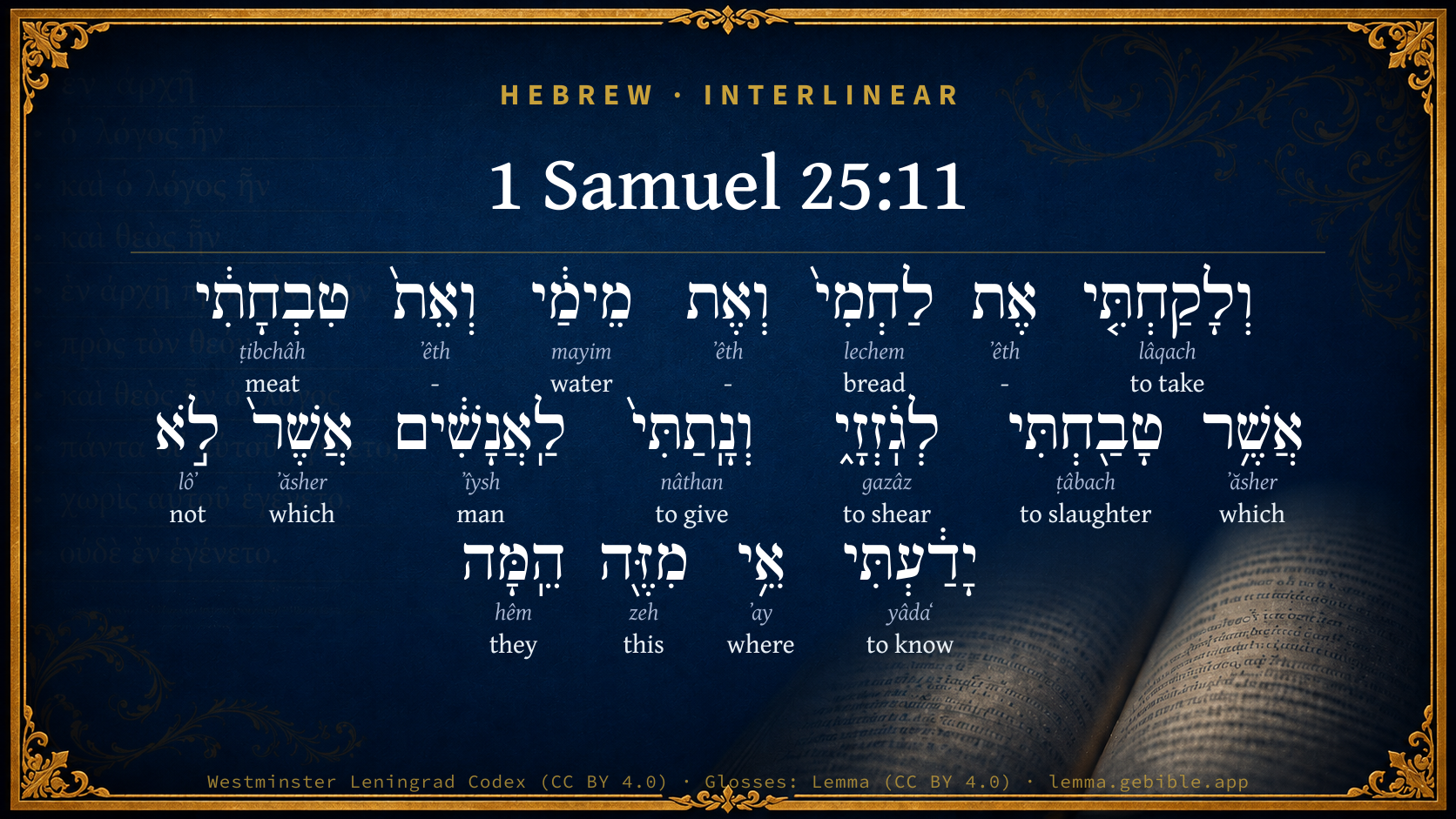
1 Samuel 25:11

Hebrew (Westminster Leningrad Codex) 1 Samuel 25:11 appears in the Hebrew Old Testament. The text above is from the Westminster Leningrad Codex. Each word links to its Strong’s number, a concise gloss, and parsing drawn from the Open Scriptures Hebrew Bible morphology. Click any word for its full Brown-Driver-Briggs (BDB) entry.
Download image
Cite this verse

1 Samuel 25:11 (World English Bible). Public Domain. Lemma interlinear Bible study tool, https://lemma.gebible.app/v/1-samuel/25/11.

Show BibTeX & RIS
BibTeX
RIS
English Translation
Shall I then take my bread, and my water, and my meat that I have killed for my shearers, and give it to men who I don't know where they come from?
World English Bible · Public Domain
Highlights
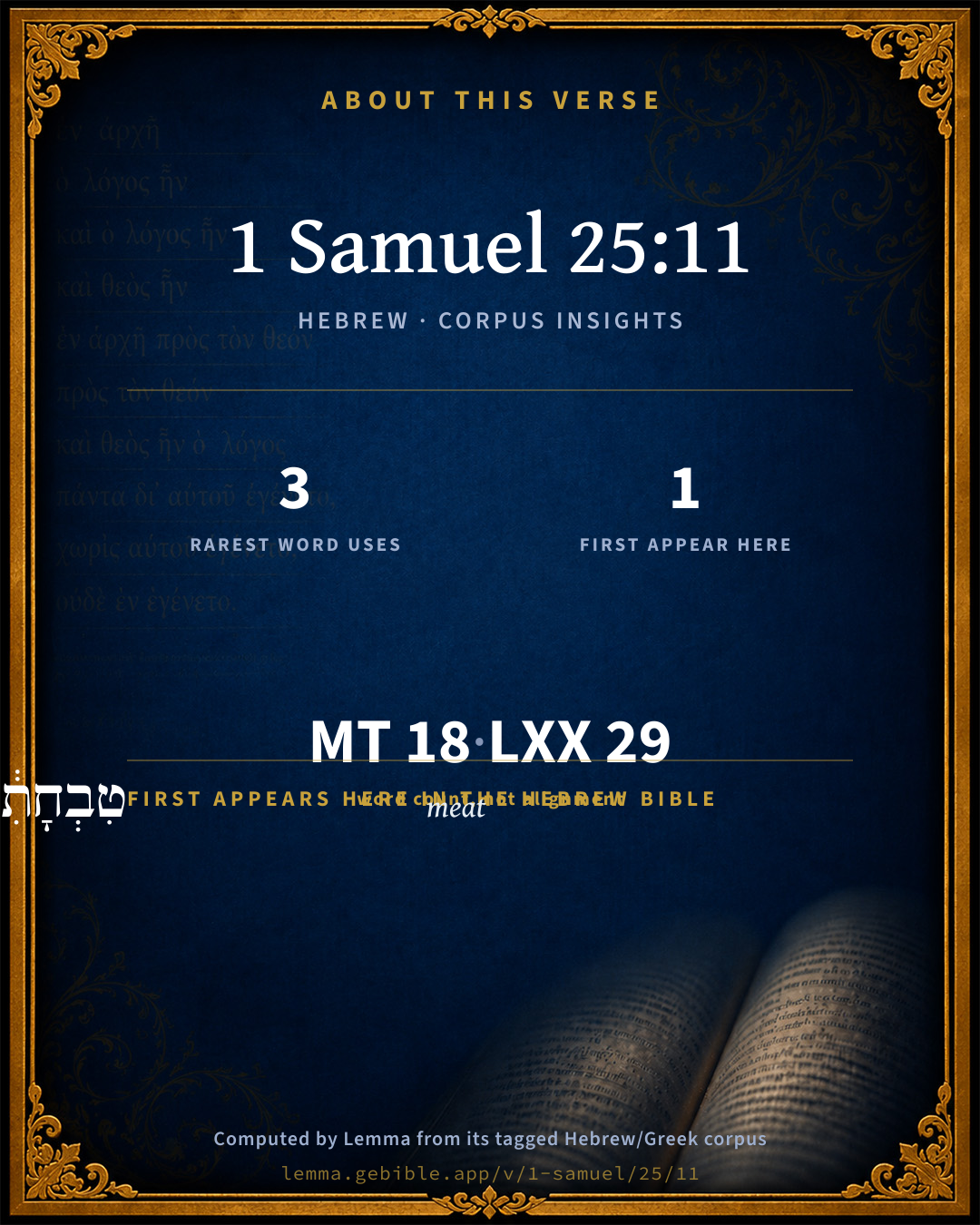
  • 1 first appearance in the Hebrew Bible
Full analysis ↓
Download a study sheet

One document with this verse’s original text, its word-by-word gloss line, the meaning frame, cross-references with their text, attributed commentary, and full source and license credits — printable, and it pastes into notes with its structure intact.

This verse Autodidact and up

Study sheet (.html) Plain text (.txt)

A passage Seminary Student

Up to 50 verses in one chapter. A passage sheet keeps up to 6 commentary sources and 12 cross-references per verse, in the order this page ranks them, and says so on the sheet whenever that leaves anything out. Ask for a single verse and you get the Autodidact verse sheet above.

Everything on this page stays free to read, with no account — the sheet is a download of what is already on screen, not access to it.

Want to remove ads? Support Godless Engineer
Compare translations 3

The same verse in 3 English versions, stacked beneath the original-language interlinear above. Click any original word for its lexicon entry.

Each is an independent rendering of the whole verse — the interlinear is not word-aligned to these translations.

Highlighted words mark where these versions differ — a whole-verse word diff, not a word-by-word alignment.

  • World English Bible Public Domain
    Shall I then take my bread, and my water, and my meat that I have killed for my shearers, and give it to men who I don't know where they come from?
  • King James Version Public Domain
    Shall I then take my bread, and my water, and my flesh that I have killed for my shearers, and give it unto men, whom I know not whence they be?
  • unfoldingWord Literal Text CC BY-SA 4.0
    So shall I take my bread and my water and my slaughter that I have slaughtered for my shearers and give to men whom I do not know where from this they?”

unfoldingWord Literal Text — © unfoldingWord, licensed CC BY-SA 4.0. Word-aligned USFM3 via Door43 (git.door43.org/unfoldingWord/en_ult).

Versions to compare (up to 4)

3 of 4 selected

Show all 18 translations

Every available English version of this verse, each an independent rendering of the whole verse.

  • World English Bible Public Domain
    Shall I then take my bread, and my water, and my meat that I have killed for my shearers, and give it to men who I don't know where they come from?
  • Berean Standard Bible Public Domain
    Why should I take my bread and water and the meat I have slaughtered for my shearers, and give them to these men whose origin I do not know?”
  • Majority Standard Bible Public Domain
    Why should I take my bread and water and the meat I have slaughtered for my shearers, and give them to these men whose origin I do not know?”
  • King James Version Public Domain
    Shall I then take my bread, and my water, and my flesh that I have killed for my shearers, and give it unto men, whom I know not whence they be?
  • American Standard Version (1901) Public Domain
    Shall I then take my bread, and my water, and my flesh that I have killed for my shearers, and give it unto men of whom I know not whence they are?
  • Revised Version (1885) Public Domain
    Shall I then take my bread, and my water, and my flesh that I have killed for my shearers, and give it unto men of whom I know not whence they be?
  • Geneva Bible (1599) Public Domain
    Shall I then take my bread, and my water, and my flesh that I haue killed for my sherers, and giue it vnto men, whom I know not whence they be?
  • Douay-Rheims (1899) Public Domain
    Shall I then take my bread, and my water, and the flesh of my cattle, which I have killed for my shearers, and give to men whom I know not whence they are?
  • Young's Literal Translation Public Domain
    and I have taken my bread, and my water, and my flesh, which I slaughtered for my shearers, and have given `it' to men whom I have not known whence they `are'!'
  • Literal Standard Version CC BY-SA 4.0
    And have I taken my bread, and my water, and my flesh, which I slaughtered for my shearers, and have given [it] to men whom I have not known where they [are] from?”
  • Unlocked Literal Bible CC BY-SA 4.0
    Should I take my bread and my water and my meat that I have killed for my shearers, and give it to men who come from I do not know where?”
  • unfoldingWord Literal Text CC BY-SA 4.0
    So shall I take my bread and my water and my slaughter that I have slaughtered for my shearers and give to men whom I do not know where from this they?”
  • Darby Bible Public Domain
    And shall I take my bread, and my water, and my flesh which I have killed for my shearers, and give [it] to men whom I know not whence they are?
  • World Messianic Bible Public Domain
    Shall I then take my bread, my water, and my meat that I have killed for my shearers, and give it to men who I don’t know where they come from?”
  • Webster's Bible Public Domain
    Shall I then take my bread, and my water, and my flesh that I have killed for my shearers, and give it to men, whom I know not whence they are?
  • Free Bible Version CC BY-SA 4.0
    Why should I take the bread and water I've supplied, and the meat I've slaughtered for my shearers, and hand it over to these strangers? I don't even know where they're from!”
  • Bible in Basic English Public Domain
    Am I to take my bread and my wine and the meat I have got ready for my wool-cutters and give it to men coming from I have no idea where?
  • JPS Tanakh (1917) Public Domain
    shall I then take my bread, and my water, and my flesh that I have killed for my shearers, and give it unto men of whom I know not whence they are?'

Literal Standard Version (2020), Covenant Press — licensed CC BY-SA 4.0. Text via the HelloAO Bible API (eBible.org). Unlocked Literal Bible (unfoldingWord) — licensed CC BY-SA 4.0. Text via the HelloAO Bible API (eBible.org). unfoldingWord Literal Text — © unfoldingWord, licensed CC BY-SA 4.0. Word-aligned USFM3 via Door43 (git.door43.org/unfoldingWord/en_ult). Free Bible Version, Dr. Jonathan Gallagher — licensed CC BY-SA 4.0. Text via the HelloAO Bible API (eBible.org).

Word by word

More ways to search: Search by grammar → Find every occurrence → Compare this word →

Practice this passage: Drill this verse → Learn its vocabulary →

טִבְחָתִ֔י
ṭibchâh
H2878
“meat · my”
Noun, Common, Feminine, Singular, Construct + Suffix, Personal, 1st Person, Common, Singular
Part of Speech
Noun
Type
Common
Gender
Feminine
Number
Singular
State
Construct
Full BDB Definition

Origin: from H2874

TWOT: 786b

slaughtered meat, a slaughter, flesh, meat, thing slaughtered
  1. וְלָקַחְתִּ֤י lâqach H3947 “and · to take” Conjunction + Verb, Qal, Sequential Perfect, 1st Person, Common, Singular
  2. אֶת ʼêth H853 “-” Particle, Direct Object
  3. לַחְמִי֙ lechem H3899 “bread · my” Noun, Common, Both, Singular, Construct + Suffix, Personal, 1st Person, Common, Singular
  4. וְאֶת ʼêth H853 “and · -” Conjunction + Particle, Direct Object
  5. מֵימַ֔י mayim H4325 “water(s) · my” Noun, Common, Masculine, Plural, Construct + Suffix, Personal, 1st Person, Common, Singular
  6. וְאֵת֙ ʼêth H853 “and · -” Conjunction + Particle, Direct Object
  7. אֲשֶׁ֥ר ʼăsher H834 “which” Particle, Relative
  8. טָבַ֖חְתִּי ṭâbach H2873 “to slaughter” Verb, Qal, Perfect, 1st Person, Common, Singular
  9. לְגֹֽזְזָ֑י gazâz H1494 “to/for · shearing · me” Preposition + Verb, Qal, Participle Active, Masculine, Plural, Construct + Suffix, Personal, 1st Person, Common, Singular
  10. וְנָֽתַתִּי֙ nâthan H5414 “and · to give” Conjunction + Verb, Qal, Sequential Perfect, 1st Person, Common, Singular
  11. לַֽאֲנָשִׁ֔ים ʼîysh H376 “to/for · men” Preposition + Noun, Common, Masculine, Plural, Absolute
  12. אֲשֶׁר֙ ʼăsher H834 “which” Particle, Relative
  13. לֹ֣א lôʼ H3808 “not” Particle, Negative
  14. יָדַ֔עְתִּי yâdaʻ H3045 “to know” Verb, Qal, Perfect, 1st Person, Common, Singular
  15. אֵ֥י ʼay H335 “where” Particle, Interrogative
  16. מִזֶּ֖ה zeh H2088 “from · this” Preposition + Pronoun, Demonstrative, Masculine, Singular
  17. הֵֽמָּה hêm H1992 “they” Pronoun, Personal, 3rd Person, Masculine, Plural

About this verse

These counts appear in no published source. They are computed here, from the morphology-tagged text and Lemma’s own curated glosses. What Lemma adds →

18
words
15
distinct lemmas
Historical
section

Notable vocabulary

The rarest word here is טִבְחָתִ֔י meat H2878 — appearing just 3 times in the whole Hebrew Bible.

First appearance in Scripture

This word makes its first canonical appearance in the Hebrew Bible here:

  • טִבְחָתִ֔י meat H2878

Shared distinctive vocabulary

טִבְחָתִ֔י meat H2878 occurs in 3 verses of the Hebrew Bible. Also found in:

Grammatical profile

  • 5 verbs
  • 4 nouns
  • 2 pronouns
  • 7 particles

Verb forms

  • וְלָקַחְתִּ֤י Qal · Sequential Perfect
  • טָבַ֖חְתִּי Qal · Perfect
  • לְגֹֽזְזָ֑י Qal · Participle Active
  • וְנָֽתַתִּי֙ Qal · Sequential Perfect
  • יָדַ֔עְתִּי Qal · Perfect

Repetition

A word recurs within this verse — often emphatic in Hebrew:

  • אֲשֶׁ֥ר which H834 ×2

Hebrew & Septuagint length

In English translation the verse runs 32 words from the Hebrew and 34 from the Septuagint (LXX English) — closely comparable.

A rough comparison of the two English renderings, which tokenize alike — not a word-level alignment.

Word counts can differ between the Hebrew and the Greek without any difference in meaning — e.g. the Hebrew direct-object marker אֵת has no separate Greek word, and Greek often adds the article ὁ.

In the original languages it is 18 Hebrew tokens and 29 Greek tokens — but the two are counted differently (Hebrew bundles its prefixes and suffixes into one token; the Greek is in lemma form), so that isn’t a like-for-like length.

Cross-references

12

Topical passages linked to 1 Samuel 25:11 in the Treasury of Scripture Knowledge — connected by theme and wording, ordered by reader-vote popularity; previews shown in the World English Bible.

  • Judges 8:6 The princes of Succoth said, Are the hands of Zebah and Zalmunna now in your hand, that we should give bread to your army?
  • Galatians 6:10 So then, as we have opportunity, let's do what is good toward all men, and especially toward those who are of the household of the faith.
  • Deuteronomy 8:17 and [lest] you say in your heart, My power and the might of my hand has gotten me this wealth.
  • 1 Samuel 24:13 As says the proverb of the ancients, Out of the wicked comes forth wickedness; but my hand shall not be on you.
  • 1 Samuel 25:3 Now the name of the man was Nabal; and the name of his wife Abigail; and the woman was of good understanding, and of a beautiful face: but the man was churlish and evil in his doings; and he was of the house of Caleb.
  • 1 Samuel 25:14–15 But one of the young men told Abigail, Nabal's wife, saying, Behold, David sent messengers out of the wilderness to Greet our master; and he railed at them.
  • Job 31:17 Or have eaten my morsel alone, And the fatherless has not eaten of it
  • Psalms 73:7–8 Their eyes bulge with fat. Their minds pass the limits of conceit.
  • Ecclesiastes 11:1–2 Cast your bread on the waters; For you shall find it after many days.
  • John 9:29–30 We know that God has spoken to Moses. But as for this man, we don't know where he comes from."
  • 2 Corinthians 6:9 as unknown, and yet well known; as dying, and behold, we live; as punished, and not killed;
  • 1 Peter 4:9 Be hospitable one to another without grumbling.

Cross-references courtesy of OpenBible.info (CC BY 4.0).

Hebrew and Greek witnesses Masoretic Hebrew ↔ Greek Septuagint

The same verse in the two great witnesses to the Old Testament, shown verse-for-verse.

These are two independent witnesses, not word-aligned to each other, and the Septuagint is shown in lemma (dictionary) form.

Hebrew 1 Samuel 25:11 Masoretic · Westminster Leningrad Codex

וְלָקַחְתִּ֤י אֶת לַחְמִי֙ וְאֶת מֵימַ֔י וְאֵת֙ טִבְחָתִ֔י אֲשֶׁ֥ר טָבַ֖חְתִּי לְגֹֽזְזָ֑י וְנָֽתַתִּי֙ לַֽאֲנָשִׁ֔ים אֲשֶׁר֙ לֹ֣א יָדַ֔עְתִּי אֵ֥י מִזֶּ֖ה הֵֽמָּה

Shall I then take my bread, and my water, and my meat that I have killed for my shearers, and give it to men who I don't know where they come from?

World English Bible · Public Domain

Greek LXX 1 Samuel 25:11 Septuagint · lemma form

καί λαμβάνω ὁ ἄρτος ἐγώ καί ὁ οἶνος ἐγώ καί ὁ θῦμα ἐγώ ὅς θύω ὁ κείρω ἐγώ ὁ πρόβατον καί δίδωμι αὐτός ἀνήρ ὅς οὐ οἶδα πόθεν εἰμί

And shall I take my bread, and my wine, and my beasts that I have slain for my shearers, and shall I give them to men of whom I know not whence they are?

LXX2012 (modern English Septuagint) · Public Domain

On this verse, Ellicott's Commentary for English Readers discusses the Septuagint’s reading. Read the note in Commentary ↓

Hebrew: Westminster Leningrad Codex (CC BY 4.0). Greek: Septuagint (public domain); English from LXX2012 (modern English Septuagint) (Public Domain). How the Septuagint differs from the Hebrew →

Targum (Aramaic paraphrase)

1

The Targum is the ancient Jewish Aramaic paraphrase of the Hebrew Scriptures — an interpretive translation, not the Hebrew text itself. Onkelos (literal) and Pseudo-Jonathan (expansive) render the Torah, and Jonathan the Prophets. Coverage is partial: where no permissively-licensed English translation exists for a verse, only the Aramaic is shown. This is verse-level text, not a word-by-word alignment to the Hebrew.

  1. Targum Jonathan Prophets (Joshua–Malachi)
    וְאֶסַב יַת מֵיכְלֵי וְיַת מִשְׁתִּי וְיַת שֵׁירוּתִי דְאַתְקֵינִית לְגָזְזַי וְאֶתֵּן לְגַבְרַיָא דְלָא יְדַעַת אֵי מִנָן אִנוּן:

    (no public-domain English translation for this verse)

    Targum Jonathan — Aramaic: “Mikraot Gedolot” (public domain). English: “Sefaria Community Translation” (CC0 1.0 (public-domain dedication)); “London "Chaldee Paraphrase," 1871” (public domain). Text via Sefaria.

Commentary

Notes on 1 Samuel 25:11 from classic Christian and Jewish commentators (each source and its license shown beneath its notes). The classic Christian expositions comment on the surrounding passage and are grouped to its opening verse, so a note may address several verses; the Jewish commentaries on the Tanakh (Rashi and others) are per-verse, so they appear only where the commentator wrote on this verse.

Lemma curates 59 commentaries, every one of them public domain or Creative Commons licensed, each selected and text-cleaned for this edition rather than reprinted as found. About our sources →

Trapp's Complete Commentary

John Trapp

1Sa 25:11 Shall I then take my bread, and my water, and my flesh that I have killed for my shearers, and give [it] unto men, whom I know not whence they [be]?

Ver. 11. Shall I then take my bread.] All Nahal’s logic was little enough to conclude for himself and his sheep shearers: as those envious Athenians would sacrifice for none but themselves and their neighbours of Chios. Selfish people had as gladly part with their blood as with their goods: it is not the lack, but the love of money that maketh men churls.

John Trapp, A Commentary or Exposition upon All the Books of the Old and New Testament (1647–1656) — public domain. Text from a community e-Sword module.

The Biblical Illustrator

Joseph S. Exell

1Sa_25:11

Shall I then take my bread, and my water.

Avarice of Nabal

Such is still the language of the avaricious man; such are still the excuses made by the insensible heart, when it seeks some pretext to exempt it from relieving the wants of the unhappy. Let us consider the frivolity of these his excuses.

I. Excuse made by Nabal my possessions are strictly and properly my own, and I have a right to employ them as I please. Shall I take my bread, and my water, and my flesh. This is also an excuse that we still hear daily presented by the covetous and uncharitable. But common as is this excuse, it is not only demonstrably false, but also awfully impious, and strikes directly at the providence, the government, and the sovereignty of the Most High God. No! Your wealth is not your own natural, as well as revealed religion, declares that you are only stewards.

II. Excuse of nabal: the supposed inferiority of those for whom his assistance was solicited and his want of relationship to him. Who is David? and who is the son of Jesse? There be many servants now-a-days that break away every man from his master. This excuse also is still daily presented, when we plead for the distressed. There can be little doubt, that the ignorance of Nabal was only pretended, that he might render his reply more contemptuous, he well knew the valour and reputation of David. Do you add, with Nabal, Who is David? Who are these poor orphans? What relationship are they to me, that I should assist them? They have descended from the same patent with you; their origin is your own. In them as well as you, there is a soul endued with wonderful faculties; a soul destined to endless happiness or eternal misery.

III. Excuse of Nabal: his unwillingness to encourage vice or indolence. There be many servants now-a-days that break away every man from his master! This excuse too we often hear when we ask relief for the distressed. Shall I give? Yes: because of the instability of all earthly things. Do you still ask with Nabal, Shall I give? Yes; consider the day of trouble and bestow your benefaction. Shall I give? Yes; if you wish your memory to be cherished by your survivors. Shall I give? Yes! for the judgment day is approaching: and then: what unutterable anguish, what agonising horror, shall convulse the heart of him who shall receive judgment without mercy, because he hath showed no mercy! (H. Kollock, D. D.)

The Message of the Church to man of wealth

An awful and uncertain spectacle, but the spectacle which is exhibited in every country where Rights are keenly felt and Duties lightly regarded--where insolent demand is met by insulting defiance. Wherever classes are held apart by rivalry and selfishness instead of drawn together by the Law of Love--wherever there has not been established a kingdom of heaven, but only a kingdom of the world--there exist the forces of inevitable collision.

I. The causes of this false social state.

1. False basis on which medial superiority was held to rest. Throughout Nabals conduct was built upon the assumption of his own superiority. He was a man of wealth. David was dependent on his own daily efforts. Now observe two things.

(1) An apparent inconsistency in Davids conduct. One injury from Nabal, and David is striding over the hills to revenge his wrong with naked steel. How came this reverence and irreverence to mix together? We reply. Saul had a claim of authority on Davids allegiance: Nabal only one of rank. Between these the Bible makes a vast difference. It says, The powers which be are ordained of God. But upper and lower, as belonging to difference in property are fictitious terms: true, if character corresponds with titular superiority; false, if it does not.

(2) This great falsehood respecting superior and inferior, rested on a truth. There had been a superiority in the wealthy class once. In the patriarchal system wealth and rule had gone together. It is a fallacy in which we are perpetually entangled. We expect reverence for that which was once a symbol of what was reverenced, but is reverenced no longer. No. That patriarchal system has passed forever.

2. A false conception respecting Rights. It would be unjust to Nabal to represent this as an act of wilful oppression and conscious injustice. He did what appeared to him fair between man and man. He paid his labourers. Why should he pay anything beyond stipulated wages? Recollect too, there was something to be said for Nabal. This view of the irresponsible right of property was not his invention. It was the view probably entertained by all his class. It had descended to him from his parents. They were prescriptive and admitted rights on which he stood. On the other hand, David and his needy followers were not slow to perceive that they had their rights over that property of Nabals. In point of fact, David had a right to a share of Nabals profits. The harvest was in part Davids harvest, for without David it never could have been reaped. Here, then, is one of the earliest instances of the Rights of Labour coming into collision with the Rights of Property. Now when it comes to this, Rights against Rights, there is no determination of the question but by overwhelming numbers or blood. We find another cause in circumstances. Want and unjust exclusion precipitated David and his men into this rebellion. It is common enough to lay too much weight on circumstances. Circumstances of outward condition are not the sole efficients in the production of character, but they are efficients which must not be ignored. Favourable condition will not produce excellence: but the want of it often hinders excellence. It is true that vice leads to poverty: all the moralisers tell us that, but it is also true that poverty leads to vice.

II. The message of the Church to the man of wealth. The message of the Church contains those principles of life which, carried out would, and hereafter will, realise the Divine Order of Society.

1. The spiritual dignity of man as man. Recollect David was the poor man, but Abigail, the high-born lady, admits his worth. Worth does not mean what a man is worth--you must find some better definition than that. That is the Churchs message be the man of wealth, and a message which it seems has to be learned afresh in every ago. It was new to Nabal. It was new to the men of the ago of Christ. In His day, they were offended in Him, because He was humbly born. Is not this the carpenters son? It is the offence now. They who retain those superstitious ideas of the eternal superiority of rank and wealth, have the first principles of the Gospel yet to learn.

2. The second truth expressed by Abigail was the Law of Sacrifice. She did not heal the grievance with smooth words. Starving men are not to be pacified by professions of good will. She brought her two hundred loaves, and her two skins of wine, her five sheep ready dressed, etc. A princely provision! Now this the Church proclaims as part of its special message to the rich. The Self-sacrifice of the Redeemer was to be the living principle and law of the self-devotion of His people. To the spirit of the Cross alone we look as the remedy for social evils.

3. The last part of the Churchs message to the man of wealth touches the matter of rightful influence. Very remarkable is the demeanour of David towards Nabal, as contrasted with his demeanour towards Abigail. In the one case, defiance, and a haughty self-assertion of equality--in the other, deference, respect, and the most eloquent benediction. It was not therefore against the wealthy class, but against individuals of the class, that the wrath of these men burned. See then, the folly and the falsehood of the sentimental regret that there is no longer any reverence felt towards superiors. There is reverence to superiors, if only it can be shown that they are superiors. The fiercest revolt against false authority is only a step towards submission to rightful authority. Emancipation from false lords only sets the heart free to honour true ones. (F. W. Robertson, M. A.)

The Biblical Illustrator, edited by Joseph S. Exell (c. 1880s–1900s) — public domain. Text from a community e-Sword module.

Ellicott's Commentary for English Readers

(11) Unto men, whom I know not.—In other words, “Shall I give largesse to the enemies of my king—to a band of rebel freebooters?”

My water.—The LXX., instead of “water,” read “wine.” This is one of the countless alterations this version arbitrarily makes in the original sacred text. The Greek translators were puzzled at Nabal’s enumeration of “water” as one of the demands of David. Its mention, however, is a mark of the accuracy of the record. Water in many parts of the East is exceedingly precious. The words of Jos_15:19 clearly indicate the especial want of this district of Palestine, when Caleb’s daughter Achsah specially prayed her father for springs of water. Its mention, however, can scarcely, as Dean Payne Smith observes, “mark the abstemious habits of the people,” considering in the same chapter we find the owner of all these flocks prostrate through intoxication.

A Bible Commentary for English Readers, edited by Charles John Ellicott (1878–1897) — public domain. Text from a community e-Sword module.

The Cambridge Bible for Schools and Colleges

gen. ed. J. J. S. Perowne

11. my water] Perhaps water is specially mentioned because it is scarce in the district. Cp. Jos_15:19. The Sept. however has “wine.”

The Cambridge Bible for Schools and Colleges (gen. ed. J. J. S. Perowne; Cambridge University Press, 1878–1918) — public domain. Text from a community e-Sword module.

John Gill's Exposition

Shall I then take my bread, and my water,.... Which include all food and liquors, everything eatable and drinkable; and "water" may be particularly mentioned, because very scarce in the wilderness, and so precious; though the Septuagint version has "wine" instead of "water":

and my flesh which I have killed for my shearers; whether oxen, or sheep, or lambs, as there might be of each sort, for an entertainment made on such an occasion:

and give it unto men whom I know not whence they be? which is another argument Abarbinel makes use of that he meant not David, but his men only, because he did not know who and from whence they were.

John Gill's Exposition of the Whole Bible (1746–1763) — public domain (CC PDM 1.0). Text via the HelloAO Bible API.

Albert Barnes' Notes on the Bible

The mention of water indicates a country where water was scarce (compare Jos 15:19). Or “bread and water” may be equivalent to “meat and drink.”

Albert Barnes' Notes on the Bible (1834–1885) — public domain. Text from a community e-Sword/MySword module.

Haydock's Catholic Bible Commentary

Water, under which name all sorts of drinks are included. Nabal had plenty of wine, and was much intoxicated, ver. 36. Septuagint translate, "wine." Syriac and Arabic, "drink." --- Cattle. Hebrew, "victims," which is a term used both for sacred and profane feasts.

George Leo Haydock (1774–1849), Haydock's Catholic Family Bible and Commentary, 1859 edition — public domain. Excludes Psalms (Douay-Rheims chapter numbering differs from Protestant) and Deuterocanonical books (Catholic canon only).

Matthew Poole's English Annotations

My water; he speaketh thus, either because in those hot and dry parts water was scarce and precious; or water is here put for any kind of drink, as bread is oft taken for all sorts of meat.

Matthew Poole's English Annotations on the Holy Bible (1683–1685) — public domain. Text from a community e-Sword/MySword module.

Lesson kit

Teaching starters — assembled from the data on this page, not authored interpretation. Every prompt links to the verse data it draws on. Edit before teaching.

1 Samuel, in the Historical, opens this verse with 18 words (15 distinct Hebrew lemmas). Its most distinctive word is ṭibchâh (“meat”). A historical commentator’s framing appears above. Read the whole chapter for the surrounding context.

Discussion questions

  1. How does “meat” (ṭibchâh) shape what this verse is saying?
  2. This is the first place “meat” appears in Scripture (first appears here). What does its debut here establish?
  3. How does Psalms 44:22, which shares the word «meat», read alongside this verse?
  4. What does the repetition of “which” (2× in this one verse) do in this verse?
  5. These translations render this verse differently. What is at stake in choosing one wording over another?
  6. «וְלָקַחְתִּ֤י» is a Qal Sequential Perfect verb. How does that grammatical form shape the action described?
  7. Compare how Trapp's Complete Commentary and The Biblical Illustrator read this verse. Where do they agree or differ?

Things to notice

Reading settings

Reading text

Shown beneath each verse's original-language words.

Old Testament
Old Testament edition

Read the OT as the Masoretic Hebrew (MT) or the Greek Septuagint (LXX).

English shown for the Greek Septuagint (in the Hebrew ↔ Greek comparison).

Comparing translations? Open the Compare panel on any verse page to stack up to four side by side.