Genesis 21:29

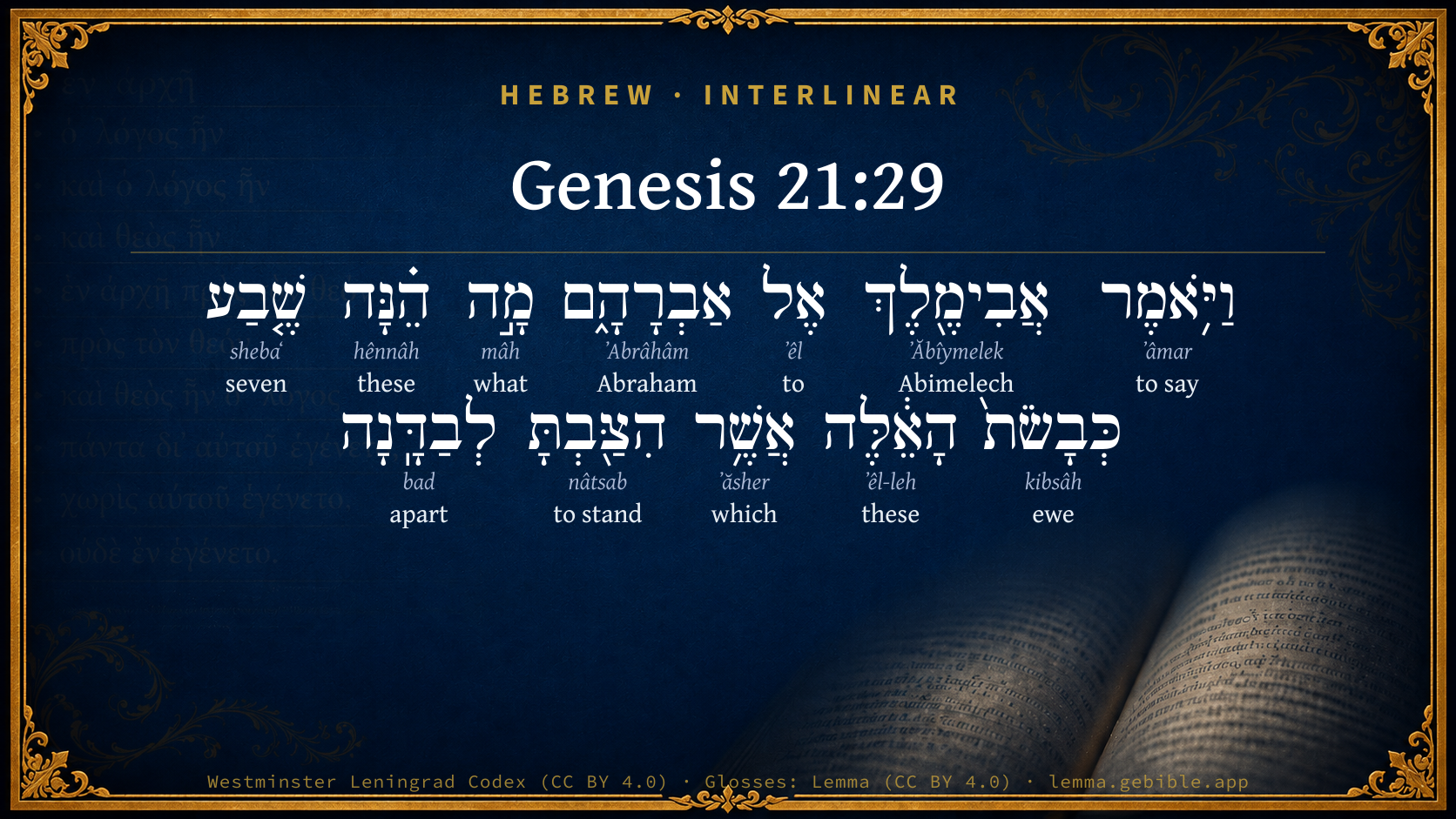
Hebrew (Westminster Leningrad Codex) Genesis 21:29 appears in the Hebrew Old Testament. The text above is from the Westminster Leningrad Codex. Each word links to its Strong’s number, a concise gloss, and parsing drawn from the Open Scriptures Hebrew Bible morphology. Click any word for its full Brown-Driver-Briggs (BDB) entry.
Download image
Cite this verse

Genesis 21:29 (World English Bible). Public Domain. Lemma interlinear Bible study tool, https://lemma.gebible.app/v/genesis/21/29.

Show BibTeX & RIS
BibTeX
RIS
English Translation
Abimelech said to Abraham, "What do these seven ewe lambs which you have set by themselves mean?"
World English Bible · Public Domain
Download a study sheet

One document with this verse’s original text, its word-by-word gloss line, the meaning frame, cross-references with their text, attributed commentary, and full source and license credits — printable, and it pastes into notes with its structure intact.

This verse Autodidact and up

Study sheet (.html) Plain text (.txt)

A passage Seminary Student

Up to 50 verses in one chapter. A passage sheet keeps up to 6 commentary sources and 12 cross-references per verse, in the order this page ranks them, and says so on the sheet whenever that leaves anything out. Ask for a single verse and you get the Autodidact verse sheet above.

Everything on this page stays free to read, with no account — the sheet is a download of what is already on screen, not access to it.

Want to remove ads? Support Godless Engineer
Compare translations 3

The same verse in 3 English versions, stacked beneath the original-language interlinear above. Click any original word for its lexicon entry.

Each is an independent rendering of the whole verse — the interlinear is not word-aligned to these translations.

Highlighted words mark where these versions differ — a whole-verse word diff, not a word-by-word alignment.

  • World English Bible Public Domain
    Abimelech said to Abraham, "What do these seven ewe lambs which you have set by themselves mean?"
  • King James Version Public Domain
    And Abimelech said unto Abraham, What mean these seven ewe lambs which thou hast set by themselves?
  • unfoldingWord Literal Text CC BY-SA 4.0
    So Abimelech said to Abraham, “What they, these seven ewe lambs that you have set apart by themselves?”

unfoldingWord Literal Text — © unfoldingWord, licensed CC BY-SA 4.0. Word-aligned USFM3 via Door43 (git.door43.org/unfoldingWord/en_ult).

Versions to compare (up to 4)

3 of 4 selected

Show all 18 translations

Every available English version of this verse, each an independent rendering of the whole verse.

  • World English Bible Public Domain
    Abimelech said to Abraham, "What do these seven ewe lambs which you have set by themselves mean?"
  • Berean Standard Bible Public Domain
    and Abimelech asked him, “Why have you set apart these seven ewe lambs?”
  • Majority Standard Bible Public Domain
    and Abimelech asked him, “Why have you set apart these seven ewe lambs?”
  • King James Version Public Domain
    And Abimelech said unto Abraham, What mean these seven ewe lambs which thou hast set by themselves?
  • American Standard Version (1901) Public Domain
    And Abimelech said unto Abraham, What mean these seven ewe lambs which thou hast set by themselves?
  • Revised Version (1885) Public Domain
    And Abimelech said unto Abraham, What mean these seven ewe lambs which thou hast set by themselves?
  • Geneva Bible (1599) Public Domain
    Then Abimelech said vnto Abraham, What meane these seuen lambes, which thou hast set by themselues?
  • Douay-Rheims (1899) Public Domain
    And Abimelech said to him: What mean these seven ewe lambs which thou hast set apart?
  • Young's Literal Translation Public Domain
    And Abimelech saith unto Abraham, `What `are' they -- these seven lambs which thou hast set by themselves?'
  • Literal Standard Version CC BY-SA 4.0
    And Abimelech says to Abraham, “What [are] they—these seven lambs which you have set by themselves?”
  • Unlocked Literal Bible CC BY-SA 4.0
    Abimelech said to Abraham, “What is the meaning of these seven female lambs that you have set by themselves?”
  • unfoldingWord Literal Text CC BY-SA 4.0
    So Abimelech said to Abraham, “What they, these seven ewe lambs that you have set apart by themselves?”
  • Darby Bible Public Domain
    And Abimelech said to Abraham, What [mean] these seven ewe-lambs, these which thou hast set by themselves?
  • World Messianic Bible Public Domain
    Abimelech said to Abraham, “What do these seven ewe lambs, which you have set by themselves, mean?”
  • Webster's Bible Public Domain
    And Abimelech said to Abraham, What mean these seven ewe-lambs, which thou hast set by themselves?
  • Free Bible Version CC BY-SA 4.0
    “What are these seven female lambs for that you've separated from the flock?” Abimelech asked.
  • Bible in Basic English Public Domain
    Then Abimelech said, What are these seven lambs which you have put on one side?
  • JPS Tanakh (1917) Public Domain
    And Abimelech said unto Abraham: 'What mean these seven ewe-lambs which thou hast set by themselves?'

Literal Standard Version (2020), Covenant Press — licensed CC BY-SA 4.0. Text via the HelloAO Bible API (eBible.org). Unlocked Literal Bible (unfoldingWord) — licensed CC BY-SA 4.0. Text via the HelloAO Bible API (eBible.org). unfoldingWord Literal Text — © unfoldingWord, licensed CC BY-SA 4.0. Word-aligned USFM3 via Door43 (git.door43.org/unfoldingWord/en_ult). Free Bible Version, Dr. Jonathan Gallagher — licensed CC BY-SA 4.0. Text via the HelloAO Bible API (eBible.org).

Word by word

More ways to search: Search by grammar → Find every occurrence → Compare this word →

Practice this passage: Drill this verse → Learn its vocabulary →

כְּבָשֹׂת֙
kibsâh
H3535
“ewes”
Noun, Common, Feminine, Plural, Absolute
Part of Speech
Noun
Type
Common
Gender
Feminine
Number
Plural
State
Absolute
Full BDB Definition

Origin: from H3532

TWOT: 950

ewe-lamb, lamb
  1. וַיֹּ֥אמֶר ʼâmar H559 “and · to say” Conjunction + Verb, Qal, Sequential Imperfect, 3rd Person, Masculine, Singular
  2. אֲבִימֶ֖לֶךְ ʼĂbîymelek H40 “Abimelech” Noun, Proper
  3. אֶל ʼêl H413 “to” Preposition
  4. אַבְרָהָ֑ם ʼAbrâhâm H85 “Abraham” Noun, Proper
  5. מָ֣ה mâh H4100 “what” Particle, Interrogative
  6. הֵ֗נָּה hênnâh H2007 “these” Pronoun, Personal, 3rd Person, Feminine, Plural
  7. שֶׁ֤בַע shebaʻ H7651 “seven” Adjective, Cardinal number, Feminine, Singular, Absolute
  8. הָאֵ֔לֶּה ʼêl-leh H428 “the · these” Particle, Definite Article + Pronoun, Demonstrative, Common, Plural
  9. אֲשֶׁ֥ר ʼăsher H834 “which” Particle, Relative
  10. הִצַּ֖בְתָּ nâtsab H5324 “to stand” Verb, Hiphil, Perfect, 2nd Person, Masculine, Singular
  11. לְבַדָּֽנָה bad H905 “to/for · apart · their” Preposition + Noun, Common, Masculine, Singular, Construct + Suffix, Personal, 3rd Person, Feminine, Plural

About this verse

These counts appear in no published source. They are computed here, from the morphology-tagged text and Lemma’s own curated glosses. What Lemma adds →

12
words
12
distinct lemmas
Pentateuch
section

Notable vocabulary

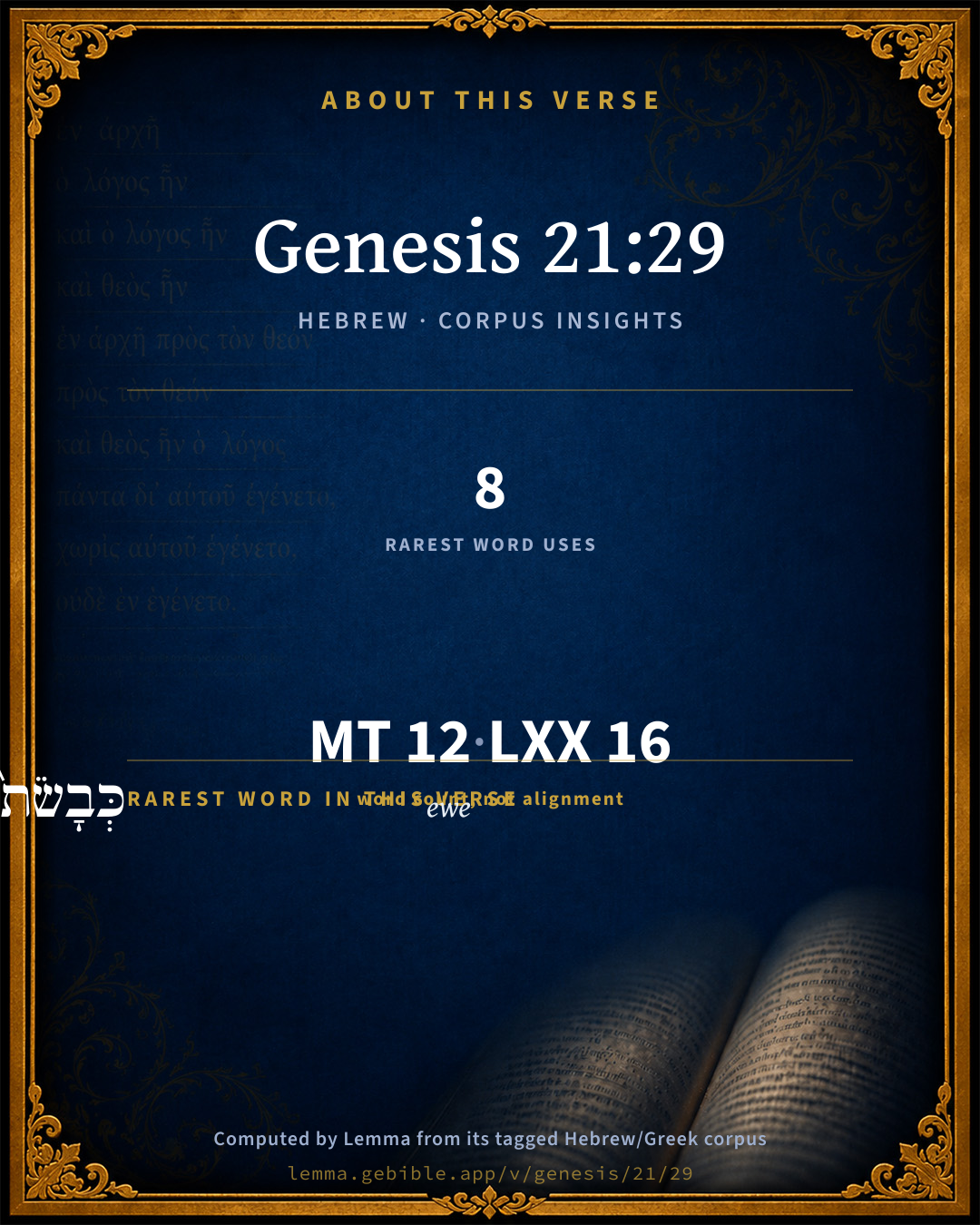
The rarest word here is כְּבָשֹׂת֙ ewe H3535 — appearing just 8 times in the whole Hebrew Bible.

Shared distinctive vocabulary

כְּבָשֹׂת֙ ewe H3535 occurs in 8 verses of the Hebrew Bible. Also found in:

Grammatical profile

  • 2 verbs
  • 4 nouns
  • 1 adjective
  • 2 pronouns
  • 1 preposition
  • 2 particles

Verb forms

  • וַיֹּ֥אמֶר Qal · Sequential Imperfect
  • הִצַּ֖בְתָּ Hiphil · Perfect

Hebrew & Septuagint length

In English translation the verse runs 17 words from the Hebrew and 15 from the Septuagint (LXX English) — closely comparable.

A rough comparison of the two English renderings, which tokenize alike — not a word-level alignment.

Word counts can differ between the Hebrew and the Greek without any difference in meaning — e.g. the Hebrew direct-object marker אֵת has no separate Greek word, and Greek often adds the article ὁ.

In the original languages it is 12 Hebrew tokens and 16 Greek tokens — but the two are counted differently (Hebrew bundles its prefixes and suffixes into one token; the Greek is in lemma form), so that isn’t a like-for-like length.

Cross-references

3

Topical passages linked to Genesis 21:29 in the Treasury of Scripture Knowledge — connected by theme and wording, ordered by reader-vote popularity; previews shown in the World English Bible.

  • Genesis 33:8 Esau said, "What do you mean by all this company which I met?" Jacob said, "To find favor in the sight of my lord."
  • Exodus 12:26 It will happen, when your children ask you, 'What do you mean by this service?'
  • 1 Samuel 15:14 Samuel said, What means then this bleating of the sheep in my ears, and the lowing of the oxen which I hear?

Cross-references courtesy of OpenBible.info (CC BY 4.0).

Hebrew and Greek witnesses Masoretic Hebrew ↔ Greek Septuagint

The same verse in the two great witnesses to the Old Testament, shown verse-for-verse.

These are two independent witnesses, not word-aligned to each other, and the Septuagint is shown in lemma (dictionary) form.

Hebrew Genesis 21:29 Masoretic · Westminster Leningrad Codex

וַיֹּ֥אמֶר אֲבִימֶ֖לֶךְ אֶל אַבְרָהָ֑ם מָ֣ה הֵ֗נָּה שֶׁ֤בַע כְּבָשֹׂת֙ הָאֵ֔לֶּה אֲשֶׁ֥ר הִצַּ֖בְתָּ לְבַדָּֽנָה

Abimelech said to Abraham, "What do these seven ewe lambs which you have set by themselves mean?"

World English Bible · Public Domain

Greek LXX Genesis 21:29 Septuagint · lemma form

καί εἶπον αβιμελεχ ὁ αβρααμ τίς εἰμί ὁ ἑπτά ἀμνάς ὁ πρόβατον οὗτος ὅς ἵστημι μόνος

And Abimelech said to Abraam, What are these seven ewe-lambs which you have set alone?

LXX2012 (modern English Septuagint) · Public Domain

Hebrew: Westminster Leningrad Codex (CC BY 4.0). Greek: Septuagint (public domain); English from LXX2012 (modern English Septuagint) (Public Domain). How the Septuagint differs from the Hebrew →

Targum (Aramaic paraphrase)

2

The Targum is the ancient Jewish Aramaic paraphrase of the Hebrew Scriptures — an interpretive translation, not the Hebrew text itself. Onkelos (literal) and Pseudo-Jonathan (expansive) render the Torah, and Jonathan the Prophets. Coverage is partial: where no permissively-licensed English translation exists for a verse, only the Aramaic is shown. This is verse-level text, not a word-by-word alignment to the Hebrew.

  1. Targum Onkelos Torah (Genesis–Deuteronomy)
    וַאֲמַר אֲבִימֶלֶךְ לְאַבְרָהָם מָה אִנּוּן שְׁבַע חוּרְפַן אִלֵּין דַּאֲקֵמְתָּא בִּלְחוֹדֵיהֶן

    (no public-domain English translation for this verse)

    Targum Onkelos — Aramaic: “Onkelos Genesis” (public domain); “Onkelos Exodus” (public domain); “Onkelos Leviticus” (public domain); “Onkelos Numbers” (public domain); “Onkelos Deuteronomy” (public domain). English: “Sefaria Community Translation” (CC0 1.0 (public-domain dedication)); “J.W. Etheridge. The Targums of Onkelos and Jonathan Ben Uzziel on the Pentateuch. London: Longmans, Green, 1862” (public domain). Text via Sefaria.

  2. Targum Pseudo-Jonathan Torah (Genesis–Deuteronomy)
    וַאֲמַר אֲבִימֶלֶךְ לְאַבְרָהָם מָה הִינוּן שְׁבַע חוּרְפַן הָאִלֵין דַאֲקֵמְתָּא בִּלְחוֹדֵיהוֹן

    And Abimelek said to Abraham, What are these seven lambs which thou hast set apart?

    Targum Pseudo-Jonathan — Aramaic: “Targum Jonathan on Genesis” (public domain); “Targum Jonathan on Exodus” (public domain); “Targum Jonathan on Leviticus” (public domain); “Targum Jonathan on Numbers” (public domain); “Targum Jonathan on Deuteronomy” (public domain). English: “The Targum of Jonathan ben Uzziel, trans. J. W. Etheridge, London, 1862” (public domain). Text via Sefaria.

Commentary

Notes on Genesis 21:29 from classic Christian and Jewish commentators (each source and its license shown beneath its notes). The classic Christian expositions comment on the surrounding passage and are grouped to its opening verse, so a note may address several verses; the Jewish commentaries on the Tanakh (Rashi and others) are per-verse, so they appear only where the commentator wrote on this verse.

Lemma curates 59 commentaries, every one of them public domain or Creative Commons licensed, each selected and text-cleaned for this edition rather than reprinted as found. About our sources →

Trapp's Complete Commentary

John Trapp

Gen 21:29 And Abimelech said unto Abraham, What [mean] these seven ewe lambs which thou hast set by themselves?

Gen 21:30 And he said, For [these] seven ewe lambs shalt thou take of my hand, that they may be a witness unto me, that I have digged this well.

Ver. 29, 30. These seven ewe-lambs.] Wherewith I will buy my peaceable enjoyment of this well, for the future.

That they may be a witness.] A means to prevent contention, which is sooner stirred than stinted. And I have not observed, saith one, that many have been healed by going into troubled waters, though moved by the best angels of the Church.

John Trapp, A Commentary or Exposition upon All the Books of the Old and New Testament (1647–1656) — public domain. Text from a community e-Sword module.

John Gill's Exposition

Thus they made a covenant at Beersheba,.... Which took its name from the oath annexed to the covenant there made; and which is observed for the sake of what follows, to show that when they finished their agreement, and the ceremony of it:

then Abimelech rose up, and Phichol, the chief captain of his host; from the place where they had been conversing and covenanting with Abraham:

and they returned into the land of the Philistines; from Beersheba, which was in the extreme border of it, unto Gerar, which lay in the midst of it, and was the capital city in it; otherwise both places were in Palestine, or the land of the Philistines, a people that came out of Egypt originally, and settled here: in Jerom's (u) time Beersheba was a large village, twenty miles from Hebron to the south.

(u) De loc. Heb. fol. 89. F.

John Gill's Exposition of the Whole Bible (1746–1763) — public domain (CC PDM 1.0). Text via the HelloAO Bible API.

Lesson kit

Teaching starters — assembled from the data on this page, not authored interpretation. Every prompt links to the verse data it draws on. Edit before teaching.

Genesis, in the Pentateuch, opens this verse with 12 words (12 distinct Hebrew lemmas). Its most distinctive word is kibsâh (“ewe”). A historical commentator’s framing appears above. Read the whole chapter for the surrounding context.

Discussion questions

  1. How does “ewe” (kibsâh) shape what this verse is saying?
  2. Genesis 21:28 shares the word «ewe» with this verse. How do the two illuminate each other?
  3. These translations render this verse differently; the difference is in the English rendering, not the original. What questions does that raise?
  4. The verb «וַיֹּ֥אמֶר» is Qal Sequential Imperfect. How does its form color the action?
  5. Reading how Trapp's Complete Commentary and John Gill's Exposition read this verse, where do the two commentators agree and where do they part?

Things to notice

Reading settings

Reading text

Shown beneath each verse's original-language words.

Old Testament
Old Testament edition

Read the OT as the Masoretic Hebrew (MT) or the Greek Septuagint (LXX).

English shown for the Greek Septuagint (in the Hebrew ↔ Greek comparison).

Comparing translations? Open the Compare panel on any verse page to stack up to four side by side.