2 Kings 4:5

Hebrew (Westminster Leningrad Codex) 2 Kings 4:5 appears in the Hebrew Old Testament. The text above is from the Westminster Leningrad Codex. Each word links to its Strong’s number, a concise gloss, and parsing drawn from the Open Scriptures Hebrew Bible morphology. Click any word for its full Brown-Driver-Briggs (BDB) entry.
Download image
Cite this verse

2 Kings 4:5 (World English Bible). Public Domain. Lemma interlinear Bible study tool, https://lemma.gebible.app/v/2-kings/4/5.

Show BibTeX & RIS
BibTeX
RIS
English Translation
So she went from him, and shut the door on her and on her sons; they brought [the vessels] to her, and she poured out.
World English Bible · Public Domain
Download a study sheet

One document with this verse’s original text, its word-by-word gloss line, the meaning frame, cross-references with their text, attributed commentary, and full source and license credits — printable, and it pastes into notes with its structure intact.

This verse Autodidact and up

Study sheet (.html) Plain text (.txt)

A passage Seminary Student

Up to 50 verses in one chapter. A passage sheet keeps up to 6 commentary sources and 12 cross-references per verse, in the order this page ranks them, and says so on the sheet whenever that leaves anything out. Ask for a single verse and you get the Autodidact verse sheet above.

Everything on this page stays free to read, with no account — the sheet is a download of what is already on screen, not access to it.

Want to remove ads? Support Godless Engineer
Compare translations 3

The same verse in 3 English versions, stacked beneath the original-language interlinear above. Click any original word for its lexicon entry.

Each is an independent rendering of the whole verse — the interlinear is not word-aligned to these translations.

Highlighted words mark where these versions differ — a whole-verse word diff, not a word-by-word alignment.

  • World English Bible Public Domain
    So she went from him, and shut the door on her and on her sons; they brought [the vessels] to her, and she poured out.
  • King James Version Public Domain
    So she went from him, and shut the door upon her and upon her sons, who brought the vessels to her; and she poured out.
  • unfoldingWord Literal Text CC BY-SA 4.0
    And she went from him, and she shut the door behind her and behind her sons. They were bringing to her, and she was pouring.

unfoldingWord Literal Text — © unfoldingWord, licensed CC BY-SA 4.0. Word-aligned USFM3 via Door43 (git.door43.org/unfoldingWord/en_ult).

Versions to compare (up to 4)

3 of 4 selected

Show all 18 translations

Every available English version of this verse, each an independent rendering of the whole verse.

  • World English Bible Public Domain
    So she went from him, and shut the door on her and on her sons; they brought [the vessels] to her, and she poured out.
  • Berean Standard Bible Public Domain
    So she left him, and after she had shut the door behind her and her sons, they kept bringing jars to her, and she kept pouring.
  • Majority Standard Bible Public Domain
    So she left him, and after she had shut the door behind her and her sons, they kept bringing jars to her, and she kept pouring.
  • King James Version Public Domain
    So she went from him, and shut the door upon her and upon her sons, who brought the vessels to her; and she poured out.
  • American Standard Version (1901) Public Domain
    So she went from him, and shut the door upon her and upon her sons; they brought `the vessels' to her, and she poured out.
  • Revised Version (1885) Public Domain
    So she went from him, and shut the door upon her and upon her sons; they brought the vessels to her, and she poured out.
  • Geneva Bible (1599) Public Domain
    So shee departed from him, and shut the doore vpon her, and vpon her sonnes. And they brought to her, and she powred out.
  • Douay-Rheims (1899) Public Domain
    So the woman went, and shut the door upon her, and upon her sons: they brought her the vessels, and she poured in.
  • Young's Literal Translation Public Domain
    And she goeth from him, and shutteth the door upon her, and upon her sons; they are bringing nigh unto her, and she is pouring out,
  • Literal Standard Version CC BY-SA 4.0
    And she goes from him, and shuts the door on her, and on her sons; they are bringing [them] near to her, and she is pouring [it] out,
  • Unlocked Literal Bible CC BY-SA 4.0
    So she left Elisha and shut the door behind her and her sons. They brought the jars to her, and she filled them with oil.
  • unfoldingWord Literal Text CC BY-SA 4.0
    And she went from him, and she shut the door behind her and behind her sons. They were bringing to her, and she was pouring.
  • Darby Bible Public Domain
    And she went from him, and shut the door upon her and upon her sons: they brought [the vessels] to her, and she poured out.
  • World Messianic Bible Public Domain
    So she went from him, and shut the door on herself and on her sons. They brought the containers to her, and she poured oil.
  • Webster's Bible Public Domain
    So she went from him, and shut the door upon her and upon her sons, who brought the vessels to her; and she poured out.
  • Free Bible Version CC BY-SA 4.0
    She left Elisha, went home, and shut the door behind her and her sons. They brought the jars to her and she kept on pouring.
  • Bible in Basic English Public Domain
    So she went away, and when the door was shut on her and her sons, they took the vessels to her and she put oil into them.
  • JPS Tanakh (1917) Public Domain
    So she went from him, and shut the door upon her and upon her sons; they brought the vessels to her, and she poured out.

Literal Standard Version (2020), Covenant Press — licensed CC BY-SA 4.0. Text via the HelloAO Bible API (eBible.org). Unlocked Literal Bible (unfoldingWord) — licensed CC BY-SA 4.0. Text via the HelloAO Bible API (eBible.org). unfoldingWord Literal Text — © unfoldingWord, licensed CC BY-SA 4.0. Word-aligned USFM3 via Door43 (git.door43.org/unfoldingWord/en_ult). Free Bible Version, Dr. Jonathan Gallagher — licensed CC BY-SA 4.0. Text via the HelloAO Bible API (eBible.org).

Word by word

More ways to search: Search by grammar → Find every occurrence → Compare this word →

Practice this passage: Drill this verse → Learn its vocabulary →

מיצקת
yâtsaq
H3332
“pouring”
Verb, Hiphil, Participle Active, Feminine, Singular, Absolute
Part of Speech
Verb
Stem
Hiphil
Form
Participle Active
Gender
Feminine
Number
Singular
State
Absolute
Full BDB Definition

Origin: a primitive root

TWOT: 897

to pour, flow, cast, pour out - (Qal) - to pour, pour out - to cast - to flow - (Hiphil) to pour, pour out - (Hophal) - to be poured - cast, molten (participle) - being firmly established (participle)
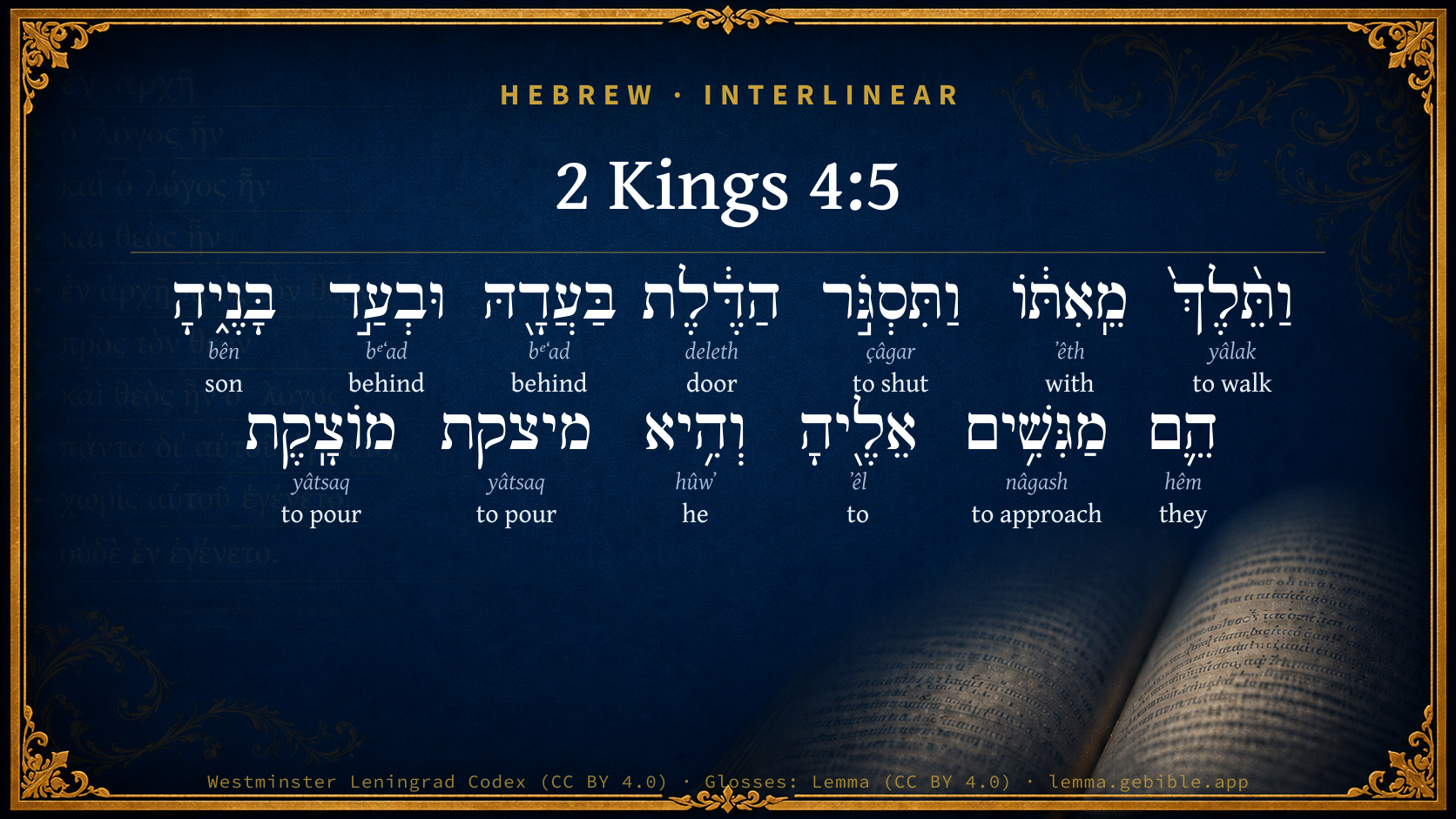
  1. וַתֵּ֨לֶךְ֙ yâlak H3212 “and · to walk” Conjunction + Verb, Qal, Sequential Imperfect, 3rd Person, Feminine, Singular
  2. מֵֽאִתּ֔וֹ ʼêth H854 “from · with · him” Preposition + Preposition + Suffix, Personal, 3rd Person, Masculine, Singular
  3. וַתִּסְגֹּ֣ר çâgar H5462 “and · to shut” Conjunction + Verb, Qal, Sequential Imperfect, 3rd Person, Feminine, Singular
  4. הַדֶּ֔לֶת deleth H1817 “the · door” Particle, Definite Article + Noun, Common, Feminine, Singular, Absolute
  5. בַּעֲדָ֖הּ bᵉʻad H1157 “behind · her” Preposition + Suffix, Personal, 3rd Person, Feminine, Singular
  6. וּבְעַ֣ד bᵉʻad H1157 “and · behind” Conjunction + Preposition
  7. בָּנֶ֑יהָ bên H1121 “sons · her” Noun, Common, Masculine, Plural, Construct + Suffix, Personal, 3rd Person, Feminine, Singular
  8. הֵ֛ם hêm H1992 “they” Pronoun, Personal, 3rd Person, Masculine, Plural
  9. מַגִּשִׁ֥ים nâgash H5066 “approaching” Verb, Hiphil, Participle Active, Masculine, Plural, Absolute
  10. אֵלֶ֖יהָ ʼêl H413 “to · her” Preposition + Suffix, Personal, 3rd Person, Feminine, Singular
  11. וְהִ֥יא hûwʼ H1931 “and · he” Conjunction + Pronoun, Personal, 3rd Person, Feminine, Singular
  12. מוֹצָֽקֶת yâtsaq H3332 “pouring” Verb, Hiphil, Participle Active, Feminine, Singular, Absolute

About this verse

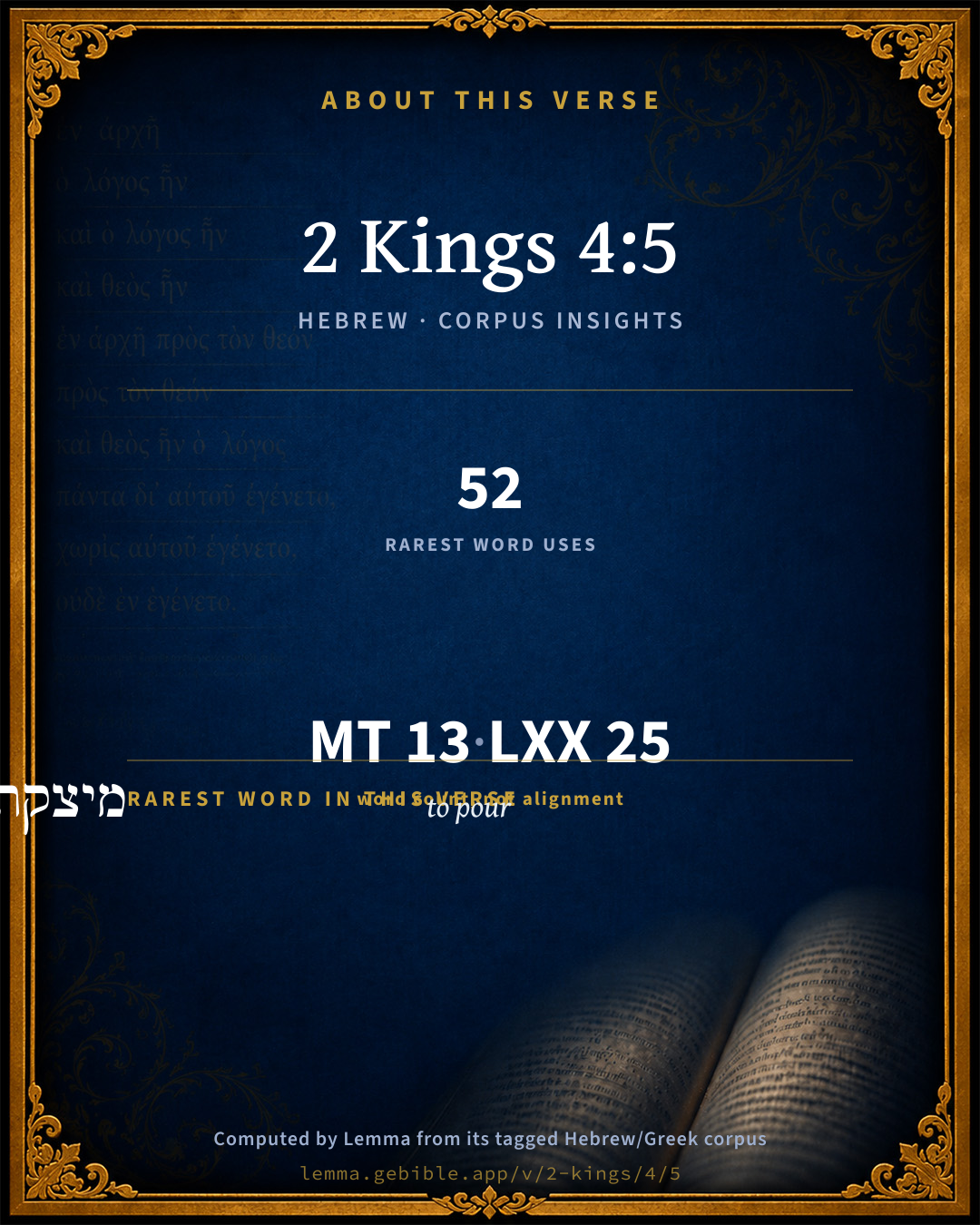
These counts appear in no published source. They are computed here, from the morphology-tagged text and Lemma’s own curated glosses. What Lemma adds →

13
words
11
distinct lemmas
Historical
section

Shared distinctive vocabulary

מיצקת to pour H3332 occurs in 49 verses of the Hebrew Bible. Also found in:

Grammatical profile

  • 5 verbs
  • 2 nouns
  • 2 pronouns
  • 4 prepositions

Verb forms

  • וַתֵּ֨לֶךְ֙ Qal · Sequential Imperfect
  • וַתִּסְגֹּ֣ר Qal · Sequential Imperfect
  • מַגִּשִׁ֥ים Hiphil · Participle Active
  • מיצקת Hiphil · Participle Active
  • מוֹצָֽקֶת Hiphil · Participle Active

Repetition

Words recur within this verse — often emphatic in Hebrew:

  • בַּעֲדָ֖הּ behind H1157 ×2
  • מיצקת to pour H3332 ×2

Hebrew & Septuagint length

In English translation the verse runs 25 words from the Hebrew and 31 from the Septuagint (LXX English) — closely comparable.

A rough comparison of the two English renderings, which tokenize alike — not a word-level alignment.

Word counts can differ between the Hebrew and the Greek without any difference in meaning — e.g. the Hebrew direct-object marker אֵת has no separate Greek word, and Greek often adds the article ὁ.

In the original languages it is 13 Hebrew tokens and 25 Greek tokens — but the two are counted differently (Hebrew bundles its prefixes and suffixes into one token; the Greek is in lemma form), so that isn’t a like-for-like length.

Cross-references

4

Topical passages linked to 2 Kings 4:5 in the Treasury of Scripture Knowledge — connected by theme and wording, ordered by reader-vote popularity; previews shown in the World English Bible.

  • 2 Kings 5:11 But Naaman was angry, and went away, and said, Behold, I thought, He will surely come out to me, and stand, and call on the name of Yahweh his God, and wave his hand over the place, and recover the leper.
  • Hebrews 11:7–8 By faith, Noah, being warned about things not yet seen, moved with godly fear, prepared an ark for the saving of his house, through which he condemned the world, and became heir of the righteousness which is according to faith.
  • 1 Kings 17:15–16 She went and did according to the saying of Elijah: and she, and he, and her house, ate [many] days.
  • Luke 1:45 Blessed is she who believed, for there will be a fulfillment of the things which have been spoken to her from the Lord!"

Cross-references courtesy of OpenBible.info (CC BY 4.0).

Hebrew and Greek witnesses Masoretic Hebrew ↔ Greek Septuagint

The same verse in the two great witnesses to the Old Testament, shown verse-for-verse.

These are two independent witnesses, not word-aligned to each other, and the Septuagint is shown in lemma (dictionary) form.

Hebrew 2 Kings 4:5 Masoretic · Westminster Leningrad Codex

וַתֵּ֨לֶךְ֙ מֵֽאִתּ֔וֹ וַתִּסְגֹּ֣ר הַדֶּ֔לֶת בַּעֲדָ֖הּ וּבְעַ֣ד בָּנֶ֑יהָ הֵ֛ם מַגִּשִׁ֥ים אֵלֶ֖יהָ וְהִ֥יא מיצקת מוֹצָֽקֶת

So she went from him, and shut the door on her and on her sons; they brought [the vessels] to her, and she poured out.

World English Bible · Public Domain

Greek LXX 2 Kings 4:5 Septuagint · lemma form

καί ἀποἔρχομαι παρά αὐτός καί ποιέω οὕτως καί ἀποκλείω ὁ θύρα κατά αὐτός καί κατά ὁ υἱός αὐτός αὐτός προςἐγγίζω πρός αὐτός καί αὐτός ἐπιχέω

And she departed from him, and shut the door upon herself and upon her sons: they brought the vessels near to her, and she poured in until the vessels were filled.

LXX2012 (modern English Septuagint) · Public Domain

Hebrew: Westminster Leningrad Codex (CC BY 4.0). Greek: Septuagint (public domain); English from LXX2012 (modern English Septuagint) (Public Domain). How the Septuagint differs from the Hebrew →

Targum (Aramaic paraphrase)

1

The Targum is the ancient Jewish Aramaic paraphrase of the Hebrew Scriptures — an interpretive translation, not the Hebrew text itself. Onkelos (literal) and Pseudo-Jonathan (expansive) render the Torah, and Jonathan the Prophets. Coverage is partial: where no permissively-licensed English translation exists for a verse, only the Aramaic is shown. This is verse-level text, not a word-by-word alignment to the Hebrew.

  1. Targum Jonathan Prophets (Joshua–Malachi)
    וַאֲזַלַת מִלְוָתֵיהּ וַאֲגָפַת דָשָׁא בְּאַפָּהָא וּבְאַפֵּי בְנָהָא אִינוּן מְקַרְבִין לָהּ מָנַיָא וְהִיא מְרִיקָא מִשְׁחָא:

    (no public-domain English translation for this verse)

    Targum Jonathan — Aramaic: “Mikraot Gedolot” (public domain). English: “Sefaria Community Translation” (CC0 1.0 (public-domain dedication)); “London "Chaldee Paraphrase," 1871” (public domain). Text via Sefaria.

Commentary

Notes on 2 Kings 4:5 from classic Christian and Jewish commentators (each source and its license shown beneath its notes). The classic Christian expositions comment on the surrounding passage and are grouped to its opening verse, so a note may address several verses; the Jewish commentaries on the Tanakh (Rashi and others) are per-verse, so they appear only where the commentator wrote on this verse.

Lemma curates 59 commentaries, every one of them public domain or Creative Commons licensed, each selected and text-cleaned for this edition rather than reprinted as found. About our sources →

Trapp's Complete Commentary

John Trapp

2Ki 4:5 So she went from him, and shut the door upon her and upon her sons, who brought [the vessels] to her; and she poured out.

Ver. 5. And shut the door, &c.] This her prompt and present obedience was a noble fruit of her heroical faith. She doth not reason, as Naaman did, but run; she doth not dispute, but despatch the prophet’s commands. God loveth Curristas non Quaeristas, saith Luther.

And she poured out.] And the more she poured out, the more she might; the angels making new supplies of oil continually, saith A Lapide.

John Trapp, A Commentary or Exposition upon All the Books of the Old and New Testament (1647–1656) — public domain. Text from a community e-Sword module.

Tyndale Open Study Notes

Tyndale Open Resources

4:5-6 Elisha was absent during the miracle so the woman and her son would recognize that the provision was by the Lord’s power.

Tyndale Open Study Notes — © Tyndale Open Resources, licensed CC BY-SA 4.0. Text via the HelloAO Bible API.

Ellicott's Commentary for English Readers

(5) From him.—Mç’ittô, the correct form. (Comp. 2Ki_3:11.)

Who brought . . . poured out.—There should be a semicolon at “sons.” The rest is literally, They were bringing to her, and she was pouring continually (mĕyaççèqeth, only here). She did not leave her pouring. The story is evidently abridged in this verse.

A Bible Commentary for English Readers, edited by Charles John Ellicott (1878–1897) — public domain. Text from a community e-Sword module.

The Cambridge Bible for Schools and Colleges

gen. ed. J. J. S. Perowne

5. who [R.V. they] brought the vessels to her] The R.V. marks that the Hebrew here begins a new clause with a personal pronoun. The widow’s unquestioning obedience, in which her sons also imitated her, has its reward.

The Cambridge Bible for Schools and Colleges (gen. ed. J. J. S. Perowne; Cambridge University Press, 1878–1918) — public domain. Text from a community e-Sword module.

John Gill's Exposition

So she went from him,.... And did as he advised her, borrowed many empty vessels of her neighbours, having faith in what the prophet had said to her:

and shut the door upon her, and upon her sons; and then went to work as she was directed, with her sons:

who brought the vessels to her; the empty ones she had borrowed: and she poured out; the oil out of her pot into them.

John Gill's Exposition of the Whole Bible (1746–1763) — public domain (CC PDM 1.0). Text via the HelloAO Bible API.

The Pulpit Commentary

So she went from him, and shut the door upon her and upon her sonsi.e. obeyed exactly the prophet"s orderswho brought the vessels to her; and she poured out; literally, they bringing the vessels to her, and she pouring out. The modus operandi had been left to the woman and her sons, and was thus arranged and ordered, so that there was no confusion nor hurry.

The Pulpit Commentary (1880–1919), ed. H.D.M. Spence-Jones & Joseph S. Exell — public domain. Text from a community e-Sword module.

unfoldingWord translationNotes

Door43 World Missions Community

the vessels

"the jars"

unfoldingWord translationNotes — © Distant Shores Media and the Door43 World Missions Community, licensed CC BY-SA 4.0. Source: git.door43.org/Door43/en_tn.

Rashi

Rabbi Shlomo Yitzchaki (Rashi)

They would bring [the containers] to her. The vessels.

Rashi on the Tanakh — English translations: “The Judaica Press complete Tanach with Rashi, translated by A. J. Rosenberg” (CC BY 4.0); “Pentateuch with Rashi's commentary by M. Rosenbaum and A.M. Silbermann, 1929-1934” (public domain); “The Metsudah Tanach series, Lakewood, N.J” (CC BY 4.0); and “The Book of Joshua, Metsudah Publications, 1997” (CC BY 4.0). Text via Sefaria.

Lesson kit

Teaching starters — assembled from the data on this page, not authored interpretation. Every prompt links to the verse data it draws on. Edit before teaching.

2 Kings, in the Historical, opens this verse with 13 words (11 distinct Hebrew lemmas). Its most distinctive word is yâtsaq (“to pour”). A historical commentator’s framing appears above. Read the whole chapter for the surrounding context.

Discussion questions

  1. How does “to pour” (yâtsaq) shape what this verse is saying?
  2. How does Genesis 28:18, which shares the word «to pour», read alongside this verse?
  3. What does the repetition of “behind” (2× in this one verse) do in this verse?
  4. The translations on this page render this verse differently — a whole-verse word diff, not a word-by-word alignment. What might account for the different wordings?
  5. «וַתֵּ֨לֶךְ֙» is a Qal Sequential Imperfect verb. How does that grammatical form shape the action described?
  6. Compare how Trapp's Complete Commentary and Tyndale Open Study Notes read this verse. Where do they agree or differ?

Things to notice

Reading settings

Reading text

Shown beneath each verse's original-language words.

Old Testament
Old Testament edition

Read the OT as the Masoretic Hebrew (MT) or the Greek Septuagint (LXX).

English shown for the Greek Septuagint (in the Hebrew ↔ Greek comparison).

Comparing translations? Open the Compare panel on any verse page to stack up to four side by side.