
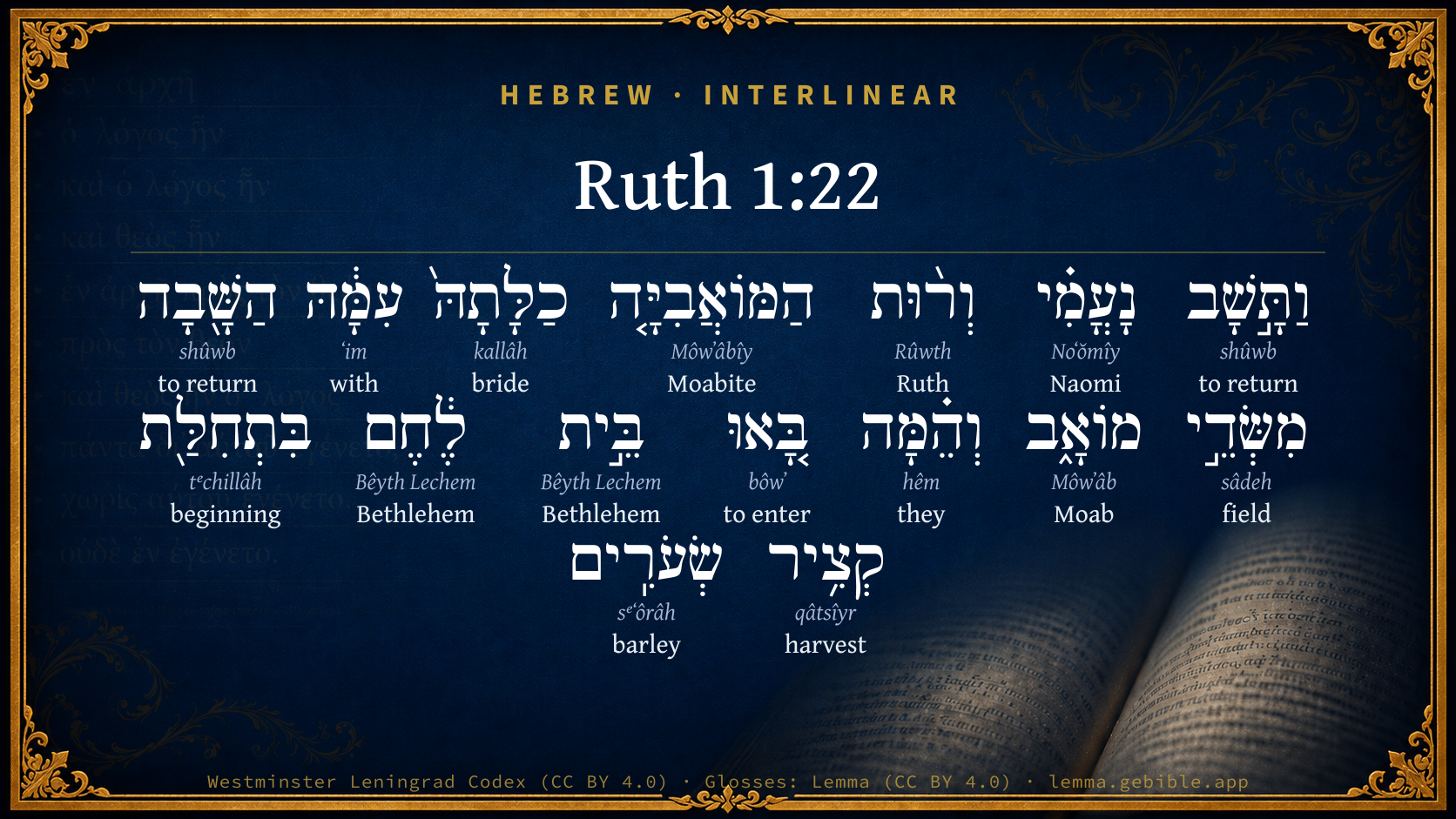
Ruth 1:22

Hebrew (Westminster Leningrad Codex) Ruth 1:22 appears in the Hebrew Old Testament. The text above is from the Westminster Leningrad Codex. Each word links to its Strong’s number, a concise gloss, and parsing drawn from the Open Scriptures Hebrew Bible morphology. Click any word for its full Brown-Driver-Briggs (BDB) entry.
Download image
Cite this verse

Ruth 1:22 (World English Bible). Public Domain. Lemma interlinear Bible study tool, https://lemma.gebible.app/v/ruth/1/22.

Show BibTeX & RIS
BibTeX
RIS
English Translation
So Naomi returned, and Ruth the Moabitess, her daughter-in-law, with her, who returned out of the country of Moab: and they came to Bethlehem in the beginning of barley harvest.
World English Bible · Public Domain
Download a study sheet

One document with this verse’s original text, its word-by-word gloss line, the meaning frame, cross-references with their text, attributed commentary, and full source and license credits — printable, and it pastes into notes with its structure intact.

This verse Autodidact and up

Study sheet (.html) Plain text (.txt)

A passage Seminary Student

Up to 50 verses in one chapter. A passage sheet keeps up to 6 commentary sources and 12 cross-references per verse, in the order this page ranks them, and says so on the sheet whenever that leaves anything out. Ask for a single verse and you get the Autodidact verse sheet above.

Everything on this page stays free to read, with no account — the sheet is a download of what is already on screen, not access to it.

Want to remove ads? Support Godless Engineer
Compare translations 3

The same verse in 3 English versions, stacked beneath the original-language interlinear above. Click any original word for its lexicon entry.

Each is an independent rendering of the whole verse — the interlinear is not word-aligned to these translations.

Highlighted words mark where these versions differ — a whole-verse word diff, not a word-by-word alignment.

  • World English Bible Public Domain
    So Naomi returned, and Ruth the Moabitess, her daughter-in-law, with her, who returned out of the country of Moab: and they came to Bethlehem in the beginning of barley harvest.
  • King James Version Public Domain
    So Naomi returned, and Ruth the Moabitess, her daughter in law, with her, which returned out of the country of Moab: and they came to Bethlehem in the beginning of barley harvest.
  • unfoldingWord Literal Text CC BY-SA 4.0
    So Naomi returned, with Ruth the Moabite woman her daughter-in-law, with her, the woman who returned from the fields of Moab. And they came to Bethlehem at the beginning of the harvest of barley.

unfoldingWord Literal Text — © unfoldingWord, licensed CC BY-SA 4.0. Word-aligned USFM3 via Door43 (git.door43.org/unfoldingWord/en_ult).

Versions to compare (up to 4)

3 of 4 selected

Show all 18 translations

Every available English version of this verse, each an independent rendering of the whole verse.

  • World English Bible Public Domain
    So Naomi returned, and Ruth the Moabitess, her daughter-in-law, with her, who returned out of the country of Moab: and they came to Bethlehem in the beginning of barley harvest.
  • Berean Standard Bible Public Domain
    So Naomi returned from the land of Moab with her daughter-in-law Ruth the Moabitess. And they arrived in Bethlehem at the beginning of the barley harvest.
  • Majority Standard Bible Public Domain
    So Naomi returned from the land of Moab with her daughter-in-law Ruth the Moabitess. And they arrived in Bethlehem at the beginning of the barley harvest.
  • King James Version Public Domain
    So Naomi returned, and Ruth the Moabitess, her daughter in law, with her, which returned out of the country of Moab: and they came to Bethlehem in the beginning of barley harvest.
  • American Standard Version (1901) Public Domain
    So Naomi returned, and Ruth the Moabitess, her daughter-in-law, with her, who returned out of the country of Moab: and they came to Bethlehem in the beginning of barley harvest.
  • Revised Version (1885) Public Domain
    So Naomi returned, and Ruth the Moabitess, her daughter in law, with her, which returned out of the country of Moab: and they came to Beth-lehem in the beginning of barley harvest.
  • Geneva Bible (1599) Public Domain
    So Naomi returned and Ruth the Moabitesse her daughter in law with her, when she came out of the countrey of Moab: and they came to Beth-lehem in the beginning of barly haruest.
  • Douay-Rheims (1899) Public Domain
    So Noemi came with Ruth the Moabitess her daughter in law, from the land of her sojournment: and returned into Bethlehem, in the beginning of the barley harvest.
  • Young's Literal Translation Public Domain
    And Naomi turneth back, and Ruth the Moabitess her daughter-in-law with her, who hath turned back from the fields of Moab, and they have come in to Beth-Lehem at the commencement of barley-harvest.
  • Literal Standard Version CC BY-SA 4.0
    And Naomi turns back, and Ruth the Moabitess, her daughter-in-law, with her, who has turned back from the fields of Moab, and they have come to Beth-Lehem at the commencement of barley-harvest.
  • Unlocked Literal Bible CC BY-SA 4.0
    So Naomi and Ruth the Moabite woman, her daughter-in-law, returned from the country of Moab. They came to Bethlehem at the beginning of the barley harvest.
  • unfoldingWord Literal Text CC BY-SA 4.0
    So Naomi returned, with Ruth the Moabite woman her daughter-in-law, with her, the woman who returned from the fields of Moab. And they came to Bethlehem at the beginning of the harvest of barley.
  • Darby Bible Public Domain
    So Naomi returned, and Ruth the Moabitess, her daughter-in-law, with her, who returned out of the fields of Moab; and they came to Bethlehem in the beginning of the barley-harvest.
  • World Messianic Bible Public Domain
    So Naomi returned, and Ruth the Moabitess, her daughter-in-law, with her, who returned out of the country of Moab. They came to Bethlehem in the beginning of barley harvest.
  • Webster's Bible Public Domain
    So Naomi returned, and Ruth the Moabitess her daughter-in-law with her, who returned from the country of Moab: and they came to Beth-lehem in the beginning of barley-harvest.
  • Free Bible Version CC BY-SA 4.0
    This is the way that Naomi returned from Moab with Ruth, the Moabite, her daughter-in-law. They arrived in Bethlehem at the beginning of the barley harvest.
  • Bible in Basic English Public Domain
    So Naomi came back out of the country of Moab, and Ruth the Moabitess, her daughter-in-law, with her; and they came to Beth-lehem in the first days of the grain-cutting.
  • JPS Tanakh (1917) Public Domain
    So Naomi returned, and Ruth the Moabitess, her daughter-in-law, with her, who returned out of the field of Moab — and they came to Beth-lehem in the beginning of barley harvest.

Literal Standard Version (2020), Covenant Press — licensed CC BY-SA 4.0. Text via the HelloAO Bible API (eBible.org). Unlocked Literal Bible (unfoldingWord) — licensed CC BY-SA 4.0. Text via the HelloAO Bible API (eBible.org). unfoldingWord Literal Text — © unfoldingWord, licensed CC BY-SA 4.0. Word-aligned USFM3 via Door43 (git.door43.org/unfoldingWord/en_ult). Free Bible Version, Dr. Jonathan Gallagher — licensed CC BY-SA 4.0. Text via the HelloAO Bible API (eBible.org).

Word by word

More ways to search: Search by grammar → Find every occurrence → Compare this word →

Practice this passage: Drill this verse → Learn its vocabulary →

וְר֨וּת
Rûwth
H7327
“and · Ruth”
Conjunction + Noun, Proper
Part of Speech
Conjunction + Noun
Type
Proper
Full BDB Definition

Origin: probably for H7468

TWOT: None

Ruth = "friendship" - daughter-in-law of Naomi, wife of Boaz, and grandmother of David
  1. וַתָּ֣שָׁב shûwb H7725 “and · to return” Conjunction + Verb, Qal, Sequential Imperfect, 3rd Person, Feminine, Singular
  2. נָעֳמִ֗י Noʻŏmîy H5281 “Naomi” Noun, Proper
  3. הַמּוֹאֲבִיָּ֤ה Môwʼâbîy H4125 “the · Moabite” Particle, Definite Article + Noun, Gentilic, Feminine, Singular, Absolute
  4. כַלָּתָהּ֙ kallâh H3618 “bride · her” Noun, Common, Feminine, Singular, Construct + Suffix, Personal, 3rd Person, Feminine, Singular
  5. עִמָּ֔הּ ʻim H5973 “with · her” Preposition + Suffix, Personal, 3rd Person, Feminine, Singular
  6. הַשָּׁ֖בָה shûwb H7725 “the · to return” Particle, Definite Article + Verb, Qal, Perfect, 3rd Person, Feminine, Singular
  7. מִשְּׂדֵ֣י sâdeh H7704 “from · fields of” Preposition + Noun, Common, Masculine, Plural, Construct
  8. מוֹאָ֑ב Môwʼâb H4124 “Moab” Noun, Proper
  9. וְהֵ֗מָּה hêm H1992 “and · they” Conjunction + Pronoun, Personal, 3rd Person, Masculine, Plural
  10. בָּ֚אוּ bôwʼ H935 “to enter” Verb, Qal, Perfect, 3rd Person, Common, Plural
  11. בֵּ֣ית Bêyth Lechem H1035 “Bethlehem” Noun, Proper
  12. לֶ֔חֶם Bêyth Lechem H1035 “Bethlehem” Noun, Proper
  13. בִּתְחִלַּ֖ת tᵉchillâh H8462 “in/at · beginning of” Preposition + Noun, Common, Feminine, Singular, Construct
  14. קְצִ֥יר qâtsîyr H7105 “harvest of” Noun, Common, Masculine, Singular, Construct
  15. שְׂעֹרִֽים sᵉʻôrâh H8184 “barley” Noun, Common, Feminine, Plural, Absolute

About this verse

These counts appear in no published source. They are computed here, from the morphology-tagged text and Lemma’s own curated glosses. What Lemma adds →

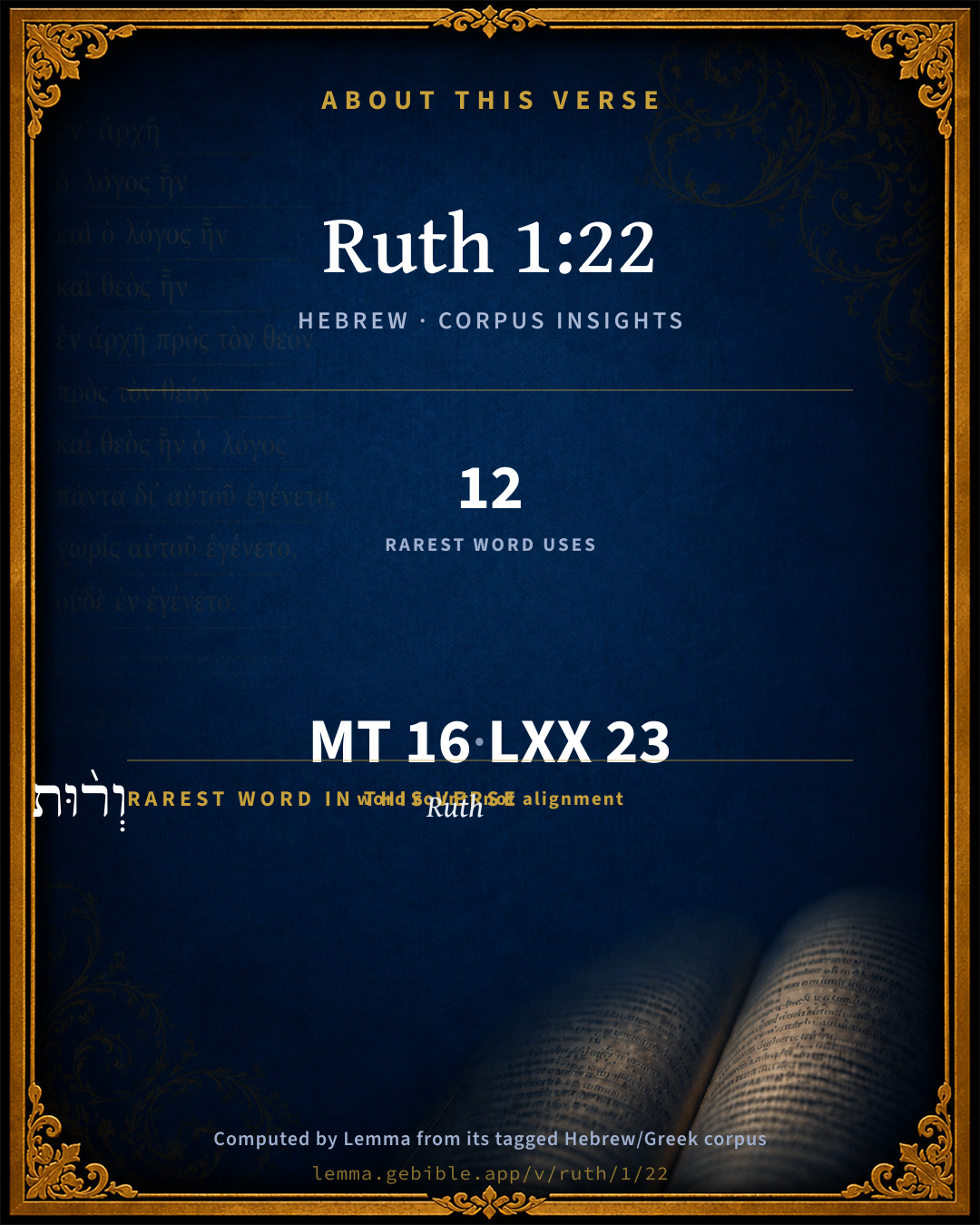
16
words
14
distinct lemmas
Historical
section

Notable vocabulary

The rarest word here is וְר֨וּת Ruth H7327 — appearing just 12 times in the whole Hebrew Bible.

Shared distinctive vocabulary

וְר֨וּת Ruth H7327 occurs in 12 verses of the Hebrew Bible. Also found in:

Grammatical profile

  • 3 verbs
  • 11 nouns
  • 1 pronoun
  • 1 preposition

Verb forms

  • וַתָּ֣שָׁב Qal · Sequential Imperfect
  • הַשָּׁ֖בָה Qal · Perfect
  • בָּ֚אוּ Qal · Perfect

Repetition

Words recur within this verse — often emphatic in Hebrew:

  • וַתָּ֣שָׁב to return H7725 ×2
  • בֵּ֣ית Bethlehem H1035 ×2

Hebrew & Septuagint length

In English translation the verse runs 30 words from the Hebrew and 25 from the Septuagint (LXX English) — closely comparable.

A rough comparison of the two English renderings, which tokenize alike — not a word-level alignment.

Word counts can differ between the Hebrew and the Greek without any difference in meaning — e.g. the Hebrew direct-object marker אֵת has no separate Greek word, and Greek often adds the article ὁ.

In the original languages it is 16 Hebrew tokens and 23 Greek tokens — but the two are counted differently (Hebrew bundles its prefixes and suffixes into one token; the Greek is in lemma form), so that isn’t a like-for-like length.

Cross-references

3

Topical passages linked to Ruth 1:22 in the Treasury of Scripture Knowledge — connected by theme and wording, ordered by reader-vote popularity; previews shown in the World English Bible.

  • Ruth 2:23 So she kept fast by the maidens of Boaz, to glean to the end of barley harvest and of wheat harvest; and she lived with her mother-in-law.
  • 2 Samuel 21:9 He delivered them into the hands of the Gibeonites, and they hanged them in the mountain before Yahweh, and they fell [all] seven together. They were put to death in the days of harvest, in the first days, at the beginning of barley harvest.
  • Exodus 9:31–32 The flax and the barley were struck, for the barley was in the ear, and the flax was in bloom.

Cross-references courtesy of OpenBible.info (CC BY 4.0).

Hebrew and Greek witnesses Masoretic Hebrew ↔ Greek Septuagint

The same verse in the two great witnesses to the Old Testament, shown verse-for-verse.

These are two independent witnesses, not word-aligned to each other, and the Septuagint is shown in lemma (dictionary) form.

Hebrew Ruth 1:22 Masoretic · Westminster Leningrad Codex

וַתָּ֣שָׁב נָעֳמִ֗י וְר֨וּת הַמּוֹאֲבִיָּ֤ה כַלָּתָהּ֙ עִמָּ֔הּ הַשָּׁ֖בָה מִשְּׂדֵ֣י מוֹאָ֑ב וְהֵ֗מָּה בָּ֚אוּ בֵּ֣ית לֶ֔חֶם בִּתְחִלַּ֖ת קְצִ֥יר שְׂעֹרִֽים

So Naomi returned, and Ruth the Moabitess, her daughter-in-law, with her, who returned out of the country of Moab: and they came to Bethlehem in the beginning of barley harvest.

World English Bible · Public Domain

Greek LXX Ruth 1:22 Septuagint · lemma form

καί ἐπιστρέφω νωεμιν καί ρουθ ὁ μωαβῖτις ὁ νύμφη αὐτός ἐπιστρέφω ἐκ ἀγρός μωαβ αὐτός δέ παραγίγνομαι εἰς βαιθλεεμ ἐν ἀρχή θερισμός κριθή

So Noemin and Ruth the Moabitess, her daughter-in-law, returned from the country of Moab; and they came to Bethleem in the beginning of barley harvest.

LXX2012 (modern English Septuagint) · Public Domain

Hebrew: Westminster Leningrad Codex (CC BY 4.0). Greek: Septuagint (public domain); English from LXX2012 (modern English Septuagint) (Public Domain). How the Septuagint differs from the Hebrew →

Commentary

Notes on Ruth 1:22 from classic Christian and Jewish commentators (each source and its license shown beneath its notes). The classic Christian expositions comment on the surrounding passage and are grouped to its opening verse, so a note may address several verses; the Jewish commentaries on the Tanakh (Rashi and others) are per-verse, so they appear only where the commentator wrote on this verse.

Lemma curates 59 commentaries, every one of them public domain or Creative Commons licensed, each selected and text-cleaned for this edition rather than reprinted as found. About our sources →

Trapp's Complete Commentary

John Trapp

Rth 1:22 So Naomi returned, and Ruth the Moabitess, her daughter in law, with her, which returned out of the country of Moab: and they came to Bethlehem in the beginning of barley harvest.

Ver. 22. So Naomi returned, &c.] So Jews and Gentiles walk to heaven together.

In the beginning of barley harvest.] In the beginning of the passover, saith the Chaldee Paraphrast, taking the fittest opportunity both for soul and body.

John Trapp, A Commentary or Exposition upon All the Books of the Old and New Testament (1647–1656) — public domain. Text from a community e-Sword module.

The Biblical Illustrator

Joseph S. Exell

Rth_1:22

So Naomi returned, and Ruth.

The young convert

Little was Naomi aware of the treasure she was bringing to Israel or of the honour which was in store for Ruth. She says, The Lord hath brought me back empty. And it was so, so far as she was herself concerned. But the Lord had brought back with her one whom all generations should call blessed; one who was to be a mother of the promised Messiah, the anointed Saviour of Israel. We are now to contemplate her admission to Israel. The young converts entrance among the people of God. We cannot enter upon such a view without stopping for a moment to think of the happiness of Naomi in such a companion. How great was the privilege to her to bring back with her own return so precious a soul to the Lord of hosts! What an unspeakable joy it is to a Christian parent to be attended by his children in the heavenly path! So they two went together until they came to Bethlehem. I cannot conceive a greater blessing in social life than when we can say this of father and son, of mother and daughter. This is a bond which must long outlast every other one; and a treasure of enjoyment which must remain when every other one has failed. How such companionship in religion relieves the sorrows of the road! How it multiplies the joys of the way ! The mother and the daughter take sweet counsel together on their journey. Naomi has much to tell, Ruth has much to ask, in reference to the new home to which they are returning together. Their mutual prayers and encouragements are full of advantage. The blending of the varied experience of the two becomes helpful to both. The despondency of age is animated by the joyful anticipations of youth. The effervescence of youth is moderated by the experience and soberness of age. So they went together. Unity of feeling, unity of interest, unity of hope, bind them together. They have fellowship one with another. But while Ruth took sweet counsel with Naomi her thoughts and feelings were still in a great degree peculiar to herself and completely her own. To her every prospect is hopeful, and her imagination loves to stray through all the anticipations which are presented to her youthful mind. The young Christian truly living and walking in Christ rejoices in the hopes which a Saviour gives; is encouraged, ardent, and delighted in looking forward over the way in which the great Captain of salvation is leading the sons of God. I see no trials or sorrows in it. Thus would Ruth have said. She could have no feeling but unmingled pleasure in the prospect of the journey she had undertaken. Delightful encouragements arise in her mind which overwhelm all possible regrets or fears. How many hopes and plans cluster around Bethlehem and Judah! She knows not what the Lord has prepared for her. It has not entered into her youthful heart to conceive the actual blessings which are laid up in store for her there. But she knows that all must be well and happy for her under the shadow of His wings in whom she has come to put her trust. Nothing is in your way. You may do all things through Christ that strengtheneth you, and be made more than conquerors in Him. She comes with a deep sense of her own unworthiness. But this is silenced by her conscious desire and choice. The young convert knows and feels his guilt. But he needs not, and does not, stop to sit clown under the mere dominion of grief for the past. He has his new work to do. He must press forward in it. And the cloud will pass away and leave him in the sunshine of his Saviours love, to finish and perfect it. But the perseverance of Ruth furnishes us with another most important example. They went together until they came to Bethlehem. There is no fact which gives the Church more peculiar joy in the coming of young converts to Christ than their habitual perseverance. They are the ones who hold fast the beginning of their confidence steadfast unto the end. The most fruitful, faithful Christians are habitually those who begin the earliest. The time of Ruths arrival at Bethlehem was most significant. They came to Bethlehem in the beginning of barley harvest. The barley harvest of Palestine was in the early spring. The barley was sown after the autumnal rains, in the month of October, and the harvest was in the month of April. It was a time of special joy, the first spring-gathering of their annual fruits. The harvest is always employed as an illustration of satisfaction and joy. They joy before Thee, according to the joy of harvest. And is it not always a scene of rejoicing when the sinner returns? The harvest was a time of opening abundance. No wants or poverty were pressing now. There is thus bread enough and to spare in the Saviours house. And when the sinner finds a shelter there he finds all his needs supplied. His soul has abundance of all things which it desireth. No more encouraging time could there have been for Ruths first acquaintance with Israel. Every aspect of the land was promising and prosperous. The sight of plenty crowned every prospect. And she sees her new home clothed with every attraction. Is it not always so when we first come to the feet of Jesus and find our peace and acceptance there? Now we seem to live for the first time. There is reality, happiness, satisfaction here. We have found Him whom our soul loveth, and we have found everything we want in Him. The barley harvest was the time of the Passover. Thus this young convert from the Gentiles comes as the first-fruits of a Gentile harvest to be gathered, and is welcomed with Israel as a partaker of the paschal feast. Happy are we in welcoming our youthful friends giving evidence of their new birth for God and their living faith in Jesus to the table of the Lord. Happy is the house the first-fruits of which are thus consecrated and sanctified to be the Lords for ever. (S. H. Tyng, D. D.)

.

The Biblical Illustrator, edited by Joseph S. Exell (c. 1880s–1900s) — public domain. Text from a community e-Sword module.

The Preacher's Complete Homiletical Commentary

Joseph S. Exell (gen. ed.)

CRITICAL AND EXEGETICAL NOTES.—Which returned out of the country [territories or fields] of Moab. The description by which Ruth was commonly designated [cf. Rth_2:6]. (Speaker’s Com.). As the same expression occurs at Rth_4:3, in connexion with Naomi, it may be supposed that it became customary to speak of Naomi and Ruth as “the returned from Moab,” or, as we should say popularly, “the returned Moabites” (Lange). Here the phrase applies to Ruth, as at Rth_2:6, but in Rth_4:3 to Naomi (Keil). Dr. Cassel translates, “And so Naomi was returned home, and Ruth, the Moabitess, her daughter-in-law, with her [who accompanied her] after [or on] her departure from the fields of Moab.” And she desired to return with her [that is, with Naomi] with the whole heart; and they came from the land of Moab, etc. (Syr.). The Douay, following the Vulgate, trans., “So Naomi came with Ruth the Moabitess, her daughter-in-law, from the land of her sojourning” [from the land of her pilgrimage (Wyeliffe)]. Aben Ezra thinks this to be understood of her returning at another time (Gill). In the beginning of barley harvest. The harvest as a whole commenced with the barley harvest (Keil). The beginning of spring, for the barley harvest began immediately after the passover, and that feast was held on the 15th of the month Nisan. which corresponded with our March (A. Clarke). They came to Bethlehem on that day in which the children of Israel began to mow the sheaf of barley which was to be waved before the Lord (Targum). The firstfruits of the barley harvest were. as we know, presented at the passover, before which it was not lawful to begin the harvest (Kitto). In the next chapter (Rth_2:23) it is related that Ruth gleaned “until the end of barley and of wheat harvest.” This book was therefore appointed by the ancient Hebrew Church to be read in the synagogues at the feast of weeks or Pentecost, when the wheat harvest began (Wordsworth) [cf. Intro., p. 1, par. 2]. They came to Bethlehem in the beginning of the barley harvest. Opens the way for the further course of the history (Keil). Explains the narrative in the next chapter. Keil questions whether the Bethlehem mentioned in connexion with Ibzan in Jdg_12:8-10 is the Bethlehem of the text, as Josephus affirms.

Rth_1:22

Theme.—THE WANDERER HOME AGAIN

“I still had hopes, my long vexations past,

Here to return, and die at home at last.”—Goldsmith.

“We leave

Our home in youth—no matter to what end—

Study, or strife, or pleasure, or what not;

And coming back in few short years, we find

All as we left it outside: …

But lift that latehet,—all is changed as doom.”—Bailey.

So Naomi returned … and they came to Bethlehem in the beginning of the barley harvest.

This first chapter of the book of Ruth is in itself a perfect poem, as well as an epitome of human life and a parable of the soul’s pilgrimage. The theme is that of “the wanderers.” It has its prologue in the famine, and its epilogue in the return. Blow follows blow until the catastrophe is complete in the death of all who left the land of promise, save one. Then out of the dark night of sorrow hope is born and the return begins. Love lights up the picture, a love surpassing the ordinary and usual love of woman, and the chastened spirit bows at last, not to fate, but God. It is a poem complete in itself, rich with contrasting lights and shadows, and as Goethe has well said, “the loveliest thing in the shape of an epic or idyl which has come to us.” Penned by inspiration, it has no equal and no second.

See here then, in conclusion,

I. The wanderer home again. The most friendless of human beings has a country which he admires and extols (Sydney Smith). The greatest wanderer, some place dear above all else which he thinks of as home. Even the prodigal, sitting in the far country among the swine, remembers he has a “father’s house,” and turns longingly towards it. So with Naomi. [For the return, see on Rth_1:6-7, pp. 32–36, and on Rth_1:19; Rth_1:21.] Note. (a) The home ties the strongest, the home claims the most binding in human life. True friendship as well as true religion centres there. Bethlehem was Naomi’s proper place, and the whole scope of the narrative is to show that in leaving it she had gone out of the way of God’s providences, as well as of His ordinances. (b) Christian love begins its work at home. Christian manhood shows its best there, and the circle of genial influence spreads and widens from that centre.

II. Home again in a fortunate way. Led of God; for she recognizes that the Lord had brought her home again (Rth_1:21). Naomi’s extremity was God’s opportunity. So with David (1 Samuel 23). The statement of the text made in order to intimate that the help of God did not tarry long (Lange). Note. (a) When God leads, it is not ours to linger. Beware of by-paths and idle goings, keep straight on (Bernard). These came from Moab to Bethlehem; they had no idle vagaries that we read of. Old Naomi desired to see her country, and young Ruth was not wantonly disposed, but constantly kept her company (Bernard). (b) They arrive safely, whom God conducts. He neither slumbereth nor sleepeth. He led Israel through the wilderness for forty years, and landed them safely in Canaan at last. So always in lawful journeys, so especially in the heavenward one. Only let us see to it that we are of the same mind as Moses, “If Thy presence go not with us, carry us not up hence” (Exo_33:15), and all our journeyings must come to a prosperous issue.

III. Home again at a fortunate time. At the time of the barley harvest (see Crit. and Exeget. Notes). When there was at least gleaning to yield them sustenance, and the summer before them. In the beginning of the passover, saith the Chaldee Paraphrast, taking the fittest opportunity both for soul and body (Trapp). Here we see the providence of God, in ordering and disposing the journey of Naomi, to end it in the most convenient time. Had she come before harvest, she would have been straitened for means to maintain herself; if after harvest, Ruth had lost all those occasions which paved the way to her future advancement. God therefore, who ordered her going, concludes her journey in the beginning of harvest (Fuller). Note. There is a fulness and fitness of time for every event (Macgowan). The redemption from Egypt; the coming of Shiloh when the sceptre was departing from Judah; the soul’s conversion; deliverance from affliction, etc. (ibid). God’s time is always the best time.

IMPROVEMENT.—(a) When the heart is truly repentant, past error and sin, the humiliating experiences which have left their scars upon our inmost souls, may become to us blessed monitors urging us onward in the path that God has appointed. (b) Like the wounded hart, the bruised and troubled spirit turns homeward in its last extremity, if perchance it be only to die there.

“Tender and dear memories cluster around many a spot: none so sacred, so hallowed as this; for once again she is standing in the place consecrated by a thousand memories of the sacred dead. Returns like these ought to be significant of rest and privileges restored, as well as of new consecration to God; and this, although the past has been a barren past of worldly compromise and spiritual deadness.”—B.

“There is a latter as well as a former rain in spiritual things; covenant mercies to be manifested in our declining years, as well as in the days when the kingdom of heaven was but newly entered. Our youth may have been given in part to folly, the more reason that old age should be consecrated unmistakably to God. And perhaps we, like Naomi, shall best find the Protector of our declining years in the Bethlehems of our youth.… Understand the meaning of this place to Naomi. No dreamy haze of mysticism rests upon it, no unreal sanctity. It is a place where the heart writes bitter things against itself, where the icy fountains of the great deep within break up, a place where the past seems a failure, and the future hopeless; and yet for all this it is a place where the winter time of the soul is ending, and the new summer life of prosperity begins to dawn.”—B.

“The wandering of men from the perfect Home has brought with it degradation and scourging. Their return will be to find a Divine birthright restored in Christ.”—Pulsford.

“Woe for my vine-clad home,

That it should ever be so dark to me,

With its bright threshold and its whispering tree,

That I should ever come,

Fearing the lonely echo of a tread

Beneath the roof-tree of my glorious dead!”

N. P. Willis.

“Perhaps this world of sorrows presents no sadder picture than that here brought before us—the return of a childless widow to the spot she had left a happy wife and mother.”—Macartney.

“Thou needest not, then, sit down in weariness and hopelessness, whatever of earlier years thou hast lost, whatever grace thou hast forfeited; though thou hast been in a far country, far away in affections from him who loved thee; and wasting on his creatures,—nay, sacrificing on idol altars, with strange fire, the gifts which God gave thee that thou mightest be precious in His own sight.”—Pusey.

“Landed property in Palestine is of very little value, except the possessor has the means of cultivating it; and as it was under the Jewish law unalienable, strangers could not purchase it. A landed proprietor might thus be reduced to beggary, and in times of general distress might long remain so. Such seems to have been the case with the family of Elimelech, and they were therefore forced to remain in Moab. Even upon the return of Naomi and Ruth, though the family property was still theirs, they were completely destitute. Their property was valueless, because they did not possess the means of cultivating it. This will serve to explain the peculiar position of Naomi and Ruth on their arrival in Bethlehem.”—Kitto.

“Many a Swiss has sunk a martyr to his longing after home. The malady is commonly brought on by hearing the celebrated national air of the ‘Ranz des Vaches,’ sung at an unexpected moment, or when under the influence of dejected feelings. Overcome with the recollections which it awakens, he sheds tears; and is only to be consoled by the prospects of immediately returning to that home, his exile from which he deplores. If unable to accomplish this wish of his heart, he sinks into a profound melancholy, which’ not unfrequently terminates in disease and death.”—Percy.

“It was the custom, and still may be, at the coronation of our sovereigns, that every peer of the realm should come forward, and placing his hand upon the crown, swear that he would maintain due allegiance to it in his own realm and upon his own estate. So true hearts give themselves to God—in that which is truly theirs, at least, He shall reign supreme.”—B.

The Preacher's Complete Homiletical Commentary (gen. ed. Joseph S. Exell; Funk & Wagnalls, c. 1892) — public domain (pre-1929). A full-Bible homiletical/sermon-outline anthology covering 65 of 66 books (2 John is absent from the source module). Text from a community e-Sword module.

Tyndale Open Study Notes

Tyndale Open Resources

1:22 The beginning of the barley harvest was between late March and mid-April by our calendar.

Tyndale Open Study Notes — © Tyndale Open Resources, licensed CC BY-SA 4.0. Text via the HelloAO Bible API.

Geneva Bible (1599)

Geneva Bible translators

Which was in the month Nisan, that containeth part of March and part of April.

Geneva Bible (1599) marginal notes — public domain. Text via Bolls.life.

Jamieson, Fausset & Brown

Robert Jamieson, A. R. Fausset & David Brown

in the beginning of barley harvest--corresponding to the end of our March.

Next: Ruth Chapter 2

Jamieson, Fausset & Brown — Commentary Critical and Explanatory on the Whole Bible (1871) — public domain (CC PDM 1.0). Text via the HelloAO Bible API.

Adam Clarke's Commentary

Verse 22. In the beginning of barley harvest.] This was in the beginning of spring, for the barley harvest began immediately after the passover, and that feast was held on the 15th of the month Nisan, which corresponds nearly with our March.

The Targum says, "They came to Beth-lehem on that day in which the children of Israel began to mow the sheaf of barley which was to be waved before the Lord." This circumstance is the more distinctly marked, because of Ruth's gleaning, mentioned in the succeeding chapter.

1. THE native, the amiable simplicity, in which the story of the preceding chapter is told, is a proof of its genuineness. There are several sympathetic circumstances recorded here which no forger could have invented. There is too much of nature to admit any thing of art.

2. On the marriage of Orpah and Ruth, and the wish of Naomi that they might find rest in the house of their husbands, there are some pious and sensible observations in Mr. NESS'S History and Mystery of the Book of Ruth, from which I shall lay the following extract before my readers: -

"A married estate is a state of rest; so it is called here, and in Ru 3:1. Hence marriage is called portus juventutis, the port or haven of young people; whose affections, while unmarried, are continually floating or tossed to and fro, like a ship upon the waters, till they come into this happy harbour. There is a natural propension in most persons towards nuptial communion, as all created beings have a natural tendency towards their proper centre, (leve sursum, et grave deorsum,) and are restless out of it, so the rabbins say, Requiret vir costam suam, et requiret femina sedem suam, 'The man is restless while he misses his rib that was taken out of his side; and the woman is restless till she get under the man's arm, from whence she was taken.' O! look up to God then, ye unmarried ones, and cry with good Naomi, The Lord grant me rest for my roving affections in the house of some good consort, that I may live in peace and plenty, with content and comfort all my days. Know that your marriage is, of all your civil affairs, of the greatest importance, having an influence upon your whole life. It is either your making or marring in this world; 'tis like a stratagem in war, wherein a miscarriage cannot be recalled when we will, for we marry for life. I am thine, and thou art mine, brevis quidem cantiuncula est, 'is a short song;' sed longum habet epiphonema, 'but it hath a long undersong.' So an error here is irrecoverable; you have need of Argus's hundred eyes to look withal before you leap."

This is good advice; but who among the persons concerned will have grace enough to take it?

Adam Clarke's Commentary on the Bible (1810–1826) — public domain. Text from a community e-Sword/MySword module.

Ellicott's Commentary for English Readers

(22) Barley-harvest.—God had restored plenty to His people, and the wayfarers thus arrive to witness and receive their share of the blessing. The barley harvest was the earliest (Exo_9:31-32), and would ordinarily fall about the end of April.

II.

A Bible Commentary for English Readers, edited by Charles John Ellicott (1878–1897) — public domain. Text from a community e-Sword module.

The Cambridge Bible for Schools and Colleges

gen. ed. J. J. S. Perowne

22. which returned out of the country of Moab] A superfluous expression after Naomi returned, and possibly an insertion from Rth_2:6, unless we regard it as a standing description of Ruth.

in the beginning of barley harvest] i.e. in April. Barley was the first crop to be cut, Exo_9:31 f., 2Sa_21:9.

The Cambridge Bible for Schools and Colleges (gen. ed. J. J. S. Perowne; Cambridge University Press, 1878–1918) — public domain. Text from a community e-Sword module.

John Gill's Exposition

So Naomi returned,.... Aben, Ezra thinks this is to be understood of her returning at another time; but it is only an observation of the writer of this history, to excite the attention of the reader to this remarkable event, and particularly to what follows:

and Ruth the Moabitess her daughter in law with her, which returned out of the country of Moab; to Bethlehem, the birth place of the Messiah, and who was to spring from her a Gentile; and which, that it might be the more carefully remarked, she is called a Moabitess, and said to return out of the country of Moab:

and they came to Bethlehem in the beginning of barley harvest; which began on the second day of the feast of unleavened bread, on the "sixteenth" of Nisan, which answers to our March, and part of April, when they offered the sheaf of the firstfruits to the Lord, and then, and not till then, might they begin their harvest; see Gill on Lev 23:10; see Gill on Lev 23:14, hence the Targum here is,"they came to Bethlehem at the beginning of the day of the passover, and on that day the children of Israel began to reap the wave sheaf, which was of barley.''So the Egyptians and Phoenicians, near neighbours of the Jews, went about cutting down their barley as soon as the cuckoo was heard, which was the same time of the year; hence the comedian (n) calls that bird the king of Egypt and Phoenicia. This circumstance is observed for the sake of the following account in the next chapter.

(n) Aristoph. in Avibus, p. 565.

Next: Ruth Chapter 2

John Gill's Exposition of the Whole Bible (1746–1763) — public domain (CC PDM 1.0). Text via the HelloAO Bible API.

Haydock's Catholic Bible Commentary

Harvest. About the month of Nisan, or our March (Calmet) and April. (Menochius)

George Leo Haydock (1774–1849), Haydock's Catholic Family Bible and Commentary, 1859 edition — public domain. Excludes Psalms (Douay-Rheims chapter numbering differs from Protestant) and Deuterocanonical books (Catholic canon only).

Whedon's Commentary on the Bible

Daniel D. Whedon

22. The beginning of barley harvest — April is the month in which the barley harvest is chiefly gathered in, although it begins earlier in some parts of Palestine and later in others. The mention of the harvest at the time of Naomi’s return contrasts suggestively with the notice of the famine which was the occasion of her emigration.

Daniel D. Whedon (gen. ed.), Commentary on the Old and New Testaments (1874–1909) — public domain. Text from a community e-Sword module.

The Pulpit Commentary

So Naomi returned. The narrator pauses to recapitulate his narrative of the return, and hence the recapitulatory so is, in English, very much to be preferred to the merely additive and of the original. And Ruth the Moabitess, her daughter-in-law, with her, who returned out of the land of Moab. The cumulative and apparently redundant expression, "who returned out of the land of Moab," is remarkable, at once for its simplicity and for its inexactitude. Ruth, strictly speaking, had not returned, but she took part in" Naomi"s return. And they arrived in Bethlehem at the commencement of barley-harvest. Barley ripened before wheat, and began to be reaped sometimes as early as March, but generally in April, or Abib. By the time that the barley-harvest was finished the wheat crop would be ready for the sickle.

Ver. Mat_1:5, and you will find in the genealogy of our Lord the name of Ruth. The earlier part of that Divine life, how fresh and beautiful it is the advent, the angels, the shepherds" songs! The mother, the first visit to the temple, the doctors! And beautiful ministry too. Power wedded to mercy, miracles of healing, mighty deeds of love, sermons amid the mountains and the cities. True! But stand here a moment. It is an early evening of life, I admit; but it is evening. Do you see in the blue distance One coming from the judgment hall? Do you hear the wild cry of the mob, "Away with him! Away with him! Crucify him! Crucify him!"? Do you mark the crush of the crowd round one fallen form, who fainted beneath the burden of that cross which he bore for us all? Follow him on to the slopes, while Simon, the Cyrenian, helps to bear his cross. The soldiers mock him. The crowd insult him. They spat upon him, they smote him with their hands, they buffeted him. And now his hands and feet are nailed; his pale face is bowed. Come nearer and gaze. Behold the man I As the reapers asked, "Is this Naomi?" so we ask, "Is this Jesus?" Is this he whose sweet face lay in the manger? Is this he whose bright inquisitive face was in the temple? Is this he who passed the angels at heaven"s high gate, and came to earth, saying, "Lo! I come to do thy will, O God." Yes! Bowed, bruised, broken for us. The same Savior, who now endures the cross, despising the shame. Well may we wonder and adore! He saved others, himself he cannot will not save! More beautiful now than in the stainless infancy of the Holy Child. More beautiful now than when by the shores of Galilee"s lake, he spake words which mirrored heaven more purely and clearly than those waters the gold and crimson of the sky. It is the bowed, broken, forsaken, suffering, dying Lord that moves the world"s heart. He knew it all. In that hour, when his soul was made an offering for sin, he, being lifted up, had power to draw all hearts unto him. Is this Naomi? Well might angels ask, Is this the eternal Son of the Father? Is this he of whom the Almighty said, "He is my fellow." Is this he to whom command was given, Let all the angels of God worship him? Yes! It is he. It is finished. "Lift up your heads, O ye gates, and be ye lift up, ye everlasting doors, and the King of glory shall come in.

II NAOMI IS A PROVIDED-FOR PILGRIM. Back to Bethlehem; but how to live? how to find the roof-tree that should shelter again? She knew the Eternal"s name, "Jehovah-Jireh," the Lord will provide. A kinsman of her husband"s, a mighty man Of wealth, lived there: of the family of Elimelech; his name was Boaz. We must not mind criticism when we talk of chance, or happening. The Bible does. It is simply one way of stating what seems to us accidental; although in reality we know that the least secrets are in the good hand of him "to whom is nothing trivial." Ruth wants to glean! And Naomi says, Go, my daughter; "and her hap her chance was to light on the part of a field belonging unto Boaz?" We know that the same old love story, which is new in every generation begins again; so Boaz took Ruth, and she was his wife. So that a new home begins, and a smile plays through the tears of the lonely widow. Naomi has some human light again in her landscape; she will see the children"s children, and take them by the hand into the coming barley-harvests; she will have some appropriate hopes and joys and interests still. Life to her will not be desolate, because she has still a God above her and a world around her to call forth interest and hope. Her sorrow was not greater than she could bear, and the summer over, even autumn had its tender beauties before life"s winter came. So it ever is. Trust in the Lord, and you shall never want any good thing. Believe still in your Savior, and provided for you will be with all weapons of fence, all means of consolation, all prosperity that shall not harm your soul. So true, then, is the Bible to the real facts of human life. It is not a book of gaiety, for life is real and earnest, and its associations are mortal and mutable. It consecrates home joy, and yet reminds us that every garden has its grave, every dear union its separation. But, on the other hand, there are no utterances of unbearable grief, or unmitigated woe. It says ever to us, Jehovah-Jireh, the Lord will provide. And the facts of experience in every age endorse its truth. As the snows bide flowers even in the Alps, so beneath all our separations and sorrows there are still plants of the Lord, peace, and hope, and joy, and rest in him. Blessed, indeed, shall we be if we can rest in the Lord, and wait patiently for him. We, too, shall all change. Time and sorrow will write their experiences on our brow. There will be hours in which we feel like Naomi, empty, oh I so empty. The cup of affection poured out on the ground, the forest without its songsters, the garden without its flowers, the home without its familiar faces. We shall see these pictures every day, and wonder, more and more, how any hearts can do without a Brother and a Savior in Jesus Christ. But if character be enriched and trained, all is well; for this very end have we bad Divine discipline, and the Lord will perfect that which concerneth us for the highest ends of eternal life in him. The baptism with which our Lord was baptized changed his face, altered his mien, enlarged even his Divine experience. He was made "perfect through suffering," and became the Author of eternal salvation to all who trust in him. Coming back even to Bethlehem is only for a season. As Naomi returns, nature alone remains the same; the blue roller-bird would flash for a moment across her path, the music of the turtle-dove remind her of the melody of nature in her childhood; the peasant garb would tell her of the old unchanged ways; and the line of hills against the sky would remind her that the earth abideth forever. But for her there was a still more abiding country, where Elimelech, like Abraham, lived, and where Mahlon and Chillon waited for the familiar face that had made their boyhood blessed. And so we wait. The redemption we celebrate here is a passover, a memorial of deliverance and a prophecy of home. Home where sorrow and sighing, night and death, will flee away; where, no longer pilgrims, we shall no more go out, and where the worn face and the weary heart shall be transfigured into the immortal life. W.M.S.

The Pulpit Commentary (1880–1919), ed. H.D.M. Spence-Jones & Joseph S. Exell — public domain. Text from a community e-Sword module.

unfoldingWord translationNotes

Door43 World Missions Community

So Naomi and Ruth

This begins a summary statement. English marks this by the word "so." Determine how your language marks concluding or summary statements and do the same. (See: End of Story)

at the beginning of the barley harvest

The phrase "the barley harvest" can be translated with a verbal phrase. AT: "when the farmers were just beginning to harvest barley" (See: Abstract Nouns)

translationWords

Ruth

Moab

Bethlehem

barley

harvest

unfoldingWord translationNotes — © Distant Shores Media and the Door43 World Missions Community, licensed CC BY-SA 4.0. Source: git.door43.org/Door43/en_tn.

Rashi

Rabbi Shlomo Yitzchaki (Rashi)

at the beginning of the barley harvest Scripture is speaking of the harvest of the Omer.

Rashi on the Tanakh — English translations: “The Judaica Press complete Tanach with Rashi, translated by A. J. Rosenberg” (CC BY 4.0); “Pentateuch with Rashi's commentary by M. Rosenbaum and A.M. Silbermann, 1929-1934” (public domain); “The Metsudah Tanach series, Lakewood, N.J” (CC BY 4.0); and “The Book of Joshua, Metsudah Publications, 1997” (CC BY 4.0). Text via Sefaria.

Lesson kit

Teaching starters — assembled from the data on this page, not authored interpretation. Every prompt links to the verse data it draws on. Edit before teaching.

Ruth, in the Historical, opens this verse with 16 words (14 distinct Hebrew lemmas). Its most distinctive word is Rûwth (“Ruth”). A historical commentator’s framing appears above. Read the whole chapter for the surrounding context.

Discussion questions

  1. What does “Ruth” (Rûwth) contribute to the verse as a whole?
  2. Ruth 1:4 shares the word «Ruth» with this verse. How do the two illuminate each other?
  3. “to return” occurs 2× in this one verse. What is the effect of the repetition?
  4. The translations on this page render this verse differently — a whole-verse word diff, not a word-by-word alignment. What might account for the different wordings?
  5. The verb «וַתָּ֣שָׁב» is Qal Sequential Imperfect. How does its form color the action?
  6. Reading how Trapp's Complete Commentary and The Biblical Illustrator read this verse, where do the two commentators agree and where do they part?

Things to notice

Reading settings

Reading text

Shown beneath each verse's original-language words.

Old Testament
Old Testament edition

Read the OT as the Masoretic Hebrew (MT) or the Greek Septuagint (LXX).

English shown for the Greek Septuagint (in the Hebrew ↔ Greek comparison).

Comparing translations? Open the Compare panel on any verse page to stack up to four side by side.