
Judges 6:5

Hebrew (Westminster Leningrad Codex) Judges 6:5 appears in the Hebrew Old Testament. The text above is from the Westminster Leningrad Codex. Each word links to its Strong’s number, a concise gloss, and parsing drawn from the Open Scriptures Hebrew Bible morphology. Click any word for its full Brown-Driver-Briggs (BDB) entry.
Download image
Cite this verse

Judges 6:5 (World English Bible). Public Domain. Lemma interlinear Bible study tool, https://lemma.gebible.app/v/judges/6/5.

Show BibTeX & RIS
BibTeX
RIS
English Translation
For they came up with their cattle and their tents; they came in as locusts for multitude; both they and their camels were without number: and they came into the land to destroy it.
World English Bible · Public Domain
Download a study sheet

One document with this verse’s original text, its word-by-word gloss line, the meaning frame, cross-references with their text, attributed commentary, and full source and license credits — printable, and it pastes into notes with its structure intact.

This verse Autodidact and up

Study sheet (.html) Plain text (.txt)

A passage Seminary Student

Up to 50 verses in one chapter. A passage sheet keeps up to 6 commentary sources and 12 cross-references per verse, in the order this page ranks them, and says so on the sheet whenever that leaves anything out. Ask for a single verse and you get the Autodidact verse sheet above.

Everything on this page stays free to read, with no account — the sheet is a download of what is already on screen, not access to it.

Want to remove ads? Support Godless Engineer
Compare translations 3

The same verse in 3 English versions, stacked beneath the original-language interlinear above. Click any original word for its lexicon entry.

Each is an independent rendering of the whole verse — the interlinear is not word-aligned to these translations.

Highlighted words mark where these versions differ — a whole-verse word diff, not a word-by-word alignment.

  • World English Bible Public Domain
    For they came up with their cattle and their tents; they came in as locusts for multitude; both they and their camels were without number: and they came into the land to destroy it.
  • King James Version Public Domain
    For they came up with their cattle and their tents, and they came as grasshoppers for multitude; for both they and their camels were without number: and they entered into the land to destroy it.
  • unfoldingWord Literal Text CC BY-SA 4.0
    For they and their livestock would come up, and their tents, and they would come like the abundance of the locust in multitude. And of them and of their camels there was no counting. And they came into the land to destroy it.

unfoldingWord Literal Text — © unfoldingWord, licensed CC BY-SA 4.0. Word-aligned USFM3 via Door43 (git.door43.org/unfoldingWord/en_ult).

Versions to compare (up to 4)

3 of 4 selected

Show all 18 translations

Every available English version of this verse, each an independent rendering of the whole verse.

  • World English Bible Public Domain
    For they came up with their cattle and their tents; they came in as locusts for multitude; both they and their camels were without number: and they came into the land to destroy it.
  • Berean Standard Bible Public Domain
    For the Midianites came with their livestock and their tents like a great swarm of locusts. They and their camels were innumerable, and they entered the land to ravage it.
  • Majority Standard Bible Public Domain
    For the Midianites came with their livestock and their tents like a great swarm of locusts. They and their camels were innumerable, and they entered the land to ravage it.
  • King James Version Public Domain
    For they came up with their cattle and their tents, and they came as grasshoppers for multitude; for both they and their camels were without number: and they entered into the land to destroy it.
  • American Standard Version (1901) Public Domain
    For they came up with their cattle and their tents; they came in as locusts for multitude; both they and their camels were without number: and they came into the land to destroy it.
  • Revised Version (1885) Public Domain
    For they came up with their cattle and their tents, they came in as locusts for multitude; both they and their camels were without number: and they came into the land to destroy it.
  • Geneva Bible (1599) Public Domain
    For they went vp, and their cattel, and came with their tentes as grashoppers in multitude: so that they and their camels were without number: and they came into the land to destroy it.
  • Douay-Rheims (1899) Public Domain
    And pitching their tents among them, wasted all things as they were in the blade even to the entrance of Gaza: and they left nothing at all in Israel for sustenance of life, nor sheep, nor oxen, nor asses.
  • Young's Literal Translation Public Domain
    for they and their cattle come up, with their tents; they come in as the fulness of the locust for multitude, and of them and of their cattle there is no number, and they come into the land to destroy it.
  • Literal Standard Version CC BY-SA 4.0
    for they and their livestock come up, with their tents; they come in as the fullness of the locust for multitude, and of them and of their livestock there is no number, and they come into the land to destroy it.
  • Unlocked Literal Bible CC BY-SA 4.0
    Whenever they and their livestock and tents came up, they would come as a swarm of locusts, and it was impossible to count either the people or their camels. They invaded the land in order to destroy it.
  • unfoldingWord Literal Text CC BY-SA 4.0
    For they and their livestock would come up, and their tents, and they would come like the abundance of the locust in multitude. And of them and of their camels there was no counting. And they came into the land to destroy it.
  • Darby Bible Public Domain
    For they would come up with their cattle and their tents, coming like locusts for number; both they and their camels could not be counted; so that they wasted the land as they came in.
  • World Messianic Bible Public Domain
    For they came up with their livestock and their tents. They came in as locusts for multitude. Both they and their camels were without number; and they came into the land to destroy it.
  • Webster's Bible Public Domain
    For they came up with their cattle, and their tents, and they came as grasshoppers for multitude; for both they and their camels were without number: and they entered into the land to destroy it.
  • Free Bible Version CC BY-SA 4.0
    They arrived in huge numbers with their livestock and tents like swarms of locusts, with so many camels they couldn't be counted. They invaded the land to completely devastate it.
  • Bible in Basic English Public Domain
    For they came up regularly with their oxen and their tents; they came like the locusts in number; they and their camels were without number; and they came into the land for its destruction.
  • JPS Tanakh (1917) Public Domain
    For they came up with their cattle and their tents, and they came in as locusts for multitude; both they and their camels were without number; and they came into the land to destroy it.

Literal Standard Version (2020), Covenant Press — licensed CC BY-SA 4.0. Text via the HelloAO Bible API (eBible.org). Unlocked Literal Bible (unfoldingWord) — licensed CC BY-SA 4.0. Text via the HelloAO Bible API (eBible.org). unfoldingWord Literal Text — © unfoldingWord, licensed CC BY-SA 4.0. Word-aligned USFM3 via Door43 (git.door43.org/unfoldingWord/en_ult). Free Bible Version, Dr. Jonathan Gallagher — licensed CC BY-SA 4.0. Text via the HelloAO Bible API (eBible.org).

Word by word

More ways to search: Search by grammar → Find every occurrence → Compare this word →

Practice this passage: Drill this verse → Learn its vocabulary →

אַרְבֶּה֙
ʼarbeh
H697
“locust”
Noun, Common, Masculine, Singular, Absolute
Part of Speech
Noun
Type
Common
Gender
Masculine
Number
Singular
State
Absolute
Full BDB Definition

Origin: from H7235

TWOT: 2103a

a kind of locust, locust swarm (collective) - (CLBL) - sudden disappearance (figuratively) - insignificance (figuratively) - activity (figuratively)
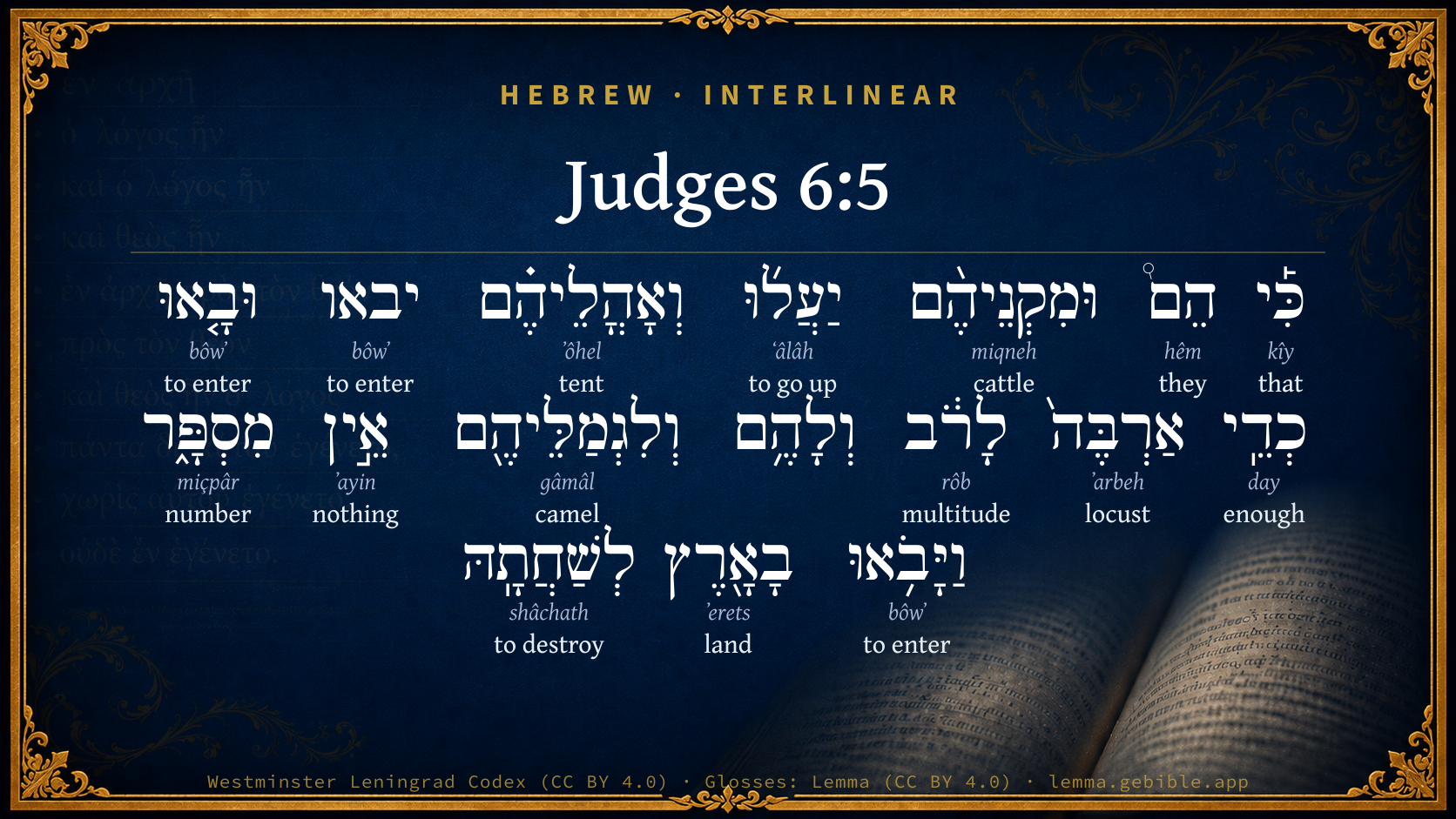
  1. כִּ֡י kîy H3588 “that” Conjunction
  2. הֵם֩ hêm H1992 “they” Pronoun, Personal, 3rd Person, Masculine, Plural
  3. וּמִקְנֵיהֶ֨ם miqneh H4735 “and · cattle · their” Conjunction + Noun, Common, Masculine, Plural, Construct + Suffix, Personal, 3rd Person, Masculine, Plural
  4. יַעֲל֜וּ ʻâlâh H5927 “to go up” Verb, Qal, Imperfect, 3rd Person, Masculine, Plural
  5. וְאָהֳלֵיהֶ֗ם ʼôhel H168 “and · tents · their” Conjunction + Noun, Common, Masculine, Plural, Construct + Suffix, Personal, 3rd Person, Masculine, Plural
  6. יבאו bôwʼ H935 “to enter” Verb, Qal, Imperfect, 3rd Person, Masculine, Plural
  7. וּבָ֤אוּ bôwʼ H935 “and · to enter” Conjunction + Verb, Qal, Sequential Perfect, 3rd Person, Common, Plural
  8. כְדֵֽי day H1767 “like/as · enough of” Preposition + Noun, Common, Masculine, Singular, Construct
  9. לָרֹ֔ב rôb H7230 “to/for · multitude” Preposition + Noun, Common, Both, Singular, Absolute
  10. וְלִגְמַלֵּיהֶ֖ם gâmâl H1581 “and · to/for · camels · their” Conjunction + Preposition + Noun, Common, Masculine, Plural, Construct + Suffix, Personal, 3rd Person, Masculine, Plural
  11. אֵ֣ין ʼayin H369 “nothing” Particle, Negative
  12. מִסְפָּ֑ר miçpâr H4557 “number” Noun, Common, Masculine, Singular, Absolute
  13. וַיָּבֹ֥אוּ bôwʼ H935 “and · to enter” Conjunction + Verb, Qal, Sequential Imperfect, 3rd Person, Masculine, Plural
  14. בָאָ֖רֶץ ʼerets H776 “in/at the · land” Preposition, Determined + Noun, Common, Both, Singular, Absolute
  15. לְשַׁחֲתָֽהּ shâchath H7843 “to destroy · her” Preposition + Verb, Piel, Infinitive Construct + Suffix, Personal, 3rd Person, Feminine, Singular

About this verse

These counts appear in no published source. They are computed here, from the morphology-tagged text and Lemma’s own curated glosses. What Lemma adds →

17
words
14
distinct lemmas
Historical
section

Notable vocabulary

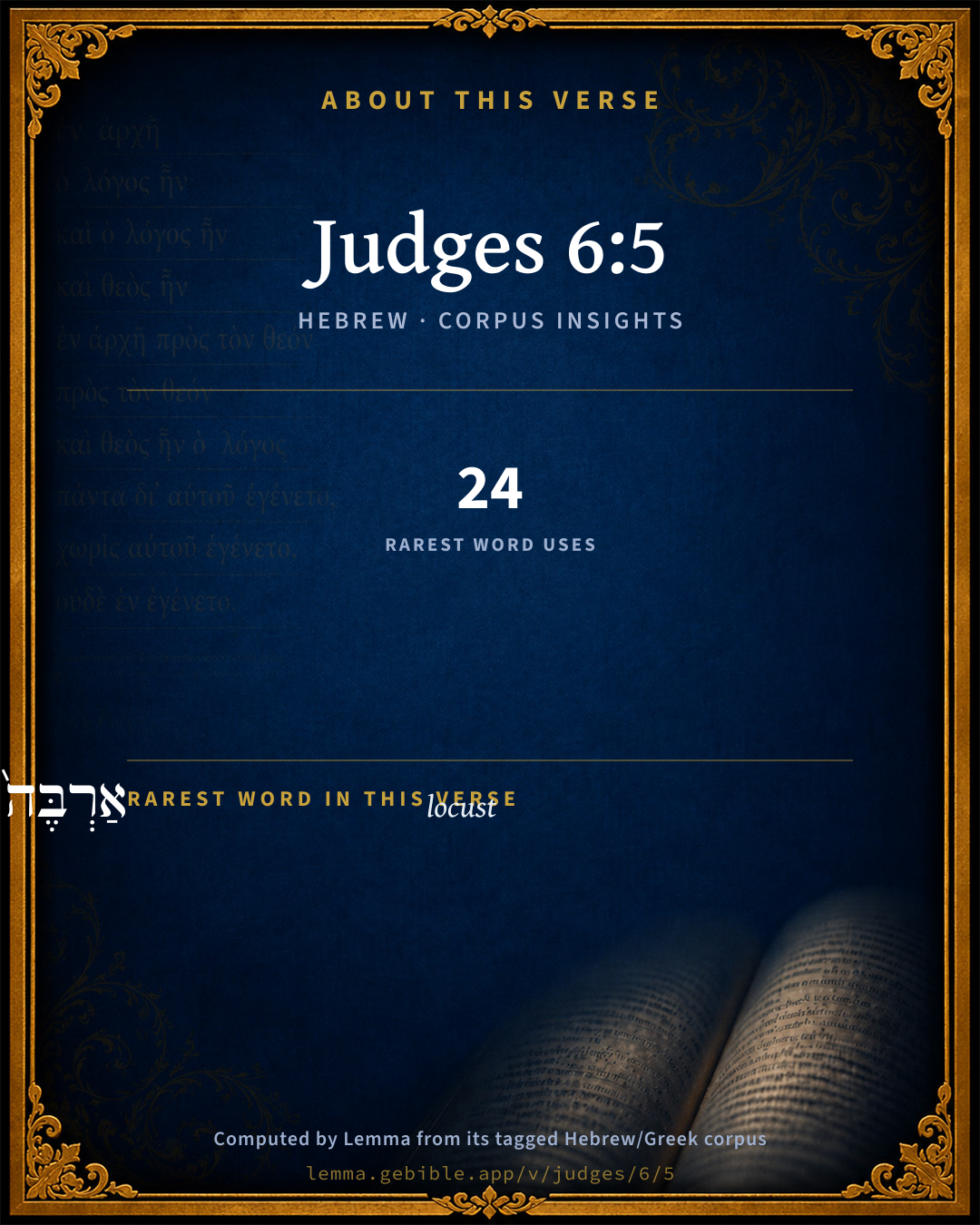
The rarest word here is אַרְבֶּה֙ locust H697 — appearing just 24 times in the whole Hebrew Bible.

Shared distinctive vocabulary

אַרְבֶּה֙ locust H697 occurs in 21 verses of the Hebrew Bible. Also found in:

Grammatical profile

  • 5 verbs
  • 8 nouns
  • 1 pronoun
  • 1 preposition
  • 1 conjunction
  • 1 particle

Verb forms

  • יַעֲל֜וּ Qal · Imperfect
  • יבאו Qal · Imperfect
  • וּבָ֤אוּ Qal · Sequential Perfect
  • וַיָּבֹ֥אוּ Qal · Sequential Imperfect
  • לְשַׁחֲתָֽהּ Piel · Infinitive Construct

Repetition

A word recurs within this verse — often emphatic in Hebrew:

  • יבאו to enter H935 ×3

Hebrew & Septuagint length

In English translation the verse runs 34 words from the Hebrew and 40 from the Septuagint (LXX English) — closely comparable.

A rough comparison of the two English renderings, which tokenize alike — not a word-level alignment.

Word counts can differ between the Hebrew and the Greek without any difference in meaning — e.g. the Hebrew direct-object marker אֵת has no separate Greek word, and Greek often adds the article ὁ.

Cross-references

11

Topical passages linked to Judges 6:5 in the Treasury of Scripture Knowledge — connected by theme and wording, ordered by reader-vote popularity; previews shown in the World English Bible.

  • Judges 7:12 The Midianites and the Amalekites and all the children of the east lay along in the valley like locusts for multitude; and their camels were without number, as the sand which is on the sea-shore for multitude.
  • Judges 8:10 Now Zebah and Zalmunna were in Karkor, and their hosts with them, about fifteen thousand men, all who were left of all the host of the children of the east; for there fell one hundred twenty thousand men who drew sword.
  • Isaiah 60:6 The multitude of camels shall cover you, the dromedaries of Midian and Ephah; all they from Sheba shall come; they shall bring gold and frankincense, and shall proclaim the praises of Yahweh.
  • Isaiah 13:20 It shall never be inhabited, neither shall it be lived in from generation to generation: neither shall the Arabian pitch tent there; neither shall shepherds make their flocks to lie down there.
  • Jeremiah 46:23 They shall cut down her forest, says Yahweh, though it can't be searched; because they are more than the locusts, and are innumerable.
  • Jeremiah 49:29 Their tents and their flocks shall they take; they shall carry away for themselves their curtains, and all their vessels, and their camels; and they shall cry to them, Terror on every side!
  • Jeremiah 49:32 Their camels shall be a booty, and the multitude of their cattle a spoil: and I will scatter to all winds those who have the corners [of their hair] cut off; and I will bring their calamity from every side of them, says Yahweh.
  • Judges 8:21 Then Zebah and Zalmunna said, Rise you, and fall on us; for as the man is, so is his strength. Gideon arose, and killed Zebah and Zalmunna, and took the crescents that were on their camels' necks.
  • 1 Samuel 30:17 David struck them from the twilight even to the evening of the next day: and there not a man of them escaped, except four hundred young men, who rode on camels and fled.
  • Psalms 83:4–12 "Come," they say, "and let's destroy them as a nation, That the name of Israel may be remembered no more."
  • Song of Solomon 1:5 I am dark, but lovely, You daughters of Jerusalem, Like Kedar's tents, Like Solomon's curtains.

Cross-references courtesy of OpenBible.info (CC BY 4.0).

Hebrew and Greek witnesses Masoretic Hebrew ↔ Greek Septuagint

The same verse in the two great witnesses to the Old Testament, shown verse-for-verse.

These are two independent witnesses, not word-aligned to each other, and the Septuagint is shown in lemma (dictionary) form.

Hebrew Judges 6:5 Masoretic · Westminster Leningrad Codex

כִּ֡י הֵם֩ וּמִקְנֵיהֶ֨ם יַעֲל֜וּ וְאָהֳלֵיהֶ֗ם יבאו וּבָ֤אוּ כְדֵֽי אַרְבֶּה֙ לָרֹ֔ב וְלָהֶ֥ם וְלִגְמַלֵּיהֶ֖ם אֵ֣ין מִסְפָּ֑ר וַיָּבֹ֥אוּ בָאָ֖רֶץ לְשַׁחֲתָֽהּ

For they came up with their cattle and their tents; they came in as locusts for multitude; both they and their camels were without number: and they came into the land to destroy it.

World English Bible · Public Domain

Greek LXX Judges 6:5 Septuagint · lemma form

ὅτι αὐτός καί ὁ κτῆσις αὐτός ἀναβαίνω καί ὁ σκηνή αὐτός παραγίγνομαι καθώς ἀκρίς εἰς πλῆθος καί αὐτός καί ὁ κάμηλος αὐτός οὐ εἰμί ἀριθμός καί ἄρχω εἰς ὁ γῆ ἰσραήλ καί διαφθείρω αὐτός

For they and their stock came up, and their tents were with them, as the locust in multitude, and there was no number to them and their camels; and they came to the land of Israel, and laid it waste.

LXX2012 (modern English Septuagint) · Public Domain

Hebrew: Westminster Leningrad Codex (CC BY 4.0). Greek: Septuagint (public domain); English from LXX2012 (modern English Septuagint) (Public Domain). How the Septuagint differs from the Hebrew →

Targum (Aramaic paraphrase)

1

The Targum is the ancient Jewish Aramaic paraphrase of the Hebrew Scriptures — an interpretive translation, not the Hebrew text itself. Onkelos (literal) and Pseudo-Jonathan (expansive) render the Torah, and Jonathan the Prophets. Coverage is partial: where no permissively-licensed English translation exists for a verse, only the Aramaic is shown. This is verse-level text, not a word-by-word alignment to the Hebrew.

  1. Targum Jonathan Prophets (Joshua–Malachi)
    אֲרֵי אִינוּן וְגֵיתֵיהוֹן סַלְקִין וּמַשְׁכְּנֵיהוֹן וְאָתָן כְּמִסַת גוֹבָא לִסְגֵי וּלְהוֹן וְלִגְמַלֵיהוֹן לֵית מִנְיָן וְעָלִין בְּאַרְעָא לְחַבָּלוּתָהּ:

    (no public-domain English translation for this verse)

    Targum Jonathan — Aramaic: “Mikraot Gedolot” (public domain). English: “Sefaria Community Translation” (CC0 1.0 (public-domain dedication)); “London "Chaldee Paraphrase," 1871” (public domain). Text via Sefaria.

Commentary

Notes on Judges 6:5 from classic Christian and Jewish commentators (each source and its license shown beneath its notes). The classic Christian expositions comment on the surrounding passage and are grouped to its opening verse, so a note may address several verses; the Jewish commentaries on the Tanakh (Rashi and others) are per-verse, so they appear only where the commentator wrote on this verse.

Lemma curates 59 commentaries, every one of them public domain or Creative Commons licensed, each selected and text-cleaned for this edition rather than reprinted as found. About our sources →

The Cambridge Bible for Schools and Colleges

gen. ed. J. J. S. Perowne

5. as locusts] Repeated in Jdg_7:12; for the comparison see Jer_46:23. The text of Jdg_6:3-5 shews signs of a mixed origin. Thus the grammar is irregular, frequentative tenses in Jdg_6:3 are followed by narrative aorists in Jdg_6:4, and these again by frequentatives in Jdg_6:5. Notice the repetition of came up in Jdg_6:3 and came into in Jdg_6:5; the Amalekites, and the children of the east is due to the same hand as Jdg_6:33 and Jdg_7:12; till thou come to Gaza has the look of an editorial exaggeration. Perhaps in their simplest form the verses may have run: “(3) And it used to happen that when Israel had sown, Midian used to come up against him, (4) and they used to leave no sustenance … nor ass, (5) for they and their cattle used to come up, and their tents, and come into the land to destroy it.” This may have formed the introduction to the earlier of the two narratives which are combined in 6–8; and the remaining sentences may have been derived from the introduction to the later of the two narratives (Moore, Nowack, Lagrange), or they may be merely glosses (Budde). The whole passage has been pieced together by the Dtc. editor.

The Cambridge Bible for Schools and Colleges (gen. ed. J. J. S. Perowne; Cambridge University Press, 1878–1918) — public domain. Text from a community e-Sword module.

John Gill's Exposition

For they came up with their cattle, and their tents,.... Brought their flocks and their herds with them, to eat up the increase of the earth, and their tents, which they pitched and removed from place to place, for the convenience of feeding their cattle, and while they cut down the fruit of the earth everywhere, which serves to confirm the sense of the Targum and Vulgate Latin version of Jdg 6:5.

and they came as grasshoppers for multitude; or "as locusts" (c), they were like them for their number, and for devouring all they came to:

and their camels were without number; which they brought with them, to load and carry off their plunder they could not eat. Midian was a place famous for camels and dromedaries, Isa 60:6 and so Arabia, the people of which joined the Midianites in this expedition; of whom Leo Africanus says (d), that they reckon of their riches and possessions by their camels; wherefore if anyone speaks of the riches of such a prince or nobleman, he says that he is possessed of so many camels, and not of so many thousands of pieces of gold, see Job 1:3.

and they entered into the city to destroy it; this was their sole view. In suchlike manner as this did Alyattes king of the Lydians make war with the Milesinns, as Herodotus (e) relates; which passage Grotius has quoted at large.

(c) "tanquam locustae", Pagninus, V. L. Tigurine version, Junius & Tremellius, Piscator. (d) Descriptio Africae, l. 9. p. 745. (e) Clio, sive, l. 1. c. 17.

John Gill's Exposition of the Whole Bible (1746–1763) — public domain (CC PDM 1.0). Text via the HelloAO Bible API.

Trapp's Complete Commentary

John Trapp

Jdg 6:5 For they came up with their cattle and their tents, and they came as grasshoppers for multitude; [for] both they and their camels were without number: and they entered into the land to destroy it.

Ver. 5. And they came as grasshoppers.] Innumerable and devoratory. See Jdg 6:4 Joe 2:25

John Trapp, A Commentary or Exposition upon All the Books of the Old and New Testament (1647–1656) — public domain. Text from a community e-Sword module.

Adam Clarke's Commentary

Verse 5. They came up with their cattle and their tents] All this proves that they were different tribes of wanderers who had no fixed residence; but, like their descendants the Bedouins or wandering Arabs, removed from place to place to get prey for themselves and forage for their cattle.

Adam Clarke's Commentary on the Bible (1810–1826) — public domain. Text from a community e-Sword/MySword module.

Ellicott's Commentary for English Readers

(5) As grasshoppers.—See Jdg_7:12. Rather, as locusts. The magnificent imagery of Joe_2:2-11 enables us to realise the force of the metaphor, and Exo_10:4-6 the number of locusts, which are a common metaphor for countless hordes. Aristophanes (Ach. 150) speaks of an army so numerous that the Athenians will cry out, “What a mass of locusts is coming!” The Bedouin call the locusts Gurrud Allah, “Host of God” (Wetzstein, Hauran, p. 138).

Their camels.—These were very uncommon in Palestine, and were brought by the invaders from the Eastern deserts.

Without number.—This is Oriental hyperbole. “When Burckhardt asked a Bedouin, who belonged to a tribe of 300 tents, how many brothers he had, he flung a handful of sand into the air, and replied, ‘Equally numberless’” (Cassel).

A Bible Commentary for English Readers, edited by Charles John Ellicott (1878–1897) — public domain. Text from a community e-Sword module.

Albert Barnes' Notes on the Bible

Grasshoppers - Rather locusts (compare Exo 10:4-6, Exo 10:14-15; Joel 1; 2; Psa 78:46)

Albert Barnes' Notes on the Bible (1834–1885) — public domain. Text from a community e-Sword/MySword module.

Haydock's Catholic Bible Commentary

Locusts. This comparison shews the rapacity and devastation of the enemy. Locusts in those countries often obscure the air with their numbers, and presently eat up every green thing. They proceed in regular order like a great battalion, and it is reported that they send some before to explore the country. (St. Jerome in Joel ii.; Bochart; Calmet) (Genesis x. 4.)

George Leo Haydock (1774–1849), Haydock's Catholic Family Bible and Commentary, 1859 edition — public domain. Excludes Psalms (Douay-Rheims chapter numbering differs from Protestant) and Deuterocanonical books (Catholic canon only).

Matthew Poole's English Annotations

Without number, i.e. so many that it was not easy to number them. It is an hyperbole.

Matthew Poole's English Annotations on the Holy Bible (1683–1685) — public domain. Text from a community e-Sword/MySword module.

Whedon's Commentary on the Bible

Daniel D. Whedon

5. As grasshoppers — Or locusts, a specimen of whose desolating and all-devouring march is depicted in Joe_1:4; Joe_2:1-11. They come in such numbers as to darken all the land, and speedily consume every green thing.

Daniel D. Whedon (gen. ed.), Commentary on the Old and New Testaments (1874–1909) — public domain. Text from a community e-Sword module.

The Pulpit Commentary

As grasshoppers. See the striking description of the destruction caused by locusts in Joe 3. I have heard travellers in India describe the sudden darkening of the sky by a flight of locusts.

The Pulpit Commentary (1880–1919), ed. H.D.M. Spence-Jones & Joseph S. Exell — public domain. Text from a community e-Sword module.

John Wesley's Explanatory Notes

Without number - That is, so many that it was not easy to number them. And not in a regular army to engage, but in a confused swarm, to plunder the country. Yet Israel, being forsaken of God, had not spirit to make head against them; God fighting against them with those very terrors, with which otherwise he would have fought for them.

John Wesley, Explanatory Notes Upon the Whole Bible (1754–1765) — public domain. Text via the GEBible commentary corpus.

unfoldingWord translationNotes

Door43 World Missions Community

Whenever they and their livestock and tents came up

The land of Midian was south of the land of Israel, near the Red Sea. It was common to use the phrase "came up" when speaking of traveling from Midian to Israel. AT: "Whenever the Midianites brought their livestock and tents to the land of Israel"

they would come as a swarm of locusts

The Midianites are compared to a swarm of locusts because they came in with a great number of people and their livestock ate everything that grew. (See: Simile)

it was impossible to count

This is an exaggeration, a hyperbole, showing the number is very great. (See: Hyperbole and Generalization)

Midian weakened

Here "Midian" represents the people of Midian. (See: Metonymy)

called out to Yahweh

This is an idiom. AT: "prayed to Yahweh for help" (See: Idiom)

translationWords

livestock

tent

locust

camel

Midian

Israel

call

Yahweh

unfoldingWord translationNotes — © Distant Shores Media and the Door43 World Missions Community, licensed CC BY-SA 4.0. Source: git.door43.org/Door43/en_tn.

Rashi

Rabbi Shlomo Yitzchaki (Rashi)

With their cattle to graze on the produce.

Rashi on the Tanakh — English translations: “The Judaica Press complete Tanach with Rashi, translated by A. J. Rosenberg” (CC BY 4.0); “Pentateuch with Rashi's commentary by M. Rosenbaum and A.M. Silbermann, 1929-1934” (public domain); “The Metsudah Tanach series, Lakewood, N.J” (CC BY 4.0); and “The Book of Joshua, Metsudah Publications, 1997” (CC BY 4.0). Text via Sefaria.

Lesson kit

Teaching starters — assembled from the data on this page, not authored interpretation. Every prompt links to the verse data it draws on. Edit before teaching.

Judges, in the Historical, opens this verse with 17 words (14 distinct Hebrew lemmas). Its most distinctive word is ʼarbeh (“locust”). A historical commentator’s framing appears above. Read the whole chapter for the surrounding context.

Discussion questions

  1. What does “locust” (ʼarbeh) contribute to the verse as a whole?
  2. How does Exodus 10:4, which shares the word «locust», read alongside this verse?
  3. What does the repetition of “to enter” (3× in this one verse) do in this verse?
  4. The translations on this page render this verse differently — a whole-verse word diff, not a word-by-word alignment. What might account for the different wordings?
  5. «יַעֲל֜וּ» is a Qal Imperfect verb. How does that grammatical form shape the action described?
  6. Compare how The Cambridge Bible for Schools and Colleges and John Gill's Exposition read this verse. Where do they agree or differ?

Things to notice

Reading settings

Reading text

Shown beneath each verse's original-language words.

Old Testament
Old Testament edition

Read the OT as the Masoretic Hebrew (MT) or the Greek Septuagint (LXX).

English shown for the Greek Septuagint (in the Hebrew ↔ Greek comparison).

Comparing translations? Open the Compare panel on any verse page to stack up to four side by side.