
1 Kings 11:2

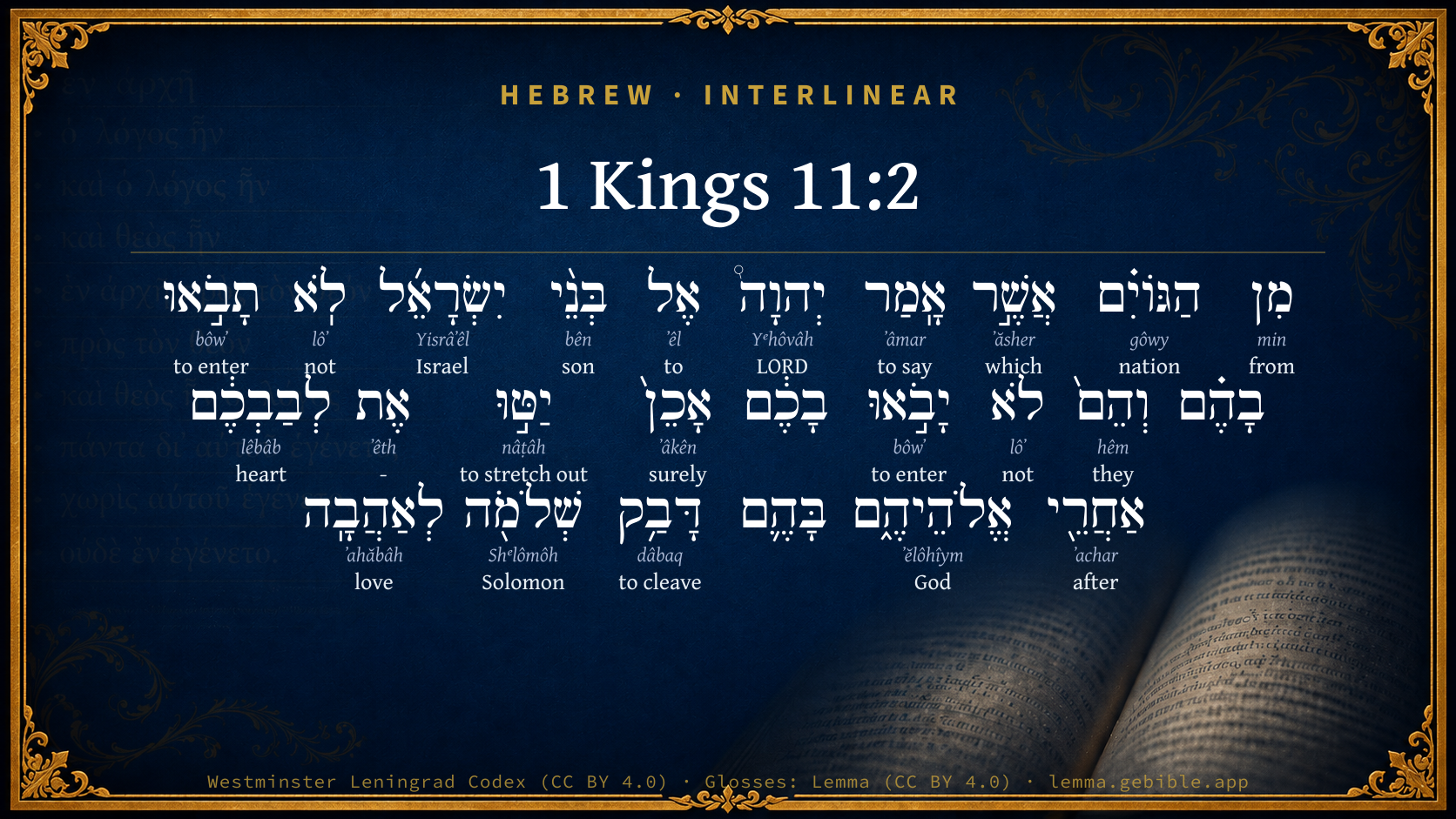
Hebrew (Westminster Leningrad Codex) 1 Kings 11:2 appears in the Hebrew Old Testament. The text above is from the Westminster Leningrad Codex. Each word links to its Strong’s number, a concise gloss, and parsing drawn from the Open Scriptures Hebrew Bible morphology. Click any word for its full Brown-Driver-Briggs (BDB) entry.
Download image
Cite this verse

1 Kings 11:2 (World English Bible). Public Domain. Lemma interlinear Bible study tool, https://lemma.gebible.app/v/1-kings/11/2.

Show BibTeX & RIS
BibTeX
RIS
English Translation
of the nations concerning which Yahweh said to the children of Israel, You shall not go among them, neither shall they come among you; for surely they will turn away your heart after their gods: Solomon joined to these in love.
World English Bible · Public Domain
Download a study sheet

One document with this verse’s original text, its word-by-word gloss line, the meaning frame, cross-references with their text, attributed commentary, and full source and license credits — printable, and it pastes into notes with its structure intact.

This verse Autodidact and up

Study sheet (.html) Plain text (.txt)

A passage Seminary Student

Up to 50 verses in one chapter. A passage sheet keeps up to 6 commentary sources and 12 cross-references per verse, in the order this page ranks them, and says so on the sheet whenever that leaves anything out. Ask for a single verse and you get the Autodidact verse sheet above.

Everything on this page stays free to read, with no account — the sheet is a download of what is already on screen, not access to it.

Want to remove ads? Support Godless Engineer
Compare translations 3

The same verse in 3 English versions, stacked beneath the original-language interlinear above. Click any original word for its lexicon entry.

Each is an independent rendering of the whole verse — the interlinear is not word-aligned to these translations.

Highlighted words mark where these versions differ — a whole-verse word diff, not a word-by-word alignment.

  • World English Bible Public Domain
    of the nations concerning which Yahweh said to the children of Israel, You shall not go among them, neither shall they come among you; for surely they will turn away your heart after their gods: Solomon joined to these in love.
  • King James Version Public Domain
    Of the nations concerning which the LORD said unto the children of Israel, Ye shall not go in to them, neither shall they come in unto you: for surely they will turn away your heart after their gods: Solomon clave unto these in love.
  • unfoldingWord Literal Text CC BY-SA 4.0
    from the nations which Yahweh had said to the sons of Israel, “You must not enter into them, and they must not enter into you. Surely they will stretch out your heart after their gods.” Solomon clung to them in love.

unfoldingWord Literal Text — © unfoldingWord, licensed CC BY-SA 4.0. Word-aligned USFM3 via Door43 (git.door43.org/unfoldingWord/en_ult).

Versions to compare (up to 4)

3 of 4 selected

Show all 18 translations

Every available English version of this verse, each an independent rendering of the whole verse.

  • World English Bible Public Domain
    of the nations concerning which Yahweh said to the children of Israel, You shall not go among them, neither shall they come among you; for surely they will turn away your heart after their gods: Solomon joined to these in love.
  • Berean Standard Bible Public Domain
    These women were from the nations about which the LORD had told the Israelites, “You must not intermarry with them, for surely they will turn your hearts after their gods.” Yet Solomon clung to these women in love.
  • Majority Standard Bible Public Domain
    These women were from the nations about which the LORD had told the Israelites, “You must not intermarry with them, for surely they will turn your hearts after their gods.” Yet Solomon clung to these women in love.
  • King James Version Public Domain
    Of the nations concerning which the LORD said unto the children of Israel, Ye shall not go in to them, neither shall they come in unto you: for surely they will turn away your heart after their gods: Solomon clave unto these in love.
  • American Standard Version (1901) Public Domain
    of the nations concerning which Jehovah said unto the children of Israel, Ye shall not go among them, neither shall they come among you; for surely they will turn away your heart after their gods: Solomon clave unto these in love.
  • Revised Version (1885) Public Domain
    of the nations concerning which the LORD said unto the children of Israel, Ye shall not go among them, neither shall they come among you: for surely they will turn away your heart after their gods: Solomon clave unto these in love.
  • Geneva Bible (1599) Public Domain
    Of the nations, whereof the Lord had sayd vnto the children of Israel, Goe not ye in to them, nor let them come in to you: for surely they will turne your hearts after their gods, to them, I say, did Salomon ioyne in loue.
  • Douay-Rheims (1899) Public Domain
    Of the nations concerning which the Lord said to the children of Israel: You shall not go in unto them, neither shall any of them come in to yours: for they will most certainly turn away your heart to follow their gods. And to these was Solomon joined with a most ardent love.
  • Young's Literal Translation Public Domain
    of the nations of which Jehovah said unto the sons of Israel, `Ye do not go in to them, and they do not go in to you; surely they turn aside your heart after their gods;' to them hath Solomon cleaved for love.
  • Literal Standard Version CC BY-SA 4.0
    of the nations of which YHWH said to the sons of Israel, “You do not go in to them, and they do not go in to you; surely they turn aside your heart after their gods”; Solomon has cleaved to them for love.
  • Unlocked Literal Bible CC BY-SA 4.0
    They were from the nations about which Yahweh said to the people of Israel, “You will not go among them to marry, neither will they come among you, for they will certainly turn your heart to their gods.” In spite of this command, Solomon was affectionate toward these women in love.
  • unfoldingWord Literal Text CC BY-SA 4.0
    from the nations which Yahweh had said to the sons of Israel, “You must not enter into them, and they must not enter into you. Surely they will stretch out your heart after their gods.” Solomon clung to them in love.
  • Darby Bible Public Domain
    of the nations of which Jehovah had said to the children of Israel, Ye shall not go in to them, neither shall they come in to you; they would certainly turn away your heart after their gods: to these Solomon was attached in love.
  • World Messianic Bible Public Domain
    of the nations concerning which the LORD said to the children of Israel, “You shall not go among them, neither shall they come among you, for surely they will turn away your heart after their gods.” Solomon joined to these in love.
  • Webster's Bible Public Domain
    Of the nations concerning which the LORD said to the children of Israel, Ye shall not go in to them, neither shall they come in to you: for surely they will turn away your heart after their gods: Solomon cleaved to these in love.
  • Free Bible Version CC BY-SA 4.0
    They were from the nations that the Lord had warned the Israelites, “You must not intermarry with them, for they will undoubtedly convince you to worship their gods.” Yet Solomon because of his love for women held on to them.
  • Bible in Basic English Public Domain
    The nations of which the Lord had said to the children of Israel, You are not to take wives from them and they are not to take wives from you; or they will certainly make you go after their gods: to these Solomon was united in love.
  • JPS Tanakh (1917) Public Domain
    of the nations concerning which the LORD said unto the children of Israel: 'Ye shall not go among them, neither shall they come among you; for surely they will turn away your heart after their gods'; Solomon did cleave unto these in love.

Literal Standard Version (2020), Covenant Press — licensed CC BY-SA 4.0. Text via the HelloAO Bible API (eBible.org). Unlocked Literal Bible (unfoldingWord) — licensed CC BY-SA 4.0. Text via the HelloAO Bible API (eBible.org). unfoldingWord Literal Text — © unfoldingWord, licensed CC BY-SA 4.0. Word-aligned USFM3 via Door43 (git.door43.org/unfoldingWord/en_ult). Free Bible Version, Dr. Jonathan Gallagher — licensed CC BY-SA 4.0. Text via the HelloAO Bible API (eBible.org).

Word by word

More ways to search: Search by grammar → Find every occurrence → Compare this word →

Practice this passage: Drill this verse → Learn its vocabulary →

אָכֵן֙
ʼâkên
H403
“surely”
Adverb
Part of Speech
Adverb
Full BDB Definition

Origin: from H3559 [compare H3651 ]

TWOT: 86

surely, truly, indeed - truly, indeed (strong assertive force) - but indeed, but in fact (emphasizing a contrast)
  1. מִן min H4480 “from” Preposition
  2. הַגּוֹיִ֗ם gôwy H1471 “the · nations” Particle, Definite Article + Noun, Common, Masculine, Plural, Absolute
  3. אֲשֶׁ֣ר ʼăsher H834 “which” Particle, Relative
  4. אָֽמַר ʼâmar H559 “to say” Verb, Qal, Perfect, 3rd Person, Masculine, Singular
  5. יְהוָה֩ Yᵉhôvâh H3068 “LORD” Noun, Proper
  6. אֶל ʼêl H413 “to” Preposition
  7. בְּנֵ֨י bên H1121 “sons of” Noun, Common, Masculine, Plural, Construct
  8. יִשְׂרָאֵ֜ל Yisrâʼêl H3478 “Israel” Noun, Proper
  9. לֹֽא lôʼ H3808 “not” Particle, Negative
  10. תָבֹ֣אוּ bôwʼ H935 “to enter” Verb, Qal, Imperfect, 2nd Person, Masculine, Plural
  11. וְהֵם֙ hêm H1992 “and · they” Conjunction + Pronoun, Personal, 3rd Person, Masculine, Plural
  12. לֹא lôʼ H3808 “not” Particle, Negative
  13. יָבֹ֣אוּ bôwʼ H935 “to enter” Verb, Qal, Imperfect, 3rd Person, Masculine, Plural
  14. יַטּ֣וּ nâṭâh H5186 “to stretch out” Verb, Hiphil, Imperfect, 3rd Person, Masculine, Plural
  15. אֶת ʼêth H853 “-” Particle, Direct Object
  16. לְבַבְכֶ֔ם lêbâb H3824 “heart · your” Noun, Common, Masculine, Singular, Construct + Suffix, Personal, 2nd Person, Masculine, Plural
  17. אַחֲרֵ֖י ʼachar H310 “after” Preposition
  18. אֱלֹהֵיהֶ֑ם ʼĕlôhîym H430 “God(s) · their” Noun, Common, Masculine, Plural, Construct + Suffix, Personal, 3rd Person, Masculine, Plural
  19. דָּבַ֥ק dâbaq H1692 “to cleave” Verb, Qal, Perfect, 3rd Person, Masculine, Singular
  20. שְׁלֹמֹ֖ה Shᵉlômôh H8010 “Solomon” Noun, Proper
  21. לְאַהֲבָֽה ʼahăbâh H160 “to/for · love” Preposition + Verb, Qal, Infinitive Construct

About this verse

These counts appear in no published source. They are computed here, from the morphology-tagged text and Lemma’s own curated glosses. What Lemma adds →

25
words
20
distinct lemmas
Historical
section

Notable vocabulary

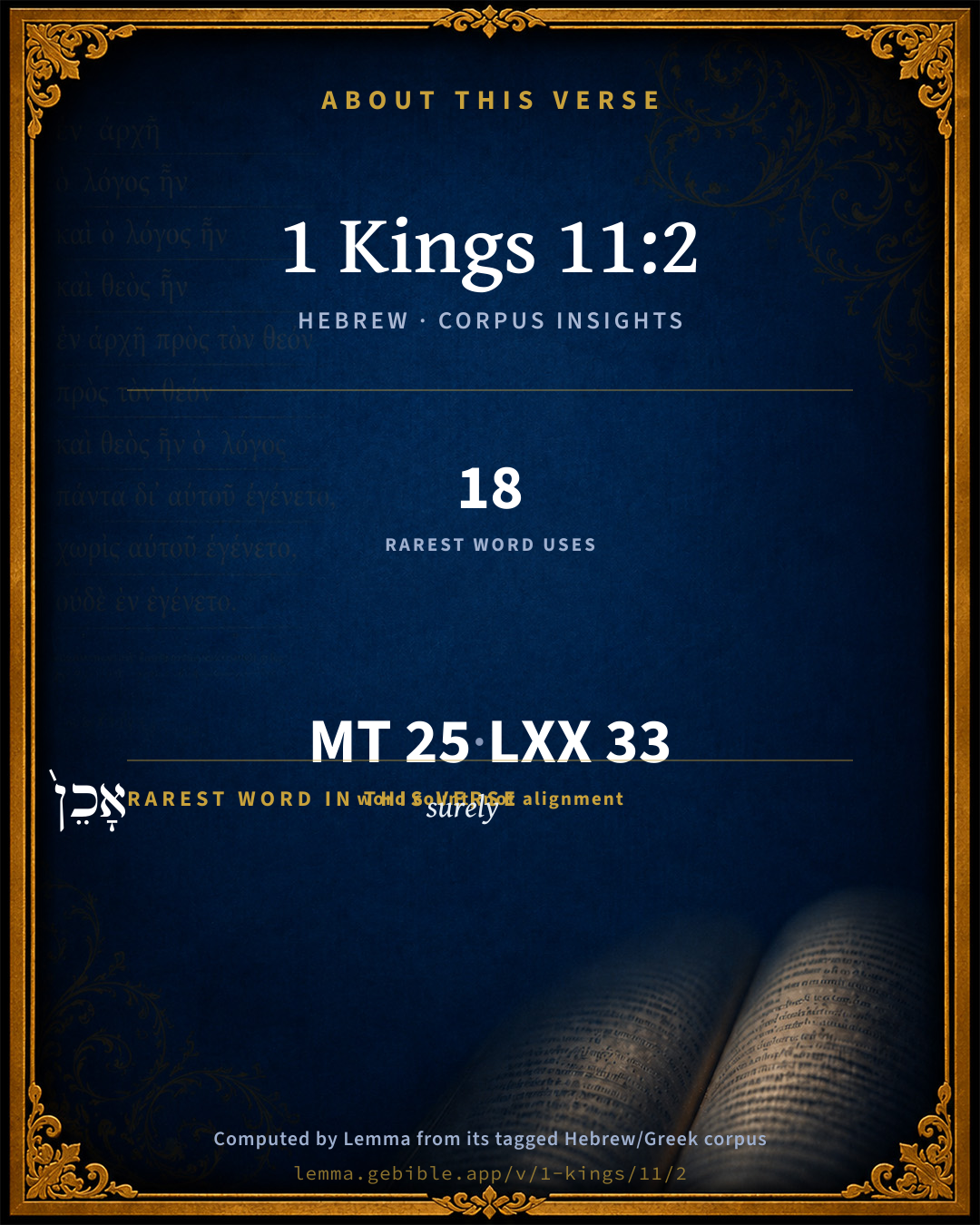
The rarest word here is אָכֵן֙ surely H403 — appearing just 18 times in the whole Hebrew Bible.

Shared distinctive vocabulary

אָכֵן֙ surely H403 occurs in 17 verses of the Hebrew Bible. Also found in:

Grammatical profile

  • 6 verbs
  • 7 nouns
  • 1 pronoun
  • 6 prepositions
  • 1 adverb
  • 4 particles

Verb forms

  • אָֽמַר Qal · Perfect
  • תָבֹ֣אוּ Qal · Imperfect
  • יָבֹ֣אוּ Qal · Imperfect
  • יַטּ֣וּ Hiphil · Imperfect
  • דָּבַ֥ק Qal · Perfect
  • לְאַהֲבָֽה Qal · Infinitive Construct

Repetition

Words recur within this verse — often emphatic in Hebrew:

  • תָבֹ֣אוּ to enter H935 ×2
  • לֹֽא not H3808 ×2

Hebrew & Septuagint length

In English translation the verse runs 41 words from the Hebrew and 43 from the Septuagint (LXX English) — closely comparable.

A rough comparison of the two English renderings, which tokenize alike — not a word-level alignment.

Word counts can differ between the Hebrew and the Greek without any difference in meaning — e.g. the Hebrew direct-object marker אֵת has no separate Greek word, and Greek often adds the article ὁ.

In the original languages it is 25 Hebrew tokens and 33 Greek tokens — but the two are counted differently (Hebrew bundles its prefixes and suffixes into one token; the Greek is in lemma form), so that isn’t a like-for-like length.

Cross-references

21

Topical passages linked to 1 Kings 11:2 in the Treasury of Scripture Knowledge — connected by theme and wording, ordered by reader-vote popularity; previews shown in the World English Bible.

  • Exodus 34:16 and you take of their daughters to your sons, and their daughters play the prostitute after their gods, and make your sons play the prostitute after their gods.
  • Deuteronomy 7:3–4 neither shall you make marriages with them; your daughter you shall not give to his son, nor his daughter shall you take to your son.
  • Joshua 23:12–13 Else if you do at all go back, and cleave to the remnant of these nations, even these who remain among you, and make marriages with them, and go in to them, and they to you;
  • Exodus 23:32–33 You shall make no covenant with them, nor with their gods.
  • Numbers 25:1–3 Israel abode in Shittim; and the people began to play the prostitute with the daughters of Moab:
  • 1 Corinthians 15:33 Don't be deceived! "Evil companionships corrupt good morals."
  • 2 Corinthians 6:14–16 Don't be unequally yoked with unbelievers, for what fellowship have righteousness and iniquity? Or what communion has light with darkness?
  • Romans 12:9 Let love be without hypocrisy. Abhor that which is evil. Cling to that which is good.
  • Malachi 2:11 Judah has dealt treacherously, and an abomination is committed in Israel and in Jerusalem; for Judah has profaned the holiness of Yahweh which he loves, and has married the daughter of a foreign god.
  • Romans 1:32 who, knowing the ordinance of God, that those who practice such things are worthy of death, not only do the same, but also approve of those who practice them.
  • Revelation 2:4 But I have this against you, that you left your first love.
  • Genesis 2:24 Therefore a man will leave his father and his mother, and will join with his wife, and they will be one flesh.
  • Genesis 34:3 His soul joined to Dinah, the daughter of Jacob, and he loved the young lady, and spoke kindly to the young lady.
  • Judges 3:6–7 and they took their daughters to be their wives, and gave their own daughters to their sons and served their gods.
  • Judges 16:4–21 It came to pass afterward, that he loved a woman in the valley of Sorek, whose name was Delilah.
  • 1 Kings 16:31–33 It happened, as if it had been a light thing for him to walk in the sins of Jeroboam the son of Nebat, that he took as wife Jezebel the daughter of Ethbaal king of the Sidonians, and went and served Baal, and worshiped him.
  • 2 Chronicles 19:2 Jehu the son of Hanani the seer went out to meet him, and said to king Jehoshaphat, Should you help the wicked, and love those who hate Yahweh? for this thing wrath is on you from before Yahweh.
  • 2 Chronicles 21:6 He walked in the way of the kings of Israel, as did the house of Ahab; for he had the daughter of Ahab as wife: and he did that which was evil in the sight of Yahweh.
  • Ezra 9:12 now therefore don't give your daughters to their sons, neither take their daughters to your sons, nor seek their peace or their prosperity forever; that you may be strong, and eat the good of the land, and leave it for an inheritance to your children forever.
  • Ezra 10:2–17 Shecaniah the son of Jehiel, one of the sons of Elam, answered Ezra, We have trespassed against our God, and have married foreign women of the peoples of the land: yet now there is hope for Israel concerning this thing.
  • Psalms 139:21 Yahweh, don't I hate those who hate you? Am I not grieved with those who rise up against you?

Cross-references courtesy of OpenBible.info (CC BY 4.0).

Hebrew and Greek witnesses Masoretic Hebrew ↔ Greek Septuagint

The same verse in the two great witnesses to the Old Testament, shown verse-for-verse.

These are two independent witnesses, not word-aligned to each other, and the Septuagint is shown in lemma (dictionary) form.

Hebrew 1 Kings 11:2 Masoretic · Westminster Leningrad Codex

מִן הַגּוֹיִ֗ם אֲשֶׁ֣ר אָֽמַר יְהוָה֩ אֶל בְּנֵ֨י יִשְׂרָאֵ֜ל לֹֽא תָבֹ֣אוּ בָהֶ֗ם וְהֵם֙ לֹא יָבֹ֣אוּ בָכֶ֔ם אָכֵן֙ יַטּ֣וּ אֶת לְבַבְכֶ֔ם אַחֲרֵ֖י אֱלֹהֵיהֶ֑ם בָּהֶ֛ם דָּבַ֥ק שְׁלֹמֹ֖ה לְאַהֲבָֽה

of the nations concerning which Yahweh said to the children of Israel, You shall not go among them, neither shall they come among you; for surely they will turn away your heart after their gods: Solomon joined to these in love.

World English Bible · Public Domain

Greek LXX 1 Kings 11:2 Septuagint · lemma form

ἐκ ὁ ἔθνος ὅς ἀποεἶπον κύριος ὁ υἱός ἰσραήλ οὐ εἰςἔρχομαι εἰς αὐτός καί αὐτός οὐ εἰςἔρχομαι εἰς σύ μή ἐκκλίνω ὁ καρδία σύ ὀπίσω ὁ αὐτός εἰς αὐτός κολλάω σαλωμών ὁ ἀγαπάω

of the nations concerning whom the Lord forbade the children of Israel, saying, You⌃ shall not go in to them, and they shall not come in to you, lest they turn away your hearts after their idols: Solomon clave to these in love.

LXX2012 (modern English Septuagint) · Public Domain

Hebrew: Westminster Leningrad Codex (CC BY 4.0). Greek: Septuagint (public domain); English from LXX2012 (modern English Septuagint) (Public Domain). How the Septuagint differs from the Hebrew →

Targum (Aramaic paraphrase)

1

The Targum is the ancient Jewish Aramaic paraphrase of the Hebrew Scriptures — an interpretive translation, not the Hebrew text itself. Onkelos (literal) and Pseudo-Jonathan (expansive) render the Torah, and Jonathan the Prophets. Coverage is partial: where no permissively-licensed English translation exists for a verse, only the Aramaic is shown. This is verse-level text, not a word-by-word alignment to the Hebrew.

  1. Targum Jonathan Prophets (Joshua–Malachi)
    מִן עַמְמַיָא דִי אֲמַר יְיָ לִבְנֵי יִשְׂרָאֵל לָא תִתְעָרְבוּן בְּהוֹן וְאִינוּן לָא יִתְעָרְבוּן בְּכוֹן דִלְמָא יַטְעוּן יַת לִבְּכוֹן בָּתַר טַעֲוַתְהוֹן בְּהוֹן אִתְרְעֵי שְׁלֹמֹה לְמִרְחַם:

    (no public-domain English translation for this verse)

    Targum Jonathan — Aramaic: “Mikraot Gedolot” (public domain). English: “Sefaria Community Translation” (CC0 1.0 (public-domain dedication)); “London "Chaldee Paraphrase," 1871” (public domain). Text via Sefaria.

Commentary

Notes on 1 Kings 11:2 from classic Christian and Jewish commentators (each source and its license shown beneath its notes). The classic Christian expositions comment on the surrounding passage and are grouped to its opening verse, so a note may address several verses; the Jewish commentaries on the Tanakh (Rashi and others) are per-verse, so they appear only where the commentator wrote on this verse.

Lemma curates 59 commentaries, every one of them public domain or Creative Commons licensed, each selected and text-cleaned for this edition rather than reprinted as found. About our sources →

Trapp's Complete Commentary

John Trapp

1Ki 11:2 Of the nations [concerning] which the LORD said unto the children of Israel, Ye shall not go in to them, neither shall they come in unto you: [for] surely they will turn away your heart after their gods: Solomon clave unto these in love.

Ver. 2. Solomon clave unto these in love,] i.e., In lust; which, when once set on fire, is as hard to be quenched as the fire of Etna. See Jdg 16:16. Libidinous persons will not spare to bury name, substance, soul, carcass, all in the bosom of a filthy harlot.

John Trapp, A Commentary or Exposition upon All the Books of the Old and New Testament (1647–1656) — public domain. Text from a community e-Sword module.

Joseph Benson's Commentary

1Ki 11:2. Concerning which the Lord said — Ye shall not go in unto them — This relates especially to the Hittites and the Zidonians, and consequently the rest of the seven nations of Canaan, with whom they were forbidden to make any marriage, (Exo 34:16; Deu 7:3,) for the weighty reason here mentioned. For though they might marry women of other nations, if these women embraced the true religion, yet of the seven nations of Canaan they might not, although they were converted to their religion; lest the venom should lurk and lie hid, and at last break out and infect them. Great was the foresight wherewith God endowed Moses in giving this precept, as Grotius remarks; and the not observing it was of fatal consequence to the Israelites, and laid the foundation of their utter ruin. Solomon clave unto these in love — Was extravagantly fond of them. He had much knowledge; but to what purpose, when he knew not how to govern his appetites?

Joseph Benson's Commentary on the Old and New Testaments (1811–1818) — public domain. Text from a community e-Sword module.

The Cambridge Bible for Schools and Colleges

gen. ed. J. J. S. Perowne

2. of the nations concerning which the Lord said] The prohibition of intermarriage with the nations of Canaan is given in Exo_34:16; Deu_7:3-4. Like so much else in the Law, it was a great ideal toward which neither the people nor their rulers were earnest in advancing, when they once became settled in some portion of the land.

The Cambridge Bible for Schools and Colleges (gen. ed. J. J. S. Perowne; Cambridge University Press, 1878–1918) — public domain. Text from a community e-Sword module.

John Gill's Exposition

Of the nations concerning which the Lord said unto the children of Israel, ye shall not go in to them, neither shall they come in unto you,.... That is, they should not intermarry with one another; this is to be understood of the last mentioned, the Hittites, who were one of the seven nations this law respected, Deu 7:1.

for surely they will turn away your heart after their gods; which is the reason given for the making the above law, and was sadly verified in Solomon:

Solomon clave unto these in love; he not only took them, but kept them, and expressed a strong affection for them.

John Gill's Exposition of the Whole Bible (1746–1763) — public domain (CC PDM 1.0). Text via the HelloAO Bible API.

Albert Barnes' Notes on the Bible

Ye shall not go in unto them ... - These words are not a quotation from the Pentateuch. They merely give the general meaning of the two passages prohibiting intermarriage with neighboring idolators (marginal references). Strictly speaking, the prohibition in the Law of intermarriage was confined to the Canaanite nations. But the principle of the prohibition applied equally to the Moabites, Ammonites, and Edomites who all bordered on the holy land; and was so applied by Ezra Ezr 9:1 and Nehemiah Neh 13:23.

Albert Barnes' Notes on the Bible (1834–1885) — public domain. Text from a community e-Sword/MySword module.

Haydock's Catholic Bible Commentary

Gods. See Exodus xxxiv. 16., and Deuteronomy vii. 4. The law only forbids expressly the marrying of the women of Chanaan. But is was easy to discern, that the spirit of the law equally prohibited connexions with others who were addicted to idol-worship. See 1 Esdras x. 3. Such alliances are always dangerous, and generally prove fatal; (Calmet) unless there be good reason to believe that the parties are sincerely converted: in which case the prohibition ceases. (Haydock) --- Love. Thus, nitimur in vetitum semper, cupimusque negata; and, stolen waters are sweeter, says impure love; but her guests are in the depths of hell, Proverbs ix. 17, 18.

George Leo Haydock (1774–1849), Haydock's Catholic Family Bible and Commentary, 1859 edition — public domain. Excludes Psalms (Douay-Rheims chapter numbering differs from Protestant) and Deuterocanonical books (Catholic canon only).

Matthew Poole's English Annotations

Ye shall not go in to them, i.e. marry them. See Poole "Gen 6:4".

They will turn away your heart after their gods: possibly Solomon might think himself too wise to be drawn to idolatry by his wives, and therefore to be unconcerned in the reason of the law; and consequently free in some measure from the obligation of the law; and so, like our first parents, trusting his own fancy more than God’s word, he fell dreadfully.

Matthew Poole's English Annotations on the Holy Bible (1683–1685) — public domain. Text from a community e-Sword/MySword module.

The Pulpit Commentary

Of the nations concerning which the Lord said unto the children of Israel Of the nations just enumerated, the law expressly forbade marriage with the Hittites alone (Exo_34:11-16; Deu_7:1-4) though the Zidonians are probably to be included, as being Canaanites. (Gen_10:15) But the principle which applied in the ease of the seven nations of Canaan applied equally to all other idolaters. "They will turn away thy son from following me," etc. (Deu_7:4) The spirit of the law, consequently, was as much violated by an Edomite or Ammonite as by a Hittite alliance, Ye shall not go in to them, neither shall they come in unto you much the same expression, Jos_23:12. The historian does not cite any specialScripture, however, but gives the substance of several warnings for surely they will turn away your heart after their gods cf.: Exo_34:16 Solomon clave same word Gen_2:4 unto these emphatic in Heb. "even to these," instead of cleaving to God, (Deu_4:4 Deu_10:20 Deu_30:20) each of which has the same word as here and despite the prohibitions of the law, etc. in love.

The Pulpit Commentary (1880–1919), ed. H.D.M. Spence-Jones & Joseph S. Exell — public domain. Text from a community e-Sword module.

Lesson kit

Teaching starters — assembled from the data on this page, not authored interpretation. Every prompt links to the verse data it draws on. Edit before teaching.

1 Kings, in the Historical, opens this verse with 25 words (20 distinct Hebrew lemmas). Its most distinctive word is ʼâkên (“surely”). A historical commentator’s framing appears above. Read the whole chapter for the surrounding context.

Discussion questions

  1. How does “surely” (ʼâkên) shape what this verse is saying?
  2. How does Genesis 28:16, which shares the word «surely», read alongside this verse?
  3. What does the repetition of “to enter” (2× in this one verse) do in this verse?
  4. These translations render this verse differently; the difference is in the English rendering, not the original. What questions does that raise?
  5. «אָֽמַר» is a Qal Perfect verb. How does that grammatical form shape the action described?
  6. Compare how Trapp's Complete Commentary and Joseph Benson's Commentary read this verse. Where do they agree or differ?

Things to notice

Reading settings

Reading text

Shown beneath each verse's original-language words.

Old Testament
Old Testament edition

Read the OT as the Masoretic Hebrew (MT) or the Greek Septuagint (LXX).

English shown for the Greek Septuagint (in the Hebrew ↔ Greek comparison).

Comparing translations? Open the Compare panel on any verse page to stack up to four side by side.