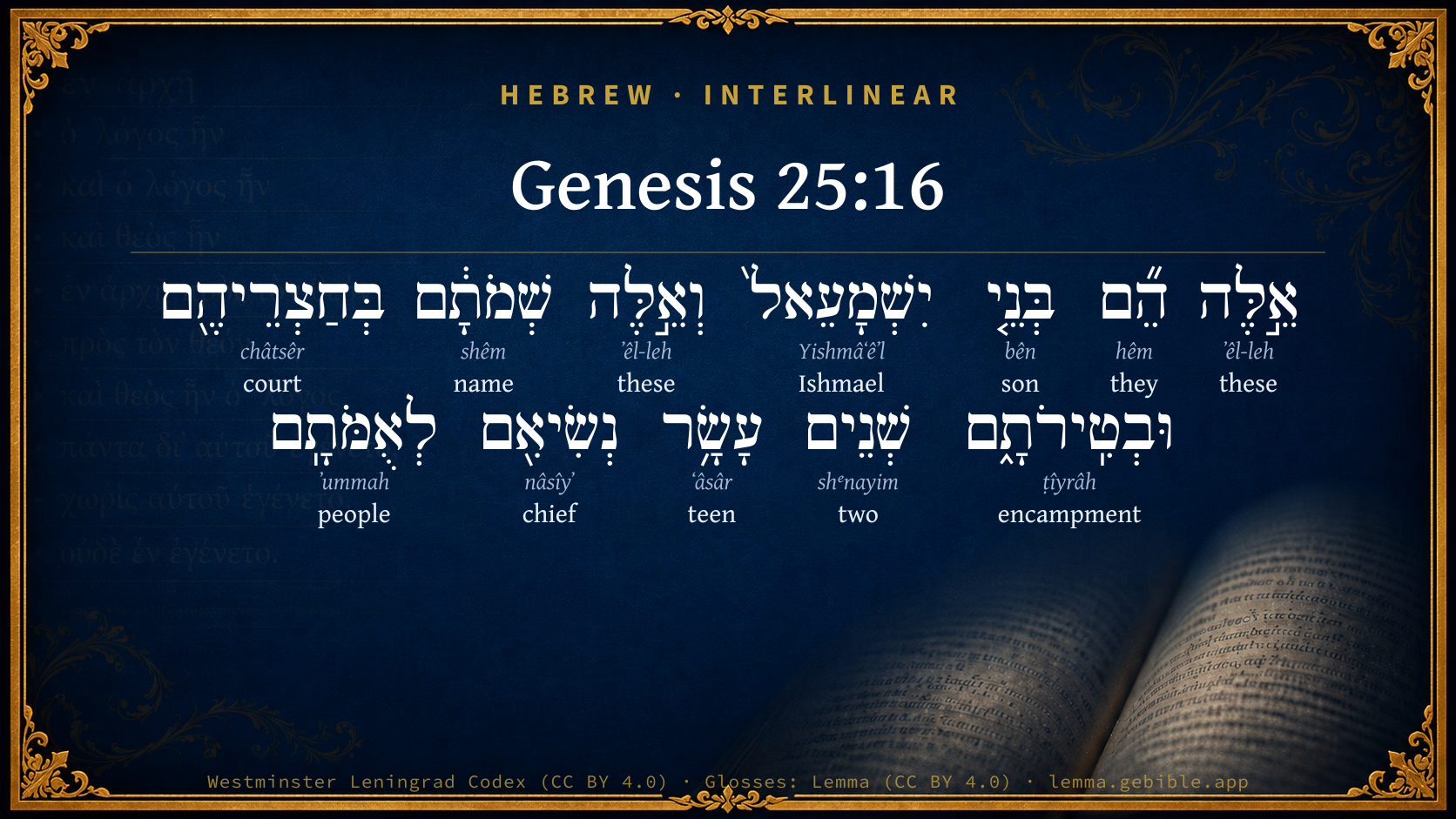
Genesis 25:16

Hebrew (Westminster Leningrad Codex) Genesis 25:16 appears in the Hebrew Old Testament. The text above is from the Westminster Leningrad Codex. Each word links to its Strong’s number, a concise gloss, and parsing drawn from the Open Scriptures Hebrew Bible morphology. Click any word for its full Brown-Driver-Briggs (BDB) entry.
Download image
Cite this verse

Genesis 25:16 (World English Bible). Public Domain. Lemma interlinear Bible study tool, https://lemma.gebible.app/v/genesis/25/16.

Show BibTeX & RIS
BibTeX
RIS
English Translation
These are the sons of Ishmael, and these are their names, by their villages, and by their encampments: twelve princes, according to their nations.
World English Bible · Public Domain
Highlights
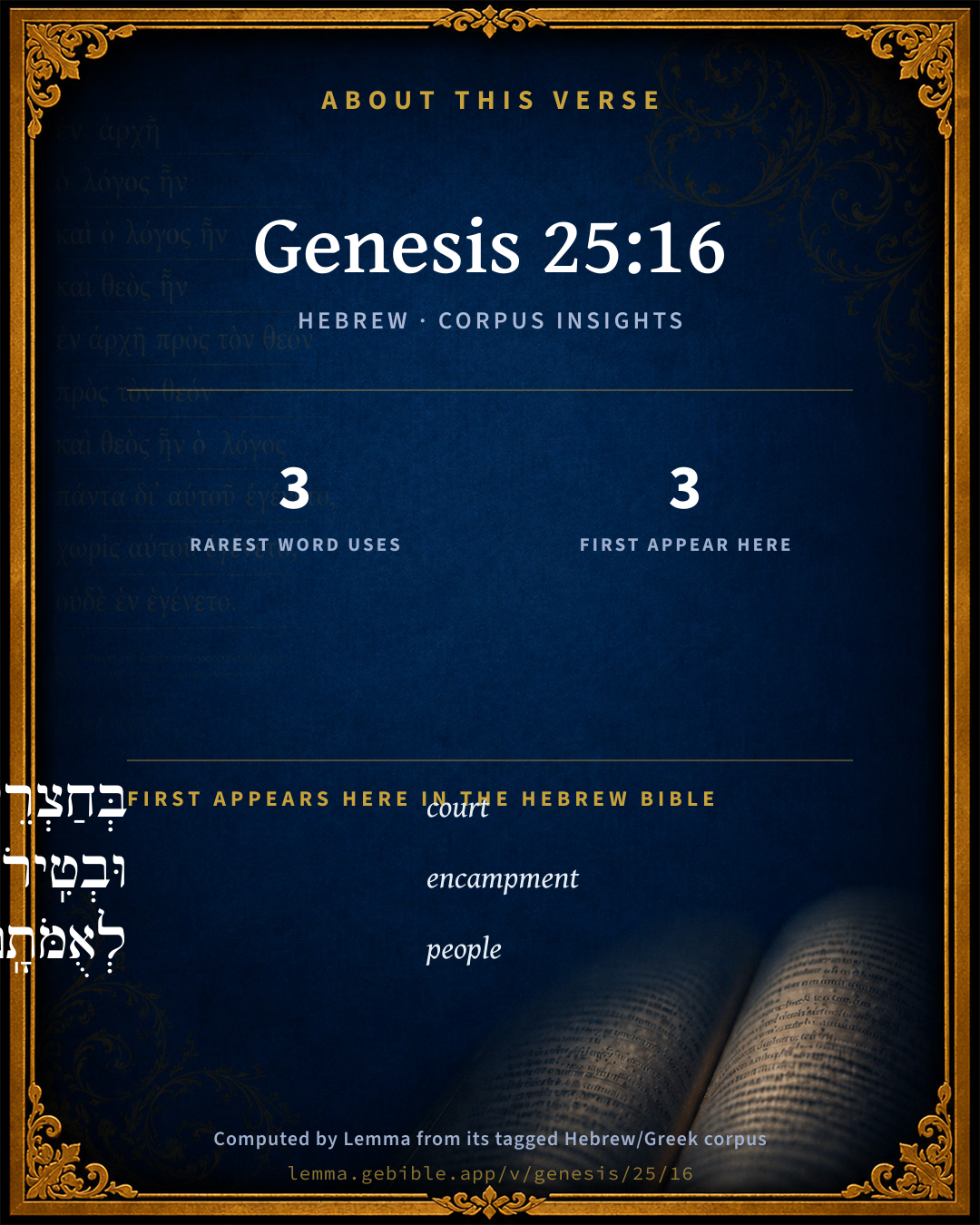
  • 3 first appearances in the Hebrew Bible
Full analysis ↓
Download a study sheet

One document with this verse’s original text, its word-by-word gloss line, the meaning frame, cross-references with their text, attributed commentary, and full source and license credits — printable, and it pastes into notes with its structure intact.

This verse Autodidact and up

Study sheet (.html) Plain text (.txt)

A passage Seminary Student

Up to 50 verses in one chapter. A passage sheet keeps up to 6 commentary sources and 12 cross-references per verse, in the order this page ranks them, and says so on the sheet whenever that leaves anything out. Ask for a single verse and you get the Autodidact verse sheet above.

Everything on this page stays free to read, with no account — the sheet is a download of what is already on screen, not access to it.

Want to remove ads? Support Godless Engineer
Compare translations 3

The same verse in 3 English versions, stacked beneath the original-language interlinear above. Click any original word for its lexicon entry.

Each is an independent rendering of the whole verse — the interlinear is not word-aligned to these translations.

Highlighted words mark where these versions differ — a whole-verse word diff, not a word-by-word alignment.

  • World English Bible Public Domain
    These are the sons of Ishmael, and these are their names, by their villages, and by their encampments: twelve princes, according to their nations.
  • King James Version Public Domain
    These are the sons of Ishmael, and these are their names, by their towns, and by their castles; twelve princes according to their nations.
  • unfoldingWord Literal Text CC BY-SA 4.0
    Those the sons of Ishmael, and those their names by their settlements and by their camps, twelve rulers according to their tribes.

unfoldingWord Literal Text — © unfoldingWord, licensed CC BY-SA 4.0. Word-aligned USFM3 via Door43 (git.door43.org/unfoldingWord/en_ult).

Versions to compare (up to 4)

3 of 4 selected

Show all 18 translations

Every available English version of this verse, each an independent rendering of the whole verse.

  • World English Bible Public Domain
    These are the sons of Ishmael, and these are their names, by their villages, and by their encampments: twelve princes, according to their nations.
  • Berean Standard Bible Public Domain
    These were the sons of Ishmael, and these were their names by their villages and encampments—twelve princes of their tribes.
  • Majority Standard Bible Public Domain
    These were the sons of Ishmael, and these were their names by their villages and encampments—twelve princes of their tribes.
  • King James Version Public Domain
    These are the sons of Ishmael, and these are their names, by their towns, and by their castles; twelve princes according to their nations.
  • American Standard Version (1901) Public Domain
    These are the sons of Ishmael, and these are their names, by their villages, and by their encampments. Twelve princes according to their nations.
  • Revised Version (1885) Public Domain
    these are the sons of Ishmael, and these are their names, by their villages, and by their encampments; twelve princes according to their nations.
  • Geneva Bible (1599) Public Domain
    These are the sonnes of Ishmael, and these are their names, by their townes and by their castles: to wit, twelue princes of their nations.
  • Douay-Rheims (1899) Public Domain
    These are the sons of Ismael: and these are their names by their castles and towns, twelve princes of their tribes.
  • Young's Literal Translation Public Domain
    these are sons of Ishmael, and these their names, by their villages, and by their towers; twelve princes according to their peoples.
  • Literal Standard Version CC BY-SA 4.0
    these are sons of Ishmael, and these [are] their names, by their villages, and by their towers; twelve princes according to their peoples.
  • Unlocked Literal Bible CC BY-SA 4.0
    These were Ishmael's sons, and these were their names, by their villages, and by their encampments; twelve princes according to their tribes.
  • unfoldingWord Literal Text CC BY-SA 4.0
    Those the sons of Ishmael, and those their names by their settlements and by their camps, twelve rulers according to their tribes.
  • Darby Bible Public Domain
    These are the sons of Ishmael, and these are their names, in their hamlets and their encampments -- twelve princes of their peoples.
  • World Messianic Bible Public Domain
    These are the sons of Ishmael, and these are their names, by their villages, and by their encampments: twelve princes, according to their nations.
  • Webster's Bible Public Domain
    These are the sons of Ishmael, and these are their names, by their towns, and by their castles; twelve princes according to their nations.
  • Free Bible Version CC BY-SA 4.0
    These were the sons of Ishmael, and these became the names of the places where they lived and camped—the twelve family rulers of their tribes.
  • Bible in Basic English Public Domain
    These are the sons of Ishmael, and these are their names in their towns and their tent-circles; twelve chiefs with their peoples.
  • JPS Tanakh (1917) Public Domain
    these are the sons of Ishmael, and these are their names, by their villages, and by their encampments; twelve princes according to their nations.

Literal Standard Version (2020), Covenant Press — licensed CC BY-SA 4.0. Text via the HelloAO Bible API (eBible.org). Unlocked Literal Bible (unfoldingWord) — licensed CC BY-SA 4.0. Text via the HelloAO Bible API (eBible.org). unfoldingWord Literal Text — © unfoldingWord, licensed CC BY-SA 4.0. Word-aligned USFM3 via Door43 (git.door43.org/unfoldingWord/en_ult). Free Bible Version, Dr. Jonathan Gallagher — licensed CC BY-SA 4.0. Text via the HelloAO Bible API (eBible.org).

Word by word

More ways to search: Search by grammar → Find every occurrence → Compare this word →

Practice this passage: Drill this verse → Learn its vocabulary →

לְאֻמֹּתָֽם
ʼummah
H523
“to/for · peoples · their”
Preposition + Noun, Common, Feminine, Plural, Construct + Suffix, Personal, 3rd Person, Masculine, Plural
Part of Speech
Preposition + Noun
Type
Common
Gender
Feminine
Number
Plural
State
Construct
Full BDB Definition

Origin: from the same as H517

TWOT: 115e

people, tribe, nation
  1. אֵ֣לֶּה ʼêl-leh H428 “these” Pronoun, Demonstrative, Common, Plural
  2. הֵ֞ם hêm H1992 “they” Pronoun, Personal, 3rd Person, Masculine, Plural
  3. בְּנֵ֤י bên H1121 “sons of” Noun, Common, Masculine, Plural, Construct
  4. יִשְׁמָעֵאל֙ Yishmâʻêʼl H3458 “Ishmael” Noun, Proper
  5. וְאֵ֣לֶּה ʼêl-leh H428 “and · these” Conjunction + Pronoun, Demonstrative, Common, Plural
  6. שְׁמֹתָ֔ם shêm H8034 “names · their” Noun, Common, Masculine, Plural, Construct + Suffix, Personal, 3rd Person, Masculine, Plural
  7. בְּחַצְרֵיהֶ֖ם châtsêr H2691 “in/at · courts · their” Preposition + Noun, Common, Both, Plural, Construct + Suffix, Personal, 3rd Person, Masculine, Plural
  8. וּבְטִֽירֹתָ֑ם ṭîyrâh H2918 “and · in/at · encampments · their” Conjunction + Preposition + Noun, Common, Feminine, Plural, Construct + Suffix, Personal, 3rd Person, Masculine, Plural
  9. שְׁנֵים shᵉnayim H8147 “two” Adjective, Cardinal number, Masculine, Dual, Absolute
  10. עָשָׂ֥ר ʻâsâr H6240 “teen” Adjective, Cardinal number, Masculine, Singular, Absolute
  11. נְשִׂיאִ֖ם nâsîyʼ H5387 “chiefs” Noun, Common, Masculine, Plural, Absolute

About this verse

These counts appear in no published source. They are computed here, from the morphology-tagged text and Lemma’s own curated glosses. What Lemma adds →

12
words
11
distinct lemmas
Pentateuch
section

Notable vocabulary

The rarest word here is לְאֻמֹּתָֽם people H523 — appearing just 3 times in the whole Hebrew Bible.

First appearance in Scripture

These words make their first canonical appearance in the Hebrew Bible here:

  • בְּחַצְרֵיהֶ֖ם court H2691
  • וּבְטִֽירֹתָ֑ם encampment H2918
  • לְאֻמֹּתָֽם people H523

Shared distinctive vocabulary

לְאֻמֹּתָֽם people H523 occurs in 3 verses of the Hebrew Bible. Also found in:

Grammatical profile

  • 7 nouns
  • 2 adjectives
  • 3 pronouns

Repetition

A word recurs within this verse — often emphatic in Hebrew:

  • אֵ֣לֶּה these H428 ×2

Hebrew & Septuagint length

In English translation the verse runs 24 words from the Hebrew and 24 from the Septuagint (LXX English) — the same length.

A rough comparison of the two English renderings, which tokenize alike — not a word-level alignment.

Word counts can differ between the Hebrew and the Greek without any difference in meaning — e.g. the Hebrew direct-object marker אֵת has no separate Greek word, and Greek often adds the article ὁ.

Cross-references

2

Topical passages linked to Genesis 25:16 in the Treasury of Scripture Knowledge — connected by theme and wording, ordered by reader-vote popularity; previews shown in the World English Bible.

  • Genesis 17:20 As for Ishmael, I have heard you. Behold, I have blessed him, and will make him fruitful, and will multiply him exceedingly. He will become the father of twelve princes, and I will make him a great nation.
  • Genesis 17:23 Abraham took Ishmael his son, all who were born in his house, and all who were bought with his money; every male among the men of Abraham's house, and circumcised the flesh of their foreskin in the same day, as God had said to him.

Cross-references courtesy of OpenBible.info (CC BY 4.0).

Hebrew and Greek witnesses Masoretic Hebrew ↔ Greek Septuagint

The same verse in the two great witnesses to the Old Testament, shown verse-for-verse.

These are two independent witnesses, not word-aligned to each other, and the Septuagint is shown in lemma (dictionary) form.

Hebrew Genesis 25:16 Masoretic · Westminster Leningrad Codex

אֵ֣לֶּה הֵ֞ם בְּנֵ֤י יִשְׁמָעֵאל֙ וְאֵ֣לֶּה שְׁמֹתָ֔ם בְּחַצְרֵיהֶ֖ם וּבְטִֽירֹתָ֑ם שְׁנֵים עָשָׂ֥ר נְשִׂיאִ֖ם לְאֻמֹּתָֽם

These are the sons of Ishmael, and these are their names, by their villages, and by their encampments: twelve princes, according to their nations.

World English Bible · Public Domain

Greek LXX Genesis 25:16 Septuagint · lemma form

οὗτος εἰμί ὁ υἱός ισμαηλ καί οὗτος ὁ ὄνομα αὐτός ἐν ὁ σκηνή αὐτός καί ἐν ὁ ἐπαύλις αὐτός δώδεκα ἄρχων κατά ἔθνος αὐτός

These are the sons of Ismael, and these are their names in their tents and in their dwellings, twelve princes according to their nations.

LXX2012 (modern English Septuagint) · Public Domain

On this verse, The Cambridge Bible for Schools and Colleges discusses the Septuagint’s reading. Read the note in Commentary ↓

Hebrew: Westminster Leningrad Codex (CC BY 4.0). Greek: Septuagint (public domain); English from LXX2012 (modern English Septuagint) (Public Domain). How the Septuagint differs from the Hebrew →

Targum (Aramaic paraphrase)

2

The Targum is the ancient Jewish Aramaic paraphrase of the Hebrew Scriptures — an interpretive translation, not the Hebrew text itself. Onkelos (literal) and Pseudo-Jonathan (expansive) render the Torah, and Jonathan the Prophets. Coverage is partial: where no permissively-licensed English translation exists for a verse, only the Aramaic is shown. This is verse-level text, not a word-by-word alignment to the Hebrew.

  1. Targum Onkelos Torah (Genesis–Deuteronomy)
    אִלֵּין אִנּוּן בְּנֵי יִשְׁמָעֵאל וְאִלֵּין שְׁמָהַתְהוֹן בְּפַצְחֵיהוֹן וּבִכְרַכֵּיהוֹן תְּרֵין עֲסַר רַבְרְבִין לְאֻמֵּיהוֹן

    (no public-domain English translation for this verse)

    Targum Onkelos — Aramaic: “Onkelos Genesis” (public domain); “Onkelos Exodus” (public domain); “Onkelos Leviticus” (public domain); “Onkelos Numbers” (public domain); “Onkelos Deuteronomy” (public domain). English: “Sefaria Community Translation” (CC0 1.0 (public-domain dedication)); “J.W. Etheridge. The Targums of Onkelos and Jonathan Ben Uzziel on the Pentateuch. London: Longmans, Green, 1862” (public domain). Text via Sefaria.

  2. Targum Pseudo-Jonathan Torah (Genesis–Deuteronomy)
    אִלֵין הִינוּן בְּנוֹי דְיִשְׁמָעֵאל וְאִילֵין שׁוּמְהוֹן בְּכַּפְרָנֵיהוֹן וּבְקַסְטְרָוַותְהוֹן תְּרֵיסַר רַבְרְבִין לְאוּמַתְהוֹן

    These were the sons of Ishmael, and these their names in their villages, and in their fenced dwellings, twelve chiefs of their peoples.

    Targum Pseudo-Jonathan — Aramaic: “Targum Jonathan on Genesis” (public domain); “Targum Jonathan on Exodus” (public domain); “Targum Jonathan on Leviticus” (public domain); “Targum Jonathan on Numbers” (public domain); “Targum Jonathan on Deuteronomy” (public domain). English: “The Targum of Jonathan ben Uzziel, trans. J. W. Etheridge, London, 1862” (public domain). Text via Sefaria.

Commentary

Notes on Genesis 25:16 from classic Christian and Jewish commentators (each source and its license shown beneath its notes). The classic Christian expositions comment on the surrounding passage and are grouped to its opening verse, so a note may address several verses; the Jewish commentaries on the Tanakh (Rashi and others) are per-verse, so they appear only where the commentator wrote on this verse.

Lemma curates 59 commentaries, every one of them public domain or Creative Commons licensed, each selected and text-cleaned for this edition rather than reprinted as found. About our sources →

Trapp's Complete Commentary

John Trapp

Gen 25:16 These [are] the sons of Ishmael, and these [are] their names, by their towns, and by their castles; twelve princes according to their nations.

Ver. 16. These are their names by their towns.] Which they called after their own names, as Cain did, that first built the city Enoch, after his son’s name; that he might be styled "Lord Enoch of Enoch." So, the many Alexandrias, Caesareas, Augustas, &c. See Psa 49:11.

John Trapp, A Commentary or Exposition upon All the Books of the Old and New Testament (1647–1656) — public domain. Text from a community e-Sword module.

Tyndale Open Study Notes

Tyndale Open Resources

25:16 Ishmael’s twelve sons fulfilled God’s promise of blessing (17:20).

Tyndale Open Study Notes — © Tyndale Open Resources, licensed CC BY-SA 4.0. Text via the HelloAO Bible API.

Adam Clarke's Commentary

Verse 16. These are their names] By which their descendants were called. Their towns - places of encampment in the wilderness, such as have been used by the Arabs from the remotest times. Their castles, טירתם tirotham, their towers, probably mountain tops, fortified rocks, and fastnesses of various kinds in woods and hilly countries.

Adam Clarke's Commentary on the Bible (1810–1826) — public domain. Text from a community e-Sword/MySword module.

Ellicott's Commentary for English Readers

(16) By their towns, and by their castles.—Towns and castles in the wilderness of Paran there were none, but we know for certain that the first of these words signified an unwalled village. (See Lev_25:31, where it is exactly described; also Psa_10:8·, Isa_42:11.) It was, however, a settled and permanent place of dwelling. The other word rendered here castle, but used as the equivalent of tent in Psa_69:25, is really a cluster of tents, the encampment of a tribe, and movable. It occurs in Num_31:10; 1Ch_6:54; Eze_25:4. As is well known, the Arabs are divided into two classes—the dwellers in tents, who are ever moving from station to station, within certain limits, nevertheless, which they seldom pass over; and the agricultural class, who have fixed habitations, are looked upon as inferiors, and probably are the remains of a conquered race. To this day they pay a sort of rent, or black-mail, to the nobler Arabs. We find, then, this distinction already existing when this Tôldôth was drawn up; the agricultural Arabs dwelling in unwalled villages, while the nomad tribes pitched now here, and now there, their clusters of black camels’-hair tents. And thus we have in these words proof that Ishmael and his subjects were not all upon the same level; for while he, his sons, and his noblest retainers would dwell in tents, the inhabitants of the villages would be men of inferior origin, compelled to submit themselves to him.

A Bible Commentary for English Readers, edited by Charles John Ellicott (1878–1897) — public domain. Text from a community e-Sword module.

The Cambridge Bible for Schools and Colleges

gen. ed. J. J. S. Perowne

16. by their villages, and … encampments] The distinction is, probably, between settled habitations in open unwalled villages, and circles of black tents in which the Bedouins dwell. This distinction between the permanent and the movable dwellings of the Ishmaelites is not reproduced in the versions. LXX ἐν ταῖς σκηναῖς … ἐν ταῖς ἐπαύλεσιν, Lat. per castella et oppida.

See, also, for “encampments,” the tîrôth of the Midianites (Num_31:10) and of “the children of the east” (Eze_25:4).

twelve princes] See note on Gen_25:2. The fulfilment of Gen_17:20 (P). The “princes” are “leaders,” or Sheikhs, of clans.

nations] A technical term for “clan” (’ummah = ’ummat in Arabic); cf. Psa_117:1 : elsewhere only Num_25:15 = “a father’s house.”

The Cambridge Bible for Schools and Colleges (gen. ed. J. J. S. Perowne; Cambridge University Press, 1878–1918) — public domain. Text from a community e-Sword module.

John Gill's Exposition

These are the sons of Ishmael,.... The twelve before mentioned, Gen 25:13,

these are their names, by their towns and by their castles; their towns and their castles being called after their names, some of which we are able to trace at this distance, as the above notes show:

twelve princes according to their nations; these were princes, or heads of tribes, and there were twelve of them, and continued so, see Gen 17:20; where is the prophecy, and here an accomplishment of it.

John Gill's Exposition of the Whole Bible (1746–1763) — public domain (CC PDM 1.0). Text via the HelloAO Bible API.

Haydock's Catholic Bible Commentary

By their castles; or, the castles, towns, and tribes of principal note, received their names from these twelve princes, or phylarks, whose authority is still recognized among all the tribes of the Arabs. (Thevenot.) (Haydock) --- The towns of these people were easily built, and more easily destroyed; for they consisted only of tents, Jeremias xlix. 31. Their castles were perhaps only sheep-folds, as the original Tiroth may signify; or they were a sort of watch-towers, to prevent the sudden attack of an invading enemy, and to serve also for a retreat. (Calmet)

George Leo Haydock (1774–1849), Haydock's Catholic Family Bible and Commentary, 1859 edition — public domain. Excludes Psalms (Douay-Rheims chapter numbering differs from Protestant) and Deuterocanonical books (Catholic canon only).

Whedon's Commentary on the Bible

Daniel D. Whedon

16. By their towns, and… castles — Rather, in their village and in their encampment. “It is generally known, that the Arabs are, according to their mode of life, divided into two chief classes: those of towns or villages, and those of the deserts, or the dwellers in tents. The latter, of course nomadic in their habits, are the Bedouins and Scenitae. It is not improbable that these two different classes are alluded to in the words, ‘By their villages and by their tents.’ The roaming Bedouins regard the agricultural population with a certain contempt as slaves of toil and drudgery. They seldom cultivate the land which they may have inherited or won by their valour; but rent it out for a fixed annual sum to peasants subordinated to them in a kind of vassalage.” — Kalisch.

Twelve princes — Ishmael, like Israel, had twelve sons, who became the princes and heads of so many tribes.

Nations — אמות, peoples, or tribes sprung from one common mother, אם.

Daniel D. Whedon (gen. ed.), Commentary on the Old and New Testaments (1874–1909) — public domain. Text from a community e-Sword module.

The Pulpit Commentary

These are the sons of Ishmael, and these are their names, by their towns, unwalled encampments, from hatzar, to surround; used of the movable villages of nomadic tribes (cf. Isa_42:11) and by their castles; fortified keeps (Murphy); tent villages (Keil); nomadic camps (Kalisch). Cf. (Num_31:10; 1Ch_6:39; Eze_25:4) twelve princes this does not imply that Ishmael had only twelve sons, like Israel a very suspicious circumstance (De Wette); but only that these twelve became phylarchs (Havernick). The Egyptian dedecarchy rested on a like earlier division of names. Homer mentions a similar case among the Phoenicians (Odyss., 8. 390); Thucydides another in ancient Attica (2. 15); vide Havernick"s "Introch," according to their nations (or tribe divisions).

The Pulpit Commentary (1880–1919), ed. H.D.M. Spence-Jones & Joseph S. Exell — public domain. Text from a community e-Sword module.

Rashi

Rabbi Shlomo Yitzchaki (Rashi)

בחצריהם BY THEIR ENCLOSURES — Unwalled towns. In the Targum it is rendered by בפצחיהון because they are מפוצחים, which means “open”; similar in meaning to (Psalms 98:4) ‘‘Open your mouths (פצחו) and sing for joy”.

Rashi on the Tanakh — English translations: “The Judaica Press complete Tanach with Rashi, translated by A. J. Rosenberg” (CC BY 4.0); “Pentateuch with Rashi's commentary by M. Rosenbaum and A.M. Silbermann, 1929-1934” (public domain); “The Metsudah Tanach series, Lakewood, N.J” (CC BY 4.0); and “The Book of Joshua, Metsudah Publications, 1997” (CC BY 4.0). Text via Sefaria.

Radak

Rabbi David Kimhi (Radak)

אלה, the general rule follows the individual components of the general rule. This is a method employed by the Torah on many occasions.

ואלה שמותם, the Torah reminds us that whenever a person or a people mentioned in Scripture bears any of these names of the princes of Ishmael, he or they are descendants of Ishmael even if many generations previous.

בחצריהם ובטירותם, wherever they had claimed their ancestral inheritance they existed in splendour and numerical prominence. The word חצר refers to an open, unwalled city, whereas the word טירות refers to cities which were surrounded by walls.

שנים עשר נשיאים לאומתם, twelve princes corresponding to the number of their families (tribes). Each one of the ones named by the Torah was a tribal chief, member of a family which grew into a mighty tribe bearing the name of their first founder. We find further detailed examples of these tribes in Chronicles I 5,19. A number of these tribes have been mentioned in different contexts in the Books of the Prophets.

Radak on the Tanakh — English translations: “Sefaria Community Translation” (CC0 1.0 (public-domain dedication)); “Eliyahu Munk, HaChut Hameshulash” (CC BY 4.0); “Rabbi Mike Feuer, Jerusalem Anthology” (CC BY 4.0); and “R. David Kimhi on the first book of Psalms, Translated by R.G. Finch, London, 1919” (public domain). Text via Sefaria.

Lesson kit

Teaching starters — assembled from the data on this page, not authored interpretation. Every prompt links to the verse data it draws on. Edit before teaching.

Genesis, in the Pentateuch, opens this verse with 12 words (11 distinct Hebrew lemmas). Its most distinctive word is ʼummah (“people”). A historical commentator’s framing appears above. Read the whole chapter for the surrounding context.

Discussion questions

  1. What does “people” (ʼummah) contribute to the verse as a whole?
  2. 3 words here appear for the first time in Scripture. What is being introduced at this debut?
  3. Numbers 25:15 shares the word «people» with this verse. How do the two illuminate each other?
  4. “these” occurs 2× in this one verse. What is the effect of the repetition?
  5. These translations render this verse differently. What is at stake in choosing one wording over another?
  6. Reading how Trapp's Complete Commentary and Tyndale Open Study Notes read this verse, where do the two commentators agree and where do they part?

Things to notice

  • 3 words make their first canonical appearance in Scripture here.
  • These translations choose different wording for 10 words in this verse.
  • “these” occurs 2× in this single verse.
  • 11 distinct Hebrew lemmas span 12 words in this verse.

Reading settings

Reading text

Shown beneath each verse's original-language words.

Old Testament
Old Testament edition

Read the OT as the Masoretic Hebrew (MT) or the Greek Septuagint (LXX).

English shown for the Greek Septuagint (in the Hebrew ↔ Greek comparison).

Comparing translations? Open the Compare panel on any verse page to stack up to four side by side.