
Proverbs 30:24

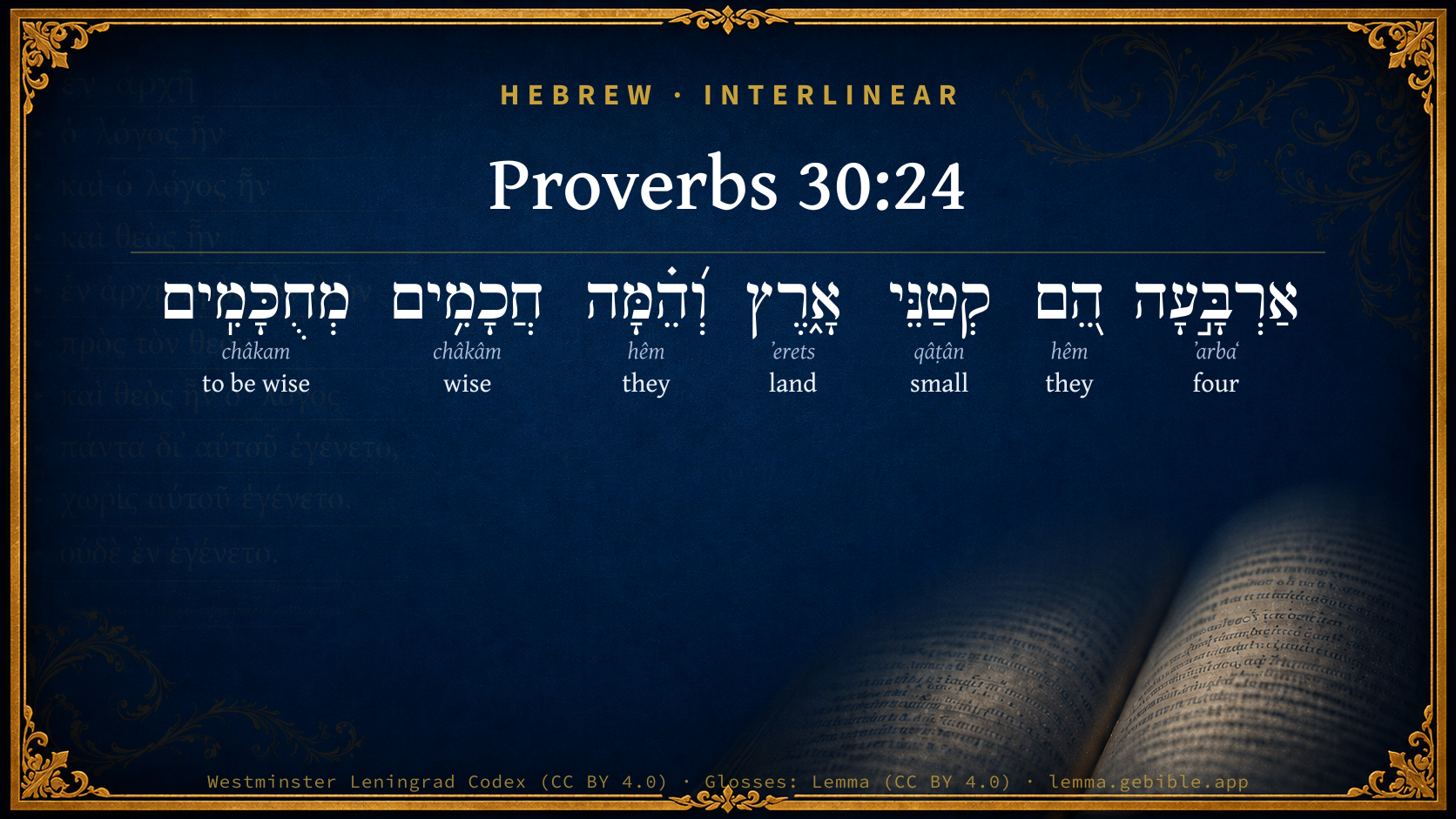
Hebrew (Westminster Leningrad Codex) Proverbs 30:24 appears in the Hebrew Old Testament. The text above is from the Westminster Leningrad Codex. Each word links to its Strong’s number, a concise gloss, and parsing drawn from the Open Scriptures Hebrew Bible morphology. Click any word for its full Brown-Driver-Briggs (BDB) entry.
Download image
Cite this verse

Proverbs 30:24 (World English Bible). Public Domain. Lemma interlinear Bible study tool, https://lemma.gebible.app/v/proverbs/30/24.

Show BibTeX & RIS
BibTeX
RIS
English Translation
"There are four things which are little on the earth, But they are exceedingly wise:
World English Bible · Public Domain
Download a study sheet

One document with this verse’s original text, its word-by-word gloss line, the meaning frame, cross-references with their text, attributed commentary, and full source and license credits — printable, and it pastes into notes with its structure intact.

This verse Autodidact and up

Study sheet (.html) Plain text (.txt)

A passage Seminary Student

Up to 50 verses in one chapter. A passage sheet keeps up to 6 commentary sources and 12 cross-references per verse, in the order this page ranks them, and says so on the sheet whenever that leaves anything out. Ask for a single verse and you get the Autodidact verse sheet above.

Everything on this page stays free to read, with no account — the sheet is a download of what is already on screen, not access to it.

Want to remove ads? Support Godless Engineer
Compare translations 3

The same verse in 3 English versions, stacked beneath the original-language interlinear above. Click any original word for its lexicon entry.

Each is an independent rendering of the whole verse — the interlinear is not word-aligned to these translations.

Highlighted words mark where these versions differ — a whole-verse word diff, not a word-by-word alignment.

  • World English Bible Public Domain
    "There are four things which are little on the earth, But they are exceedingly wise:
  • King James Version Public Domain
    There be four things which are little upon the earth, but they are exceeding wise:
  • unfoldingWord Literal Text CC BY-SA 4.0
    Four things, they small things of the earth but they wise things, being made wise:

unfoldingWord Literal Text — © unfoldingWord, licensed CC BY-SA 4.0. Word-aligned USFM3 via Door43 (git.door43.org/unfoldingWord/en_ult).

Versions to compare (up to 4)

3 of 4 selected

Show all 18 translations

Every available English version of this verse, each an independent rendering of the whole verse.

  • World English Bible Public Domain
    "There are four things which are little on the earth, But they are exceedingly wise:
  • Berean Standard Bible Public Domain
    Four things on earth are small, yet they are exceedingly wise:
  • Majority Standard Bible Public Domain
    Four things on earth are small, yet they are exceedingly wise:
  • King James Version Public Domain
    There be four things which are little upon the earth, but they are exceeding wise:
  • American Standard Version (1901) Public Domain
    There are four things which are little upon the earth, But they are exceeding wise:
  • Revised Version (1885) Public Domain
    There be four things which are little upon the earth, but they are exceeding wise:
  • Geneva Bible (1599) Public Domain
    These be foure small things in the earth, yet they are wise and full of wisedome:
  • Douay-Rheims (1899) Public Domain
    There are four very little things of the earth, and they are wiser than the wise:
  • Young's Literal Translation Public Domain
    Four `are' little ones of earth, And they are made wiser than the wise:
  • Literal Standard Version CC BY-SA 4.0
    Four [are] little ones of earth, || And they are made wiser than the wise:
  • Unlocked Literal Bible CC BY-SA 4.0
    Four things on earth are small and yet they are very wise:
  • unfoldingWord Literal Text CC BY-SA 4.0
    Four things, they small things of the earth but they wise things, being made wise:
  • Darby Bible Public Domain
    There are four [things] little upon the earth, and they are exceeding wise:
  • World Messianic Bible Public Domain
    “There are four things which are little on the earth, but they are exceedingly wise:
  • Webster's Bible Public Domain
    There are four things which are little upon the earth, but they are very wise:
  • Free Bible Version CC BY-SA 4.0
    There are four things on earth that are small, but very wise:
  • Bible in Basic English Public Domain
    There are four things which are little on the earth, but they are very wise:
  • JPS Tanakh (1917) Public Domain
    There are four things which are little upon the earth, but they are exceeding wise:

Literal Standard Version (2020), Covenant Press — licensed CC BY-SA 4.0. Text via the HelloAO Bible API (eBible.org). Unlocked Literal Bible (unfoldingWord) — licensed CC BY-SA 4.0. Text via the HelloAO Bible API (eBible.org). unfoldingWord Literal Text — © unfoldingWord, licensed CC BY-SA 4.0. Word-aligned USFM3 via Door43 (git.door43.org/unfoldingWord/en_ult). Free Bible Version, Dr. Jonathan Gallagher — licensed CC BY-SA 4.0. Text via the HelloAO Bible API (eBible.org).

Word by word

More ways to search: Search by grammar → Find every occurrence → Compare this word →

Practice this passage: Drill this verse → Learn its vocabulary →

About this verse

These counts appear in no published source. They are computed here, from the morphology-tagged text and Lemma’s own curated glosses. What Lemma adds →

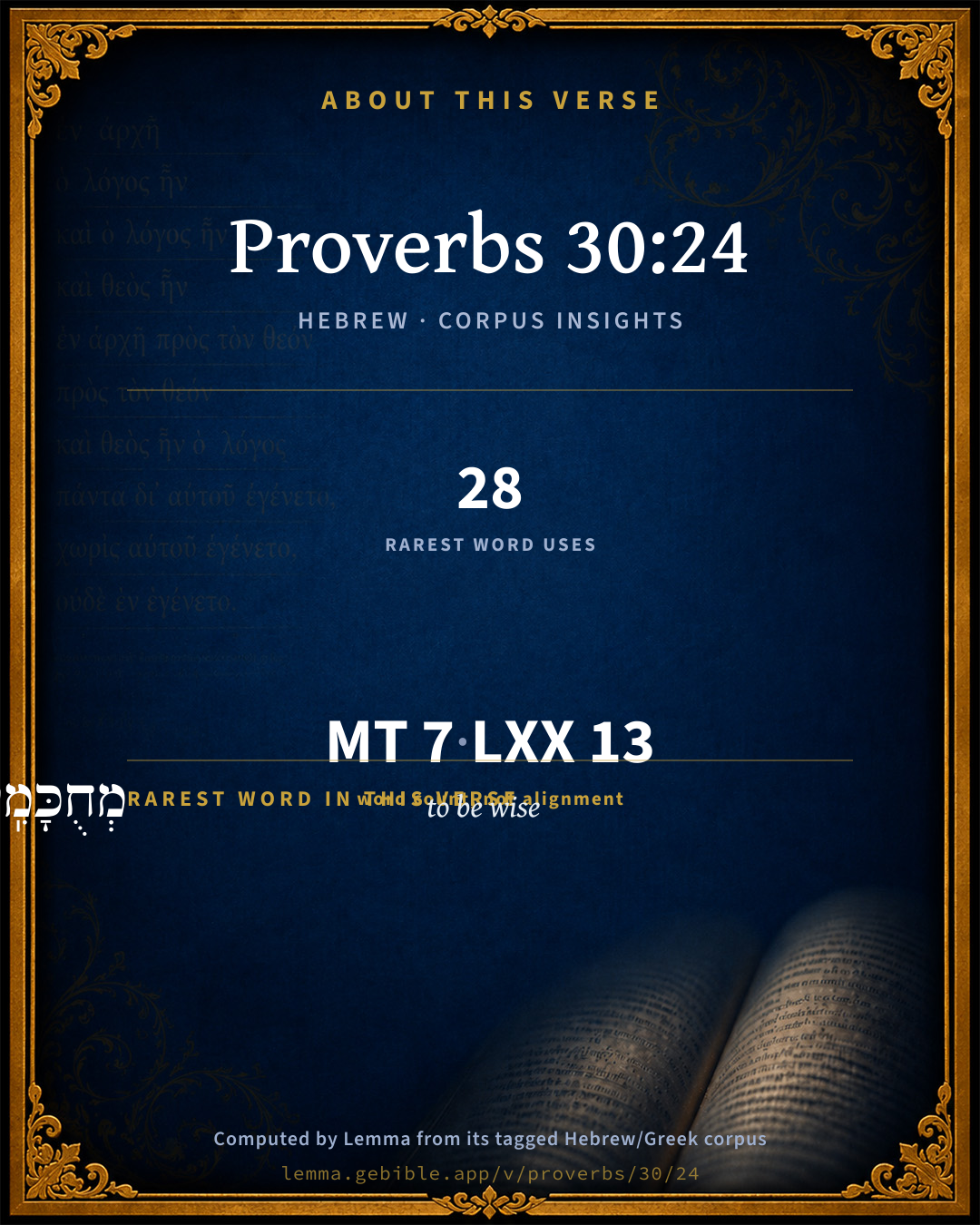
7
words
6
distinct lemmas
Wisdom
section

Shared distinctive vocabulary

מְחֻכָּמִֽים to be wise H2449 occurs in 26 verses of the Hebrew Bible. Also found in:

Grammatical profile

  • 1 verb
  • 1 noun
  • 3 adjectives
  • 2 pronouns

Verb forms

  • מְחֻכָּמִֽים Pual · Participle Passive

Repetition

A word recurs within this verse — often emphatic in Hebrew:

  • הֵ֭ם they H1992 ×2

Hebrew & Septuagint length

In English translation the verse runs 15 words from the Hebrew and 17 from the Septuagint (LXX English) — closely comparable.

A rough comparison of the two English renderings, which tokenize alike — not a word-level alignment.

Word counts can differ between the Hebrew and the Greek without any difference in meaning — e.g. the Hebrew direct-object marker אֵת has no separate Greek word, and Greek often adds the article ὁ.

In the original languages it is 7 Hebrew tokens and 13 Greek tokens — but the two are counted differently (Hebrew bundles its prefixes and suffixes into one token; the Greek is in lemma form), so that isn’t a like-for-like length.

Cross-references

1

Topical passages linked to Proverbs 30:24 in the Treasury of Scripture Knowledge — connected by theme and wording, ordered by reader-vote popularity; previews shown in the World English Bible.

  • Job 12:7 "But ask the animals, now, and they shall teach you; The birds of the sky, and they shall tell you.

Cross-references courtesy of OpenBible.info (CC BY 4.0).

Hebrew and Greek witnesses Masoretic Hebrew ↔ Greek Septuagint

The same verse in the two great witnesses to the Old Testament, shown verse-for-verse.

These are two independent witnesses, not word-aligned to each other, and the Septuagint is shown in lemma (dictionary) form.

Hebrew Proverbs 30:24 Masoretic · Westminster Leningrad Codex

אַרְבָּ֣עָה הֵ֭ם קְטַנֵּי אָ֑רֶץ וְ֝הֵ֗מָּה חֲכָמִ֥ים מְחֻכָּמִֽים

"There are four things which are little on the earth, But they are exceedingly wise:

World English Bible · Public Domain

Greek LXX Proverbs 30:24 Septuagint · lemma form

τέσσαρες δέ εἰμί ἐλαχύς ἐπί ὁ γῆ οὗτος δέ εἰμί σοφός ὁ σοφός

And there are four very little things upon the earth, but these are wiser than the wise:

LXX2012 (modern English Septuagint) · Public Domain

On this verse, Albert Barnes' Notes on the Bible discusses the Septuagint’s reading. Read the note in Commentary ↓

Hebrew: Westminster Leningrad Codex (CC BY 4.0). Greek: Septuagint (public domain); English from LXX2012 (modern English Septuagint) (Public Domain). How the Septuagint differs from the Hebrew →

Commentary

Notes on Proverbs 30:24 from classic Christian and Jewish commentators (each source and its license shown beneath its notes). The classic Christian expositions comment on the surrounding passage and are grouped to its opening verse, so a note may address several verses; the Jewish commentaries on the Tanakh (Rashi and others) are per-verse, so they appear only where the commentator wrote on this verse.

Lemma curates 59 commentaries, every one of them public domain or Creative Commons licensed, each selected and text-cleaned for this edition rather than reprinted as found. About our sources →

Trapp's Complete Commentary

John Trapp

Pro 30:24 There be four [things which are] little upon the earth, but they [are] exceeding wise:

Ver. 24. There be four things.] Made up thus in quaternions (as the 119th Psalm is in octonaries, and those in an alphabetical order), for help of memory.

Which are little upon the earth, but exceeding wise.] God is maximus in minimis, very much seen in the smallest creatures. In formicis maior anima quam in elephantis, in nanis quam in gigantibus, The soul is more active in ants than elephants, in dwarfs than in giants. "Who hath despised the day of small things?" {Zec 4:10}

“A cane non magno saepe tenetur aper.” - Ovid.

The creatures, next to the Scriptures, are the best layman’s books, whereby we may learn to know God and ourselves savingly. "Ask now the beasts, and they shall teach thee, and the fowls of the heaven, and they shall tell thee." {Job 12:7}

John Trapp, A Commentary or Exposition upon All the Books of the Old and New Testament (1647–1656) — public domain. Text from a community e-Sword module.

Joseph Benson's Commentary

Pro 30:24-28. There be four things little, &c., but exceeding wise — Comparatively to other brute creatures, they act very wisely and providently, through the direction of Divine Providence, which secretly influences them to do those things for their own preservation which are most agreeable to the rules of wisdom. The design of this observation Isaiah , 1 st, To commend wisdom to us, and to teach us to imitate the providence of these creatures, as we are excited, Pro 6:6, to imitate their diligence; 2d, To keep us from being proud of our own wisdom, because we are either equalled or exceeded therein by brute creatures, in the wise conduct of their affairs; and, 3d, To direct us to whom to apply for wisdom when we want and desire it, even to that God who inspires such wisdom even into irrational animals. The ants are a people — Which title is often given to insects, and other inferior creatures, both in the Scriptures, (see Joe 1:6; Joe 2:2,) and in Homer, and Virgil, and divers other authors; yet they prepare their meat in the summer — Of which see on Pro 6:6-8. The conies are but a feeble folk — Rather, the rock-rats, or mountain-mice: see on Lev 11:5. Yet make their houses in the rocks — In the holes of rocks, where they secure themselves against their too potent enemies. The locusts have no king — To rule and order them; yet they go forth all of them by bands — In great numbers, in several companies, and in exact order, as is observed in Scripture, and in other authors. The spider taketh hold — Of the threads which she spins out of her own bowels; with her hands — With her legs, which he calls hands, because they serve her for the same use to do her work, to weave her web, and to catch gnats or flies. And is in kings’ palaces — Is not only in poor cottages, but many times in palaces also.

Joseph Benson's Commentary on the Old and New Testaments (1811–1818) — public domain. Text from a community e-Sword module.

The Preacher's Complete Homiletical Commentary

Joseph S. Exell (gen. ed.)

CRITICAL NOTES.—

Pro_30:26. Conies. A gregarious animal of the class Pachydermata, which is found in Palestine living in the caves or clefts of the rocks. Its scientific name is Hyrax Syriacus.… It is like the Alpine marmot, scarcely the size of a domestic cat, having long hair, a very short tail, and round ears (Smith’s Biblical Dictionary).

Pro_30:28. Spider. Most commentators translate “lizard.” Delitzsch reads, “The lizard thou canst catch with the hands, and yet it is in the king’s palaces.”

MAIN HOMILETICS OF THE PARAGRAPH.—Pro_30:24-28

LOWLY TEACHERS

I. Man can learn from creatures far beneath him. Herein he gives evidence both of his greatness and of his imperfection. He is often so faulty in many respects that some of the most insignificant creatures around him read him lessons of wisdom, and yet his capability of receiving instruction from them shows how superior he is to them. For creatures below man, although their actions are often marked by something that seems very nearly akin to reason, are not capable of receiving moral instruction, either from those above or beneath them, and so give proof that they lack a capacity which man possesses.

II. The lessons taught him by each of these creatures.

1. From the ant industry and forethought. On this subject see on chap. Pro_6:6, page 79.

2. From the coney (see Critical Notes) a prudent acknowledgment of weakness. It is one of the marks of a wise man that he knows his weakness as well as his strength, and this seems to be the lesson conveyed by the feeble folk who, conscious of their feebleness, make their abodes in the rocks. Foolhardiness may ruin a man as surely as cowardice, and it is quite a different thing from courage, though it is sometimes mistaken for it.

3. From the locust the need of unity and co-operation. The locust is in itself a small and weak insect, yet it is well known what mighty and terrible work can be accomplished by them when they unite. They stand as an example of the wonderful effect of perfect combination and unanimity in action. (See Joe_2:2-11.) They seem animated by a single purpose, and the myriads of individuals seem to become one great and irresistible monster, and thus show us what great things can be accomplished in any community when men are of one heart and mind on any subject, and are willing to lay aside personal preferences and individual interests in order to achieve a common purpose.

4. From the lizard (see Critical Notes) the results of perseverance. This little creature is constantly found in Eastern houses, and doubtless in the palace as well as in more lowly dwellings. Although hardly so good an example of perseverance as the spider, yet it owes its presence in the house to its own energy in overcoming obstacles, and its pertinacity in seeking out some means of entrance, and may therefore be regarded as worthy of man’s imitation when some task is set before him which calls for continuous and watchful effort.

OUTLINES AND SUGGESTIVE COMMENTS

It has been remarked by some, that the four emblems express all that is requisite for the conservation and well-being of a STATE or KINGDOM. There is supply of food;—commodious and secure dwelling places;—subordination, concord, and united exertion;—and the prevalence and encouragement of the ingenious and useful arts. These are things that governors and kings should look to. And we may apply the emblematic lessons to domestic life. Before a man can prudently marry, and have a family, he should have some suitable provision made, and something like a fair prospect of being able to support them. Next is to be found a suitable dwelling, adapted to his circumstances and convenience, Then, when settled, there must be harmony, union, co-operation, in all departments of the household. And lastly, there must be the diligent, constant, persevering application of his skill and labour to his worldly calling.—Wardlaw.

The ants prepare their meat in the summer, that they may not starve in the rigours of the winter months. How despicable, compared with these insects, are the rational creatures, who suffer the thoughts of an endless duration to be pushed out of their minds by threescore and ten years? The high hills are a refuge for the wild goats, and the rocks for the conies; and has God provided no refuge for our souls? God himself is our refuge and our strength, and those that make him their habitation shall be secured from the fear of evil.—Lawson.

The Preacher's Complete Homiletical Commentary (gen. ed. Joseph S. Exell; Funk & Wagnalls, c. 1892) — public domain (pre-1929). A full-Bible homiletical/sermon-outline anthology covering 65 of 66 books (2 John is absent from the source module). Text from a community e-Sword module.

Tyndale Open Study Notes

Tyndale Open Resources

30:24-28 Another example of number parallelism. Here, small, insignificant animals are surprisingly powerful and resourceful.

Tyndale Open Study Notes — © Tyndale Open Resources, licensed CC BY-SA 4.0. Text via the HelloAO Bible API.

Geneva Bible (1599)

Geneva Bible translators

They contain great doctrine and wisdom.

Geneva Bible (1599) marginal notes — public domain. Text via Bolls.life.

Matthew Henry's Commentary

I. Agur, having specified four things that seem great and yet are really contemptible, here specifies four things that are little and yet are very admirable, great in miniature, in which, as bishop Patrick observes, he teaches us several good lessons; as, 1. Not to admire bodily bulk, or beauty, or strength, nor to value persons or think the better of them for such advantages, but to judge of men by their wisdom and conduct, their industry and application to business, which are characters that deserve respect. 2. To admire the wisdom and power of the Creator in the smallest and most despicable animals, in an ant as much as in an elephant. 3. To blame ourselves who do not act so much for our own true interest as the meanest creatures do for theirs. 4. Not to despise the weak things of the world; there are those that are little upon the earth, poor in the world and of small account, and yet are exceedingly wise, wise for their souls and another world, and those are exceedingly wise, wiser than their neighbours. Margin, They are wise, made wise by the special instinct of nature. All that are wise to salvation are made wise by the grace of God.

II. Those he specifies are, 1. The ants, minute animals and very weak, and yet they are very industrious in gathering proper food, and have a strange sagacity to do it in the summer, the proper time. This is so great a piece of wisdom that we may learn of them to be wise for futurity, Pro 6:6. When the ravening lions lack, and suffer hunger, the laborious ants have plenty, and know no want. 2. The conies, or, as some rather understand it, the Arabian mice, field mice, weak creatures, and very timorous, yet they have so much wisdom as to make their houses in the rocks, where they are well guarded, and their feebleness makes them take shelter in those natural fastnesses and fortifications. Sense of our own indigence and weakness should drive us to him that is a rock higher than we for shelter and support; there let us make our habitation. 3. The locusts; they are little also, and have no king, as the bees have, but they go forth all of them by bands, like an army in battle-array; and, observing such good order among themselves, it is not any inconvenience to them that they have no king. They are called God's great army (Joe 2:25); for, when he pleases, he musters, he marshals them, and wages war by them, as he did upon Egypt. They go forth all of them gathered together (so the margin); sense of weakness should engage us to keep together, that we may strengthen the hands of one another. 4. The spider, an insect, but as great an instance of industry in our houses as the ants are in the field. Spiders are very ingenious in weaving their webs with a fineness and exactness such as no art can pretend to come near: They take hold with their hands, and spin a fine thread out of their own bowels, with a great deal of art; and they are not only in poor men's cottages, but in kings' palaces, notwithstanding all the care that is there taken to destroy them. Providence wonderfully keeps up those kinds of creatures, not only which men provide not for, but which every man's hand is against and seeks the destruction of. Those that will mind their business, and take hold of it with their hands, shall be in kings' palaces; sooner or later, they will get preferment, and may go on with it, notwithstanding the difficulties and discouragements they meet with. If one well-spun web be swept away, it is but making another.

Matthew Henry's Commentary on the Whole Bible (1708–1710) — public domain (CC PDM 1.0). Text via the HelloAO Bible API.

Jamieson, Fausset & Brown

Robert Jamieson, A. R. Fausset & David Brown

These verses provide two classes of apt illustrations of various aspects of the moral world, which the reader is left to apply. By the first (Pro 30:25-28), diligence and providence are commended; the success of these insignificant animals being due to their instinctive sagacity and activity, rather than strength. The other class (Pro 30:30-31) provides similes for whatever is majestic or comely, uniting efficiency with gracefulness.

Jamieson, Fausset & Brown — Commentary Critical and Explanatory on the Whole Bible (1871) — public domain (CC PDM 1.0). Text via the HelloAO Bible API.

Adam Clarke's Commentary

Verse 24. There be four things] Of which it is said, they are very little but very wise. 1. The ants. 2. The rabbits. 3. The locusts. 4. The spider.

1. The ants show their wisdom by preparing their meat in the summer; seeking for it and storing it when it may be had; not for winter consumption, for they sleep all that time; but for autumn and spring. See Clarke on Pr 6:6. The ants are a people; they have their houses, towns, cities, public roads, c. I have seen several of these, both of the brown and large black ant.

2. The rabbits act curiously enough in the construction of their burrows but the word שפן shaphan probably does not here mean the animal we call coney or rabbit. It is most likely that this is what Dr. Shaw calls the Daman-Israel; a creature very like a rabbit, but never burrowing in the ground, but dwelling in clefts and holes of rocks.

3. The locusts. These surprising animals we have already met with and described. Though they have no leader, yet they go forth by troops, some miles in circumference, when they take wing.

4. The spider. This is a singularly curious animal, both in the manner of constructing her house, her nets, and taking her prey. But the habits, &c., of these and such like must be sought in works on natural history.

Adam Clarke's Commentary on the Bible (1810–1826) — public domain. Text from a community e-Sword/MySword module.

The Cambridge Bible for Schools and Colleges

gen. ed. J. J. S. Perowne

24–28. Four things which though little are wise.

The Cambridge Bible for Schools and Colleges (gen. ed. J. J. S. Perowne; Cambridge University Press, 1878–1918) — public domain. Text from a community e-Sword module.

John Gill's Exposition

There be four things which are little upon the earth,.... Small in bulk, that have little bodies, are the lesser sort of animals;

but they are exceeding wise; show a great deal of art and wisdom in what they do; or "but they are wise, made wise" (e) by the instinct of nature, by the direction of Providence, by which they do things that are surprising. Some versions, that have no regard to the points, read the words, "but their are wiser than the wise" (f); than even wise men; wise men may learn much from the least of creatures; see Job 12:7.

(e) "sapientia, sapientia imbuta"; Heb. "sapientificata", Piscator, Gejerus. (f) "Sapientiora sapientibus", so Sept. V. L. Arabic and Syriac versions; "sapientia superant, vel prudentissimos", Tigurine version.

John Gill's Exposition of the Whole Bible (1746–1763) — public domain (CC PDM 1.0). Text via the HelloAO Bible API.

Albert Barnes' Notes on the Bible

Exceeding wise - Some prefer the reading of the Septuagint and Vulgate: “wiser than the wise.” The thought, in either case, turns upon the marvels of instinct, which, in their own province, transcend the more elaborate results of human wisdom.

Albert Barnes' Notes on the Bible (1834–1885) — public domain. Text from a community e-Sword/MySword module.

Matthew Poole's English Annotations

Comparatively to other brute creatures. They act very wisely and providently, not from any reason which they have, but by the direction of Divine Providence, which secretly guides them to do those things for their own preservation which are most agreeable to the rules of wisdom. The design of this observation is either,

1. To commend wisdom to us, and to teach us to imitate the providence of these creatures, as we are provoked to imitate their diligence, Pro 6:6. Or,

2. To keep us from being proudly conceited of our own wisdom, because we are either equalled or exceeded therein by the unreasonable creatures in the wise conduct of their affairs. Or,

3. To direct us to whom to resort for wisdom when we want and desire it, even to that God who is able to inspire wisdom even into the brute creatures.

Matthew Poole's English Annotations on the Holy Bible (1683–1685) — public domain. Text from a community e-Sword/MySword module.

Whedon's Commentary on the Bible

Daniel D. Whedon

24-28. Four things… little — Here is the enigma of the four small and contemptible things, that are yet esteemed for their wisdom and other qualities.

The ants — See Pro_6:6; and notes there.

The conies — Rabbits. But the coney of Scripture — the hyrax Syriacus, also called the daman — is a different animal from our rabbit. “It is small, gregarious, timid, easily tamed, and lives in the mouth of caves, or clefts of the rocks.”-Baird. Compare Lev_11:5; Psa_104:18.

The spider — שׂממית, (semamith;) rather, the house lizard, which is tolerated even in palaces, because it helps to cleanse them of vermin. “Its principal food is flies, and these it springs upon and grasps with both its prehensiles, as if they were hands.” — Stuart. There have been various conjectures about the semamith. A writer in Calmet contends for the common house fly.

The locusts — Compare Joe_2:7-8. “The most striking fact about the flight of locust swarm’s is their apparent order and discipline, sweeping over the land like a great invading army.” — Speaker’s Commentary. Our Western “grasshoppers” are supposed to be a variety of the same insect.

Daniel D. Whedon (gen. ed.), Commentary on the Old and New Testaments (1874–1909) — public domain. Text from a community e-Sword module.

The Pulpit Commentary

Vers. 24-28. Four things small and weak, and yet wise.

There be four things which are little upon the earth, in contrast with the intolerable pretensions of the last group. The Vulgate has minima; but the original is not superlative, which would not be true of some of the creatures named. But they are exceeding wise; " quick of wit, wise," the participle meaning "rendered wise, cunning" (Delitzsch). The Septuagint and Vulgate translate in the comparatives. "These are wiser than the wise," the instincts of these animals being more marvellous than human wisdom.

Vers. 24-28. Success within success.

Many things go to make a man successful, in a true and large sense of that word. A man may have many elements of success, and yet, for want of one more, he may fail. The best part of our succeeding is this that if we are labouring for some present and visible reward, we are, whilst so doing and in the very act, securing a deeper and a larger good, as the schoolboy seeking the prize is really storing up knowledge and power. We may learn from some of the least and humblest of God"s creatures what are the elements of success in the ordering of our life and, at the same time, in the construction of our character.

I THE ORDERING OF OUR LIFE. If we would live such a life before men as is most honourable and gratifying, we must show the qualities which are manifested by those little creatures of our text.

1. Forethought. (Ver. 25) The man who does not look forward and prepare for the day and the hour when some special demand will be made upon him, must go down. A wise provision made in the time of leisure or abundance is essential to outward and visible success. We must "buy up the opportunity "redeem the time"; (Col_4:5) otherwise, "when the occasion comes, we shall not be equal to the occasion;" e.g. the apprentice, the student, etc.

2. Securing a retreat, or having a reserve (ver. 26). To be able to run to the rocks or fastnesses is necessary for the feeble. And in the ordering of our life it is necessary to count on our being sometimes defeated. He is but a poor captain who conducts his campaign without "securing his base;" and he does not know the practical wisdom of life who does not provide for himself a retreat, a reserve, when fortune goes against him, as it sometimes will, in "the battle of life.

3. Cooperation. (Ver. 27) It is an essential part of personal equipment that a man be able to cooperate with others. And in the great majority of cases this means readiness to take an inferior place, to obey instructions, to fall in with the suggestions of other people, to forego our own preference and adopt another man"s method. It means listening and learning, conciliation and concession, punctuality and politeness.

4. Aspiration and patient. (Ver. 28) For the little and unwelcome spider (or lizard) to establish itself in king"s palaces there is demanded this twofold virtue. And for our success we need this also ambition to attempt and assiduity to win our way, in spite of all the obstacles that may intervene. He that has no heart for enterprise will certainly achieve nothing; and he who lacks patience to wait his time, perseverance to renew his efforts as often as he is fooled, or as often as one success opens the way to another, will reach no king"s palace, no place of honour or of influence.

II THE CONSTRUCTION OF OUR CHARACTER. God has so ordered all things with us and for us that. as we are striving for one thing, we do gain another. As we seek an honourable position in life, we are building up our character. All these elements of success are features of human character, so that while we are "making our way," we are making ourselves also. Much that is most valuable in our moral and spiritual constitution is constructed by us in ways and at times when we think not of it; it is like the seed that grows secretly, night and day, the farmer "knoweth not how". (Mar_4:27) Hence the very great importance that we should be always and everywhere acting on sound, Christian principles; for it is not so much by the direct endeavours we put forth for the purpose, as it is by the constantly and silently operating influence of our daily and hourly actions, that we become what we do become in the sight of God. Beyond and within the success of which men take notice, and on which they congratulate us, is a success which is deeper and truer, for which we may well give to God our heartier thanksgiving. C.

Vers. 24-28. Four weak things, and the greatness of them.

The four little creatures that are here mentioned all illustrate the wonderful way in which the disadvantages of weakness may be overcome by some countervailing quality. In the spiritual world Christianity teaches us to look for the triumph of weakness the weak things of the world confounding the things which are mighty. (1Co_1:27) Now, we have illustrations from nature for the same principle. Each of the four creatures teaches us its own special lesson, as each conquers its weakness by some separate and distinctive quality. The ant succeeds by foresight, the coney by finding shelter, the locust by organization, and the lizard by quiet persistency.

I THE ACHIEVEMENTS OF FORESIGHT.

1. This is a triumph of wind. The ant is in some respects the most wonderful creature in the world; for it seems to be about equal in intelligence to the elephant, which is not only the greatest, but also the most intelligent of the larger animals. A bull, so immensely greater than an ant in body, is far smaller in mind. Similarly, man"s lordship over the animal world is a triumph of mental power. The driver is weaker in body than the horse he drives, but he has a stronger mind. We shall triumph in the world just in proportion as we develop our inner life.

2. This is a triumph of industry. The ant rebukes the sluggard. (Pro_6:6)

3. It is a triumph of patience. The ant toils for the future. Herein is its true strength. Men who care only for the passing moment are shallow and weak. We are strong in proportion as we live in the future.

II THE SAFETY OF A SOUND SHELTER. "The conies are but a feeble folk," and they have not the compensating intelligence of the ants. But their instinct leads them to live among the rocks, and hide themselves in dark caves and inaccessible crevices. Thus the strength of the hills is theirs. When there is no hope of holding our ground in the open field, we may find shelter in the Rock of Ages. If souls have their instincts in a healthy condition, these will drive them to the true shelter, and there weakness will be safe.

III THE TRIUMPH OF ORGANIZATION. Though the locusts have no king, they are able to make successful marches over miles of country, and to completely devastate the lands they visit. They do not waste their time by flying hither and thither, and by opposing one another. They all move on in solid phalanx. This instinctive order secures success. It teaches us that the welfare of the individual must be subordinate to that of the community. If a small stream has to be crossed, the myriads of locusts who are so unfortunate as to be in the van of the mighty army fall in and fill up the bed till they make a causeway that can be used by their fellows. The victory of man is got through the suffering and death of many self-sacrificing heroes. In the Church the cause of Christ will best triumph when all Christians move together in harmony, all seeking to win the world for the kingdom of heaven.

IV THE SUCCESS OF PERSISTENCY. The little lizard is found in king"s palaces because he can stick to the walls, and so run into unlooked for places out of the way of men. It is a great thing to be able to hold on. Quiet perseverance wins many a victory. Patient endurance is crowned in the end with glorious success. In the highest things, "he that endureth unto the end, the same shall be saved". (Mar_13:13)

Vers. 24-28. The significance of little things.

I EXAMPLES.

1. The ant (Ver. 25); tiny in frame, yet full of providence, making wise provision against the rainy day.

2. The hedgehog ("coney," ver. 26); though feeble, finds compensation in the strength of the dwelling it selects.

3. The locust (ver. 27); a creature, as an individual, easily crushed, yet gaining immense force by union with others. Joel

(2) gives a splendid description of the raid of locusts under the figure of an invading army, with which the accounts of travellers in tropical lands may be closely compared.

4. The lizard (ver. 28); another tender and feeble creature, nevertheless penetrates human dwellings, and makes itself at home in the palaces of kings.

II LESSONS. The lower creatures show unconscious mind. What they do, apparently with blind mechanical impulse, is exemplary in many respects to us who have reason and will. The profoundest lessons may be derived from the lowliest things. Mr. Darwin"s work on "Worms" shows how the most despised of creatures, by the very law of its being, labours for others and blesses a world. It is folly to seek to explore the heights of wisdom until we are familiar with what it teaches us in the little and low. The "little flower in the crannied wall" contains in its life the secret and mystery of all existence. J.

The Pulpit Commentary (1880–1919), ed. H.D.M. Spence-Jones & Joseph S. Exell — public domain. Text from a community e-Sword module.

Keil & Delitzsch

C. F. Keil & F. Delitzsch

Another proverb with the cipher 4, its first line terminating in ארץ:

24 Four are the little things of the earth,

And yet they are quick of wit - wise:

25 The ants - a people not strong,

And yet they prepare in summer their food;

26 Conies - a people not mighty,

And yet set their dwelling on the rocks;

27 No king have the locusts,

And yet they go forth in rank and file, all of them together;

28 The lizard thou canst catch with the hands,

And yet it is in the king's palaces.

By the disjunctive accent, ארבּעה, in spite of the following word toned on the beginning, retains its ultima-toning, 18a; but here, by the conjunctive accent, the tone retrogrades to the penult., which does not elsewhere occur with this word. The connection קטנּי־ארץ is not superlat. (for it is impossible that the author could reckon the שׁפנים, conies, among the smallest of beasts), but, as in the expression נכבּדּי־ארץ, the honoured of the earth, Isa 23:8. In 24b, the lxx, Syr., Jerome, and Luther see in מ the comparative: σοφώτερα τῶν σοφῶν (מחכמים), but in this connection of words it could only be partitive (wise, reckoning among the wise); the part. Pual מחכּמים (Theodotion, the Venet. σεσοφισμένα) was in use after Psa 88:6, and signified, like בּשׁל מבשּׁל, Exo 12:9, boiled well; thus חכמים מחכמים, taught wit, wise, cunning, prudent (cf. Psa 64:7, a planned plan = a cunningly wrought out plan; Isa 28:16, and Vitringa thereto: grounded = firm, grounding), Ewald, 313c. The reckoning moves in the contrasts of littleness to power, and of greatness to prudence. The unfolding of the ארבעה [four] begins with the הנּמלים [the ants] and שׁפנּים [conies], subject conceptions with apposit. joined; 26a, at least in the indetermination of the subject, cannot be a declaration. Regarding the fut. consec. as the expression, not of a causal, but of a contrasted connection, vid., Ewald, 342, 1a. The ants are called עם, and they deserve this name, for they truly form communities with well-ordered economy; but, besides, the ancients took delight in speaking of the various classes of animals as peoples and states.

(Note: Vid., Walter von der Vogelweide, edited by Lachmann, p. 8f.)

That which is said, 25b, as also Pro 6:8, is not to be understood of stores laid up for the winter. For the ants are torpid for the most part in winter; but certainly the summer is their time for labour, when the labourers gather together food, and feed in a truly motherly way the helpless. שׁפן, translated arbitrarily in the Venet. by ἐχῖνοι, in the lxx by χοιρογρύλλιοι, by the Syr. and Targ. here and at Ps 104 by חגס, and by Jerome by lepusculus (cf. λαγίδιον), both of which names, here to be understood after a prevailing Jewish opinion, denote the Caninichen

(Note: The kaninchen as well as the klippdachs [cliff-badgers] may be meant, Lev 11:5 (Deu 14:7); neither of these belong to the bisulca, nor yet, it is true, to the ruminants, though to the ancients (as was the case also with hares) they seemed to do. The klippdach is still, in Egypt and Syria, regarded as unclean.)

(Luther), Latin cuniculus (κόνικλος), is not the kaninchen [rabbit], nor the marmot, χοιρογρύλλιος (C. B. Michaelis, Ziegler, and others); this is called in Arab. yarbuw'; but שׁפן is the wabr, which in South Arab. is called thufun, or rather thafan, viz., the klippdachs (hyrax syriacus), like the marmot, which lives in societies and dwells in the clefts of the mountains, e.g., at the Kedron, the Dead Sea, and at Sinai (vid., Knobel on Lev 11:5; cf. Brehm's Thierleben, ii. p. 721ff., the Illustrirte Zeitung, 1868, Nr. 1290). The klippdachs are a weak little people, and yet with their weakness they unite the wisdom that they establish themselves among the rocks. The ants show their wisdom in the organization of labour, here in the arranging of inaccessible dwellings.

Pro 30:27

Thirdly, the locusts belong to the class of the wise little folk: these have no king, but notwithstanding that, there is not wanting to them guidance; by the power and foresight of one sovereign will they march out as a body, חצץ, dividing, viz., themselves, not the booty (Schultens); thus: dividing themselves into companies, ordine dispositae, from חצץ, to divide, to fall into two (cogn. חצה, e.g., Gen 32:7) or more parts; Mhlau, p. 59-64, has thoroughly investigated this whole wide range of roots. What this חצץ denotes is described in Joe 2:7 : "Like mighty men they hunt; like men of war they climb the walls; they march forward every one on his appointed way, and change not their paths." Jerome narrates from his own observation: tanto ordine ex dispositione jubentis (lxx at this passage before us: ἀφ ̓ ἑνὸς κελεύσματος εὐτάκτως) volitant, ut instar tesserularum, quae in pavimentis artificis figuntur manu, suum locum teneant et ne puncto quidem et ut ita dicam ungue transverso declinent ad alterum. Aben Ezra and others find in חצץ the idea of gathering together in a body, and in troops, according to which also the Syr., Targ., Jerome, and Luther translate; Kimchi and Meri gloss חצץ by חותך and כורת, and understand it of the cutting off, i.e., the eating up, of plants and trees, which the Venet. renders by ἐκτέμνουσα.

Pro 30:28

In this verse the expression wavers in a way that is with difficulty determinable between שׂממית and שׁממית. The Edd. of Opitz Jablonski and Van der Hooght have 'שׂם, but the most, from the Venetian 1521 to Nissel, have 'שׁם (vid., Mhlau, p. 69). The Codd. also differ as to the reading of the word; thus the Codd. Erfurt 2 and 3 have 'שׂם, but Cod. 1294 has 'שׁם. Isaak Tschelebi and Moses Algazi, in their writings regarding words with שׁ and שׂ (Constant. 1723 and 1799), prefer 'שׂם, and so also do Mordecai Nathan in his Concordance (1563-4), David de Pomis (1587), and Norzi. An important evidence is the writing סממית, Schabbath 77b, but it is as little decisive as סריון [coat of mail], used by Jer 44:4, is decisive against the older expression שׁריון. But what kind of a beast is meant here is a question. The swallow is at once to be set aside, as the Venet. translates (χελιδών) after Kimchi, who explains after Abulwald, but not without including himself, that the Heb. word for (Arab.) khuttaf (which is still the name given to the swallow from its quickness of motion), according to Haja's testimony, is much rather סנוּנית, a name for the swallow; which also the Arab. (Freytag, ii. p. 368) and the modern Syriac confirm; besides, in old Heb. it has the name of סוּס or סיס (from Arab. shash, to fly confusedly hither and thither). In like manner the ape (Aben Ezra, Meri, Immanuel) is to be set aside, for this is called קוף (Indian kapi, kap, kamp, to move inconstantly and quickly up and down),

(Note: Vid., A Weber's Indische Studien, i. pp. 217, 343.)

and appears here admissible only on the ground that from בידים תתפשׂ they read that the beast had a resemblance to man. There remains now only the lizard (lxx, Jerome) and the spider (Luther) to be considered. The Talmud, Schabbath 77b, reckons five instances in which fear of the weaker pursues the stronger: one of these instances is אימת סנוניתעל הנשׁר, another אימת סממית על העקרב. The swallow, thus Rashi explains, creeps under the wings of the eagle and hinders it from spreading them out in its flight; and the spider (araigne) creeps into the ear of the scorpion; or also: a bruised spider applied heals the scorpion's sting. A second time the word occurs, Sanhedrin 103b, where it is said of King Amon that he burnt the Tôra, and that over the altar came a שממית (here with ש), which Rashi explains of the spider (a spider's web). But Aruch testifies that in these two places of the Talmud the explanation is divided between ragnatelo (spider) and (Ital.) lucrta (lizard). For the latter, he refers to Lev 11:30, where לטאה (also explained by Rashi by lzard) in the Jerus. Targ. is rendered

(Note: The Samaritan has, Lev 11:30, שממית for אנקה, and the Syr. translates the latter word by אמקתא, which is used in the passage before us (cf. Geiger's Urschrift, p. 68f.) for שממית; omakto (Targ. akmetha) appears there to mean, not a spider, but a lizard.)

by שממיתא (the writing here also varies between שׁ and שׂ or ס). Accordingly, and after the lxx and Jerome, it may be regarded as a confirmed tradition that שממית means not the spider, for which the name עכּבישׁ is coined, but the lizard, and particularly the stellion (spotted lizard). Thus the later language used it as a word still living (plur. סממיּות, Sifre, under Deu 33:19). The Arab. also confirms this name as applicable to the lizard.

(Note: Perhaps also the modern Greek, σαμιάμινθος (σαμιάμιδος, σαμιαμίδιον), which Grotius compares.)

"To this day in Syria and in the Desert it is called samawiyyat, probably not from poison, but from samawah = שׁממה, the wilderness, because the beast is found only in the stony heaps of the Kharab" (Mhlau after Wetzstein). If this derivation is correct, then שׁממית is to be regarded as an original Heb. expression; but the lizard's name, samm, which, without doubt, designates the animal as poisonous (cf. סם, samam, samm, vapour, poisonous breath, poison), favours Schultens' view: שממית = (Arab.) samamyyat, afflatu interficiens, or generally venenosa. In the expression בּידים תּתפּשׂ, Schultens, Gesenius, Ewald, Hitzig, Geier, and others, understand ידים of the two fore-feet of the lizard: "the lizard feels (or: seizes) with its two hands;" but granting that ידים is used of the fifteen feet of the stellio, or of the climbing feet of any other animal (lxx καλαβώτης = ἀσκαλαβώτης), yet it is opposed by this explanation, that in line first of this fourth distich an expression regarding the smallness of the weakness of the beast is to be expected, as at 25a, 26a, and 27a. And since, besides, תפשׂ with ביד or בכף always means "to catch" or "seize" (Eze 21:16; Eze 29:7; Jer 38:23), so the sense according to that explanation is: the lizard thou canst catch with the hand, and yet it is in kings' palaces, i.e., it is a little beast, which one can grasp with his hand, and yet it knows how to gain an entrance into palaces, by which in its nimbleness and cunning this is to be thought of, that it can scale the walls even to the summit (Aristoph. Nubes 170). To read תּתּפשׂ with Mhlau, after Bttcher, recommends itself by this, that in תּהפּשׂ one misses the suff. pointing back (תּתפּשׂנּה); also why the intensive of תפשׂ is used, is not rightly comprehended. Besides, the address makes the expression more animated; cf. Isa 7:25, תבוא. In the lxx as it lies before us, the two explanations spoken of are mingled together: καὶ καλαβώτης (= ἀσκαλαβώτης) χερσὶν ἐπειδόμενος καὶ εὐάλωτος ὢν... This εὐάλωτος ὢν (Symmachus, χερσὶν ἐλλαμβανόμενος) hits the sense of 28a. In היכלי מלך, מלך is not the genit. of possession, as at Psa 45:9, but of description (Hitzig), as at Amo 7:13.

Keil & Delitzsch — Biblical Commentary on the Old Testament (1861–1891) — public domain (CC PDM 1.0). Text via the HelloAO Bible API. (Old Testament only.)

Bridges on Proverbs

Charles Bridges

The mind of man spreads over the length and breadth of creation, and draws instruction from every part of the universe presented to his senses. Everywhere God teaches us by his works as well as by his word;†1 by his works, small as well as great. He instructed Job by Behemoth and Leviathan. (Job 40. 41.) Here he instructs us by the ants and the conies. And indeed in the minute creation his splendor shines as gloriously as in the more majestic. ’At one end’ (of the scale) (as Dr. Paley finely draws the contrast) ’we see an intelligent power arraying planetary systems; fixing, for instance, the trajectory of Saturn, or constructing a ring of two hundred thousand miles diameter, to surround his body, and be suspended like a magnificent arch over the head of his inhabitants; and at the other, bending a hooked tooth, concerting and providing an appropriate mechanism for the clasping and re-clasping of the filaments of the feathers of the hummingbird.’†2

Agur had before mentioned four things, that seemed great, but were really despicable. Here he produces four things little upon the earth, but exceeding wise. Therefore despise them not for their littleness: but admire the wonder-working hand, which hath furnished these little creatures with such sufficient means of provision, defense, and safety. As has been beautifully remarked — ’God reigns in a community of ants and ichneumons as visibly, as among living men or mighty seraphim.’†3 Truly nothing was made for nought. The world of instinct shews that which will put to blush our higher world of reason. Yes, — these four remarkable instances of Almighty skill, the natures and habits of these four little animals, teach many useful and important lessons, to which the greatest philosopher might attend with profit, and "he that hath ears to hear may hear" words of suitable wisdom, rebuke, direction and encouragement for himself.

’Industry is commended to us by all sorts of examples, deserving our regard and imitation. All nature is a copy thereof, and the whole world a glass, wherein we may behold this duty represented to us. Every creature about us is incessantly working toward the ends for which it was designed; indefatigably exercising the powers with which it is endued; diligently observing the laws of its creation.’†4 The ants have already brought the lesson before us (Pro 6:6-8 ) — a people not strong;†5 indeed so weak, that thousands are crushed by one tread of the foot; yet wise in preparing their meat in the summer. A quickening sermon do these little insects preach to us! They make preparation for the coming winter. What must be the thoughtlessness of making no provision for the coming eternity! whiling away life in inactivity, as if there was no work for God, for the soul, or for eternity! Shall not we learn to be wise betimes; to improve the present moment of salvation; not to wait for the winter — the verge of life, when that grace, offered now, shall be offered no more? Sinner! if all be lost by thy indolence, wilt not thou be the great loser? What else hast thou to do, but to prepare for eternity? What hope canst thou have of heaven at the last, if thou hast never seriously thought of heaven before? Oh! — ere it be too late, throw thyself at his feet, whose heart overflows with love. If thou art ready, "all things are ready." Exclusion is with thyself, not with thy Savior.†6

The ants are a people not strong. Yet — apart from their wisdom — what people more diligent, more persevering, or more effective? Indeed the union of so many noble qualities in so small a corpuscle is one of the most remarkable phenomena in the works of nature.†7 Weakness, then, is no excuse for indolence, no occasion of despondency. Is it not rather the cheering exercise of faith? (2Co 12:9-10 .) "The worm shall thresh the mountains." (Isa 41:15 .) To the diligent "laborer shall be given the meat, that endureth to everlasting life." (Joh 6:27 .) "Working out his salvation in helpless dependence," his "labor shall not be in vain in the Lord."†8

As the ants prepare their meat, so do the conies their refuge. Feeble folk as they are, they secure themselves from impending danger by making their houses in the holes of inaccessible rocks.†9 Thus what they want in strength they make up in wisdom. Not less feeble are we; not less exposed to assault. And is not our refuge, like theirs, "the munitions of rocks"? (Isa 33:16 .) Are we then, like them, making our house, our home, there? in the foresight of evil hiding ourselves? abiding in our shelter in conscious security? (Pro 22:3 .)

Observe again the instinct of the locusts. Some insects, like the bee, are under monarchical government. But the locusts have no king. Yet how wonderful is their order, going forth all of them by bands; like an army with unbroken ranks, and under the strictest discipline!†10 Jerome mentions what he had lately seen — ’When the swarms of locusts came, and filled the lower region of the air, they flew in such order, by the divine appointment, and kept their places as exactly, as when several tiles or party-colored stones are skillfully placed in a pavement, so as not to be an hair’s-breadth out of their several ranks.’†11 Do not these little insects read to us a lesson on the importance of unity and unanimous movement? Here is not an ungoverned, disorderly multitude flying in different directions. But all go forth by bands. All keep their ranks. Many professors, instead of going by bands, prefer an individual course. They belong to no cohort. They are under no discipline. This unsettled principle can never issue in a Christian steadfastness. Unity, not diversity, brings "the good thing of the heart established with grace." (Heb 13:9 .) The strength of the Church is — not as an army of irregular soldiers, a regiment in loose disorder, unconnected with each other; but when she goeth forth by bands, united, concentrated, well disciplined, every officer at his post, every soldier in his ranks, each under rule, helpful to each other and to their great cause! (Numbers 2.) "When shall it once be." Lord, heal our unhappy divisions. Unite our energies ’in one holy bond of Truth and Peace, of Faith and Charity.’†12

And what lessons does the spider teach, of ingenuity, patience, and untiring labor and perseverance! ’Its claws or spinning-organs serve both as hands and eyes to the animal.’†13 She forms her web against the walls, as if she took hold of them with her hands. She frames her fine-spun house with such exactness of proportion, as if conversant with mathematical rule.†14 She steals her way alike into the cottage of the poor and king’s palaces; as if God would instruct even the great ones of the earth by this pattern of diligence. Such assiduity; such "diligence" in the work of our high calling, if it shall not bring us into the king’s palaces (Pro 22:29 ), will ensure the full reward of the man, whom the Great "King delighteth to honor."†15

The general lesson to learn from these diminutive teachers is the importance of acting wisely according to the principles of our nature, as the best means to secure the greatest quantum of happiness, of which they are capable. God has provided happiness for every nature, and for each its own happiness. In more particular detail how many of us stand condemned by the sermons of these little insects! Let us not be too proud to learn, or too careless to attend to, the humbling but most valuable lessons taught in this school of instruction: "A wise man will hear, and will increase learning." (Pro 1:5 .)

Footnotes:

†1 The stupid beasts reprove our ingratitude (Isa 1:3 .) The fowls of the air, our inattention (Jer 8:7 ); our unbelieving carefulness (Mat 6:26 ); and anxious fears (Mat 10:29-31 .)

†2 Natural Theology. Conclusion.

†3 McCheyne’s Life, p. 34.

†4 Barrow’s Sermon on Industry.

†5 The term - nation or people - is applied to the animal creation, Joe 1:6 ; Joe 2:2. This is a frequent classical allusion. Homer spoke of a nation of bees (Ib. B. 1. 87); of hogs (??? 73); Virgil of fishes, Geor. iv. 430.

†6 Luk 14:16-24. Joh 6:37 .

†7 Paxton’s Natural History of the Scripture, p. 97.

†8 Php 2:12-13. 1Co 15:58 . Chrysostom ingeniously remarks upon the wonders of divine wisdom, in inspiring so minute a body with such a perpetual desire for labor; teaching us so strongly the lesson, not to affect softness and delicacy, or to fly from toil and labor. He adds - that the wise man, sending us to learn of these little creatures, is just as we should in our families put to shame the disobedience of the elder children, by pointing to the little ones - Behold one much younger and smaller than yourself; yet how pliable and ready he is to do as he is bid!’ Hom. xii. Ad Pop. Antioch.

†9 Psa 104:18. There is much difficulty in determining this animal, which was reckoned among the unclean (Lev 11:55 . Deu 14:7 .) Dr. Shaw (with whom Parkhurst agrees) considers it to be ’the Daman of Mount Libanus, though common in other parts of Syria and Palestine, of the rabbit size and form. As its usual residence and refuge is in the holes and clefts of the rocks, we have so far a presumptive evidence, that this creature may be the coney of the Scriptures.’ Travels, vol. ii. 160, 161. Mr. Bruce strongly confirms this account from his own observation - adding - ’He is above all other animals so much attached to the rock, that I never once saw him on the ground, and from among large stones in the mouth of caves, where is his constant residence. He is in Judæa, Palestine, and Arabia, and consequently must have been known to Solomon.’ See his Travels, v. pp. 139-147.

’Gaudet in effossis habitare caniculus antris.’

Mart. Epig. Lib. xiii. Ep. 58.

†10 See the picture, Joe 2:7-8, Joe 2:25.

†11 Quoted by Lowth on Joel, ut supra. The mystical locusts have a king. Compare Rev 9:3-11 .

†12 Prayer for Unity in the Service of Accession - a most suitable and spiritual pleading with the God of Peace.

†13 Kirby’s Bridgewater Treatise, vol. ii. 186.

†14 ’Who made the spiders parallels design,

Sure as Demoivre, without rule or line.’ - Pope.

†15 Interpreter expounded this figure to Christiana; that, as the venomous spider hung by her hands by the wall; so, how full of the venom of sin soever we be, ’yet we may by the hand of faith lay hold of, and dwell in the best room, that belongs to the King’s house above.’ - Pilg. Prog. part ii. Important as this truth doubtless is; yet our inimitable allegorist we judge to have here pressed his imagination beyond due bounds. Accommodation may admit of far greater latitude than exposition; though even in this department - as the Writer would desire to remember for himself - a sober discipline must be exercised.

Charles Bridges, An Exposition of the Book of Proverbs (1846) — public domain. Text from a community e-Sword module.

unfoldingWord translationNotes

Door43 World Missions Community

rock badgers

an animal with small, rounded ears, short legs, and no tail

translationWords

earth

wise

creature

might

unfoldingWord translationNotes — © Distant Shores Media and the Door43 World Missions Community, licensed CC BY-SA 4.0. Source: git.door43.org/Door43/en_tn.

Lesson kit

Teaching starters — assembled from the data on this page, not authored interpretation. Every prompt links to the verse data it draws on. Edit before teaching.

Proverbs, in the Wisdom, opens this verse with 7 words (6 distinct Hebrew lemmas). Its most distinctive word is châkam (“to be wise”). A historical commentator’s framing appears above. Read the whole chapter for the surrounding context.

Discussion questions

  1. What does “to be wise” (châkam) contribute to the verse as a whole?
  2. Exodus 1:10 shares the word «to be wise» with this verse. How do the two illuminate each other?
  3. “they” occurs 2× in this one verse. What is the effect of the repetition?
  4. The translations on this page render this verse differently — a whole-verse word diff, not a word-by-word alignment. What might account for the different wordings?
  5. The verb «מְחֻכָּמִֽים» is Pual Participle Passive. How does its form color the action?
  6. Reading how Trapp's Complete Commentary and Joseph Benson's Commentary read this verse, where do the two commentators agree and where do they part?

Things to notice

Reading settings

Reading text

Shown beneath each verse's original-language words.

Old Testament
Old Testament edition

Read the OT as the Masoretic Hebrew (MT) or the Greek Septuagint (LXX).

English shown for the Greek Septuagint (in the Hebrew ↔ Greek comparison).

Comparing translations? Open the Compare panel on any verse page to stack up to four side by side.